Fiddling With the Yaesu 818ND

Yes, it’s more amateur radio stuff. Hey, I got new toys so I have to play with ’em, right? Anyway, this is not an equipment review. I don’t do those. Doing a proper equipment review requires proper test equipment, extensive knowledge, patience, and a lot of work, and I don’t have any of that stuff. Well, okay, so I do except for the patience thing. And the work thing… I have mentioned I’m one of the laziest people in the state, right? Besides, the 818 has been on the market for some time now and it’s been reviewed by people a lot better than me. Even by people who actually know what they’re doing. Which I don’t. What I do is play with stuff, mess around with it, use it, fiddle with it. I look at stuff not like a reviewer, but as someone who actually uses the equipment I talk about.

Disclaimer: I suppose I should stick this in here because it seems every other person I know these days is trying to be an “influencer” and get companies to send them free stuff and make gazillions of dollars on the youtubes and myspaces and facefarts. I don’t get paid by anyone to do these. The equipment was all purchased by myself, through regular retail channels (in this case Gigaparts). No one gives me free stuff or discounts or anything like that. I am not an “influencer” because apparently you have to be A) young, B) good looking, and C) morally and ethically compromised to be able to do that crap, and I don’t fit in with A, B or C. Although if Kenwood would want to give me a new 890 or Yaesu has an extra 101 laying around with one of those fancy $1,000 microphones, I might be willing to reconsider the whole ethics thing.

Anyway, let’s get on with this, shall we?

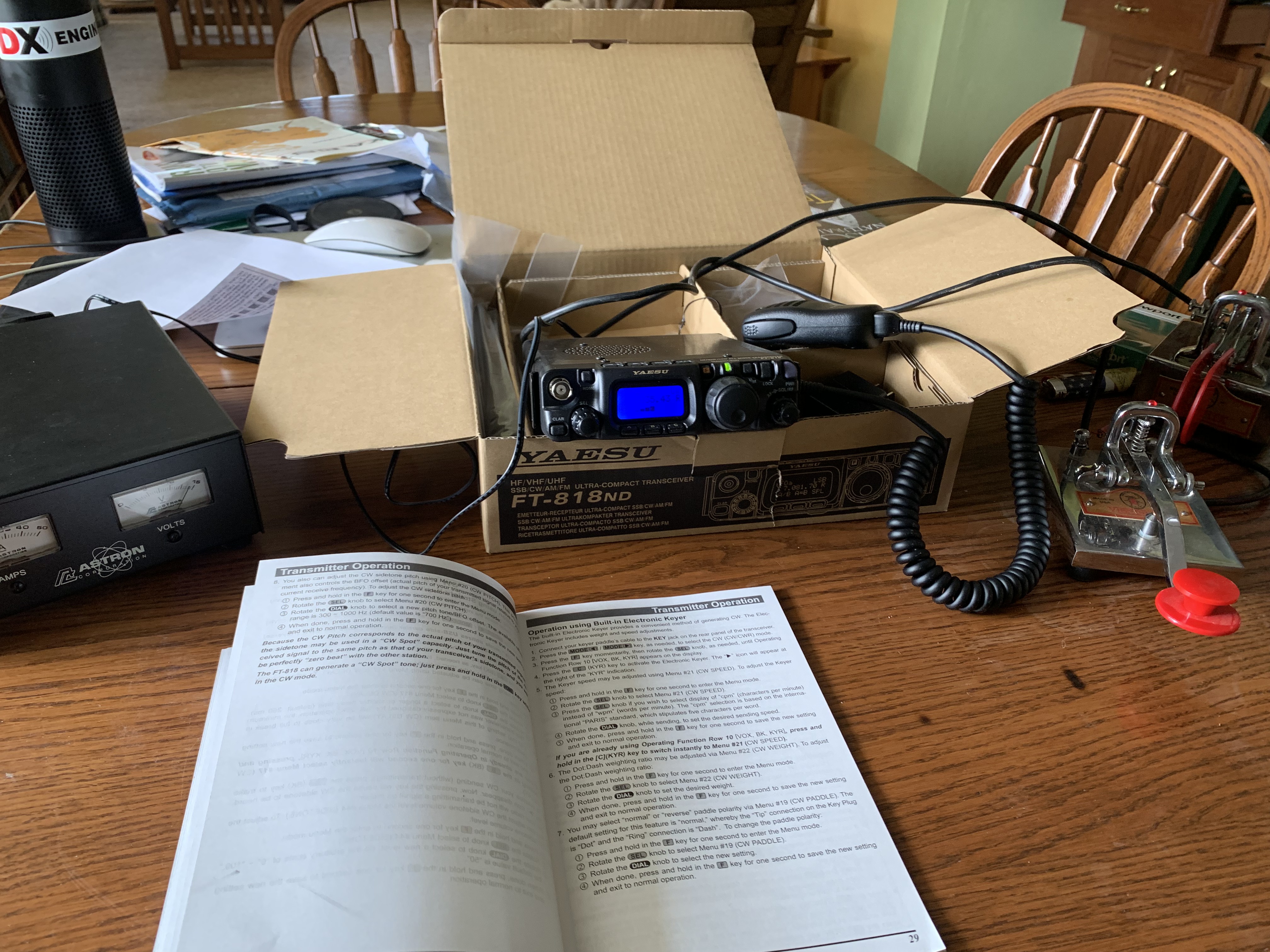
Of course it didn’t take me long after getting the Yaesu 818ND in my hot little hands to be overcome with the desperate need to actually play with it. So, while enduring scathing looks of disapproval from MrsGF, I temporarily took over the dining room table to fiddle with it. First with 8 AA alkaline batteries powering it and then with the included rechargeable power pack, and then the next day with an Astron power supply feeding it a more adequate amount of juice.

The 818 is definitely a fun little transceiver, and it is also definitely annoying at the same time, although I’m sure the annoyances will fade as I become more familiar with it. Well, some of them, anyway.

I did read the manual before I set it up and tried using it. Despite what I said in the last post where I implied I never read manuals, that’s not true when it comes to things as complex as transceivers because there is always the possibility of actually damaging the equipment if you do something wrong. Not that the 818 is difficult to set up and get going. Basically you just hook up an antenna, plug in the mic, use the internal battery or connect to a 12V power supply, and it’s ready to go. But if you want to actually do anything useful with it, well, read the manual first!

Speaking of the manual, it’s about average for the kind of thing that comes with amateur radio equipment these days. Which means, of course, that it isn’t really very good. Oh, all the essential details are in there. Sort of. If you managed to pass your general class license test you should be able to figure it out. Maybe.

Like most modern transceivers, the 818 is almost ridiculously complex, which means there are lots and lots of settings and functions to play with, and in order to get at any of them you have to delve into the menu system which I’m not even going to try to describe. I’ll just put it this way, if you lose the manual, you’re screwed.

I want to talk about the annoyances first. I should point out that I really, really like the little 818. It is a nifty little QRP transceiver that does everything I want it to do and more. But there are always annoyances with any piece of equipment, and this one is no exception. And all of them pertain to the user interface, so to speak, not how the radio actually works as a radio.

The most obvious and visible of the annoyances is that LCD display. Take a look at that closeup up there. If it looks a bit dim and fuzzy, that’s because it is dim and fuzzy. It is, frankly, awful. I’m sorry, but it is just utterly terrible and it shouldn’t be. I don’t know if it’s just mine or if this is true for all 818s. This is not a cheap piece of equipment. This thing sells for $650. But that LCD looks like something they swiped off a disposable $5 handheld game. In normal room lighting or in the shade or evening outside, with the backlight off, it’s almost impossible to read it at all. Even with the backlight turned on it’s difficult to read unless I’m directly in front of it at the proper viewing angle. Out in bright sunlight it isn’t bad, but still, there is simply no excuse for that on a piece of equipment this expensive.

Then there is the Squelch/RF/AF gain knob. Like a lot of knobs on transceivers these days it is a double knob. There is a sort of collar around the base of the knob that turns which is the RF gain adjustment, while the main knob is the AF gain. It’s, well, floppy is the only way I can describe it. If I put my index finger on the tip of it and move it, the end of the knob can wiggle back and about 1/16th to 1/8th of an inch. It feels cheap, like that $5 kid’s toy mentioned earlier, and this is more than a little troubling because it makes me wonder how long it’s going to last.

The collar around the base of the knob controls the RF gain and it’s damned near impossible for me to turn it. It’s positioned awkwardly. I can’t actually grasp it. I have to put the tip of my index finger on the side of it and try to push up and down to move it. More often than not I end up moving both the RF gain and the AF knob at the same time.

Interestingly enough, the SEL knob on the left side of the radio is rock solid and exhibits none of the floppiness of the AF gain knob.

Then there are the buttons. They are very small, which is understandable because this is a very small radio. But the buttons are also either recessed into the bezel or there are plastic extrusions surrounding the buttons, which makes them damned near impossible for me to push with a finger tip. I either have to try to use the edge my fingernail to push the buttons or use the eraser end of a pencil.

The only reason to recess the buttons like that is to protect them from accidentally being pressed. But exactly how would they be accidentally be pressed on this radio? You aren’t going to be operating this thing while it’s in your pocket. In fact, I can’t think of any circumstances when it would actually be in operation when there it would experience conditions that would cause a button to be accidentally pressed. If it’s in a carrying bag, sure, it might jostle around to the point where something in the bag could make contact with a button, but the radio isn’t going to be turned on and operating if you’re carrying it in a bag. So what, exactly, are they protecting the buttons from?

Like most transceivers these days, the little 818 is loaded with bells and whistles, all of which are accessed via a system of menus. The menu system is, well, all I can say is that it’s no worse than any other I’ve worked with. You’re going to want to keep a copy of the manual with the radio itself, or at least a cheat sheet with the more commonly used menu items written down. You can get a PDF file of the Yaesu 818 manual here directly from the company’s web site. Once you get to the 818 page, click on the “Files” tab and it will take you to a download page where you can get it as a .PDF in English and several other languages.

Using the 818

As you can see from the lead photo, I’ve had the 818 set up and running on the dining room table (while enduring some rather irritated looks from MrsGF, but then she’s an amateur radio operator as well so she understands that if I have a new piece of equipment laying around there’s no way I can keep my hands off it).

The 818 operates either from it’s internal batteries (either 8 AA alkaline batteries or the included rechargeable battery pack) or an external 13V power supply that can handle at least a 3 amp load. When operated with the internal batteries the 818’s transmit power automatically drops to 2.5 watts. You can override this in the menus, but don’t bother. If you try to transmit at 6 watts with the radio on it’s internal batteries it will just turn itself off because the batteries just don’t have enough power to handle that kind of output power.

I put in 8 AA batteries and fired it up and played around with it for a while to get familiar with the menu system, with the Alpha mag loop antenna hooked to the rear antenna connector.

Once I had the antenna tuned, I was faced with a noise level running about S8 to S9+. Now that isn’t at all surprising. I don’t exactly live in a radio quiet zone here. I have a huge cattle feed processing facility just down the street from me, a shop that does powder coating and painting for a major manufacturer of lawn equipment, and about 5 blocks away Sargento has a huge processing facility. Then add in all the electronics here in the house which includes a half dozen computers, networking gear, printers, WiFi points, etc., and, well, some days it gets pretty bad around here. Some days are better than others, it all depends on what equipment is running where. But an S8 noise level is pretty typical.

Now with my Kenwood TS-990 I can generally deal with that kind of thing thanks to some pretty sophisticated filtering. With the 818, well, not so much. I was able to pick up a few very strong CW stations and one or two SSB conversations on 20 and 40 meters, but then I had to pack it all up because it was time for dinner. (I really, really need to stop procrastinating and get the shop in the basement set up!)

Next morning I tried again, feeding the 818 with an external power supply instead of batteries, and was determined to sit down and do some serious goofing around with the little transceiver. That’s the jury rigged setup you see in the lead photo up at the top of the page. And yes, that’s a DX Engineering sticker on the Alexa thingie sitting there. Every time I order something from DXE they send a fistful of stickers and, well, I have to do something with ’em, so they’re everywhere. I tried putting one on MrsGF but she was a wee bit irritated. Tried to put one on one of the cats and she got even more irritated. So after several bandaids to cover the scratches (from the cat, not MrsGF. MrsGF just gives me one of those looks and I know it’s time to stop whatever it is I’m doing.) I only put them on inanimate objects now.

I was picking up several decent CW and SSB transmissions, well above the S7 noise level, which was encouraging. I tried replying to several CQs from other operators, and got nothing in reply. Wondering if I was putting out anything at all I put MrsGF on the 990 in the other room and, well, just about blew her ears out. Forgot to turn on the attenuator. Sigh… Still, the 818 was transmitting. I tried calling CQ on SSB for quite a while on 20 and 40 meters and got nothing.
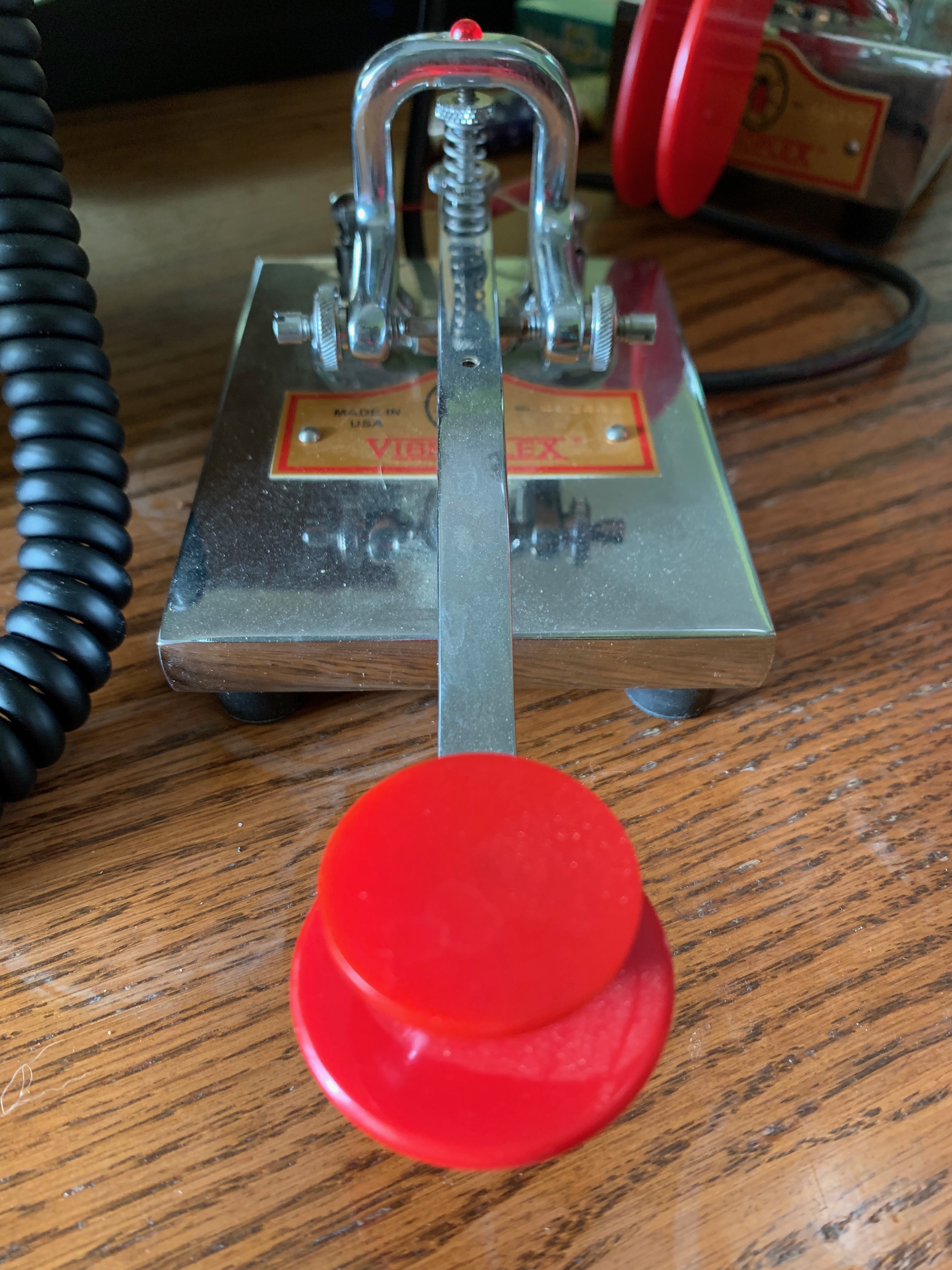
Hard to tell in the photo but the poor thing is covered with dust from disuse. Still, considering how bad I am at CW that’s probably not a bad thing.

I dragged out the CW keys and dusted them off. I mean seriously dusted them off. Oh dear, had it been that long since I used ’em? How the heck had they gotten so filthy? They were in a drawer, for heaven’s sake. And cat fur? Really? How the heck did they get covered with cat fur in a drawer? Do the cats like open up all the drawers and look for things to shed on?

Anyway, I dialed down to the frequencies where the QRP people allegedly hang out and fiddled around with CW for a while. Nothing there, either. Sigh…

Getting discouraged I went in the other room and fired up the TS-990 again on the dipole antenna in the backyard. If there’s anybody on the air who can be heard, that sucker will pick it up. And, well, nothing. Tuning from one end of 20 and 40 to the other and nothing. Well, almost nothing. Just a few signals way down in the weeds. Oh, and FT8. The FT8 portions of the bands were lighting up the waterfall like a Christmas tree. (Has everyone moved to FT8? Seems that way sometimes)

Still, the experiment did give me an excuse to clean up the straight key and iambic paddle.

So I know the 818 receives (although after about 5 minutes I really, really missed the filters and noise reduction systems on the TS-990). I know it transmits. I know the Alpha antenna works because I’ve been using it on the 990 with considerable success. It’s just that the gods of propagation have a grudge against me, I guess.

I’m still waiting for the connectors and other things I need to get the 818 on the air with digital so I can’t try FT8 yet. Oh, and I still haven’t come up with a laptop yet.

I suppose I should to a better test. Dial the 818 down to 1 watt, put MrsGF on the 990 in the next room (with the attenuator on this time) and see what kind of signal the 818 is actually putting out. But that’s going to have to wait until MrsGF lets me use the kitchen table again.

First Look At The Alpha Mag-Loop Antenna

The antenna with the optional “booster loop” allowing operation on 80 & 60 meters installed, with it’s tripod and mast.

If you’ve come here looking for pictures of flowers and nature and me babbling about gardening and farming, you might want to skip this one because this entry is entirely amateur radio related. I want to talk about mag loop antennas. I’ve been fascinated with mag loop antennas since I first heard about them, and have always wanted to build or buy one to experiment with. I finally broke down and bought one from Alpha Antenna.

I’m not going to explain what a mag-loop antenna is. If you’ve read this far you either already know or you’ve already used Google to look it up. I’ll just say that these compact, efficient antennas have become extremely popular, especially in the QRP (low power) amateur radio community, and for good reason. But mag-loops do have some issues. There are always trade offs in the world of radio. First they have an extremely narrow bandwidth, making it necessary to retune the antenna if you change frequency. And second, they are generally only rated for low power transmissions. They’re usually considered to be QRP (low power) antennas. Mag loop antennas can be built that can handle impressive amounts of wattage, but there are problems that are difficult (and expensive) to deal with.

I should explain why I picked the Alpha rather than one of the other antennas on the market. The Alpha can handle more power than many other mag loops on the market, up to 100 watts on SSB, 50 watts on CW, and 25 on digital, depending on the frequency being used. This is more than what a lot of the other ones can deal with, at least in this price range. It works from 4o meters to 10 meters, and with the Booster Cable, can even work down on 80 meters. A lot of mag loops only work from 20 to 10 meters, and most have no options to extend their range down to the 80 meter band. The Alpha I bought also included the tripod, mast, and other parts necessary to fully assemble and use the antenna. Basically it is a complete antenna system. All you have to do is put it together, hook up your coax and begin using it. It was everything I really wanted in one convenient package.

You can order it directly from the company, but I bought mine off Amazon. Retail price is $500 including the main antenna, the booster cable, tripod and mast and a carrying bag. (Note: I have no connection to either Amazon nor Alpha, do not get paid by them, do not get special deals or anything else. I paid full retail price for the antenna and ordered it through normal retail channels.)

There’s enough room in the bag that it would hold just about everything I’d need, the 818, SignaLink, cables, battery, etc. plus the antenna itself.

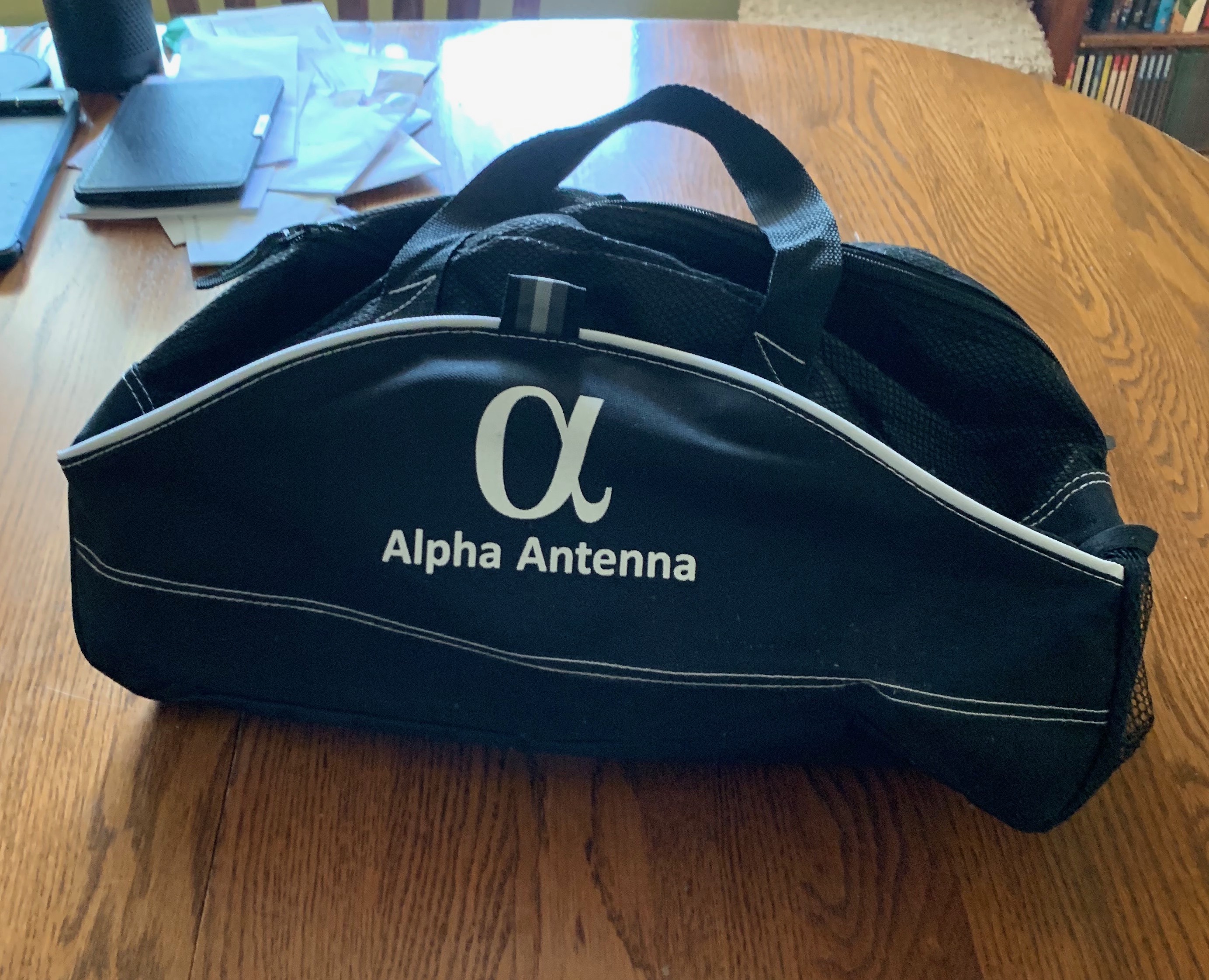
The antenna comes in its own gym style carrying bag with the Alpha logo on it. Everything, including the tripod and short mast (basically a selfie stick, and Alpha refers to it as such), fits neatly in the bag with room left over.

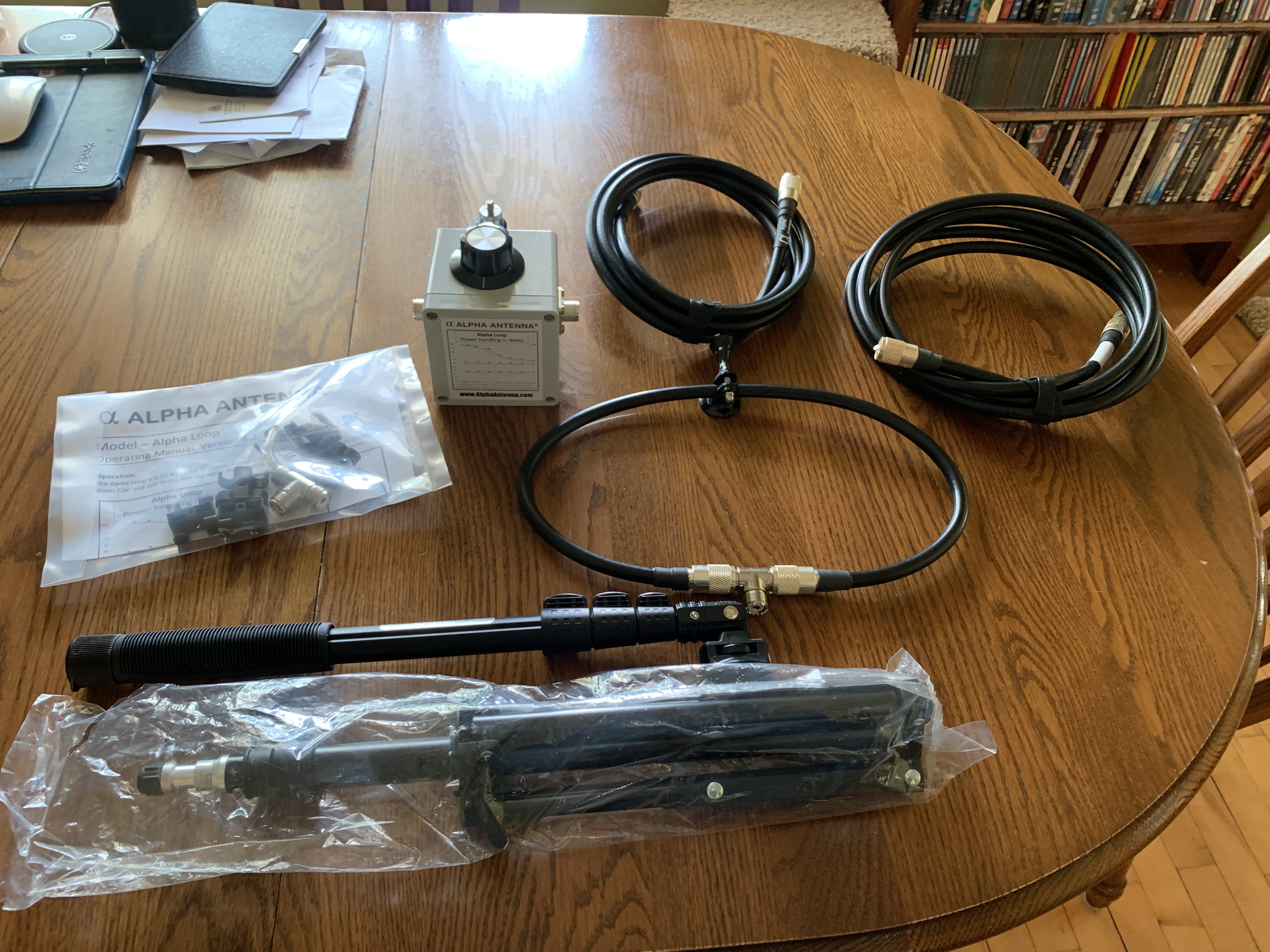
Once you unpack everything from the bag, this is what you get:

This is the entire antenna, including both the normal loop, the “booster cable” loop for 80/60 meter operations, the tuning box, the tripod and mast, and the plastic bag containing nylon clips to position the antenna, a sheet of instructions, and an extra “T” coax connector.

Note the extra “T” coax connector in the plastic bag. I had no idea why that was included, but a bit of research turned up why they tucked that in with the rest of the antenna. That’s being included because Alpha had reports of bad T connectors in the recent past. All previous owners of the antenna were sent new T connectors and they’re including spare T’s just in case.

Assembly is a piece of cake. Being a typical amateur radio operator I, of course, never looked at the instructions until after I’d put it together. (I really should stop doing that, shouldn’t I?) Even so, it took me all of about five minutes to get it fully assembled and ready to go. And, amazingly enough, I even got it right the first time. Alpha has a video up on youtube showing how to assemble it, including how to add the Booster Cable for 80 meter operations. Just click the link there to see it. It’s all very straight forward.

Note that the loop does not have to be perfectly circular to work properly. As long as it’s reasonably close, you’re good to go. Note: Yes, that is the world’s ugliest recliner back there behind the antenna. And the less said about that sofa, the better. We can’t have nice furniture because we have cats who think they own the house and its contents and we’re just there to feed them and occasionally provide them with entertainment when they’re bored.

The photo above shows it fully assembled, without the booster cable, in my dining room. The loops are all made of LMR 400 coax, which is extremely stiff and has no trouble holding any shape you want to bend it into. Use some caution when you’re coiling and uncoiling the coax. It can be awkward to work with because of how stiff it is. Note the two plastic clips holding the large loop in the proper position above the small loop. 6 of those clips are included. The other four are required for use with the Booster Cable installed. This is the antenna with the “Booster Cable” installed.

The booster cable is connected in series with the regular large loop, so you now have a double loop instead of just a single loop. All the proper connectors are already installed on the ends of the cable so you don’t need adaptors.

Without the booster cable installed it’s impossible to use the antenna on frequencies below 40 meters. And I should point out that with the booster installed it’s impossible to use the antenna on frequencies higher than 40 meters. So you can either work 80/75 to 60 meters, or you can work 40 to 10 meters, but not both.

Overall quality is quite good. The coax is genuine LMR 400 from Times Microwave. The small tripod is more than sturdy enough to handle the antenna. The mast/selfie stick is sturdy enough to handle supporting the loops. Once it’s set up the mast and tripod are very easy to adjust if necessary. The connectors on the coax and on the tuning unit look to be of good quality and appear to be silver plated. I did not open up the box to look at the variable capacitor, but others have and if you want to see what’s in there, you can find photos and videos on Youtube and other sources. It looks well made from quality materials and should provide years of reliable use.

I should point out that if you’re using it outside and there is more than a gentle breeze you’re going to have to stabilize the tripod somehow. A stiff breeze will blow it over.

The first thing I did after putting it together was hook it to my antenna analyzer to see how good of a match I could get on the frequencies I normally use.

Now most of you reading this probably know this already, but just in case I’ll mention it. You never use your transceiver’s internal antenna tuner or an external tuner, with a mag-loop antenna. You adjust the antenna for a proper match by turning the knob connected to the variable capacitor inside that little gray box. And getting a match can be very touchy sometimes depending on the antenna, the type of capacitor being used and other factors. Now I don’t have any personal experience with mag-loop antennas before getting the Alpha, but from what I’ve heard from others, tuning the Alpha is no worse than tuning any of the others, and actually a lot easier than some reports from other models.

BTW: If you do any kind of fiddling around with antennas, an antenna analyzer quickly becomes your best friend.

I don’t use 80/75 meters much, and have no plans to use it for QRP, but since I already had the booster cable installed for the photo I checked that first. I didn’t have high hopes for a decent match down there, but much to my surprise the Alpha with the booster installed indicated an SWR of a bit over 1.1:1.

I took the booster cable off and set it up the way I would normally use it and looked at the rest of the HF frequency range.

I got excellent, or at least decent, SWR all across the amateur radio bands with one exception, 12 meters. No matter what I did I couldn’t get an SWR of less than 2.5:1 on 12 meters. Considering that I’m getting matches of 1.5:1 or better, usually much better, on the other bands, I’m assuming that there’s something wrong with what I’m doing and I’ll look into it further when I get some time. It’s entirely possible that I simply missed the “sweet spot” when trying to tune the antenna because I was in a hurry to get it hooked up and on the air.

Now, the question is, of course, does the thing actually work as an antenna? The answer to that question is an emphatic yes!

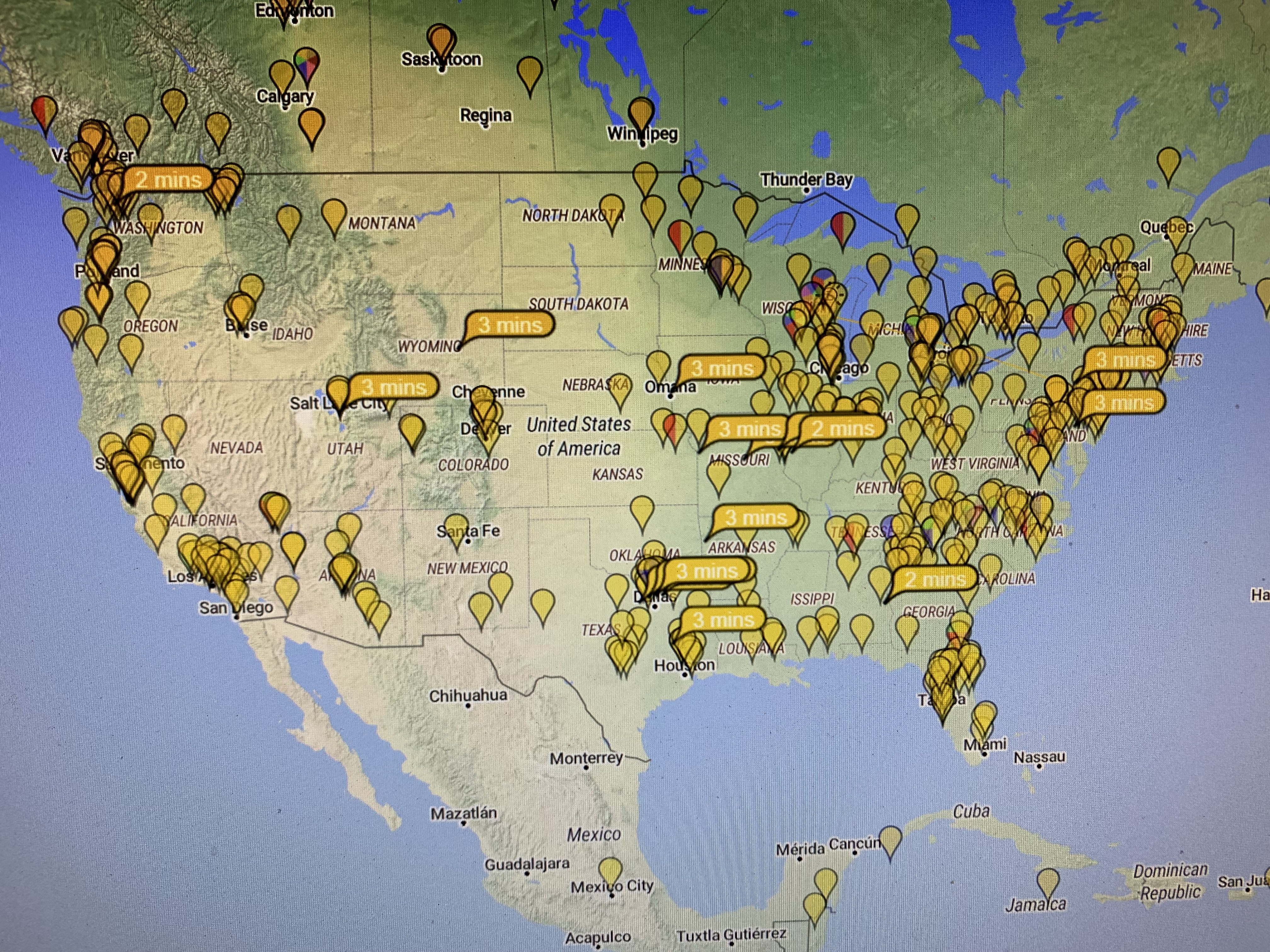
I don’t have my Yaesu 818 yet, so I tested it with my Kenwood TS-990, with the antenna standing on it’s tripod right behind me in the office where I could easily reach the knob to adjust it. Once I got a few glitches straightened out (My fault, not the antenna’s. Turned out the coax I was using had a bad connector. Once I re-soldered that all was well.), I gave it a try on 20 meters using FT8 with the 990’s power turned down to 8 watts and the SWR adjusted down to 1.4:1. And this is what popped up on PSK Reporter a short time later:

Now FT8 is a pretty efficient mode, but still… Damn. I was getting reception reports from all over the country while putting about 8 watts into an antenna sitting on the floor behind me in the office.

I moved up to 10 meters. Now 10 meters has been in the doldrums because we’re at the bottom of the solar cycle, but you never know. After adjusting things tried with the 990’s output set to 6 watts. I honestly didn’t expect to see anything pop up on PSK Reporter, but low and behold, when it cycled through, there I was, with reception reports popping up all over the place.:

Reaching Texas, Kansas and a large part of the east coast with 6 watts output using an antenna sitting in my office? Yeah, that’s not bad at all. Okay, I am officially impressed.

So far I’m very pleased with this antenna. More than pleased. In fact the few times I’ve had a chance to operate this past week or two, I’ve been using the loop exclusively when I use FT8. Getting it tuned is a bit fiddly, but as I’ve gained experience with it I’ve found I can tune it reasonably quickly and easily. (More about that in a minute.) I can’t wait to have a chance to really work with it and see what it can do out in the field. Once the Yaesu 818 gets here I’m hoping to throw together a complete portable digital system compact enough to throw into the back of the car along with my fishing gear and making some contacts out in the wild, so to speak.

Let’s talk about tuning mag-loop antennas for a moment. I mentioned before that you do not use an antenna tuner with these antennas because they have their own built in tuners, that variable capacitor. That’s how you adjust ’em to get a match. And these antennas are very, very touchy when it comes to tuning. They are very narrow bandwidth to begin with, and moving the dial a fraction of a degree can make a huge difference in the SWR.

I used an antenna analyzer at first when testing. It’s pretty easy to dial them in that way, but connecting and disconnecting an analyzer is a pain in the neck, and you don’t want to have to lug one along if you’re going portable. There is a technique to make it easier to set them up. The trick is to hook it up to your transceiver, set your transceiver to the frequency you want to use, and then listen to the receiver as you turn the dial on the antenna. (Hint: Turn that knob slowly. It is very, very easy to slip right past the sweet spot if you turn the knob too quickly.) As you get close to a match there will be a sudden increase in noise coming from your receiver. When you reach that point watch your S meter or listen to the noise level to bring that noise to a peak. Once you do that you’ll be pretty close and you can use a test transmission to dial it in for the best SWR before you being actually trying to make contacts.

Another issue with tuning is how the antenna reacts to being close to y0ur body. The mere presence of your hand near the antenna when turning the knob is enough to alter it’s characteristics in some cases. Since you have to bring your hand close to the antenna to adjust the tuner, this can mean that as soon as you take your hand away from the antenna, your SWR will change, sometimes significantly so. If that kind of thing happens, you can often compensate for it. I quickly learned to stop tuning a bit before or a bit after the ideal SWR in order to get a good match once I took my hand away when that happened. Interestingly, it doesn’t happen all the time. This is due to a phenomenon known as body capacitance or hand capacitance. The human body can act like a capacitor. The actual amount of capacitance varies depending on environmental conditions. So depending on conditions, just bringing your hand close to the antenna can cause it’s characteristics to change. Don’t worry about it. It doesn’t happen all the time, and if it does, you’ll learn to adapt.

So overall the Alpha has been a lot of fun to use. Only time will tell how it holds up, but it looks to be well made and certainly it works as advertised. I’m really very, very pleased with it so far.

Later — Look what the nice UPS driver just delivered today !!!

The 818 is here! I still have some bits and bobs to put together before I’m ready to take it out on the road. I want to do digital modes, and that means I need a laptop, and the elderly Toshiba I was planning on using looks like it is instead headed for the recycling center, so I’m going to have to scrounge up a laptop. I’ll need make or buy connector cables to hook everything up to the laptop and SignaLink. Then I’ll need a power supply of some sort. The 818 does have it’s own battery, but the SignaLink requires a power source and I’d like to have a central power source to run everything. Nothing serious but it’s going to take some time, which is in short supply right now because we’re up to our necks with landscaping and gardening projects and house updating projects and other stuff at the moment. Until I get all the bits together I need for digital operations I may try it with the Alpha on SSB and see what happens.

I’ll keep you posted as “The Great QRP Project” progresses

I thought I’d have time for all this stuff once I retired, but it turns out that between things MrsGF wants me to do, landscaping, gardening and other things going on around here, I actually have less time for playing radio than I did before I retired. How the hell did that happen?

Stuff and Nonsense

Stuff & Nonsense is a catch-all category for random stuff that doesn’t deserve a complete blog entry accumulated into a disorganized mess and put up here because I’m bored and/or feel guilty about not having posted anything recently.

Proposed Amateur Radio Licensing Changes Are Prelude to Apocalypse

The ARRL submitted a petition to the FCC to expand privileges for Technician class license holders on the HF bands and this will quickly usher in the end of the world as we know it. Or at least according to the curmudgeons over at QRZ and some of the other amateur radio forums. It isn’t, of course. It will probably have little or no effect at all on anything. Despite what the ARRL seems to believe, huge numbers of Technician licensees are not desperate to get on the HF frequencies so even if they did have access to them they wouldn’t use them.

The Move

It took days to move all of the junk out of there just so I could find that bench there and I could get at the walls.

Moving my stuff from the office to the basement is coming along far more slowly than I’d like because of various reasons. But mostly because I’m in no great rush to get it done and a lot of prep work has to be done before I can actually start moving things.

Things look a bit better down there, though. I’ve moved a ton of junk out of there and I’ve been working on prepping the walls for painting.

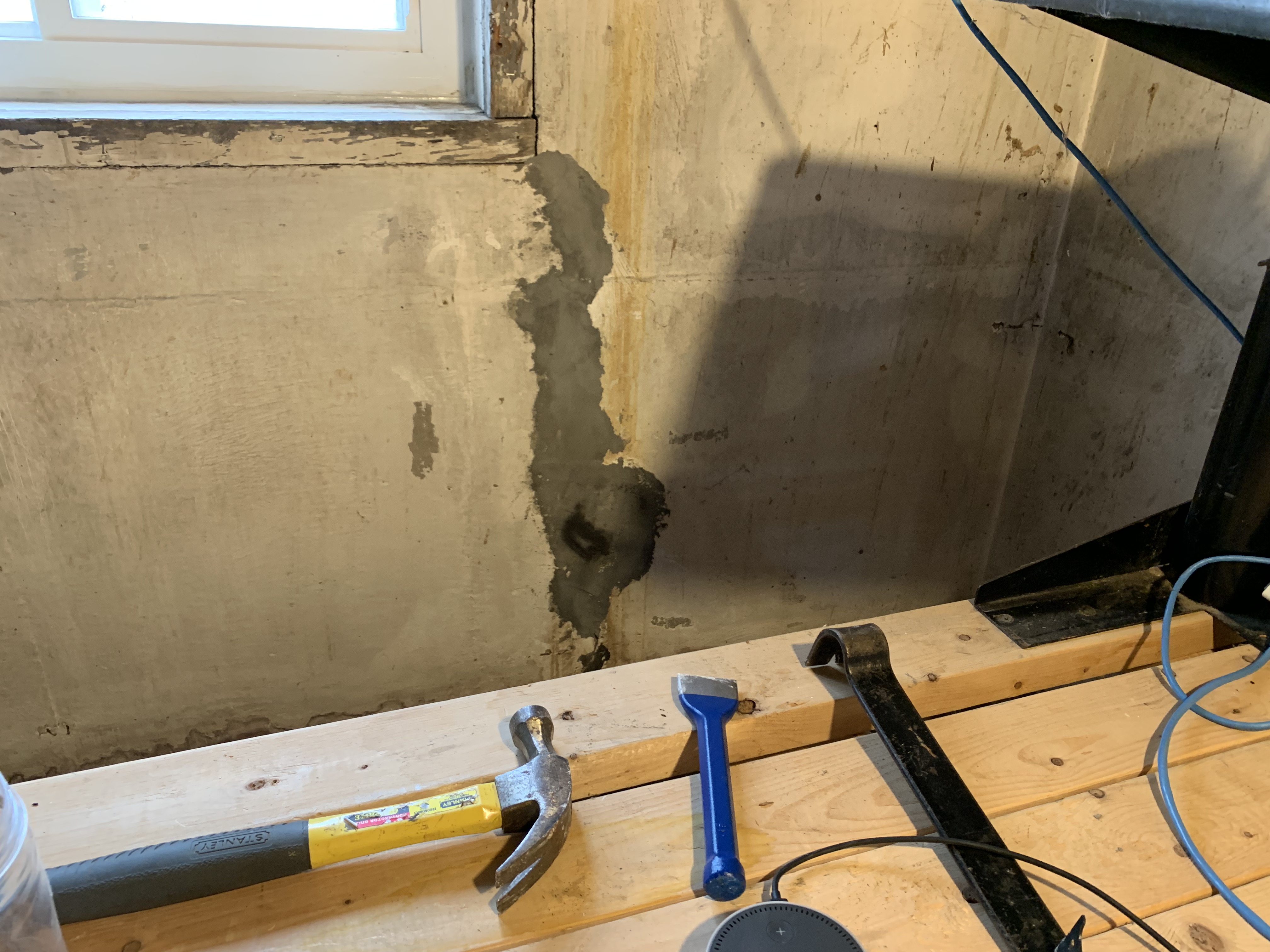
Any nearly 100 year old house is going to have cracks, holes and defects in the concrete and this place is no exception.

This house was built in two parts. The original house was built in the 1930s, and a large living room with a fireplace and full basement under it was added in the 1980s. The place where I’m moving is part of the old house, and, the 75+ year old basement walls aren’t exactly very attractive. So I’ve been patching and scraping and prepping for paint. I’m hoping to finally get some painting done this weekend. Once I get that done I can start re-wiring that area to put in about a dozen 120V electrical outlets and at least one 240V line. There is already electrical wiring there, but the outlets are located in inconvenient places. The wiring in the office will be left alone except for the 240V line. We’ll disconnect that one just so no one ends up trying to hammer a 120V plug into that 240V outlet.

Later: Got that one wall finished finally. I didn’t think I was ever going to get it done. It’s the worst of the bunch and the rest will come along more easily. They just need to be scraped down and painted. Just getting that one done makes a huge difference.

Nice to see some progress down there after all of the delays. I don’t have any set schedule for making the move. Whenever it gets done, it gets done. And there is still a ton of my son’s old equipment to get out of that area. I had to start piling his stuff in my woodshop just so I could get at this wall and it’s really starting to clutter up the rest of the basement as well. He’s moving it as he gets time, but it’s a slow process

And while I’m on the subject of amateur radio, I had to take down my dipole antenna because one leg ran to a neighbor’s tree and that house just sold so I figured I’d better get the antenna down before the new owner shows up and wonders if I’m trying to electrocute his tree or something. Next time I see my other neighbor I need to ask him if I can run it to his tree. He probably won’t have a problem with it. He’s a radio geek too, but with CB and FRS stuff.

I’m not off the air. I still have the Comet antenna up, but it isn’t exactly very good. About the only thing it’s good for is high efficiency digital modes like JS8Call and FT8 and, if propagation conditions are good, PSK. And while it’s rated for 250 watts I’ve been hearing from people that when using digital you really shouldn’t put more than 100 watts into it, so I can forget about using my amplifiers.

Well, not that I ever use the amplifiers anyway. The tube amp hasn’t been fired up since 2013 and the other amp hasn’t been used in over a year. Should probably sell at least the tube amp one of these days.

I also need to get that GAP Titan antenna up finally! That poor thing has been laying outside waiting to be set up for way, way too long now.

Speaking of the neighbor’s house – When it first went up for sale we seriously considered buying it. It is an old house, easily as old as ours, and has never been well maintained or updated. We figured it was worth maybe $50,000 at the most, and if that’s what they’d asked, we probably would have bought it. The plan was to tear down the existing house because it is essentially worthless without about $40K worth of work, wait a few years and then put up 1,500 sq ft single level house for me and MrsGF when we were ready to downsize, and then sell this place.

But they were asking $80,000 for that place which was way, way too much, and they didn’t want to budge on the price. And there were some issues with the title of the house too. The owners had defaulted, gone into bankruptcy, and didn’t even know who actually held the mortgage on the place because that had changed hands. They were making payments to someone, somewhere, but didn’t actually own the place any more and didn’t know exactly who did, and, well, that was a mess I didn’t want to get involved with either.

So it sold now. For $50K. Sigh… To a house flipper. Oh, goodie…

Water Water Everywhere

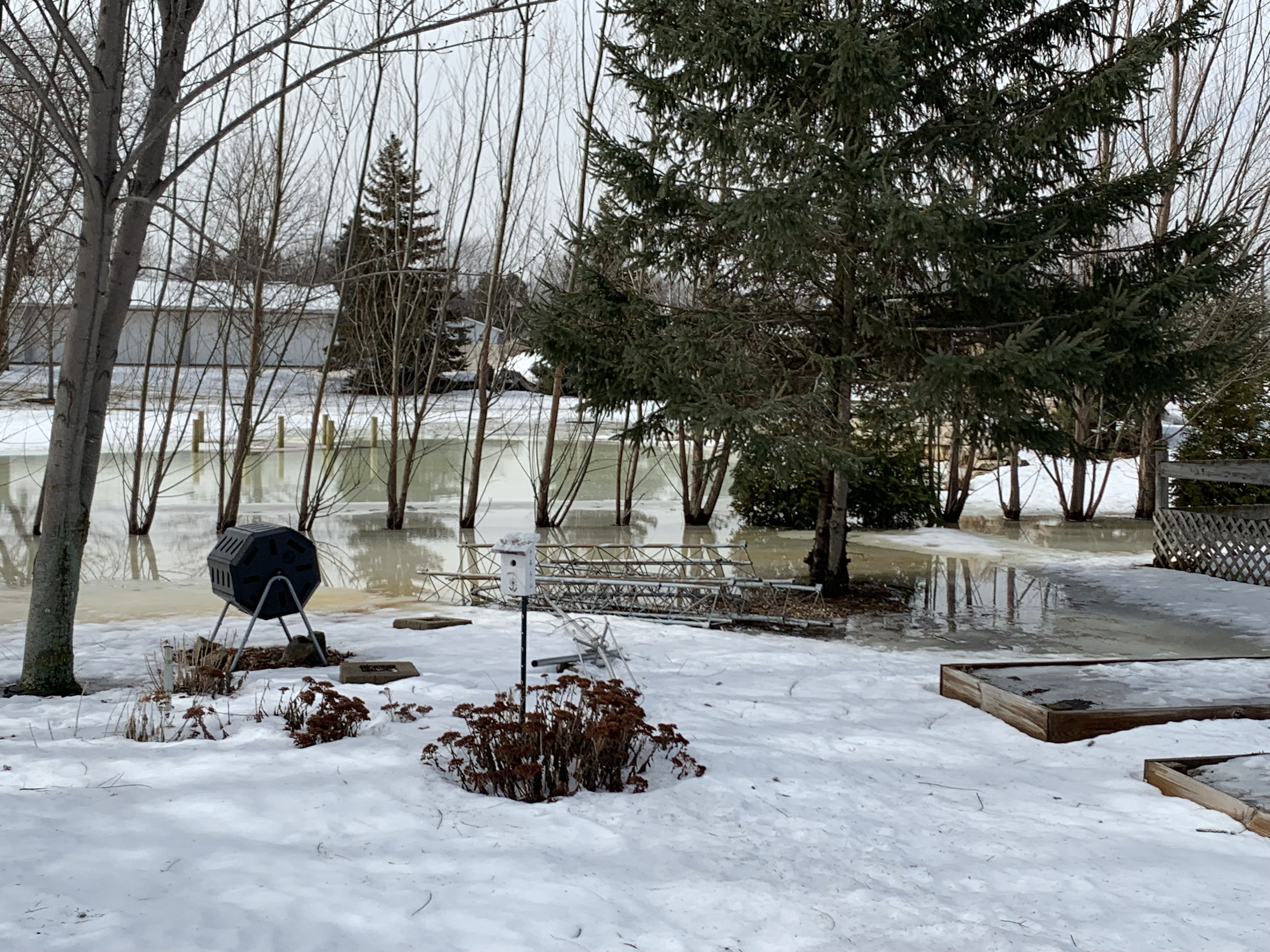
The backyard is currently under about 2 feet of water back along the property line. This is actually not bad. At one point that antenna tower you see laying on it’s side back there was completely underwater. Later: Almost all of the snow is melted off now and the water level has gone down quite a bit but it’s still flooded back there.

We had near records amounts of snow in February, then rain, then more snow, followed by an abrupt jump in temperature up to 50 degrees, so, well, flooding. The state was under an emergency declaration for quite a while because of flooding. Low lying areas and and people along rivers were hit hard. The biggest problem was ice damming. When the ice started to break up and then we got the rain, the ice jammed up under bridges, culverts, etc. causing widespread flooding.

Chinese Pork Smuggling

The US Customs Service intercepted a shipment of about one million pounds of pork in more than 50 shipping containers that someone was trying to smuggle into a New Jersey port. The stuff was packed into many different types of packaging, including ramen noodle boxes and Tide detergent containers, and sometimes just shoved into spaces in between other products packed into the containers.

The big fear is African Swine Fever, of course, which is sweeping through China. While ASF doesn’t harm human beings, it is virtually 100% fatal for pigs and there is no treatment or vaccine. The only way to control outbreaks is to try to prevent the virus from spreading with quarantines and killing infected swine. Needless to say the US would very much like to keep ASF out of the country, but I suspect it’s only a matter of time before we start having problems with it too.

The question is why would anyone want to smuggle large amounts of Chinese pork into the US in the first place? There is little or no demand for imported pork in the US. We produce more than enough of it ourselves, and it’s almost ridiculously cheap here. How in the world were they expecting to make any money from smuggling a product into the US that we already have a surplus of and is at almost record low prices?

Anyway, that’s it for now. MrsGF and I are working out plans for what we’re going to plant this coming season and considering making some major changes to the landscaping, so we’ll see what comes of that. We’re starting to see things popping up out of the ground already. The chives are up, some of the early spring flowers are starting to pop up as well. The prep work in the basement goes on. Hopefully in a short time I’ll be able to get the bicycle back out on the road.

Catching Up with Ham Radio Stuff : The Move and A New (sort of) digital mode

The Move, shifting all of my radio and computer gear to the basement, is now officially underway. Well, sort of. Nothing has actually gotten moved yet. I’m still in the process of cleaning out the area I want to use and getting it ready. But the handwriting is on the wall. MrsGF is retiring at the end of Feb and if I don’t move out of our shared office we’re going to drive each other nuts.

For years now my “radio shack” has been shoved into a corner of the office MrsGF and I share, with all my equipment perched on a single desk and a small filing cabinet. It’s worked, but it has been awkward and cramped. There just isn’t enough room. I have a work table in that room as well where, theoretically, at least, I was going to be able to tinker with electronics and repair equipment. But because the room is also our office, what actually happened was the table ended up with about ten inches of papers, books, files and I don’t know what all else on top of my tools and test gear. To make things even more cramped, I also have a big iMac, various graphics tablets, several RAID arrays, three printers, including a massive professional photo printer, well, you get the idea. Then add in MrsGF’s desk, computer and all her stuff, and something has to go, and that’s me.

Even that wouldn’t be so bad if it weren’t for my own psychological quirks. I simply cannot concentrate if there is someone behind me. I’ve always been that way. Her desk and computers are directly behind me and when she’s back there I can’t concentrate on anything. I can’t read, can’t write, can’t work on photos or drawings. I also need a fairly quiet environment to get anything done. Soft music is okay, but the sound of someone behind me moving, coughing, talking on the phone… well, I just can’t deal with it.

So between the crowded environment up here and my own personal issues, well, I need to move this whole operation if MrsGF and I are going to stick together for another 40 years or so…

Unfortunately, the area I want to move into looks like this.

This is what your basement will end up looking like if both you and your son are A) packrats, and B) computer/electronics geeks.

This used to be Eldest Son’s workshop in the basement when he lived with us years ago, and represents years worth of accumulated computers, parts, hard drives, terminals, networking gear and I don’t know what all else that he neglected to take with him when he moved out years ago. We never bothered with it before because I didn’t have any use for this space. And now that I do, the first order of business is getting all this stuff out of there, and that’s what I’ve been working on.

Some progress has been made, though! Really.

That bench there used to be covered three feet deep in stuff, so just getting that cleared out is a major victory. I’m hoping that by the end of the week I’ll have enough stuff shifted so I can start painting the walls. I’ll keep that work bench but put a nice sheet of plywood or something similar over the top of it to make a smooth work surface. The radios and computers will go here eventually. We’ll also have to rewire the whole area, adding a half dozen or so 120V outlets and at least one 220V outlet (maybe two) for the amplifiers.

There is another work bench behind me and to the left, about the same size, that is going to be where I’ll have my actual workbench with my meters and test gear, soldering equipment, tools, etc.

Anyway, that’s what’s been going on here of late. I’m sure MrsGF is eagerly looking forward to getting me out of the office so she can move all her stuff in.

JS8Call

I’ve been playing with a fairly new digital mode in amateur radio called JS8Call. It is based on the wildly popular FT8 mode that was first implemented with the WSJT-X software developed by K1JT and others. (WSJT-X is open source and it is available for Linux, Windows, OSX and Unix like operating systems. You can learn more about FT8 at https://physics.princeton.edu/pulsar/k1jt/index.html)

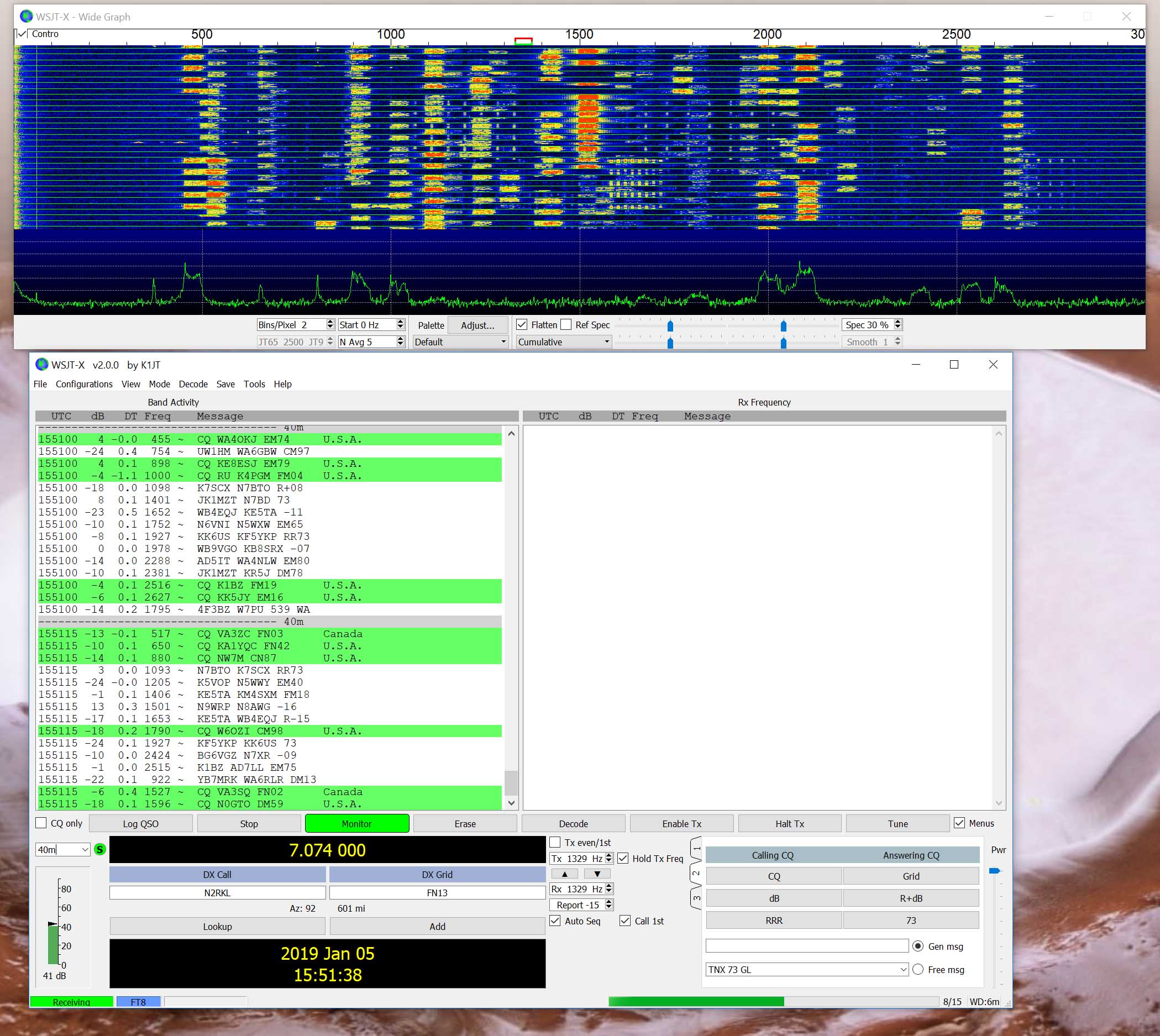
This is what the WSJT-X software looks like when running FT8.

FT8 works well as a weak signal mode, allowing contacts to be made under poor conditions and with modest or even poor antennas and low power levels. But FT8 isn’t designed to actually communicate with other people. It is intended to make “contacts” only. And in the amateur radio world, “contact” means exchanging only enough information to fulfill the requirements of some contest or award program, and not actually talking to another person. In fact, it would be almost impossible to use FT8 to exchange any kind of useful information with another radio operator. FT8 exchanges call signs, a grid reference (location) and a signal report, and that’s it. And all of that is pre-programmed into the system. Once the contact is started, the WSJT software conducts the entire exchange by itself. There are provisions for a so-called “free message”, but it is extremely awkward to use and very limited.

And, frankly, boring. At least to me. Don’t get me wrong, I use FT8 myself. But after about half an hour of it I’m bored. I can’t actually talk to anyone, can’t ask questions, just sit there and watch WSJT go through it’s automated contact sequence. It gets dull fast.

Screen capture of JS8Call running on my system.

That’s where JS8Call comes in. It uses the same digital encoding techniques used by FT8. It still uses the same 15 second transmission bursts. But it permits actual conversations to be held between two operators. Not very quickly, true. It looks like it’s limited to about 15 words per minute or less, but that’s still a heck of a lot faster than a lot of us can bang along in CW.

And since it uses the exact same encoding protocols used by FT8, it shares that mode’s robust nature and permits people with less than ideal equipment and antennas to make contacts they otherwise would not be able to make.

JS8Call has a lot of fun and potentially useful features as well as the ability to send actual text messages back and forth rather than FT8’s limited contact system. Messages can be directed to a specific call sign or a group of call signs. There are directed commands that you can send which will generated automated replies from anyone who hears them, it can relay messages to others if you have it set up right. There is a lot of neat stuff JS8Call is capable of doing. Read the documentation at their website to find out more.

So if you’ve use FT8 but have found it’s pre-programmed, automated contact system frustrating, give JS8Call a try. You can find out more about it at their website. Click here to take a peek.

A few things, though.

First, JS8Call is still very much in beta testing. New versions with added/changed features and bug fixes are being released every few weeks. While the program seems stable, it can have odd little quirks and problems from time to time. How it works and its various functions can change with each new edition of the software.

Second, because it is still in beta testing, it is not available for general release. You can indeed get it, but you need to join a discussion group to get access to the download. It isn’t a big deal. They aren’t going to spam you or anything like that. The reason for restricting access is, as I said, because it is still in testing and is being changed frequently. Once the feature set is frozen and they’ve worked all of the bugs out, a version will be made available for general release.

Third, because it is based on FT8, it has a lot of the same quirks and drawbacks FT8 has. It only transmits in 12.6 second bursts, based on a 15 second time frame. Your computer clock must be accurately synchronized. You are going to need to run a utility program that will keep your computer’s internal clock accurate. Most computer clocks are not accurate enough by themselves.

Fourth, as noted earlier, it isn’t exactly fast. You’re going to average about 10 – 15 wpm when using it. But as I also said, most CW operators don’t work much faster than that.

If you’re interested in the digital modes, are getting bored of FT8, give JS8Call a try.

Cleaning Up, Snow, Evaluating the Gardens, And Stuff…

MrsGF and I set aside Saturday to clean up the last of the gardens around here. We’ve had several hard frosts now and almost everything has died back so there was no reason to put it off any longer. So, of course, this happened…IMG_0056

Yep, that’s snow. Saturday was pretty miserable. Temperature around 38 degrees, 30 – 40 mph winds and then it started snowing. Oh, well. Ah, Wisconsin weather…


IMG_0055We got out the winter coats, hats and gloves and went at it anyway because, well, it has to get done. It wasn’t exactly a fun job in that kind of weather, but we did get it done. There was no point in putting it off because this time of year the chances of the weather being much better are pretty slim.


We ended up filling the entire back of the old truck. It’s amazing how much debris we ended up with after cleaning everything up. And this is just half of it. We already had taken out the remains of the tomatoes, squash and a lot of other stuff over the last few weeks. Good thing we live just down the street from the town’s compost site. That makes this a heck of a lot easier.

The snow didn’t stick around. It was too warm for that. But the wind did, with gusts of up to 40 mph all day. That kept us from raking up the leaves in the yard, but we got that done on Sunday. So we have just about everything cleaned up outside now.

All things considered, the growing season was pretty successful this past season. The tomatoes and peppers were ridiculously prolific. Our little lettuce bed kept us supplied with greens when we needed them. Some things weren’t very good, and some of that was our own fault.

We keep trying to plant onions and they never seem to make it to maturity for us. They start out good, but as they mature they seem to just stop growing before they get anywhere close to full sized. I don’t really mind that too much because my main interest is in having fresh green onions, not in full size bulbs for storage. So while that crop might look like a failure, it really isn’t because I get what I want out of it.

The squash disappointed. The acorn squash never developed fully at all and were a total loss, and while we did get a few absolutely beautiful butternut squash (wow, they tasted good!) they didn’t produce as well as they should have. We aren’t sure why because they were in the same place they’d been last year where they’d done really well. We’re going to have to reconsider planting squash. The stuff takes up a huge part of the garden and if all we’re going to get for it is three squash, well, there’s not much point in planting them and we need to look for alternatives.

Our rhubarb plant wasn’t looking too good towards the end of the season, but we think that’s the fault of the squash which were planted nearby. It was getting shaded by the huge squash leaves and wasn’t getting enough sun, so we’re hoping it will come back.

I raise that rhubarb more for nostalgic reasons than because I like it. For me, a little bit of rhubarb goes a long, long way. But I have fond memories of playing under the huge rhubarb plants we had when I was a little kid on hot, summer days, and whenever I see that thing in hot, summer weather it brings back memories that make me grin. So yeah, I’m going to grow rhubarb if I can even if I don’t particularly like eating it.

Let’s see, what are we planning on changing — I’d like to put in more raised beds if I can find a good location for them. Those two 4 X 8 raised beds I put in a few years ago are ridiculously productive. If I’d known how good they were going to be I would have built them long ago. Just those two beds provide more vegetables than the rest of our gardens combined some years. The problem is where to put more of them. We just have too many trees so finding a spot where there will be direct sunlight for more than 4-5 hours a day is difficult here. About the only decent location is on the south side of the house and there isn’t much room there any more.

Of course that could change if the pear tree doesn’t survive the damage it suffered. I figure about a full third of the canopy of the tree went down because the limbs were too loaded with fruit to be able to handle a thunderstorm that rolled through here. I’d hate to lose that tree. We planted that, oh, about 17 years ago, a couple of years after we bought this place. It’s not a very good looking tree, it leans at a crazy angle, but wow, it produces some of the most delicious pears I’ve ever had.

But on the other hand, if we do lose it, it would open up a very large area that could be garden with full sun. So if it does have to come down, well, it wouldn’t be the worst thing.

With MrsGF retiring in March she’s trying to figure out just what the heck she’s going to do if she isn’t working full time any longer. Right now it looks like as soon as she pulls the plug on her job she’s going to be dragging me along into the Master Gardener classes. Well not dragging, to be honest. I’m rather looking forward to it. We’d talked about getting into the Master Gardener program for a long time but we never had the time to do it. So now is the ideal time for it. She’s been on-line looking to get us signed up for the classes next year. And being able to tack on “certified master gardener” on the byline up at the top of this website is an added incentive because, well, hey, I’ve got an ego too, you know <grin>.

The other thing that is (probably) going to happen after she retires is all of my electronics gear, test equipment, radio equipment, etc. is going to get moved out of the office/library/workshop and moved into what used to be eldest son’s work area in the basement, and the office space is going to be her’s. She loves sewing and craftsy kinds of things but she’s never had much time to actually do it. Right now her work area for that kind of thing is in a small room upstairs. But it’s hot up there in the summer, cold in the winter, and she has difficulty getting up and down a lot of stairs because of her knees. So the solution to that is turn the office on the main floor over to her and have me move my stuff out.

I am not looking forward to moving. Eldest son’s work area down there is still crammed full of old computers and other equipment that somehow never got moved when he moved out years ago. So all of that has to be moved somewhere. Hopefully out of our house and into his house. Then I have to buy or build suitable work surfaces for all my stuff. Then tear down all of my equipment, move all of it down to the basement. Then I have to re-route all of the antenna cables, ground cables and other stuff to the new location down there. Then install a new electrical system down there including 240V lines to run some of the equipment like the amplifiers. Then try to figure out how to set up all of the equipment again because by that time I’ll have forgotten how everything was set up originally. Move all of my computers… Like I said, I am not looking forward to it.

Well, I’ve bored you long enough with this. Time to go.


Catching Up With Stuff

I’m afraid I’ve been neglecting this blog recently because, well, to be honest, not a heck of a lot is really going on this time of year.

IMG_0969.jpg

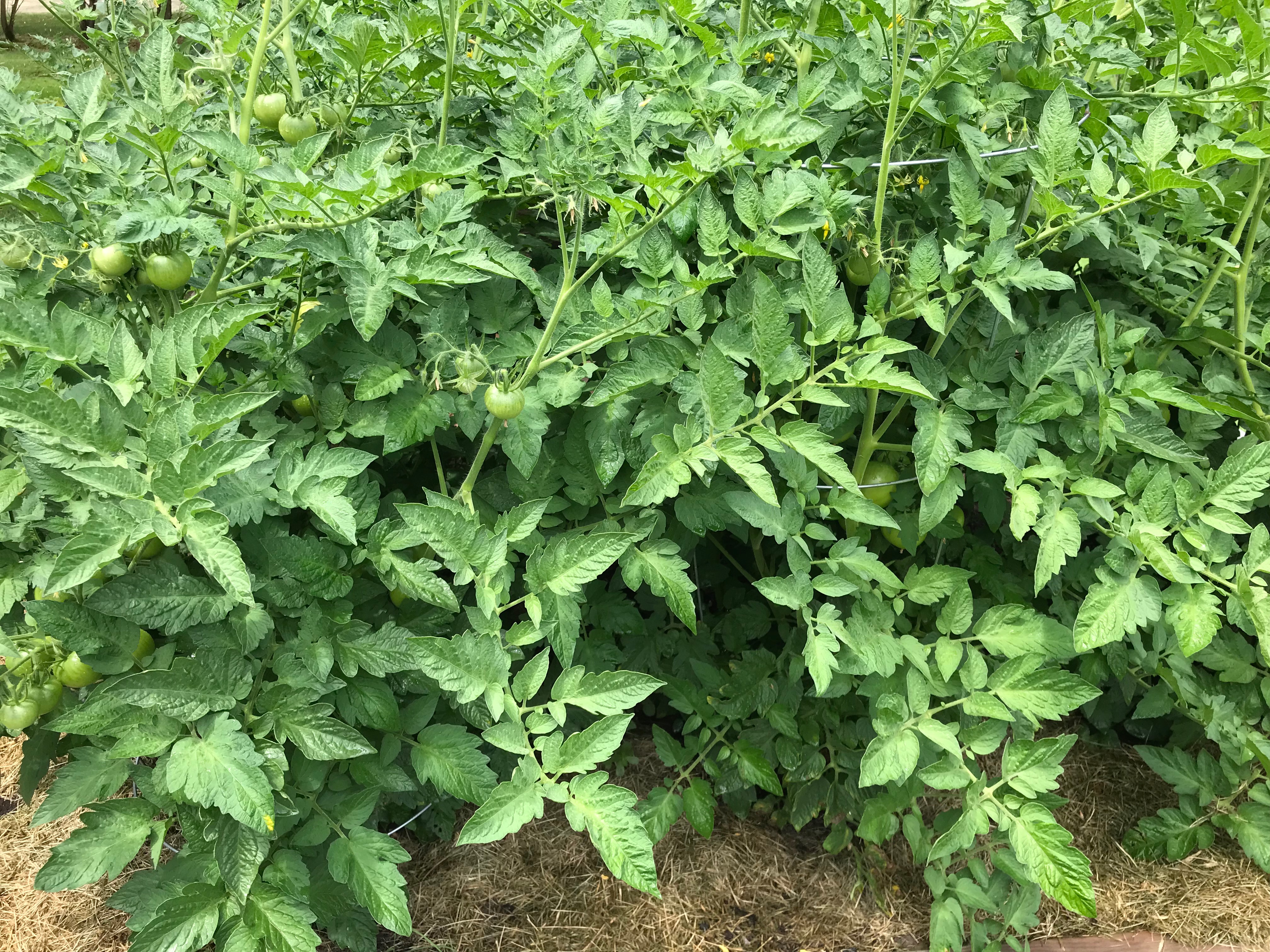
The tomatoes are going crazy this year. They’re almost chest high and at least 4 feet wide at this point, and loaded with fruit. In about a week or two at the most we’re going to be able to start picking tomatoes. If we manage to avoid blossom end rot and other problems this year, we’re going to have more tomatoes than we know what to do with.

I’m not sure why they became this ridiculously prolific this year. MrsGF pointed out that we added a lot of compost to the beds this year and top dressed with a very mild fertilizer. But even so, this is a bit much. The wire tomato cages are starting to collapse from the weight of the plants and I’ve had to put in additional rods to keep the cages from collapsing.

I don’t know why I bother with the wire tomato cages they sell in the garden centers around here. They just can’t handle the plants we grow here. I think I’m going to have to go get some rebar or something like that, fire up the torch and weld up my own.

We put in 2 varieties, Early Girl and Wisconsin 55, and both seem to be doing equally well.

IMG_0950.jpg

We’ve been getting raspberries too this year. MrsGf’s sister gave her about a dozen plants a couple of years ago and they’ve completely taken over the corner of the garden where they were planted.

We aren’t getting a huge number, but enough to give us a nice sized bowl full every few days. I’m not supposed to eat them anyway. I have  diverticulosis which, fortunately, has never flared up on me, but I still need to be careful. I’m supposed to avoid eating things with seeds and chopped nuts, which means raspberries are on the avoidance list. But, well, come on, fresh raspberries right off the plant? I’m afraid probably half of the berries we get never make it into the house.

IMG_0935I picked up one of those goofy little roses in a teacup that you see at discount stores sometimes for MrsGF one day because I thought it would look neat on the window sill in the kitchen for a few days, and then it would probably die and we’d toss it and that would be the end of it. Well, MrsGF transplanted the dopy thing into a larger pot, stuck it outside and it’s been going crazy just like the tomatoes have. It’s quadrupled in size and has been putting out brilliant red flowers ever since.

We’re going to try to keep it through the winter and see what happens. If it makes it, great. If not, no big deal. It only cost me something like $5

Other Stuff:

I just realized the other day that I’ve put more miles on the bicycle than I have on the Corvette this summer. Nothing wrong with that but it does seem a bit odd for someone who enjoys driving as much as I do. MrsGF and I haven’t really managed to get away on a vacation this summer. Since, oh, 2007 or so, we’ve managed to get away for a couple of weeks or so to go somewhere, usually out west. And I used to go to South Dakota, Montana and Wyoming at least once during the summer by myself if I could. One year we took a three week road trip on the motorcycles with Eldest Son out to Maine.

One reason is MrsGF has been crazy busy this summer. The state is trying to bring an electronic health records system on-line before winter and she’s involved in that and you wouldn’t believe how difficult and complex that project has been. Plus she’s going to be on the road now for two days to do audits. She’s managed to get a few days off here and there, but any kind of real vacation for her is going to have to wait until October.

She’s still planning on retiring in March and is really looking forward to that. She’s already been looking into getting into the Master Gardener program. One local charity is pushing to get her on the board, and I’m threatening to run her for town council <grin> just to keep her busy..

Amateur Radio Stuff:

Right now there is considerably controversy about the Technician class license, which has become the entry level license for amateur radio.

AR is in a rather odd situation at the moment. We are seeing record numbers of new licensees. The latest number I’ve seen is that there are over three quarters of a million holders of an amateur radio license, most of them holding the Technician license. This may sound like amateur radio isn’t doing too bad since we have more than 750,000 people in the hobby and that number is growing every year. But there are some concerns.

First, most of those new Tech licensees don’t seem to be actually using that license. We should be hearing them popping up on those parts of the spectrum where they are licensed to operate. Only we aren’t. Tune in the local repeaters around here (and everywhere else, apparently) and you almost never hear any of the new licensees on the air. And we never hear them down on the HF (shortwave) frequencies where they are permitted to operate.

Second, the vast majority of Tech licensees never upgrade their licenses to General or Extra class to get access to all of the HF spectrum. They get the Technician license and stay Technicians.

A lot of people find this troubling. If these people are getting their licenses and never actually using those privileges, or using them only very rarely, why aren’t they? Obviously they were interested in amateur radio in the first place or they wouldn’t have gotten the license. So why aren’t they actually using it? And why aren’t they eventually upgrading to the General or Extra license?

The ARRL thinks it’s because the Techs only have extremely restricted access to the HF bands. Below 50 mHz, Techs can legally only use a very small portion of the 10 meter band for voice and CW. And below the 10 meter band they only have access to an even smaller range of frequencies, and there they can use CW (morse code) only. The ARRL believes that if Techs were granted expanded privileges on HF they would be more interested in AR and actually get on the air, and even become interested enough so they would upgrade their licenses to gain more privileges.

The problem with that is there is no actual evidence to support that belief. The ARRL is basing that on the results of a very flawed survey that almost no tech licensees actually saw or responded to, and on little more than wishful thinking.

The ARRL’s thinking in this is fundamentally flawed, I believe. The Technician licensees they’re so worried about haven’t upgraded because either A) they aren’t interested in HF at all and are only interested in VHF/UHF, or B) they aren’t interested in amateur radio in the first place and got the license for emergency communications, storm spotting, flying drones or are “preppers” of one variety or another.

In any case, any Tech who is interested in the HF frequencies can get access simply by taking the General license test. It isn’t that hard. Seriously. It isn’t. A current Tech license holder could easily pass the General with minimal preparation.

I don’t particularly care if the ARRL gets this past the FCC or not, to be honest. It isn’t going to effect me one way or the other. I rather doubt the FCC is going to grant the ARRL’s petition. I suspect the FCC will point out to the ARRL that if Techs want access to HF they should just take the General test.


Catch Up: Monsanto Ceases to Exist, Heat, and Stuff!

IMG_0935
A picture of a rose because, well, why not?

That heading up there is not a typo. Monsanto ceased to exist as of June 7 when the merger with ag giant Bayer was completed. The name “Monsanto” will be retired completely within a few months, the company will no longer exist, and all of its business will be conducted under the Bayer name. The complete acquisition will take a few months longer. Bayer still has to sell off some of its business parts to satisfy the DOJ’s requirements for approval of the acquisition, but it’s pretty much a done deal.

If you don’t find these mergers concerning, well, you should. As the saying goes, “the only thing we learn from history is that we learn nothing from history”. The claim that these “mega-mergers” improve the efficiency of a company, reduce prices to consumers, etc., is pure nonsense. There were valid reasons for the rise of the “trust busters” in the late 19th and early 20th century as the abuses of the monopolies became so great and so obvious that not even their wealth and influence could prevent the outrage that caused the development of the anti-monopoly laws, lawsuits and legal actions that broke many of them up back then.

Trade Wars

Oh brother… I could go on and on about this nonsense. I won’t. I try to stay away from politics here because, well, why bother? You get flooded with enough of that nonsense in other forums. However, I find it more than a little ironic to have you-know-who here in Wisconsin celebrating giving away more than $4 billion in taxpayer money to a Chinese company to lure it to Wisconsin while at the same time engaging in never ending tweet-storms about unfair trade practices by that country.

Oh, I should add that the company quietly announced that, to paraphrase them, “oh, by the way, the factory we’re going to put up is going to be a fraction of the size we said it would, isn’t going to make the product we said it was going to make, and we’re only going to hire a few hundred people not the 13,000 we said, but that the big factory will be put up “real soon”. Maybe.”

What remains to be seen is where FoxCon is going to find any employees. The unemployment rate in the state is under 4%, and in some parts of the state it’s under 3%. Employers have tried hiring bonuses, improving benefits, even upping starting wages. Several companies here have now even dropped the high school diploma requirement.

How Hot Is It?

In a word, very. It hit 97 F here yesterday (Friday), with very high humidity. Heat index was up around 107 the weather people said. It’s supposed to be even worse today with a heat index pushing 110. It was already 83 when I got up at 5:30 this morning. Basically no one goes outside in this weather unless they absolutely have to.

I remember what it was like milking cows in this kind of weather. Dear lord, it was bad. The cows were miserable, we were miserable, the cats were miserable, the dog was miserable…

IMG_0925
I don’t know what in the world made me think taking this photo was a good idea. MrsGF makes me wear the dopey vest. Make it easier for the police to find my body when I get hit by a truck, I guess.

While I looked at the poor bike sitting there in the garage behind the car, and was momentarily tempted, not even I am crazy enough to go out on the back roads and trails on a bicycle in this kind of weather.

I’ve become addicted to biking, though. Whenever the weather is even close to being decent I want to get out and put at least a few miles on. Being addicted to biking isn’t a bad thing, of course. It’s healthy, fun, relaxing.

But definitely not when it’s this hot and humid.

Amateur Radio Stuff

Okay, I have to admit it, I’m a bit bored with the FT8 mode. Don’t get me wrong, I’m not agreeing with the curmudgeons who think FT8 is ruining amateur radio. FT8 is just one of a long line of technologies that was going to “destroy amateur radio” according to the GOBs (good ole boys).  If you get on some of the amateur radio forums like QRZ and listen to some of these people ranting, you’d think FT8 was the harbinger of the apocalypse, for heaven’s sake.

But dam, FT8 does work if you want to make contacts under bad conditions and with less that ideal equipment.

Speaking of the QRZ website, I don’t know what’s wrong with some of the people who stalk the forums. And I do not use the term “stalk” lightly. That’s what they seem to do. They haunt the forums just waiting to pounce on anyone they think they can get away with insulting. Newcomers to the hobby are the natural prey of these jackasses. The most innocuous question will result in them pouncing on them without mercy with snide remarks, sarcasm, insults, accusations of them not knowing what they’re doing.

It’s a shame, really. QRZ has some great resources and there are a lot of people in the forums who are genuinely willing to help when you run into problems or are looking for information. But this handful of jackasses really ruin things. The moderators really need to step up and shut this kind of crap down. Right now QRZ has become so toxic because of some of these people that I have started to tell newcomers to avoid it completely and when my current subscription runs out next year I might not renew it.

Astronomy Stuff

Screen Shot 2018-06-30 at 8.01.13 AM
my 11 inch Celestron set up in the driveway. I must confess I don’t use it very often because the thing is almost impossible for one person to set up. Just the optical tube goes about 70 pounds.

Newcomers to this blog or whatever it is may not know I’m also an amateur astronomer because I haven’t talked about that in a long time here. I have two telescopes, the big 11 inch Celestron shown here, and a 3 inch Meade. I’ve been fascinated with astronomy since I was a kid. But as much as I love astronomy, there are aspects of it that I find more than a little tiresome, the main one being so-called scientists who claim life is everywhere out there.

It seems NASA spokespersons and even a lot of professional astronomers have gone right off the deep end with this. Mars could have life. Or may have had life billions of years ago. Moons of Jupiter and Saturn could have life. Hell, according to some of these people, Pluto could have life because they think there may be liquid water under the crust. Venus, which is as toxic a place as you can imagine with temperatures of 700+ degrees and sulfuric acid rain could have life, they tell us. And…

well, it’s all BS. I’m sorry, it just is.

As the Fermi paradox points out, if life out there is as common as some people claim, where the heck is it? Fermi pointed out that, given the number of stars in the galaxy and the age of the universe, if there was any intelligent life out there, there should be some kind of evidence that it exists that should be obvious to us by now. So where is it?

Despite the PR fluff pieces coming out of NASA and from astronomers who really should know better, there is no evidence of life anywhere outside of the Earth. The SETI project has turned up nothing but a few questionable signals that could be from natural sources or from man made sources. The Mars rovers have turned up some interesting results,  yes, but any sign of actual life either now or in the past? No. A lot has been made of the presence of methane on Mars and they’re attempting to link that to some kind of life. But there are other, far more likely explanations for the presence of methane.

We have no evidence at all that there is life out there. None. All we have is speculation, theory, beliefs, claims, and no actual evidence.

A study by Oxford scientists Sandberg, Drexler and Ord that came out a short time ago, examined the Fermi paradox and the Drake equation and other factors with an unbiased eye and, well, the results aren’t good for the proponents of life being common. They found huge margins for error in the calculations and that the “evidence” presented to support wide spread life in the universe is little more than wishful thinking.

The Drake equation is pretty much worthless. The parameters assigned to the equation are, well, flat out guesses. No one knows for sure. The parameters are often wildly optimistic, failing to take into account known facts.

If you look at the actual facts, the results are less optimistic. As the authors said in their report, “When we take account of realistic uncertainty, replacing point estimates by probability distributions that reflect current scientific understanding, we find no reason to be highly confident that the galaxy (or observable universe) contains other civilizations.”

“When we update this prior in light of the Fermi observation, we find a substantial probability that we are alone in our galaxy, and perhaps even in our observable universe.

“‘Where are they?’ — probably extremely far away, and quite possibly beyond the cosmological horizon and forever unreachable.”


More Stuff!

Almost as soon as the weather got warmer the bike got pulled out of storage and I was out on it. It took me a few days to get back into it again, but it was easier than I thought it was going to be. Apparently doing the treadmill every day during the winter kept me from completely falling apart and it wasn’t long before it was comfortable to be back in the saddle and putting on more than a few miles.

IMG_0895This is an amazing time of year to be out in the countryside biking around. Everything is lush and green, everything is in flower this time of year. I sometimes struggle between the temptation to keep going to put on some miles in a reasonable amount of time and the temptation to stop every few hundred feet to take photos of some neat plant or flower as I rid around the backroads.

I wish the trail in the lead photo up there was a bit closer, though. The start of the trail is about four miles from town, but once you get on it, it runs for more than 30 miles all the way to Green Bay, with branches leading off into towns like Brillion.IMG_0901.jpg

This year I’m trying an app for my phone called aprs.fi. It uses the phone to tie into the APRS system. Automatic Packet Reporting system. It uses the phone to send and receive little bits of data back and forth to a network. It’s been used by amateur radio operators for many years now to send information, and one of its uses is position tracking. A lot of VHF/UHF transceivers have APRS capabilities built into them, and some transceivers have GPS built into them as well. They can be set up to periodically transmit the position of the radio to permit it to be tracked by others using the system.

MrsGf has a similar program for her iPhone plus the FTM-400DR transceiver in her car has APRS and GPS capabilities. The local ARES group she belongs to is just now looking into using APRS to track members of the group when they’re out in the field. Since APRS/GPS capable transceivers are still pretty pricy they’re looking at the APRS applications available for smart phones. Some work pretty well, others have problems, some serious. The one I use is aprs.fi and it seems well above average in it’s utility and capabilities. When the group was out doing volunteer communications for the Elkhart Lake Triathlon over the weekend a couple of people were using using some of the apps and I was able to track their positions in near real-time on a map.

IMG_0902I had it running when I was out on the bike Saturday and used it to plot my course when I did about 11 miles that morning. You can see the plot in the screen capture.

The question is why would I want to do this? Well, I’m out on the bike, on backroads or trails, and you never know what happens. Accidents, health issues, any number of things could happen that would incapacitate me. Yes, they can use the cell phone to try to find me, but trying to find the exact location of a cell phone is an iffy thing and often very inaccurate. The APRS app uses the phone’s GPS system so it’s much more accurate than trying to use the cell phone system to do the locating.

Certainly it’s a great technology for emergency services and ARES/RACES organizations should almost certainly be looking into it as a way of tracking their operators when they’re out in the field.

Let’s see, what else… The gardens are doing well. We’ve had to do a lot of watering. It’s been pretty dry around here over the last couple of weeks. Temperatures have been fairly cool after the heat wave we went through a few weeks ago.

They drag me into the clinic every 6 months so I spent the whole morning doing that. To make a long story short, everything checked out fine. All the numbers were where they are supposed to be. BP is still higher than it should be, but it’s no where near as bad as it was a year ago so I’m happy about that. And they’re delighted I’ve taken up biking. I think everyone was afraid that once I retired I was going to end up sitting on my butt all day in front of the radio or computer or television and it kind of surprised everyone that I started doing that last year.

The next thing I want to do is put together a low-power (QRP) transceiver that I can throw into a backpack and take out on the trail with me. I think it would be great fun to sit out in the woods or on a trail somewhere with an antenna strung up in a tree and trying to make contacts with just a couple of watts of power.


Rabbits, Cans and Antennas

Screen Shot 2018-06-05 at 6.07.48 AMWhile we live in town, we live in an area with large house lots, many trees, lots of bushes and a lot of rather lush vegetation, so we have the curse of the gardener, rabbits. Last year the little buggers ate all of my red runner beans almost as soon as they sprouted. There are mornings when I get up and I’ll see a half dozen of them in our yard or in the neighbors’ yards grazing on whatever the four legged locusts can gobble down. They’re getting more and more brave, too, coming out by mid afternoon in some parts of town. One of my neighbors tried live trapping them but had no success.

IMG_0891So to keep the little four legged vacuum cleaners out of our veggies we resort to fencing and one of the things MrsGF and I did over the weekend was put one up to keep them out of our produce. We got new fencing this year to replace the nasty looking chicken wire we used previously. It’s only 2 feet tall, a dark green color to make it less intrusive looking, and it’s fairly easy to put up. Hopefully it will keep the little stinkers out of our just barely sprouting beans.

Now you probably see all those #10 sized cans in there and you may not know about this trick. This is something MrsGF introduced me to years ago. When you first put seedlings out into the garden it’s something of a shock for them. They’ve just come out of a damp, warm, cozy little greenhouse and now are stuck out in the cold, cruel world and have to fend for themselves. The cans help to give them some shelter from the elements and protect them from the previously mentioned rabbits. Just get some empty #10 cans, cut the bottoms out of them, and push them about an inch into the soil around the newly transplanted seedlings. The only thing you have to remember is that when you finally pull the cans out after the plants are established is to give the can a twist before lifting it up or it can pull up large clods of earth which can disturb the roots.

IMG_0894

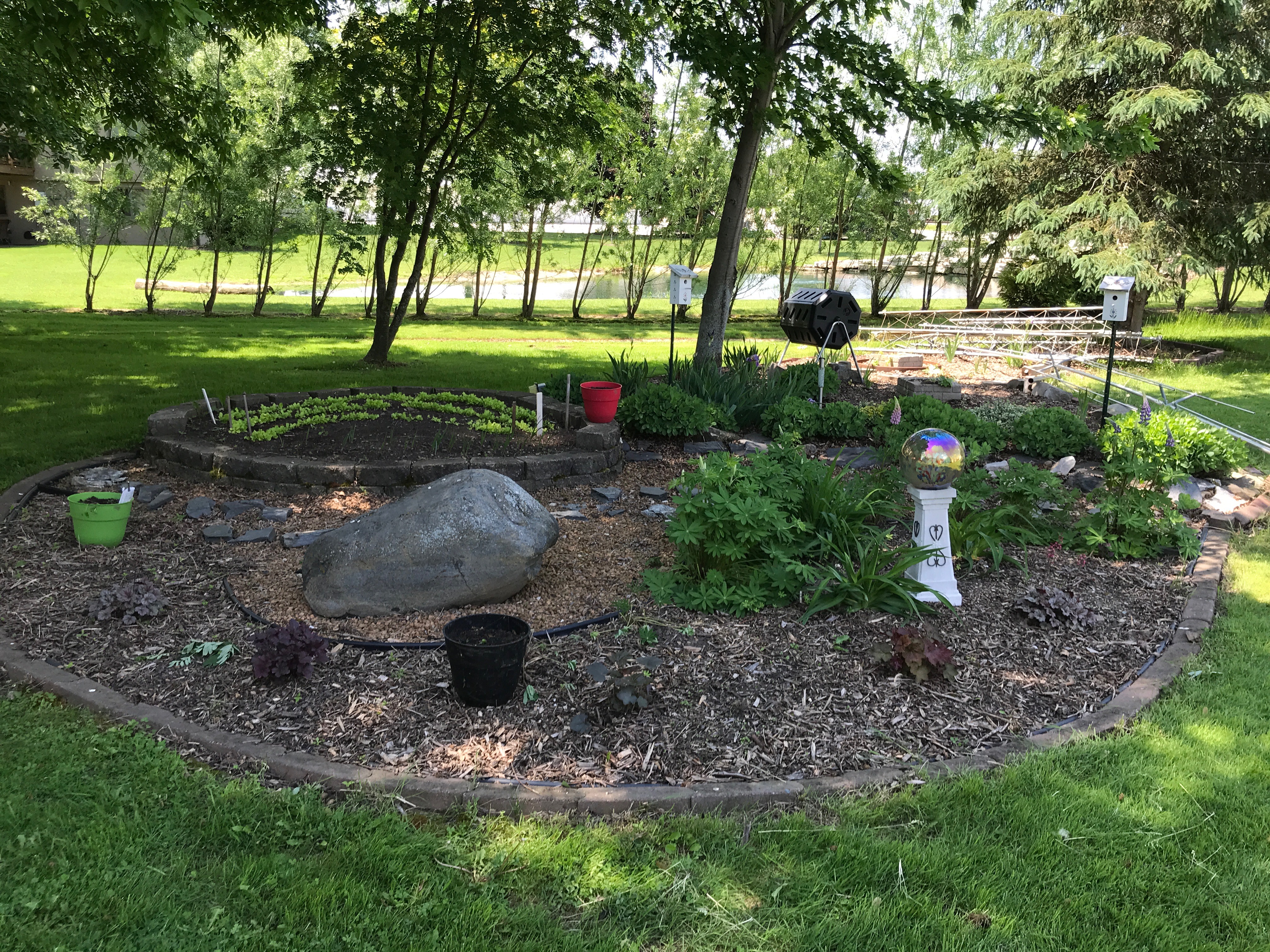
There are big changes coming for this area back here shown above. Right now it’s largely just decorative except for the lettuce bed behind the big rock. The problem back here is this area is really low and is almost underwater in the early spring, which makes it hard to grow anything except grass. That’s why we put in the raised beds which are off to the right out of sight. MrsGF and I decided this whole area is going to get raised up, perhaps yet this year if we get the time. We’re going to get decorative retaining blocks like the ones currently surrounding the lettuce bed, pull out all of the plants we want to keep, and then make the whole thing into a single raised bed about a foot above the height of the lawn.

Antennas

Well, we’ll have to move the antenna parts you see off to the right before we can start anything back there. Hopefully that tower you see laying back there that has been going to be put up “real soon now” for about 5 years will get put up this year. Maybe. And the GAP Titan vertical antenna will replace the Comet vertical as soon as I can corner eldest son and guilt him into helping.

The antenna tower… I traded a deep cycle marine battery for that with one of the ARES guys. He needed a battery for the power system in the emcomm trailer, he had this tower laying around that he just took down, so we made a swap. The tower was supposed to go up at the end of the garage and be the support for various antennas, including one for broadcast TV so MrsGF can watch PBS in the evening. (The problem with digital TV versus the old analog is that with the old analog if you were in a fringe reception area, you still could see and hear something. There would be static, yes, but you’d still get a watchable picture. If you’re in a fringe area with digital, you get nothing). Eldest son keeps claiming he’s going to help get it up the next time he gets over here.

Antennas are really my biggest problem when it comes to amateur radio. I play around with them, experiment, etc. but I haven’t come up with anything really any better than the off center fed dipole currently strung up from the garage to a couple of trees. It works reasonably well, but is way too low to the ground. And the biggest problem is that one leg of the dipole runs to a tree in the neighbor’s yard, and the neighbor is moving, so that means the antenna has to be moved too.

Like a lot of amateur radio operators, I’ve accumulated a lot of junk related to the hobby, including several different types of antennas. And despite claims from the manufacturers of many antennas, most of them don’t really work all that well. It’s basic physics, really. In order to be efficient, antennas for radio frequencies down in the shortwave (HF) portions of the amateur radio bands, like down in 80 or 40 meters, need to be pretty long. Your cell phone has a really, really tiny antenna, because it works with very, very high frequencies.

Antennas for the frequencies I work with are huge. We’re talking 80, 90 feet long or longer. My OCFD, if laid out straight, would be 135 feet long.

So if it needs to be that long, how can that GAP Titan antenna laying out there be only 21 feet tall? Well, it cheats, basically. It uses various tricks to make itself work better than it really should at first glance. It looks simple, but it isn’t. It’s actually a very complicated piece of equipment with various radiators and stubs and, well, antenna stuff. It would take more space than I have here to try to explain it all.

What it boils down to is you can’t get something for nothing. You can’t fool physics. You can make smaller, shorter antennas, but you sacrifice efficiency when you do that. I wince when I see some of the ads for some of the antennas on the market because I know the claims being made for the are pretty much bogus.

Catching Up

I suppose I could talk about how Mike Pence not only killed NAFTA but drove a stake into it’s still quivering heart last week, or how the latest round of that popular game in D.C, Trade Wars, is going to decimate the agriculture economy, but that’s just too damned depressing. Besides, if you want to read about that kind of thing there are only about five hundred million websites out there where “experts” are pontificating and bloviating.

No, it’s spring. Everything is in bloom, as you can see from the closeup of the lilac there up at the top of this. I’m rather pleased with how that image turned out. MrsGF keeps telling me I should start printing some of these and trying to sell ’em, but well, that would mean I’d actually have to do some work.

Almost everything we planted is doing well. Tomatoes are doing great. One variety we planted called Wisconsin 55 (I think) is already starting to blossom. The peppers are doing pretty good. Even the two blueberry bushes MrsGF picked up seem to be doing pretty good. Even the spindly and sickly looking cucumber plants that looked like they were dead are starting to take off.

And the weather has been — well, I was going to say good, but that’s not really true. The weather has been odd. In late May we had temperatures well up into the mid-90s that broke records all over the state. And caused dozens of incidents of highways buckling from the heat. And in just the space of a few days we went from conditions being too wet to conditions way too dry. We haven’t had any significant rainfall in weeks now. Other parts of the state did get some rain, but it always seemed to evaporate before it got to us. We have to water everything almost every day. It’s rather discouraging. If it’s this bad this early in the season, what is it going to be like come August? We did finally get some rain over the weekend, about half an inch.

Still, it’s hard to complain when I see stuff like this when I walk out the door:

Screen Shot 2018-06-02 at 7.40.59 AM

And I’ve finally been able to get the bike out and put some miles on on a fairly regular basis. I’d almost forgotten how delightful it is to get out in the country on the bike this time of year. A lot of people don’t understand why I enjoy it so much. It isn’t the exercise, it’s getting out in nature and being able to hear the birds and frogs, and seeing the little treasures along the roadside like these tiny little flowers:

Screen Shot 2018-06-02 at 7.41.47 AM

Amateur Radio Stuff

Field Day is rapidly approaching. I think it’s June 23-24. It’s an annual event that has been going on for ages in the amateur radio community. The idea is to get us troglodytes out of our basements and the dark corners where we usually huddle over smoking soldering irons, and play with all kinds of technologies that range from 100+ year old telegraph keys to ultra-modern mesh networks, satellite communications and bouncing radio signals off the moon, and set up our gear in parking lots, parks, and even fields in the middle of nowhere, and hope we don’t burst into flames like vampires from the exposure to the sun.

Alas, I’ve never participated because MrsGF and I are usually gone of vacation at that time of year because of how our schedules work out. It’s great fun, though. So if you see a bunch of very pale looking people stringing up wires in trees, standing around tables laden with strange looking equipment, don’t worry. It’s just us making a rare excursion into the daylight.