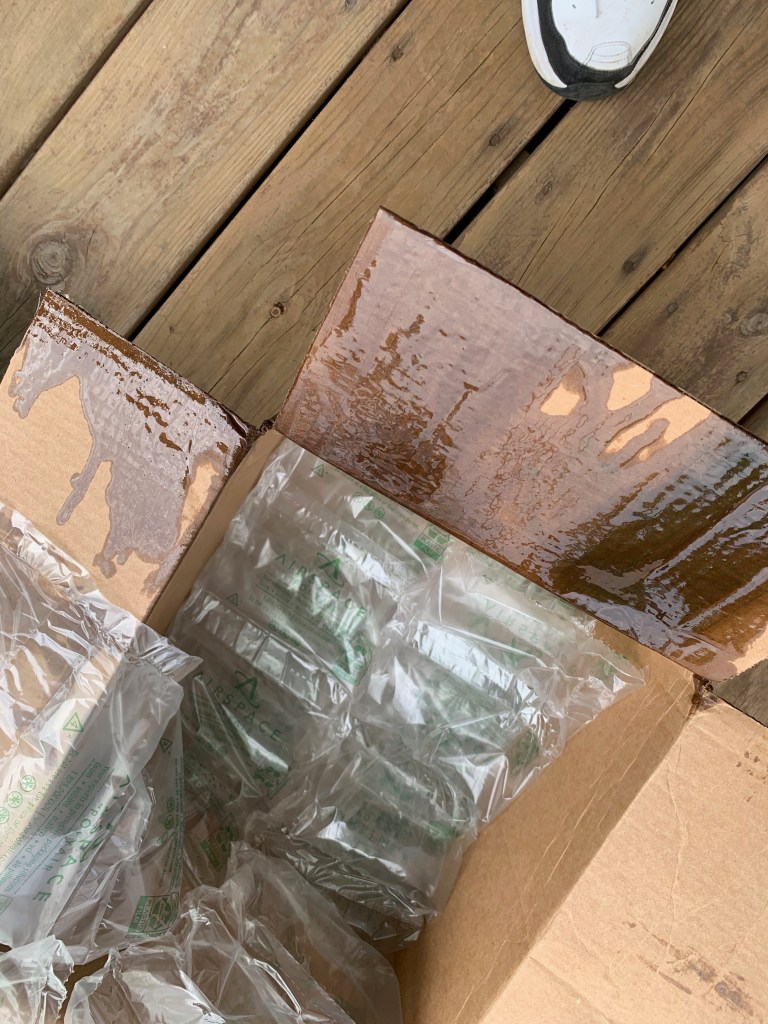
This is what I found on my front deck the other day.
This is, or was, rather, $180 worth of epoxy resin. This stuff ain’t cheap, folks.
Fortunately I got out there in time to keep the stuff from soaking into the wood on the deck. There were two plastic bottles in that box, a 1 gallon and a 2 quart, containing the epoxy resin and the catalyst. The catalyst bottle had a dent in the bottom that was leaking, and the plastic bag the bottle was in which is supposed to keep stuff from leaking out failed too.
I suspect it made it through shipment until the moment it hit the porch. The delivery driver seems to have just tossed it onto the deck, at which point it hit just right to punch in the bottom corner of the bottle and crack it. I was in the basement and fortunately heard the thud when it hit the deck and got up there before it soaked into the wood. It looks like it was badly packed. Someone threw in some of those plastic air pads, shoved the bottles in, put a bit more packing on top and sealed it up, leaving the bottles laying loose so they could move around and work their way around the padding.
Amazon’s response was great. Seriously great. I got on line to report it and within a minute I had a real person on the chat line and within another minute or two they issued me a full refund. No red tape, no arguments, no need to send photos or try to return the stuff (that would have been interesting, trying to return a leaking jug of resin) just an apology and asking me how I wanted them to send me a full refund. A short time later I got a confirmation email from them. The email told me that I was free to do whatever I liked with whatever I could salvage from the shipment.
I got to the leak before I lost a lot and transferred it into glass jars. There was a gallon and a half total before the puncture happened, and it looks like I have at least a gallon plus a couple of cups left that’s going to be useable, which is a good thing because I waited two weeks for this stuff to come in.
It might sound like I’m getting a lot of free resin out of the deal, and I suppose I am, but this could have been a complete disaster if I hadn’t been home and heard the thud when it hit the porch. If that stuff had soaked into the wood deck I don’t know what we would have done. I suspect we would have ended up having to replace a significant amount of wood on the deck. That catalyst is thick, sticky, and doesn’t dry by itself. The wood would have been ruined.
Anyway it could have been a heck of a lot worse, and I have enough of the stuff left that I can play with it and see how it works.
Well, okay, not according to the calendar. But as far as I’m concerned the seasons change not by the actual date but according to the weather conditions. We got hit with a hard frost the other day and that pretty much brings the growing season to an end for a lot of our plants. So that means it’s autumn no matter what the calendar may say.
And while it may be chilly outside, we’re still getting a new central air system put in tomorrow morning. Our old air conditioning system is probably pushing 25+ years, if not a bit more than that. It’s actually a bit amazing that it lasted this long. But it has a freon leak now, and while they could probably repair it, we’d still have a 25 year old AC system that could fail at any time just when we need it most. This is as good a time as any to get it done. Probably the ideal time, really. The air conditioning season is over, the heating season hasn’t started yet, so the company has the time to do it. So we might as well get it over with now so we’re ready when the heat comes next summer.
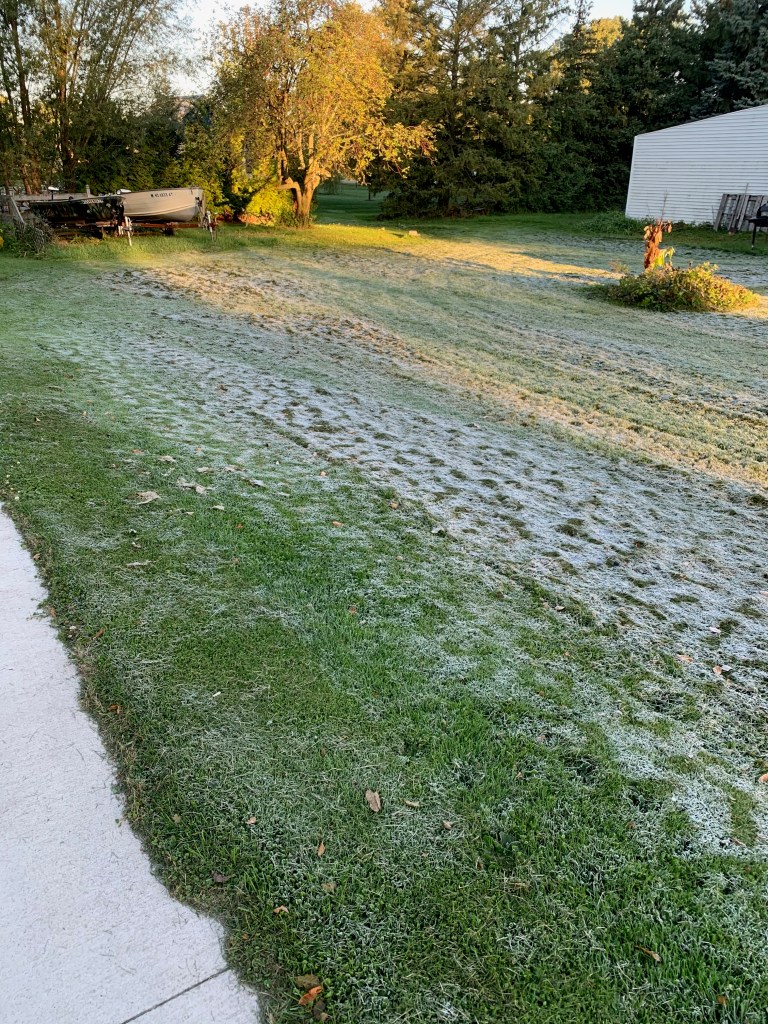
Gads, it’s going to be an expensive fall, though. The AC is going to run us $3,200 (this is a big house). The contractor just called and said our new windows and doors are now ordered so he’s going to be rolling in sometime in a couple of weeks to do that, that’s going to be over $7,000. Ouch. Still, it all needs to get done. Especially the windows. One window on the north side of the house is literally rotting away and won’t survive a winter and the exterior door is nearly as bad. So once that’s done we’ll be ready for cold weather. And we got a taste of that already as you can see from the frost covered grass below.
It got cold. The remote sensor for the thermometer is out on the front porch which is pretty sheltered, and that said it got down to 32 F so that means out in the yard and gardens it got well below 30. The grass out in the yard was white with frost before the sun came up and the roof was covered with frost, so it was pretty cold out there for a fairly extended period of time overnight.
This is the time of year when we’d normally have so many pears we didn’t know what to do with them, so it seems odd not having the tree any more. While I do miss having fresh pears, I don’t miss having the tree, to be honest. It collapsing and having to be removed wasn’t really a bad thing. If it were still there the whole area would be covered with a thick carpet of fallen pears, and those would be covered with bees, wasps and, well, it could get nasty out there. MrsGF and I would no sooner pick up 5 gallon buckets full of the things, and the tree would drop a few hundred more.
We’re already talking about what we’re going to do with that area. Now that it isn’t shaded out by the tree we can grow just about anything out there and we don’t have to worry about finding plants that can handle shade. We’re thinking about putting a raised bed out there or expanding the existing garden that was being shaded out by the tree that we had in flowers.
The frost brought an end to the tomatoes, of course. But that’s not a big loss because they were already well on the way to winding up anyway. The peppers are still doing fine, though. They aren’t as fragile as tomatoes are and are in a sheltered area that didn’t get hit with the frost.
The raised beds did very, very well again this year. Building those was the best thing we’ve done in the garden over the years. We cut back on the number of tomato plants drastically this year and still had more than we really needed. We planted onions around the outside edges of the raised bed and that worked out beautifully as well. The onions did really well. We didn’t have to buy a single onion all season. Just walk out to the garden and grab one. I am really going to miss that. I’m going to miss the flavor even more. Like just about everything else we grow the flavors are much more intense than the produce we get from the store.
We took a break and drove all the way to the lakeshore between Manitowoc and Two Rivers to have a picnic. Cold down there along the lakeshore, but wow, it was a beautiful day. Had a very pleasant afternoon down there. With Wisconsin’s infection rate now totally out of control and the county we live in having one of the highest infection rates in the state, opportunities to do anything are a bit restricted so just getting out and about was nice.
I haven’t talked about the virus and how it is effecting our lives because, well, you get enough of that everywhere else, don’t you? Still it’s very frustrating. This was supposed to be more or less under control by this time. Instead the number of new infections is hitting new records almost every day here in the state. It’s completely out of control here. ICUs around here are at full capacity and they’re trying to find beds in other hospitals in the state and, well, it’s scary. MrsGF and I are both in one or more high risk groups so… Well, you know. To top it off I pretty much have virus like symptoms all the time. I have upper respiratory allergies so I always have congestion, watery eyes, stuffed up sinuses, a slight cough, etc. Basically I have almost all of the early symptoms of the virus all the time except the fever. Sigh…
But enough of that. How about a rose instead?
Yes, we still have flowers despite the frost. Some of the flowers are pretty resistant to cold weather and are still doing fine, and we have a potted rose up on the front deck that’s still in full flower.
Let’s see, what else…
I’m going to take a stab at resin casting, which ought to be interesting. I’ve gotten reasonably good at wood turning and am now looking for a way to expand on that a bit by doing stuff like, well, this-
I doubt I’ll ever get as good as this guy, but what the heck, why not give it a try and see what happens? I’m rather impatient to give this a try. I have just about everything I need except for the resin and that should be here this week. I hope. More about that when it actually happens. A lot of the videos you see make it resin casting look easy. It isn’t. I expect my share of utter disasters as I get started with this.
And once again the importance of proper safety gear was proven to me rather dramatically when this happened:
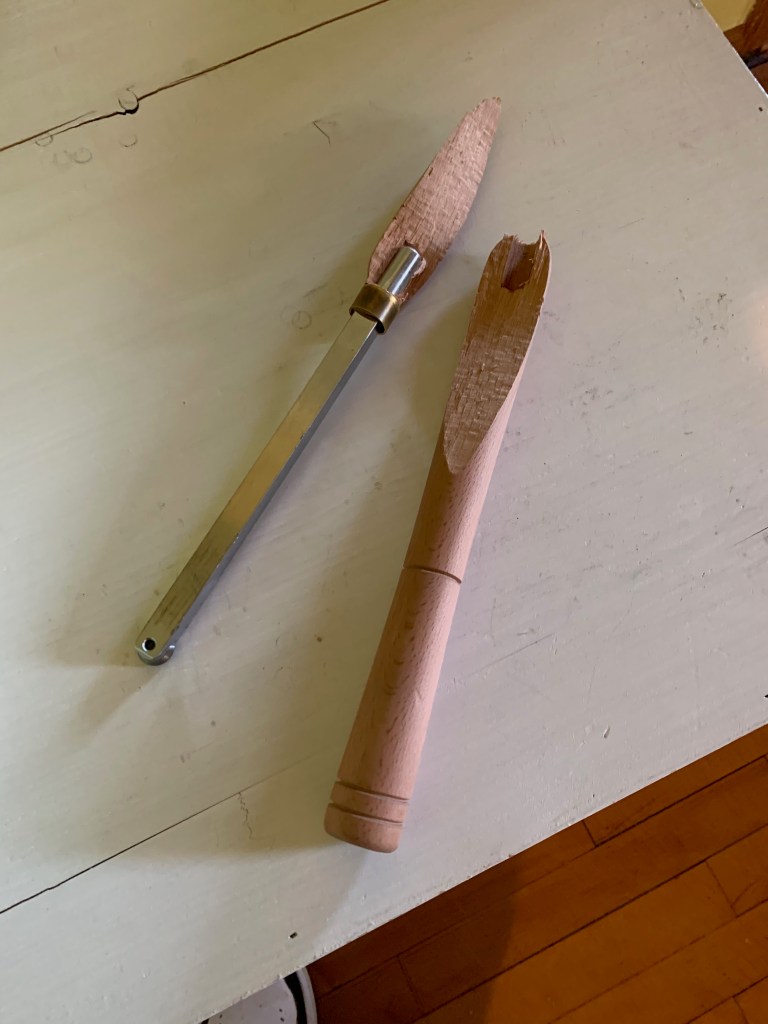
Ouch, that could have been nasty. I was turning a bit of white oak when the tool got caught, hard, on an imperfection in the wood. Not only did the force snap the tool in half, it hit so hard it actually bent the tool rest on the lathe and I have to get a new tool rest. The metal part of the tool snapped clean out of the handle, splitting the handle in half, and flew up and hit me square in the face. If I hadn’t had the face shield on, well, it would have been nasty as I said.
MrsGF and some family members have once again been suggesting I try selling some of the stuff I’ve been cranking out. And I suppose that some of it is good enough that it might be marketable. But there are so many issues with trying to sell stuff and, well, is it worth the effort? I used to run my own business so I know a bit about all of the permits, red tape and tax issues that go along with operating a business legally. Emphasis on that word, legally. A lot of people try to slip under the radar, thinking that they’re too small and insignificant for the government to bother going after them if they try to ignore all of that. But do you really want to take that risk? Heck, even zoning can be a problem. You may be turning out some really neat stuff down there in your work room in the basement or that spare bedroom, and no one is going to bother you because it’s a hobby. But if you start selling it, well, now you are a business, a manufacturer, and a lot of communities have very strict zoning ordinances concerning manufacturing. Zoning boards are often very unforgiving. They don’t give a fig if all you’re making a few pens and selling ’em on Etsy. You’re making and selling stuff commercially so you are a manufacturer. Period. Things can be even more strict if you’re in a home owners association.
And then there’s pricing your stuff. I did a scrounge around Etsy the other day looking at the various vendors selling bowls and, well, either they’re losing their shirts on every sale or something funny is going on. I found one person selling 6 inch wide, two inch deep “hand crafted solid black walnut” bowls for $20. Seriously? You add up the cost of the wood, sand paper, the finishing materials, add in a bit to cover the cost of the tools, the lathe, etc., and you’re already losing money at that price. And that isn’t even beginning to add in the cost of Etsy’s fees, bookkeeping, filing taxes, or the maker’s time to produce the bowl. So yeah, either the maker is losing his shirt on every sale, or there’s something unethical going on. I did some quick estimates and I’d figure that just to break even I’d have to sell a bowl like that for about $35, and that would be essentially doing all the labor for free. And he’s running them out for $20?
So the thing is, even if I’m only turning out a bowl a week or so, it’s just not worth the hassle to try to go commercial and sell this stuff.
That’s all for now. I’m working on the next part in the tool series. That’s going to be covering the big stuff like table saws, jointers, planers and other big ticket items. I’m having to do some serious research because I’m not really up on what’s going on in the market right now. I’ve owned all of my big power tools for at least 10 – 15 years. One of the good things about big ticket items like this is that while they’re expensive, generally speaking they’ll last you a lifetime, so you only need to buy them once. Hopefully.
Sidenote: I rarely look at the viewer statistics but I did notice an interesting thing the other day. It seems a lot of my readers are from India. On a lot of days the number of visitors from India outnumber even those from the US. India is one of the most amazing places on the planet, so I’m delighted by that. I don’t understand how they found this goofy blog, but I’m thrilled they come and read this.
I’m going to split power tools into two general groups, hand held power tools, and the big expensive ones like table saws. I’ll deal with the big ones in the next installment of this.
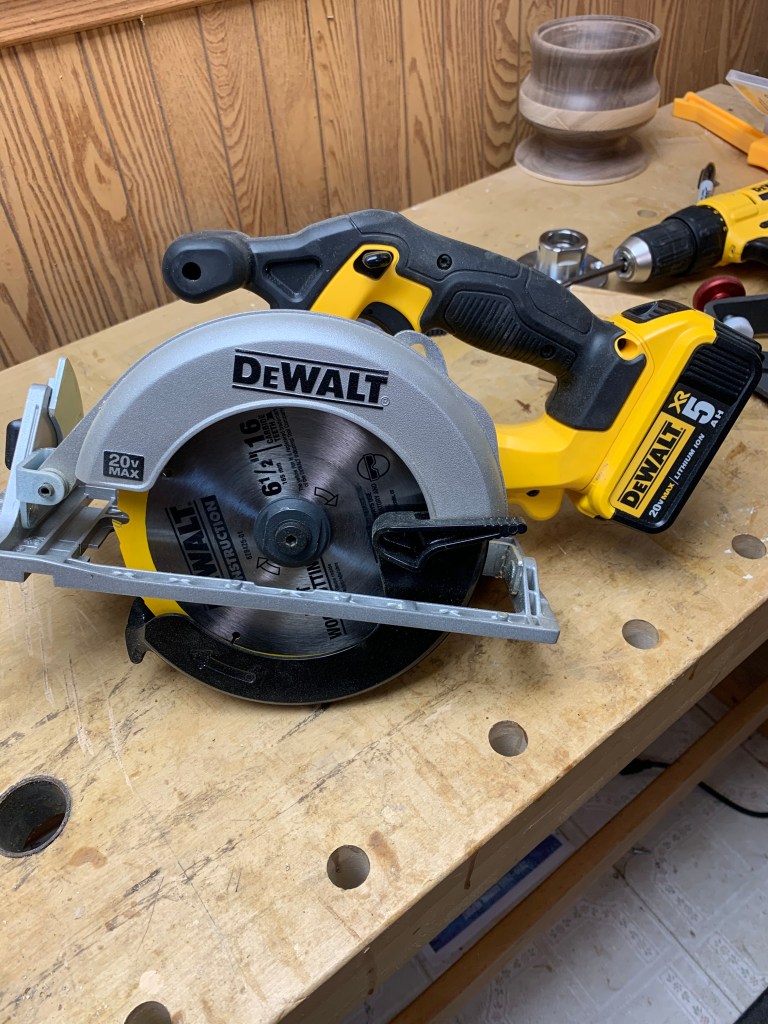
The goal of this whole series is to help you avoid making the mistakes I made, some of which have been pretty darned expensive. Far too often I’ve ended up paying big bucks for an overhyped, high end tool when a medium priced tool or even a cheap one would have worked just as well. Or even worse, I spent a lot of money on speciality tools I only used once. So hopefully this will help you avoid the mistakes I’ve made. And I’ve made a lot of them when it comes to small power tools. I never should have bought that battery powered DeWalt circular saw, for example. I never should have spent that much money on a reciprocating saw… Well, you’ll see as you read along.
DC Vs. AC – Corded or Battery?
Some of the tools I’m going to be talking about in this section are available either as battery operated, or AC versions which have to be plugged in. So which is better? Unfortunately the answer is, it depends. It depends on how much you are going to use the tool, what the tool does, etc. For some of these tools, the battery versions are so ridiculously expensive that buying one is just silly. For others, the battery versions are so much weaker and less capable that again buying one would be silly. For others it’s a coin toss as to which is better.
Buy separately or buy a kit/collection?
A lot of tool makers will gladly sell you a whole bag full of their stuff, and regularly push these collections as “deals”. DeWalt, for example, will gladly sell you a kit that includes a drill, reciprocating saw, circular saw, flashlight, even a radio, that all work off the same battery system. So will other tool makers like Milwaukee. But while they make it sound like this is a good deal, it usually isn’t. Generally you end up paying just as much for those tools as if you’d bought them separately. And often you’ll end up paying for tools you will seldom, if ever, actually use. If the collection is indeed made up only of tools you will actually use, and they aren’t overcharging you for them, then sure, go for it. But that radio? You’ll probably never use it. And that circular saw? I hate to say this but most battery operated circular saws aren’t very good, even the brand name ones. But I’ll come to that a bit later. Let’s talk about drills first of all.
Drills
Electric drills are an essential tool for any handyperson, hobbyist, woodworker or even someone who just putters around in the garage occasionally. Drills have become a utility tool, used not just for drilling holes, but for driving and removing screws and bolts, polishing, sanding, etc. I honestly can’t remember the last time I used a regular screwdriver. I grab my battery operated drill with a screwdriver bit it chucked into it. Of all the power tools in the shop or the garage, the drill is the one that is probably going to be used the most often.
Generally speaking the argument of DC Vs. AC with electric drills was over long ago, and batteries won hands down. Oh, you can still buy corded drills, really good ones. And they’re generally less expensive than the battery powered versions. But battery operated drills have become so efficient, so good, and so damned convenient to use, that the only AC powered drills I have are specialty items like hammer drills or drywall screwguns. The drill I use just about everyday is the one over there on the left, a DeWalt that runs on a 20V LI battery system that is shared with several other DeWalt tools I own.
Sidenote: A brief word about drill size, i.e. how big a drill you can chuck into the chuck. Most hobbyist and handyman type drills are 3/8 inch, which is generally fine. I prefer one that has a half inch capacity, but I’m probably tougher on drills than you are and need larger capacity than you do. You can get bigger drill bits with smaller shanks that will fit a 3/8″ drill, of course, but I think the 1/2″ capacity drills are better all the way around. The motors in the bigger ones are generally stronger and the whole drill is more heavy duty. The drawback is money, of course. 1/2″ drills are going to be more expensive. But for the average home owner, hobbyist and even woodworker, the smaller sized drill will probably work just fine.
What Does A Drill Need?
Any drill, whether corded or battery powered, should have should have all of these features.
1 – Reversible – you should be able to reverse the direction of the drill with the flip of a switch. Why? Because in all likelihood you’re going to use that drill not just for drilling holes but for driving or removing screws, tightening or removing bolts, etc. and being reversible is absolutely necessary.
2 – Keyless chuck. The chuck is the part of the drill that accepts the drill bit or screwdriver bit, etc. Once upon a time we had to use a chuck key, that thing over there on the left, to tighten up the chuck to hold the bit or whatever in place. The gear on the key matched a gear on the chuck, and you twisted it to tighten it up. And everyone had trouble keeping track of the damned chuck key. They were always getting lost. Or the gears would get stripped. Or you could never get it tight. You get the idea. They were a royal pain in the neck. Keyless chucks let you clamp down on a drill bit or whatever by just twisting a collar around the chuck by hand. Best invention to hit the drill market since, well, rechargeable battery packs, really.
3 – Variable speed. The speed of the drill should increase as you increase pressure on the trigger, and decrease as you let up on the trigger. Some cheaper drills come with just a fast/slow or hi/lo switch. That’s okay but it isn’t a real replacement for a variable speed trigger. Why do you need it? Because drilling different materials requires different speeds. And you don’t want that drill immediately jumping to a gazillion RPM as soon as you hit the trigger when you’re trying to drive a screw into a board.
4 – A clutch. A clutch is a device that limits the amount of torque, or force, that the drill applies. This allows you to set the drill so it will stop turning when it has to apply more force than you want. This makes it a lot easier to drive screws, use it as a nut driver, etc. You set the clutch, and when it gets the bolt or screw tight, it stops turning before it strips out the screw or twists your wrist off. It should be adjustable so you can set it where even gentle resistance will trip the clutch, all the way up to full torque.
Those four things are absolute musts. There are other features that are nice to have but not absolutely necessary. A built in light so you can see what you’re doing is nice to have. So is a built in bubble level so you can make sure you are drilling level and plumb.
As I said before, that drill in that photo up there is the one I use almost every day, and it’s proven itself to be pretty darned tough and has been able to handle everything I’ve thrown at it. It’s been dropped, kicked, slid across floors and otherwise beaten and abused, and has handled everything it has needed to. I don’t think it’s over priced, either, even though there are cheaper ones out there that are almost as good. Without a battery it’s going for about $80 on Amazon. And it also works off the same battery packs my little circular saw, sawzall, string trimmer and leaf blower use. Yes, all my battery operated tools are DeWalt. I’m not a DeWalt fanboy and I certainly don’t get any kind of reimbursement. But I do like that DeWalt drill a lot and think it’s well worth the money. And just to prove I’m relatively unbiased, I’m about to badmouth DeWalt’s battery operated circular saw in a moment here.
I’m not telling you to run out and buy one like mine. There are a lot of drills on the market that do everything this one does, and do it just as well, and are even cheaper. And when it comes right down to it, well, a drill is a drill, right? If all you need to do is drill a few holes and drive a few screws, a cheap 3/8″ drill off the shelf from Walmart is going to do it. As long as it has the necessary features and seems to be made reasonably well, go for it. The DeWalt is a good choice, but you can also get good drills from Milwaukee, Skil, Black & Decker and a dozen other brands, and almost all of them are going to do the job.
Circular Saws
I own this one. I wish I didn’t. You don’t want a battery operated circular saw. Seriously.
Circular saws like the battery operated one of mine over there on the right are pretty much ubiquitous. Just about everyone who has ever needed to cut a piece of wood has one and, well, why not? They’re handy, they’re cheap (or should be), and not too difficult to use. If you need to whack six inches off a 2X4 or cut a board in half, chances are good you’re going to reach for a circular saw.
But then I realized I haven’t used my circular saw is something like two years. Seriously. When I wanted to take a photo of my saw for this, it took me twenty minutes just to find the dopey thing. But that doesn’t mean you don’t need one. I don’t generally use one because I have alternatives like a table saw, power miter saw and stuff like that laying around the shop. For lopping off the occasional 2X4, cutting down a sheet of plywood or something like that, there really isn’t any alternative.
This is one of those cases where basically a saw is a saw is a saw. There is little or no difference between brands. Sure, the more expensive ones will be of a bit better quality and will probably last longer, but generally this is a case where a $50 saw is going to serve the average person just as well as a $150 one will. Seriously.
And this is a situation where you do not want a battery operated tool. Battery operated circular saws are almost universally underpowered, have less cutting capacity, usually, and generally can’t stand up to the same kind of heavy use (and abuse) that even the medium priced corded versions can deal with. And you end up paying two or three times as much for a decent battery powered saw as you’d pay for a corded one. I have a 20 year old Skil circular saw laying around somewhere that has more power, bigger capacity and is easier to use than that $120 battery powered DeWalt that I own in that photo up there. And I paid a whopping $40 for the Skil brand saw. So for three times the money I got a saw with less power, less cutting capacity, and a battery that lasts a woefully inadequate amount of time? Oh, brother…
That isn’t DeWalt’s fault, of course. To be fair the saw itself isn’t bad. It’s about average or even a bit above average quality for it’s price. But almost all battery operated circular saws just aren’t very good. It’s basic physics. Cutting wood takes a lot of energy and a motor with a lot of torque. A DC motor and battery pack that is light enough to be easily handled by the average person just doesn’t have the torque or the energy storage capacity. So almost all battery operated circular saws are under powered, can’t cut material as thick, and the batteries discharge astonishingly fast. Stick with the AC ones.
What about features you should look for? Uh, well, okay, how about one that cuts wood? Seriously, that’s really all you need to be concerned with. Oh, and is it well built enough that it isn’t dangerous to use. And that’s about it. When it comes to circular saws, the bells and whistles on the high end models aren’t worth the money. You can drop $300, believe it or not, on a high end circular saw, and in the long run it doesn’t do anything that a $50 Black & Decker or Skil does.
There is one upgrade that will make just about any circular saw, especially the cheap ones, work even better, and that’s a better blade. A lot of these cheaper saws come with blades that are a joke, little more than a piece of stamped sheet metal. For about $20 or or a bit more, you can get a carbide toothed blade that will cut better and last much, much longer. Frued makes excellent circular saw blades (and blades for miter saws and table saws). About the only good thing about my DeWalt battery saw is that it comes out of the box with a decent blade.
Routers
Routers can easily turn into the proverbial money pit, to be honest. We’re talking some serious cash here. Almost every hobbyist woodworker I talk to thinks they need a router. And when I ask them what they actually use it for, they either lie and tell me they use it all the time, or admit they’ve used it maybe twice since they bought it and it’s been gathering dust on the shelf ever since.
Okay, so what the heck is a router and do you need one?
My 890 Porter Cable must be well over 10 years old now and it’s still purring along like brand new
A router is sort of like a combination high speed drill and plane built into one. It spins at up to 28,000 RPM or so, turning a bit that has cutter blades shaped in various profiles.You use ’em to make decorative moldings, putting edges on table tops and panels, rounding over edges of boards, to cut complex shapes, and the list goes on and on. Basically they’re used for for shaping and adding decorative elements. You can get jigs and templates that will let you do things like make dovetails and other speciality joints.
That’s my Porter Cable up there in that picture, and as you can see from how dirty it is, it gets a lot of use. It’s an old 890 series router, with an optional plunge base, 1/4 and 1/2 inch collets (the thing that holds the bits), variable speed, soft start, and I dropped a considerable amount of money on it. I’ve had it for – well, must be more than ten years now, and it’s still going strong. It was not cheap. They don’t make this particular model any more but it looks like models comparable to this one are going for well over $200, probably closer to $300, and that’s without a plunge base, bits and accessories. When I add everything up I probably have close to $1,000 sunk into just this one tool system. See what I mean about a money pit?
But do you really need one? I could use a router to cut a sheet of plywood. But I don’t. I use a saw for that. I could use it to round off sharp corners on a table top. But I generally don’t. I’d use my little block plane for that. There are a lot of things a router could be used for, but it’s generally easier using a different tool for the job. What they are good for is mostly decorative things like moldings, making dovetail joints with a jig and things like that. So unless you make fine furniture or are making custom moldings for a window or picture frame or something like that as I do, you probably don’t need one.
Power Sanders
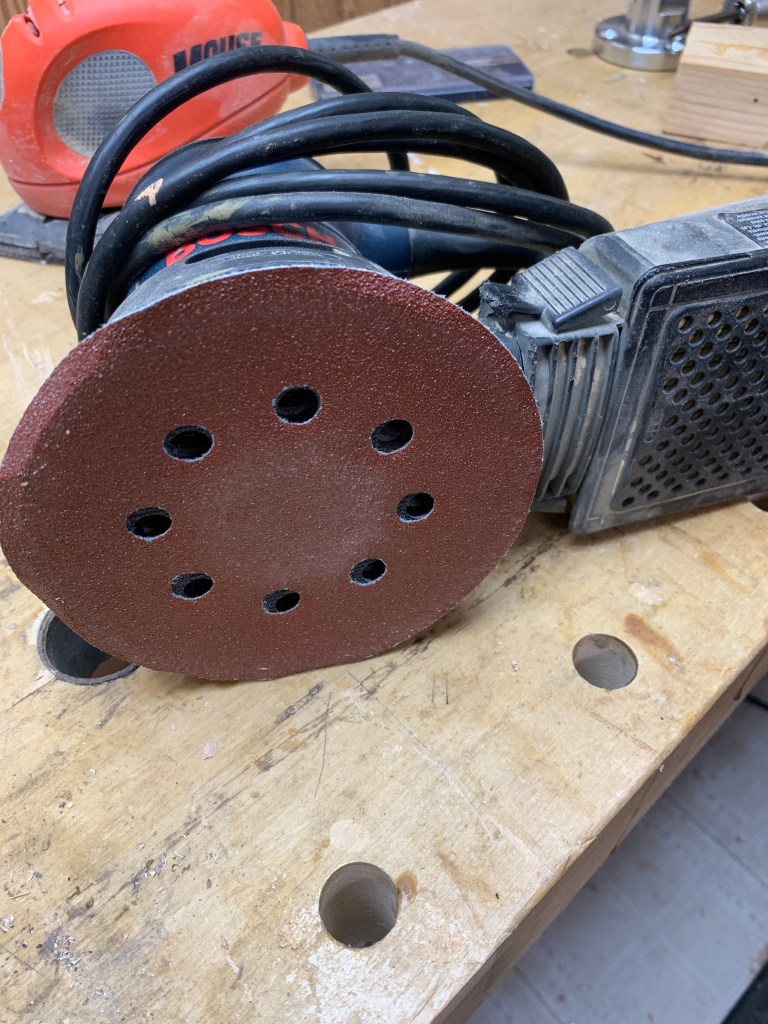
These are one of the greatest inventions ever, in my opinion. Anyone who has ever had to sand a 3′ by 6′ table top by hand before finishing it will tell you the same. I have four of them laying around at the moment, but I only use three. The one on the left, the square one, does work but it doesn’t have any kind of dust collection system so it sits on the shelf. The other three get used regularly, though.
Most orbital sanders have holes in the pad to match holes in the sanding discs. This is help with dust control. Most of them have some kind of dust collection system that, in theory, sucks up the dust through the holes and shoves it into a bag or some kind of filter. Sometimes it actually works. Maybe. Sort of. Kinda.
Despite the variety of sanders in that photo, IMO the only one you really need is an orbital sander like that Bosch up there. That’s really my workhorse sander. It uses sanding disks that attach with a hook and loop system, has holes in the disk that match holes in the sanding disks that permit it to suck up a lot, but not all, of the dust generated from sanding, and does a pretty good job of smoothing wood down. Discs are available in a wide variety of grades ranging from very coarse to very fine.
Prices bounce all over the place, but dear lord don’t spend a lot on one of these! I’ve seen prices pushing $200 for a sander that doesn’t do any more than a $40 Skill or Black & Decker.
Belt sanders like the Skil can be useful. Generally I use mine for hogging off large amounts of material with a coarse belt on it. Works well for fitting doors that stick, for example. But it gets used nowhere near as much as the orbital.
The “Mouse” is the red one with the point from Black & Decker and generally only used for finish sanding into tight corners. It’s handy, but do you really need one? Probably not. It also has no dust collection system on it so it gets messy real fast.
Generally speaking power sanders are reasonably cheap and can save you a lot of time. If you’re building furniture or doing any kind of finish carpentry, you probably need one.
Reciprocating Saw
Okay, here we go again – Yes, don’t buy this one either! I way, way over spent on this saw. I was, I suspect, drunk when I bought it. I could have got one for almost half the price that would work just as well.
Sometimes called a “sawzall” these things have pretty much replaced things like hacksaws, pipe cutters and the like for a lot of us. I wouldn’t technically call it a woodworking tool, but damn, the thing is handy. I’ve worn out three of these over the years. This DeWalt is the latest to move into the workshop. I use it for cutting pipe, trimming branches, sawing off bolts, well, you get the idea. You can get different saw blades suitable for everything from cutting steel, to wood, to demolition work.
Do you need one? Well, maybe? They’re certainly handy to have around. If you do buy one, don’t buy one like mine!!! I almost put this one in the “Holy Cow Did I Screw Up With This One” category because that puppy up there would set you back over $170. Dear lord, did I really spend that much on a saw? What the hell was the matter with me? Was I drunk? Temporarily insane?
No, no, no, no… If you decide you need a reciprocating saw, don’t spend more than $100 on one. This isn’t rocket science. All the thing does is move a blade back and forth for heaven’s sake. $170? Really? What the hell was I thinking? If I needed to stick with DeWalt they make one for $100 that would have worked just as well.
Nailers
This is the last one I’m going to cover in this segment. I’m not going to go into a lot of detail about nailers, but damn, they’re handy, so I’ll touch on them briefly.
Now if you’ve ever hammered a nail in and, after smashing several fingers, bending a half dozen nails over and hammering the heck out of your wood, you’ve told yourself there has to be a better way of doing this. There is. Nail guns. Now there are electric ones and pneumatic ones (air powered). Generally speaking the electric ones are, well, frankly every electric one I’ve tried has been crap. I’m sorry, but they were. I stick with pneumatic.
I have three. One is a finish nailer for finish nails (duh), one is a pinner, a special type of nailer that uses headless nails called pins. They don’t have much structural strength and are generally used for holding together glue joints in furniture until the glue cures. I also have a big framing nailer for, well, framing (also duh).
Do you need one? Well, not really, to be honest. They certainly do make life a lot easier if you’re remodeling a house or putting up trim and stuff like that. But you can get along without one. They aren’t all that expensive, though. Well, unless you add in the cost of the air compressor you’ll need to power them. And you can generally rent them, along with an air compressor, at tool rental places so if you only need one for a short time for a special project like remodeling a room, you don’t need to buy the thing.
Specialty Tools, Or, Holy Cow Did I Screw Up With This One
I make mistakes. A lot of them. Over the years I’ve bought a lot of tools I wish I hadn’t. For whatever reason, buying xxxxx seemed like a good idea at the time, or I bought into the hype and advertising or whatever. And now I’ve ended up with a tool that spends its life collecting dust and providing a home for spiders. Here are a couple of examples.
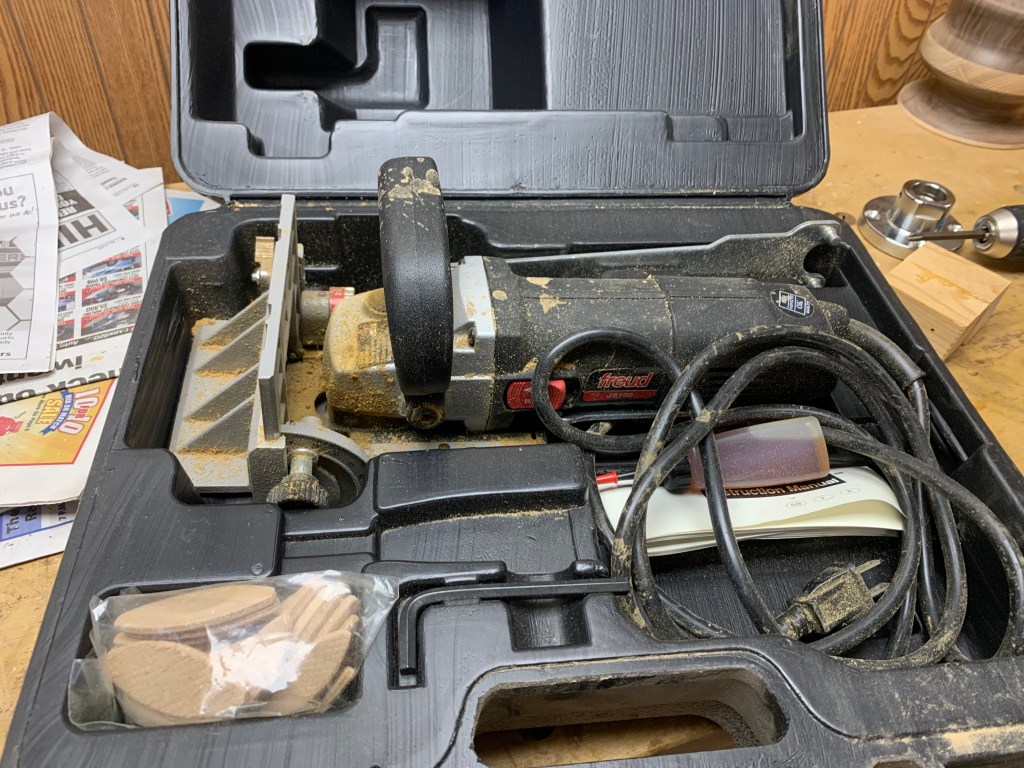
My biscuit joiner. What the hell is that? Well, back in the good old days when “This Old House” was an actual home improvement show that showed you how to actually do stuff instead of what it is today, which is apparently an advertising platform for whatever company gives them free stuff or coughs up a few bucks, the biscuit joiner was the tool to have if you were making tables or panels according to their in-house carpenter, Norm. And I was gluing up a lot of boards to make panels for wardrobes and tables and said, wow, this is something I have to have. I mean, if Norm says I have to have one, well, I do. Right? Spoiler warning: I didn’t.
The tool is basically a special purpose saw that does only one thing, cut matching slots in two boards that accept those wooden biscuits you see in the lower left corner of the case. Cut the slots in the edge of the boards, slop on some glue, slip in the biscuits, shove the boards together, and it makes a strong, secure joint that is better than just merely gluing the two boards together.
Only it is utterly useless. Yes, it will indeed let you cut matching slots for the biscuits and all that. But it doesn’t matter. If you know what you’re doing that joint isn’t going to fail whether you have those biscuits in there or not. As I mentioned in a previous post, I have never had a glue joint fail if the joint was properly prepared, and I used a good quality glue and properly clamped everything while the glue cured. Never. I’ve had the wood fail alongside of a glue joint. But the joint itself? No. That includes edge glued boards. So why the heck do I need a biscuit joiner? I don’t. I used it twice, realized it was a complete waste of time, shoved it back on the shelf and there it’s sat for the last, oh, decade or so. I don’t remember what I paid for that thing, but I might as well have just flushed the money down the toilet.
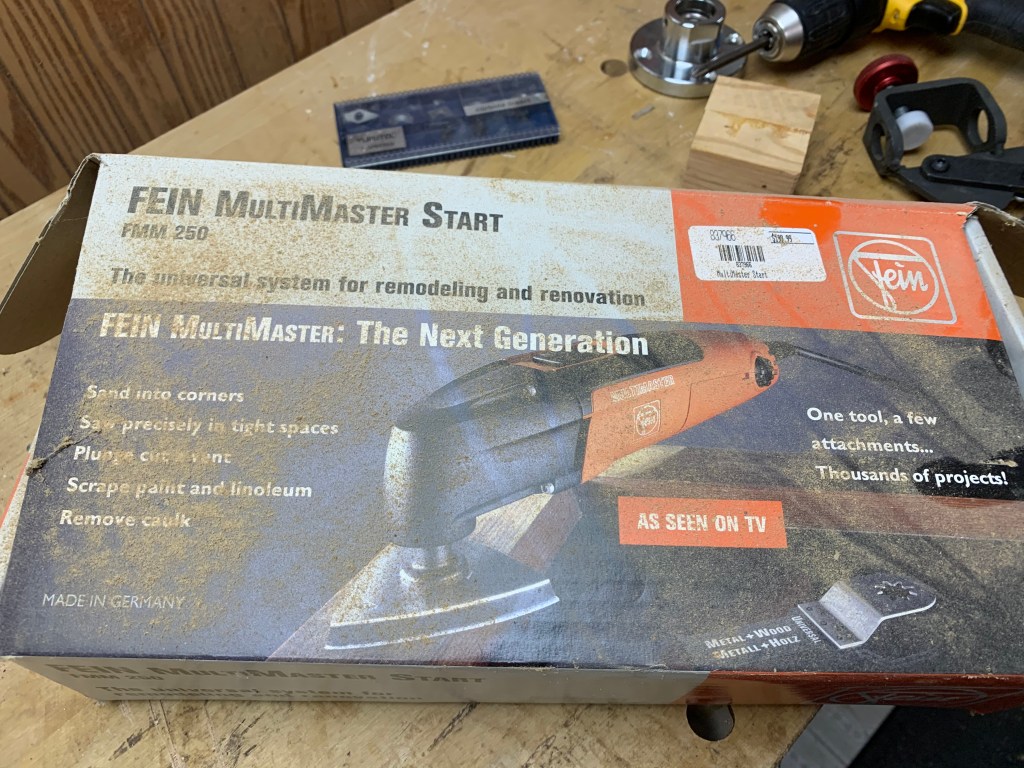
I do know what I paid for this thing up there because the price tag is still on it, $199.99. And once again it was money not well spent. I bought it because I was refurbishing hardwood floors at the time and thought it would be really useful. It wasn’t. I did use the saw attachment to cut out boards that needed to be replaced, but I could have used tools I already had for that. The other functions like sanding, scraping and all that which are listed on the front of the box? It would do that, yes, but very, very badly. (Handy hint: the phrase “As Seen On TV” actually means “Totally Useless”. If it appears anywhere on the box or in the advertising for a product, don’t buy it. Just don’t.)
The thing about speciality tools in general is that they usually don’t work very well, and they almost never work as well in real life as they do in the advertising. I have a tenon jig for a table saw that works, but takes so much time to properly set up that by the time I have it ready to go I could have cut the tenon by hand faster. I have sharpening gadgets that either don’t work at all or actually make tools more dull than they were to begin with.
The vessel is made from ambrosia maple. The top is made from scraps of black walnut and padauk I found in the scrap bin. Black stripes are done with graphite. Finish is bees wax mixed with a bit of tung oil.
Making just about anything out of wood means that you are going to need to cut the wood into the correct size and shape for it to be useful. For centuries the only tools carpenters had for cutting and shaping wood were hand saws, wood chisels, and hand planes. And those three hand tools are still essential today. While I use power tools whenever I possibly can (I may be crazy but I’m not stupid) I still use good old fashioned hand versions of those tools all the time.
I’m going to keep this as simple and cheap. You can spend thousands of dollars on hand tools, a lot of them speciality items that you’re probably never going to use or will use only rarely. What you really only need is one saw, three different size chisels, and one or maybe two hand planes. All of the ones I’m going to recommend are reasonably cheap, except for the one hand plane, and you can probably get along nicely without the expensive one. Yes, I have a lot of speciality tools, and I have some tools that are pretty damned pricey, but when it comes down to it the ones I use most often and couldn’t live without are these few.
Saws
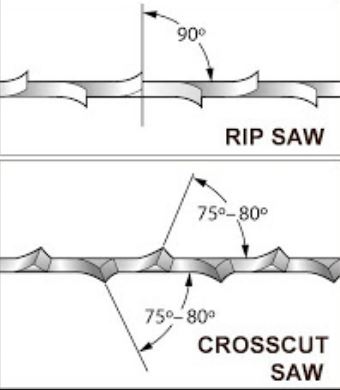
Note how the teeth are bent out from the blade. This creates the kerf. Both the bend angle and the grind angle determine if the saw is a rip saw or a cross cut saw.
Saws are a basic tool that have been around since at least the time of the ancient Egyptians. They have evolved a lot over the years but it is basically a metal blade with a series of teeth cut into the edge. The teeth are set at a specific angle and ground in a specific way so they not only cut wood, but also drag the cut wood out of the kerf (the slot left by a saw as it cuts through wood). Without the teeth being set and ground properly, the saw would become jammed in the kerf. The set of the teeth (how far out from the blade of the saw they extend) determines how wide the kerf will be. How the teeth are set and ground also determines if the saw is for ripping or cross cutting. A rip saw is designed to cut with the direction of the grain, while a crosscut saw cuts across the grain. Don’t worry about that, though. You don’t need to have two types of hand saws. I certainly don’t. If I have to rip a board lengthwise I’m going to use my table saw or a circular saw with a guide, not a hand saw. Trying to rip a board down the middle with a hand saw is not something most people want to do. But I will grab a hand saw to whack off five inches of a 2X4 that’s too long rather than go trying to find where I left my circular saw.
So you’re ready to get a handsaw, you run down to the local hardware store, and you grab one of these over there in the photo on the right because, well, it’s a saw, right? A good old fashioned more or less generic Stanley saw. And it will work. Not very well, but it will work. But all things considered, a saw like this will probably work reasonably well for you.
But there is a problem with that saw. The same problem shared by all western style saws. As I said, they don’t work very well.
The problem with western style saws is that they cut on the push stroke. Think about that for a minute. You’re wielding a tool made of a thin, floppy piece of metal, and trying to push it through a piece of wood. What happens? If the saw binds in the kerf or if you move the handle of the saw just a tiny bit left or right while pushing, the saw binds up, comes to an abrupt stop, and the metal blade bends. If you’re lucky that’s all that happens and when you pull back the blade will straighten. If you’re not lucky, you now have a permanently bent saw. This is not a good thing.
Then I discovered Japanese style saws a few years ago and the only thing I use my western style saws for these days is hanging on the wall and serving as a home for spiders. The Japanese saws are simple, elegant, razor sharp, cut on the pull stroke, and generally are so much easier and nicer to use that I haven’t touched one of my western style saws since.
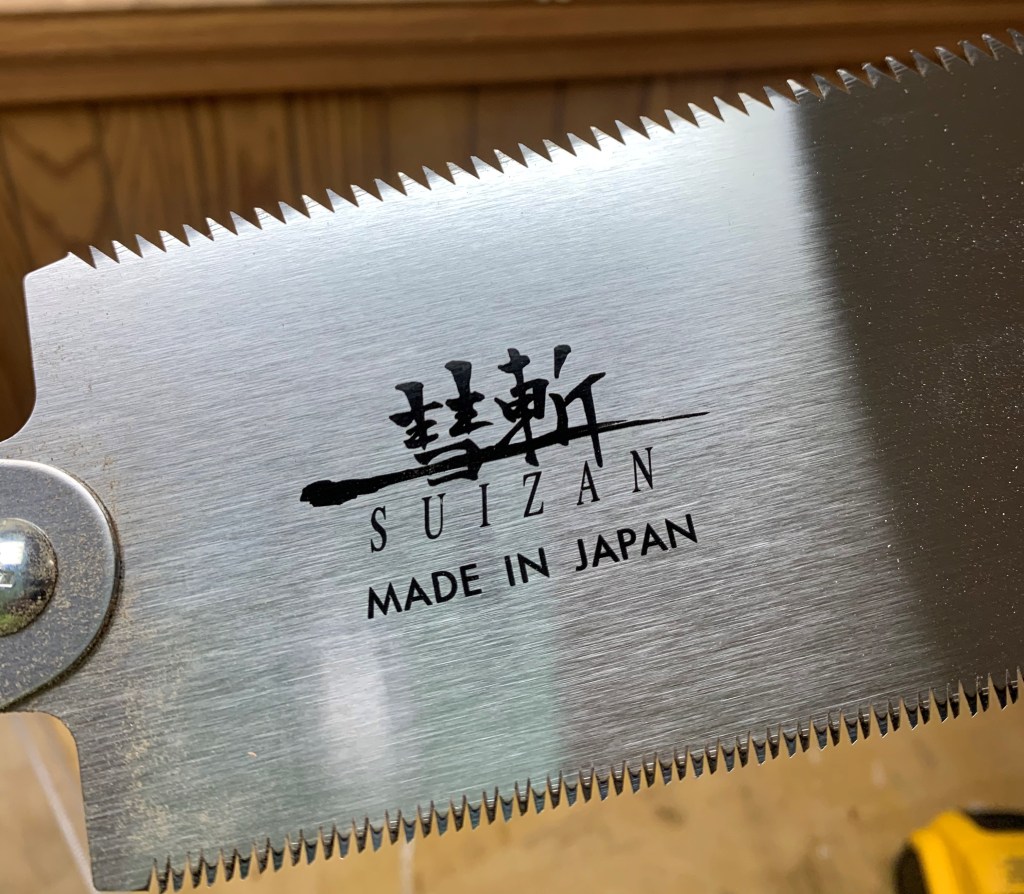
My favorite is from a Japanese maker called Suizan. This one is has a blade a bit less than 10 inches long, has coarse teeth on one side and fine on the other, is razor sharp. It is my all around utility saw here in the shop and the one I use almost all the time. It is a joy to use. It’s not that expensive, either, about $39, and the blade alone can be bought for about $20. Can you get them resharpened when they start to dull? You probably could, but at only $20 for a replacement blade I suspect that having one resharpened would cost more than buying a replacement. Just chuck the old one in recycling and bolt on a new one.
Speciality Saws
Dovetail saw. The only thing I’ll say about it is that you don’t need one, and if you do need one, don’t buy this one because it’s a piece of junk.
I’m going to mention these saws even though you most likely aren’t going to need any of them. At least not unless you’re a really, really high end carpenter turning out very detailed, complex projects. If you’ve done any research at all about woodworking you already know that there are a lot of speciality saws out there like tenon saws, dovetail saws, “gentleman’s” saws, back saws and I don’t know what all else. What about those? Just pretend they don’t exist. Seriously. Oh, they have their place. If, that is, you’re working someplace like Colonial Williamsburg where you have to abandon modern technology and are trying to recreate the past. In the real world, the one you and I live in, no, you don’t need ’em. Do you know when I last cut a dovetail by hand? Maybe twenty years ago just to see if I could do it. If I have to cut dovetails for a joint I use a jig and a router. And as for the other speciality saws? Don’t need ’em. Look, I build full sized wardrobes, cabinets, boxes, chests, make my own hardwood panels for tables, build bookcases, tables, arts and crafts furniture, have made hundreds of mortise and tenon joint and all that fun stuff, and I have neverneeded one of those speciality hand saws.
Chisels
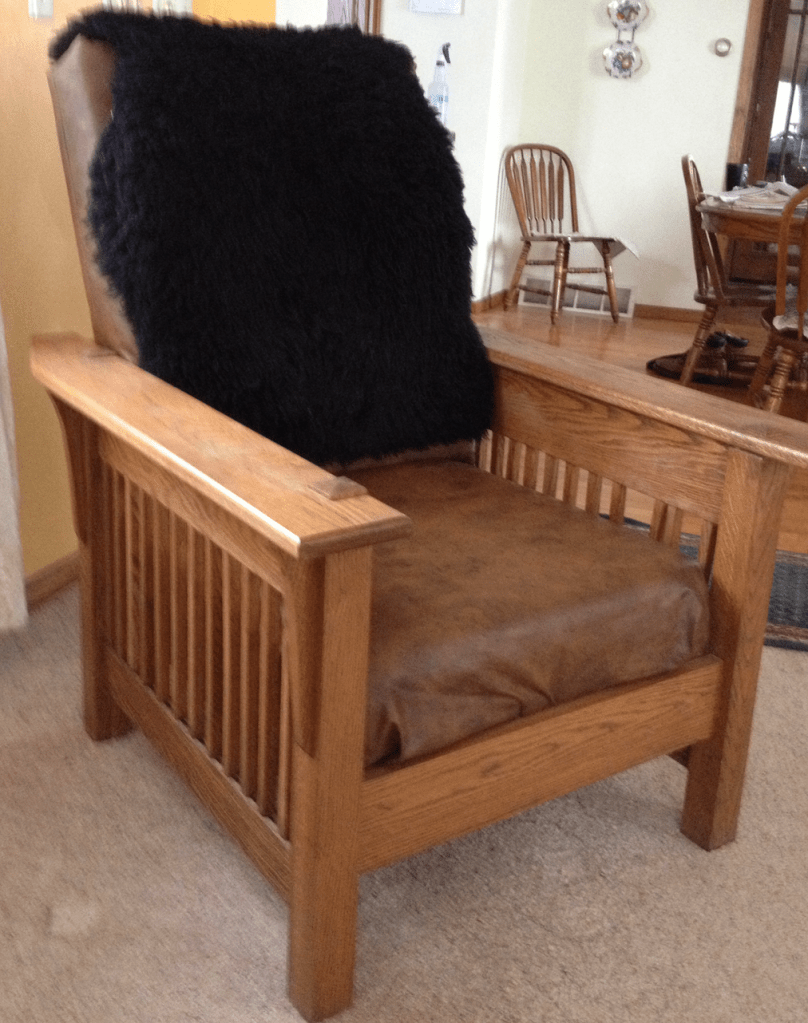
So, why do you need chisels? See that chair over there on the left? That’s one of mine. There isn’t a single screw or nail in that chair. It’s put together entirely with mortise and tenon joints. A lot of mortise and tenon joints. And while most of them were cut with power tools, the final fitting of the joints was done using wood chisels. Whenever you’re trying to fit bits of wood together you’ll find situations where you need to trim just wee bit off to get something to fit, and often the best tool to use for that is one of these:
Now the set with the wooden handles I have is darn near 20 years old at this point, and back then I paid about $120 or so for those, a pretty hefty chunk of money back then. These are Woodcraft brand and I just looked and they don’t seem to carry these any more. A comparable set I did find over there though was going for… Wait, seriously??? $230??? For a set of six chisels? Well, I suppose with inflation and all that, that’s something I should have expected.
What I’m about to tell you would probably give some woodworkers a stroke, but forget about fancy matched sets, things like “Sheffield steel” and “hand forged” and all that guff. You don’t need a fancy boxed set of over priced chisels. You don’t need six, you could probably get away with two, a one inch and a half inch, and maybe a one-quarter inch. For most people those three are all you’ll probably ever need. Of all the chisels I have, the 1 inch and the 1/2 inch are the ones I use about 95% of the time.
And here’s another thing. One of those chisels up there is not like the others. Way off on the left is that nasty looking one with the black handle. Guess what? The reason it looks nasty is because that one lives on the workbench and gets used for everything. It’s a Stanley brand, looks nasty, has a cheap, dented and stained plastic handle, and I paid a whopping $1 for it at a garage sale. Yeah, a buck. And guess what? It works just as good as the high end Sheffield steel ones to its right. Oh, it doesn’t feel quite as good in my hand, it looks awful, but it holds an edge almost as well as the expensive ones. And because it was so cheap I’m not afraid to whack it with hammers, use it to open paint cans, scrape glue or whatever.
So don’t get all goofy about chisels the way some people do. Just go get yourself two or three cheap Stanley’s off the wall at the local hardware store.
The woodworking “elite” will have a fit about this, but when it comes down to it a chisel is, well, a chisel. What matters isn’t the brand, what the handle is made of or any of that. What matters is if it can be sharpened easily and can hold an edge while being used. Period.
But I’ll be honest, I still love those Woodcraft ones and I think they are much, much better. But whether that is because they really are better, or I just think they are, well, I’m not really sure.
Sidenote: I talk about the Stanley brand hand tools quite a bit in this because it is a brand just about anyone who has ever been in a hardware store will recognize, not because I have stock in the company or something like that. I know a lot of people badmouth Stanley hand tools and I’m not sure why. They’re cheap, usually of decent quality, and generally better than the more generic brands that seem to pop up and then vanish almost overnight every few months.
Planes
The other cutting hand tool I want to talk about is the handplane.
Planes get complicated real fast because there are dozens of different types of special purpose planes out there. But you really don’t need to worry about any them. While there are some really neat speciality planes, generally when it comes to those speciality needs you’re going to resort to using power tools like a router, shaper, jointer or planer. But the two most basic types of hand planes can be very useful.
A hand plane is, well, basically it’s a wood chisel held in a special frame. The frame holds the plane iron (the cutting bit) it at a specific height and angle so it doesn’t cut too deep and helps to direct shavings up away from the throat of the plane and out of the way of the cut. It lets you smooth off high spots on a piece of wood, trim the edges of a board, trim the edge of a door that doesn’t fit, shave off sharp corners, that kind of thing.
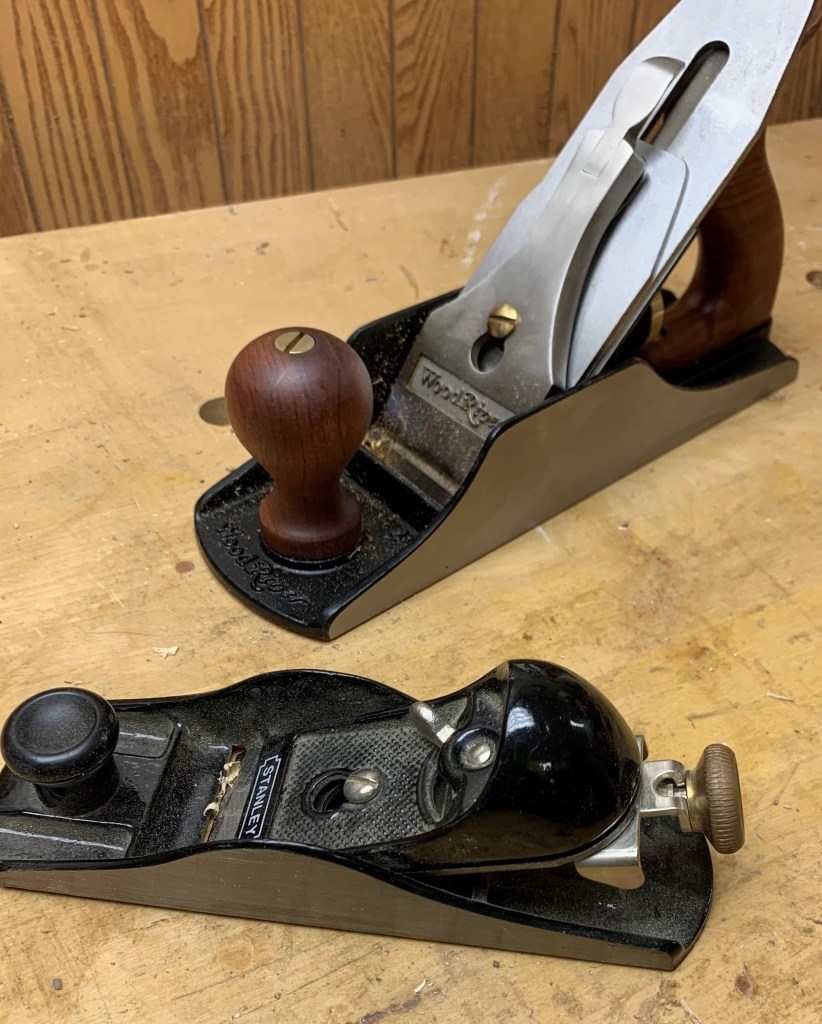
The one on the bottom is my favorite. That is a Stanley block plane (sheesh, there’s Stanley again). Block planes are a bit different from a standard bench plane (that’s the one with the wooden handles in that photo). The blade is set at a lower angle, with the bevel up, and it is designed to cut end grain easily and do light touch up work, take off sharp edges, and work across the grain instead of with the grain. It’s small enough to use with one hand, fairly lightweight and easy to use. This one lives full time on my workbench and it gets used a lot. I use it for cleaning up tenons, knocking off sharp edges and things like that.
They’re handy and reasonably cheap. Dear lord, don’t buy into the hype and pay a hundred bucks or more for one of the fancy ones block planes!. The Stanley works quite nicely, thank you very much, and you can get one for about $30 off Amazon. Yes, you’ll need to do some tinkering with it to get it to work really well, although out of the box is generally isn’t horrible. You’ll definitely need to sharpen the blade and perhaps flatten it. And you may need to flatten the sole of the plane. But that’s easy enough to do with some wet/dry sand paper glued to a sheet of glass. And there’s no need to get obsessive about it and get out your micrometers and all that. Close is good enough for a block plane.
If you do get a plane, I recommend you go out on the internet and look at a short 7 minute video at Fine Woodworking’s website about how to properly “tune up” a plane. (https://www.finewoodworking.com/2013/09/26/handplane-tune-up-tips) Most hand planes will need to be checked over and have some work done to them before they work really well. It isn’t that hard to do, doesn’t take long, and that video goes through the basics pretty well. If you know what you’re doing you can take even take a not very good hand plane and make it work at least reasonably well.
The other plane up there is my Wood River #4 1/2 bench plane.
So, what’s a bench plane do, and do you need one? Basically this is what you’d call a smoothing plane. It’s used to smooth the surface of wood, take down high spots, smooth rough areas and things like that. The #4 is the most common size, usually about 9″ long and with a blade that’s about 2″ wide. I find the #4 a good, all around size. But I prefer the 4 1/2 personally.
So what’s with the 1/2 bit? The 4 1/2 is longer, about 10″, the blade is a bit wider, and it is considerably heavier. I work with mostly hardwoods like white oak and ash, and since I build furniture I work with some lengthy pieces of wood. The 4 1/2 is heavier, meaning it’s easier to keep enough downforce on it to keep a cut going even in hardwood. It’s slightly wider so it covers more territory. And the way I have this one set up and tuned up I have virtually zero tearout. It is smooth and slick and cuts through hardwood like butter, peeling off shavings so thin you can almost read through them. I love this plane. I used this plane to smooth down a white ash table top that was two and a half feet wide and almost four feet long. If it can handle that, it can handle anything.
But do you need one? While they can be nice to have, probably not. Not for a newcomer to woodworking. Nor is something like this an impulse purchase because this is the most expensive hand tool in the whole bunch. The Wood River up there currently is selling for about $200. Granted the Wood River is a high quality hand plane. There are more expensive ones on the market but I did a lot of research before buying this one and the Wood River line of hand planes is just plain good across the board. (oh, wait, that was a pun, wasn’t it – plane, plain. Feel free to wince if you like.)
What about the cheap ones? You can pick up generic bench planes for not much more than that Stanley block plane. But almost all of those aren’t worth the effort it would take to recycle ’em. I have a few of those cheap models, and no matter what I do to them to try to properly tune them up, they’re so badly made with such poor tolerances and poor materials they’re pretty much hopeless.
What about used planes? Well, good luck in finding one at a decent price. Old hand planes have become collectors items, and collectors have driven the price of old planes through the roof. If you do find one chances are good it’s been used hard and will be in bad condition and won’t be good for anything except as a display piece.
In my opinion you probably won’t need a bench plane unless you start to get into building high end stuff. For most of us, all you really need is that $30 block plane.
Sharpening Stuff
Sooner rather than later you are going to need to sharpen this stuff. Chisels get dull, plane irons get dull, saws get dull, and when that happens they don’t work well and can even be dangerous. A mentor of mine once said that more people get hurt by dull tools than sharp ones, and he had a very valid point. Unfortunately nothing seems to generate more hot air, bluster and nonsense than the topic of sharpening. Entire books have been written about sharpening, there are hundreds of hours of video floating around out there, and to be frank, a lot of it is pure nonsense. Some people get ridiculously obsessive about sharpening, often to the point where I don’t see how they ever actually get any work done because they’re spending all their time trying to get the perfect edge on their tools rather than actually doing any work.
Saw Sharpening
I don’t recommend sharpening saws yourself. It requires special tools and skills and generally isn’t worth the effort. Use a sharpening service. Or better yet start using the Japanese style saws like the Suizan up there and when it goes dull just recycle the blade and buy a new one. As I said before, $20 for a replacement blade is probably going to be cheaper than trying to get it resharpened. And the blades last a long, long time.
Chisel and Plane Sharpening
This is something you can do for yourself, and you’ll have to do it because chisels and plane irons get dull pretty quickly depending on what you’re doing with them.
There is a lot of silly stuff floating around on the internet about sharpening, and most of it isn’t worth bothering to read or listen to. I don’t think I’ve ever seen a subject where people get more weird and obsessive than sharpening. This is going to irritate a lot of people, I imagine, but when you find these guys talking about getting mirror polish on the bevels, sharp enough to shave with, and all that guff, it’s just that, guff. It doesn’t matter! The goal isn’t producing a chisel or plane iron that you can shave with, it’s creating an edge sharp enough to cut wood and staying sharp during a reasonable amount of use. I’ve seen Youtube videos of guys spending twenty bloody minutes to get the perfect edge on a chisel. But guess what? The very first time they actually use that chisel the edge is already starting to dull and it doesn’t cut wood any better than my chisels do. And it takes me maybe 30 seconds to sharpen mine.
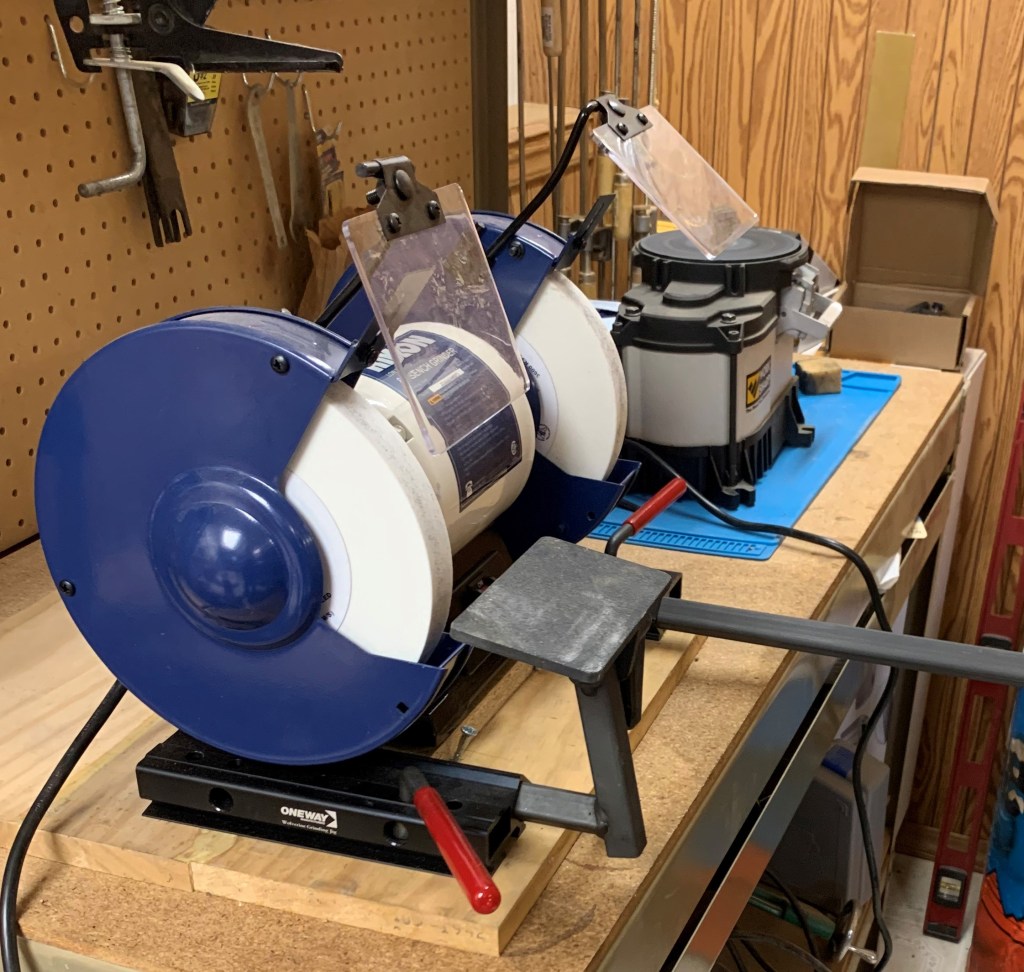
Don’t get me wrong. Sharpening your tools is incredibly important, and it’s something I have to do so often that I have a workbench setup exclusively for that purpose. And you’ll notice that there isn’t a single leather strop, expensive sharpening stone, exotic honing oils or or diamond hones or any of that other stuff sitting around there. Just two power grinders, the Rikon with the white abrasive wheels for my lathe tools, and the Work Sharp sharpening wheel I use for chisels and plane irons.
Let’s look at a really bad drawing of the parts of a chisel.
Thought I was kidding when I said it was a really bad drawing, didn’t you?
When sharpening a chisel (or a plane iron) there are three things we’re concerned with; the angel of the bevel, the cutting edge and, believe it or not, the back side of the chisel. You’d think that the only important thing when sharpening a chisel is getting that cutting edge sharp. But that’s only one third of the whole process. All three of those determine how well the chisel will cut wood. Sounds complicated but it takes me a half minute or less to do it.
Here’s a short video of me down below sharpening my $1 garage sale special Stanley chisel, and doing it in less than half a minute. How? I cheat of course. I use a machine. In this case it’s a Work Sharp sharpening system. And yes, it works just as easy and fast as it shows in the video once you get it set up. I admit it isn’t cheap. It goes for about $200 over on Amazon. But the darn thing just works. I don’t know how much time and effort this thing has saved me in the years I’ve owned it. I’ve had this one for, good grief, must be ten years or so now. It is one of the very few sharpening tools I own that actually lives up to its advertising.
Let’s see if this video thingie actually works and take a look at me actually sharpening a chisel, in this case my beat up old $1 garage sale Stanley.
dear lord that shop is a mess!
Egads, looks like it did upload the video. Okay, let’s go through this.
I blackened the backside of the chisel and the bevel to make it easier to see what actually happens. First I put the back of the chisel flat down on the sharpening wheel and hold it in place to make sure the back of the chisel is perfectly flat. Once I do that, I put it in the guide underneath and slide it up onto the underside of the wheel, which also has an abrasive on it. The guide holds it at the correct angle for the bevel. Then when it was finished sharpening I got a piece of scrap oak and sliced some end grain to see how sharp it was. Which was pretty darn sharp. It doesn’t slice through end grain like a hot knife through butter, but it’s pretty darned close to that. You couldn’t shave with that chisel, but I don’t want to shave with it, I just want it to cut wood, and it does quite nicely, thank you. And it took – what? Less than 20 seconds to sharpen it?
But, GF, you say, I don’t want to drop $200 just to sharpen a chisel. Good for you. I don’t blame you at all, and you don’t have to. You can do it by hand with a piece of glass, some wet/dry sandpaper and one of these.
As the label says, that’s a honing guide made by Veritas. It, along with the gadget to help you set the correct bevel angle, will set you back about $70, or a bit less if you shop around. When set up properly it will hold your chisel or plane iron at the proper angle. Then you get out a piece of glass, stick some wet/dry sandpaper to it, and use the guide to hold the chisel properly while you move it back and forth across the sandpaper. You start with maybe, oh, 240 grit paper, and work your way up to 1,000 grit. That should give you and edge that’s more than sharp enough for general woodworking.
It works reasonably well, and I sharpened chisels like this for a long time before I got the Work Sharp rig.
That’s it for this time. In part 3 I’ll look at tools where the prices do get pretty high pretty fast, power tools.
Let’s talk about tools for a while. I had a few questions from people interested in (you can ask questions in the comments or email me at old.grouchyfarmer@gmail.com) about woodworking tools, so I thought this was a good time (OMG I’m sooo bored…) to talk about what you need, what the prices are like, things you should look for, things you should avoid, etc.
(Disclaimer: I should point out that I do not get free stuff from manufacturers or vendors, I don’t accept advertising, I don’t get paid for anything I publish here. Every tool, piece of equipment or other supplies that I mention in these posts was purchased by myself, with my own money. My comments are based totally on my own experiences with any products I mention. I only comment about products I have actually used myself. )
When talking about tools things get complicated because it is such a general category that it can include everything from the tweezers you use to pull slivers out of your hand all the way up to massive power tools. To complicate things even more, there are tools you need just to keep your other tools operating properly. I’m going to try to keep this as simple as I can, though.
And I should point out that tools can get expensive real fast. But generally speaking you don’t need to spend huge amounts of money. Most of those super expensive tools are basically intended for people who have more money than brains. But I’ll get into that as I talk about more specific types of tools.
So, let’s get on with this, then.
First Of All Protect Your Ass Yourself
I’m not going to sugarcoat this. Woodworking is dangerous. But then so is, well, eating breakfast, as far as that goes. Do you have any idea how many people end up in the ER from breakfast related injuries, or even killed? So much for that “most important meal of the day” BS. (That “most important meal” nonsense was started by a cereal company, by the way.)
So the first thing I want to talk about is safety gear to keep you from ending up in the emergency room.
First of all there is eye/face protection. You’re working with sharp tools, power tools that spin at hundreds or even thousands of RPM, wood that shatters and splinters, and while an eye patch may look good on a pirate or Commander Fury, in real life it isn’t much fun.
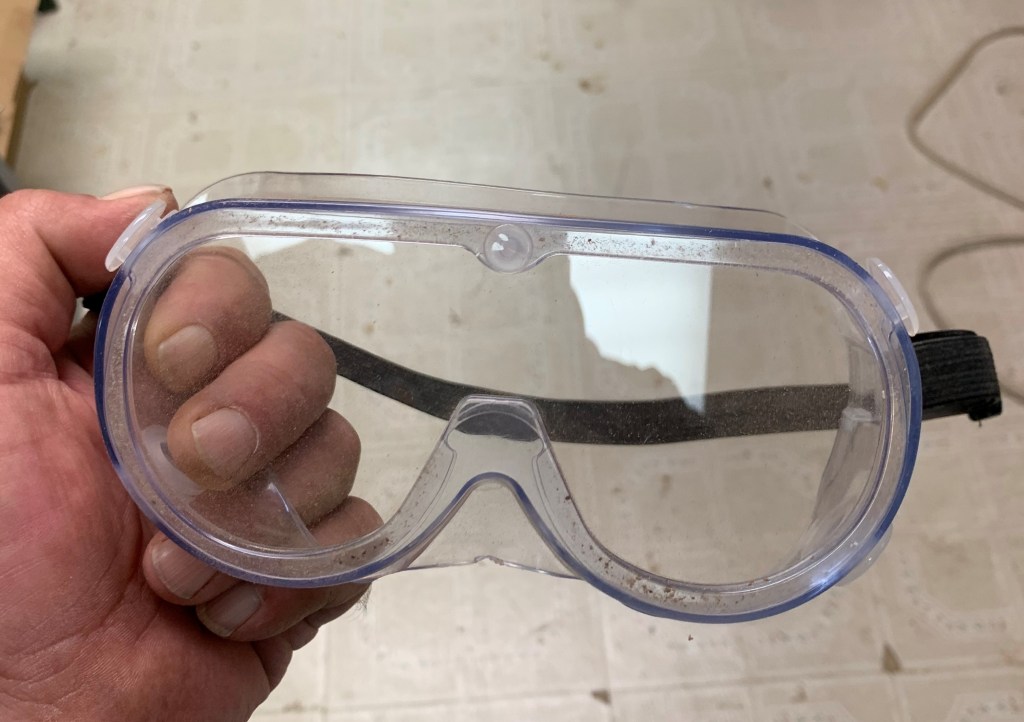
Those safety glasses you see people wearing on This Old House and home improvement shows are better than nothing, but they’re entirely inadequate for anything except a direct frontal impact. They have minimal side shielding, fit loosely, and generally do little to protect your eyes from stuff coming in from the sides. And stuff will come in from the sides. I guarantee it. What you need is something like this:
They give protection all the way around, seal tight against the skin, are not only impact resistant but dust resistant as well. Uncomfortable to wear? Yep. But would you rather be uncomfortable for a few hours or lose an eye? Yeah, thought so. They’re also cheap. You can usually get decent quality safety goggles for well under $10.
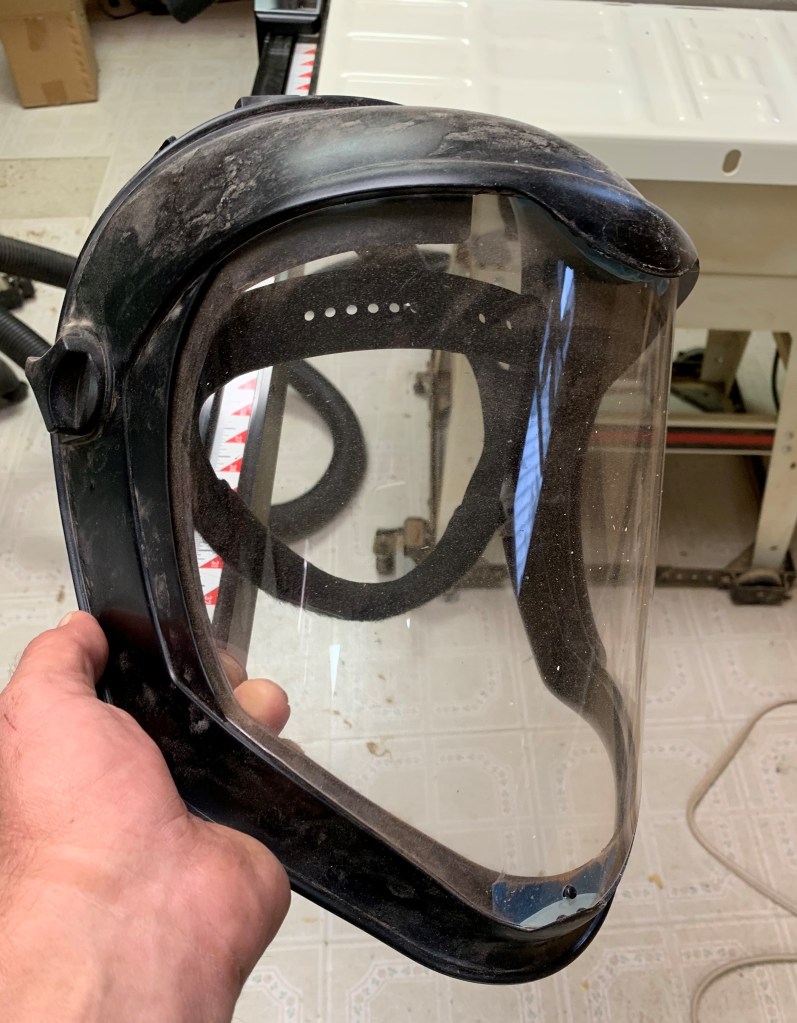
Now I do wear those goggles up there sometimes, but they don’t protect the entire face so what I personally prefer, is this:
This is a full face shield from Honeywell Safety Products. This is generally what I wear. It can be easily worn over prescription glasses, protects the entire face, not just the eyes, and is far more comfortable to wear than the goggles are. And it’s easy to wear it over the top of most respirators, although it’s a tight fit over the top of a cartridge respirator. And it’s not real expensive. You’re going to pay under $40 for one like this. You can get better ones than this, at a higher price, of course. Some even come with air filtration systems, but those are a bit awkward to wear and damn they’re expensive.
And speaking of respirators…
Protect Your Lungs
Working with wood generates dust, a lotof dust. Just about everything you do with wood makes dust. Whether it’s sanding or sawing or wood turning, it is going to make dust. And while a lot of people seem to be under the impression wood dust is generally harmless, it isn’t.
Now I know that “the state of California has determined that (insert product of your choice here) can cause cancer” warnings have turned into pretty much a joke, but in this case they’re right. Long term exposure to wood dust does seem to be linked to an increased risk of cancer. It is also linked to asthma attacks, chronic lung impairment, life threatening allergic reactions and other nasty stuff. To make things even more interesting, some types of wood are literally toxic.
Now you can have the best dust extraction system in the world (and let’s face it, most of us don’t have anykind of dust extraction system except maybe a shop vac) but you’re still going to get ultrafine particles of wood floating in the air and ending up in your lungs unless you wear a respirator of some type.
Just about every hardware store carries (or did carry before the pandemic hit) paper masks laughingly called “respirators” or more generically, “dust masks”. Most of those are, frankly, just about worthless. They do little or nothing to remove the very fine particles of dust floating around in the air. The “gold standard” when it comes to paper type respirators is, of course, one of these:
That’s a N95 respirator, and that’s what I used to wear before they became unavailable because of the pandemic. Yes they were expensive. But no where near as expensive as having your lungs ruined. Now you can’t find them anywhere, and if you can find them for sale chances are good they’re counterfeits and/or insanely expensive. (I would really, really like to know why, some 8 months into this pandemic, protective equipment is still in such short supply that it still needs to be rationed.)
What I wear is this:
That’s a respirator from MSA with replaceable filter cartridges. It provides better protection than even an N95 mask, and, believe it or not, these masks and cartridges are still generally available. And they aren’t that expensive, either. A quick peek at Amazon tells me the masks, without cartridges, are going for about $15. The cartridge filters are not cheap but not as bad as you might think. Depending on the type of cartridge they’re going for under $20 or so for a pair. And the cartridges last for much, much longer than the typical N95 paper mask does.
Is it comfortable to wear? Not really, but at the same time it isn’t horrible to wear, either. And you do get used to it and hardly even know you’re wearing it after a while. I’m used to it and it’s nowhere near as difficult to wear as some of the safety gear I had to wear for enclosed spaces training or even when painting cars. To be honest I hardly know I have the thing on once I have it in place. (Needless to say I have no respect at all for the little cry babies who whine about ‘but it’s so hot and uncomfortable’ when they have to wear a light weight surgical mask in a store. I’d like to see what they’d think of having to wear full air gear including 100+ lb. air tanks, full face mask and a protective suit.)
Whichever respirator you wear, you have to wear it the right way. It isn’t going to do you any good at all if you don’t have a good seal against bare skin. (As one of my instructors once said, if you can smell anything, you’re already dead. He had a rather warped sense of humor.)
Speaking of surgical masks, will one of those protect your lungs? Those might be better than nothing but they aren’t very good for this kind of thing.
Ewwww! It’s Sticky!
Let’s talk about glue. A large part of woodworking is attaching one piece of wood to another. And often the best way of doing it is to glue those suckers together.
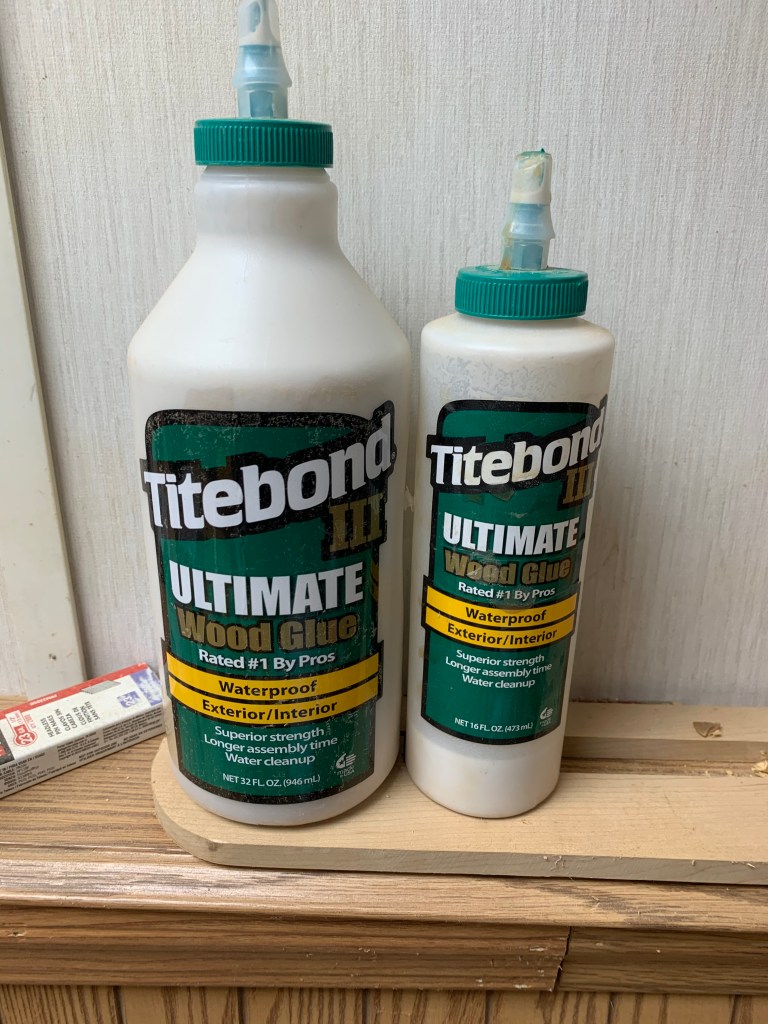
Now there are dozens of different brands of wood glue out there, and I’ve tried pretty much all of them over the last twenty or so years. To be honest, there’s really not much difference between the name brands as far as performance goes. But the one I’ve used almost exclusively for years now is Titebond. The company makes different types of glues, but my favorite is Titebond III Ultimate wood glue. The stuff just plain works if you follow the instructions on the bottle. I’ve never had a glue joint fail as long as I used reasonable care and followed the instructions. It’s easy to use, has little or no odor with no toxic fumes (unlike CA adhesives), is reasonably easy to clean up and it just works. Best of all it’s reasonably inexpensive.
Clamps are your friends.
The drawback to most wood glues, including Titebond, is that the wood needs to be clamped for an extended period of time. Hours. Generally I’ll leave it in the clamps for at least twelve hours before doing anything that would put strain on the glued joint
That means, of course, that you need clamps. Lots and lots of clamps. Someone once told me you can’t have too many clamps and for me, at least, that seems to be true. Don’t get too obsessive about clamps. Some people get a bit weird when it comes to clamps. Most of us don’t need anything fancy. For most of us a clamp is a clamp is a clamp, and as long as it’s fairly easy to adjust and doesn’t bend when it’s under pressure, it’s going to be good enough. I have everything from cheap hardware store junk all the way up to the pricey Jorgenson brand name clamps, but in the long run they all do the same thing, clamp stuff together. I do prefer the ones that have the squeeze handles for clamping instead of the screw type. Those are much easier to work with. But in the long run, they’re all still clamps.
What About CA (cyanoacrylate) Adhesives?
CA glues, or “super glue” or “instant glue” or whatever you want to call them, are the ones that bond virtually instantly (well, actually they really don’t bond instantly). And it is really tempting to try using them instead of having to clamp up joints for hours using normal wood glue, isn’t it? Just slap on some CA glue, stick the wood together, and bang, it’s done.
But CA glues have some issues as they say.
Now I’ve experimented extensively with CA glues over the last few years, especially after watching Youtube videos of guys slapping together bits and pieces of wood with one type of CA glue or another and then chucking it up on a lathe and whacking away at it with a bloody great roughing gouge while spinning it at about a gazillion RPM. To say that doing something like that would make me a wee bit nervous is an understatement. While I’ve never had a Titebond wood glue joint fail on me, I have had multiple CA glue joints fail. Enough so that I don’t trust the stuff to be able to handle any significant sheer forces. So my experience with CA adhesives in general is that while they have their place, they generally don’t work well with wood.
But that being said, I have had good luck with Starbond CA glues. I use it with wood turning projects for things like stabilizing cracks in bowl blanks, reinforcing weak wood and things like that. It works amazingly well for that. Especially the very thin consistency stuff. Saturate the bad wood or crack with the adhesive, give it a shot of accelerator to cure the glue, and away I go without having to worry about the crack causing a piece to shatter or a bit of punky wood wrecking an otherwise nice bowl blank.
There are three problems, though, that are shared by virtually all CA type adhesives.
First of all the stuff is expensive. That little 2 oz bottle of Starbond black medium up there costs almost as much as a whole quart of Titebond III. A quart of Titebond III is about $19. That 2 oz bottle of Starbond Black in the photo up there sells for $15. And you really need the accelerator as well, which will set you back another $14.50. So while Starbond works really well, it can be prohibitively expensive if you use large quantities of the stuff.
The second problem is it is still a CA based adhesive, so that means it gives off some very nasty fumes, as does the accelerator. If you’re using more than a few drops of the stuff it is recommended you do so only with very good ventilation or wearing a respirator.
The third problem is that it has virtually zero open time. Literally zero open time if used with an accelerator. What’s open time? That’s the amount of time you have before the adhesive begins to cure and you can no longer move the two pieces of wood to position them. With a glue like Titebond, you have many minutes before the glue begins to setup so you can move the pieces around to get them positioned properly before you put on the clamps. But with CA glues like Starbond, there is literally zero open time, especially if you’re using an accelerator. You apply the adhesive to one piece of wood, apply the accelerator to the other, slap them together and they are immediately bonded. You’d better make darn sure that you have those pieces positioned properly the moment you put them together, because that’s it. Once they touch, they’re bonded.
I’ve bored you long enough. Part II (if I ever get around to writing it) will look at hand tools for cutting wood; things like saws, wood chisels and lathe tools, an how to keep them sharp.
Things are pretty slow here at the moment. We’re cleaning up the gardens, the temperatures are plummeting (it’s 42F right now out there), I’m waiting for supplies and equipment so I can start experimenting with resin casting (that could either be a lot of fun or an utter disaster, but I’ll talk about that when the time comes). I’m still trying to learn morse code. I just got a new RaspberryPi 4 computer that will probably become the new computer for a digital QRP amateur radio setup using the FT-818. We’re waiting for the contractor to set up a time to get a bunch of windows and doors replaced.
(Where the grouchy farmer rambles on and on and on about misc. stuff because he’s bored.)
What Is the Future of Ethanol?
Someone asked me about the long term future of the ethanol fuel industry, and I think I rather shocked him when my reply was that it has no future. None. Within ten to twenty years the entire ethanol fuel industry will be dead if current trends continue.
The entire transportation sector is on the cusp of a major change as consumers become increasingly interested in electric vehicles instead of gasoline and diesel cars and light trucks. The current generation of EVs are extremely good for the most part. They now have significantly expanded ranges, often on the order of 200+ miles before needing to be recharged. They’re good looking, comfortable, nice to drive, and are far less expensive to operate than gas/diesel vehicles, and require little maintenance. The biggest problem right now seems to be the lack of fast charging infrastructure, and that is a problem that can be rather easily solved.
So if current trends continue, the era of gasoline/diesel fueled transportation is nearing the end. And that means people using ever decreasing amounts of gasoline and diesel fuel. And that is going to cause huge problems in the farming business because almost 6 billion bushels of corn goes to make ethanol. That’s not a typo. In 2018, the last year I had accurate data for, almost 5.8 billion bushels of corn, more than 40% of all corn grown in the US, went to making ethanol. And in a fairly short time, that market is going to come to an end.
You’d think that the ag industry would be concerned about this. But the ag industry doesn’t seem care. As far as I’ve been able to see, the ag industry is doing absolutely nothing to prepare for the day when literally half of their corn market is simply going to disappear. And that kind of scares me. Apparently they seem to think they can keep bribing lobbying Congress to keep propping up the whole market through increasing blending requirements and other government intervention in the markets. What they should be doing is looking to the future and examining alternative crops to take the place of corn. Not even the government is going to be able to bail them out of this situation.
Lathe Stuff
Walnut and white oak
I’m having way too much fun with that new lathe. I’m new to using this thing so I’m still in the experimental stage, learning how to use the tools properly, how to prep the wood, etc. I’ve managed to crank out a few items that are actually pretty good looking, but that’s due more to the woods I used for the project than my skills as a wood turner. It’s hard to really screw up a lathe project when you start out with wood as nice as in that bowl up there in that picture.
The biggest problem is getting my hands on cheap wood to play with. So far I’ve been using up scraps left over from other woodworking projects, but I have actually spent real money on some premium hunks of wood. Really good wood, with excellent grain patterns and good color for serious projects gets expensive pretty fast. I’ve seen some hunks of “artistic” woods going not for tens of dollars or even hundreds of dollars, but thousands of dollars. But then again I’ve seen people glue up bits and pieces of old shipping pallets they got for free and turn out some pretty respectable looking stuff.
wow, I really need to learn how to do better lighting when I take these photos.
This bowl is a work in progress, made from ambrosia maple, and yeah, that little hunk of wood up there was expensive. I think it cost about $25 for a 6 inch square, 3 inch thick piece of that stuff. And I was surprised to get it that cheap. The stuff seemed really too good to be true when I read the ad, but, well, heck, I thought I’d give it a try and ordered four pieces of the stuff and, well, holy cow it’s nice. Incredible colors and grain patterns. It’s absolutely spectacular.
I’m still in the learning and experimenting phase of all of this. Not every attempt at turning something has turned out good. Some have been complete failures. In one case I was turning piece of oak and it literally exploded. If I hadn’t been wearing safety gear I’d have probably ended up in the emergency room with face injuries. Learning how to properly use the tools takes considerable practice. You can watch all of the training videos you like, read all the books, etc. but nothing except actual practice will get you to the point where you can do this with some skill.
Sometimes things turn out pretty good, though. Like this one.
This one turned out a lot better than it had any right to. I still need to make a lid for this one. MrsGF is telling me I should be trying to sell some of this stuff. Yeah, I don’t know about that. If I start trying to sell it then this turns from a hobby into a job. And sell it how? Etsy? Ha! There’s so much competition from similar products on Etsy I don’t see how anyone would even find my stuff. Just look up wooden bowls over there and you’ll see what I mean. And prices are brutally low, with decent wooden bowls selling for less than $30. Sometimes a lot less.
There is something not quite right going on there. I suspect a lot of those “hand made” bowls are mass produced junk being bought up wholesale by the vendors. You can’t turn hand turn a bowl, sand it, finish it, pay for the raw materials, equipment costs, supplies, plus your time, and then dump it for $20 – $30 and still make a profit on it. Add in Etsy’s fees… Sure, there are “art pieces” going for hundreds of bucks, but how many of those actually sell? Few if any, I’d suspect. Considering the amount of time I have in that bowl up there, plus the cost of the wood, wear and tear on the equipment, supplies, etc. I’d have to get probably around $150 to break even on that bowl up there.
Tree Problems
Speaking of wood, our pear tree is literally collapsing under the weight of the fruit. It just went completely nuts developing fruit this year. It’s almost impossible to get a decent photo of the damage because most of it is up at the top of the tree. Looks like at least three major branches have completely collapsed, snapping off or cracking because they couldn’t support the weight of the fruit. I knew the tree was overloaded but I didn’t think it would get this bad. It’s going to be difficult to see just how bad it is until the leaves start to fall. We’ve actually been thinking of taking that tree down. It’s leaning at a crazy angle that seems to get worse every year and it shades out areas where we’d like to grow other things. And while having fresh pears in the autumn is great, a few pears go a long way and probably 95% of the pears end up in the compost. Well, we’ll see.
Gardening Stuff
The gardens are going through one last burst of color before autumn comes. But some things are already starting to die back.
The hostas are starting to look pretty nasty up in front of the house. One thing with hostas is that once a leaf is damaged by bugs or anything else, it never grows back, so the accumulated damage from an entire summer of bugs, rain, etc. is pretty apparent. Still they do amazingly well for most of the summer. Once the frost hits in the fall they’ll die back and we’ll just leave them until spring. The old foliage can then be raked up easily.
The tomatoes are starting to die back as well. They’re still producing but they aren’t going to be around for more than another couple of weeks. They did really well this year. We cut way back on the number of tomato plants we put in, and even so we still had more than we really needed. And we’ve learned to use a calcium supplement to fix the problems we’ve had in the past with blossom end rot.
This is where we had the pattypan squash. While the plants did well, the squash themselves were a disappointment as far as eating is concerned. I’ve never had a squash before that literally had no flavor at all. No flavor, no aroma, nothing. I don’t think we’re going to grow those again. We don’t have a lot of space here to begin with, so growing something with no flavor doesn’t make much sense.
For the last few years we’ve been growing full sized sunflowers right outside of the south window of the living room. Not only do we get to see huge, brilliant yellow flowers right out the window, we get the added bonus of seeing flocks of goldfinches come swarming in to eat the seeds this time of year. They’re little acrobats, hopping and clinging upside down to the plants to get at the seeds.
And they’re chattering away at each other all the while. I think a couple of them got into an argument about politics the other day judging from how loud they were yelling at each other.
I got the new lathe so of course I had to start fiddling with it right away, hence this really, really bad video
The video was made with sunglasses that have a camera built into them. The video quality isn’t all that good, but hey, they were really, really cheap and they actually work surprisingly well. Although taking video up close like this makes them hard to keep aimed properly.
The end result of all that mess is this:
That little finial is going to be the handle for a lid I’m making for a bowl I’m making.
Since I started fiddling with lathes a few weeks ago I’ve learned a lot. I’ve learned, for example, that my upload speeds aren’t much faster than they were back in the days of using modems to transfer data over phone lines. It took me over half an hour to upload that stupid video to Youtube. Half an hour! The actual MP4 file was 0.5M, 500K long. That means my upload speeds here are less than 1 meg per hour.
Sheesh…
Anyway, with upload speeds like that you can see why I don’t put videos up on the blog here.
The Delta 46-460 mid sized lathe arrived ahead of schedule, and so far it’s a beauty. Now I don’t have a lot of experience with lathes, but to me going from the piece of junk I had to this is like going from a Model-T to a Porsche 911. Holy cow it’s nice! Beautifully machined, everything fits flawlessly, bearings are perfect, heavy, nicely machined cast iron and steel. It was even boxed beautifully. It was double boxed, with a heavy duty cardboard box on the outside, a 2nd even heavier duty box inside of that with foam spacers to protect the inner box, then about 6 inches of dense styrofoam inside of that encasing the whole thing. Set up took no time at all. Just wiped it down to get rid of the excess oil, checked everything over, put the banjo in place and it was ready to go. It is a pretty hefty beast, though. Shipping weight is about 120 pounds, but all that weight helps to damp down vibration.
I had to try it right away of course, so I put in a scrap piece of wood and fired it up, and oh, my… Smooth as silk. Motor has lots of torque. It’s fantastic.
It has three belt positions to make big speed changes, but also has electronic variable motor speed so I’ll rarely have to change the belt position. It is very, very nice.
Anyway I’ll talk more about this thing in the future as I get a chance to use it for an actual project. Now I have to start scrounging around for wood!
Flowers Everywhere!
I could go crazy with the camera just taking photos of all the flowers in the gardens this time of year. I haven’t processed any of these yet, these are the unedited images.
And people wonder why I love gardening so much…
Zombie Lily
Well, that’s what I call ’em. These things:
I call them zombie lilies because this is what they look like when they first emerge from the ground.
They are the most bizarre looking things I’ve ever seen. There’s absolutely no indication that there is anything growing there at all, and then these weird asparagus like looking stalks suddenly pop up and a few days later they put out these beautiful flowers.
What they actually are is amaryllis belladonna. They’re sometimes called naked lady lilies because they just have the bare stalks with no leaves. They’re native to South Africa but are widely grown as ornamentals.
We have no idea where they came from. We certainly never planted them. They popped up a few years ago, but we hadn’t seen them since then, and this year we now have three large clumps of them. They really shouldn’t be growing here because they don’t like Wisconsin’s cold winters, but there they are.
I should also point out that every part of the plant is poisonous, especially the bulbs, and they are very dangerous for dogs and cats. So I’m not sure I really want them out in the garden at all to be honest.
I don’t recommend equipment here unless it is something I bought and use myself and I find genuinely good. That’s the case with this, the Rocksolar battery and folding solar panel. I finally had a chance to give the Rocksolar battery pack and solar panel a good workout the other day and the whole package worked quite well. MrsGF was gone for the day and I was bored so I set up the FT-818 up on the front porch with the mag loop antenna, running off the Rocksolar battery, and tried making contacts on CW for a few hours, with it’s high intensity LED lights turned on just to give it an added load, and plugging a cell phone and my bike’s GPS/odometer into it’s USB charging ports to recharge them at the same time. I should add that just to make things more interesting I’d had the battery pack’s lights turned on for over eight hours the day before. The battery pack hardly even noticed the load. When I got sick of not making contacts (ah, the “joy” of QRP!) I gave up on that, dug out the laptop and switched to FT8 and finally made a few contacts. That got boring after a while (well, it was about 95 degrees out there) so I quit to retreat into the air conditioned house.
The Rocksolar battery pack with the Rocksolar folding solar panel.
I threw the folding solar panel out on the ground and hooked it up to the pack to recharge it and that worked well too. About as easy as it gets. No need to buy charging controllers or extra cables, everything needed is included. Just plug it into the charging port on the battery pack and lay it out in the sun. After charging up a cell phone, running the lights, powering the FT-818, etc. the panel brought the battery up to full charge in about 3 hours according to the meter on the battery.
So overall I’m really rather pleased with the battery and the matching solar panel. It takes, the documentation says, about 9 hours to do a full recharge using the included AC charger, and about the same using the solar panel if you have full sun. Of course recharging with the solar panel depends on conditions. The documentation claims it will run the dual high intensity LED lights for 189 hours. Heat is always an issue with battery packs like this, so this one includes a cooling fan that kicks in automatically if it starts to get too warm. And it has a 200 watt AC inverter to power AC equipment. But it doesn’t provide a clean AC sine wave so it isn’t suitable for some AC equipment. It has 4 USB charging ports and 4 DC ports in addition to the 3 prong AC outlet.
So if you’re looking for a solar charged battery system to run your gear, take a look at the Rocksolar stuff. You can find it on Amazon. It isn’t exactly super cheap, though. This particular battery is going for $178 at the moment, and the folding solar panel is going for $165.
Lathe Going to Junk Yard
I’ve had it with that Harbor Freight lathe. The bearings are starting to go after just a few hours of use, it’s made of cheap stamped sheet metal that flexes and shudders and it’s just – just nasty.
This thing is basically an industrial accident waiting to happen. So it’s going, and is going to be replaced by a Delta mid sized lathe that’s made out of actual real steel and iron, with a motor that won’t stall all the time. Good lathes aren’t cheap. The new Delta is going to set me back about $800. But this Harbor Freight monstrosity has reached the point where it just isn’t safe to use any more.
We Got Bats
Now I like bats. They eat bugs and all that fun stuff. But I only like bats as long as they aren’t actually inmy house. Which they have been. We’ve had two of the little buggers in the house in the last three weeks, and, well, enough is enough. We’re getting a bat removal specialist in this week to figure out where they are, how to keep them out, put in bat excluders, etc.
Uh, I have a confession to make. I said I like bats. That’s a lie. I only say that because I’m supposed to say I like bats. I don’t. Bats really, really creep me out. I’m sorry, they just do. When I see a bat in the house I want to run and scream and hide.
Snakes, on the other hand, don’t bother me at all. I think snakes are kind of neat. Which is good because…
We Also Have Snakes
This little guy has a rather indignant look on his face because he was trying to get into the wax beans and MrsGF wasn’t going to put up with that. She grabbed him and put him in the flower bed and he sat there and pouted for about ten minutes before slithering off.
We have three of these guys hanging around. They’re garter snakes and they’re amazingly beautiful creatures. They’re harmless. Well, unless you’re a frog or a mouse or bug or something else they like to eat.
I suppose I should wrap this up with a picture of a flower because holy cow we got flowers this year!