I have a ton of stuff going on around here, but none of it is important enough to make a single post so I’m just going to shovel everything into this one [grin].
Cheap crappy lathe
I’m working on another lathe project, this one a bit larger than the last two, and that cheap Harbor Freight lathe is showing the strain rather badly. I got this as a gift so I shouldn’t complain… Oh, hell, sure I should complain. This thing is just plain nasty.
Harbor Freight has a reputation for selling cheap, cheap tools of questionable quality. My experience with HF tools has not been good, and this lathe certainly hasn’t improved my opinion of their stuff. While it worked fairly well for tiny stuff, putting a substantial chunk of wood on it has brought out all of its faults. I already knew it was made from cheap, thin, stamped sheet metal, including the base. In a real lathe, the bases are made from heavy, cast and carefully machined cast iron or steel. So this thing flexes and vibrates and shakes and rattles. The bearing are worse than awful. The motor is woefully underpowered. According to the label on the motor it’s rated at 1 HP. I’d be willing to bet it’s not even a quarter of that.
So I have to decide now if I like woodturning enough, and will do it enough, to justify dropping about $500 – $700 on a good lathe. I still haven’t made up my mind.
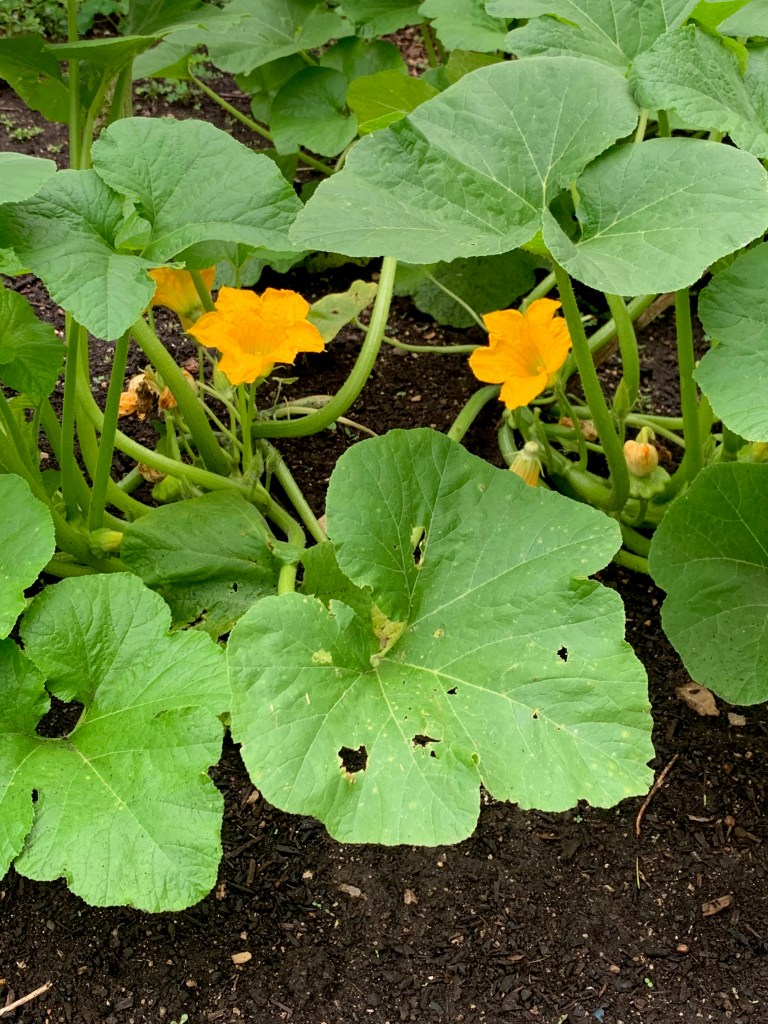
MrsGF tried something new this year, pattypan squash. We really like squash, but we haven’t had much luck growing it here. Last year our acorn squash was overcome by powdery mildew, and other years we had other issues. So she thought to try this. And it seems to be working beautifully. The plants are ridiculously healthy and absolutely loaded with fruit. We’ve never eaten this variety before so we’re looking forward to trying it. We have about three now that are ready to eat so this week we’re going to try them.
Biking as Meditation?
Everyone thought I was nuts when I dropped about $600 on a bicycle after I retired, figuring it was something I’d do for a couple of days and then it would end up hanging in the garage and getting in the way. Instead, several years and about three sets of tires and three thousand miles later, I’m still at it. And I have to admit that even I am a bit surprised at how much I enjoy it. But I’ve always been a bit of an outdoors person. I spent most of my childhood at the farm down in the woods, watching tadpoles in the streams, sitting in the woods watching chipmunks gathering acorns, watching frogs, listening to birds and trying to spot them in the trees… It was a journey of learning, amazement, wonder, and beauty. Well, except for the mosquitos. And somewhere along the way I lost that, only to have rediscovered it now. I get out on the country roads around here, especially down on the trail, and I can start to lose track of time.
And birds everywhere! Especially down along the river by the old stone bridge on Irish Road. Herons, ducks, egrets, even pelicans come down to the river. Yesterday I was watching a belted kingfisher perched on a telephone line running across the river, eyeing the water, and every once in a while diving down to try to snatch a small fish. I can hear the cardinals calling in the trees, but rarely see that flash of red. I see more of those in town where the trees are more sparse and it’s easier to catch sight of them.
And the smells… I am blessed with (or cursed with, sometimes) a hypersensitive sense of smell. As I’m out riding I can smell everything – the chicory and clover along the side of the road, the corn, the alfalfa fields, people mowing their lawns or cutting hay, a whiff of tractor exhaust wafting across a field from a distant farm, the fuel the RC airplane guys use in their planes as I get close to their flying field off Hwy 57, the wood preservative on the wooden bridge over the river on the trail, the occasional dead animal in the ditch, the asphalt outgassing on a hot day. And more often than not, an undercurrent of manure from some farm emptying its storage pits miles away.
I took up biking originally for the exercise. I went from a job where I was on my feet all day, walking for miles a day, to essentially nothing, almost literally overnight. So I figured I needed to do something or I was going to blow up like a balloon. And while the exercise is important, yes, the other benefits of being outside, the sights and smells and sounds and all that goes along with it, probably does more to keep me healthy than putting on 10 miles or so a day.
Gardening Stuff
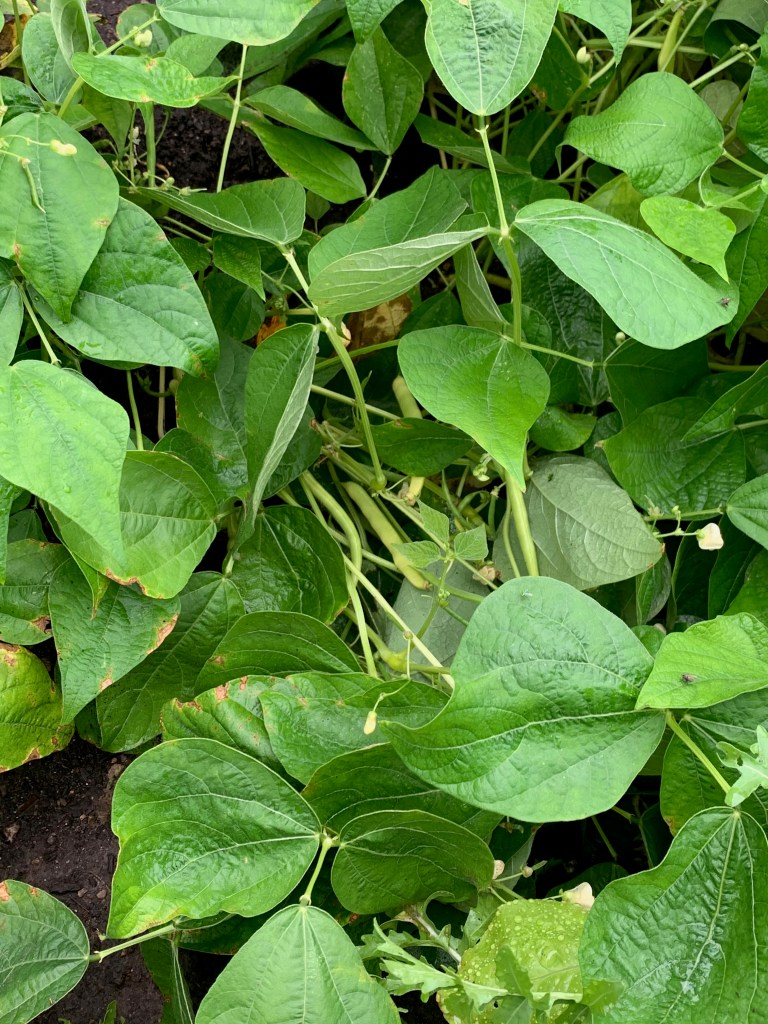
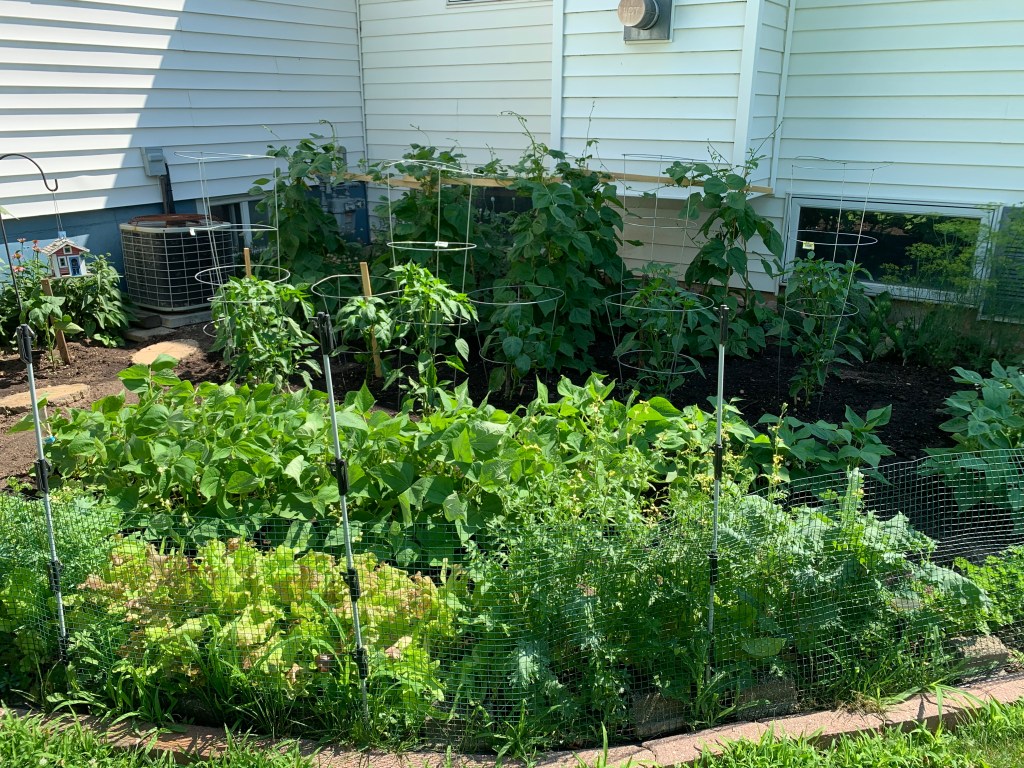
It’s been a spectacular year for growing stuff this season. Weather has been just about perfect so far. We’ve had an unusually high amount of rain so we’ve only rarely had to resort to dragging out the hose and watering cans. We’ve been blanching and freezing wax and pole beans about three times a week for a couple of weeks now. We’re rather sick of it, to be honest. MrsGF came up with a bean salad recipe that is absolutely fantastic, so she’s been using up the beans, along with some of the peppers and onions we’re also growing, and canning that. Holy cow that stuff is good.
The tomatoes are just starting to come in. Not enough to process into a batch of sauce or soup, so I’ve been dicing them up and throwing them in the freezer. Just wash ’em, core ’em, slice or dice them, throw them in freezer bags, and then pull them out whenever we need tomatoes for something.
Pretty soon though we’re going to be deluged with tomatoes, so we need to decide what we’re going to do with those.
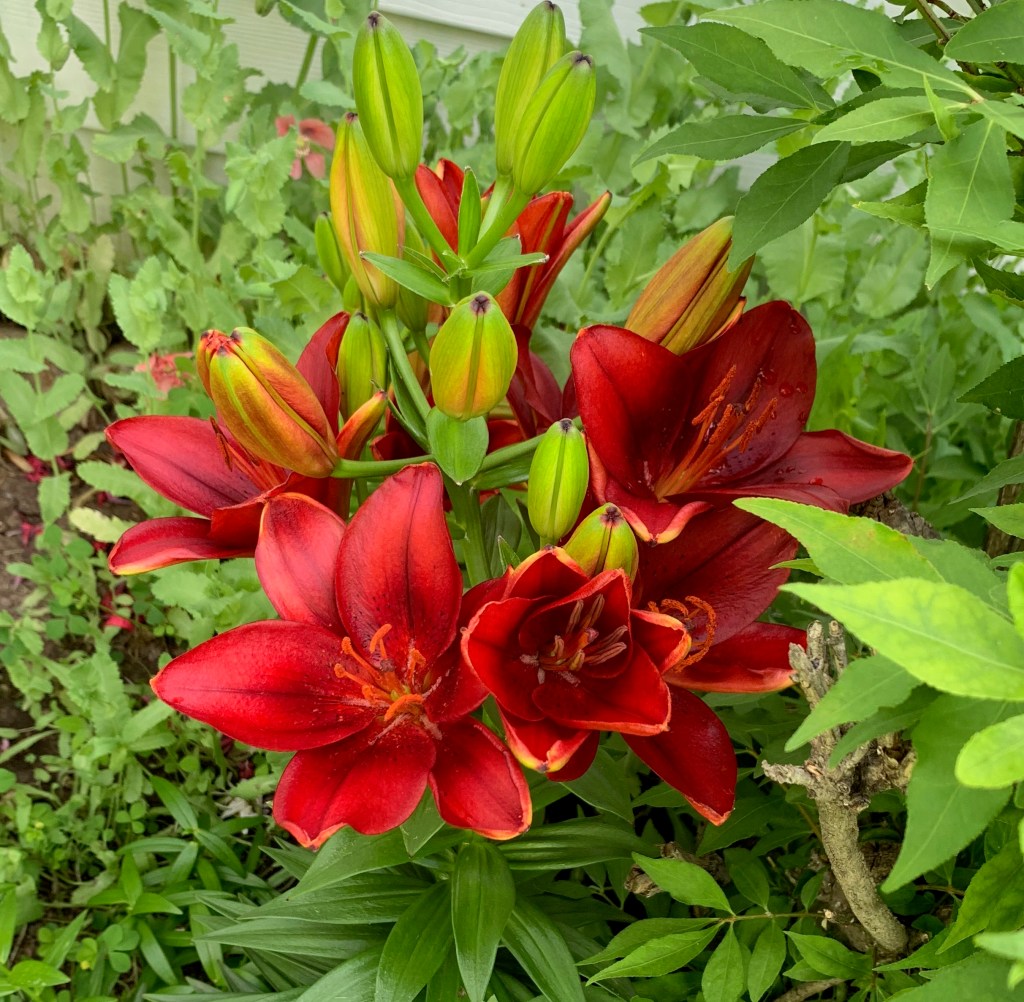
And flowers. The whole yard is alive with flowers this time of year.
Anyway, that’s about it for now. Stay safe out there.
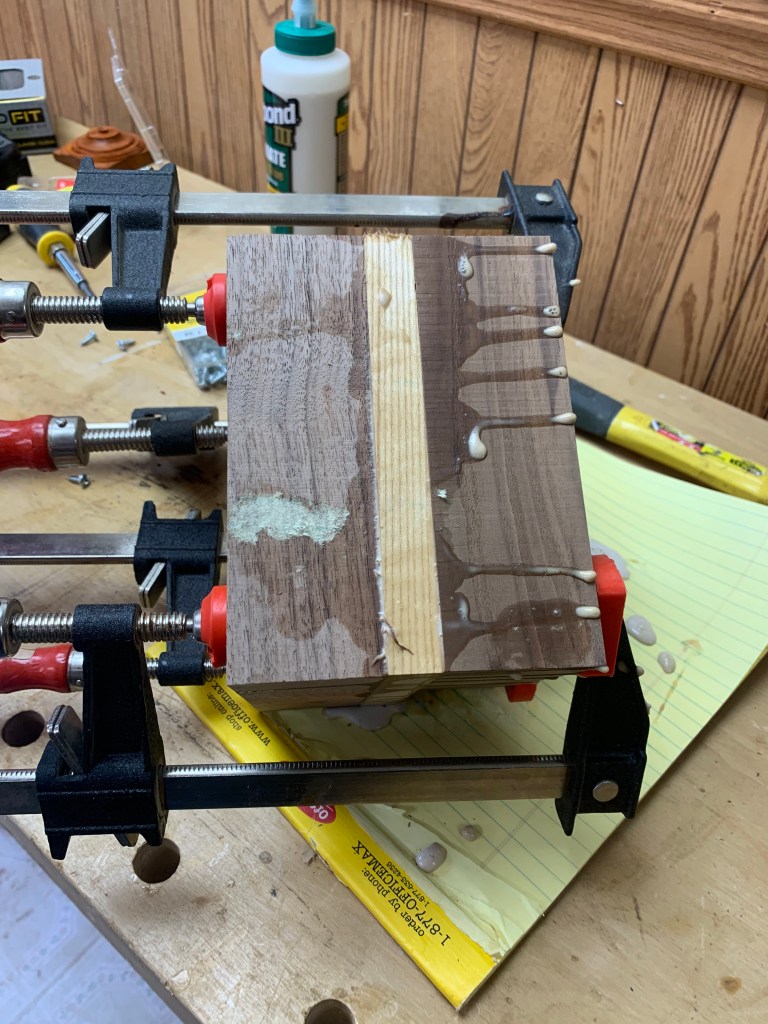
So I’ve embarked on a new project on the lathe, and we’ll see how that turns out. As with most of my woodworking projects, it starts out with a mess:
Gads, does that look nasty!
It starts out looking like this glued up mess and will, hopefully, end up as a rather nice bowl. I started actually turning it this morning and currently it looks like this.
That lathe leaves a great deal to be desired, alas. When working on small items it’s not bad, but as soon as I start working with anything with some significant weight to it, the issues with the really bad, cheap bearings and poor balance quickly become obvious. And the whole thing flexes. The base is cheap, thin, stamped sheet metal. This blank is only about 5 inches across and is about 6 inches long, and this lathe has trouble handling even something this small. If I’m going to keep on playing around with wood turning I’m definitely going to have to look into a better lathe. But considering what lathes cost, the good ones anyway, I’m not going to stick that kind of money into this unless I’m absolutely sure this is something I’m going to do a lot of.
And in case you’re interested, and you probably aren’t, this is what I look like after spending an hour or so woodturning.
Is all that safety gear overkill? No, not really. NIOSH certified respirator and cartridges, goggles or face shield, are the minimum you need when doing stuff like this. It isn’t just chips and shavings flying off when you’re turning, it’s the very fine wood dust that’s generated when doing just about any kind of woodworking. Even with a dust extraction system and good ventilation the dust can wreck havoc with your lungs. Some woods are actually toxic and can result in severe allergic reactions with some people.
And those whining little crybabies complain about wearing a surgical mask in stores? I have no sympathy for them at all. They should try wearing this getup for a few hours. And to be perfectly honest, it is not that uncomfortable once you get used to it.
One very scary thing that turned up in the news the other day was a report that virtually all non-dicamba resistant soybeans in the entire state of Iowa have been damaged by drifting dicamba based herbicides. (Source: Iowa sees most dicamba damage since 1960s | Crop | agupdate.com) The damage is the most expensive since dicamba was first introduced back in the 1960s. This isn’t just scattered spots. According to the article it seems that every single soybean field that wasn’t planted with dicamba resistant beans is showing various degrees of damage from drifting herbicide
This is exactly the kind of scenario some farmers and environmentalists feared when Monsanto first introduced its dicamba blend herbicides and dicamba resistant soybean seeds. The fear was that Monsanto would have a literal monopoly on the sale of soybean seed because if you didn’t plant their more expensive seed, you risked your crop being damaged by herbicide drift from the fields of other farmers. The company, of course, claimed this was false, that its herbicide was safe, and there was nothing to worry about. Yeah. Right…
You may recall that the EPA was forced to rescind its approval of Monsanto’s (now owned by Bayer) dicamba blend herbicide because it violated its own procedures and ignored data indicating serious problems with it. So why is the stuff still being used? Because it was ruled that farmers could continue to use any dicamba based herbicides they still had in stock, and because the EPA isn’t actually in control of what herbicides can be used on farm fields, the individual states are. And, of course, the court ruling applies only to two of the three dicamba blends being used with soybeans. So dicamba is still available and can still be used, depending on the rules of individual states. And the court ruling only applied to two of the three major types of dicamba blends on the market.
Granted, this situation is a bit extraordinary in that a “perfect storm” of conditions came into play that permitted the herbicide to vaporize and drift so badly in Iowa. But the basic problem is that despite all of the restrictions and conditions that apply to the application of these products, they are still vaporizing and drifting over long distances. It seems that there are simply no conditions under which there isn’t a significant risk of the herbicide getting out of control and damaging not just non-GM soybeans but other plants as well.
Well, it’s official. The gardens here have gone nuts. This is probably the best growing season we’ve had since we moved into this place twenty or so years ago. The ornamentals, the vegetales, fruit, everything is looking pretty much spectacular.
We put in a few raspberry plants a few years ago because MrsGF’s sister gave us some, or we wouldn’t have bothered because I can’t (or am not supposed to, anyway) eat raspberries because I have diverticulosis and seeds and nuts can cause it to flare up. They sit in a little 8ft by 8ft patch of the garden behind the garage and they never really did that well. Until this year. For about a week now I’ve been picking a bowl full almost every day. They’re starting to slow down now and will probably stop producing by the middle of next week. Beautiful berries. Just wish I could eat ’em. Sigh…
I wasn’t going to put squash in this year because we haven’t had very good luck with them. But MrsGF found a different variety and put in a few plants and they’re doing good too. So far no sign of powdery mildew which pretty much ruined them last year.
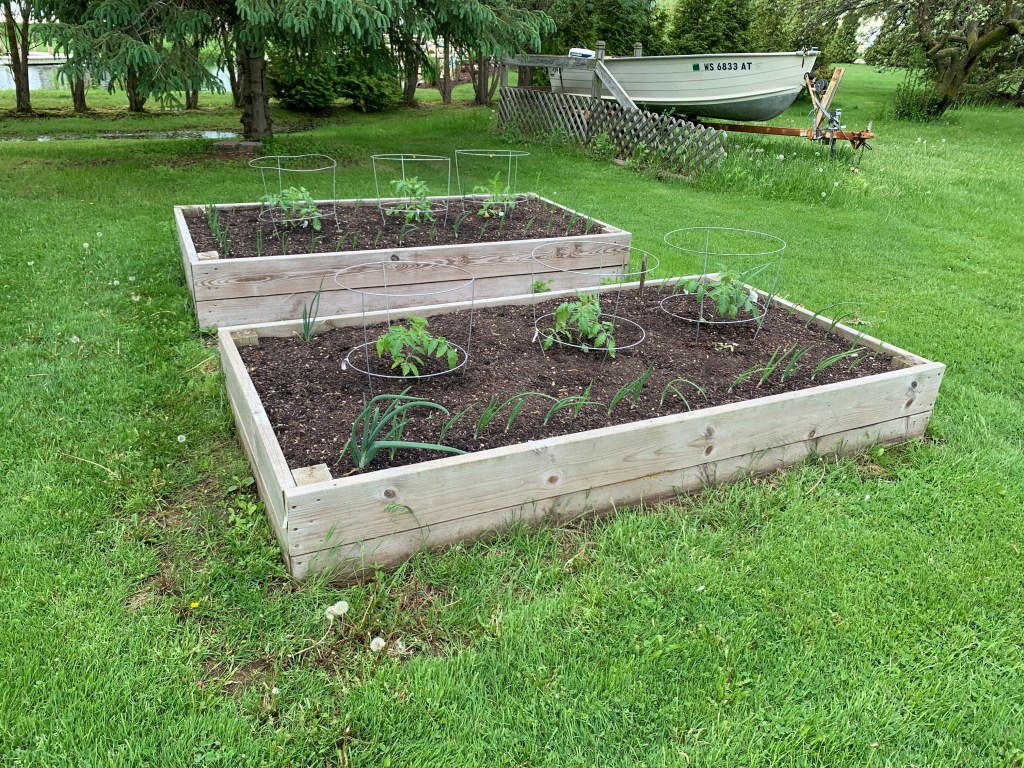
We cut back on the number of tomato plants we put in. Last year we put in 12 or 14 plants and even though it wasn’t a very good year for tomatoes we still had more than we could ever possibly use. We only put in six plants this year in the raised beds and, well, so far it looks like we’re going to get more off those six plants than we got off a dozen of them last year. They’re just barely starting to come ripe now and I’m looking forward to having fresh tomatoes again.
And dear lord, the beans… We put in two varieties this year, a wax bean and some pole beans and we over planted those as well, it seems. The picking season is only just getting started and we already are getting more beans than we know what to do with and are looking for ideas of dealing with ’em. We’ll probably be giving away a lot of produce this year.
We put in a few different varieties of peppers, and it looks like they’re going to be ridiculously prolific as well. I’m not really sure exactly what variety these are. They were labeled “hot pepper”, but no variety was listed. They aren’t really hot, though. They’re actually quite mild. There is a tiny bit of heat there, but they aren’t even close to jalapeno peppers. Nice flavor, though. I think I might try canning some of these as pickled peppers.
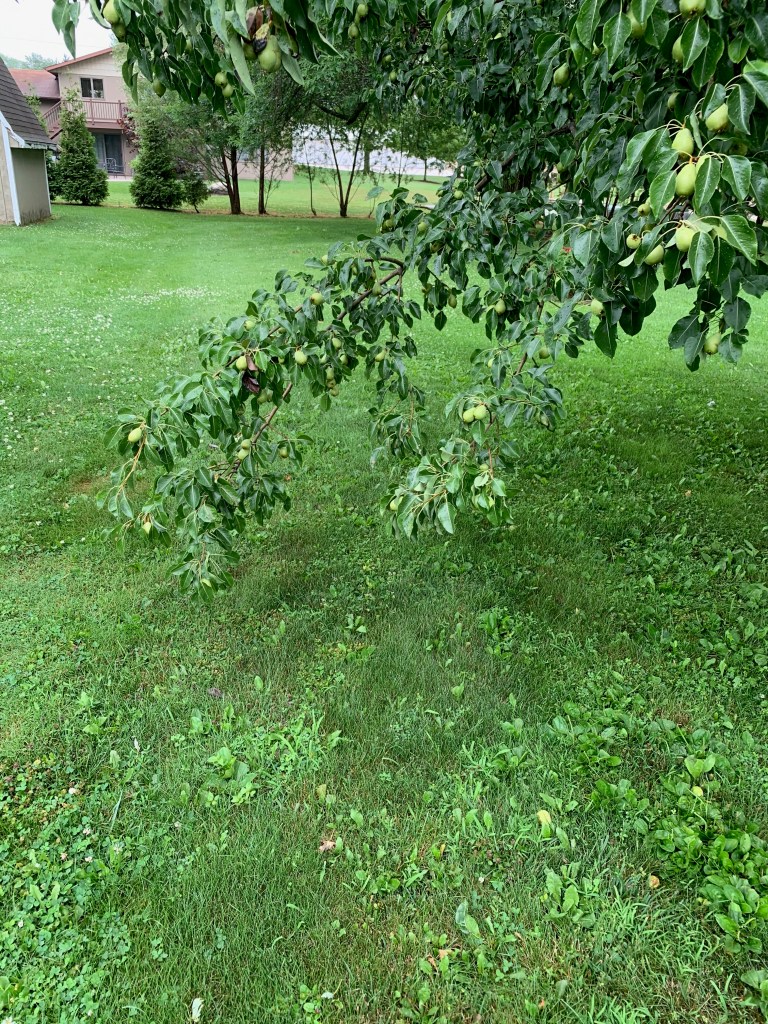
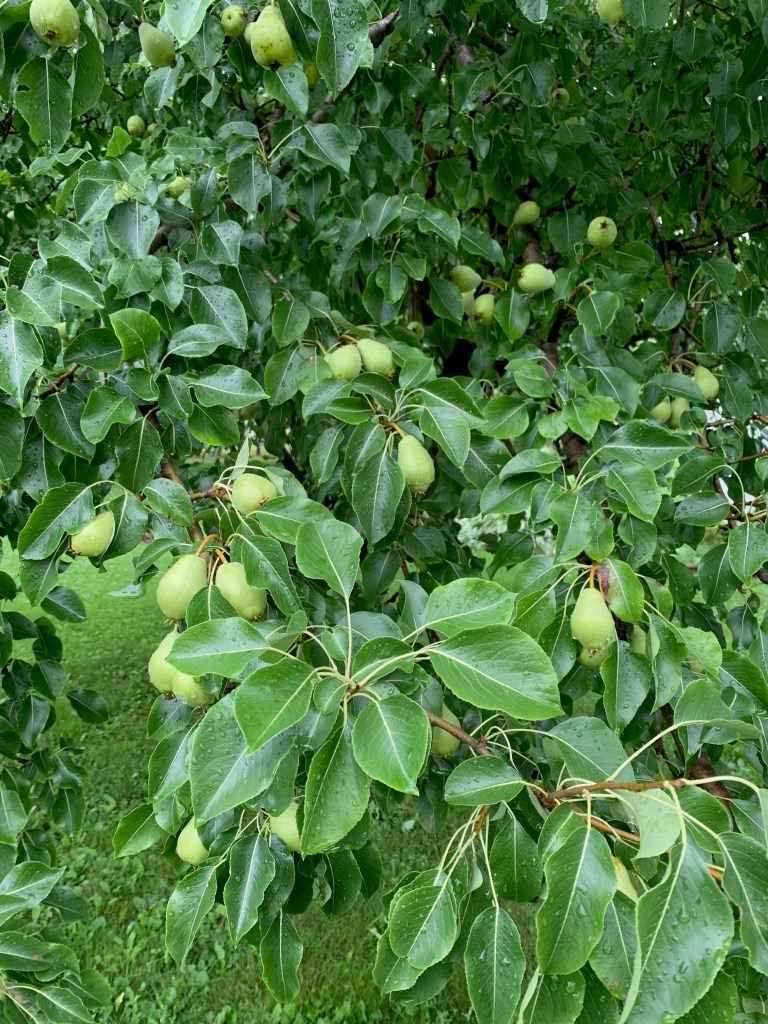
I’m a bit concerned about the pear tree. It’s so loaded with fruit that branches that normally are about head height are already being pulled down almost to the ground by the weight of the fruit. I think I’m going to have to start snipping fruit off the branches I can reach before we start having branches breaking off.
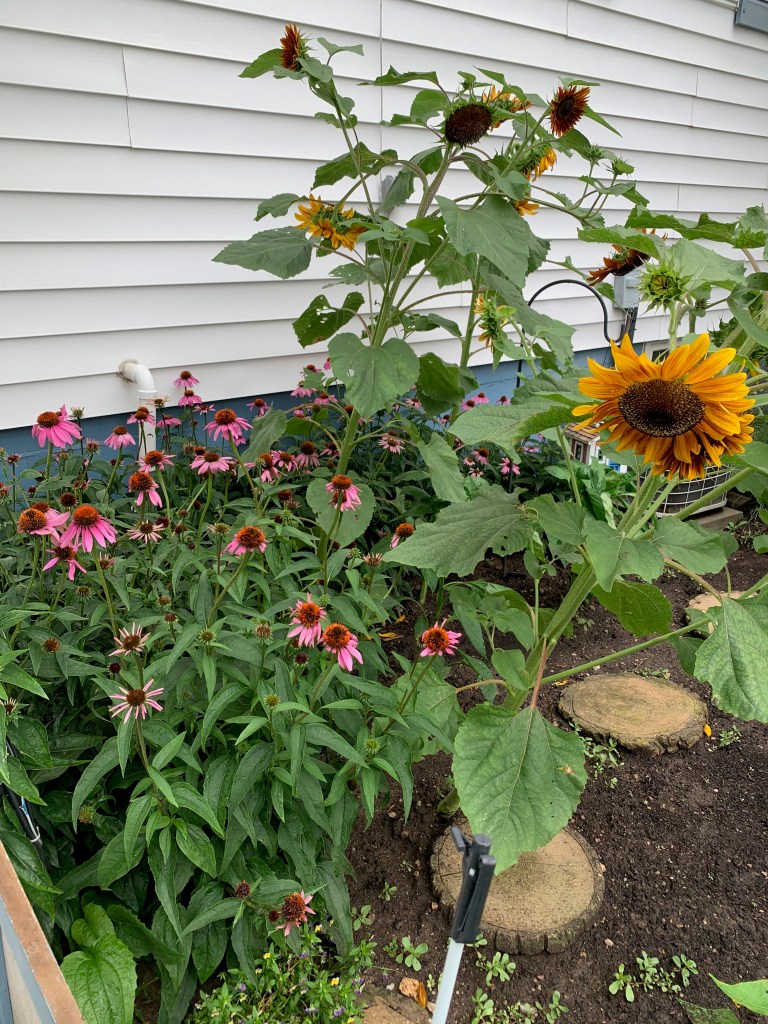
I call this the finch corner. The cone flowers and sunflowers are finch magnets, or will be in a week or two as the seeds start to develop more. In a fairly short time this whole corner will be swarming with finches coming for the seeds. Great fun to watch out of the windows of the house.
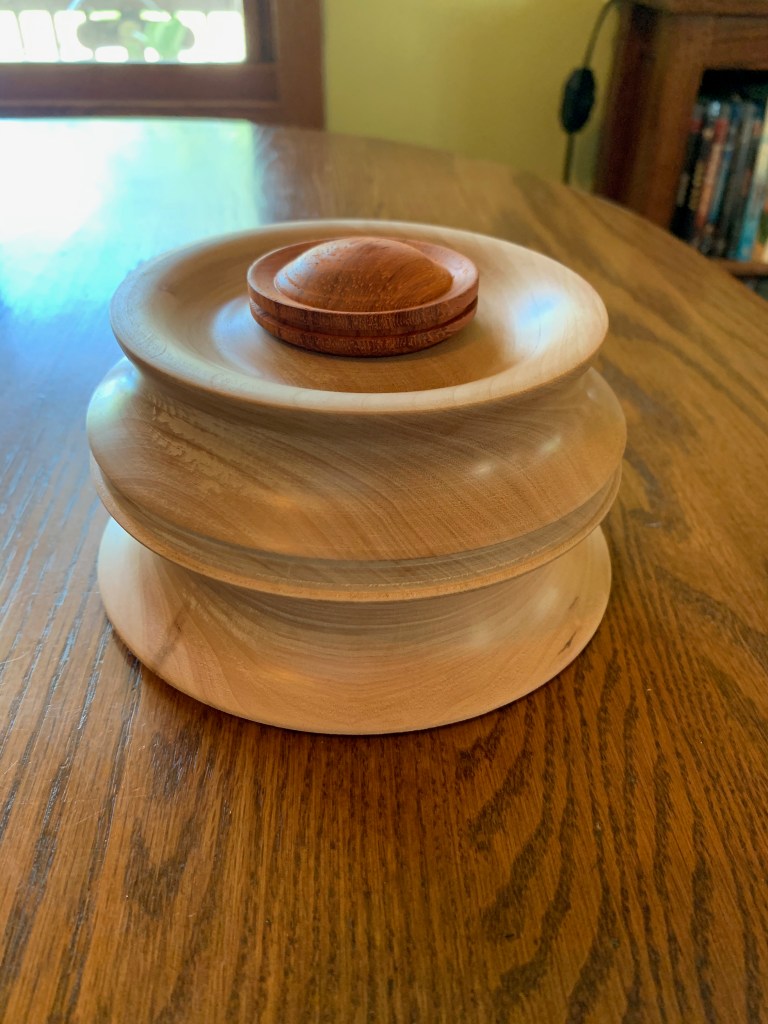
Let’s see, what else… Oh, I made a – a thing again!
Bottom part is cherry, top is… Well, to be honest I’m not sure what kind of wood the top is made from. It’s a piece of scrap I found down in the shop and thought it made a nice contrast with the bottom. You can see an indentation around the middle of the bottom part. That is going to be stained very dark, almost black, to add contrast.
What the heck is it? Who knows? It isn’t useful as a bowl or anything. It’s a sort of, oh, art piece? Maybe? Kinda?
This little guy seems to wait for me to come and water the tomato plants in the evening. He sits there patiently watching me while I putter around with the hose and I swear he seems to grin when I shower him with the plants.
I went to a college that was focused on ecology and environment way, way, way back for a few semesters. I never did finish up with a degree, but that school did have an influence on me. One of the things I learned is that amphibians are sort of an early warning system when it comes to the environment. They are very sensitive to environmental degradation. If you have a thriving amphibian population, the environment you’re in is doing pretty good generally speaking. So the environment in our backyard must be doing pretty darn good because we have an abundance of frogs and toads. They can be a bit of a nuisance because I have to be really careful when I mow the law and watch out for the little guys. Usually they get out of the way but every once in a while one will hunker down in the grass and try to hide and I have to stop the more and move him.
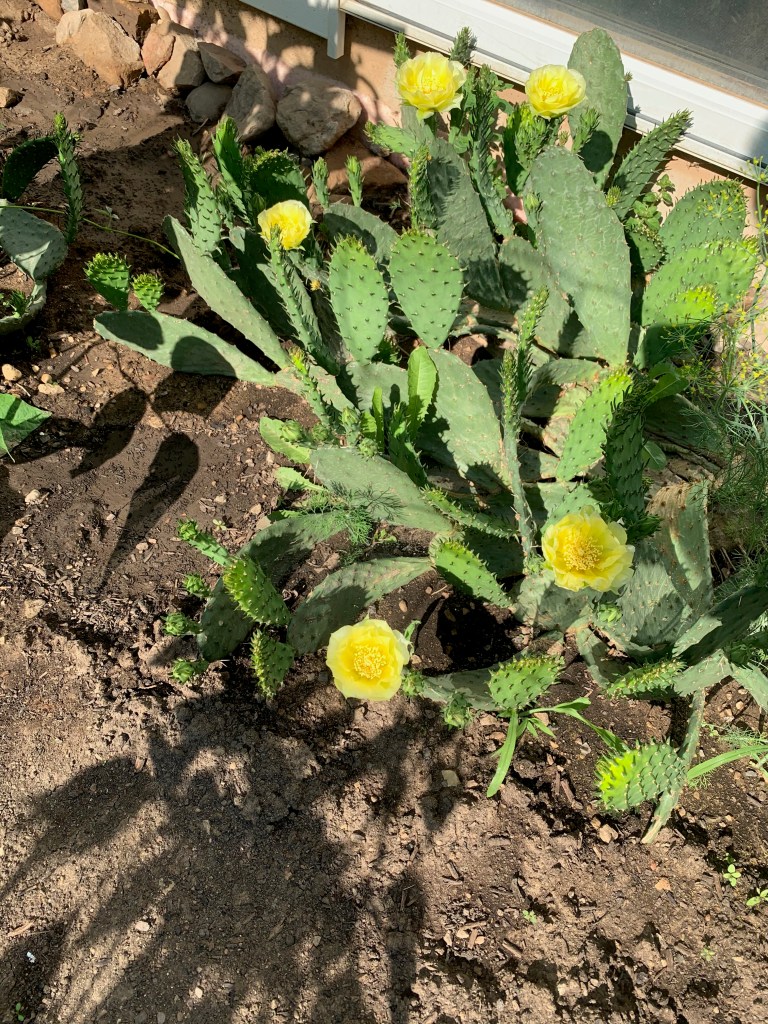
Mr. Spiny is in full flower again!
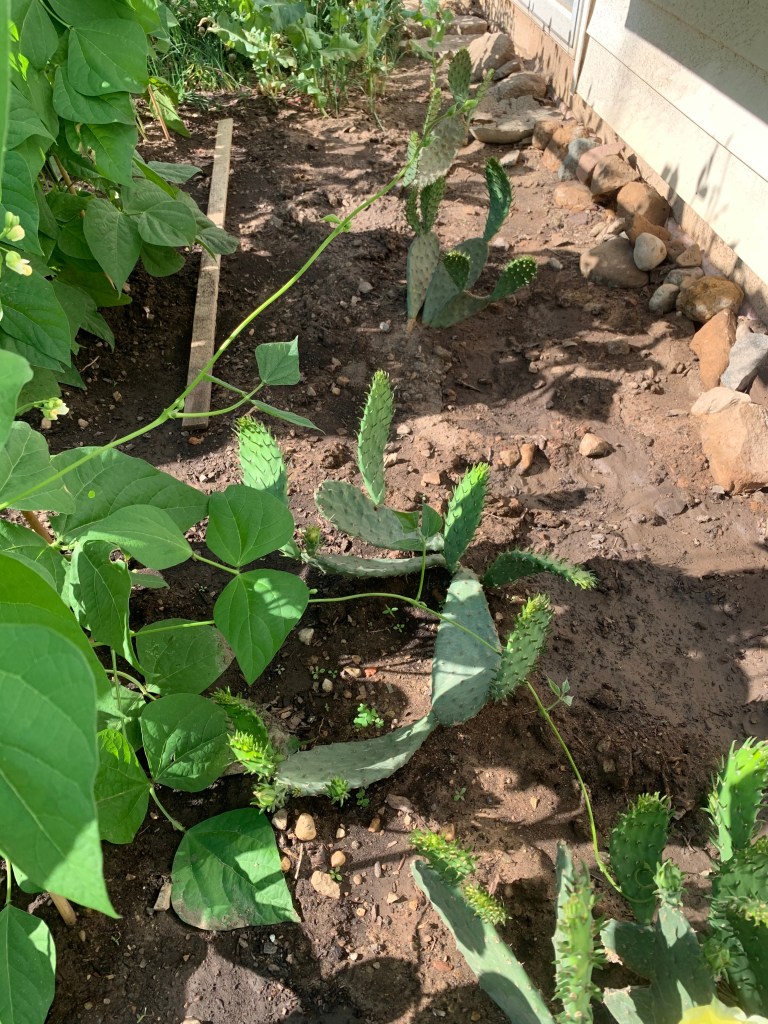
That goofy cactus of ours has turned into a major attraction in the garden. I can’t believe how many people are amazed that we can actually grow cactus outdoors in Wisconsin and think we’re some kind of magicians or something. We aren’t, though. We just got lucky. This type of cactus thrives in the conditions we put it in. The soil in that corner is rather poor, and doesn’t hold water at all because both of the soil type and because there’s a drainage tile right under it. Almost nothing else would grow there at all and it turned into a dust bath for the local birds every summer. And to be honest, when we found Mr. Spiny on the town’s compost pile I honestly had no idea if he’d grow here or not. It wasn’t until later that I found out it’s a type of cactus that’s actually native to Wisconsin, although not usually found this far north and east.
Anyway, we now have three more of them.
MrsGF cut three pads off it, stuck ’em in the dirt, and guess what? Yeah, they’re growing too tucked away back there against the foundation wall of the house.
People seem to think we’re some kind of master gardeners or something. We aren’t. There’s no secret to growing plants. The right soil, proper amount of sunlight, proper amount of water, and compost, compost and more compost.
When we bought this place years ago, the soil here was utterly horrible. It was your typical backfill kind of stuff with a skim coat of topsoil that couldn’t have been more than a couple of inches deep. We were lucky enough to live two blocks away from the town’s compost site, and we can get as much as we want for free. So we’ve probably hauled literally a couple of tons of the stuff into the gardens around the house over the years.
Selecting the right plants is important as well. You can’t just find something that looks pretty, put it in and hope for the best. You have to carefully select the plants you use to suit the conditions they’re in. All plants have specific environmental conditions in which they thrive. Some, many, in fact, can survive in environments they aren’t really comfortable in, but they’ll never do as well as they should. If you’re careful to select plants for the soil, light and moisture conditions in a specific location, you’ve gone a long way towards having a successful garden.
And water. We just went through an extended dry period, together with extremely hot conditions. MrsGF and I were out there every single night watering everything in sight. We emptied our rain barrel in two days and had to resort to city water (I don’t want to see what our quarterly water bill is going to be) after that.
But you can overdo the watering too. Again it depends on the plants. Some can handle dry weather pretty well. Some thrive on it. Letting some plants get dry can improve the quality and flavor of the fruit. Some types of peppers for example will produce more flavorful fruit if they’re allowed to experience mild environmental stress like mild drought conditions. But it can be a delicate balance. Others can’t handle even slight drought conditions.
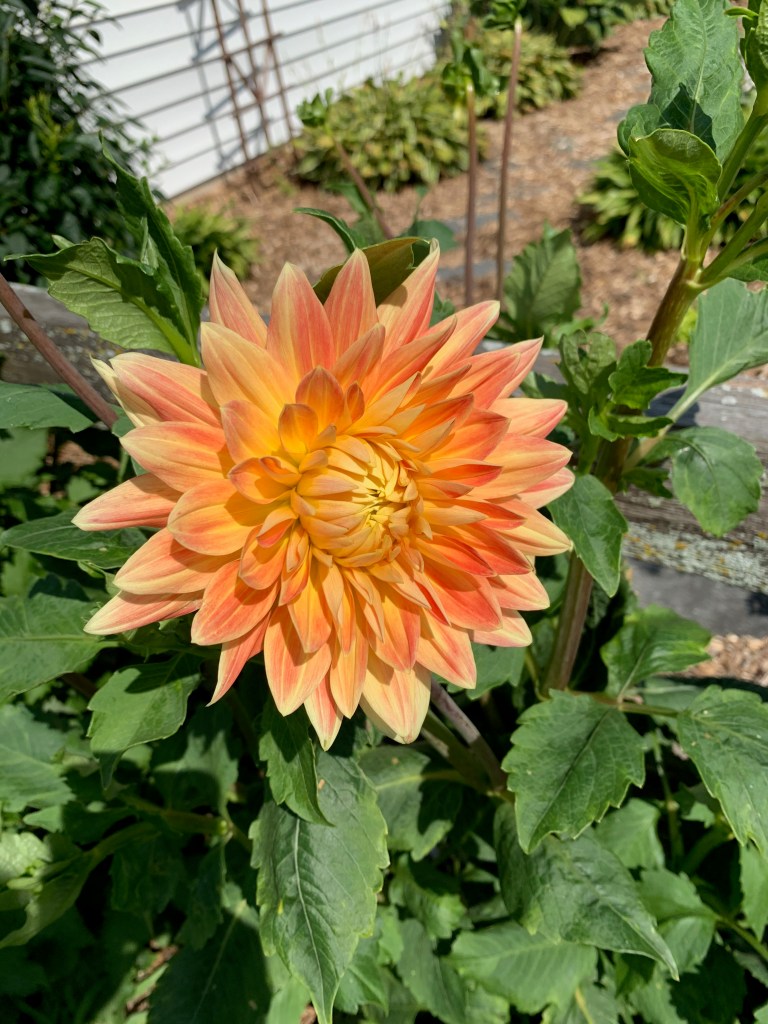
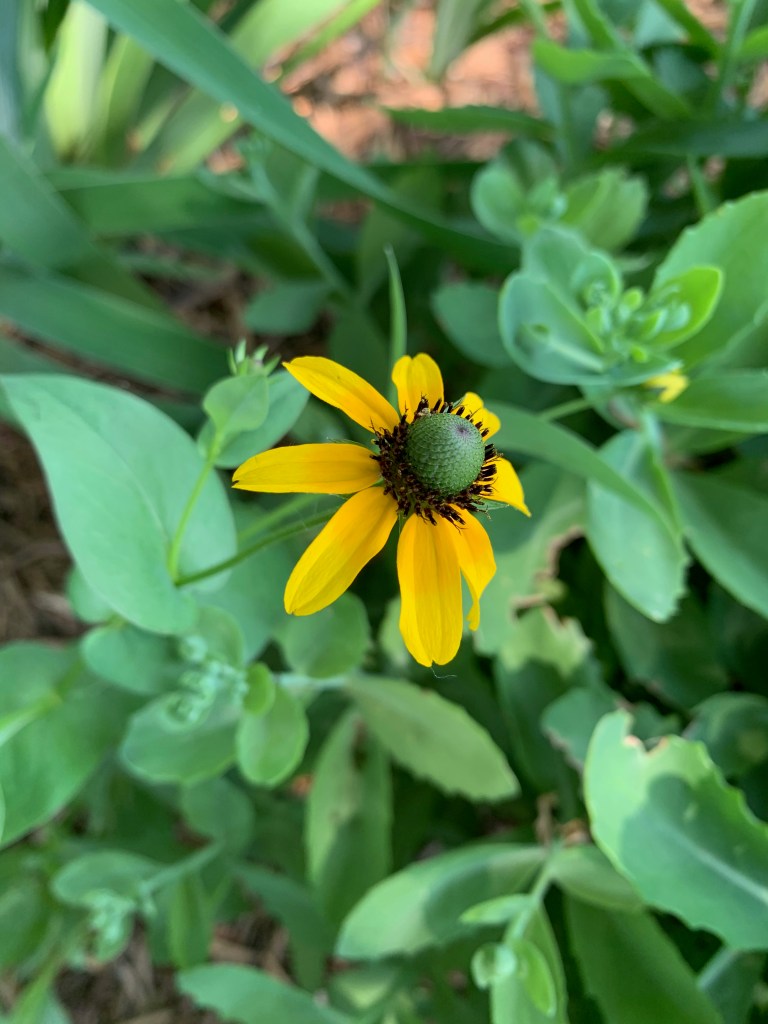
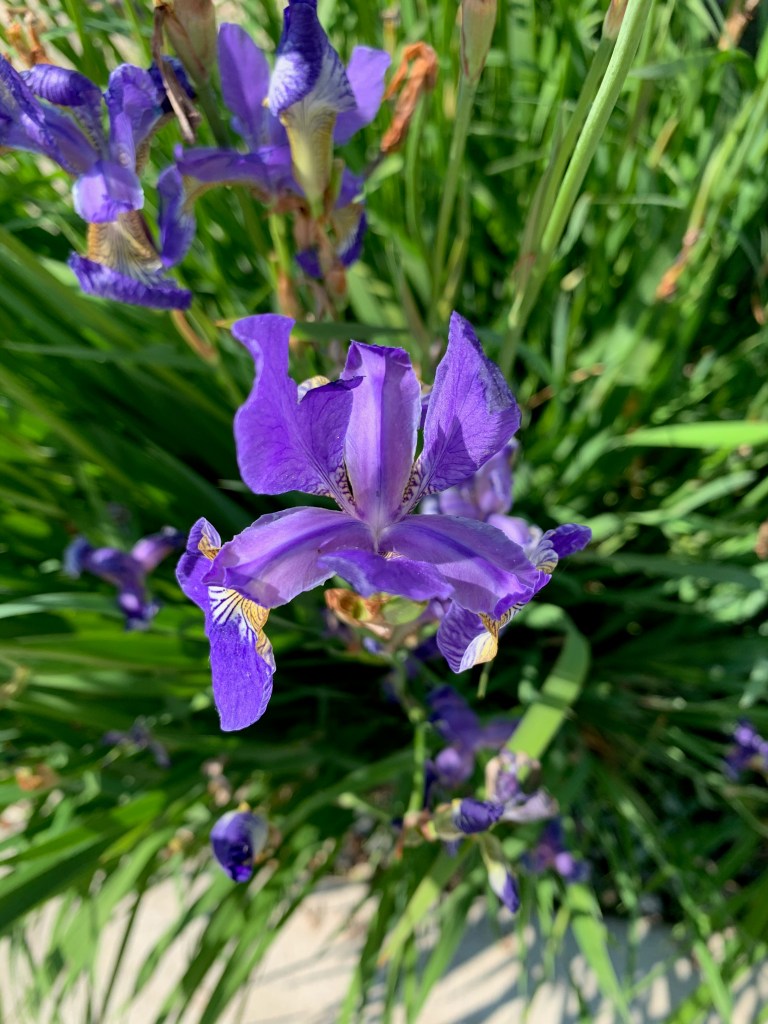
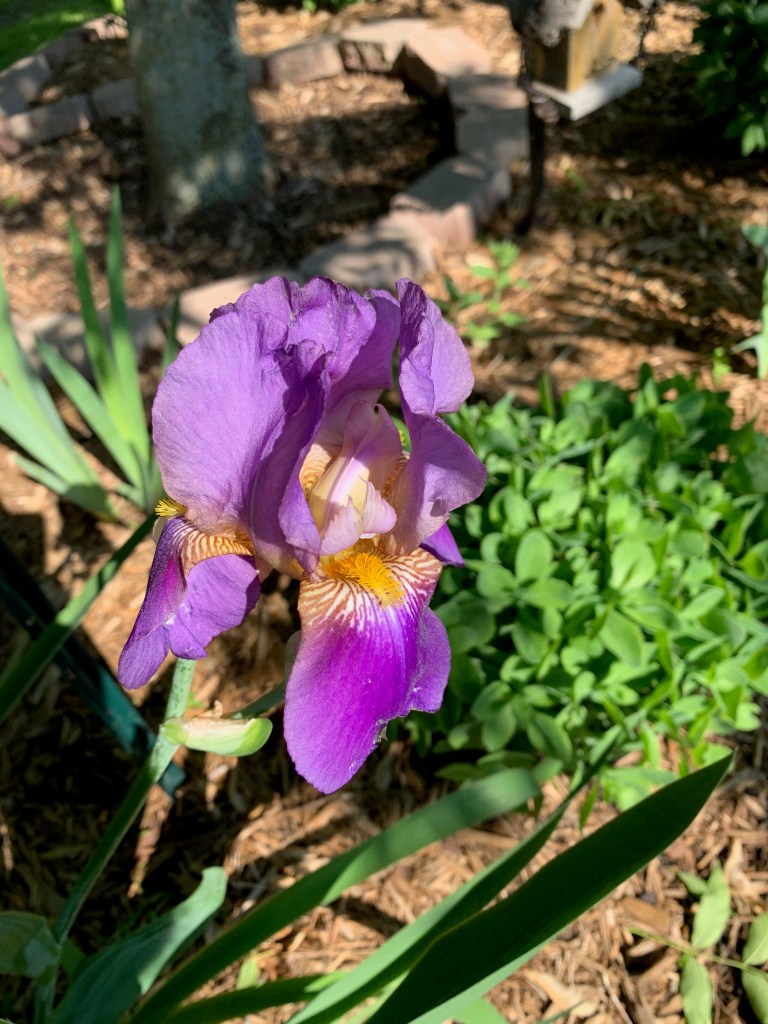
Enough of that. How about a flower?
GF Makes A – A Thing
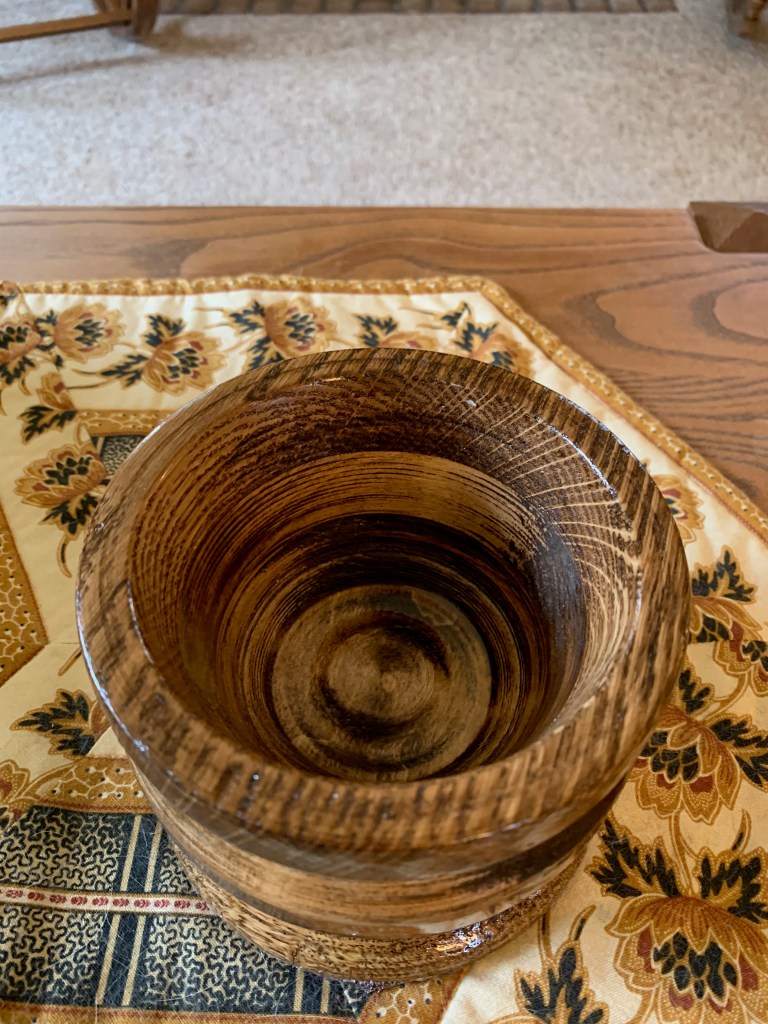
If you’ve been following this blog or whatever it is for a while you know I do wood working. I build furniture and do carpentry and stuff like that. My oldest son got me one of those cheap Harbor Freight wood lathes ages ago and, well, to be honest when it comes to woodworking tools, you get what you pay for. So let’s just say it’s not exactly the best lathe in the world and leave it at that. But I got bored a few weeks ago and decided to see if it was good for anything at all and tried my hand at making a bowl out of some old scraps of white oak that were too small for anything. I glued ’em all up into a block, stuck it in the lathe, and this is what came out after I put a finish on it.
Considering this is the first bowl I’ve turned since, well, 1969 I think, I’m rather pleased with it. Especially since it’s made out of scraps of wood that otherwise would have ended up in the neighbor’s fire pit.
I should point out that MrsGF made the table runner it’s sitting on and the table is one I made out of white ash some years ago.
I’m encouraged enough to try again. I have a few chunks of really nice wood, cherry and black walnut, that would be suitable for turning into bowls, so I think I’ll keep playing around with this and see what happens. If things go well I might end up buying a good lathe and see what happens. But good lathes, even smaller ones, gets pretty expensive. A good quality lathe in the size I’d want runs somewhere around $700 – $1,000. Which is why I never bought one myself.
But enough. Time for me to get on the bike before the weather gets too hot!
Some of the terminology, customs and traditions of amateur radio are a bit, oh, opaque, shall we say, to an outsider. Some of them seem to make no sense on the surface, and some even seem silly. But we’re stuck with ’em. And from time to time people ask me what something means, or why something is done a certain way, etc, so I thought I should explain some of this stuff. Sometimes things get a bit silly. But that’s all part of amateur radio. I can’t cover all of the terminology used in amateur radio, but here’s a few that people have asked about the most in the last month or so.
“Elmer”
Let’s start with “elmer”. In the amateur radio world, the term has come to mean a person who is a mentor, someone who helps a newcomer (or even someone not so new) learn something, troubleshoot a piece of equipment or otherwise give assistance that is related to the hobby. So how in the world did a mentor come to be referred to as an “elmer”? A whole mythology has sprung up about the term. I’ve talked to people who claim the term is a 100 years old and goes back to the early days of radio.
The term actually isn’t that old. It certainly doesn’t date back to the early 1900s as some people have tried to tell me. According to the ARRL it can be traced back to 1971. The references I’ve found say it was started by a single reference in an article in QST magazine when a writer referred to a ham who had once helped him with something. Elmer “Bud” Frohardt is apparently the person in question here. The writer of the article mentioned about how disappointed he was that more people hadn’t known someone like Elmer to help them overcome problems, and wished there were more like him. And for some reason the amateur radio community immediately latched onto this and started calling their mentors “elmers”. Why? I have no idea.
While I imagine Mr. Frohardt was pleased to be recognized, the fact of the matter was he preferred to be called “Bud”. Mr Frohardt, I should add, passed on not that long ago, 2016 I think, at the age of 93, and by all accounts he was a wonderful person and very active in amateur radio for most of his life. But…
This is a term that I don’t use and to be honest it makes me wince whenever I hear or read someone using it because to me the name “Elmer” conjures up images of a short, bald, fumbling, bumbling and very stupid hunter who, every Saturday morning, failed to catch Bugs Bunny or Daffy Duck. Yes, I’m talking about Elmer Fudd. In my world, especially when I was a kid, being called an “elmer” was actually an insult. Perhaps that’s why Mr Frohardt preferred to be called Bud? Still, the term “elmer” is one that we’re stuck with and it will probably never go away.
Contesting
Now I’m going to wander off into the realm of editorial commentary here because, to be completely blunt, amateur radio contesting is one of the most ridiculous things ever.
Usually when I start trying to explain radio contesting (at least they seem to have stopped trying to rebrand it as “radiosport”, thank goodness) people get this blank look on their faces and start shaking their heads and they mutter stuff like “Wait, you people actually do this?” and they have a point. Contesting is is one of the silliest things ever. It ranks right up there in silliness with things like, oh, golf. No, I take that back. It’s even sillier than golf. At least in golf you get to hit something with a stick which can provide, oh, minutes of entertainment. I just don’t get contesting. I’m not the only one. I know a lot of hams who actively hate contesting and would love to see it go away. I have no animosity towards contesting, myself. I just don’t see any point to it.
Basically you fire up your equipment, sit down, and for a specific period of time, let’s say 48 hours, you try to contact as many other amateur radio operators as you can. And when it’s all over you send your logs recording the contacts you made off to whatever organization is running the contest.
And that’s it.
Oh, it’s a bit more complicated than that, of course. There are various categories you can enter depending on your equipment, how you want to operate and things like that. There are bonuses and multipliers and other things that can enhance your score. But basically that’s it, just make as many contacts as you can in the time allotted.
And if you win you get a car …. Well, no, you don’t. You don’t get anything, really, except maybe a $2 plaque to hang on the wall or they email you a certificate you have to print off yourself.
The organizations that run these things, like CQ magazine and the ARRL, would dearly love to have you believe that contesting is popular. They publish page after page of interviews with contesters, photos of contesters, talk about the equipment and antennas they use in depth, and publish page after page of scores in microscopic type. And they are so desperately trying to make contesting look interesting and popular that it’s ridiculous. It’s ridiculous because virtually no one actually enters these contests.
I am not joking. If you look at the actual number of amateur radio operators who actively engage in contesting, the percentage is so small as to be statistically insignificant. Still, that doesn’t prevent CQ Magazine from using the term, “wildly popular”, when referring to one of it’s contests. But if you look at the actual data, contesting is perhaps one of the most wildly unpopular activities amatuer radio operators can do. If you look at the actual percentages, contesting is about as popular with amateur radio operators as, oh, wearing underpants made of angry bees.
Let’s look at the numbers.
In the latest worldwide contest from CQ, the magazine claims 30,000 people “participated”. But even that is extremely misleading because only about 5,000 people actually bothered to submit logs in order to actually enter the contest. I don’t understand that, either. If you participate, why the heck not finish up and send in the logs so you’re actually in the contest? Not sending in your log is sort of like entering a marathon, getting within two feet of the finish line, and then you stop, shrug, say you just can’t be bothered, and turn around and go home.
So that means there were only about 5,000 actual contestants. And while 5,000 sounds like a lot of people, let me point out that there are about three million, amateur radio operators in the world according to Wikipedia. So they claim that having 5,000 actual contestants who entered the contest out of 3,000,000, is “wildly popular”. Seriously? Let’s run some numbers and look at the percentages… Oh, dear… the calculator tells me that it is… Oh, my, is that right? Let me run that again. Well, this is a bit embarrassing, isn’t it? It’s 00.16% Not even two tenths of one percent of amateur radio operators participated in the contest.
Now I’m sorry, but if you’re getting a participation rate of less than two tenths of one percent, whatever you are doing is most definitely not “wildly popular”. If this kind of thing sounds like fun to you, heck, go for it.
For a time they were actively trying to rebrand contesting as “radiosports”. There were supposed to be “teams” and special contests and events and… Well, to be honest pretty much no one cared except the people who were actually trying to promote this silliness.
If you hear anyone ever using the term “radiosport” when referring to contesting, do this to them:
“Lid”
Oh dear….
Oh my, how to explain what a “lid” is. A lid, in amateur radio jargon is a, well, how can I put this politely?
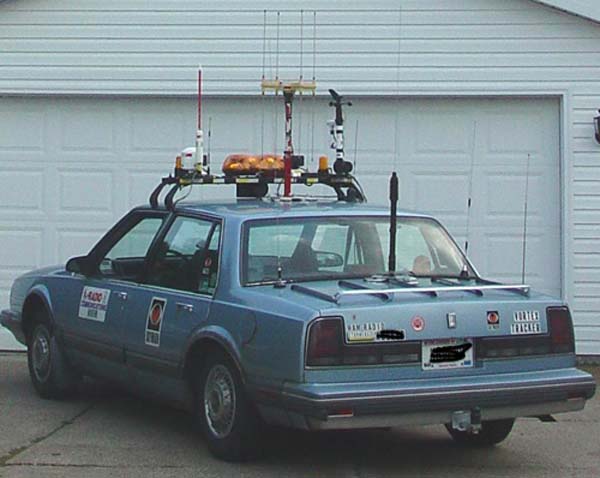
The term seems to go back a long, long way, and certainly predates radio. It turns up back in the days of the old wired telegraph system, and originally it seemed to refer to a rookie telegraph operator, but it was adopted by the amateur radio community almost as soon as there was an amateur radio community, and it rather quickly turned into a term to describe a ham who was, well, a jerk, an idiot, someone who either deliberately or through ignorance operated in such a manner as to cause interference to other operators. It can also be used to refer to a certain type of person who is fond of buying used police cars, outfitting them with dozens of antennas, multiple radio monitoring devices, badges, insignia and other official looking stuff, even appearing at emergencies wearing what looks like a uniform and wanting oh so desperately to have people take them seriously. You’ll know one when you see one. Or hear one on the radio. And the best advice I can give you is that if you encounter one of these odd creatures, run away as fast as you can.
“Q” Codes
If you have a radio receiver that can tune into the amateur radio bands, you’ll eventually hear something like “I’m getting QRM can you QSY?” Now if you read that and immediately translated that as “I’m getting interference. Can we move to a different frequency?” well, good for you. You’re well on your way to being a genuine radio nerd/geek.
The Q codes developed out of necessity to make early radio transmissions easier and less confusing, and are over a hundred years old, being developed originally in 1909 by the British government for use by ships and coastal stations, and they were quickly adopted within a few years by international radio operators. Back then the only way people could communicate via radio was with morse code, which is slow and often hard to accurately copy under poor conditions. The Q codes made essential bits of information easier to sent. Sending QSY takes much less time and is probably going to be easier to copy by the listener than sending “I am going to change frequency”, for example.
The Q codes are all three letters long, and always start with the letter Q. Why Q? Probably because the letter Q is one of the least used letters in the English language so it stands out more. These are not acronyms. The letters used in the code have nothing to do with what they stand for. If you want to know more about Q codes than anyone probably ever wants to know, you can go look it up over at Wikipedia.
The Q codes are still in use today, especially among those of us who use CW (morse code). As soon as people started to figure out how to use voice instead of just CW, the Q codes jumped over to that as well. Even though the use of Q codes is discouraged except when using CW.
PSK, FT8, RTTY, JS8Call, WTF??
All of the above are acronyms for different modes of communication. Well, except for the last one up there. All of them are the same in that they use radio to send communications from one person to another. But they differ in how the communications are sent. Instead of just talking into a microphone, a computer is inserted into the mix. You type on a computer keyboard, a program encodes the letters you type into tones, triggers the transmitter to transmit the tones via radio. A radio receiver at the other end hears those tones, feeds them into a computer which translates it back into plain text that you can read. This is ridiculously simplistic, of course, but essentially that is how most of these modes work.
So why insert a computer into the mix when all you really need to do is just pick up a microphone and talk? Well it’s because most of these digital modes are more efficient in terms of their use of the spectrum, for one thing. Radio signals take up space, so to speak. They don’t just sit on a single frequency and use only that frequency. They sort of spread out. A standard AM voice signal takes up about 6 kHz (kilohertz). A single side band (SSB) signal takes up about 3 kHz, while a CW signal takes up only about 150 Hz. Generally speaking, the narrower the bandwidth of a signal, the better. Sometimes. Maybe. Sort of. To give an example, you can have dozens and dozens of FT8 signals occupying the same bandwidth as a single AM signal. So the digital modes are generally far more efficient in terms of bandwidth than a standard voice transmission.
They are also generally better under poor conditions. You can often still communicate using some of the digital modes under propagation and noise conditions that would completely obliterate voice transmissions.
So why doesn’t everyone just use digital modes and forget about voice? Well, there’s no such thing as a free lunch, as they say. Using digital modes adds a another layer of complexity and expense to things. You have to have a computer. You need special software. Often you need some kind of interface to connect your computer to your radio. You need special cables to connect all that gear together. And if all you want to do is chat with your friend Susan down in Beloit, well, why bother with all that when all you need to do is turn on your transceiver and pick up a microphone and talk?
QRP: Less is Sometimes More
QRP is one of those Q codes I talked about a few paragraphs ago. Its original meaning was “reduce your power” or if sent with a question mark, “should I reduce power?”. But it has also become a term for those of us who enjoy the challenge of trying to communicate using as little power as possible. Officially operating QRP means using 10 watts of power or less. Often a lot less.
The average amateur radio HF (short wave) transceiver puts out a maximum of 100 watts. The more expensive high-end models may push that to 200, but most will only do 100 watts. And that’s generally enough for most amateur radio operators. If you want or need more power than that, amateur radio operators in the U.S. can legally run up to 1,500 watts maximum. (Just for comparison, a commercial FM broadcaster often pumps out 100,000 watts.)
If you do want to run higher power, you have to get an external amplifier, and those can be very expensive, often running over $4,000. They’re also very big, very heavy, and often won’t run off normal house voltages and require you to install a 220V line. And as a lot of amateur radio operators will tell you, including me, how good your antennas are is often going to be more important than how much power you’re running.
But a lot of us go in the other direction. We’re more interested in trying to communicate using as little power as we can. (I not using the editorial “we” here, I use “we” because I’m one of these gluttons for punishment who likes to run QRP) Why? Because of the challenge of it. A lot of QRP’ers look at the high power guys as, well, like fishing with a hand grenade. You dump enough power into an antenna and someone, somewhere, is going to hear you. But running 5 watts? Or 2 watts? Or less than 1 watt? Into an antenna that’s little more than a bit of wire hanging from a tree? Now that’s fun.
Well, okay, it might not be your idea of fun, but there are enough of us who enjoy this kind of thing that there is a lot of hardware out there designed specifically for QRP operators, either kits or ready made QRP transceivers like the FT-818 like mine, antennas and other goodies.
Hey, I’m bored, so how about a few before/after pics?
BeforeNowBeforeNow
I don’t have a ‘before’ photo of the squash for some reason. They’re looking great right now. They’ve just about tripled in size in the last week. The squash didn’t do well last year. They got powdery mildew which pretty much decimated them. But so far so good this year.
I had to throw in a photo of Mr. Spiny, our cactus because it just flowered yesterday and, well, look at that thing! Mr. Spiny is our “rescue cactus”. We found it laying on the town compost pile a few years ago. It had been a potted plant probably in someone’s house. We stuck him in the ground in a south west corner of the house, and he apparently loves it here.
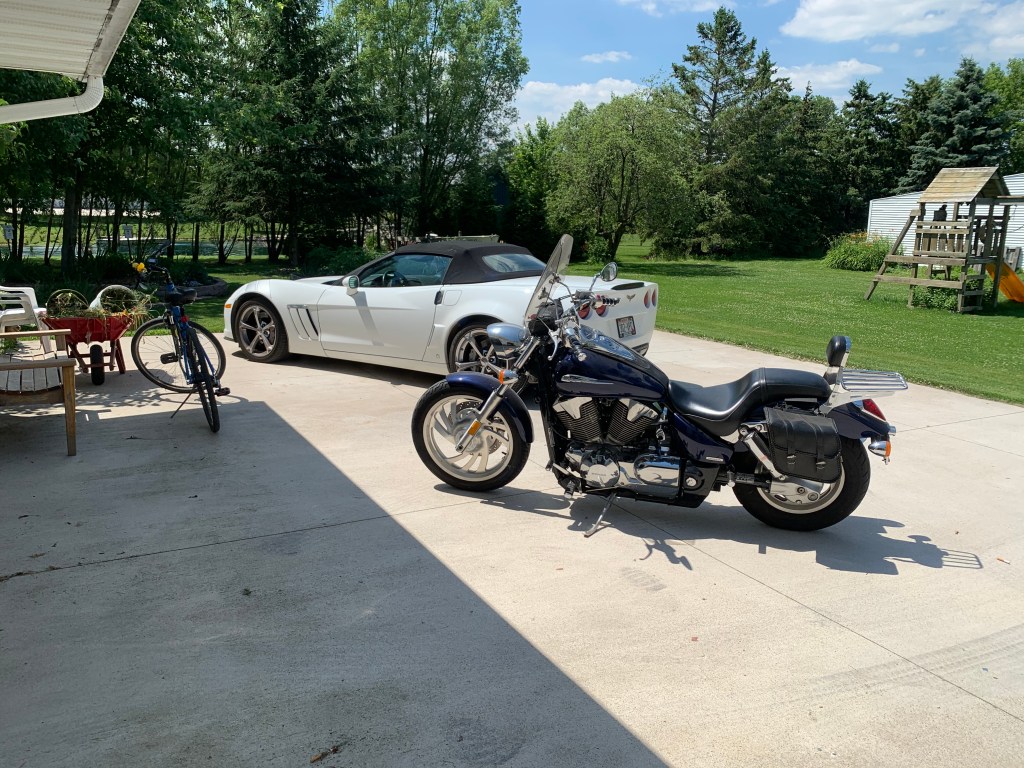
I finally got the motorcycle out the other day. It had been sitting parked in front of the car for ages. Had to get a new battery for it and it started right up so I ran it around town for a while. MrsGF and I used to really be into motorcycling, especially long distance touring. We used to have a BMW that we spent weeks on every summer. Then we traded that off on a Goldwing. But around that time she started having problems with her knees and it was really hard for her to get on and off the bike, and well, we put a whopping 5,000 miles on the Goldwing in three years so it didn’t make sense to keep it. So I worked out a trade with my son and he’s got the Goldwing now and I have this VTX to run around on when the urge strikes me.
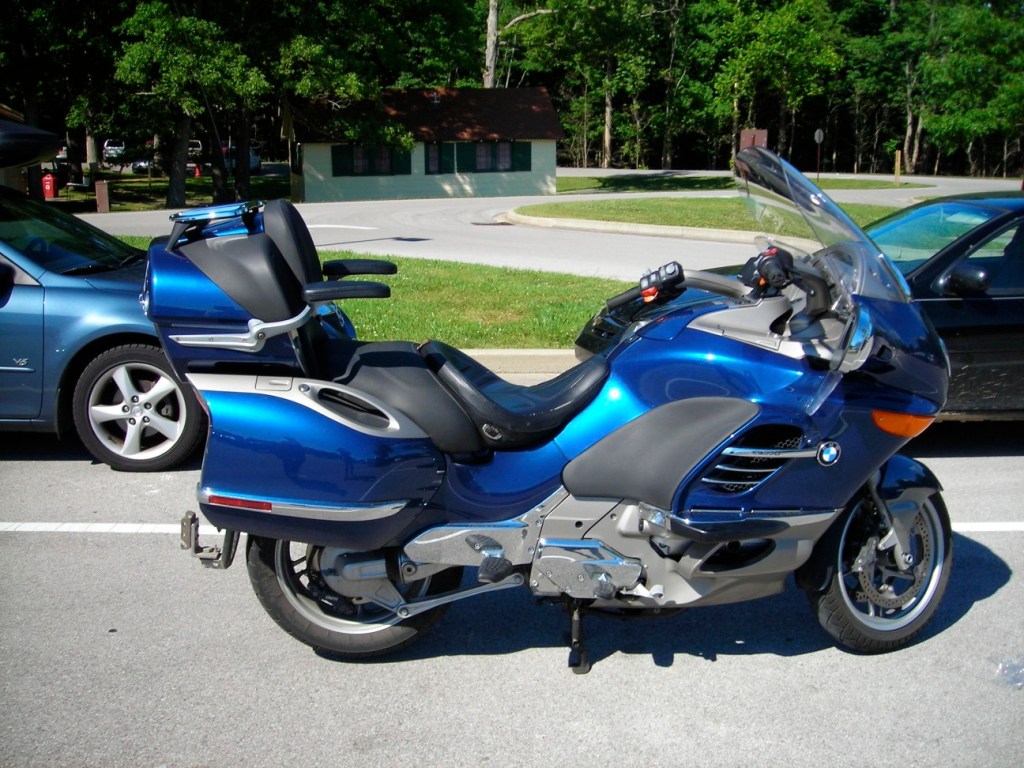
That’s the BMW we traveled on. We put about 50,000 miles on that thing traveling from Maine to Montana. Loved that bike. I suspect that if BMW hadn’t discontinued that model we’d still have one.
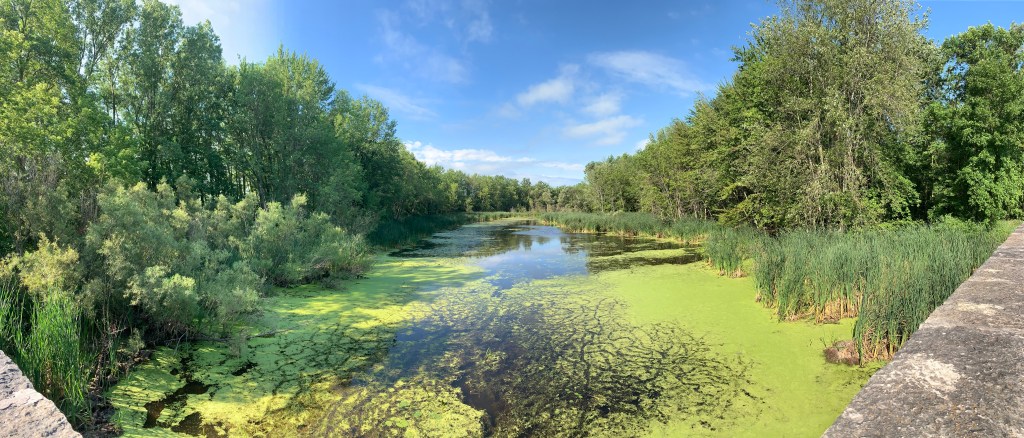
So the cat woke me up at 4:45 AM this morning… (Glares at cat. Cat doesn’t look at all ashamed of herself.) So I got tired of sitting around and was out on the bike by 6:30 and by 7 this is where I was. I was kind of glad she did wake me up that early. Nothing but me, the early morning sun, surrounded by bird song and frogs singing? It doesn’t get much better than this.
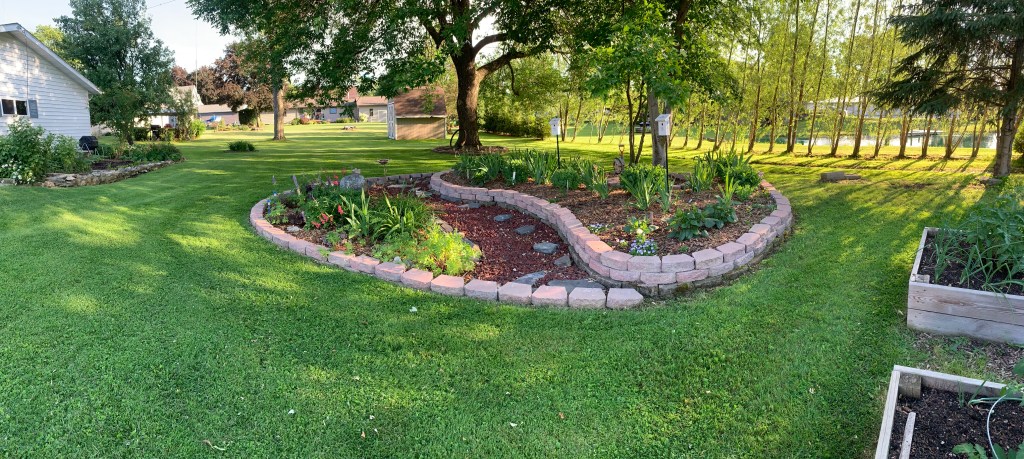
Panoramic shot that shows almost the entire backyard. Makes it look a lot smaller than it really is. That central island surrounded by blocks is about 25 feet long and 16 feet wide. Tomatoes in raised beds off to the far right. Garage off to the left showing the “garage garden” where we have raspberries squash and ornamentals.
If this time of year could be described by a single word, it would probably be “color”.
Almost everything is in full flower this time of year except for the autumn flowering plants. Just walking outside is a feast for the eyes.
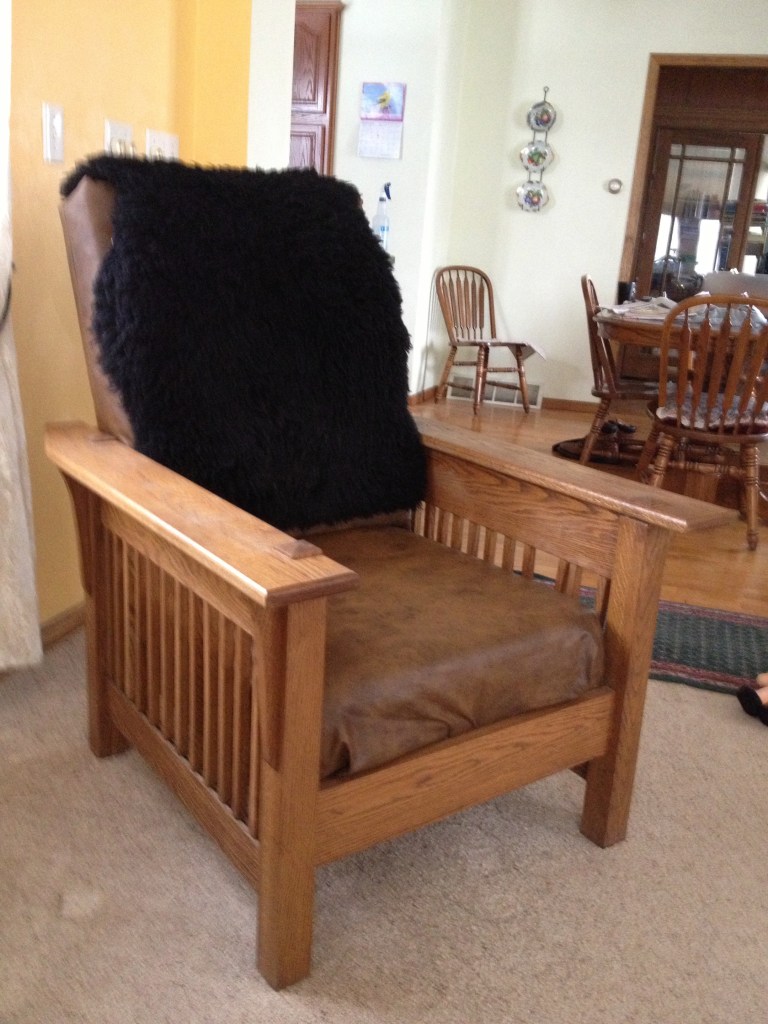
So, let’s get caught up on what’s been going on. I haven’t talked about it much but one of the things I do is build furniture like, well, like this:
It looks a bit beat up now, especially the upholstery, but considering it’s lived through two teenaged boys, a rambunctious golden retriever and several assorted cats, it’s doing pretty good. Over the years I’ve built chairs, coffee tables, wardrobes, bookcases, decorative chests and I don’t know what all else. A few years ago one of my sons gave me a cheap wood lathe from Harbor Freight and I finally started fiddling around with it. It was super cheap and to be honest the build quality isn’t exactly what I’d call good. But I’ve messed around with it a bit, bought a decent set of tools for it and I’m going to see if I can add woodturning to my skill set. We’ll see how that goes. I’ll let you know if anything comes of it.
We’ve been spending a lot of time out in the gardens, of course. Where else would we be this time of year and with the pandemic still raging? Gardening is probably the safest and most satisfying activity we can do right now. But we’re still dabbling in radio. And I mean “we”. MrsGF is a licensed amateur radio operator as well. She’s more into the emergency services aspect of it while I’m more into the technical stuff.
It looks like the Great Radio Fiasco Project is back on the agenda. I was finally able to get the toroids I needed to wind the coils I need. But considering how busy we are with other things this time of year it’s likely that will be pushed back until the fall.
Let’s see, what else… Oh, I’m working on an upcoming post that answers some questions about amateur radio that people have asked. That will be coming up in the near future.
I’ve been working on getting better at CW (morse code). I’m still struggling, especially with receiving. I’m nowhere near good enough to be able to actually use it out in the field. If someone sends at like, oh, one word per minute or slower, I can generally figure it out. But any faster than that and everything sort of blurs together and I start to fall so far behind I have to give up.
Someone asked me if I was going to do anything for the ARRL Field Day exercise. Nope. Don’t have the time. This is probably the worst time of year for me to try to participate in an event like that.
We’re going to be doing some major renovations to the house this summer, replacing a bunch of windows, the front entrance and some other stuff. That’s going to be a mess, but it needs to get done. And expensive. Sigh… Oh, well. Owning a house is great. Until you start seeing the bills for maintaining it.