Farm Catch Up

I haven’t done one of these in a while, so let’s take a look at what’s been happening in the farming world.

Dicamba Herbicide Fight Continues: The fighting over the new Dicamba blends of herbicides continues. BASF and Monsanto continue to argue that their newly approved blends of herbicides containing dicamba are completely safe and aren’t a problem at all, while the farmers who have had thousands of acres of soybeans ruined by the herbicide after it drifted long distances, argue that it isn’t safe for use.

Arkansas is pushing for a ban on all dicamba use except for those uses that were permitted before the new blends came on the market. The ban would last until October, 2018, and would halt the sale and use of both Monsanto and BASF’s new dicamba based products, and probably halt the sale of Monsanto’s dicamba resistant soybeans as well because if the herbicide can’t be used, there’s no point in paying a premium for Monsanto’s new beans, either.

Monsanto is, of course, not happy about any of this since they stand to lose millions of dollars in sales of both their herbicide and seed. The company is blaming anyone and anything for the problems that have been going on, claiming that there is no “scientific” basis for the ban, that “scientists” have discovered that even if their product does drift outside of the application area, it doesn’t really hurt anything anyway, that some of the experts testifying in favor of the ban are prejudiced against the company, blaming the people who apply the herbicide, blaming the equipment used.

It isn’t just Arkansas that’s having problems. In Missouri it’s estimated that up to 22% of the soybeans planted in the Bootheel area were damaged by dicamba drift, along with acres upon acres of tomato, watermelons, vineyards, pumpkins, organic vegetables and even trees, shrubs and people’s home gardens. The product isn’t just moving a few yards, in some cases there are indications the herbicide is drifting for miles according to the Missouri Extension weed specialist Kevin Bradley.

Farmland Partners Makes Major Buy: Farmland Partners is an investment company that buys up farmland for no reason other than to rent it to actual farmers. The company now has about 160,000 acres of farmland. They just bought over 5,000 acres of nut orchards for $110 million from Olam, a Singapore based company that ventured into the nut business.

My feelings about this kind of thing? I find it extremely concerning. Companies like this are, well, to put it bluntly, parasites. They insert themselves into the process, competing against actual farmers for a scarce resource, farmland. They artificially inflate demand for that resource, driving prices up. They rent the land back to the farmers at ever increasing prices because the shareholders demand ever increasing profits, and at the same time the company itself provides absolutely no value at all to the whole process. It exists only to skim off profits from the whole system while contributing nothing itself, while at the same time destabilizing the whole system and actually degrading its health through it’s manipulation of the market.

Seed Terminator: Combines are great at two things; harvesting wheat, corn, soybeans, Screen Shot 2017-09-26 at 5.53.30 AMetc., and spreading weed seeds all over your fields. The problem is that a lot of weeds are coming ripe at around the same time as your crop. So when you combine your crop, you’re also combining the weeds and blowing the weed seeds out the back of the combine and scattering them all over the field. A lot of people have worked for a very long time on this problem, with various attempts at a solution.

This one which is now going into production it seems, adds a screening system and high speed flails that pulverizes the weed seeds before they get blown back onto the field. If you click the link up there you’ll jump to the article about it. Apparently it works pretty good, and I’m always in favor of anything that helps farmers reduce the need for herbicides.

The problem is that this puppy costs about $70,000. Even when we’re talking about combines that cost a quarter of a million dollars or more, that is a pretty significant amount of money. Is it worth it? No idea.

Pork Cheap, Beef getting more Expensive: Beef prices at the consumer level haven’t been all that good for some time now. Pork is almost ridiculously cheap right now. Pork futures have fallen like a stone since July, dropping some 30%. Pork bellies, where we get bacon from, dove straight into the dumper, falling 60%. Although I note that hasn’t helped the price of bacon in the store. That keeps going up and up, it seems.

Beef on the other hand… Sheesh. Prices on some cuts have moderated a bit, but not by much, and they’re claiming prices are going to go up significantly over the upcoming months. We generally buy a lot of beef from MrsGF’s brother and sister, but because of logistics issues they aren’t going to have any ready to go for probably a year now. So MrsGF and I are looking into seeing if we have enough freezer space to get a quarter or half of beef from the local butcher because we can get that dressed, cut, wrapped and frozen, for $3.90 a pound which is less than what hamburger is going for in the grocery stores around here.

Syngenta Lawsuit Settled: Syngenta, a seed company, was sued a while back over one variety of it’s corn. The corn, a GM variety, was heavily marketed by the company and a  lot of farmers planted it. Only to find that when it came time to actually sell their corn to China, the country rejected it because Syngenta allegedly hadn’t told told the farmers that China had not approved that type of corn for import. In addition, it was alleged that the company deliberately misled farmers by claiming the corn variety had been approved by China when it had not.

Farmers, grain shipping companies, etc. lost millions of dollars on the deal and sued. Syngenta claimed they had told them that China hadn’t approved it. Lots of lawyers paid for their kids’ college education out of this one, raking in millions in legal fees, and the final result is Syngenta and the plaintiffs are apparently now going to settle out of court. I haven’t heard yet what the settlement will be, but you can expect that the company is going to have to pay a huge amount of money to make this one go away.

Addendum: Just ran cross another story that had more details. Syngenta is apparently going to cough up $1.4 billion to make this lawsuit go away. The company already lost a $218 million jury trial to a group of Kansas farmers about three months ago. There are still lawsuits pending in Canada against the company that will not fall under this agreement and will be thrashed out in the Canadian courts.

That Organic Food You’re Buying May Not Be. Oh, and a Cat Picture.

Screen Shot 2017-09-20 at 5.36.34 AM

With demand for organics growing every year, the US can’t produce enough to meet the demand, and hasn’t been able to for some time. At least not at a price that US consumers are willing to pay. So we rely on imports from other countries to fill the gap. Imports of organic produce, cattle feed and other organic products has been increasing every year for a long time now.  We imported about $1.2 billion worth of organic products last year, and that number is going to keep growing.

That brings up the question of how you know that a product labeled as organic, produced 7,000 miles away, is really organic? You can’t know, of course. You have to rely on government agencies to do the proper inspections, certifications and tracking to make sure the stuff you are buying is really what the seller claims it is.

And apparently USDA and its Agricultural Marketing Service, isn’t doing a very good job of doing any of that according to USDA’s own internal audits. A story originating at Bloomberg reports that USDA’s internal audits indicate that the AMS couldn’t prove that cargo labeled “organic” coming into the US were actually organic. It couldn’t even properly track whether or not the product came from an actual certified organic source.

To quote the report, “The lack of controls at U.S. ports of entry increases the risk that non-organic products may be imported as organic into the United States”.

The problem isn’t just with a potential failure to grow the product according to organic standards, it’s shipping as well. A lot of products, especially bulk shipments of grains, beans, etc, are routinely fumigated by storage facility operators and shipping companies to reduce the formation of mold, prevent rodent infestations, etc, which, of course, violates organic regulations.

So the agency responsible for making sure that organic products coming into the US actually came from certified organic sources, and weren’t fumigated or treated with non-organic substances along the way, pretty much can’t do it’s job.

Kind of depressing, so here’s a picture of one of the cats staring at me while I’m writing this, wondering why I’m not playing with her.

Screen Shot 2017-09-20 at 6.42.05 AM

Catching Up

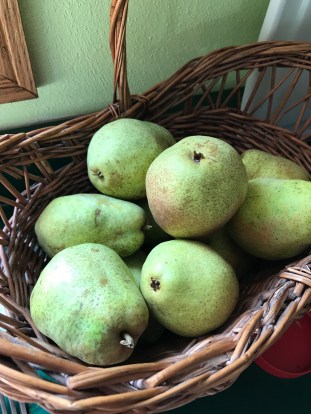
IMG_0702The pears have just started to ripen, something we always look forward to. Alas, it hasn’t been a good year for pears. Normally we end up filling five gallon buckets with the things and giving them away to anyone we can talk into taking them, but this year we’re going to be lucky if we get more than a few dozen. The weather this spring when it was putting out flowers was not very good. We were getting cold days, lots of rain, and not a single bee in sight. I think it was the lack of pollinators that caused the drastic cutback in production this year.

That’s not necessarily a bad thing, though. When that tree is in full production we have far, far more pears than we can deal with. We give away all that we can, eat what we can, and, alas, the rest end up as compost.

This particular type of pear doesn’t hold up well for canning or freezing. They are best eaten fresh, just after they turn ripe. And dear lord, they’re good. Sweet as candy, juicy, with a lush, melt in your mouth texture. The ones in the basket are still too green to eat but they’ll start to turn yellow in a few days.

One problem we have is trying to pick them before they fall. Wait a just a bit too long, and they’ll hit the ground and because of the soft texture they turn to mush from the fall. So you have to try to pick them just before they turn.

Now I love peppers, but I prefer the milder ones. Poblano peppers are probably my favorite. Just a touch of warmth to them, with a rich, slightly smokey flavor. I’m fond of jalapeno  peppers as well, but that’s about the upper limit of my tolerance for heat.

IMG_0703So how we ended up with these guys, I have no idea. The little red ones… Dear lord, they’re hot! When they were green they were tolerable and had a fairly good flavor, but now? Just cutting one in half sends out fumes that make the eyes water, and those little yellow ones are almost as bad. MrsGF, it seems, didn’t label the seedlings with great accuracy last spring, if at all, so we had no idea what we were going to get until they started to produce fruit.
The yellow ones are even worse. Just cutting one up makes my eyes start to water and my nose burn. I cut one of the yellows up last night and talked EldestSon and YoungestSon into trying them, after I took a bite myself to prove they weren’t all that bad. Apparently my tolerance for hot peppers has increased over the years because they both thought they were pretty bad. Not to the point where you’d run to the fridge for the milk, but darn close.

Addendum: I just found out that the yellow one is apparently a golden habanero pepper with a heat rating of up to 350,000 scovilles. Wow… Jalapeno is only about 5,000 scovilles. Yeah, that’s a bit hot.

I need to make sure we only put in poblano and sweet bell next year, and maybe one or two jalapeno.

MrsGF pointed out that it seems that the only veggies that grow really, really well here is the stuff we don’t really like, like the super hot peppers, eggplant and the like, while the stuff we do like a lot, gets eaten by bugs or doesn’t grow well. That’s an exaggeration of course, but some years it does seem that way.

IMG_0689We’re very fortunate in that the town has an outstanding composting program that it’s been running for years now. We’re even more luck in that we’re just a couple of blocks away from the compost site. The guys have been busy sifting the newest batch of compost and it’s ready to go. After cleaning out the garden spaces I’ll be making regular runs down here with my little trailer to take advantage of it.

IMG_0686Last weekend I proved to myself that I’m still a 6 year old at heart because seeing this thing in the parking lot at the grocery store made me grin like an idiot. Yes, the Weinermobile. Oscar Meyer has been running these for a lot of years, but this is the first time I’ve ever seen one of them close up.

I should point out I’m not a big fan of Oscar Meyer products. And the free hotdog I snagged reminded me why. A pale pink tube that tasted mainly of salt and artificial smoke flavorings and one of the most unappetizing colors I’ve ever had the misfortune to see.

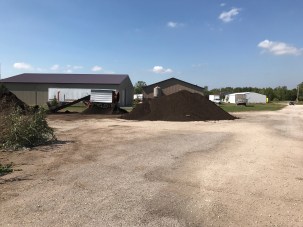
IMG_0697Then we woke up to the sound of our street being reduced to gravel. Literally. Big road grinder moving slowly back and forth in front of the house grinding the pavement and everything else in it’s path into dust as they prep for repaving a section of the street. Loud? Oh dear… Sounded and felt like a 747 was landing in the backyard. They’ve been prepping for this for weeks now, replacing sections of curb and gutter and driveway aprons.

IMG_0699We’re hoping they get this done soon. Right now the road in front of the house is pretty much nothing but dust. We get a lot of big trucks through here and there is a patina of dust over everything. It’s getting more than a little annoying.
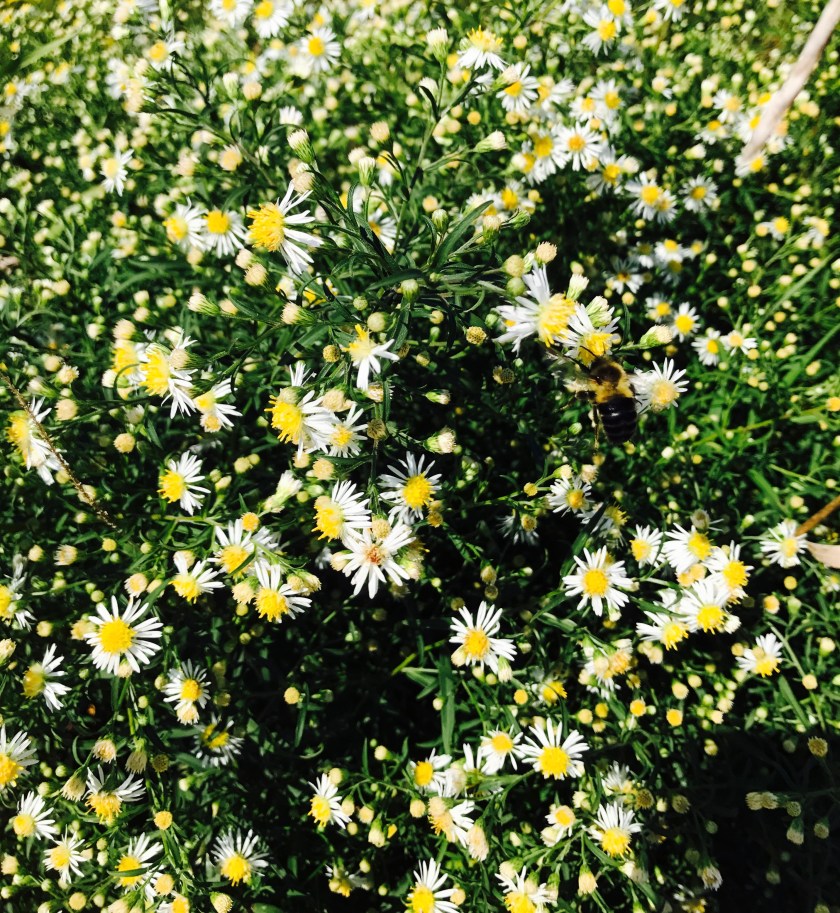
Let’s end this with some roadside flowers. Clumps of these have popped up along the backroads around here all over now and they make a brilliant display when you stumble over them.

IMG_0692

The great nutrient collapse

The atmosphere is literally changing the food we eat, for the worse. And almost nobody is paying attention. Source: The great nutrient collapse

I don’t lead off these epistles with links to outside sources very often, but this one at Politico, of all places, is a wee bit scary and it’s something that effects all of us because it’s about our food.

So here’s the background: We’ve known for some time that the nutrient density in the plants we eat has dwindled over the last century. Concentrations of minerals, vitamins, etc. in plants has been shrinking. Our produce, on average, now has fewer nutrients per kilo of plant material than it had when the measurements first began. It’s been assumed that there were two reasons why.

First, our farming techniques have changed drastically over the last hundred years. We’ve moved to “industrial” farming, which relies on heavy applications of artificial fertilizers, pesticides and herbicides. By dramatically altering the environment the plants grow in, we’ve also alters the chemical composition of the plants.

Second, over the centuries we’ve bred plants to grow faster, produce more fruit or grain, and to produce fruits that last longer after picking and which are tough enough to tolerate rough harvesting and shipping conditions. When selecting plants for these traits, we’ve often ignored things like the nutrient content of the plant and flavor. So we’ve ended up with plants that produce fruit that can be stored longer, is easier to harvest, etc. but which is lower in nutrients and flavor.

But that isn’t all that’s been going on, it seems. Apparently increasing CO2 concentrations in the atmosphere seem to have played a significant role in decreasing the nutrient levels in plants.

Maybe… The thing is, this is difficult to test for. The testing requires extensive, difficult to accomplish, and rather expensive experiments, and while there are scientists who would like to do the testing, it has been difficult to get funding to actually do it.

As of right now I don’t think the science is actually settled. The preliminary testing that has been done tends to support the belief that increased atmospheric CO2 levels can indeed result in lower nutrition levels in the plants. But there is still a lot we don’t know. We also don’t know how serious of a problem this may be. A  lot more testing and experiments need to be done to answer all of the questions that need answers.

Agrimoney.com | Butter price surge may ‘prompt fundamental market change’ – Arla

Screen Shot 2017-08-29 at 6.25.36 AMArla boss Peder Tuborgh sees a shake-up, if the rally continues which has, for the first time, made dairy fats more expensive than protein Source: Agrimoney.com | Butter price surge may ‘prompt fundamental market change’ – Arla
I haven’t been talking much about farming lately because not much has really been going on over the last month or so. But butter — good grief. The butter market has gone goofy.

Wholesale butter prices are flirting with record prices in some markets, even surpassing record levels in some areas. Retail prices have been creeping up. Demand for butter has been just about the only thing that’s been keeping farmgate fluid milk prices at a reasonably decent level over the last few months. Around here prices for generic butter is pushing close to $4/lb. while prices for the “premium” brands is in the $4.50 range, with some of the premium brands pushing $5/lb. retail prices. The exception is KwikTrip, which is selling their house brand for $2.99 in their convenience stores around here.

I’m always fascinated by how the public’s attitude towards butter and dairy fat in general has changed over the last few years. Thanks mostly to the marketing claims made by margarine manufacturers, and with little or no actual scientific studies backing those claims, butter and dairy fat was being blamed for everything from obesity, to heart disease, to stroke, to I don’t know what all else, while margarine was being pushed as a “healthy” alternative, when the opposite was true.

I always hated margarine. I hated it’s texture and flavor, I hated how it melted or didn’t melt, hated how it worked when used in cooking. But then I’m weird that way. I have one of those hypersensitive senses of smell and taste, especially smell. I’ve a bit of a reputation as being a picky eater, but I’m really not. The problem is that I smell and taste things most people seem to be unaware of.

But let’s get back to butter…

The item up there from AgriMoney reminded me of the Great Butter War going on here in Wisconsin right now. The picture of Kerry Gold butter up there isn’t just some random butter image, it’s appropriate because at the moment Kerry Gold is banned from sale in Wisconsin along with a lot of other brands of butter.

Before butter can be sold in the state, it has to be graded on taste, texture and color through some state accepted system, by state accepted inspectors. This means that if a butter maker can’t or won’t spend the time and money to put their product through the state’s inspection system because of cost or whatever reason, it can’t be sold in the state, even though it meets all other accepted federal standards.

Consumers didn’t know about this until one day Kerry Gold butter abruptly vanished from the shelves of the grocery stores here in the state not too long ago. It isn’t that the law was just passed, it’s been on the books since the 1950s. It seems that a lot of grocers just didn’t know about the law until fairly recently.

Wisconsin has a long history of laws about butter. It is still illegal for restaurants to substitute margarine for butter without the customer specifically requesting it. It is illegal to serve margarine in state prisons, schools and hospitals except for health reasons. And until the late 1950s it was illegal to sell margarine in the state that had been dyed yellow. Margarine is actually a rather sickly looking whitish color and is dyed yellow to make it look appealing. Margarine makers used to include a yellow dye packet with the margarine sold in Wisconsin so the consumer could dye it themselves.

I should point out that Wisconsin’s butter grading law has nothing to do with food safety. The grading system the state insists on is made up of largely arbitrary standards for taste, texture, smell and appearance. Kerry Gold and the other butters banned from sale in the state meet all USDA and other federal standards for quality. They just haven’t been subjected to these arbitrary tests.

Well, the whole thing is going through the legal system now, and I suspect that sooner or later the Wisconsin requirements will be overturned. But until then you’ll have to order your Kerry Gold online or hop across the border to Illinois or Minnesota to get your fix.

Catching Up With Stuff

I’ve been procrastinating terribly with a lot of projects around here because, well, because summer! I’m sorry, but when the weather is reasonably nice outside I want to be outside doing stuff; puttering in the garden, biking around the back roads, walking

Screen Shot 2017-08-27 at 5.54.10 AM
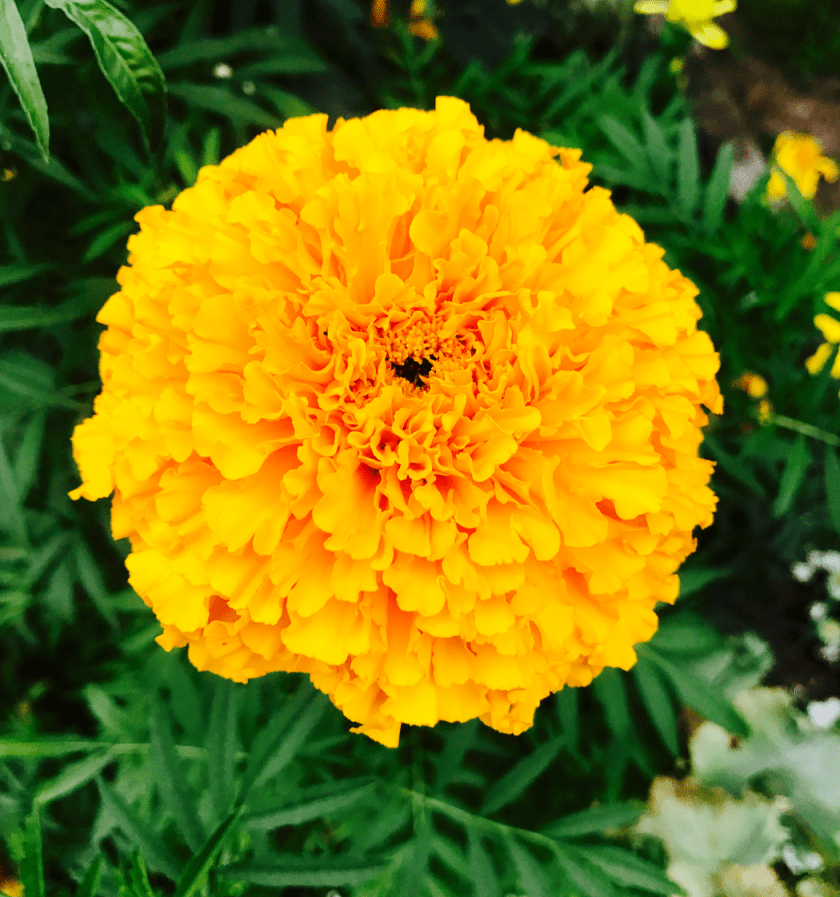
That’s one of the most perfect flowers I’ve ever seen growing out in my backyard. My wife picked up these seeds for almost nothing on sale, just threw them out into one of the gardens, and this is what we ended up with. Wow. That woman can grow anything.

around town, taking pictures of flowers and plants and trees and birds and… Well you get the idea. So indoor projects and hobbies take a backseat to outdoor stuff this time of year. When the temperature starts dipping below freezing and the snow begins to fly, that’s the time to work on those indoor projects. Maybe.

Screen Shot 2017-08-27 at 5.53.24 AMSpeaking of flowers, I really, really wish I’d put in more of these guys. We only have two or three of these and they are absolutely amazing. The brilliant red color, the shape. They just shot up through the white alyssum with that amazing contrasting red. Make note to self to put in more of these next year.
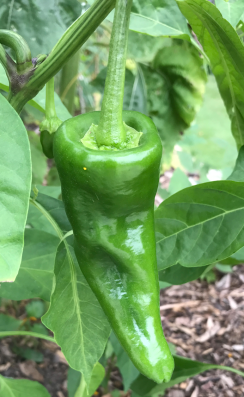
We finally admitted that we planted a lot of stuff way too close together in the vegetable gardens and did some serious weeding out of the pepper plants last weekend. This wasn’t much of a sacrifice because we just pulled out all of the “cherry bomb” hot pepper plants which were just nasty. I suspected they were going to be a bust when I brought one in, cut it in half, and almost immediately my eyes began burning. I like a bit of heat, but these things? I gave one to my neighbor who loves really hot peppers, he took a bite, and about five minutes later put down a half gallon of milk to try to stop the burning.

Screen Shot 2017-08-27 at 5.55.05 AMSo out they went. And it’s resulted in an almost immediate improvement in the other peppers we had planted in there.
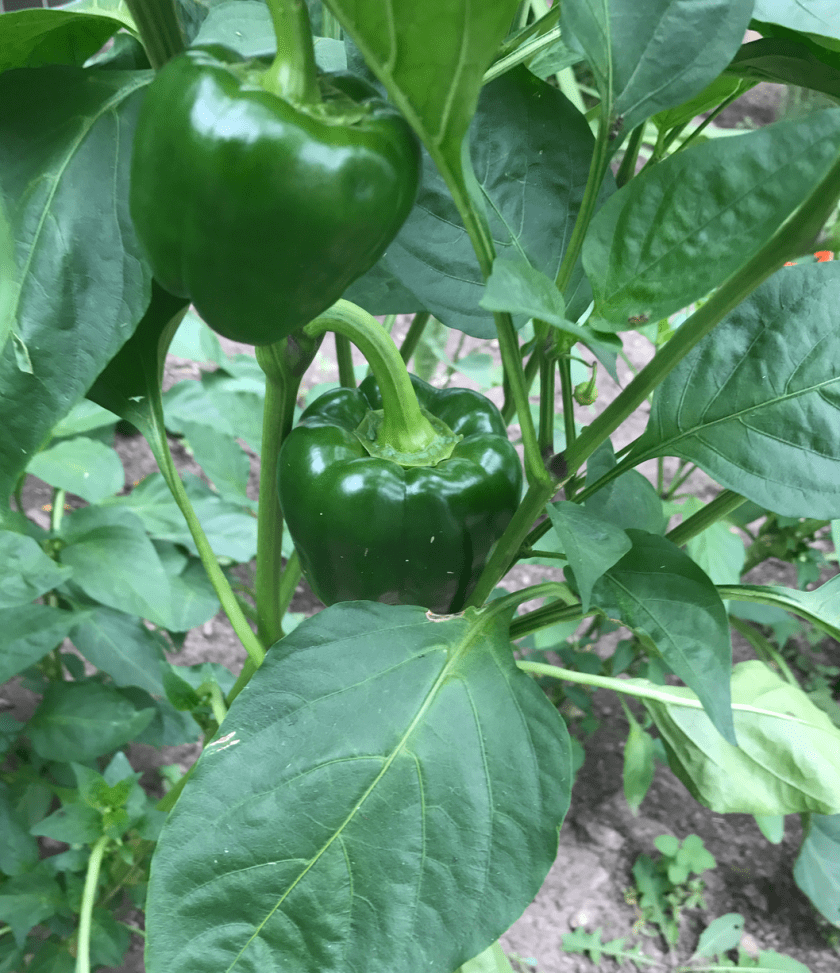
The poblanos and banana peppers began looking much healthier and started to set a lot more fruit as soon as we thinned things out.

I don’t know why we can’t learn this lesson. Every year we end up crowding things too close together in the beds, and at the end of every season we promise ourselves we won’t do it again. But the following spring there we are crowding things in again.

We really like the poblanos (ancho) peppers and the banana peppers. MrsGF and I both think they have far more flavor than the more common sweet bell peppers that are more commonly grown around here. But we did put in a few bell peppers as well and they seem to do be doing pretty good. We were a bit worried about them for a while there. The plants looked good but they were late in putting out blossoms and Screen Shot 2017-08-27 at 5.53.35 AMsetting fruit, but now they seem to be making up for lost time.

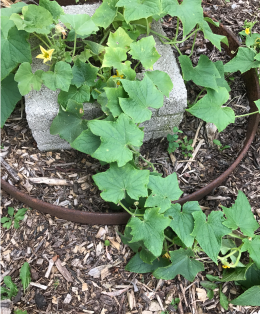
We’d never grown squash here before, and since we love acorn and butternut squash, we put some in just to see what would happen and this is what we ended up with.

That’s only four plants in there, and they’ve taken over that whole garden on the west side of the garage. Loaded with squash now. I don’t know how they grow that fast. The other day I mowed the lawn near there, and the following afternoon there were vines running three feet out onto the grass. How does a plant grow that fast?

Some are just starting to come ripe. We had one of the acorn squash last night. Just cut it in half, scoop out the seeds, put some butter and brown sugar in the empty seed cavity and bake until tender. Then just scoop out of the skin and eat.

Screen Shot 2017-08-27 at 5.53.14 AMThe cucumbers have been disappointing. I’m the only one who eats fresh cucumbers around here, so I only put in two or three plants and that usually gives me enough to satisfy my craving for fresh cukes, plus a few extra to make refrigerator pickles or something. But this year they haven’t been doing all that well. The plants themselves are doing just fine, they’re putting out flowers, but actual cucumbers? Not so much. I think I’ve gotten maybe six cucumbers off three plants so far this year.
MrsGF thinks it’s because we’ve seen so few bees around this summer. I hadn’t noticed it until she mentioned it, but she’s right. Aside from a few bumble bees, I haven’t really seen any. I haven’t seen any honey bees at all. Usually this time of year we have a many different types of bees busily working away at the flowers. I have yet to see a single honey bee here this year. That’s very troubling.

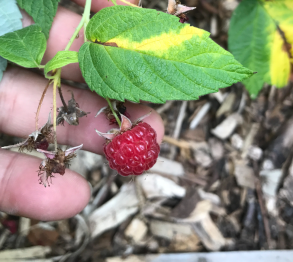
Screen Shot 2017-08-27 at 5.52.49 AMThen I ran into this yesterday. A single, lone raspberry. We only have a dozen or so raspberry plants tucked away in a corner of the garden behind the garage. I love raspberries but I’m not supposed to eat them because of the seeds. Still, it’s interesting how none of the berries ever seem to make it into the house. They seem to mysteriously vanish before they get in the door. Funny how that happens, isn’t it?

The raspberries were done producing fruit long, long ago, so I was surprised to see this lone berry out there when I was puttering in the garden yesterday. I’m surprised the birds didn’t get it.

Screen Shot 2017-08-27 at 5.51.44 AMGetting out of the garden and into the countryside, some people around here are wondering what in the world this stuff is. Fields of this have been popping up around here for the last couple of years now. It sort of looks like badly stunted corn, no more than three or four feet tall. It isn’t corn, though, it’s sorghum, or milo, and it’s being grown for Kaytee, the bird seed company. Their headquarters is in Chilton, about six miles from here. When I was a kid it used to be fairly common. It was grown as cattle feed or to make syrup. Looks like they have a pretty good crop of it this year.

Let’s see — The Old Timers are claiming we’re going to have a really, really nasty winter based on the proverbial “signs”. They’re also claiming winter is going to come early as well.

Screen Shot 2017-08-27 at 5.52.14 AM
A few maple trees have started to turn color. This is supposed to be a “sign” that we’re going to have a miserable winter. A safe prediction because in Wisconsin we generally always have a miserable winter.

The “signs” — ah, yes, the signs… I’m told the Old Timers can predict the weather based on the signs provided by nature, if only we were smart enough to interpret them. Things like the width of the band on fuzzy caterpillars, how and when birds flock together in the fall, how fat the bears are (well, not that any of them have ever actually seen a bear because they’re sitting down in the restaurant lingering for hours while nursing a cup of coffee while the waitstaff go crazy because they’re taking up a seat that a paying customer could be sitting in), maple trees starting to turn color early, that kind of thing.

Exactly how these mechanisms work is something they never explain, of course. I would be very interested in knowing how a caterpillar knows we’re going to have three weeks of -20 temperatures in January, or the geese know that we’re going to have a blizzard right after Christmas so they’re flocking up in August so — so they can what, exactly? Why would the geese even care? They’re not here when it happens so a blizzard in January isn’t exactly something they care about in the first place.

Of course the Old Timers don’t care about accuracy. By the time winter comes, anything they said will be long forgotten. Unless, of course, they hit a home run and actually manage to predict something, in which case they will remember and make sure you do too. It’s harmless and they get a kick out of it, so I just sit there and nod.

Screen Shot 2017-08-27 at 5.55.31 AMLet’s see, anything else? Oh, almost forgot. I hit 500 miles on the bike last week. When I turned up with a new bicycle on the back of the truck everyone was thinking yeah, right, he’ll ride it once or twice and it’ll end up hanging on the wall gathering dust until he drops dead and then we’ll have to sell the damned thing at the estate sale. If I keep up my current pace and the weather cooperates I should hit 1,000 before winter shuts things down.
And that is about it.

Tomatoes: We messed up, and Building Computers

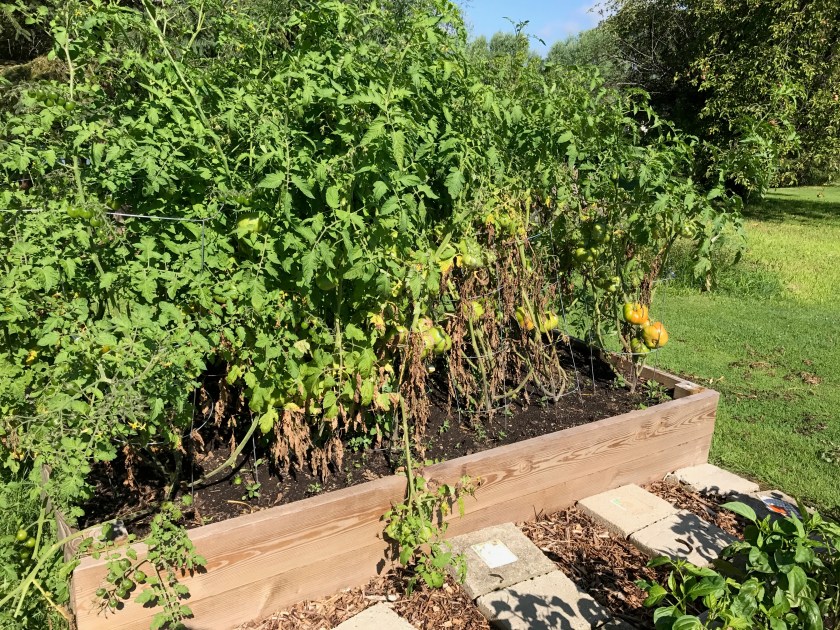
IMG_0551We messed up with the tomatoes this year. It’s partly our own fault, partly the fault of the weather this year. They’ve developed a kind of fungus that’s slowly working it’s way up the plant from the bottom, taking out the leaves. Not exactly pretty. We’re getting fruit, but we won’t get anywhere near as much as we should because of it.
Tomatoes can be a bit fragile. Depending on which variety you plant, there are all sorts of diseases the plants can get. In this case a combination of factors, the overly wet weather we’ve had this summer along with our planting the tomatoes way too close together, created an environment that permitted fungus to develop and thrive in the damp, warm conditions.

This is at least partly our own fault. We badly overcrowded the plants. There are twice as many in there as there really should be. Spreading the plants out more would certainly have helped. And there are commercial fungicides that can help with this.

We’ve been talking about putting in two more raised beds this size and perhaps this will finally get me to stop procrastinating and actually do it. We definitely need more space if we’re going to keep growing this many tomatoes.

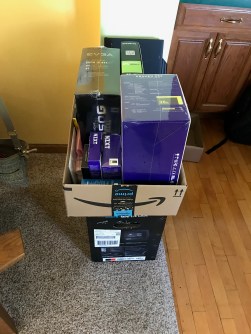
IMG_0556Computer stuff: My gaming computer, a really really nice Razor Blade laptop, decided it didn’t like me any more, got so hot the case burned my hands, and then died. I suspect the graphics card went bad, but we’re not really sure. In any case, it’s well outside of the warranty period and would probably cost more than the computer is worth to try to get it fixed. And it was pointed out to me that I could build a computer with much better specs than any gaming laptop had, for half the cost, if I went with a desktop system. So Saturday we were sitting here looking at the box full of stuff you see there on the left.

Now the last computer I built with my own hands was a 486, so that ought to give you some idea how long it’s been. I could probably have put one together myself, but Eldest Son builds this kind of stuff all the time so I let him spec out the system, select the parts and actually put the thing together. ES figures that if anything is worth doing, it’s worth doing not only to excess, but ridiculously over the top. So what IMG_0566I ended up with is this over on the right.

What we ended up with was a transparent case to show off all the fancy bits inside, and enough strobing, glowing, swirling interior lighting to put a 1970s disco to shame. All it needs is a spinning disco mirror ball hanging inside to complete the look. Sheesh…

Of course absolutely none of that has anything to do with how it actually works as a computer. So, how does it work as an actual computer? Holy s**t it’s fast! The latest Core i7 processor clocked at 4.7 Ghz, high speed Samsung SSD, threaded this and hyper that. The thing has a liquid cooling system and 8 (???) fans, 8 USB3 ports, 3 Thunderbolt ports.

And I have absolutely no idea how well it works for gaming because the video card was DOA.

Sigh… We suspect it was damaged in transit because it looks like one of the shields on the card was pushed into one of the circuit boards, so ES took it off to get a replacement. It runs, but only using the motherboard’s built in Intel video.

The interesting thing is that it seems no one has Nvidia graphics cards. It took ES almost two weeks to get this one in, and a quick browse around Amazon indicates that pretty much no one has them in stock right now. Every single listing for the Nvidia 1050 or 1080 card shows “Not available until August 10”. What’s going on? I have no idea.

So until we can get the Nvidia card replace, I won’t really know how well it will work as an actual gaming machine.

Oh, I also switched off almost all of the interior lights on the thing. It looks really neat. For about 30 seconds, then the strobing and swirling and lighting effects become seriously annoying.

Garden Update

It’s been a while since I talked about the gardens here, so let’s take a peek at those. It’s been an odd season here with above normal rainfall and rather cool temperatures. It’s been good for some things, bad for others.IMG_0552.jpg

We aren’t sure what in the world happened to the dahlias this year. Those are the red flowers behind the cone flowers in the foreground. They just went absolutely crazy. I’ve never seen them get this big before, at least not around here. They’re 4 – 5 feet tall and so thick and lush that it looks like a jungle in there. The cone flowers seem ridiculously happy back there too as you can see. And the sunflowers — oh brother, they’re pushing 7 feet tall.

Handy hint – if you love birds, especially finches, put in some sun flowers. We’ve been putting a few sunflowers in back there for years. It’s right by the window above the kitchen sink and later in the season the finches swarm around that area going after both the cone flower seeds and the sunflowers. They’re great fun to watch, arguing with each other, dangling upside down like little acrobats as they go after the seeds.

IMG_0549.jpg

The butternut and acorn squash have completely taken over the garden at the back of the garage. We’ve had issues back there because it gets shaded out quite a bit. We’re constantly dragging the vines out of the lawn, out of the raspberries, out of, well, out of everything. They seem to grow a foot or more every day. Absolutely loaded with squash now and still blossoming. We hauled a lot of compost into this bed also last year and it’s paying off now.

Screen Shot 2017-08-06 at 6.15.40 AM.png

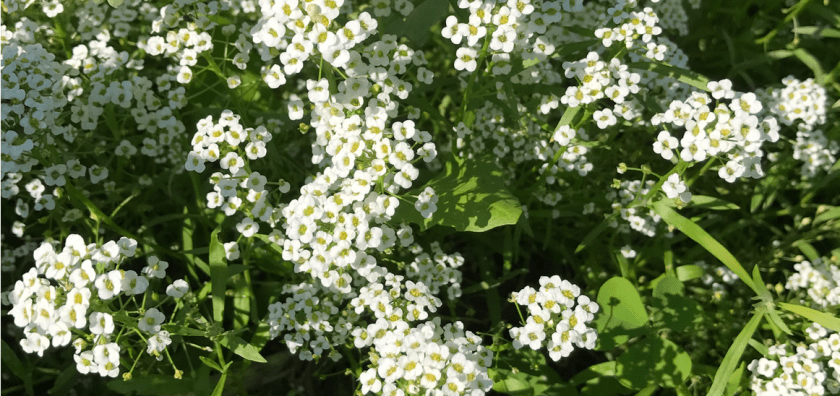
One of my issues with modern hybrid flowers is that they’re all show and no scent. I am a very scent oriented person, and it’s always disappointed me that so many flowers that I remember having amazing aromas when I was a child smell pretty much like nothing these days as the plant breeders have selected for ever more showy flowers, and sacrificed the scent, sort of like how they’ve selected vegetables for high yield and tougher fruit to make transport easier, and lost much of the flavor. The alyssum, though, make up for it. Tiny, tiny little flowers that put out an incredible amount of perfume. The scent is almost intoxicating.

IMG_0544.jpg

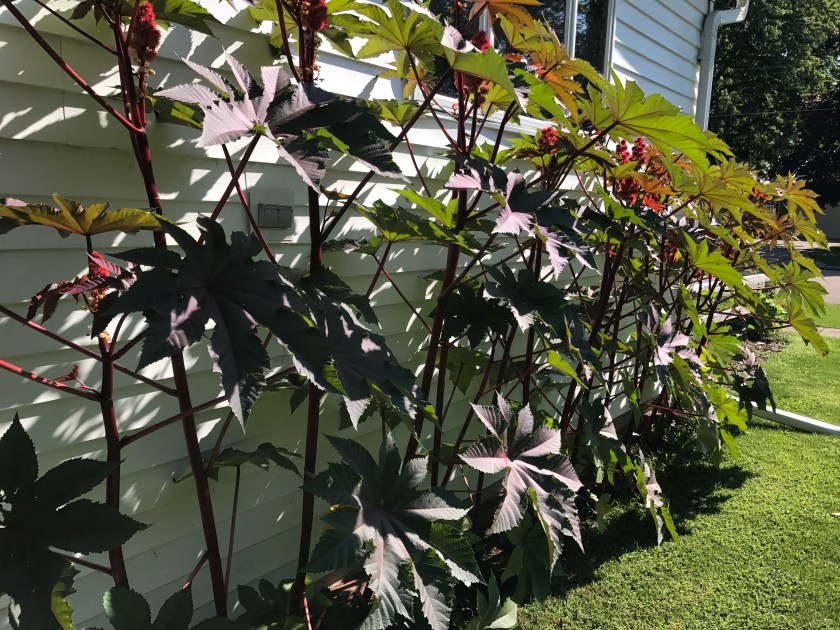
Then we have these guys. They sort of look like something from an alien planet or exotic jungle, these beans. The leaves are a foot across, a rich burgundy color when small, then changing to a reddish-green with red veins as they get bigger. They’re about 6 feet tall right now.

IMG_0554.jpg

The hostas up front have been enjoying themselves too this year. I’ve always loved hostas and we turned this into a hosta garden a few years ago. It had been a mish-mash of odd bushes, grass that never grew properly, some very invasive bushes that someone decided looked pretty. It was a mess. We ripped everything out, tilled up the whole works, put in the cedar fence and started putting hostas in. And we also seem to have pots of plants all up the stairs, along the deck… good grief, where did all those plants come from?

IMG_0559.jpg

Okay, this isn’t a plant. In the process of building a new gaming computer. My Razor Laptop died on me a couple of months ago and we’re building a new one. We’ve been working under the belief that anything that’s worth doing, is worth doing to excess, so this thing is fairly well loaded up with every goofy thing you can imagine. Interior lighting systems, the CPU cooler has a sort of vortex lighting effect built into it, the fans light up like multi-colored strobes, matching LED light strips inside, even the dopy RAM lights up.

It’s running a liquid cooled Kaby Lake Core i7 processor at 4.2 gigahertz overclocked to 4.7, a Samsung SSD, 8 USB3 ports, Thunderbolt ports, built in WiFi, bluetooth, 6 fans…

Unfortunately the Nvidia video card you see there was was DOA. It worked the first time we turned the computer on. Then we shut it down, did some work on the machine, turned it on, and the card was dead. Sigh… It works on the MBs built in Intel graphics, but that isn’t suitable for any kind of gaming. Grrr… So it’s going to be a while before we get it up and running the way it should be.

Still, dear lord that thing is fast. Eldest son was so impressed he’s thinking of building one for himself.

Queen Ann Lace and More Stuff

IMG_0489.jpg
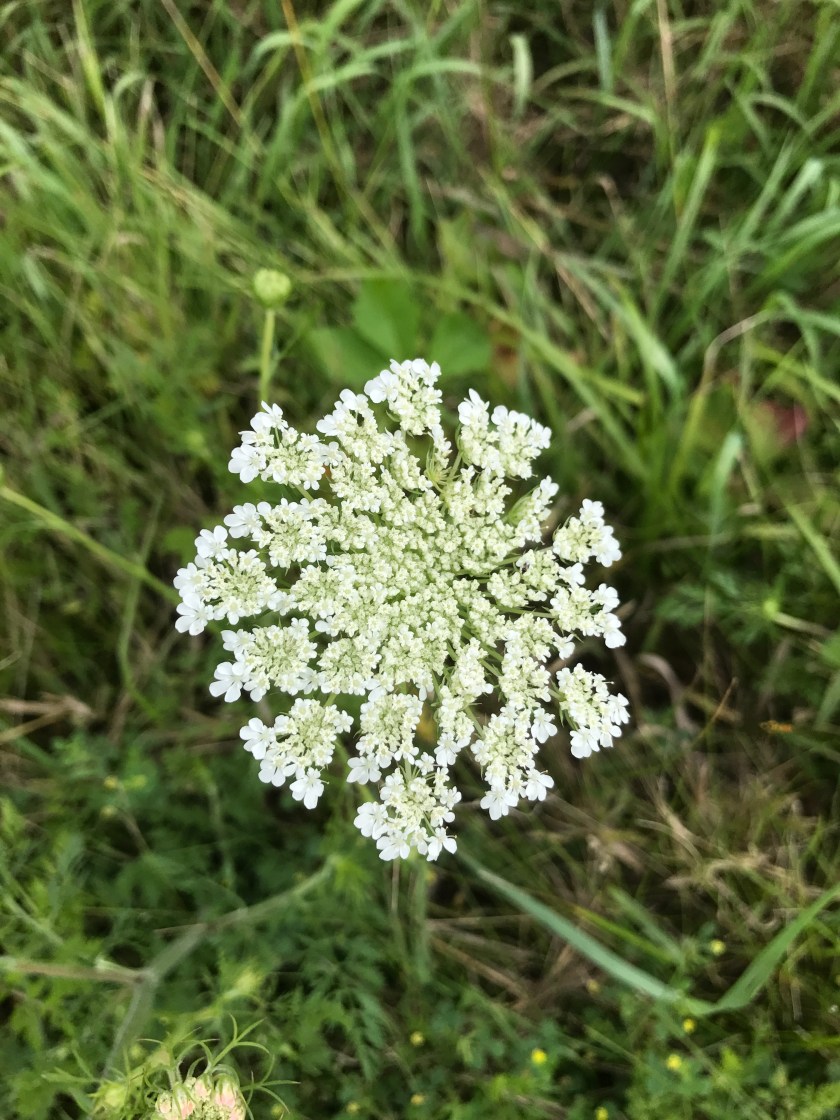
Queen Ann’s Lace (Wild Carrot)

Queen Ann’s Lace grows along the roadsides, along lanes and trails, and while a lot of people treat it like a weed I’ve always thought the flowers are absolutely beautiful. We had it growing on the farm when I was a kid. It would pop up along the lanes, on sunny, sandy hillsides in the woods. It was very common. Still is.

It’s actually a wild carrot. Supposedly the roots are edible, at least when young, and taste like, well, carrot. Apparently some people claim they eat the leaves and flowers, and other people claim it’s poisonous and will kill you. I certainly am not going to volunteer to try it and find out which is true.

My mother loved them too. She’d collect them during the summer, tie up bunches of them and hang them in the garage to dry the flowers. She also told me that some people apparently made tea out of the stuff. According to the stories she’d heard as a kid the local Native Americans made an herbal medicine out of it by steeping parts of the plant in water. Years later I learned that apparently the stories were more or less right, although not in the way she thought. A local historian told me that it was used as an abortifacient and contraceptive.

Then along one of the bike trails this stuff is popping up:

It’s a striking plant, can get very tall, and the flower head is spectacular when it’s in full bloom. This stuff used to grow along the trails and fence lines on the farm too. My father called it “Indian tobacco” or wild tobacco.

It’s actually the common mullein, and isn’t native to North America. It’s fairly common. It isn’t a nasty plant, but it can harbor some nasties, like cucumber mosaic virus and powdery mildew, so you probably don’t want it growing in your garden.

And it seems my father wasn’t really wrong because while it is not tobacco, the Native Americans apparently did smoke it as a treatment for breathing problems. it’s also been used in a wide variety of other allegedly medicinal preparations.

It’s interesting how I seem to have come full circle. As a kid, seven, eight years old, I’d spend hours wandering around the more wild areas of the farm, watching the animals and insects that congregated around the stream, walking through the woods examining the plants and wildlife with intense curiosity, and now that I’m retired I find myself doing the same thing and enjoying it just as much as I did when I was a kid.

Farm Catch Up

Stories you might have missed about food, agriculture, and the ever popular ‘stuff’, along with occasionally snarky commentary.

Coffee Linked To Not Dying!

Screen Shot 2017-07-12 at 2.14.11 PMOoo, coffee — that delightful, delicious beverage that both pleasures the taste buds and enlivens the brain, oh I feel so sorry for those of you who drink tea. (Come on, you tea drinkers know what you’re drinking is lawn sweepings soaked in tepid water, right?)

Anyway, now that I’m done annoying the tea drinkers out there (you know who you are), let’s get on with this.

That headline up there is not clickbait. It’s true. According to a study published actual real live doctors from an actual research facility and published in an actual science journal (not the Flintstone’s Institute for Advanced Studies of Sciency Stuff and Flat Earth Society where most of the congress apparently gets its science information) you have almost a 20% less chance from dying from just about anything if you drink coffee. Well, probably not getting hit by an asteroid or something like that. They mean heart disease, stroke, cancer, that kind of thing. If you click the link it will take you to an article over on The Guardian and you can get the links to the actual study from there.

Missouri Bans Dicamba

Missouri joined Arkansas in issuing an emergency ban on the sale and use of herbicides

Screen Shot 2017-07-11 at 6.29.22 AM
soybeans damaged by dicamba

containing dicamba after it was learned that more than 200,000 acres of non-GM soybeans were allegedly damaged by the product. The Arkansas ban was approved by the Governor’s office and will go into effect on July 11, and is in effect for 120 days. The Missouri one doesn’t seem to have a specific time limit, but the agency involved in Missouri said it hoped the problems could be resolved and the ban lifted yet this growing season.

Dicamba has always been difficult to work with. It turns to vapor and can drift for extremely long distances. Non-GM soybeans are extremely sensitive to the product, and even a tiny amount can damage the crop, so any kind of drifting is a serious problem. Monsanto has claimed that it’s “VaporGrip” version of the product cured the problems when used properly. But it doesn’t seem to be working very well.

So, you ask, what dos Monsanto say about all of this? Glad you asked.

They’re blaming everyone else, of course. In an interview over at CropLife, a Monsanto spokesperson blamed everyone and everything except, of course, it’s product. Farmers spraying at the wrong time of day, having residue from other products in the sprayer’s tanks, not following proper procedures, using the wrong spray nozzles, spraying in windy conditions. And all, of course, without offering any proof that any of this actually happened.

More Chlorpyrifos Controversy

Five states (and I’ve heard several more are in line to do it too) are suing the EPA over it’s decision to permit the continued use of Chlorpyrifos, a very nasty pesticide that is known to cause serious health problems, especially in children.

I mentioned this before. Last year the EPA determined that chlorpyrifos was dangerous, and public health organizations, doctors and other health care professionals have been pushing for it to be banned for years. The EPA was going to ban the stuff at last.

But then along came Pruitt and he claimed the stuff is just fine and dandy and that they had real actual “meaningful data and meaningful science” to prove it. Associated Press, other media, and health officials have repeatedly requested the EPA provide them with the data, but the EPA has refused to respond to any of the requests.

I don’t like being a cynical old bastard, but I get the feeling the EPA hasn’t provided it yet because they have interns locked in a back room somewhere desperately trying to write something sciency enough to fool the average reader into believing this stuff is “safe”.

Oh, I should point out that DOW, which makes chlorpyrifos, contributed $1 million to Trump to fund his inauguration, its CEO is supposedly good friends with him, and it has spent over $13 million “lobbying” various politicians in the past year.

Commodities Markets Are Weird

If you followed my old blog on Tumblr you know I’m fascinated with the agricultural commodities market and how it functions. Or, rather, how it doesn’t function, because it’s often so screwed up it’s laughable. Often what’s going on in the futures markets seems to have little to do with reality. Like right now.

USDA came out with it’s crop status report, and it’s the worst that they’ve issued since the 2012 drought, with only 65% of the corn crop rated at “good” or better, and only 62% of the soybean crop rated “good” or better.

Now during the drought, corn and soybean prices skyrocketed, with corn pushing the $8/bushel range for a time. So you would naturally think that a report that bad would push the prices up, right?

Well, no. After the report came out, corn prices fell by about 5 cents a bushel, and soybeans dropped more than 12 cents.

Apparently what drove the morning price down was that the report wasn’t as bad as they thought it would be.

Bureaucratic Run Around

More on the dicamba front: BASF, which has partnered with Monsanto to produce the special dicamba blend that was just banned in Arkansas and Missouri after enormous numbers of complaints about crops damaged by the herbicide, is trying to pull a bureaucratic end run around the ban by applying for something known as a “special local need label”.  This is a special permitting system that allows the use of a pesticide that normally cannot be used, because no other pesticide would be effective. Basically it was originally intended to help during emergency situations where there was an infestation of some pest that threatened to wipe out a crop, and only a non-registered pesticide would work. If you want, you can read the information about that whole process here.

Considering dicamba has damaged literally hundreds of thousands of acres of crops as it has drifted across the countryside, it seems that problem here is dicamba, not the weeds it’s supposed to control.

What The Hell Is Milk Anyway?

Screen Shot 2017-07-11 at 7.42.36 AMThere is a lot of fighting these days over the definition of the term “milk” when it comes to products being sold to consumers, specifically over the use of the term in describing drinks made with various nuts and beans. I.e. “soy milk” and “almond milk” and that kind of thing. Even USDA isn’t sure, and is using the word “milk” in much of it’s literature when referring to these products.

I can certainly understand why the almond industry wants to use the term. It’s because calling “almond milk” what it really is, isn’t exactly appealing. If they labeled it accurately, they’d have to call it “97% water with a few ground up almonds, emulsifiers, stabilizers, gums, flavoring agents, coloring, added vitamins and minerals and preservatives and you’d get more nutrition from just eating five or six actual almonds than drinking this stuff beverage”.

Try fitting that on the label on the bottle.

Rural Internet Access

For anyone living out in the country internet access is a major problem. There are various schemes and scams floating around that claim they will bring high speed internet to rural residents, but most of them are never going to get anywhere for various reasons.

Why won’t the ISPs connect rural customers? Cost, of course. It would take ages for them to make up the cost of connecting everyone outside of cities and towns. The same thing happened with electricity and telephone back in the day, the providers wouldn’t hook up rural areas until the government pretty much forced them to and paid a lot of the costs associated with it. And in this current political climate, well, a prominent Wisconsin politician (Sensenbrenner) is on record as saying that no one actually needs internet in the first place, thus illustrating that he hasn’t a clue as to what life is like out here in the real world.

The problem with most of these schemes is that they rely on some type of radio communication, either types of cellular networks, microwaves, or some kind of extended wifi system. And the fact of the matter is that we don’t really have the spectrum available to make these schemes work. The radio spectrum is so severely overcrowded now that cellular companies are paying billions of dollars for access to a few frequencies to expand their networks and improve their systems. So exactly where they’re going to squeeze in these new services is problematic.

The other problem is that some of these systems are already being tested or are even already in use in limited areas, and they don’t really work very well and they aren’t really all that fast. We have a kind of microwave system in use around here serving residents that live outside of the wired system, and it has some serious issues. Heavy rain and snow disrupts service, speeds slow to a crawl during ‘prime time’ when many people are trying to use the system, and most of these systems are very expensive, have some very serious data caps, and have lots of other issues associated with them.

Yet another problem is that what the feds are calling “broadband” isn’t really broadband by anyone’s definition. The US has some of the most abysmal internet speeds of any first world country. The ISPs here have been concentrating on throttling back usage, restricting bandwidth, charging utterly ridiculous amounts of money for going over artificially created caps so they can cram ever more paying users into an already overloaded system, and not investing any of that money in improving the infrastructure or in extending their coverage. The result is that US speeds are about half of what they are in the UK, the EU, Japan, Korea, and even the metro areas of China.

The feds definition for “broadband” internet for rural areas is even worse than what it is in urban areas, about 10 meg/second. So you can forget about making that conference call to work if your kid is playing WOW or your dear spouse is down in the basement watching PornHub.

Manure Rules

Wisconsin is finally doing something about the very serious contamination of wells by

Screen Shot 2017-07-12 at 2.45.57 PM
Why is she wearing a mask? If you had to pose in a swimsuit with a bunch of cows, you’d probably wear a mask too.

manure from farming operations. I’ve mentioned before that we have had problems with well contamination from farm runoff, especially in Kewaunee County, were it’s estimated that 30% – 40% of the wells are contaminated. It hasn’t been widely reported, but the problem is so bad that local organizations, schools and others have been giving out drinking water to local families because of the widespread contamination of the wells up there.

The state is going to be issuing new rules that will finally put some restrictions on when, how and where farms can spread manure. Hopefully this will help.

Okay, okay — I know that photo has nothing to do with the story. But if I come across a photo of a person in a swimsuit, wearing a mask, standing with a bunch of cows, I’m going to put it up. I can’t help myself.