Some motor vehicles become iconic. Almost everyone, at least in the US, will instantly come up with an image of the Ford Mustang in one of its many forms. A classic shape that Ford has more or less stuck to since it was first introduced in the 1960s.
Another automotive icon is the Jaguar E-type.
That up there is the image most people think of when someone brings up the car brand.
Jag has always produced cars that are stylish, sporty, elegant and, of course, bloody expensive. And often not very well made, I’m afraid. My experience with Jag is that it is a company that has always valued style over substance. That beautiful E-type up there? I never owned one but I have driven two different examples of that car back in the 1970s when they were still relatively new, and I can tell you from first hand experience, that while looking at one is fantastic, driving one is something else again. Both of the ones I drove were utterly awful in every single way. Over the last 20 years or so that’s changed, the cars certainly handle and perform better. But, alas, they have earned a reputation for unreliability that has hurt sales badly.
Jaguar’s biggest problem though has always been that it can’t seem to be able to actually sell cars. At least not enough to remain profitable. The company has changed hands more than once over the last few decades, and since 2007 has been owned by an Indian conglomerate called Tata. And it is doing worse than ever, I’m afraid.
Jag’s solution to the problem is to stop building cars entirely. Seriously. It is completely shutting down all production of all current models and in the future it is going to completely retool and produce only newly designed EVs. So what is it going to do to tide itself over while waiting to bring out the new models?
This is what Jaguar dropped on an unsuspecting world a few days ago:
I’ve watched that ad about six times now and I still don’t know what the hell it’s supposed to be. No one else seems to know WTF it is either.
The ad sparked a firestorm of controversy on social media, as I’m sure you can imagine. The comments on FB, X, Youtube, etc. have been scathing, and often they have descended into downright abusive language and even hate speech directed at “woke” ideology and LGBTQ persons. It’s all really rather sad.
Basically all Jag has going for it right now is its brand, Jaguar, a maker of over priced, over powered, stylish and not very good cars that seemed to be aimed squarely at the kind of fellow in upper management who takes his Jag to a secluded resort in the Catskills to cheat on his wife with his trophy girlfriend, and the golf clubs in the back so he can go golfing with his boss on Sunday while trying to explain why he doesn’t have all the receipts for his expense account claims.
What this ad tells me is that Jag is desperately trying to change that image. And I mean seriously desperate. It also tells me that they don’t have a fucking clue as to what the hell they’re actually doing. They have no sense if direction, no market that they’re aiming at, no technology they are trying to push, and worst of all, no cars. They got nothing. So all they can do is put out whatever the hell this is to try to keep the brand name alive until they have something, anything, they can try to sell.
But this? This is supposed to give consumers confidence in the brand? This is supposed to somehow make people curious enough that they’ll wait until Jag can retool and start producing cars again? No. Sorry.
Stop it. Just stop it. It’s time for Jaguar to just hang it up and retire gracefully instead of trying to hang on far, far too long like an aging quarterback who refuses to admit he no longer has the ability to compete.
It’s been ages since I posted anything here except for the brief announcement about Cat moving in with us. But there is a good reason for that. Pretty much nothing has been going on here. At least nothing worth writing about. But now I do.
Solar, Taxes and ROI
So we just got our taxes back from the accountant so I wanted to talk about money and solar power. Especially about the 30% federal tax credit for the purchase of solar equipment. I’ve been wading through a lot of solar power related forums for some time now and there is a lot of misinformation floating around about this, so let’s see if I can straighten some of this out.
First of all, the best way to determine what is or is not a qualified purchase for the purposes of the tax credit is to go straight to the horse’s mouth, the IRS, and the agency’s information about Form 5695, which is how you apply for the tax credit. All of the information you need is right there if you click on that link up there. Stop paying attention to the self appointed “experts” on the internet and go directly to the IRS if you want information.
Note first of all that this is a federal tax credit. That means it is applicable only if you owe the federal government. It goes towards reducing the amount of tax you pay.
In our case here pretty much everything that we bought for the solar power system was allowable: batteries, solar panels, inverters, circuit breakers, wiring, switches, etc. could be applied to the tax credit. Once our accountant got done with all of it, our residential energy tax credit amounted to about $5,000. Needless to say, MrsGF and I were more than pleased with this.
So what does this mean when applied to our out of pocket costs? When everything we had receipts for (you did save your receipts and invoices, right?) was added up our total cost, including solar panels, was $16,000. The tax credit brought that down to $11,000.
So let’s now talk about ROI, or return on investment. How long will it take for our solar system to more or less pay for itself?
Since we put in the system about a year ago we saw a dramatic decrease in our electric utility bill, far more than I’d anticipated. I had estimated that if we were able to use the system as intended, it would cut our utility bill by about 1/3 when it was in operation. This should have been significantly more but at the moment we are restricted because we can’t get enough solar panels out there to really feed enough power into the system. We’re going to need to mount panels permanently on the garage roof. We can fit about 5KW – 6KW of panels up there. But the garage roof (and the house, for that matter) are scheduled to have the roofs replaced in another year. That’s how we have things budgeted, and we aren’t going to change the schedule at this point in time. It doesn’t make sense to put all those panels on the roof, only to have to take them all down again and then immediately have to reinstall them in a year or so when the roof is replaced. So for the time being we only have 2KW of solar out there on the backside of the garage. Once we get enough solar panels out there, we can take full advantage of the system and batteries and there should be a lot of days when all of our electrical needs are met by solar.
Anyway, let’s look at some numbers. Our electric bill in the year before we put in the system was pushing close to $300/month and some months even more. After we put in the system that dropped to around $150 – $170 per month. We estimate that we’re saving about $1,800 per year.
Our cost after the tax credit was $11,000. 11,000 divided by 1,800 is 6.11. So the system will basically pay for itself in 6 years. That’s assuming the rate we pay the utility for electricity stays the same as it is now, $0.16/kWh. And the chances of that rate going up significantly in the next few years are pretty much 100% considering the way things are going.
Of course our expense is going to go up when we add more solar panels, but once we do that we’ll be able to utilize the system more fully and further cut our utility bill as well.
I still need to do some work on the system. It is still in “experimental mode” so to speak. I need to make some changes to the wiring, run conduit, add a few safety features dictated by building codes, etc. But now that I know the system pretty much works well I can go forward with that.
V2H
In case you don’t know what that means up there in the heading, it stands for Vehicle to Home, and it’s related to EVs and their potential use to power a house during a blackout. The idea is, of course, that you have this massive battery pack sitting in your EV so why not use that power, or at least some of it, to keep essential equipment running in your home during a blackout.
There is also something called V2G, vehicle to grid, which is where the utility company wants to suck the power out of your EV to keep the grid going under heavy load conditions, but that’s an entirely different subject.
Ford made a big deal out of the V2H capabilities of the Lightning when it was first introduced, promising to actually sell you all of the equipment you’d need to do it. At the time I did a bit of research and the marketing people were saying the kit to do this would cost about $5,000, which I thought was a bit expensive, but not too horrible, all things considered.
Well last week I was talking to an actual real person who puts these things in out in California and I found out that the $5K price that was initially bandied about was ridiculously optimistic. He just put one in last week and the total cost was actually $14,000. He’s done about a dozen of these now and the cost of the installation, including labor parts, etc, has been running between $12,000 to $15,000 depending on what the electrical service in the customer’s home is like.
But $14K??? Seriously? That is a hell of a lot of money just to be able to suck power back out of your truck. Especially when you consider that my entire solar system, including batteries, inverters and solar panels, was only $16K.
That’s about it for now. Hopefully I’ll be getting back to updating this on a more timely basis!
I was going to wrap up this whole Bluetti/solar generator discussion last time but some additional stuff came in email (theoldgrouch@grouchyfarmer.com) and other sources, so let’s get on with this.
Battery Safety
A couple of people have apparently been spending way too much time on YouTube watching people deliberately blowing up lithium battery packs and expressed the opinion that having a lithium battery in your home is the equivalent of having a rather large bomb waiting to go off at any moment. I won’t bother to point out that there are literally hundreds of millions of lithium batteries out here in the real world that somehow have managed to not blow up or suffer from “runaway thermal events” as they call it. Instead I’ll just mention that the batteries in the Bluetti and in many of these systems use LiFePo battery chemistry which is not only much safer, it also gives the batteries a much longer lifespan. I’ve seen LiFePo batteries being beaten with hammers and rocks, drilled through multiple times, stabbed with fishing spear, had nails driven through them, etc. and none of them exploded or turned into unquenchable blowtorches. They will get hot, they will vent gasses that I would very much want to avoid breathing, but none of them got explody or anything like that. If treated reasonably well LiFePo batteries could potentially continue to work well for years.
Wiring
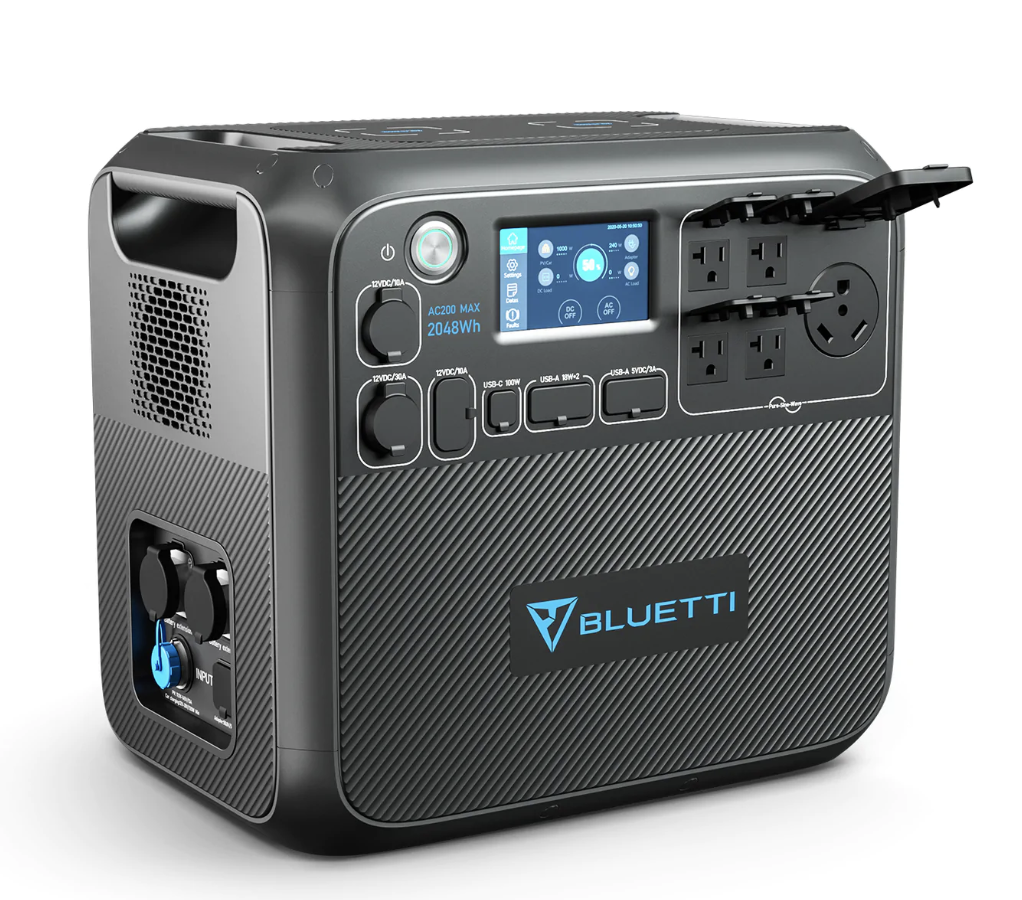
I got questions from a couple of people who have a power station or are thinking of getting one and don’t want to have to run extension cords all over the house in order to keep things running during a blackout. Why can’t you just use your house’s existing wiring system? Well you can, sort of. If you look at that photo of the AC200Max over there you’ll see a very large 3 prong socket on the far right. That’s a TT-30 plug, a high amperage connector. Well, sort of high amperage. If I remember right it’s only good for about 20 Amps because of the limitations of the AC200Max’s inverter. It’s intended to feed power to the electrical system of an RV but there’s no reason you can’t use that to supply larger amounts of power to a transfer switch system to feed selected circuits in your home without having to run extension cords everywhere.
So that takes care of… Uh? What’s a transfer switch? Ah I suppose I’m going to have to explain that now.
Okay, here’s the deal. You can’t just pump power from an external generator into your house’s electrical system. If you try most of your power is going to backfeed into the grid, overloading your generator and quite possibly killing some poor lineman working on a pole somewhere trying to restore power during a blackout. And you are not permitted to just shut off the main breaker on your electrical panel, either. In a lot of jurisdictions it is flat out illegal to hook any kind of alternative power source to your house’s wiring without the installation of some kind of transfer switch system.
And here’s an example of one.
This kit may seem expensive at $300 but it includes pretty much everything necessary to install one of these things. No, I don’t get paid by Reliance. I bought this thing with my own money. I don’t get kickbacks or free stuff or cash or anything like that. And I am seriously disappointed by this. Other bloggers get companies throwing stuff at them all the time: hugely expensive batteries, inverters, charging systems, solar panels, hardware, tools… Me? Zilch. Nada. I mean if, oh, Power Queen wanted to send me four of their 48V server rack batteries I’d be more than happy to test them out for five, six years. Or GroWatt. What’s up with you guys? Why haven’t you sent me one of your 8KW inverters, or that neat split phase unit? Hmm? I’m not above a bit of bribery now and then….
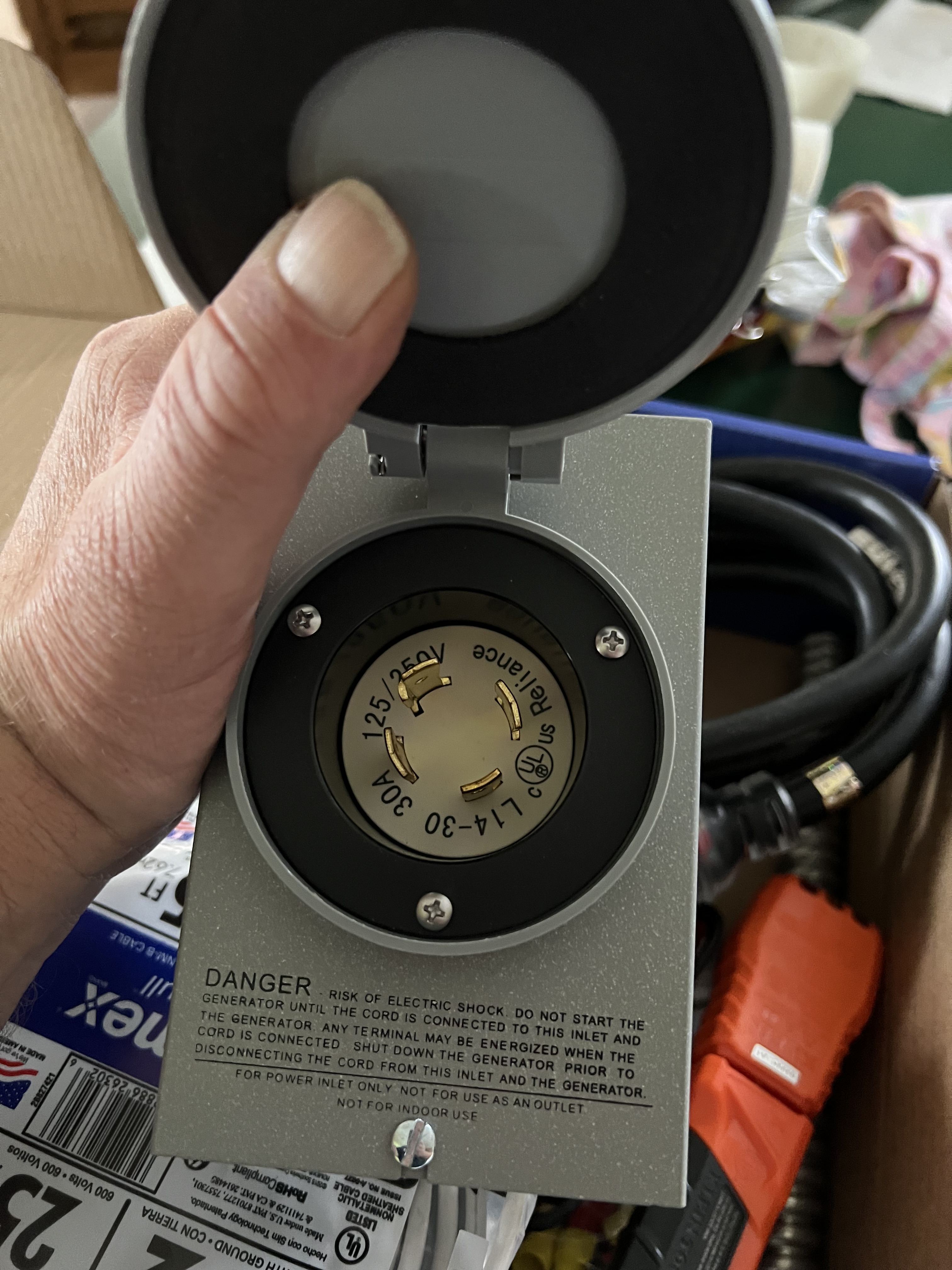
The Big Ass Plug (BAP). Well that’s what I call it. Oh, the orange thing in the bottom right isn’t part of the kit, that’s my Klein circuit tracer thingie.
That is a Reliance transfer switch kit that I picked up at a local home improvement store for about $300. These things are designed to allow you to take up to 6 individual circuits in your home and let you switch them to work with an external power supply like a generator or something like the Bluetti. A BAC (Big Ass Cable) plugs into the big socket on your generator, and the other end plugs into a BAP (Big Ass Plug) wired into the transfer switch. When you flip the switches on the box up there, you switch that circuit from the LINE, which is your connection to the grid, to the GEN input, which is fed by your generator.
And no, I’m not going to give you instructions on how to install one because I don’t want to be responsible for you electrocuting yourself or starting your house on fire or something like that. These things aren’t hard to put in. There are numerous videos out there showing you exactly how to do it. But I am going to put in the usual disclaimer that you shouldn’t go fiddling around in your circuit breaker box because you can kill yourself or someone else, burn down your house or damage equipment if you don’t know what you’re doing. In a lot of jurisdictions it’s technically illegal for you to do so. Legally you may need to get a permit, hire an actual real electrician to do the work, have it inspected, etc. before you can use one of these. So I’ll leave it at that.
Money Stuff
grouchyfarmer.com luxurious headquarters
During the weekly staff meeting here at the palatial offices of grouchyfarmer.com someone brought up the topic of maybe looking into some tax credits or something if we did a solar power system, so we’re looking into that to help offset the cost of putting in a 10 – 15 KWh battery system with something like a 8 KW or larger inverter fed with 48V batteries. We’re currently in the planning phase of that. With our electric bill running $300/month here, a decent tax credit and other factors it’s beginning to look as if it might make sense economically to install such a system to take at least part of the house’s needs off the grid.
Gardening Stuff
We already have most of our garden planning done, all the seeds bought already, and are just waiting for the weather to get better so we can get out there and start puttering around in the dirt again. We have a lot of plans, but whether or not any of it will actually get done is something else again. Some of the plans are on the expensive side and if we go ahead with the solar project that might eat up a lot of our discretionary budget for the year. So we’ll see.
I was promised a lot of things when I was a kid back in the 60s. I was told that I would have my own personal robot to serve me lunch. I was, they told me, going to be able to take a vacation on the moon or maybe even Mars. I was told I would have my very own flying car. I was told I would be able to fly from Chicago to Sydney Australia in an hour. I was told I’d have a talking computer that would understand human speech.
Only one of those things actually came true in my lifetime, the talking/listening computer that is generically called a “personal home assistant”, or specifically the Amazon Echo (often called Alexa after its wake word) and Google’s Assistant (sometimes referred to as Nest). I’m going to focus on the Echo because that’s the one I’m most familiar with.
These things are everywhere. Amazon has sold somewhere around 200+ million of these things. I think they sold about 70 million of them last year alone, and if sales trends continue it’s predicted the company will sell 130 million of them in 2025 alone. I know a lot of people don’t like them and are even suspicious of them. I mean we live in a world now where some poor woman ended up finding a photograph of herself sitting on a toilet that was taken by her vacuum cleaner ending up on the internet. But the fact remains that there are millions of these things out there and millions of people love them and even have come to depend on them for important reasons.
But there is a huge problem with the Echo and the others out there, and that is cost. Amazon sells these things at cost to keep the price down, and they are losing an absolute fortune. The company is losing billions of dollars on the Echo devices. The problem is that they require a massive and extremely expensive behind the scenes infrastructure to work. The devices themselves are, frankly, stupid. What makes them work are massive server farms, huge buildings packed with computers that do the actual work associated with operating these things. And Amazon hasn’t come up with a way to pay for any of it.
When the Echo program was conceived of, it was going to be a marketing tool. The Echo was going to be an advertising device and ordering system. It would remind you to buy coffee or dish soap or laundry detergent and you’d use the Echo to order more and things like that. Only it didn’t work out that way. In order to get people to accept these things into their homes Amazon had to make the a hell of a lot more useful than that. And they did too good of a job of it. They’re used as personal calendars, reminder devices, communications devices, entertainment devices, give reminders to take medication, play cooking videos, play fart noises, tell bad jokes.
And Amazon makes pretty much nothing off any of that.
Amazon makes huge amounts of money, true, but not even that company can afford to keep this going when it is losing literally billions of dollars on the project. The company has been laying off people working on the Echo devices and trying other cost cutting measures, but it’s losing billions and none of that is going to solve that problem.
I suspect Amazon would dearly love to shut down the whole program, but that would be a PR disaster. Despite the fact that a lot of people look at the devices with suspicion, a lot of people love the things, use them every day, and often use them in ways that help improve their health and safety. If Amazon were to just shut the whole thing down it would anger millions of people.
I haven’t done a Farm Catch Up in ages. I used to do these on a regular basis but I’ve been so busy with other stuff that I haven’t had time, so let’s see what’s been going on in the ag industry.
Rail Strike Still Possible
After union leaders, the railroads and the White House announced an agreement that would prevent a rail strike, I warned people that it was too early to do a victory lap. Union leaders may have accepted the deal, but it still had to be voted on by the union membership. Almost immediately one of the 12 unions involved in the talks rejected the deal, although a small one, and reports coming from out in the real world indicated that the rank and file of some of the other unions were not happy with the deal either. While the deal did give substantial pay raises and improved some benefits, it did little or nothing to fix the real grievances that the unions had, the biggest of which was the RR’s scheduling system which some employees called draconian and even downright sadistic. (I’ve read how the scheduling system works and if half of what I’ve heard is true, I would have quit the moment that system went into place. I won’t go into details, you can find that out yourself if do some searching for the railroad employee scheduling system.)
Now the Brotherhood of Maintenance of Way Employees Division Union (BMWED) the third largest of the unions involved, has rejected the deal, and we could be looking at a strike by mid-November unless the situation is solved.
The railroads have been having serious problems for decades, but you don’t hear about them because the media is too busy chasing after the latest celebrity gossip or bizarre conspiracy theory. Unless a catastrophe occurs, like a major derailment, you hear almost nothing about how the whole rail system has basically been falling apart.
What does this have to do with farming? A lot. A rail strike would cripple the agricultural sector of the economy. Ag businesses and farmers depend on the rail system to move bulk cargo like grain, beans, cattle feed, fertilizer, propane, fuel and many other products. Then add in everything else that is shipped… A rail strike would be a nightmare for all of us.
Fake Meat Markets Fizzle
Before I start this I should point out that I am not anti vegetarian or anything like that. My personal opinion is that we eat way, way too much meat to be healthy for us and we’d all be a heck of a lot better off if we could get people to eat more fruits and vegetables and less meat. But these fake meats are not the way to do it.
JBS, one of the three or four companies in the country that have a virtual monopoly on meat processing and distributing, announced it was shutting down its Plantera Foods division which was producing the “Ozo” brand plant based fake meat products, just two years after launching the company, because of disappointing sales. JBS says it will stay in the alt-meat business (that sounds better than ‘fake meat’ so I’ll go with that term) but not in the United States.
It isn’t just JBS that’s been having problems selling this stuff either. Sales of alt-meat products haven’t been doing so good. Beyond Meat’s stock value has plummeted. As of Sept.28 it’s stock value had fallen 75% this year. Sales of alt-meat products have falling by 10% in just this year along according to some data I’ve seen.
So why isn’t the stuff selling as well as they predicted? Impossible Burger and Beyond Meat’s products are supposed to be “healthy” and good for the environment and all of that and they’re supposed to be just as good as actual meat, so why aren’t people lining up to buy the stuff?
First is cost. Last time I looked the grocery store where we shop the Impossible Burger was selling for more than twice the cost of real hamburger. I haven’t bothered to look recently because frankly I don’t care, so I don’t know if prices have moderated a bit or not. What matters is that at most of the stores where I’ve found the stuff sell it for a lot more than regular hamburger 🍔 (Oooo, I just discovered that this goofy Macbook’s little status bar above the keyboard suggests emojis for me. Isn’t that just so – so useless?)
Second, the food industry as a whole has a long, long history of outright scamming the consumer and selling us garbage laced with salt, fat, sugar and artificial ingredients and labeling it not only as “food” but also claiming it is healthy. So people are justifiably skeptical of just about everything the food industry tries to tell us these days. If you read the list of ingredients on the Impossible Burger and Beyond Meat products, you will find almost nothing in that list that actually looks like real food. What you’ll find is a long list of chemical names, added vitamins, modified starches and other products that come out of the back end of a factory. There basically is nothing in that list of ingredients that I want to put in my mouth and I suspect a lot of people feel the same way after reading that list.
Third, these products just aren’t that good. I tried eating one of these things once, an Impossible Burger that I found in the freezer at the local grocery store. I made it according to the instructions and… Well, I’m sorry, I don’t see how anyone could ever mistake this stuff for actual meat. The texture and mouth feel was just -wrong. The aroma was extremely odd and the taste was, frankly, unpleasant. I couldn’t finish the thing. Slather it was ketchup and mustard and onions and I might have been able to choke it down, but eating it plain? No way. I’d rather eat a Bocca Burger. Still frozen.
Shipping Problems
As if disruptions with railroads and trucking weren’t bad enough, now the Mississippi River is giving us problems. A huge amount of product of all types is shipped on barges on the Mississippi River. Farmers and agricultural businesses in the midwest depend on river shipping to not only get grain and beans for export down to the Gulf of Mexico, they also depend on it to ship fertilizer, cattle feed and other products back up the river to co-ops, fertilizer distribution facilities and other businesses that sell bulk products to farmers. And thanks to scarce rainfall the Mississippi water levels are extremely low and barges are running aground. Reports are that water levels in the river system are at “historically low levels”. There are backups of barges at choke points on the river system. Barge loads have had to be reduced by up to 30% or more and towboats which usually push many barges at one time have had to cut the number of barges they can push. As of Oct. 4th the cost of shipping on the Mississippi had jumped up over 200%.
If you’re interested in actually watching shipping along the river, both barge and rail, there is an excellent live camera operated by Virtual Rail Fan in Ft. Madison Iowa that shows both the massive amount of rail traffic going across the Mississippi and a historic swing bridge across the river that has to open to allow river traffic to pass. The camera is on 24/7 and generally has a camera operator running it. In the spirit of full disclosure I should point out I am a VRF member and sponsor and you’ll occasionally see my name (No, not grouchyfarmer, my real name) listed on some VRF camera sites as a sponsor.
Why Are Egg Prices So High? Blame The Flu
I don’t know what it’s like where you are, but around here eggs are pushing up towards $5 a dozen. I was in a local grocery store three days ago and the price there was $4.79/doz. Why? Bird flu is at least part of the problem. Since February we’ve lost 47 million birds, mostly chickens and turkeys, to avian influenza in 42 states in the US. So between losses of birds to flu to increased costs for fuel, grain, labor shortages, etc, yeah, prices have shot up.
It’s affected chicken and turkey prices as well. Unless grocery stores use turkey as a loss leader you’re going to find a lot of families looking for a substitute for the traditional thanksgiving day turkey.
And that’s about it for now. I’m getting bored and I’m sure you are too. As always, comments are welcome. (Note: All comments are moderated and yours won’t appear until it has been checked.)
If you’ve followed this blog over the years you already know that I’m not a big fan of biofuels in general, and ethanol specifically. Since the ethanol blending mandates were first instituted, big agriculture, the government and the proponents of ethanol haven’t exactly been honest with us. Diverting a source of food for both people and animals, corn, into the production of fuel was never a good idea for anyone except, of course, the ag industry, its lobbyists, and the politicians they’ve bribed (cough cough, excuse me, slip of the fingers there) influenced to push ethanol fuel mandates. Ars Technica, of all places, has an interesting summary of the findings of a study just published last Tuesday in Proceedings of the National Academy of the Sciences.
The corn industry and ethanol industry, of course, immediately struck back by simply claiming that the whole study is, basically, a lie. And Monte Shaw, the head of the Iowa Renewable Fuels Association said he is “not interested in spending time on silly stuff like this“. So basically he is condemning the entire report without having even read the thing.
What the study discovered was that the biofuels industry is nowhere near as “green” as they’ve been claiming it is for decades. What the study showed is what a lot of people have been claiming for years now, that when all of the factors involved in the production of the corn used to make ethanol are added into the equation, ethanol is, at best, no better than using gasoline, it’s actually worse in some areas.
What’s ironic about the whole thing is that the whole ethanol fuel industry is doomed in the first place as we transition to EVs. Whether we like it or not the internal combustion engine is on it’s way out and is being replaced by electric vehicles. The ethanol industry can rant and rave all it wants, push for higher and higher percentages to be added to gasoline, and it all isn’t going to matter in the slightest because the market for the stuff is simply going to vanish along with the internal combustion engine.
GlyphosateShortages
Glyphosate, the generic name for the active ingredient in the herbicide RoundUp, is suffering from severe shortages, to the point where a lot of farmers aren’t sure if they’re going to be able to get any or not for the upcoming growing season. The manufacturer of a key ingredient has had a mechanical failure that’s shut down production. The product was already in short supply for several other reasons, most of them not related to the virus, I should add. The biggest problem was Hurricane Ida shutting down Bayer’s primary glyphosate production facility for an extended period of time.
Perfect Storm
There has been a sort of ‘perfect storm’ of garbage being dumped on farmers in the past few months and it looks like that isn’t going to ease up any time soon. It isn’t just glyphosate. There are shortages of fertilizers like potash and anhydrous ammonia causing prices to sky rocket. The craziness between Russia and Ukraine is causing fuel prices to increase, and putting pressure on the commodities markets because Ukraine is a major producer of wheat, sunflower seed, and rapeseed for canola oil. Prices on corn and soybeans are going up and up, which is great for the people who grow the stuff. But for dairy and beef farmers, it is causing serious problems.
What it all amounts to for us consumers is don’t look for food prices in the grocery stores to come down any time soon.
Meat Monopoly Rakes In Record Profits
If you wanted to have a nice ribeye or T-bone steak for your Superbowl party, you probably looked at the prices and once you got your heart restarted you settled for grilled cheese. Prices of meat, especially beef and chicken, have skyrocketed over the last two years, and it’s all being blamed on, of course, the virus. Or is the virus only being used as a scapegoat by the meat industry as an excuse to bring in record breaking profits?
Tyson, JBS and Nation Beef more than tripled their profits during the pandemic, despite claims that price increases were due to increased expenses caused by worker shortages and supply chain disruptions. They had a 120% increase in gross profits, and a 500% increase in net profits. And profit margins, the amount of money companies make over and above their expenses, have skyrocketed as well, with margins climbing to up to over 300% in some cases. If the price increases were indeed due to an increase in expenses, profit margins would remain flat because increases in profit would be offset by increases in expenses.
The entire beef processing system in the US is a monopoly, controlled almost entirely by four companies, Cargill, Tyson, JBS and National Beef. Chicken is controlled by Tyson, Pilgrim’s Pride, Perdue, Sanderson and Koch Foods. The situation is pretty much the same with Pork, with the biggest player there, Smithfield Foods (owned by, drum roll please, China) being the major player there, along with a couple of others. For all intents and purposes, the entire US meat production system is controlled by just a handful of multinational companies.
A Convenient Scapegoat
While I’m on the subject of the pandemic, let’s look at some other areas where it is being used as a convenient scapegoat to try to explain away problems and/or massive price increases.
Trucking – You’ve probably heard that there is a massive shortage of truck drivers due to the pandemic. That claim is only partly true. There is a driver shortage, yes, but it isn’t because of the pandemic. In fact, right now we have more registered CDL holders than at any time since trucking started. The fact is that trucking companies have never been able to hire enough truck drivers, and driver turnover rates are sky high. The problem is that driving truck is hard, frustrating work, laden with sometimes utterly ridiculous regulations in some areas and not enough regulations in others, and drivers are often abused, short changed and treated like garbage by their employers, and they don’t get paid very well either. I know one company out of Green Bay that keeps teams of drivers on standby to do nothing but fly out to pick up trucks abandoned by drivers who got so fed up that they couldn’t take it anymore and just left the trucks and walked away. I would imagine that most of the bigger companies have to do the same.
Ports – The ports in the US are really the main choke point here. The US has some of the worst ports in the industrialized world thanks to years of neglect and a failure to upgrade port facilities because that would cut into their profits. Like the trucking business, this issue with US ports actually goes back decades. While ports in Europe and Asia have been upgrading their facilities and making major investments in them, in the US little or nothing has been done to upgrade materials handling capabilities or to streamline operations. Even before the pandemic the US ports were just barely functional and were already causing disruptions in shipping. The pandemic just made an already existing problem worse and showed just how bad the situation was.
Drought
If you look at the drought map up there from https://droughtmonitor.unl.edu/ you can see that things look a bit, well, scary, really. Right now more than half of the country is under drought conditions that range from mild to extreme. For a while there it seemed the West might see some relief from what is, according to some climate researchers, the worst drought they’ve had out there in 1,500 years. But that situation seems to be changing and things are starting to get worse again. Water use restrictions are already in place in many places out there and more are almost certainly going to be instituted unless they get significant precipitation. Even here in Wisconsin we’re well behind normal for precipitation. Last I heard our snowfall amounts here were running 16 – 25 inches behind normal. I’ve only had to use the snowblower once so far this winter. Most of the snowfalls we’ve had, and we haven’t had many, have been a light dusting that we’ve dealt with using electric leaf blowers.
Of course weather is, well, weather, and things can change rather quickly, but I haven’t seen conditions this bad in a long time. The drought is one reason why commodities prices have been pushing up over the last few months.
Farmland Prices Climbing
Here in Wisconsin farmland prices have always been less volatile than in other parts of the country. Prices here haven’t gone up much since I sold the farm. But that’s changing. Here prices haven’t shifted a lot, but they’ve been moving up gradually. In other parts of the country, though, prices have gone a bit, well, bonkers, really. I’ve seen some sales where prime farmland was going for as much as $20,000 per acre, an amount that seems completely crazy to me.
One trend that I find extremely troubling is the entry of investment companies into the farmland market. This has been going on for a while now but they have been becoming much more active now and there seem to be new ones starting up every year. They buy up farmland, often outbidding actual real farmers for the land, then turn around and rent it back to the farmers. Not only is this pushing the sale price of farmland up and up, making buying land unaffordable for a lot of farmers, it is pushing land rental prices up as well as these companies will gleefully gouge farmers for every penny they can get, even if it means putting real farmers in financial jeopardy.
That’s it for this time.
Stuff Coming Up
I have all kinds of things that might end up in the pipeline that feeds this blog, whether any of it actually gets in here is something else again. One thing that will be coming up is a look at a bowl hollowing system for wood turners that I’ve been using of late. It’s been on the market for some time now but it’s new to me and I like it rather a lot.
It’s February and snowing outside as I write this so this seems like an odd time to be planning gardens and buying seed but that’s exactly what we’ve been doing here. We’re thinking of expanding the garden areas yet again, perhaps adding another raised bed or two, and making one of the in-ground gardens considerably larger. We’ll see how ambitious we get once spring gets here.
A note about seeds – if you haven’t already laid in your stock of seed for spring planting, you might be out of luck. I’ve been hearing of serious seed shortages, not just for home gardeners but also for nurseries which produce seedlings and bedding plants for the home gardening market.
I’ve been seeing a lot of ads popping up over the last few months for what are being called household emergency power systems that use batteries instead of the traditional gasoline, natural gas or diesel engine powered generators. Some of them are being called “solar generators”, even though they aren’t. A lot of the ads are wildly misleading, even outright lies. There are problems with all of these systems, whether you go with batteries or the more common gasoline or other fuel powered systems. So if I can work up enough ambition you might see a piece about that in the future.
Welcome to a new feature of grouchyfarmer.com which, I hope, will never be repeated but probably will because every time I look at the news it seems the human race is well on its way to stupiding itself into extinction. It’s called How Stupid Are We. And I’ll warn you right now this article got way, way longer than I intended. But let’s look at NFTs.
The acronym NFT has been popping up all over the place recently. I read a lot of articles in which they are mentioned, usually by people who seem to have absolutely no idea what the hell they are or how the whole system works. All they know is that they think they can make money off them. Somehow. Maybe.
As the headline up there asks, just what the hell is an NFT anyway?
Sidenote: Well, as a former writer and editor my first question was really “Is it ‘a’ NFT, or ‘an’ NFT’?”. Personally I think “an” should be used because the rule of thumb is that ‘an’ is used when the following word starts with a vowel sound, in this case ‘en’. But if you want to use ‘a’ yourself, hey, I’m not going to complain. Go for it. Just to mess with any grammar police out there, I’m going to use both.
A NFT is a non-fungible token. There you go. That clears that up, right? So let’s talk about wood or cows or photography or something really interesting…
Hm? No? It doesn’t clear that up? Yeah, I suppose it doesn’t. Let’s see if we can dig into this.
The dictionary meaning of non-fungible is that it is a thing that is unique. There is only one of them and there is no other thing that can replace it. The dining room chair I’m sitting on right now is fungible. It is not unique. There are five others just like it sitting around the table and I’m sure there are hundreds of others floating around out there.
However my van Gogh painting depicting a tiny mouse wearing antlers romping in the woods with drunken unicorns while a certain politician who shall not be named stoically suffers from severe constipation off in a corner behind a bush is, however, unique. It is non-fungible because, well, van Gogh is dead and can never make another one (thank God).
Side note: No, no, no! Not thatvan Gogh. I mean my old neighbor Coriolanus van Gogh. No relation to that van Gogh at all. Give Coriolanus a box of crayons and a case of beer and it would keep him busy for hours, but the less said about that, the better.
So when you buy an NFT you are buying a unique object that no one else can ever have?
No. A lot of people seem to have that impression, but you aren’t. You’re forgetting the “token” part of the term. A token is a thing that serves as a representation of another, entirely different thing. Let’s say we go out to the local bar and I buy you a drink but you’ve already had two (Well, this is Wisconsin so most likely you’ll have had six or eight) and don’t want another. The bartender at some places will give you a plastic or wooden coin that you can use later to exchange for a drink when you do want one. That’s a token.
When someone buys an NFT of a GIF, JPEG or video or something like that, they aren’t buying an actual thing, they’re buying a token that represents that thing and which, hopefully, maybe, ‘points’ to the actual digital representation of that thing so you can go and look at it or something. I guess. In this case the token is an entry in a kind of special database called a blockchain.
So wait, Gf, you say. You mean not only are these people are paying literally millions of dollars for a stupid GIF file of a cat horking up a hairball that’s been floating around the internet for the last 20 years, they don’t actually get, well, anything at all for their money, just an entry in a database somewhere that says they own a thing?
Well, sort of, yeah.
If it will make you feel better, please feel free to join me in banging your head against a wall to get rid of the headache this has possibly given you. It won’t make you feel any better, but it does help pass the time…
But before you start banging your head on the wall and begin to suspect that the human race is going to be the first species ever to stupid itself into extinction (it probably will but that’s fodder for a different article), remember these are special gifs and jpg and mp3 files. And these are special databases. We know they’re special because they call them blockchains and not databases.
Let me see if I can make this more clear. I probably can’t because all of this makes my head hurt, but let’s try anyway.
I wanted to call it “Harvesting Pickles in October While Being Attacked by Wild Chickens” but I was overruled for some reason
Now look at that image over there on the right. That is a digital representation of a painting I did many years ago called “The Dancer”. And I want to sell you the NFT of that painting for, oh, let’s say a hundred bucks
Come on, just play along here.
So, you say, GF if I buy that NFT you send me the painting…
No.
Well, what, you ask, do I actually get for my hundred bucks then?
You get a token entered into a database that says I sold you an NFT of that painting. Period. I still have the actual painting, I still have the copyrights. What you own is an entry in a database somewhere that says I sold you the NFT of that JPG image up there, which I have stored on a flash drive laying on my desk. Unless the cat ate it, in which case it’s, well, in the cat but that’s the cat’s problem, not mine.
You’re free to sell the NFT, the token I just sold you, but the image itself? It’s still on that flash drive, in the cat. (Well, unless the cat pooped but I’m not about to go look. Ick. I’m not going to fish it out of the litter box.) I still hold all rights to that so you can’t do things like, oh, reproduce it in a book or something without paying royalty fees. To me. And the royalty fees are going to be steep because I want to buy a Cat D10 bulldozer and those puppies aren’t cheap.
But wait, you say, it’s a picture in this blog. Anyone can just do a screen shot of it and have a copy.
Ah, but only you own the NFT which says you own, well, the NFT which is, well, something, I suppose? Maybe? Kinda?
These NFTs we’re talking about here are all, oh, digital assets, let’s call them. They are GIFs of dogs trying to take a dump behind a bush, or alleged artwork in JPEG form or sound files or video files. Someone even bought a NFT of the very first Tweet for something like three million bucks, for God’s sake. Or what they were told is the very first Tweet. And ultimately what they own is, to be completely honest, nothing. Nothing except an entry in a blockchain that says they somehow “own” that particular asset.
I have no problem with buying and selling digital artwork or other digital assets. I personally do it all the time. I’m in Second Life where I spend time building environments. At the moment I’m building a sort of cyber/diesel/steam punk city with surreal elements like bits of kawaii culture, exploding penguins (seriously, exploding penguins. they’re great fun.) and other goodies. I do create my own stuff in SL but there’s no way I can build enough props, buildings, and exploding penguins in my lifetime in order to finish an entire city, so I buy stuff from other in-world builders. I sell stuff in SL as well, and some of my paintings and photos, (well, digital representations of them), are hanging on virtual walls or are on display in a few places in SL.
But when I buy something in SL, it is something I can at least use in that environment. It’s a bit of art. or a prop for a scene I’m creating, or a building that fits into the environment I’m making. When I buy something there I am buying the right to use the creator’s intellectual property in my own environment. With an NFT I’m not even getting that. All I get with an NFT is an entry in a database somewhere that claims I own that NFT. Period.
Now if you’re starting to think this all sounds like some kind of scam designed to separate people from their money, you aren’t the only one. Personally I agree, and there are a lot of people out there who feel the same way.
Supposedly you are buying the original “thing”, whatever it is. But if you stop and think about it for a moment, there literally is no such thing as an “original” object when it comes to a digital asset. It isn’t like a painting where there is only that one, single physical object. In the digital world everything is a copy. Everything. That’s how computers work. Look at this letter “T”. Within milliseconds of my typing that letter it ceased to exist and became a copy as the pattern of bits that represent that letter were copied from the keyboard’s buffer memory into the computer’s cache memory to be stored in main memory and and the “original” pattern of bits in the keyboard’s buffer was destroyed. Then a video system looked at that copy and saw that pattern meant it needed to put a “T” in that location on the screen and made another copy of it, and then the system realized I’m writing an article so it made a backup copy just in case, and some of that data was then stored on the SSD drive in this computer, which was then backed up, and then it realized the section of the SSD where it was storing that “T” was getting full so it made a new copy of that “T” in a new location and erased the old one to recover the space… You get the idea.
The person who bought the “original Tweet” bought no such thing because there is no original. By the time the sender of that original Tweet hit the send button, it was already a copy of a copy of a copy of a copy of a… You get the idea.
Here in the real, tangible, physical world, there are “original” objects, there are non-fungible objects. They have a physical reality. In the digital world, in the “metaverse” (dear lord I hate that term), in the “virtual world”, there is no such thing as an original copy of anything. The very nature of how computers work make the concept of an ‘original’ impossible because in the act of creating something even the artist or creator of that thing is always working with a copy and the ‘original’ is destroyed in the process of creation as patterns of bits are moved around in computer memory and data storage spaces.
The whole concept behind these NFTs is fundamentally flawed from the beginning.
And then we come to blockchains. What makes the whole NFT thing possible is, of course, the blockchain, a mysterious and astonishingly complex bit of code that creates a supposedly immutable, permanent transaction record of every movement of an asset in the system. If you start to look into the technical details behind a blockchain you will find yourself quickly wandering off to watch cute cat videos on YouTube out of sheer boredom. Now I know, sort of, how blockchains work, but if I started to try to explain it completely it would take me about, oh, five days just to write down the basics before I even got to things like decentralization, the different types of forks, genesis blocks, orphaned blocks, nodes, wallets, signatures, encryption, hashing… Sorry, I just can’t be bothered. Far better writers than I have tried explaining it to non-tech people, so I’ll leave it up to you to do your own digging.
But to get back to NFTs, what can I say? Let’s just say George C. Parker would have been proud if he’d come up with this scam.
I’ve heard NFTs being called a reimagining of the old “pump and dump” stock scam. Some NFT owners are selling their own NFTs to themselves in the hopes that the transactions being generated will make people think they are valuable so they can dump them on someone else. I’ve heard others claim that when following the “chain” to try to find the actual digital object the NFT is linked to, most of them don’t actually exist at all. Someone else said that nfts are only valuable as tools for money laundering, tax evasion and fraud. Scammers are outright stealing artwork from legitimate artists and selling them as NFTs. From one end to another, the whole NFT system is little more than a great, steaming pile of sh*t.
So, hopefully this has taken a confusing subject and helped to make it even more confusing.
Well it was a wild ride on the commodities market this past week as corn hit $7.40 and soybeans hit $15.71. We haven’t seen prices like this in something like ten years or more, and a lot of people are puzzled by why the commodities prices have spiked up this high, this fast. There are no natural disasters or reports of extreme shortages that would cause this, so what’s going on?
It’s a combination of things that have made the markets a wee bit nervous. China is trying to rebuild its pig herds after they were decimated because of culling from African Swine Fever, so there is increased demand there. There are weather problems in parts of South America that are interfering with some corn production down there. USDA announced that US farmers are going to plant less corn this growing season. The reduction isn’t much, but enough to make people think it might make supplies tight. They think people are going to be driving a lot more this summer which is going to mean increased demand for gasoline which, in turn, means more demand for ethanol to meet the blending requirements.
So here we are with corn at 7.49 at the moment. Extended out into the future commodities prices get more reasonable, but not by much. July corn is sitting at 6.73 which is still high but not utterly horrible, and September corn is at 5.92
So, why should you be interested in corn prices? Because volatility in corn prices ripples through the whole economy. High corn prices mean it costs a lot more for the dairy, beef, chicken and pork producers to feed their cattle. That’s going to put pressure on consumer food prices across the board, not just dairy products and meat. High corn prices can force producers to look at other grains like wheat to substitute. That can push wheat prices up, increasing costs for flour, which increases the cost of baked goods. Well, you get the idea.
It also puts pressure on fuel prices. The government mandates that refiners blend a certain amount of ethanol into their fuels, and in the US the majority of that ethanol is made from corn.
Now the markets can absorb some of these increased costs, but not a lot and not for long, and sooner rather than later it’s going to result in increased prices on consumer products. So if corn prices stay this high for much longer, you’re going to see that rippling out into increased prices on food, fuel and other products that you buy yourself. Some companies like General Mills and a few others have already already announced that they’re going to have no choice but to start raising consumer prices. Wholesale beef prices have gone up about 33% already this past month.
And it isn’t just food. Just look at the craziness going on with lumber. And speaking of lumber…
What The Hell Is Going On With Lumber?
That’s a question a lot of people are asking because lumber prices have gone nuts. Prices on lumber have spiked up around 360% in just the past year. That is not a typo. 360% in one year. I was paying under $2 for 2×4 studs last year, now that’s up to around $7 each. MrsGF and I have pushed back plans to do a few remodeling projects here at the house because not only have prices skyrocketed, it’s hard to get materials even at those prices. I talked to one contractor who builds houses. he bid on building one house late last year at $350K and now the same house would be closer to $450K.
Why this abrupt spike in prices? It isn’t because there’s a shortage of trees or something like that. Nor are the people growing trees getting the money. They’ve seen only a 2% increase in the price they’re getting for the logs. It’s all the haulers, sawmills and processors in between that are the cause.
The claim is that it’s being caused by a labor shortage. They can’t find truck drivers, workers at sawmills, tree cutters, etc.
Herbicide and Plastic Shortages
As if corn and lumber prices weren’t enough to worry about, we’re also seeing shortages of herbicides, insecticides, fungicides and, believe it or not, plastics. Farmers are having trouble finding things like field drainage tile and the plastic wrap used to protect bales. There are reported shortages of glyphosate and some other herbicides, some fungicides and insecticides that are used to prevent weeds and protect crops.
What this all adds up to is considerable pressure to increase prices. Someone has to pay for all of these increased costs and in the long run that’s going to be us, the consumers. How bad those increases will be, well, I have no idea. It is going to depend on how long commodities prices remain high and how much of the cost increases the industry is willing to absorb before they have to raise prices. As I said earlier in this, a lot of companies have already announced price increases.
Dairy Pride Act
So, let’s talk about plant based “milk”. I didn’t really want to talk about things like almond milk and all that, but it’s in the news again thanks to the Dairy Pride Act being pushed by Sen. Baldwin from Wisconsin and a few other politicians.
The whole problem revolves around that one word, milk, and how it is defined. There are two real definitions of the word, one biological, and one legal. Biologically speaking milk is the scrections of the mammary glands from mammalian animals and which are used to feed their young. The legal definition is, well, here’s a direct quote from federal government regulations:
“Milk means the lacteal secretion, practically free from colostrum, obtained by the complete milking of one or more healthy cows, which may be clarified and may be adjusted by separating part of the fat therefrom; concentrated milk, reconstituted milk, and dry whole milk. Water, in a sufficient quantity to reconstitute concentrated and dry forms, may be added.”
You will undoubtedly note a lot of problems with the above. The most glaring problem is that it claims milk only comes from cows, ignoring the fact that goats, sheep, horses, oxen, even beavers, give milk. (Mmmm, beaver milk. Yum. Wasn’t there an old Monty Python joke about Peruvian beaver cheese?) (Sorry, my mind just flashed up an image of a farmer trying to milk a beaver. That’s just the way my brain works. It scares me sometimes. My brain, not beavers.)
So, here’s the problem. For years now certain companies have been selling nut, grain or bean based liquids as substitutes for dairy milk and calling the stuff milk. This is, technically, illegal. The US has very strict labeling requirements when it comes to food, and the government has gleefully gone after a host of companies and individuals who mislabel their products. But not when it comes to this stuff. For whatever reason the agencies responsible for food labeling accuracy have blithely ignored the mislabeling of these products, despite a considerable amount of pressure from the dairy industry to do something about it.
Now you might think this whole thing is silly, and you do have a point. But on the other hand the anger of the dairy industry is understandable as well. The dairy industry has spent many, many decades and hundreds of millions of dollars in advertising, propaganda, health claims, puffed up PR campaigns and other efforts to try to make its products appear to be healthy, good for you, pure and wholesome, and even essential. And then along come these upstarts trying to cash in on all of the work the dairy industry put into making milk look good, and claiming that their products are “milk” as well, and, well, they’re pissed.
Legally speaking, the dairy industry has a valid point. This stuff does not meet the legal definition of “milk”. US food labeling laws, if strictly interpreted, should make the labeling of this stuff as “milk” to be illegal. But the court system doesn’t seem to see it that way and has let this continue, so, well, here we are then.
Politicians from large dairy states like Wisconsin are upset about this as well because, well, let’s be blunt here. The only reason they’re upset is because the dairy industry is paying them to be upset. The dairy industry pumps huge amounts of money into the coffers of these politicians and their PACs. The result is this Dairy Pride thingie which basically says that you can only label actual milk as milk.
Will this actually go anywhere? I have no idea. If it passes, will it help the dairy industry? No. Won’t do a thing to help the dairy industry. Will it hurt the fake milk industry? Probably not. They’ll just come up with something else to call their stuff, pump a few more bucks into their advertising budgets, and that will be it.
Now, let’s see, what else did I want to babble about? There was some more stuff… Oh, amateur radio! Gads, almost forgot about that.
My OCFD (that’s an “off center fed dipole” for you non-radio people out there, a kind of antenna) came down again. That is a long wire antenna, about 130 feet long in total. It had snapped before and I’d repaired it and put it back up, but it snapped again now, so I figure that years of hanging in the air and flapping about in the wind has caused metal fatigue or something in the wires, so I didn’t bother fixing it again. It’s going to come down and I already have another one on order. Why not build my own? I could, but I did mention about the lazy thing, right? Why build one when I can buy one that’s probably going to be better than I could make myself.
Meanwhile I’m using a GAP Titan DX vertical antenna which has turned out to be way, way better than I’d hoped. I’ve had that one up for some time now and it works amazingly well. I had contacts with 3 Japanese stations in the space of about 10 minutes yesterday afternoon using less than 100 watts output, plus one or two in Europe and in other exotic places like Texas, New York, etc.
Who wants to sit in a basement workshop when stuff like this is outside?
My woodworking and wood turning has come to a screeching halt recently because I’ve been spending a lot of time out in the gardens hauling compost, tilling up stuff, etc. We got the onions and garlic in but it’s still too early to put anything else out. The weather hasn’t exactly been warm here except for two days when it was in the mid 80s. Generally it hasn’t gotten much above 50 here, with night time temps pushing down into the mid 30s or even a bit lower. That hasn’t kept the tulips from blooming though as you can see from that photo up there.
But back to wood working to wrap this up. I really enjoyed making decorative lamps with resin and wood and want to do some more of those, so I’ve got more resin on order and that should be coming this week yet. The few “jumble” pieces I did as experiments with odd bits of wood cast into resin, well much to my surprise people really seem to like those for some reason so I’ll probably do a few more of those. But what I really want to make are more decorative lamps. Anyway, more about that when I get into that.
Corn futures prices have been flirting with $6 for weeks now and prices finally pushed over that line when I got up this morning and started reading the news. As of right now May corn is sitting at $6.32. Soybeans were up to $14.78 and I wouldn’t be too surprised to see it hitting $15. We haven’t seen corn prices this high in a long time. If I remember right we haven’t had prices this high since we had a serious drought quite a few years ago.
While high corn and bean prices are good for the farmers who grow the stuff, they’re bad for just about everyone else, and if prices stay this high for more than a short time it is going to have effects that will ripple through the whole economy. Dairy farms are starting to cull their herds already because of high feed prices, as are beef ranchers and hog operations. That could potentially result in higher food prices for you and me. It could put more pressure on wheat, forcing that up causing increases in prices for anything that uses cereal grains like bread. It could even cause significant increases in fuel prices.
Weather
Holy cow it’s been cold up over here in Wisconsin for the last few days. As anyone who’s lived in Wisconsin for more than a few years can tell you, we’re all a bit paranoid about weather up here, and for good reason. We all figure Mother Nature is a sadistic b**ch and is out to get us. She lulls us into a false sense of security with a period of abnormally nice weather, and then BAM, she nails us with something nasty.
So after a couple of days with temps up in the high 70s a few weeks ago, she brought the hammer down and nailed us with icily cold weather ever since, with nighttime temps dropping down to the mid-20s and daytime temperatures rarely getting above 45 or so. We’ve had light snow for a few days, including last night. They had a bridge or two in Green Bay closed for a while because of icing.
So it’s a good thing we finally got the new windows in eh?
This project actually started late last summer when the storm window in the office was literally sucked out of its frame during a high wind. Turned out that what we thought was a solid window frame wasn’t so solid. It had been slowly rotting away behind the paint so we didn’t know how bad it was until the damage was done. So we decided to replace all the office windows and the one in the dining room.
Now usually it doesn’t take long to get new windows made, a week or two at the most. But we hadn’t taken into account the fact that 2020 was far from a normal year. Between shortages of construction materials, disruptions at the factory from sick or quarantined employees and everything else, it was mid November before the windows finally came in and by that time the weather was so bad we couldn’t do the installation.
Anyway, they’re finally in, look good and our contractor, Russ, did his usual excellent job dealing with the situation.
We’d been considering remodeling the main bathroom as well, but we’re going to be putting that off until next year because Russ told me he’s not sure he can even get the stuff we want in any kind of reasonable amount of time. He’s had a bathtub/shower unit on order since January for another job and that won’t be coming in until June. So we’re going to wait until things calm down a bit before going forward with that project.
New Wood
Friends and family know that I’m always looking for interesting bits of wood, so MrsGF’s sister and her husband showed up this weekend with this in the back of their van, some neat looking boxelder from a tree they took down a few weeks ago.
Boxelders are considered a weed around here. They’re extremely invasive, tend to grow fast and die young, and the wood isn’t really good for much. Even healthy looking trees will turn out to be rotting away on the inside. But I’ve seen some really spectacular pieces turned from boxelder so I’m looking forward to tackling this stuff. Some of it looks really promising with some spalting and interesting coloration.
One of the fun things about wood turning is you can put just about anything on that lathe. You don’t need expensive, furniture grade wood to end up with a nice bowl or art project. In fact, some of the nastiest looking stuff that you’d think should end up in the fire pit can end up making some of the most spectacular objects you can imagine.
New Laptop
I do most of the writing and photo stuff for this blog on a 10 year old Macbook Pro that lives on the kitchen table. It gets used a lot. And it is starting to show its age. The keys on the keyboard are chipped, worn and cracked, the LCD display is exhibiting, oh, I suppose you’d call it ghosting. If I bring up a white page like the editing screen for this blog, I can still sometimes see shadows of images that the screen had been showing before. Anyway, I figured it’s time to replace this thing before it just up and dies on me.
Once upon a time what to buy would have been simple, I’d just buy another Macbook. I’ve always liked Apple’s laptops and I’ve had two or three of them over the years. But… Well, Apple’s been having some problems, hasn’t it? There was the infamous keyboard problem with some Macbooks. There have been display issues, battery issues, rumors about problems with SSDs… The latest is that some models of the Macbook had bad cables connecting the LCD display to the computer.
And then there is the price problem. Apple equipment has always been expensive. And what you get for that price — well, Apple’s computers have never exactly been “cutting edge” when it comes to the capabilities of their computers. The hardware stuffed into those fancy cases might be good quality (most of the time), but the actual specifications of that hardware are mediocre at best.
What I ended up with, well, okay, what I ended up with is a bit overkill for a computer that’s probably only going to be used for doing email, writing and reading stuff. (A bit? Ha!). It’s a 17″ MSI GE75 with an i7 6 core processor clocked at a bit shy of 3 gHz, 32 gb RAM, a GeForce RTX 2070 and a 1TB SSD. So, well, yeah, it’s a bit overkill. But on the other hand I got a really good deal on it and it was a lot less than even a low end Macbook Pro would have cost me.
I needed something with some horsepower because eventually it’s going to be used to run Adobe CS to edit photos and videos, and while I don’t do actual gaming any more I do play around in SecondLife and need something with a fairly high end graphics.
Anyway, more about that in the future. Maybe.
That’s about it for now. Hopefully we’ll be getting some decent weather soon so we can get out in the gardens and I can get out on the bicycle. Trying to get on the bike when the temperatures are in the 40s isn’t exactly a lot of fun.
Some readers managed to discover Grouchy Farmer’s super secret email address and have been sending in questions. (What, you don’t know what it is? Here’s a hint: old.grouchyfarmer@gmail.com) So I thought I’d better deal with some of the stuff that’s been piling up over there.
I heard almost the entire US meat industry is controlled by just three or four companies. Is that right?
That is true. About two thirds of the beef market is controlled by just three companies, JBS, Cargill and Tyson. Add in National Beef and those four companies control 80% of the beef produced in the US. The same is true with pork and poultry. Three or four companies control almost the entire market for both of those products as well. And all of these companies have a long history of, oh, let’s call it shenanigans, shall we? All of these companies have a history of being accused of price fixing, collusion to manipulate markets, abuse of employees, supply manipulation, and, well, the list goes on and on. And in some cases not just allegations, but outright actual criminal activity. JBS took corruption to a whole new level in its home country of Brazil where it was involved in an enormous bribery scandal that involved hundreds of politicians, meat inspectors, etc. Run a Google search on “JBS bribes meat inspectors” and you’ll probably be astonished at the depth of the corruption, and disgusted by the other less than ethical things JBS is accused of participating in.
How is this happening? Don’t we have antitrust laws to prevent this kind of thing? Yes, we do. Laws that the government ignores whenever it feels like it. Antitrust laws intended to prevent monopolies from developing have been conveniently ignored for decades now, with the government either carving out loopholes for certain businesses/industries, or simply ignoring the laws entirely. Why? Because the big multinational monopolies pump millions of dollars into the campaign coffers of influential politicians in Congress who, in turn, pressure the officials who are supposed to police this into looking the other way. Or in the case of JBS, bypassing the clumsy “lobbying” and just passing actual suitcases full of money to people.
Are dairy farmers really being forced to dump milk?
That is also true. I’ve heard estimates that dairy farmers are dumping something like 1.2 million or more pounds of milk every day because they can’t sell it. About half of the milk produced doesn’t go into products sold directly to consumers, it sells to food service operations, school districts, restaurants, or processors that use the products to produce still other products. So when the virus hit and most of those operations shut down or were severely limited, dairy farmers lost almost half of their market literally overnight. While consumer demand did indeed go up because of an increase in usage of dairy products in the home, the institutional type products are in forms or packaging the consumer can’t use. The production facilities that make consumer dairy products were overwhelmed with high demand and weren’t able to keep up, resulting in temporary shortages in some areas. So we have a bizarre situation where farmers have to dump milk while there are shortages of some products at the same time because production facilities can’t keep up or can’t quickly convert over to making consumer products.
When you made that “doomsday” flashlight, why did you have to put a resistor in-line with the LED? Why not hook it up directly to the battery?
Ah, good question. I should probably have explained when I wrote that up back in April. (Link to flashlight post here.)
It would be nice if we could just hook an LED up to a battery or power supply and switch it on without having to worry about it, but, alas, you can’t. (Note: There are some types of LEDs that do not need a current limiting resistor because they either already have one or because the type of LED can deal with the current, but most do require one) You often need a resistor in-line with the LED to prevent it from drawing too much current and burning itself out. The amount of current flowing in an LED is a function of the voltage across the LED. And in an LED the relationship between current and voltage is not linear. A slight increase in voltage can result in a large increase in current. So if you have an LED that wants, oh, 2.7V for example, and you feed it 3V, that can result in a large increase in the current in the LED, overdriving it, causing it to heat up, burn out, or even, in rare cases, explode if the current gets too high. So that resistor is there to drop the voltage in the circuit down to a level that the LED likes.
How do you figure out exactly what size resistor to use? I could go through all of the explanations about forward voltages and all of that, deal with the math and stuff, but it’s a heck of a lot easier to simply point you at someone who does a heck of a lot better at explaining things than I do. It’s pretty simple really. Don’t let the math spook you. It’s very simple to figure out. You can find a detailed explanation of why resistors are needed with LEDs and how to pick the right size resistor over at https://www.evilmadscientist.com/2012/resistors-for-leds/ There are even calculators (free) on-line where you just have to plug in some numbers and it figures out the size of the resistor that you need.
Your resistor doesn’t need to match the calculations exactly, either. If you don’t have one exactly the right size you can pick one that’s a bit bigger than the one the calculations indicate. I picked a larger one than I needed to reduce current draw so the batteries would last a lot longer while still letting the LEDs give enough light to be useful
What happened to the Great Radio Receiver Fiasco Project?
Ah, that. I was afraid someone would bring that up. It did not go well, mostly because of a parts supply problem. First the ferrite rods I’d ordered arrived almost crushed into powder. Then the toroids I’d ordered for coils, after about four weeks of waiting, abruptly were listed as “unavailable” from all three of the suppliers I’d ordered from. Then the tuning capacitor I’d salvaged from another radio turned out to have serious problems and a new one would have cost me almost $40. Anyway the whole thing is on hold while I look at alternatives or really scale back the design. Or just give up. I wanted to build a multiband receiver that would cover just about the entire HF spectrum from 80 meters to 10 meters, and, well, we’ll see. I built a few very simple two or three transistor receivers that sort of, kinda, almost worked, if I kept my fingers crossed, did a little dance and hooked ’em up to my 140 foot wire antenna to be able to receive anything. One I did was supposed to be an AM band receiver and when it picked up anything at all it turned out to be receiving transmissions from a train switching cars in the small rail yard a half block from here. Still haven’t figured out what the hell that was all about. Either my receiver was ridiculously screwed up, or the transmitter the railroad was using was ridiculously screwed up. Or, perhaps, it was aliens.
Are people really attacking cell phone tower technicians in Europe and trying to destroy radio towers, or is it just more clickbait? WTF is going on?
Unfortunately, those stories are all too true. It seems to be the worst in the United Kingdom, but it’s spreading everywhere. In the last two weeks or so alone, in the UK there were 30 incidents of cellular towers being attacked, usually by arson, and almost 200 cases of technicians being abused and even physically attacked, including one having a brick thrown at his head and another being stabbed. And it seems to be spreading almost as fast as the damned virus, fueled by bizarre and utterly ridiculous conspiracy theories, and spread by so-called “celebrities” who aren’t exactly the brightest bulbs in the pack to begin with, and by the anti-vax crowd. And it’s being spread everywhere by social media services who are more interested in raking in as much money as possible than they are in preventing people from using their services to push out insane conspiracy theories and promote violent behavior.
Anyway, that’s about enough of that. Time to wrap this up.











 grouchyfarmer