Rabbits, Cans and Antennas

Screen Shot 2018-06-05 at 6.07.48 AMWhile we live in town, we live in an area with large house lots, many trees, lots of bushes and a lot of rather lush vegetation, so we have the curse of the gardener, rabbits. Last year the little buggers ate all of my red runner beans almost as soon as they sprouted. There are mornings when I get up and I’ll see a half dozen of them in our yard or in the neighbors’ yards grazing on whatever the four legged locusts can gobble down. They’re getting more and more brave, too, coming out by mid afternoon in some parts of town. One of my neighbors tried live trapping them but had no success.

IMG_0891So to keep the little four legged vacuum cleaners out of our veggies we resort to fencing and one of the things MrsGF and I did over the weekend was put one up to keep them out of our produce. We got new fencing this year to replace the nasty looking chicken wire we used previously. It’s only 2 feet tall, a dark green color to make it less intrusive looking, and it’s fairly easy to put up. Hopefully it will keep the little stinkers out of our just barely sprouting beans.

Now you probably see all those #10 sized cans in there and you may not know about this trick. This is something MrsGF introduced me to years ago. When you first put seedlings out into the garden it’s something of a shock for them. They’ve just come out of a damp, warm, cozy little greenhouse and now are stuck out in the cold, cruel world and have to fend for themselves. The cans help to give them some shelter from the elements and protect them from the previously mentioned rabbits. Just get some empty #10 cans, cut the bottoms out of them, and push them about an inch into the soil around the newly transplanted seedlings. The only thing you have to remember is that when you finally pull the cans out after the plants are established is to give the can a twist before lifting it up or it can pull up large clods of earth which can disturb the roots.

IMG_0894

There are big changes coming for this area back here shown above. Right now it’s largely just decorative except for the lettuce bed behind the big rock. The problem back here is this area is really low and is almost underwater in the early spring, which makes it hard to grow anything except grass. That’s why we put in the raised beds which are off to the right out of sight. MrsGF and I decided this whole area is going to get raised up, perhaps yet this year if we get the time. We’re going to get decorative retaining blocks like the ones currently surrounding the lettuce bed, pull out all of the plants we want to keep, and then make the whole thing into a single raised bed about a foot above the height of the lawn.

Antennas

Well, we’ll have to move the antenna parts you see off to the right before we can start anything back there. Hopefully that tower you see laying back there that has been going to be put up “real soon now” for about 5 years will get put up this year. Maybe. And the GAP Titan vertical antenna will replace the Comet vertical as soon as I can corner eldest son and guilt him into helping.

The antenna tower… I traded a deep cycle marine battery for that with one of the ARES guys. He needed a battery for the power system in the emcomm trailer, he had this tower laying around that he just took down, so we made a swap. The tower was supposed to go up at the end of the garage and be the support for various antennas, including one for broadcast TV so MrsGF can watch PBS in the evening. (The problem with digital TV versus the old analog is that with the old analog if you were in a fringe reception area, you still could see and hear something. There would be static, yes, but you’d still get a watchable picture. If you’re in a fringe area with digital, you get nothing). Eldest son keeps claiming he’s going to help get it up the next time he gets over here.

Antennas are really my biggest problem when it comes to amateur radio. I play around with them, experiment, etc. but I haven’t come up with anything really any better than the off center fed dipole currently strung up from the garage to a couple of trees. It works reasonably well, but is way too low to the ground. And the biggest problem is that one leg of the dipole runs to a tree in the neighbor’s yard, and the neighbor is moving, so that means the antenna has to be moved too.

Like a lot of amateur radio operators, I’ve accumulated a lot of junk related to the hobby, including several different types of antennas. And despite claims from the manufacturers of many antennas, most of them don’t really work all that well. It’s basic physics, really. In order to be efficient, antennas for radio frequencies down in the shortwave (HF) portions of the amateur radio bands, like down in 80 or 40 meters, need to be pretty long. Your cell phone has a really, really tiny antenna, because it works with very, very high frequencies.

Antennas for the frequencies I work with are huge. We’re talking 80, 90 feet long or longer. My OCFD, if laid out straight, would be 135 feet long.

So if it needs to be that long, how can that GAP Titan antenna laying out there be only 21 feet tall? Well, it cheats, basically. It uses various tricks to make itself work better than it really should at first glance. It looks simple, but it isn’t. It’s actually a very complicated piece of equipment with various radiators and stubs and, well, antenna stuff. It would take more space than I have here to try to explain it all.

What it boils down to is you can’t get something for nothing. You can’t fool physics. You can make smaller, shorter antennas, but you sacrifice efficiency when you do that. I wince when I see some of the ads for some of the antennas on the market because I know the claims being made for the are pretty much bogus.

Catching Up

I suppose I could talk about how Mike Pence not only killed NAFTA but drove a stake into it’s still quivering heart last week, or how the latest round of that popular game in D.C, Trade Wars, is going to decimate the agriculture economy, but that’s just too damned depressing. Besides, if you want to read about that kind of thing there are only about five hundred million websites out there where “experts” are pontificating and bloviating.

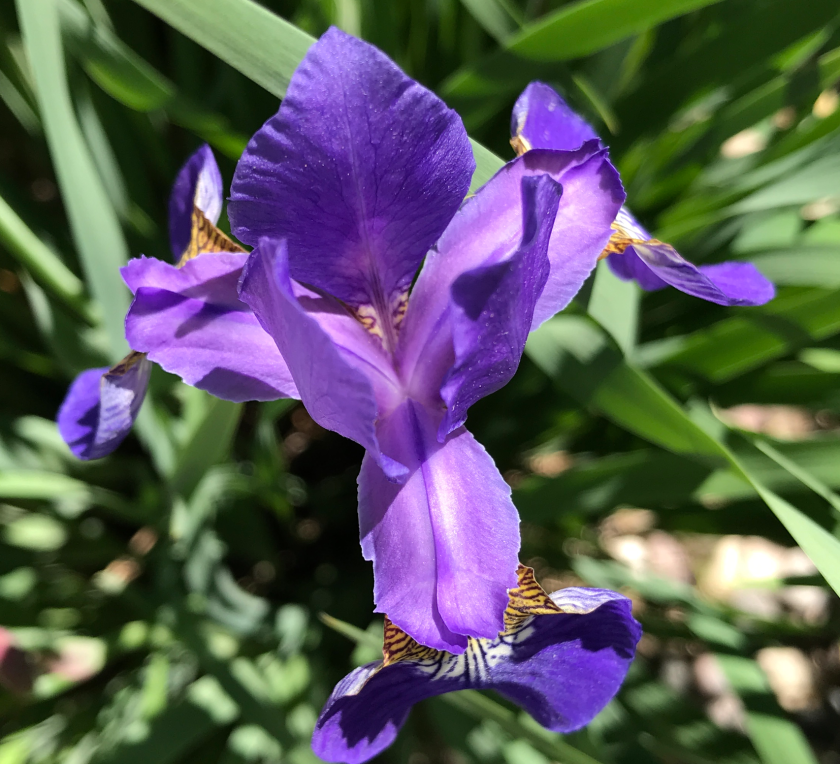
No, it’s spring. Everything is in bloom, as you can see from the closeup of the lilac there up at the top of this. I’m rather pleased with how that image turned out. MrsGF keeps telling me I should start printing some of these and trying to sell ’em, but well, that would mean I’d actually have to do some work.

Almost everything we planted is doing well. Tomatoes are doing great. One variety we planted called Wisconsin 55 (I think) is already starting to blossom. The peppers are doing pretty good. Even the two blueberry bushes MrsGF picked up seem to be doing pretty good. Even the spindly and sickly looking cucumber plants that looked like they were dead are starting to take off.

And the weather has been — well, I was going to say good, but that’s not really true. The weather has been odd. In late May we had temperatures well up into the mid-90s that broke records all over the state. And caused dozens of incidents of highways buckling from the heat. And in just the space of a few days we went from conditions being too wet to conditions way too dry. We haven’t had any significant rainfall in weeks now. Other parts of the state did get some rain, but it always seemed to evaporate before it got to us. We have to water everything almost every day. It’s rather discouraging. If it’s this bad this early in the season, what is it going to be like come August? We did finally get some rain over the weekend, about half an inch.

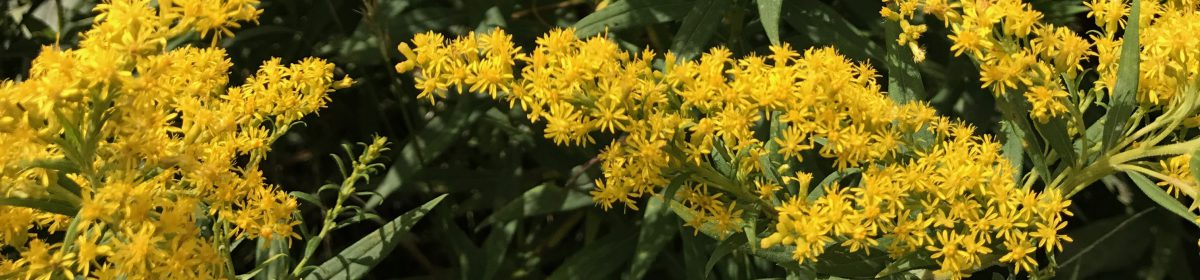
Still, it’s hard to complain when I see stuff like this when I walk out the door:

Screen Shot 2018-06-02 at 7.40.59 AM

And I’ve finally been able to get the bike out and put some miles on on a fairly regular basis. I’d almost forgotten how delightful it is to get out in the country on the bike this time of year. A lot of people don’t understand why I enjoy it so much. It isn’t the exercise, it’s getting out in nature and being able to hear the birds and frogs, and seeing the little treasures along the roadside like these tiny little flowers:

Screen Shot 2018-06-02 at 7.41.47 AM

Amateur Radio Stuff

Field Day is rapidly approaching. I think it’s June 23-24. It’s an annual event that has been going on for ages in the amateur radio community. The idea is to get us troglodytes out of our basements and the dark corners where we usually huddle over smoking soldering irons, and play with all kinds of technologies that range from 100+ year old telegraph keys to ultra-modern mesh networks, satellite communications and bouncing radio signals off the moon, and set up our gear in parking lots, parks, and even fields in the middle of nowhere, and hope we don’t burst into flames like vampires from the exposure to the sun.

Alas, I’ve never participated because MrsGF and I are usually gone of vacation at that time of year because of how our schedules work out. It’s great fun, though. So if you see a bunch of very pale looking people stringing up wires in trees, standing around tables laden with strange looking equipment, don’t worry. It’s just us making a rare excursion into the daylight.


Amateur Radio & Gardening, Hey, Why Not

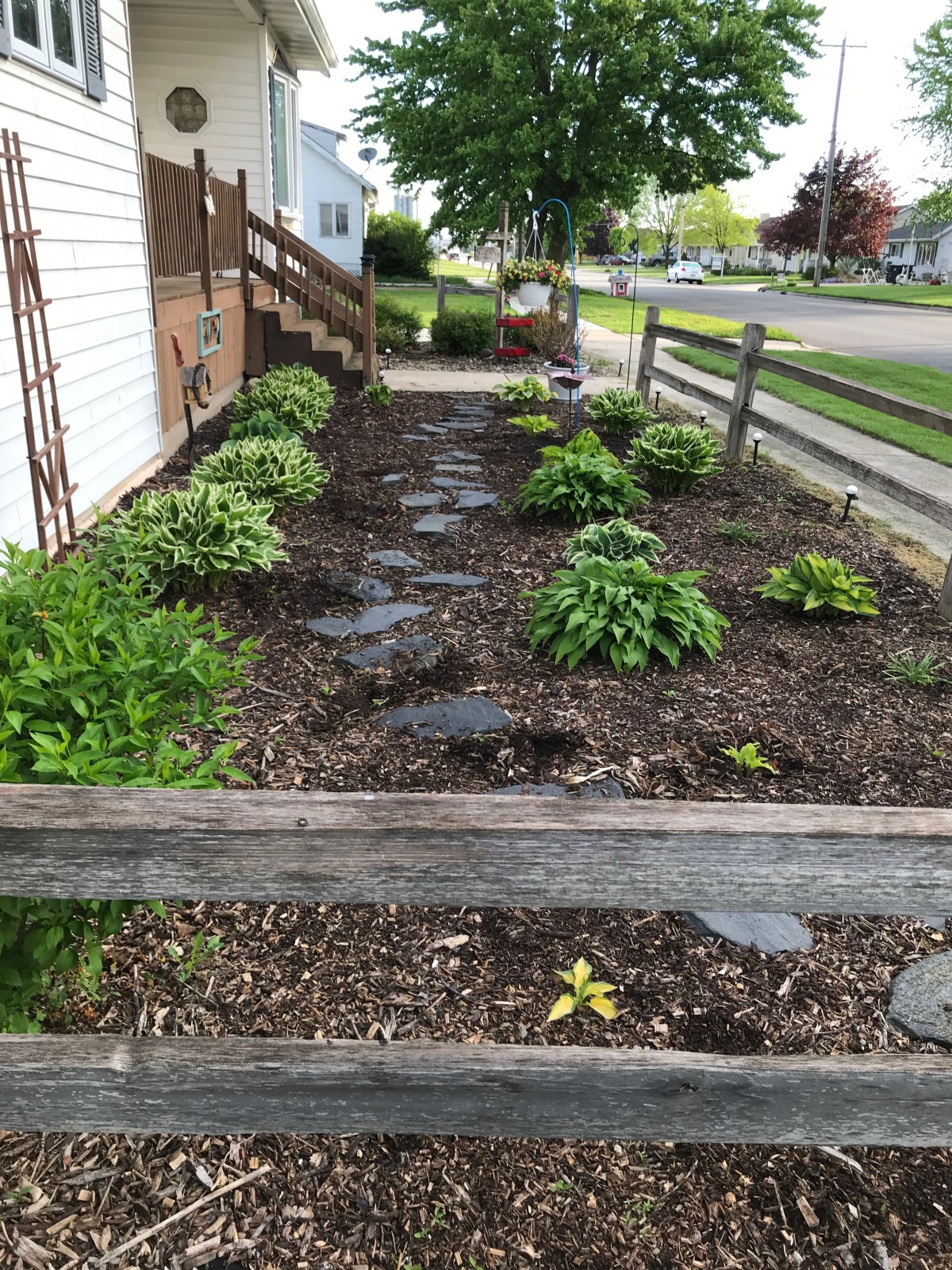
The weather has been amazingly pleasant for a change these last few days. Everything is growing like crazy as you can see from the photo of the hosta garden in front of the house that I took yesterday. Wonderful plants, hostas; decorative, resilient, with so many different shapes and types it’s hard to keep track.

IMG_0875The corner garden here has been completely redone. In the past it was mostly herbs and decorative plants, but this year we more than doubled it in size, hauled in a tons of compost (well, my aching back claimed it was tons) and it’s being switched to mostly vegetables this year. MrsGF put in something like 20+ pepper plants of varying types (can you tell we like peppers?) plus two blueberry bushes and a couple of rows of beans down along the front. The soil in there is so utterly horrible that I did something I very rarely do, I raked in some commercial fertilizer as well. We’ll see what happens. It will either be wildly successful or everything will die off.

IMG_0873We were not going to make the same mistake we did last year by crowding too many plants into the two raised beds. It’s very tempting when putting in seedlings to crowd them in because it seems like there is so much wasted space, and forgetting just how big those plants get when they’re mature. We only put 6 plants in each of the beds this year and I hope that will help to eliminate some of the issues we had last year. While we avoided the dreaded blossom end rot last year, we did have some fungus problems because the plants were so crowded together.
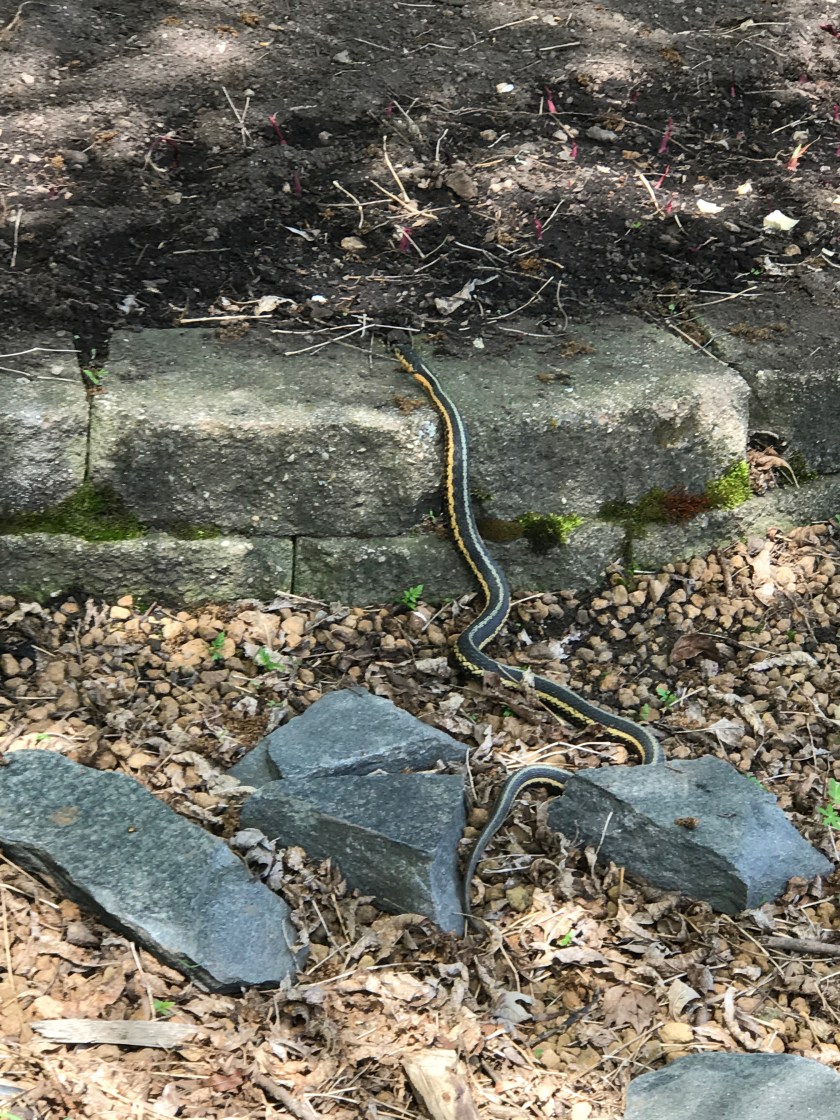
IMG_0881And then when I was walking around the yard yesterday I nearly stepped on this guy. Yes, we have snakes in Wisconsin. You wouldn’t think they could survive our winters up here, but several species do quite well. Heck, until the 1950s or 60s we still had timber rattlers around here. This little guy… Little? Ha, he was a good two and a half feet long. He scared the heck out of me although I’m sure nearly being stepped on while he was sunning himself in the grass scared him more.

Amateur Radio Stuff

IMG_0863After the fiasco of wrecking the fold down mount for the GAP antenna, I put the crappy old Comet 250 vertical back up, hooked up the coax, went inside, checked to make sure everything looked OK, turned on the transceiver and — and immediately made about 6 different contacts all over North America with the thing on 40, 30 and 20 meters, running about 40 watts of power, less than it takes to run a modern lightbulb.
Sigh… radio propagation is weird sometimes.

I’ve been getting more and more interested in QRP operations. That’s amateur radio slang for very low power. QRP operators put out 5 watts of power or less. Often a lot less. The guys who are really good at it often operated with less than one watt of radiated power. They often use transceivers they built themselves or got as kits that can be ridiculously inexpensive.

There is a ‘gotcha’, though. Trying to make contacts using voice at those low power levels is damn near impossible. If you’re going to run QRP, you really need to go with good old morse code, or CW as it’s called.

Now I’ve thrown myself at CW on numerous occasions over the years, and failed miserably in learning it. The recommended techniques, the tapes, the CDs, none of them have worked. It all sounds like pure noise to my ear.

But then I ran into an IOS app called “Ham Morse”. It does have the more traditional teaching method, which doesn’t work for me. But what does work is that Ham Morse can also tie into the headline news feeds of various news organizations and sends the as CW at whatever speed you’re comfortable with. And guess what? For me, at least, this works. Now that I’m trying to copy actual meaningful text instead of single letters or groups of letters that have no relationship, my weird brain is actually starting to make the connection between those strange noises and the text.

The result is that I can copy CW at up to about 6 – 8 words per minutes. Maybe. Sometimes. Sort of. I’ve been listening to a lot of CW down on 20 meters trying to make sense of it all and despite all of the odd abbreviations and symbols and prosigns they use, I’m starting to pick some of it up.

Anyway, one of the reasons I’m interested in QRP is that the equipment is small, the antennas are small, you can operate with nothing but a relatively small battery. The whole kit can be thrown into a backpack easily, set up and taken down quickly. It’s ideal for someone who spends a lot of time on a bicycle like me. Would be great fun to sit out on the trails making contacts on summer mornings with just a wire hanging in a tree and a couple of watts of power.

http://offgridham.com/

I don’t make a lot of recommendations for websites or products or stuff like that, but if you’re at all interested in QRP operations, battery technology, solar power technologies and amateur radio, click the link up there at offgridham.com. Chris over there has provided a wonderful resource. He delves into alternative power technologies like solar, evaluates and discusses battery charging systems, battery types, etc. While it’s oriented for amateur radio, the material he covers is going to be of interest to anyone who is interested in unplugging from the power grid.

And that’s all for now.

Oh, I keep forgetting. I have email here. If you have questions or stuff you don’t want to put in the comments, you can reach me at old.grouchyfarmer@gmail.com


Hectic Days

Everyone around here is playing catch-up now that we’ve had some nice weather following the April blizzard and heavy rains. Local farmers have finally been able to get into the fields, some of which were literally underwater just a couple of weeks ago. Everyone is scrambling to get their crops in because more rain is predicted for Monday and Tuesday.

I don’t have to worry about getting in acres and acres of corn and beans of course. Being retired has it’s perks. All I have to worry about now are my gardens here at the house. But the sight of the pear tree in full bloom outside reminds me that it’s high time we got stuff planted and we’ve been working at expanding some of the gardens and prepping the beds we already have.

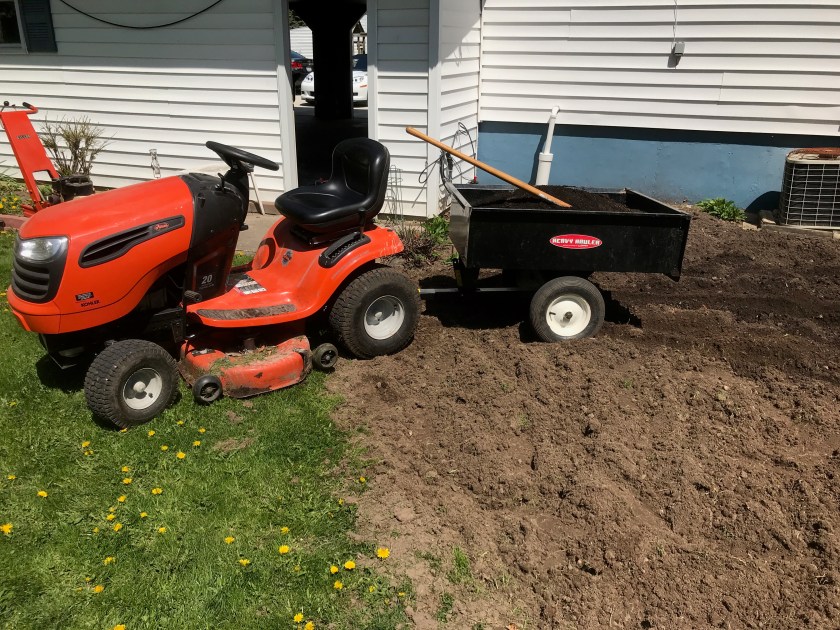
IMG_0867I spent almost a half a day hauling compost from the town compost site and working it into the various gardens around the yard. Spent another half day digging up sod to expand the corner garden where we used to grow mostly herbs. It’s one of the few spots we have here that gets full sun and one of the few options we have for adding new spots for growing stuff that needs day-long sunlight in-ground rather than in raised beds or pots.

Getting rid of sod is a royal pain in the neck, and the soil left behind isn’t exactly a good growing medium. The dirt under the sod was rock hard. I went over it at least 6 times with the tiller, getting deeper every time. Then I covered the whole area six inches deep with compost and went over that three more times to work it in.

We took the seedlings out of the house where MrsGF had started them and they’re out now “hardening off” as they call it in preparation for planting. Mostly tomatoes and peppers of various types, and some cucumbers. The squash turned out well last year so MrsGF is going to put a half dozen squash plants in as well this year. And as an experiment she planted some old corn seed she found. We have no idea how old it really is so whether it germinates or not is going to be interesting. I suspect most of it will. But its in a rather shady area so I don’t anticipate we’ll get much from it.

One big change from last spring is that this year I’ve been seeing a lot of pollinators. I haven’t seen many honey bees, but I have been seeing bumble bees and native bees. (Note: The standard honey bee you see isn’t native to North America. It’s a European import.)

Speaking of bees, it was a rough year for honey bees. A lot of bee keepers are reporting they lost most if not all of their bees over the winter. My brother-in-law started keeping bees a year ago and he lost all of his and had to buy replacements.

If the weather cooperates this weekend we’ll be out planting in the gardens.

One thing I have to do is figure out how to keep the rabbits out. They’ve been a huge pest, and the situation has been getting worse. They’re brave little buggers, too. You’ll see them out grazing on lawns and gardens even in mid-day all over town.

Several people have suggested I sit out at night with my bow and some target arrows or an airgun, and when I take care of the local population come over and help them out. And while it’s tempting I have no desire to end up in the local lock-up. Discharging even an airgun or a bow inside of city limits is illegal. So that means I have to come up with some kind of fencing. We used chicken wire the last couple of years and it worked, but it’s ugly, hard to work with and a pain in the neck, so I’m looking into different options this year. We’ll see what we can come up with.


Amateur Radio Stuff: It was one of *those* kinds of days…

Screen Shot 2018-05-13 at 9.32.00 AM
Gap Titan DX vertical antenna only not so vertical

Eldest son came over yesterday to help me get the Gap Titan antenna put up at last and for a while all went well. We got the tilt over mount installed, finished putting the antenna together except for the counter poise, got it bolted to the mount and started to tilt it upright and…

Screen Shot 2018-05-13 at 9.32.11 AM
The mounting system just couldn’t take the strain. The mounting bolts bent and one broke off.

And quickly discovered that the “heavy duty” tilt over mounting system wasn’t really all that “heavy duty” and couldn’t handle the stresses of even the relatively light weight Titan antenna.

It should have been able to handle it easily. The size and weight of the antenna was well under the specified limits of the mounting system. But we ended up with bent bolts, bent parts and everything had to be brought back down again rather quickly.

Enormously disappointing, but that’s the way it goes sometimes. The mounting system was advertised as being able to handle a 40 foot un-guyed vertical and the Titan is considerably smaller and lighter. But I should have known there would be problems as soon as I saw the small size of the bolts.

So it’s back to the drawing board as we brainstorm to try to figure out a way to get this thing in the air in the location it has to be placed in. It’s really frustrating to have a new antenna laying in the back yard and not being able to use it, especially one as expensive as the Titan is.

FT8 mode continues to generate controversy in some circles despite the fact it is now the most popular mode in use on the HF bands, and by a pretty wide margin. I’ve used it quite a bit to make contacts, but that’s really all it’s good for, making a brief contact. You can’t actually use it for exchanging actual information. It’s restricted to sending a maximum of 13 characters at a time (I think) if 15 second data bursts. The typical FT8 contact consists of exchanging call signs, location grid reference, a completely meaningless reception strength report in dB, and that’s it.

For a bunch of people who are so heavily involved in communications technologies, they don’t seem to actually like communicating. Rather curious, that.

That being said, I have been trying to talk to someone, anyone, this morning, and with very poor results. I fiddled with FT8 this morning for a while, made a few contacts, and rather quickly got bored with it all. I tried PSK for a time, and found absolutely no one on any of the PSK parts of the spectrum. Then I switched to CW, something I very rarely dabble with. I ran into a few people zipping along at 25+ words per minute, way, way too fast for normal human beings to copy. I called CQ at a more reasonable 10 wpm and got zilch. You’d think there’d be more people out there on a Sunday morning, but it seems not. Either that or band conditions are too poor.

Along The RoadSide

I was finally able to get the bicycle out on the road the other day. It felt great to be out on the road on a warm, sunny day again. Unfortunately I also quickly found out that bicycling takes an entirely different set of muscles than jogging on a treadmill does. It’s going to take a while before I’m comfortable doing 10 or 15 miles, but it was worth it. The frogs were singing, the sun was bright, and the wild flowers alongside the road had me stopping every once in a while to take photos.

So, here’s some photos… Oh, click one of the photos to start a slide show of the full size images.


Rain and More Rain and Stuff

IMG_0848
5.5 inches over night. Total rainfall was a bit over 8 inches in 2 days.

May came in wet and soggy. Very wet. Yesterday morning when I got up we’d had 5 1/2 inches of rain over night to add to the nearly 3 inches we had the day before.

Between a blizzard that dumped 2 – 3 feet of snow on us in April and now the heavy rains just a couple of weeks later, I’d say that our weather could officially be called “weird”. I haven’t been out to look around much, but we went out to eat Friday night and there was some significant flooding in low lying areas, lots of roads closed, lots of areas where water was over the road. The local radio station just announced a list of roads closed due to flooding.

I haven’t had a chance to talk to the farmers around here yet about what the weather has done to their spring planting schedule, but I’m sure they’re worried. My backyard is a swamp and has been since the snow from the blizzard started to melt. Walking through the grass is a mistake because it’s covering up about 2 inches of water and if you stand still for too long you start to sink into the ground. Sigh…

This is an old house for the most part, and the foundation walls leak, so we’ve had water in the basement following the heavy rain. It’s a pain in the neck but we’ve lived in this place for almost 20 years now so we’re used to it and know how to deal with it.

IMG_0847
It’s hard to tell from the photo but there is about an inch of water just under the top of the grass. The water way back behind the trees is the neighbor’s pond which is overflowing. Just behind the spruce tree it’s about 2 feet deep.

And out back along the property line, well, the water back there is a good foot deep or more. We aren’t going to be doing much of anything in the gardens for at least a few days. It’s going to take a while for the water to go down so we can get some work done. I think we’ll be lucky if we can start working by mid week. Oh, well.

I was down at the town’s compost site yesterday to drop off some leaves we raked before the rains hit and noted there is a huge pile of sifted compost ready to go. We’re very fortunate in that regard. The compost site is just down the street from us, an easy run with the garden tractor and trailer, and compost is free for the hauling for town residents.

MrsGF got a backyard composter thingie for Christmas, one of those things that looks like a rotating barrel on a stand. She’s going to be experimenting with that this year and see how that works out. I’m curious to see what kind of results we get from it.

Also gardening related is our rain collection system. We have a rain diverter attached to the downspout at the back of the garage. We’ve had that set up for years now and it’s been working great. We found a food grade 55 gallon plastic barrel, attached the valves and stuff to it, hooked it to the diverter, and that’s all it took. Virtually zero maintenance and it’s worked great. There isn’t enough water to keep the veggies watered, but there has always been more than enough to water all of the potted flowers and plants scattered around. The connector hose cracked over the winter and we ordered a new one from the company, but that’s the only problem we’ve ever had with it.

Radio stuff — Still don’t have the new vertical antenna up. We’ve been waiting for a weekend when eldest son can get down here because it’s a two person job to finish putting it together and getting it on the mount. I was a bit concerned about what the neighbors would think but then MrsGF pointed out that our next door neighbor has a big vertical antenna up that’s even higher than mine will be and no one complains about that, so I stopped worrying about it.

For a long time my radio equipment did little more than gather dust, but not long after Christmas I started getting interested in it again, and the reason why is FT8, the relatively new digital mode. Like a lot of other people I quickly discovered that FT8 lets me make contacts even when propagation conditions stink, as they do now, and even though my antennas are not all that good.

Long distance communications down on the shortwave bands depends on reflections of radio waves in the F layer of the atmosphere. Solar radiation causes the F layer to ionize, which causes it to reflect radio waves back down to the Earth rather than shooting straight out into space as they normally would. We are at solar minimum right now, meaning the sun is very inactive. Very few, if any, sunspots, means the atmosphere is not being ionized, which means radio waves aren’t being reflected or are being reflected very weakly generally speaking.

With my less than ideal antenna system, I normally wouldn’t be able to make many contacts. But since I started playing with the FT8 mode, I’ve made contacts in 36 different countries including ones that are notoriously difficult to reach. I’ve worked Australia, Japan, Tasmania, most of western Europe, Hawaii, Alaska, and doing that with about 70 watts of power and an antenna that is little more than a wire strung up between the garage and a couple of trees.

Despite the success of FT8, it generates a lot of controversy among some AROs who don’t consider it to be “real” amateur radio for a variety of reasons.

They don’t like the fact that is partly automated, with a computer decoding the information and issuing appropriate responses. But the fact of the matter is that AROs have been doing that for a couple of decades with packet radio, RTTY, PSK and other modes, using software that can be programmed with macros to generate automated responses.

They claim it isn’t “real” AR because the amount of information exchanged is little more than call signs, a location and a signal report. But that’s nonsense too because that’s often all you hear in a typical contact via any mode of communication on AR except for the guys down on 75 meters who go on and on and on about their hemorrhoids and hip replacement surgery or rant about politics for hours on end.

Fortunately while the detractors are rather annoying and occasionally abusive, the rest of the AR world just gets on with stuff and the attitude for most people is hey, if it works for you and you enjoy doing it and it’s legal, go have fun.


China Has Stopped Buying U.S. Soybean Supplies, Bunge CEO Says

Tariffs or not, China appears to have already stopped buying U.S. soybean.

Source: China Has Stopped Buying U.S. Soybean Supplies, Bunge CEO Says

Apparently China isn’t waiting to implement the tariffs it said it would be imposing, it’s retaliating against the ill advised trade war this administration has implemented by simply refusing to buy US soybeans entirely.

Since about 30% of our soybean crop gets exported to China, if this keeps up for more than a few weeks it could potentially bankrupt a lot of US farmers who are already right on the edge financially because of low commodities prices.


Misc. Catch Up: Snow, Gardening, Bike, AR, etc…

I have to admit that things have been a bit slow around here after the blizzard. I’ve been spending most of my time fiddling with radio equipment and antennas, but I haven’t been entirely isolated from the real world.

While we still have some piles of snow remaining, most of the white stuff has melted off thanks to daytime temperatures that have been pushing up into the 50s. The storm did lots of damage around here, mostly from roofs caving in. It’s a miracle no one got killed. Local fire departments were busy helping out farmers by bringing out their ladder trucks and using high pressure hoses to blast snow off of roofs. They saved several barns from collapse in this area.

The Resch Center in Green Bay had it’s entry way caved in when snow falling from the dome hit the entrance. No one is sure what to do about it at the moment because the Resch Center is scheduled for demolition in two years anyway. But they do have events scheduled up until that time so they’re trying to determine if it’s cost effective to repair it, or start canceling events and just bring it down and be done with it.

Any kind of gardening is still on stand-by. It’s probably going to be a week or more before we can get out there and start working on anything except superficial projects. Still, there are signs of life out there. The lilac bushes are starting to bud, the rhubarb is starting to peek up out of the cold, wet ground, and one sure sign of spring is that I got the bike out of storage at last.

Unfortunately I rather quickly remembered that riding a bicycle uses an almost entirely different set of muscles than jogging on a treadmill. That and the fact it was only about 40 degrees out this morning kept the ride rather brief, but it was still nice to be back on the bike again.

Amateur radio stuff —

The ARRL is really pushing the FCC to expand the privileges of the Technician class license. They want to give Techs voice and data privileges down on the HF bands, claiming that this will give Technicians an incentive to eventually upgrade to a General or Extra class license and get them more interested in AR in general.

Don’t get me wrong, the ARRL does a lot to support and improve amateur radio in general, but this is one case where I think they don’t know what the hell they’re talking about. The organization seems to be under the impression that there are tens of thousands of Tech licensees out there who would love to get down on the HF bands, but for whatever reason refuse to upgrade to a General class license, and as a result they aren’t upgrading their licenses, aren’t operating at all, and eventually drop out completely.

The problem with this notion is that the Tech licensees don’t give a damn about HF. I’m sorry, but they just don’t. The Tech licensees who do care about HF quickly upgrade to a General or Extra class license, and the rest just don’t care. I’m sorry, but they don’t. I know a lot of Tech license holders who haven’t upgraded and the reason they haven’t is because either they lost interest in AR completely or the Tech license allows them to do everything they want to do.

The exam to get the General class license is just not that hard in any case. Anyone who’s already passed the Tech exam could easily pass the General with minimal amount of work. It isn’t a lack of privileges on HF that keeps Techs from upgrading, it’s a complete lack of interest in HF in the first place.

Blizzard Evelyn

IMG_0836That’s what they’re calling it now, Blizzard Evelyn. We’re currently under a full scale blizzard warning and have been since yesterday. The photo doesn’t look very bad right now but we were in a lull in the storm when I took it around 6 AM. So far we’ve had about 12 inches of snow with freezing rain mixed in at times and 40 mph winds. Today they’re predicting as much as 14 inches more on top of what we already have with 50 mph winds.

Here in town it hasn’t been too bad. The buildings and trees help moderate the winds. Out in the countryside the roads are nearly impassible with whiteout conditions in many areas where the visibility is zero.

I heard one news outlet say that we’ve had more snow this April than we had during the entire winter and I suspect that might be true.

Feel sorry for the birds right now. We had a dozen or more wrens, finches, robins and mourning doves sheltering in the corner where the garage attaches to the house trying to get out of the weather.

Ah, spring in Wisconsin.