
Farm Catch Up: Why Are We Seeing Shortages?

Oh, oh, GF is trying to do artsy stuff again.

I haven’t done one of these in a long time so I thought it’s high time I took a look at what’s happening in the agricultural world. Especially now because the situation is difficult, to put it mildly. Well, not exactly agriculture directly in this article. I want to try to explain why we’re seeing empty shelves in the grocery stores when we actually don’t have any real shortages of product.

Empty Shelves

We all know that when this started almost immediately stores were stripped bare of sanitizer, sanitizing cleaners, hand soap, protective equipment like masks and gloves, etc. This was followed by store shelves being stripped of toilet paper, paper towels, and then food products, especially staples like rice, beans, flour, canned foods, butter, etc. And, oddly, even things with short shelf life like milk and cream. (Why in the world would people who almost never drink milk in the first place suddenly need to buy gallons at a time? I have no idea.)

But despite the bare shelves there are no real shortages, at least not of consumer food products. There are several factors behind the empty shelves you’re seeing in the stores. Hoarders (how much hoard could a hoarder hoard if a hoarder could hoard hoard?) and profiteers are behind some of this, of course, but the biggest disruptions are due to the way our manufacturing and distribution systems work.

We have what amounts to two almost entirely separate production and supply systems. The first is the consumer system that makes and sells product to you and me. It provides products that individual consumers want, in relatively small quantities that are suitable for individuals or families. The second is the commercial system that sells in bulk quantities to institutions like restaurants, schools, hospitals, prison systems, etc. and industrial processors that use those products to make still other products, like the processed food industry.

The result of this system is that we are in a rather bizarre situation where we have surpluses and shortages, of exactly the same products, at exactly the same time. Dairy is an example of this. Even while a lot of people are reporting shortages of milk and grocery stores putting strict limits on how much milk people can buy, we have such a surplus of milk on the supply side that a lot of farmers are dumping the stuff down the drain because they can’t find a processor to buy it.

So how the hell can you have a shortage and a surplus at the same time?

Well, we have a situation where most schools are closed, most restaurants are closed, a lot of businesses are closed, and a lot of people who would normally be at work or at school are now stuck at home. This means that meals that normally would have been eaten at school, work cafeterias, food trucks, restaurants, etc. are now being eaten at home. (About 50% of the money we spend on food here in the US is spent on meals eaten away from home.) Which means people are buying a lot more groceries, and more milk and dairy products in general for consumption at home. Add in the hoarders who, for some reason, think they need to buy six gallons of milk at a time (seriously, I’ve seen people doing this) despite the fact it will go bad long before they’ll ever use it, and it puts pressure on the whole distribution system delivering milk to grocery stores.

At the same time, schools are a major buyer of milk for the school lunch program, and they are largely shut down. As are restaurants.

So at the consumer level, the grocery store part of the market, we’re seeing increased purchases of products, while at the same time on the commercial side of things we’re seeing a dramatic loss of sales of similar products. So we’re having both shortages and surpluses, at the same time, of the same product.

Why not switch the commercial production facilities to produce for the consumer market? Well, you can’t. Production facilities used to make the half pint cartons for the school lunch program can’t be switched over to making gallon jugs for grocery stores. They use entirely different manufacturing and bottling equipment. The same is true for other sectors of the market. Attempting to switch from production of products for institutional and commercial markets to production for consumer markets is extremely difficult and very expensive. By the time a switchover could be done, the pandemic situation will have subsided and manufacturers will find themselves with manufacturing facilities that are now set up to make the wrong product.

Instead of dumping milk make cheese out of it? Can’t do that either. Cheese makers were already running at nearly 100% capacity even before this started. And even if there was the capacity to produce cheese, there isn’t any market for it because the cheese market is saturated to begin with.

The same is much the same with other products. The products are there, but those products aren’t in a form consumers would accept because they’re intended for the institutional or commercial market and are available only in bulk or in a form consumers don’t want. Toilet paper is a good example of this. While there are shortages on the consumer side, there is a glut on the institutional side of the market. With schools and a lot of businesses shut down, sales of TP for those markets has dried up. But the TP intended for that market would be entirely unacceptable for consumer use. The rolls are too big, or in sizes that wouldn’t fit a home TP holder, or the quality… Well, if you’ve used a restroom in a school you know what a miserable excuse for toilet paper that stuff is.

I have to mention the distribution system, too. Most companies, including grocery stores, switched to what is generically called a “just in time inventory” system long ago. That means that stores don’t stockpile product. You won’t find back rooms chock full of TP or canned goods or whatever at your average store. The store orders only enough product for a very limited amount of time. If they get deliveries every, oh, three days let’s say, they will order only enough product to deal with three days worth of normal sales. Why? Because storage costs money. Adding square footage to a store not only increases its build cost, it also increases its property tax bills, heating and cooling costs, electric costs, etc. So space devoted exclusively to storage of product is kept to an absolute minimum.

Normally this system works fairly well. But these aren’t normal times, so when a store gets hit by abnormally high sales of specific products, well, the whole system falls apart fast. When the panic buying started, grocery stores would see an entire day’s worth of a product sold out in an hour. Seeing the empty shelves spooked other consumers, who immediately panicked and started cleaning out the shelves of other products. Stores would restock as fast as they could, only to burn through several days worth of product in just a few hours thanks to panic buying.

If the distributors had an adequate inventory on hand it wouldn’t have been such a big problem. But they didn’t either. They were using the “just in time” system too, and were only stocking enough product to support their stores for a limited amount of time. Those stocks were depleted within days, and they were scrambling to get product from the flour mills, dried bean distributors, rice distributors, etc. to try to restock. The mills and packaging companies had more than enough bulk product on hand, but their packaging facilities couldn’t increase production beyond a certain point. Basically the entire distribution system began to fail under the strain of the panic buying and the increase in consumer sales.

The system is, finally, starting to adapt, at least around here. But as for what’s going to happen in the future, well, that’s anyone’s guess.

Foxconn Update. No Viruses Allowed.

Since I’m already in a bad mood, let me rant a bit about this whole Foxconn fiasco. I’ve talked about this before going back to 2018, with a couple of brief mentions being tossed into other posts. Basically the situation is that no one seems to know what the hell is Foxconn is up to, not even Foxconn. Anyway, I thought that with the factory supposedly to open in May, this would be a good time to revisit the whole thing.

If you want some background on the situation click that link up there and it will take you to the original item I wrote back then. Go ahead. I’ll wait. (hums ‘Singing in the Rain’ and a few other showtunes)

Ah, good, you’re back. Let’s see what’s going on now, shall we?

The basic answer to that question is that no one seems to know what the hell is going on down there at the Mount Pleasant site. They’re building a factory. Maybe. I think. But what that factory is going to produce is anyone’s guess. No one knows. Certainly not the town of Mount Pleasant itself which borrowed so much money to upgrade the infrastructure around the facility that the inhabitants of the town will probably be paying off that debt for generations to come. Channel 12 in Milwaukee tried to do a story about what was going on with the town a while back, only to have the president of Mount Pleasant literally hide behind a door to try to avoid having to answer reporter’s questions, and their reporter being thrown off the factory site by local security.
Not even Foxconn seems to know what the hell they’re actually building down there. A half dozen different stories about what the company is going to build there, if anything, have come from company spokespersons since this all started, and none of them have anything to do with what the company said it was going to do when they signed the original contracts.

The latest that I heard before the pandemic hit was that they were going to make…

Wait for it… You aren’t going to believe this.

Drum roll please….

Coffee machines for airports.

Seriously. They were going to make, they claimed, automated coffee kiosks for airports according to a story in Milwaukee Business News.

Now that story has changed as well and now the company claims it’s going to make – ventilators for hospitals?

Look, I don’t care how “nimble” a company may be, but… Come on, this is all BS. I’m sorry, but it is. What the hell, exactly, is going on in that building down there in Mount Pleasant? You can’t build a factory specifically to produce flat panel displays, and then suddenly, overnight, decide you’re going to make coffee machines in it. Or then turn around and claim that within just a few weeks you’re going to take your alleged coffee machine/LCD display/whatever factory and start cranking out hospital grade ventilators. Making changes like that would require retooling the entire factory, reprogramming robots, building or buying new equipment, retraining employees. You’re looking at months of lead time plus tens of millions of dollars to retool and, no, ain’t gonna happen.

Well, not that they have many employees to retrain. The 13,000 employees they were going to hire seems to only be about 550.

But let’s ignore all of that for a moment and take a look at the other buildings the company bought here in the state..

Since the company signed the deal it made a huge PR stunt out of buying buildings in Green Bay, Eau Claire, Racine, Milwaukee and Madison. The one in Milwaukee was to be it’s “Wisconsin headquarters” and the others were to be some kind of “innovation centers”. There were big press conferences and media events to publicize the purchases, with the company announcing grand plans for – for something. It was never made clear exactly what they were going to do with the buildings, but it was going to be really, really important.

And absolutely nothing has been done with any of the buildings. At least nothing related to Foxconn itself. It’s been a year or more since the company bought them and they are still sitting empty. The company’s “Milwaukee headquarters” is a seven story building, and it is completely empty except for a bank that leases the first floor. The Eau Claire building is completely empty, and has been since it was acquired. The Green Bay, Madison and Racine “innovation centers” are occupied only by the businesses that were leasing space in them before Foxconn bought them. No renovations, no remodeling, nothing. No signs of Foxconn doing anything, not even any sign of actual Foxconn employees anywhere at any of the sites.

So what the heck is Foxconn actually doing? What will it be doing in the future? No one knows. Not even Foxconn.

Stuff

Spring daffodils are up!

Woke up around 4 AM for some reason, pulled open the curtains and saw – snow??? Yeah, snow, not that daffodil up there from this weekend. But I’m not going to put up a picture of snow because things are depressing enough, so hopefully a daffodil will cheer you up. We knew it was coming, the storm, but I don’t think we really believed it. We were lucky because we got just a light dusting. Other parts of the state got as much as 5-8 inches. Sheesh. Welcome to spring.

Perfectly safe to go vote, says the man in full infection control equipment. No need to delay the election.

I have to admit that all of this is getting to me. I’m a rather anxious person to begin with and this whole climate of fear we’re living in with the 24/7 virus news going on right now certainly isn’t helping. I try to avoid even watching the news or reading newspapers, to be honest. But it’s hard not to. You can’t turn on the television, pick up a newspaper, turn on a radio or get on the internet without being bombarded with infection numbers, number of deaths, warnings to stay home and if you do have to go out wear hazmat equipment and treat everyone you meet as if they were infected. And meanwhile we have an administration that is saying everything is going really, really well and the isolation may be lifted at the end of the month, and at the exact same time the crawler down at the bottom of the screen is showing the number of deaths ticking up all the time and an announcement pops up that New York had to hire a contractor to begin digging mass graves on an island in NY harbor because they can’t deal with the number of bodies, and one of the heads of the Wisconsin legislature is shown in full hazmat gear telling people it’s safe to go vote in person without taking any kind of special precautions and later claiming the election is totally valid even though hundreds, perhaps thousands of people gave up trying to vote because of the 4+ hour wait times because most of the polling places were closed (only 5 out of 180 were open in Milwaukee) and the fact that the post office didn’t bother to actually deliver hundreds, perhaps thousands of absentee ballots that people had sent in for weeks ahead of the election, and even if people did get them and sent them in they won’t be counted because the post office didn’t put a postmark on them…

Yeah, it’s starting to get to me.

Getting Silly: The Virus Doomsday Flashlight

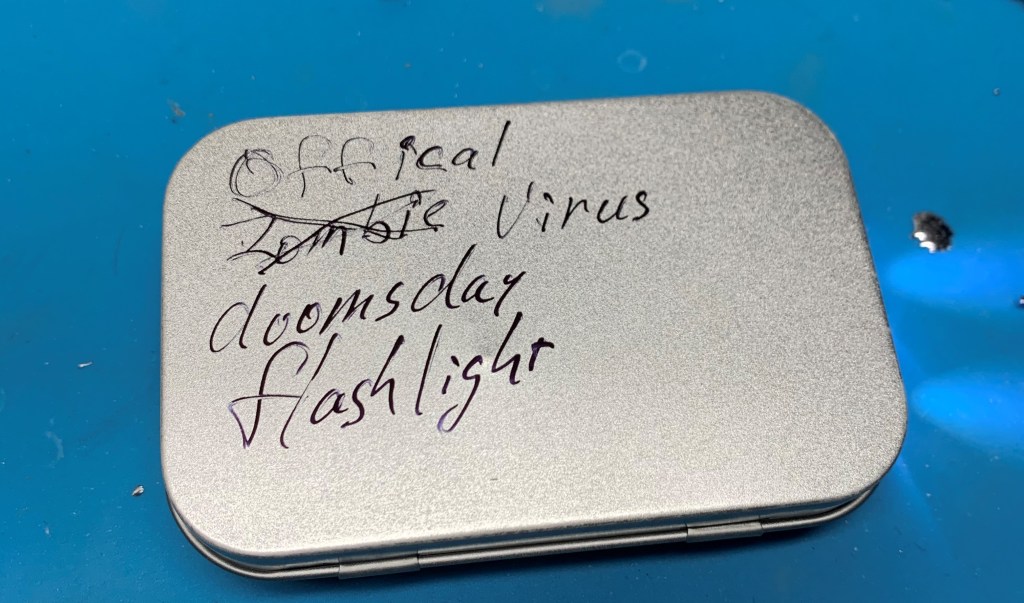
What do you do when you have a lot of time on your hands, a whole case of “Altoid” style metal boxes for a project that never came to fruition, and a bags full of surplus electronics parts? If you’re me, you end up with stuff like this:

I used “doomsday” because I can’t spell apocolypse, appocololips, apocalypse by the way. Is this “project” silly? You bet. Don’t care. We all need to be silly once in a while.

So I was sitting around this morning staring at all this stuff on the shelves down here in my version of a mad scientist’s laboratory (I’m not really mad, only slightly eccentric.) wondering what I could do that would A) kill time because dear lord I was getting bored (so, sooo bored) after being in self imposed exile for weeks, B) be really, really cheap, C) be fairly easy to do because even though I was bored, I’m also lazy, and D) use up some of the junk I have laying around like that bag full of weird little switches. So there I was with a bunch of small metal boxes, a bunch of LEDs, a bunch of switches that aren’t good for much of anything, at least not for anything I normally tinker with, and I started thinking – ooo, it’s lunch time, let’s go eat.

But after lunch I thought hey, there is no such thing as having too many flashlights, is there? I mean whenever you need a flashlight either you can’t find one, or the batteries are dead, or someone took out the batteries to stuff in the remote for the TV or to power a robot or weather station or something. Even better, maybe MrsGF might stop wondering if she needs to call someone about my “problem” with accumulating various parts and gadgets and similar stuff if I actually use some of this stuff to crank out something remotely useful.

(Sidenote: LEDs are a lot of fun to play with, and cheap to boot. A few LEDs, some resistors, a 555 timer, a few transistors, maybe a microcontroller, and you too can have a lot of fun building really cool and utterly useless little gadgets)

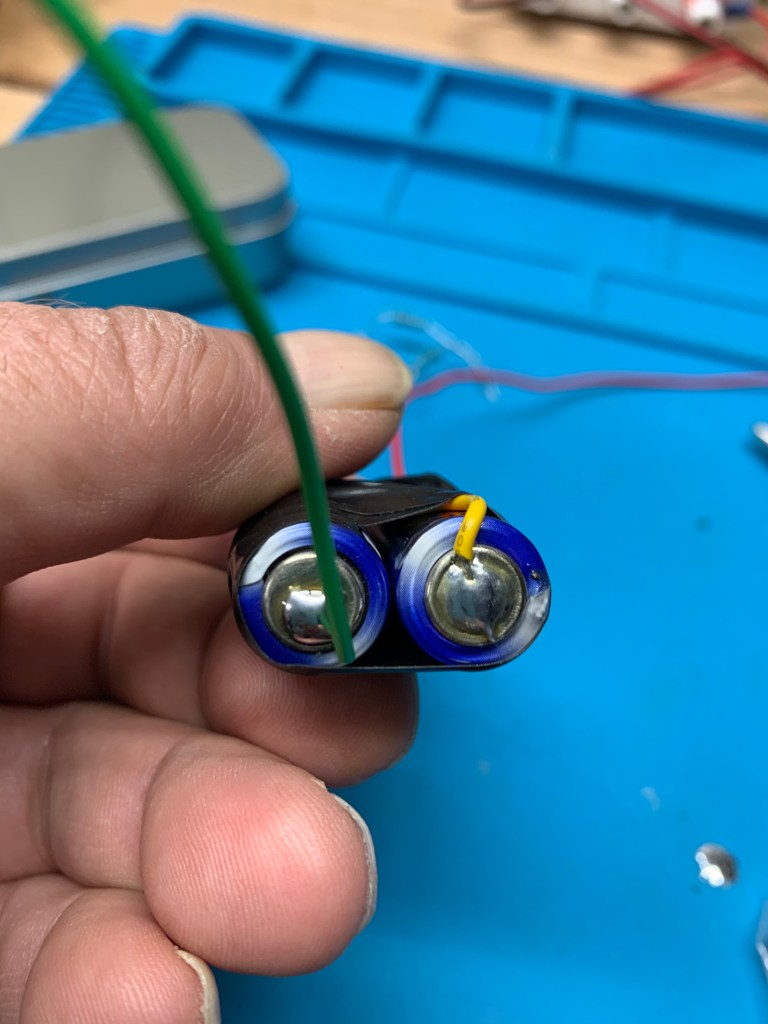
So first I need a 3V power supply of some kind because the LEDs I got want to be fed about 3 volts. AA batteries work well for this. (So would AAA batteries, BTW) Two AA batteries together will put out 3V so… Oh, I didn’t have a battery holder thingie. Ah, well, no problem there. Just solder the suckers together. Solder the negative pole of one battery to the positive of the other with a hunk of wire, solder jumper wires on, and away we go. Instant battery pack.

Is this safe? Um, maybe? Probably not? Is it easy? Not really. It’s a pain in the neck. Solder doesn’t want to stick to those suckers. (Hint: scuff the surface of the battery with fine sandpaper. Seems to help the solder adhere.) But this is a doomsday flashlight, remember? You don’t need neat and tidy and professional looking, you just need something that works. Jury rigging is encouraged.

Speaking of jury rigging…

Solder splashes are an optional accessory. The leads are just twisted together here, but I did eventually solder everything together before I packed it into the box. You really don’t even need to solder anything. Just securely twisting the leads and wires together and wrapping everything in tape would be good enough.

What about actually making some light? That’s the easy part, really. A couple of resistors for current limiting, a couple of LEDs, and away we go.

Now for mounting the LEDs in that case. How the heck do we do that? I don’t have any of those fancy mounts… Well, we’ll just drill some holes just barely big enough to shove the LED through and add lots and lots of glue.

Now, to sort through this lot to find a switch that might work…

The problem when you buy bulk lots of stuff labeled “100 Misc. Switches, $1.99” is that the chances of you getting anything actually useable out of that lot is pretty slim. Still, we work with what we got. All of those are momentary contact switches that stay turned on only as long as pressure is applied to them, and they aren’t really suited for what I want. Unless… Ooo, I know! Use the lid of the case as the switch. Close the lid it puts pressure on the switch and turns it on. Open the lid and it turns off.

And this is what I ended up with. LEDs glued into holes drilled in the end of the case. Lots of plastic tape to insulate the wires. The batteries wrapped in tape and held in with a self adhesive velcro pad, and the switch glued to the top of the battery conveniently makes it exactly the right height to turn on when the lid is closed. Damn, that was lucky there because otherwise I had no idea how I was going to mount that switch. Ooo, can you say serendipity?

And, damn, it actually works??? Yeah, it does. Closing the lid puts enough pressure on the switch to turn it on. Open the lid and it turns off. And puts out a surprisingly large amount of light, too. Damn, I actually made something useful? Wow!

It also uses very, very little power. I put it on the meter and it draws about 0.005 amps. A set of AA batteries will probably keep this thing going 24/7 for a couple of weeks. Which is good because changing the batteries in this thing would be a royal pain in the neck, them being soldered in like that.

Total cost on this, excluding the batteries, is maybe a buck at the most? Most of this stuff like the LEDs and the switches were bought in large lots as “surplus” in a moment of weakness when I was scrounging around on-line. (“Ooo, that’s a real deal! I’m sure I’ll need 1,000 miscellaneous LEDs in the future”) It took maybe half an hour to put it all together, and it only took that long because I’m easily distracted. And because it took me 10 minutes to find a roll of electrical tape.

Reviewing the MFJ 8100K World Band SW Receiver Kit

Being stuck in the house “social distancing” (OMG I’m so bored) has some advantages, one of which is being able to get caught up on a lot of stuff. One of those things is the MFJ-8100K world band shortwave radio kit. That’s the little beastie you see in the photo below that I (ahem) stole borrowed from somewhere on the internet.

Damn, that’s pretty slick looking. It beats the heck out of what the average electronics kit looks like when it’s done. Most of them don’t even offer any kind of decent case. Whether it actually will look like this when it’s done remains to be seen because I haven’t actually built it yet as I write this. Instead of putting it together and taking some photos and talking about it after it’s all done, I’m going to do this live, so to speak, writing and photographing as I go along so you too can experience the joys and pains associated with putting something like this together.

I should warn you ahead of time that this could get pretty lengthy because I’ve done little more than just open the box and it is already looking like this is going to be a problem.

But let’s look at the basics a little more closely before we get started. It’s a world band shortwave receiver with 5 bands. They cover 3.5 – 4.3 mHz, 5.85 – 7.4 mHz, 9.5 – 12.00 mHz, 13.2 – 16.4 mHz and 17.5 – 22 mHz.

As for the basic design, this is a regenerative receiver, a design that dates back to, oh, the 1920s or so, and was quickly abandoned as soon as superhets were developed. And for good reason, as anyone who has ever fallen off their chair from the blast of noise if you tweak the regen just a tad too far and it goes into oscillation can tell you. About the only good thing regenerative receivers have going for them is a fairly low parts count and easy assembly. Well, that’s not really true. They can be decent receivers once you get used to their quirks, but with really high quality superheterodyne designs out there, why even bother with one of these? How did I even end up having this on the shelf in the first place? I don’t remember buying it. Do I have people breaking into the house and leaving me stuff instead of stealing it now?

The first thing I started wondering was why the heck is this thing so expensive?It’s going for $90, for heaven’s sake. And there is nothing exotic or hard to find in the electronics. While that variable capacitor is kind of pricey (that goes for about $20+ alone and I know that because I had to buy one of the things a few months ago) But other than that I think there’s maybe $10 worth of parts in the thing. I suspect that really fancy faceplate and heavy duty metal case probably costs more than the electronics inside does.

But let’s get on with this.

Opening the box and poking around.

This is what the promotional photos tells you is in the box.

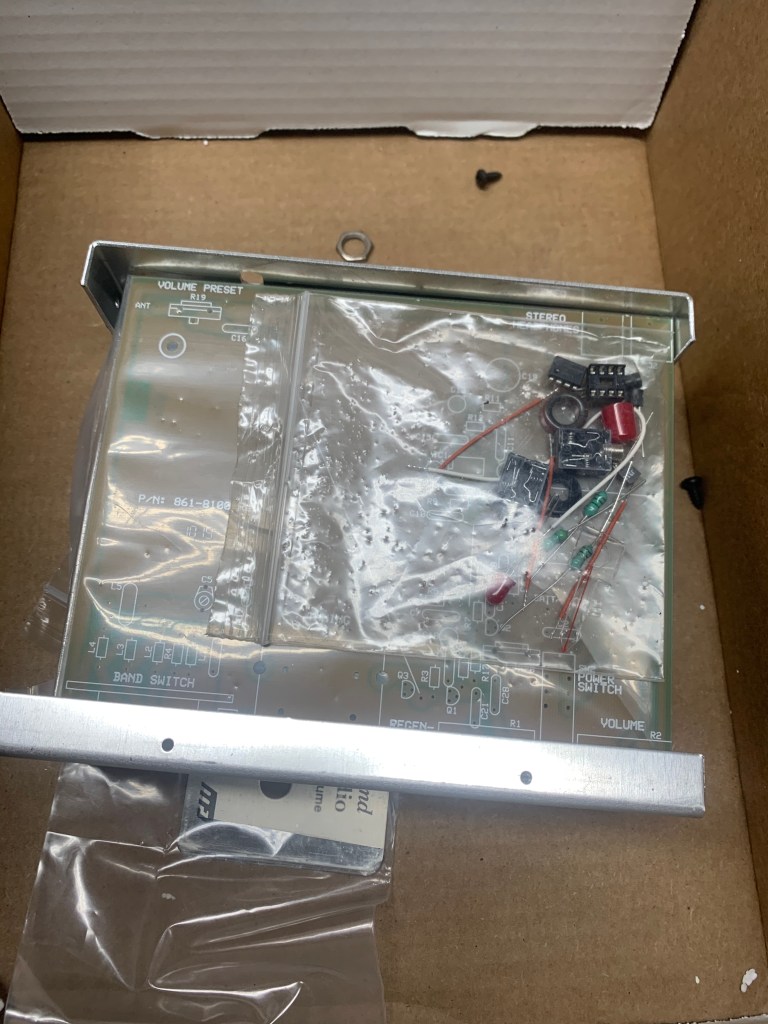
First I should point out that this kit starting with the photos below is shown exactly as it came and while I assembled it. The box was still sealed and I hadn’t opened it until I started this. What it really looks like when you open the box is this:

Um, okay… Are those screws and nuts rolling around loose in the box? Yeah, they are. And not just screws and nuts and washers, we got electronic components floating around loose in there too. Oh, goodie.

Opening the box and finding components strewn about all over inside doesn’t exactly inspire confidence about the quality of a product. Whoever originally packed this thing and chucked in the little plastic bags holding the components hadn’t bothered to actually close up the plastic bags.

And as for the case, well, damn, that’s probably the best case I’ve ever seen for a kit in a long time. Beautifully finished, heavy steel, with an equally beautiful brushed polished steel faceplate.

You can’t get much better than that. See what I mean about the case probably costing more than the electronics? It’s – it’s shiny. Oooo

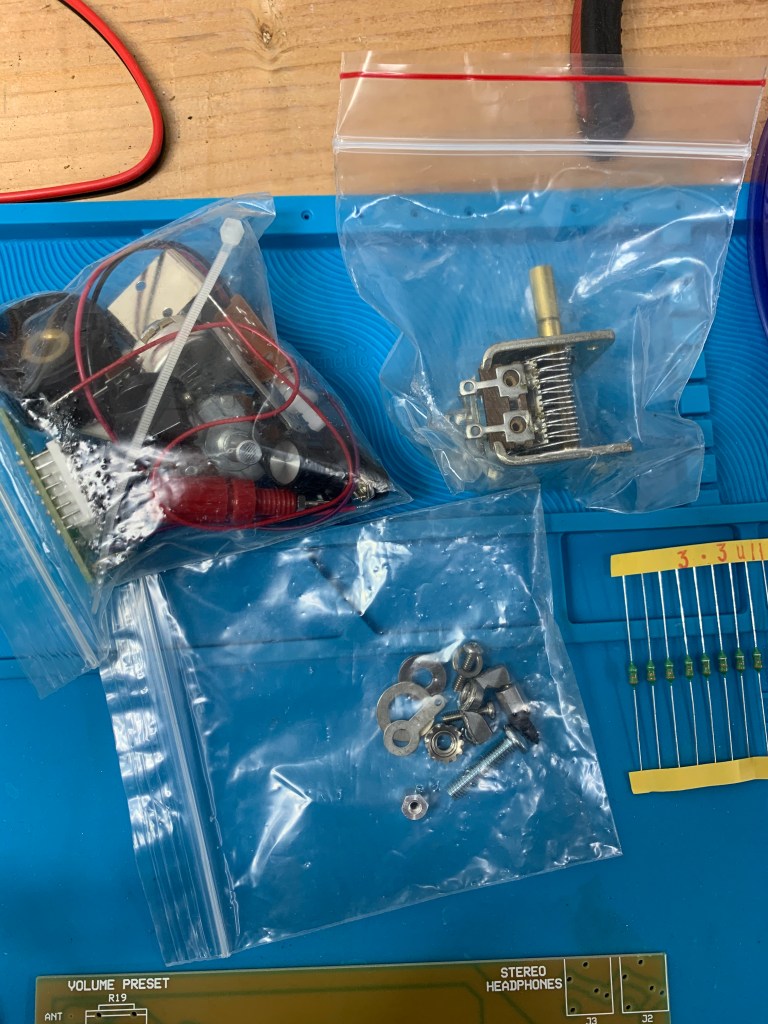
The rest of what was in the box looks like this:

The inductors on the right edge were not included in the kit. See text for explanation

As noted, most of the little baggies containing parts were open and had shed a considerable number of electronic components, screws, washers, etc. all over the inside of the box..

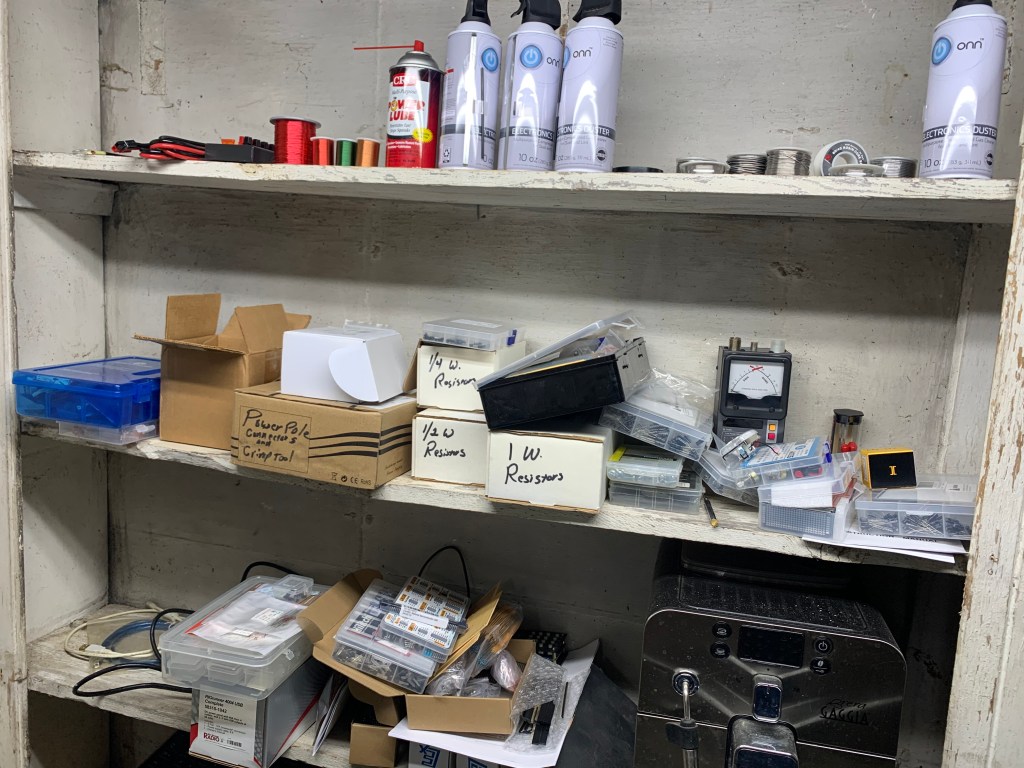
Half of “The Wall O’ Parts.” If I need something, it’s probably in there. Somewhere. Maybe. There’s even an emergency backup espresso machine in there

On the far right of the photo above you’ll see a strip of components held together with bits of yellow tape. Those are 3.3 uH inductors and those were not in the kit. I had to dig those out from my “Wall O’ Parts” because the kit wants one, and MFJ either thoughtfully failed to provide one because they figured I’d be getting bored by this time and needed to get up and stretch or something, or it got lost because of they left the baggies open. I expect I shall have to resort to the Wall O’ Parts several times as I try putting this sucker together. I’ve only just started to look at this and sort through parts and I’m already finding stuff missing, so I’m a wee bit irritated. There is nothing more upsetting than getting into an electronics kit and finding parts missing. Me, I have hundreds of components sitting on the shelf (well, if I can find ’em, that is) but the average person building this is not going to have that luxury and is going to be royally ticked off.

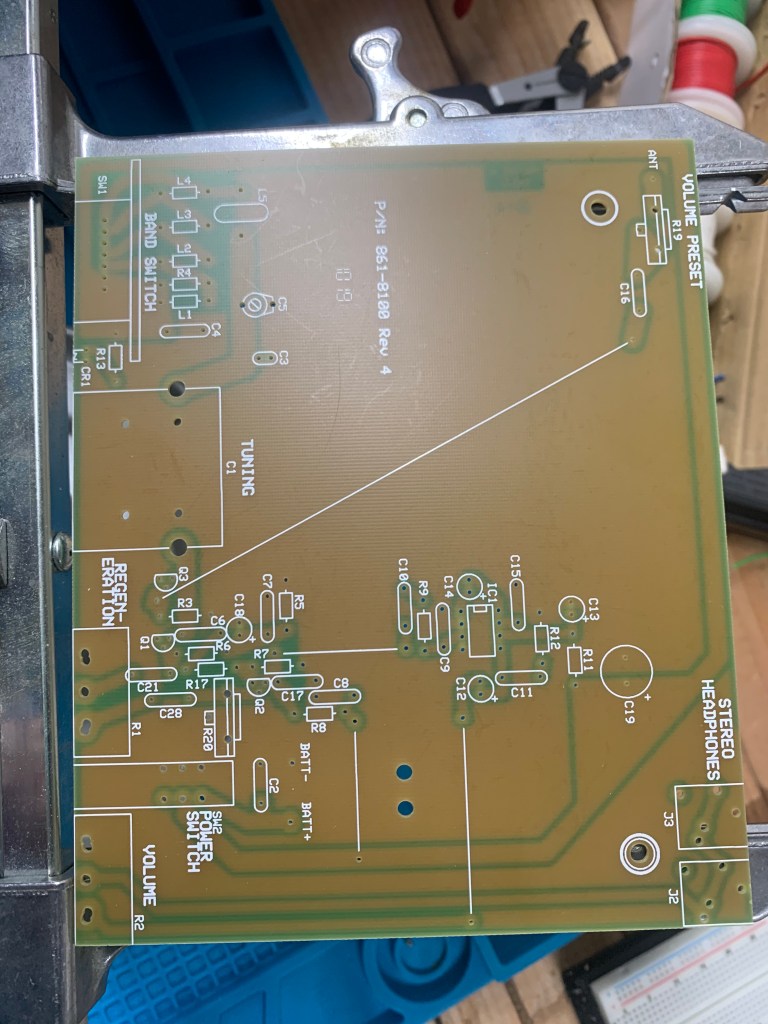
The circuit board looks reasonably well made and the parts locations are all nicely detailed. You could probably put it together without instructions if it weren’t for a few gotchas, like having to wind your own coil on a toroid.

Where’s the fecking Manual???

Now, the more sharp eyed amongst you might have noticed something missing from those photos up there. Where the heck is the manual/assembly instructions? Well, you don’t see it because there isn’t one. Instead of a manual there is a half sheet of paper telling me I need to download the manual from the MFJ website, giving me a URL to go to. So I go to the webpage as instructed and find a bad PDF of the circuit diagram which was so low resolution I couldn’t even make out the symbols or component labels. It looked like someone had almost deliberated fuzzed out all of the labels and component symbols, and the “manual” was actually a booklet in PDF telling me how to use the radio, not how to put it together. No assembly instructions. No readable schematic. Oh, goodie…

This exactly what the schematic I found looks like. Can you read that? Yeah, neither can I

A search on MFJ’s site using its own search function turned up a reference leading straight back to the useless info I’d already seen. I finally ran a general search on Google and found the real assembly manual tucked away somewhere on MFJ’s site and I printed it out.

(Update 3/27/20: And now I can’t even find that website, for pete’s sake! I was going to put the link to the correct PDF in here as I edit this before posting it, and when I just tried I get a “page not found” error. MFJ is apparently upgrading its website and I can’t find it at all. Good job, there, MFJ. I didn’t keep a copy of the PDF, but at least I printed the thing out so I can at least take a stab at this. But anyone else wanting that booklet, well, it looks like you’re on your own.)

The manual itself (if you can find it) is actually pretty good. Sort of. Clearly written, mostly, with lots of detail, but sadly lacking in illustrations.

So let’s sling some solder and see what happens.

Now that’s interesting. Look at the 4 inductors up there. Notice anything different about one of ’em? Yeah, the third from the left is about half the physical size of the other three. The big three were supplied with the kit while the small one is my replacement and is about half the physical size, but it is the right specification according to the color codes and I put it on my tester just to double check, and it should be the right one. Is this going to be an issue? No idea at this point. All of the inductors I have in stock are the smaller size.

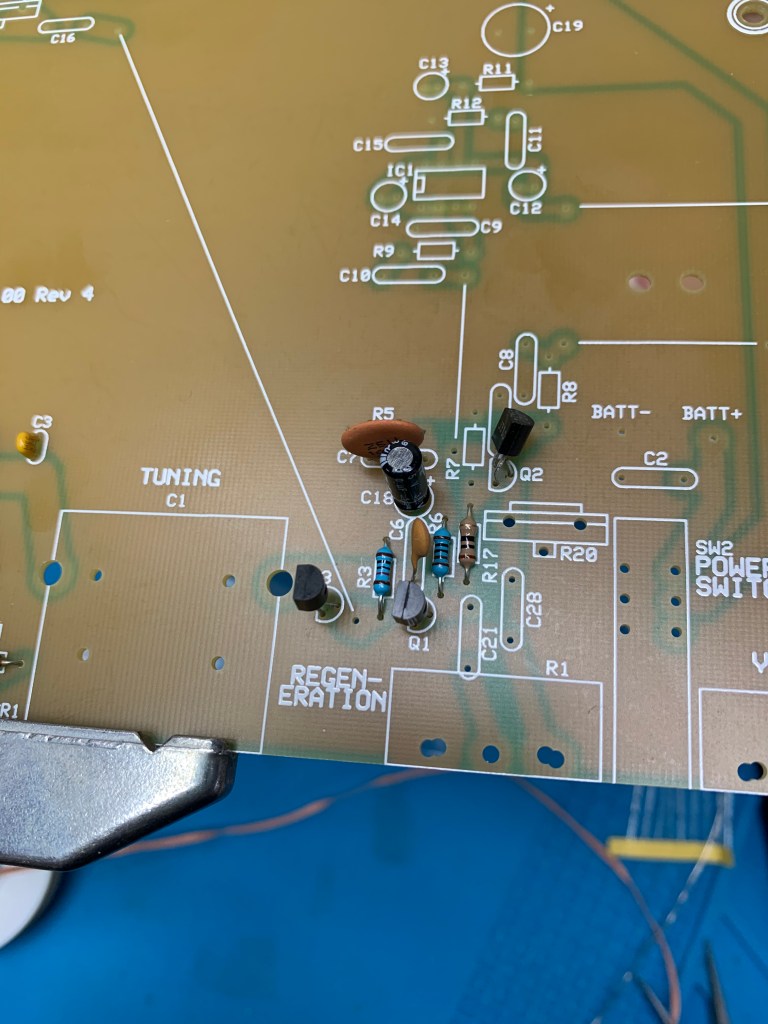
Also, more missing parts. Just found two resistors are missing. Look at this pic:

R3 and R6 were missing so I had to pull those off the shelf. Notice that they’re an entirely different color from the kit supplied one, R17. I use the generally more reliable metal film resistors (the blue ones) while the kit supplies carbon resistors (the tan ones). Now very, very rarely the type of resistor can make a difference, so I’m hoping that isn’t the case here.

Later – Missing parts list now sits at 1 missing inductor, 4 missing resistors, and 2 missing capacitors.

And now there’s an issue with one of the electrolytic capacitors.

C14 there next to the IC socket is, according to the instructions, supposed to be a 10 uF cap, but the kit supplies a 1 uF. Or at least I think that’s the one because the 1 uF is the only one left. Do I follow instructions and put in a 10, or use the 1 uF supplied? I finally pulled a 10 uF off the shelf and used that in the hopes that the instructions are right and the parts picker was wrong. (Later – Apparently the 10uF was the right choice because now that it’s done it works)

Watch out for solder bridges or pins with cold solder joints. Here on the bottom row of pins, the third from the left is a bad joint.

And speaking of IC sockets, and this applies to whenever you’re soldering a socket, use caution soldering the pins because it is very easy to apply a tiny bit too much solder and end up with solder bridges shorting out the pins. And it’s easy to do a bad joint as well. Double check under a magnifier.

Time to install the variable cap which is how you tune this puppy. And…

And the solder lugs on the cap are way too big for the holes in the circuit board. I could either drill the holes out, which I don’t want to do because the solder pads are none too large to begin with, or I could trim off the lugs. I finally trimmed the lugs off.

Above here I’m trying to mount the volume control and the regen control. They don’t make this easy either. We’ve gone from holes being to small to holes being way, way too big. Note how some of those holes at the top edge of the board have been double drilled, which makes them way too large for the solder lugs on the potentiometers that are supposed to fit in there.

And speaking of soldering, look closely at those solder pads on that board. It’s difficult to see in the photos but almost all of them seem to be covered with some kind of oxidation that makes it difficult for the solder to adhere. I’ve been using a bit of a scotch brite pad held in a needle nose pliers to buff them before I solder anything.

Then there’s the band switch. The switch has 8 pins, the board has 7 holes. Hmm… Let’s look at the manual. Ah, here we are… Oh, nothing. Says nothing about what to do about the missing hole. Oh, goodie.

I ended up bending the extra pin out of the way and keeping my fingers crossed that it wouldn’t get mad at me. (Later – Don’t know if I was supposed to do this or not but the thing is working this way.)

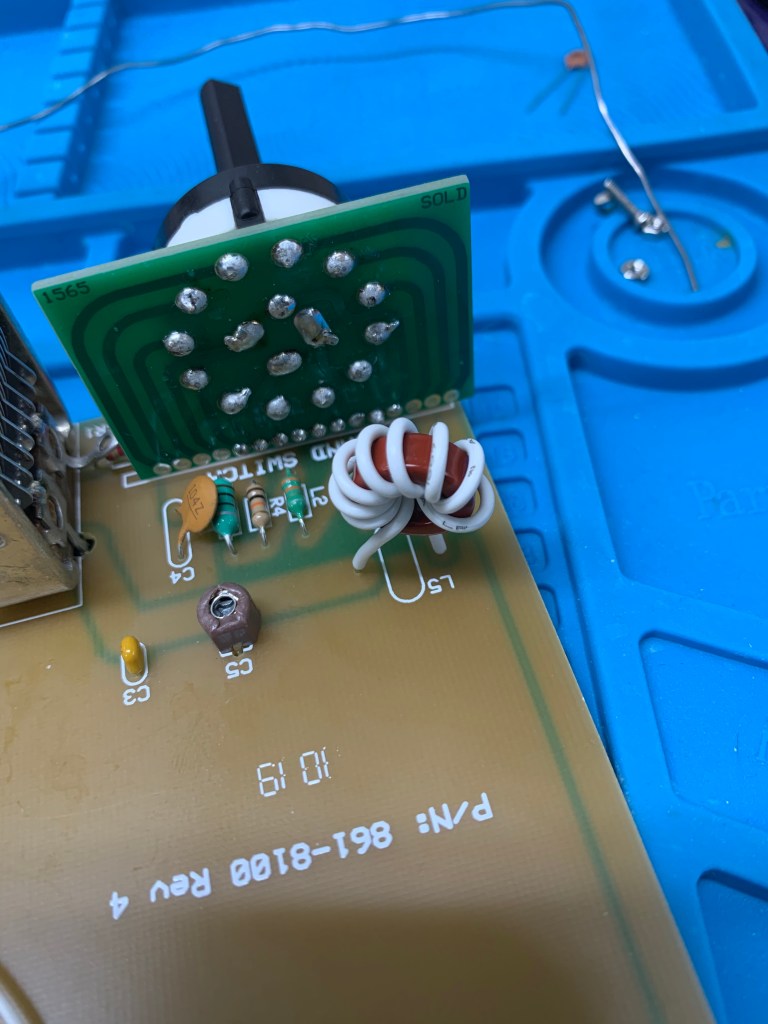
That circle thing with the white wire wound around it is a coil made by winding 8 turns of wire around a provided toroid core. Some people get a bit weird about winding their own coils. I’m not sure why. A small one like this is a piece of cake. They don’t get nasty until you start having to make ’em with, oh, 30 or 40 turns.

And there it is, ready for testing. It runs off 9V and supposedly a 9V battery will last for weeks and weeks as long as you remember to turn it off. I don’t have a 9V battery, tho, so I hooked it up to my DC power supply and…

Damn, I wish my upload speed wasn’t about 15K baud so I could put up a video of this, but the damned thing actually works! I won’t go through all of the alignment procedures because they will bore you to tears. This is, believe it or not, an actual, working SW receiver. Not a very good one, granted, but it will pick up something.

But then there’s this

This is it fully assembled, mostly. You will note that I don’t have the knobs on. There is a reason for that. MFJ neglected to include the collar nuts you need to actually attach the front properly, anchor the controls down so I can put the knobs on. Now there were indeed collar nuts in the box. You probably saw that in the photos from the box opening. But they were for control shafts about twice the size of these. Sigh… Thanks again, MFJ. Complete assembly is going to have to wait until I can get the right sized nuts.

Okay, this has gone on long enough. Let’s wrap this up. What’s the overall assessment of this beastie?

Well, on the plus side it looks good. It is, amazingly enough, a working radio receiver, although not what I’d call a good working radio. It wasn’t hard to put together. Just about anyone who knows which end of a soldering iron to grab could put this together. Well, mostly, with the application of a bit of common sense. And that case sure looks cool.

Elenco AM/FM superhet kit under construction

But then we come to the negative side.

First problem is the price. They’re getting $90 for this thing, my friends. While the Elenco AM/FM receiver I put together a couple of weeks ago is far more sophisticated, much more sensitive, has an actual amplifier so it can drive a speaker and not just headphones, and sells for half the cost of the MFJ kit at about $44. Granted, it doesn’t come with the fancy case, but you can always cobble together something to throw the Elenco into. And when you’re done with the Elenco you’ll have a radio you can actually listen to, whereas the MFJ is never going to be more than a curiosity for most people.

Then there are the missing parts. A half dozen or so resistors, two capacitors, an inductor, the collar nuts to hold the controls in place, all missing. I don’t know if this was a problem with the person who packed up the parts in the first place, or if they were lost somehow because the bags weren’t closed, or what. My guess is that they were never in there to begin with, because while parts did spill out, the box was sealed and there were no openings for anything to fall out.

As I said before missing parts isn’t much of a problem for me, but for someone who doesn’t have a “Wall O’ Parts”, like some kid doing this for a STEM project or someone who just enjoys occasionally tinkering with kits, this could be a real problem. Sure, you could probably email MFJ and they’d probably replace the parts. Eventually. Maybe. But come on, they should have all been in there in the first place.

Then there’s the manual. Or, rather, the lack of one. What’s the matter with you people over at MFJ? You could throw an 100 page product catalog into the box but you couldn’t be bothered to run off a 30 page manual on the office printer and throw that in too? And then even worse, direct me to a website to find the manual that doesn’t exist? Or to utterly useless schematics?

I’m really disappointed with this because this could have been a really good kit if MFJ had bothered to just just be a little more careful.

So, because of the high price, the missing parts, the missing manual, etc. I can’t score the 8100 very high. On a scale of A to F, where A is excellent and F is abysmal, I’d give the 8100 kit a D+.

I Am *NOT* Going to Mention the "V" or "C" Words!

If you’re like me, you’re ready to scream because of the 24/7 fear, panic and everything else you’re seeing on the news and internet. So here’s some photos to distract you. Well, if my internet connection stays up, that is. It’s been down a half dozen times already today.

Yes, it’s a dead horse. No, not a real one. This was a tourist trap in S.D. that we stopped at that apparently bought up all of the movie props from Dances with Wolves. Although I don’t remember there being a stuffed dead horse in that movie.
Skunks in S.D. are very friendly, it seems. This little stinker wasn’t much more than a baby and decided I was his mother and began following me around. He couldn’t understand why I retreated very quickly.
Ooo, it’s orange!
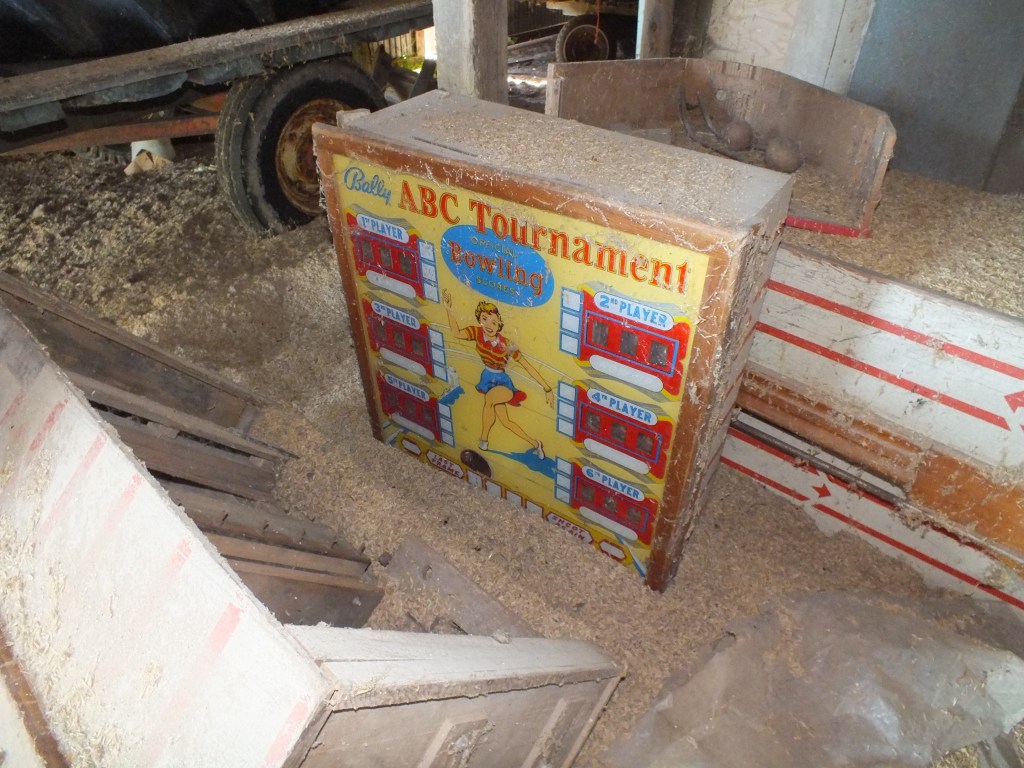
We found some odd things when we cleaned out the buildings on the farm, including a complete 1940s or 1950s era bowling machine.
I had no idea eggplant flowers were so pretty until we grew some one year.
I don’t need to tell you these are cats, do I?
The big telescope and its little brother
Overlooking the Mississippi
Dorms at my old college.
Copper Falls park in north western Wisconsin. Beautiful place. Highly recommended.
Somewhere in the Big Horn mountains. I think.

That’s enough for now. I’m pushing my luck with my internet connection here, I think. It went down three times while I was uploading photos.

Hang in there, my friends!

Weird stuff at WordPress

I’m not sure what’s going on with WP this morning but I’ve been running into all kinds of issues here. I can’t “Like” posts or comments on other WP sites, I can’t Like comments on my own blog, for heaven’s sake. I can’t access WP tools from my website, only if I go directly to my administration page. All kinds of weird stuff. I don’t know if it’s something local (i.e. and issue with my browser) or if this is effecting other people. Hopefully it’s just a temporary thing, possibly caused by system overloads. It’s about 7 AM local time so that means a hell of a lot of people are probably trying to get online to check emails, do work, school, etc so it could be just some kind of overload.