Roses of Winter and Holy Cow it is Bloody Cold Plus Some Radio Stuff

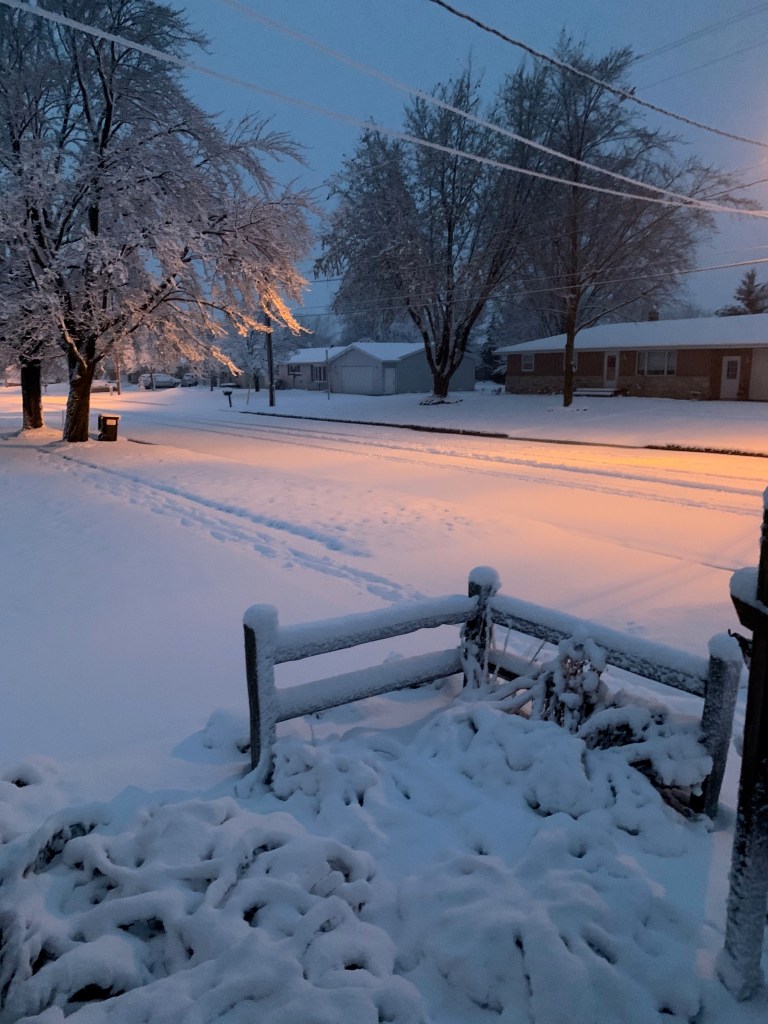
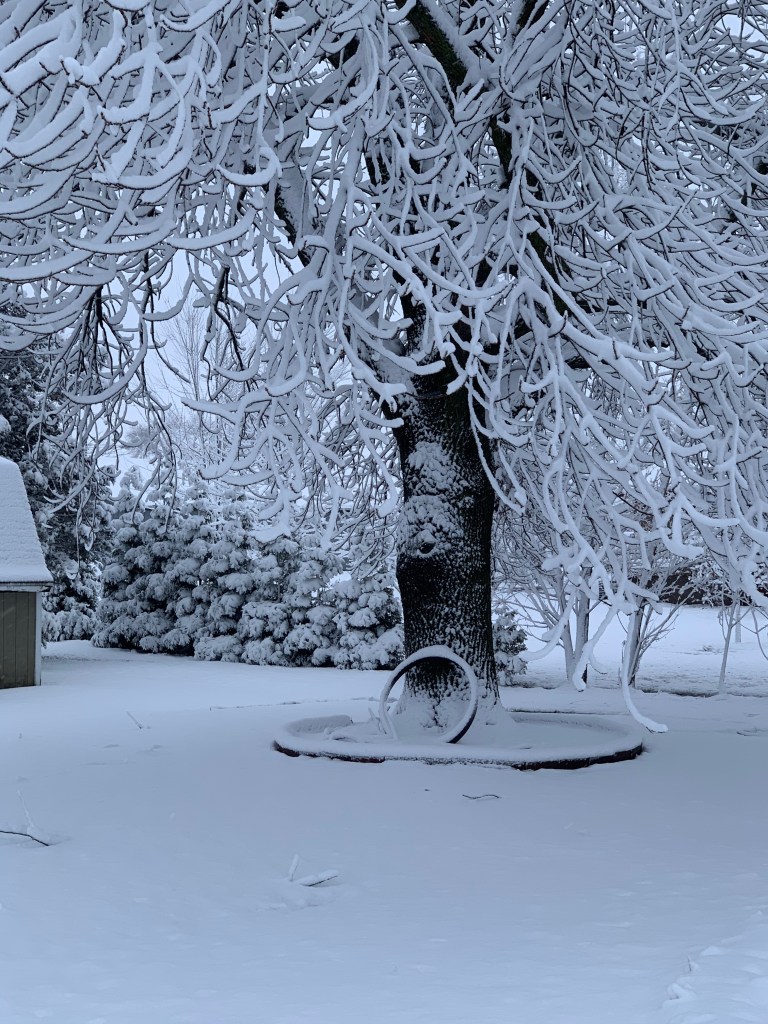
Apparently Mother Nature wasn’t satisfied with deluging us with snow a month early, now she’s trying to freeze us with temperatures we usually don’t see until well into January. It’s about 3 degrees (F) out there, with windchills down in the -10 range. Sheesh…

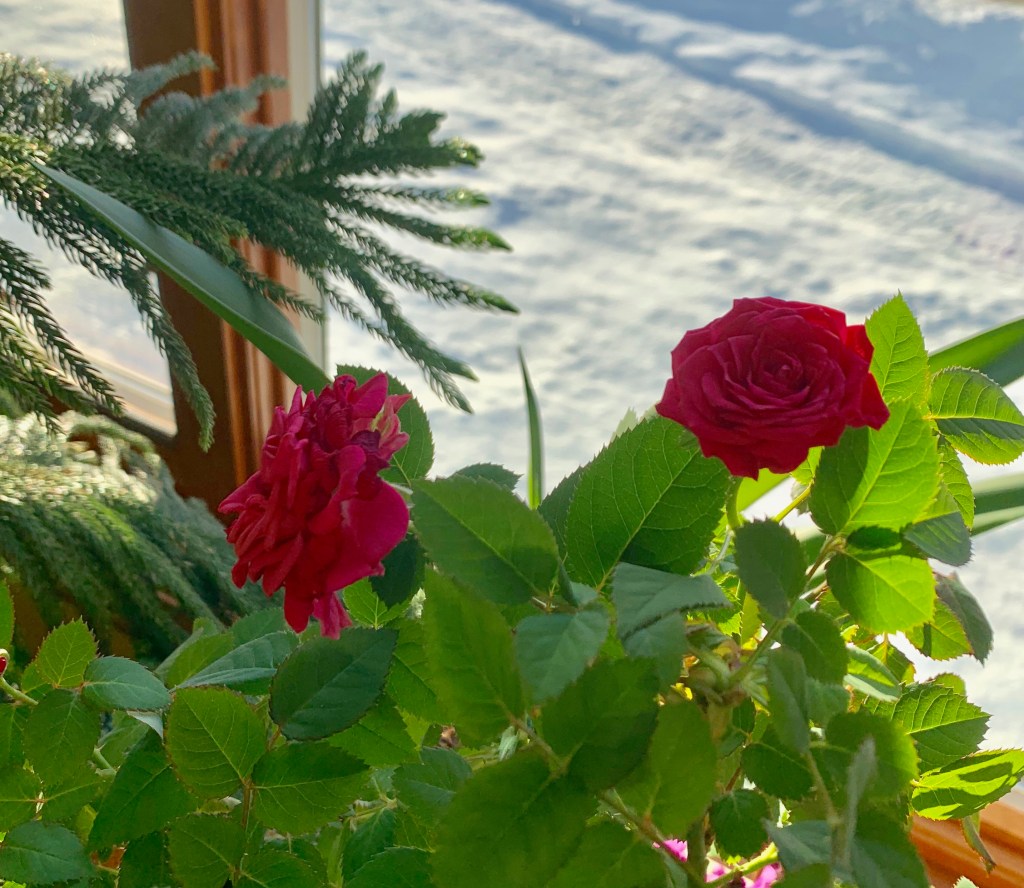
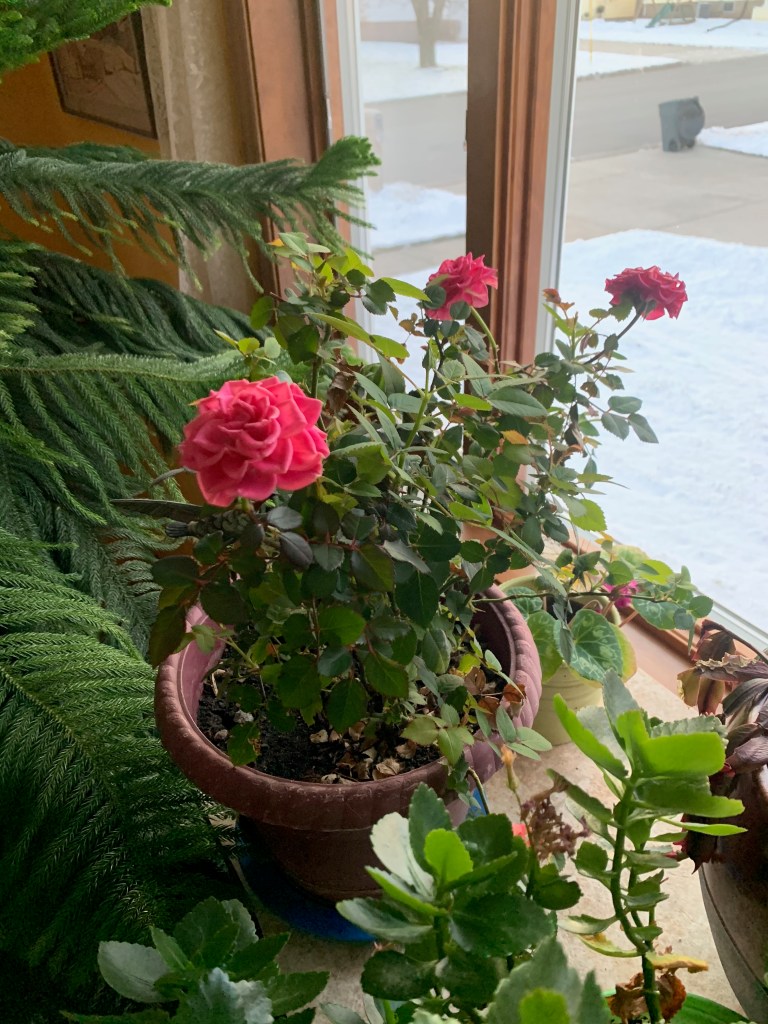
Meanwhile, MrsGF has this growing in the living room. Just took these photos the other day-
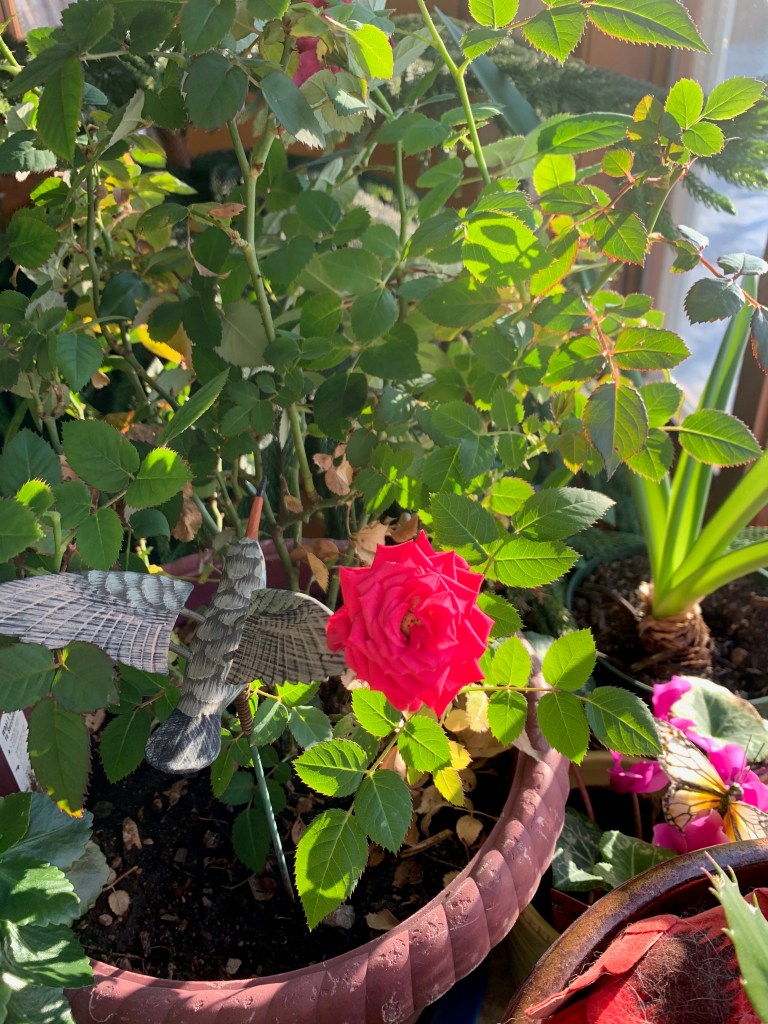
Yeah, roses. I’ve put up photos of this before, but I figured this plant would go dormant or something by now. But it just keeps right on blooming.

This thing started out as one of those goofy little teacup roses, a tiny plant in a cheap cup that they sell for a few bucks on Mother’s Day or Valentine’s Day. Think I paid all of $7 for it, oh, must be at least two or three years ago. And after we got sick of it sitting around the house MrsGF said what the heck, let’s put it in a big pot and see what happens and the dopey thing just kept growing and flowering. We were putting it in the basement, letting it go dormant over winter, but this year she thought she’d put it in the living room where it could get some light and keep watering it, and well, it apparently likes it there, and it’s been flowering on a regular basis all winter so far.

I asked her how she’s keeping it flowering and she swears she’s just watering it and isn’t doing anything else. Personally I figure witchcraft is involved.

The MagLoop Antenna

I talked about this antenna before, and I continue to be more than pleased with it. Since my dipole came down in the last snowstorm it’s been the main antenna for my TS-990, sitting on the floor behind me in the office. And it is doing ridiculously good.

This is putting 15 watts into an antenna sitting just behind me in my office this morning.

The Great Radio Fiasco Project

I mentioned this before, but let me summarize what I’m trying to do here. For reasons I won’t get into right now, I challenged myself to build, from scratch, a decent radio receiver, preferably shortwave. Emphasis on the word “decent” because I could throw together a few parts and end up with – well, with something that would receive, well, something that might be a radio signal, and pump it into a speaker and you’d hear some sound that might be interpreted as a radio transmission by someone with bad hearing. It could technically be called a radio receiver, but, well, let’s face it, it wouldn’t exactly be useful.

When I first conceived of this project I was like how hard can this be? In those WWII movies the Resistance throws together a radio out of bits of string, a piece of wire, an old cigar box and bits off a horse (don’t ask me what bits, I don’t know, ask them, they built the thing) and call up Churchill at Bomber Command and call in an air strike on Hitler’s outhouse. And the Good Ole Boys in amateur radio weep bitter tears of disappointment over the fact that modern day hams don’t build stuff any more like they did, when they’d throw together a 1,500 watt amplifier, transmitter and superhet receiver in an afternoon, out of parts they salvaged from old washing machines. And bits off a horse for all I know.

Here’s the thing, though – 95% of that (maybe even 98%) is pure BS. I’m sorry, but it just is.

The days of being able to salvage anything useful from discarded electronics are long gone. Modern SMD (surface mount devices) and robotic assembly methods make it virtually impossible to salvage anything useful from relatively modern equipment. And while you can buy discrete components like resistors, capacitors, etc. in the more common values, increasingly it is difficult to find a lot of stuff in anything but SMD form, and in quantities of 1,000 or more. I was trying to find what had once been a very common opamp the other day. It is still available. But if I want to get it from a US supplier I can only buy it in quantities of 1,000 or more, and in SMD format. If I want it in the traditional 6 pin IC form, and only want a few of them, it looks like I’m going to have to order it from China and it won’t get here until mid-March.

Nor are parts cheap. Oh, some are, true, but not the kind of stuff I’m looking for. A single variable capacitor I need for a project sells for $25. And I need two of them. So I’m going to have $50 stuck in that project before I even get started on it.

And then there’s the design of the equipment you want to build. If you were going to set out to build your own radio receiver, probably the first thing you’d do is fire up Google and look for something like “build your own radio” and find, well, hundreds and hundreds of hits that are utterly worthless, along with a few sites that might have actual plans to build something. Only most of those plans are for useless crystal radios and other nonsense. And the designs that do look useful are probably going to be wrong and no one is going to tell you how to fix it when you build it and it doesn’t work. In fact, most of the designs I saw out there were copies of stuff pulled out of old radio or electronics magazines from the 1960s or 70s that didn’t work in the first place.

(Sidenote: I’m convinced that the building plans in all those electronics magazines published in the 50s, 60s, 70s, etc. were never actually built by anyone because about six or eight months after the plans were published there’d be a “corrections” item pointing out that they forgot this part, or the wiring was wrong and if you’d actually build the thing it would have exploded, electrocuted your cat or something.)

So the question is, can I build a decent radio receiver from scratch? Probably. Will it work? Maybe. Can I do it for less than what it would cost to just go buy one? No way in hell. Will it work as good as even a cheap piece of junk commercial radio? Almost certainly not.

So why am I doing this? Uh, because I’m a stubborn old goat?
Catching Up With Stuff

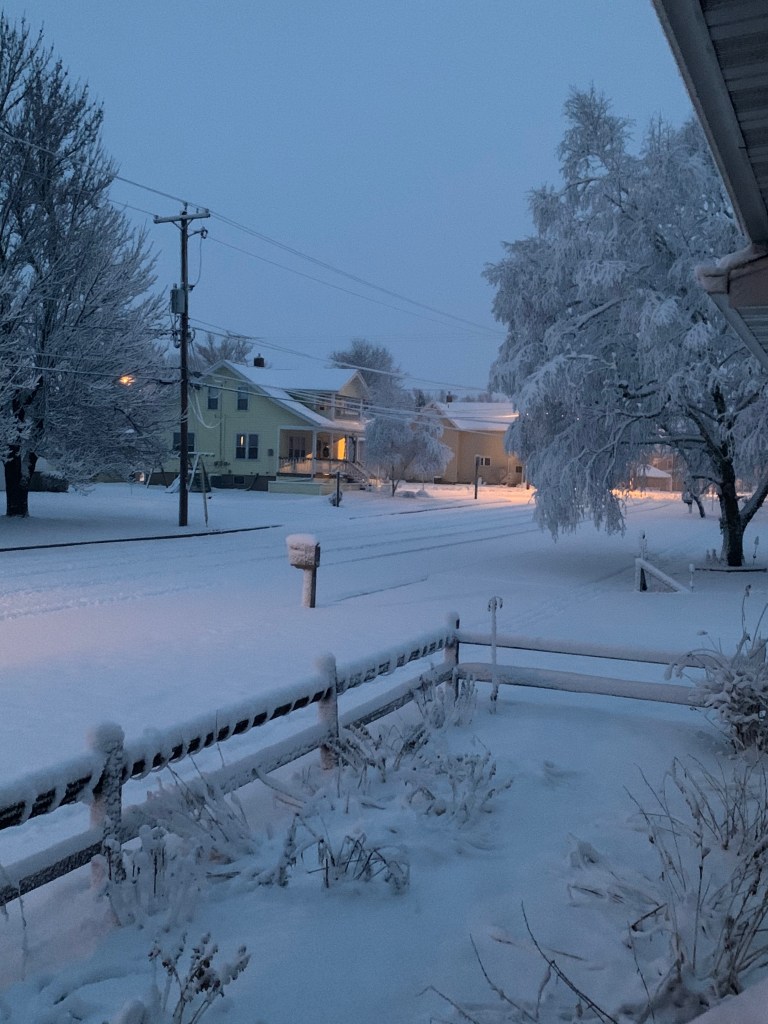
Well, there’s no doubt that winter is here. With a vengeance. Still, it could be worse. Up in Washburn (really nice little town along Lake Superior) they got 31 inches of snow from the storm. I rather like winter, but in small doses. Winter is best experienced by gazing out at the snow from the inside of a nice warm house. My favorite winter activity is hunkering down in my warm corner of the basement where I can play with radios, electronics, and computers. So you might see more items about ham radio and electronics until the spring thaw finally comes.

JS8Call Ver. 2 Just Released

Revision 2 of JS8Call by KN4CRD was just released a few days ago after coming out of beta testing. I’ve been running the beta versions for weeks now and can tell you that the new version is stable, works very well, and is a huge improvement over version 1. Ver. 2 now includes a turbo mode that more than doubles the speed of communications from about 15 WPM to about 40 WPM. There’s no such thing as a free lunch, of course, so that increase in speed comes at a cost. Bandwith in turbo mode is significantly wider and it isn’t as sensitive to weak signals. But you can always drop back to the original slow mode if you have trouble making a contact.

What’s great about JS8Call and it’s cousin, FT8, is that when using these modes of communications you don’t need to invest thousands of dollars in equipment and antennas in order to talk to people, even when radio propagation conditions are as poor as they are right now. Because these modes work so well with very low signal levels they can permit communications under even very poor conditions that shut down voice and even other digital modes.

Antennas

You probably remember that photo over there on the left from the other day if you follow this blog. That’s the remains of my off center fed dipole antenna. A dipole antenna is a wire antenna configured in a sort of “T”. The vertical base of the “T” is the feed line or coax going to the transmitter. The horizontal lines to the left and right at the top of the “T” are the legs of the antenna that extend out a considerable distance. In this case, if I remember right, and I probably don’t, one leg of that “T” was about 40+ feet long and the other was about 90 feet long. It was strung up between some trees here, about 10 – 15 feet off the ground. It really should have been much higher up, but that was as high as I could get it, and sometimes you have to work with what you have and adapt.

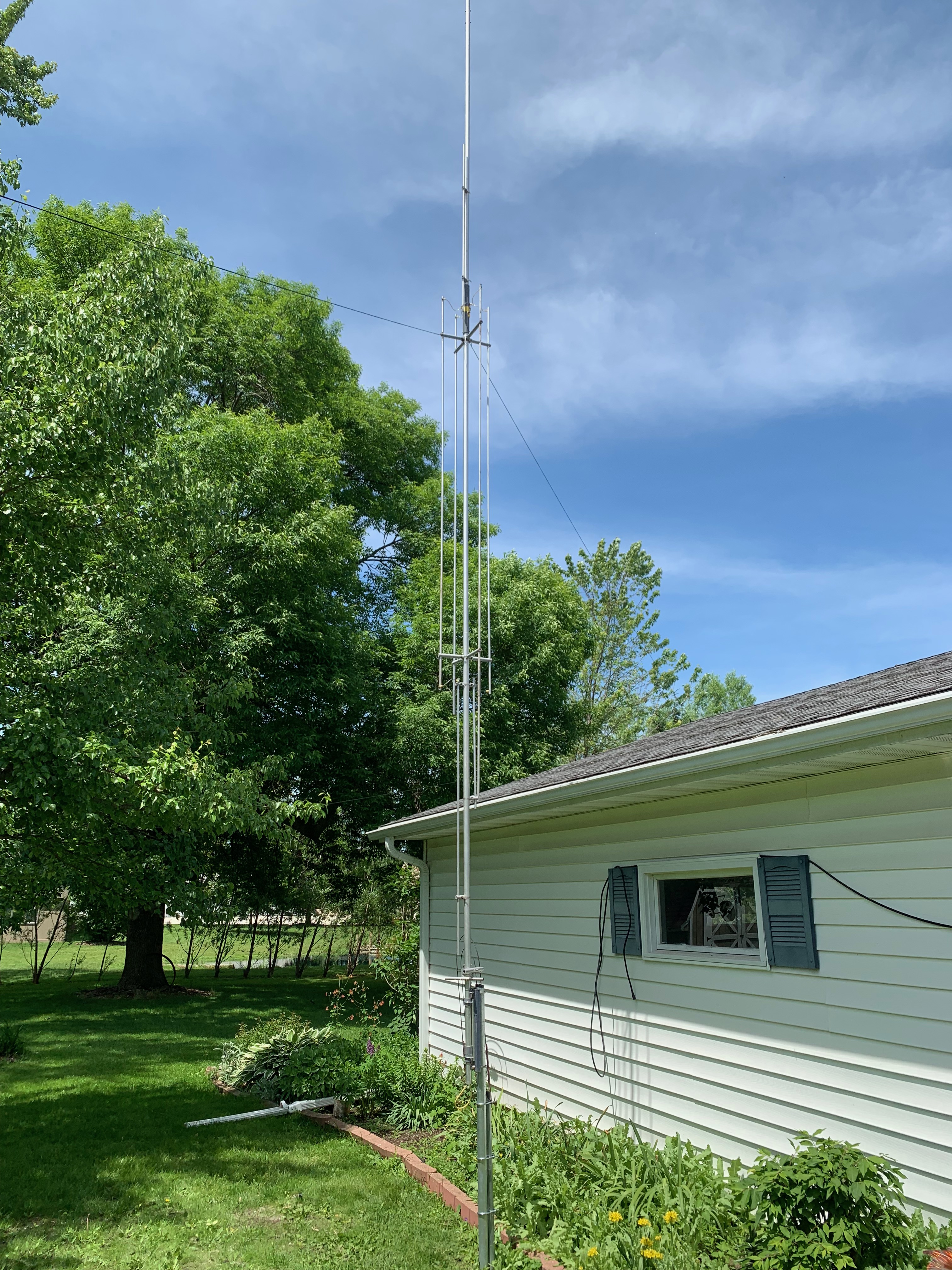
I was very surprised that it came down, even in the snowstorm. While it was encrusted with snow, there wasn’t that much snow on it. And if it would break, I expected it to break at the lines at the end that held it up. I never expected the wire itself to break like that. I expected the GAP Titan vertical to collapse before that wire would break, but the vertical survived just fine. The counterpoise rods were bent almost to the ground from the weight of the snow, but once they were cleaned off they snapped back into the right position.

Since my main transceiver, the TS-990, was hooked to the OCFD while the vertical is hooked up in the basement to the 450, that means I had no antenna for the 990 because I’m too lazy to try to thread 30 feet of coax through the basement and up into the office to the 990, especially since all the radio equipment is going to get moved down there in the near future. So I’m running the 990 off the Alpha mag-loop antenna at the moment so I can still fiddle with radios up in the office. And the results are embarrassing, really. I was playing with FT8, running about 15 watts into the mag-loop, and according to PSK Reporter I was getting results almost as good as I’d been getting using the OCFD at 75 watts.

What the hell ever happened to NAFTA?

The current administration turned NAFTA into a campaign issue, claiming that it was bad for the US and needed to be scrapped and that they would negotiate a much, much better deal called USMCA. And do it in just a few weeks…

Yeah, sure they would. The “few weeks” has turned into almost two years, and while a treaty has been negotiated, it still hasn’t been passed by either the US or Canada, although Mexico has approved it. And it looks like it won’t be approved until well into 2020. If ever.

And as for it being so much better than NAFTA – yeah, well, no. About 95% of it is almost exactly the same as what the administration trumpeted as being “the worst deal in US history”. And what has changed doesn’t really amount to much. In fact, according to an analysis by the IMF the only real beneficiaries of the deal are Canada and Mexico. The US ends up on the short end. At best, best, the US might see a positive outcome of 0.1% of GDP. That’s one tenth of one percent. And an increase of about 175,000 jobs, not the “millions” that the administration claimed. And at worst the US might actually lose about $800 million a year on the deal.

So much for the “beautiful” deal the administration promised it would negotiate.

Well, if it ever actually passes, that is. The Congress is not exactly happy with some of the things in this treaty, and with all of the crap that’s going on in DC at the moment, plus ramping up for the election, well, the chances of USMCA actually getting through Congress are pretty slim at the moment.

The Foxconn Fiasco

I’ve talked before about the whole Foxconn fiasco, but let me recap briefly. Foxconn is one of the largest manufacturers of electronics in the world. It’s claim to fame is that it once treated its employees so badly that it had to install anti-suicide nets around the roofs of its buildings because employees were jumping off the buildings to kill themselves rather than work for the company.

Anyway, here it is, a little more than a year since I wrote that, and we still don’t have a factory. Or much of anything. And we still don’t know exactly what the hell FC is going to do. They’re building something down there at the site, but no one seems to be sure what the hell it really is. Supposedly it’s what they call a “Gen 6” LCD flat panel display factory, but that makes no sense at all because there is a glut of flat panels that size on the market and there’s no way Foxconn could ever make those panels here in the US at a competitive price.

One thing we can be sure of, is that Wisconsin, if you’ll excuse the expression, got screwed.

A new study by George Mason University concerning Wisconsin’s deal with Foxconn (and of government subsidies in general) has discovered what a lot of us have been claiming all along, that the state will never get back all of the money being given to the company in the form of concessions, cash payments, tax breaks, and billions of dollars in roads, sewers, electrical infrastructure and other things being paid for by the taxpayers of the state. That money will never be recovered, and we would have been much, much better off investing that money in things like education which would have made the people of the state smarter, better trained and better at adapting to a changing job market.

The FC situation is the most visible because so much money is involved, but if you look at other “deals” the state has made with other companies, almost none of them have worked out as well as the state has claimed they would. The state’s own figures show that when looked at as a whole, these “job creation” deals the state has made have produced only about 34% of the jobs the state and the companies involved have claimed they would produce. The WEDC, the agency in charge of this, has proven to be exceptionally good at funneling money to lobbyists, big campaign donors and outright criminals, while being rather bad at actually stimulating job growth in the state.

Let’s see, what else?

Down in the workshop I’ve pushed the computers off to one side and it’s littered with transistors, diodes, capacitors, coils and other bits of stuff as I try to go “old school” and build my own shortwave receiver from scratch. I got into a discussion with Chris over at Off Grid Ham in response to an item he’d posted about the importance of short wave broadcasting, and I started wondering just how hard it would be to build a shortwave receiver from scratch. And doing it the old school way, with no SMD components, no ICs, not even printed circuit boards. I should be able to do this, I told myself. I know the theory and I used to be an electronics technician, for pete’s sake. It shouldn’t be all that hard to do, right?

Yeah, well, it depends. Yes, I can breadboard a simple receiver that will pick up very strong signals. Sometimes. If the phases of the moon are correct and I keep my fingers crossed and hold my breath. But if I want something that qualifies as a decent radio receiver, well, that’s not so easy. Just trying to find the parts I need for this project is proving to be an issue. So we’ll see where this goes. If something ever comes of it I’ll let you know.

There are a group of older amateur radio operators who hang out on the forums over at QRZ and other places who constantly complain that modern AROs are, well, idiots, to be honest. They complain that us ‘modern’ hams don’t build our own equipment like they did, don’t know which end of a soldering iron to hold, and that we could save tons of money if we’d build our own transmitters, receivers, etc like they did back in the ‘good old days’.

The problem with that whole attitude is that it doesn’t reflect reality. Most hams back in the 50s and 60s didn’t build their own equipment, they bought it off the shelf. If they didn’t, manufacturers like Collins, Hallicrafters, National, etc. never would have existed. Some did build their own, yes, but the fact is that most AROs bought their equipment and didn’t build their own.

Another problem, as I’ve been discovering, is that anything I can build isn’t going to come even close to the performance specifications of modern equipment.

The other issue is cost. Yes, I could build, for example, a VHF transmitter and receiver. Probably. But it would take me months to do it, and hundreds of dollars in parts, plus a few thousand bucks in additional test equipment I’d need.

Or I could go to Amazon and pick up a generic Baofeng hand held VHF/UHF transceiver for $30.

Anyway, I’ll keep you posted on The Great Receiver Project. If it ever goes anywhere, that is. I’m going to start out simple and try to put together a classic 1960s style transistor radio first and if I can get that working, I’ll go from there.

So This Is What It Looked Like This Morning…

Sure looks pretty, but this is heavy, wet, nasty stuff that does a lot of damage. Surprised we didn’t lose power.

So much for my off center fed dipole antenna. Grrr… Weight of the snow ripped that sucker right apart. Since this is the antenna that goes to the TS-990, my main transceiver is off the air until I can get this repaired or replaced. Or moved to the basement and hooked to the other antenna.

This was the antenna I was really worried about. I never thought the OCFD would break, but this one, yeah. But the GAP vertical handled the snow just fine while the wire antenna snapped. Hmph…

JS8Call Ver. 2 Released

JS8Call Ver. 2 is now out of beta and is available for general release. I’ve been using the beta version for some time now and I can tell you that it is a significant improvement over Ver. 1. It’s available for Linux, Win10, RaspberryPi and OSX, which should cover just about anyone reading this.

Most of you probably won’t care and are going “WTF is this JS8 thing?”, but if you’re into amateur radio, you probably already know what it is or have at least heard of it.

JS8 is built on the same communications technique used with the wildly popular FT8 digital mode, which means it is extremely robust at working with very weak signals as FT8 is. But FT8 is only good for very brief, pre-programmed exchanges that contain only enough information to qualify as a “contact” for contesting and awards purposes. You can’t really talk to anyone using it. JS8Call changes that because it allows people to actually chat with one another while retaining FT8’s ability to work with very weak signals.

JS8Call’s biggest problem has been that it is very slow when compared to other modes of communications. Because of bandwidth restrictions and other issues, it maxed out at around 15 words per minute and often was considerably slower than that. It worked well, but you needed some patience.

This new version offers a “turbo” mode that boosts that up to about 40 WPM, which pushes it up to speeds approaching that of other digital modes. There is a cost for this, though. The turbo mode uses a slighter wider bandwidth, and sensitivity drops a bit.

JS8 also offers a lot of other goodies, like call groups, message forwarding, relays and some other very useful features.

So if you’re into amateur radio and digital communications, click the link up there and go take a look.

Cheap Amateur Radio. The FT-450D and holy s**t it’s cold! And some flowers and stuff

Okay, can we stop with this nonsense already? It’s only Nov 8, for pete’s sake! Normally we don’t get really cold weather and snow until mid to late December. Usually it’s in the mid 30s to low 40s this time of year and you can still go outside without freezing your bits off. Last night it was 10 degrees. Night before that it was 11 degrees. And snow? Really? A lot of years we’re lucky if we have snow by Christmas. In the last two weeks we’ve had a total of about 12 inches here. Most of that melted off, thank goodness, but now that the temperatures have plummeted it’s sticking around.

There’s so much we didn’t get done outside this fall. Between MrsGF’s knee surgery and everything else that’s been going on, I just didn’t have time to get everything done. I didn’t get some of the dahlias dug up, so those are probably going to be a total loss. Didn’t get any of the leaves raked because I was waiting for both the pear tree and the maple in the backyard to shed their leaves. Only they didn’t this year for some reason. It’s been a strange, strange autumn.

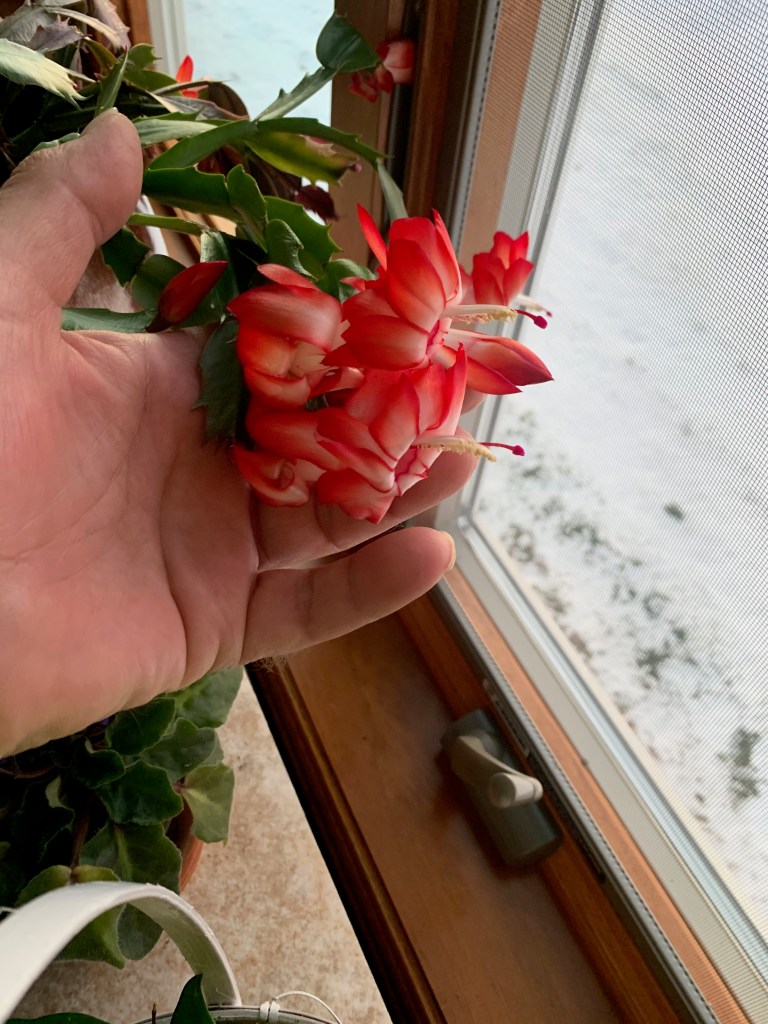
On the plus side, MrsGF’s Christmas cactus is in full bloom and it’s gorgeous. I know a lot of people who just can’t get these things to blossom no matter what they do, but MrsGF has a real knack with plants. I’m not sure what it is. I suspect she could take an old, half rotted twig, shove it in the ground, and in a few weeks it would turn into a healthy tree. This thing just keeps going and going. Some years it blooms twice.

And she has a rose bush in the living room this year, also in full blossom, in November. I don’t know how she does that, either. But it does make me grin like an idiot to have a rose in full bloom while it’s 10 degrees and snowy outside.

But I was really going to talk about amateur radio stuff when I started all of this so let’s get on with this…

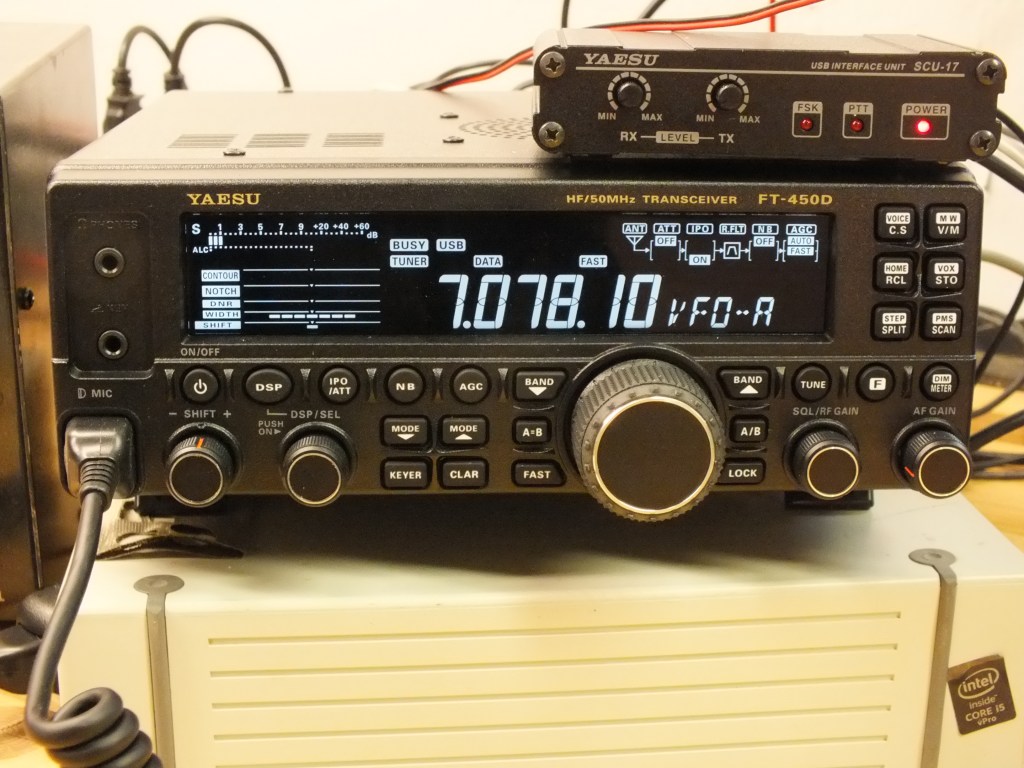
Yaesu FT-450D hooked to the SCU-17 interface. It’s been in production for a while but it’s still one heck of a nice little radio for the money

Oh, before that, though, I thought I’d just throw this in even though it has nothing to do with the headline starting this off. This is what it looked like here on Oct 31 a little after 6 AM.

Last day of October in Wisconsin.

Now I know this is Wisconsin and the weather here is a bit, well, odd, but still, really? Ick.

Now, finally, the amateur radio stuff!

The Dilemma

Whenever I start talking to someone about amateur radio, whether they’re other amateur radio operators or people who know nothing at all about it, invariably the topic turns to cost, and it becomes clear immediately that a lot of people, including a lot of hams, think that amateur radio is way too expensive. A lot of people I know who would otherwise be interested in getting into the hobby think it’s so expensive they could never be able to afford it. And that simply isn’t true.

I can’t really blame them for thinking that because some of this equipment is indeed expensive. The top of the line transceivers that the manufacturers and owners love to show off can quickly push up into the $5,000+ range or more. The Kenwood TS-990 sells new for just under $8,000 and iCom makes one that sells for more than $12K, for heaven’s sake. Once you add in other things that you may think you need, if you believe the ads, like amplifiers, computers, morse code keys, etc. you can quickly end up sinking $15,000 or more in a top of the line set up.

But here’s something the manufacturers don’t want you to know:

You don’t need any of that high priced junk.

Seriously. You don’t. If you want to get on the air on the HF bands (shortwave) you don’t have to spend a fortune. That little Yaesu in that photo up there costs literally less than one tenth of what my TS-990 costs new, and to be perfectly honest, does everything you need. Granted, it doesn’t have all the bells and whistles the 990 has, doesn’t have the fancy displays and all that, but when it comes down to actually communicating, those bells and whistles aren’t really necessary and the 450 will do everything you need.

I was looking for a fairly full featured, small, full power (100 watts output), 12V powered transceiver to lug out to field day and special events or whenever I feel like it, in situations where the little low powered 818 wouldn’t do the job. I love that little 818, but let’s face it, with a maximum of 6 watts output (3 watts or less running digital), any kind of communications using it is going to depend more on luck than anything else. I ran across someone talking about the 450 and it sounded like a nice little transceiver so I looked into it more and decided it was just what I needed. It sells new for about $750 – $800 which is, as I said before, one tenth of the cost of my TS-990. You can find them used for about $500 or even less if you look around.

And for that price what you get is not some stripped down little radio, either. This thing has a lot of features, including a built in antenna tuner, decent filtering, good noise reduction features, etc. In fact, just about everything you might need in an HF transceiver is packed into this little unit. True, it doesn’t have many of the goodies my 990 has, but I have to admit that in real life I don’t use a lot of those goodies anyway. If this were the only transceiver I had, I would be more than satisfied with its capabilities.

But for me the main question was how well was it going to work using digital modes like PSK, FT8 and JS8Call because those are pretty much the only modes I use. And it turned out it deals with digital very, very well indeed. It took me all of 10 minutes to get it up and running with the SCU-17 you see sitting on top of it in that photo. It was just a matter of plugging in the cables, setting the baud rate in the menu, firing up the computer and setting things up in the software there, and I was on the air. Now granted I had only just fairly recently set up the Yaesu 818 with the same interface, computer and software, so I already had experience working with Yaesu equipment which certainly made it easier. But still, for me, getting a rig up and running on digital modes in under 10 minutes is a bit of a miracle, really. It took me days to get my TS-2000 working properly with digital modes when I first started this years ago.

It’s currently set up in the basement, hooked to the Titan Gap vertical antenna, and it’s been doing a very, very nice job. I’ve made contacts all over the place with it using JS8 and FT8, putting out about 40 watts.

Sidenote: The 450 may be capable of putting out 100 watts, but you never run full power in the digital modes on any transceiver because the power ratings of all transceivers are seriously misleading. Those maximum power ratings they give you are for single side band, which does not stress the transmitter in the radio. With SSB you’re actually averaging far less power output than advertised. Your signal may peak at 100 watts, but you’re actually averaging 50 – 60 watts or so because of how SSB works. Unlike SSB, most digital modes are considered to be 100% duty cycle. A general rule of thumb is when using digital, always dial your power levels back to less than 50% of the radio’s maximum. Sometimes the recommendations are as low as 25%. Otherwise you risk overheating the radio and damaging it.

Anyway, I’m very pleased with this little radio. I didn’t really expect much from it when I got it, and it has certainly exceeded all of my expectations. I’ve been having a lot of fun with it, and I’ve been using it more than my TS-990 of late.

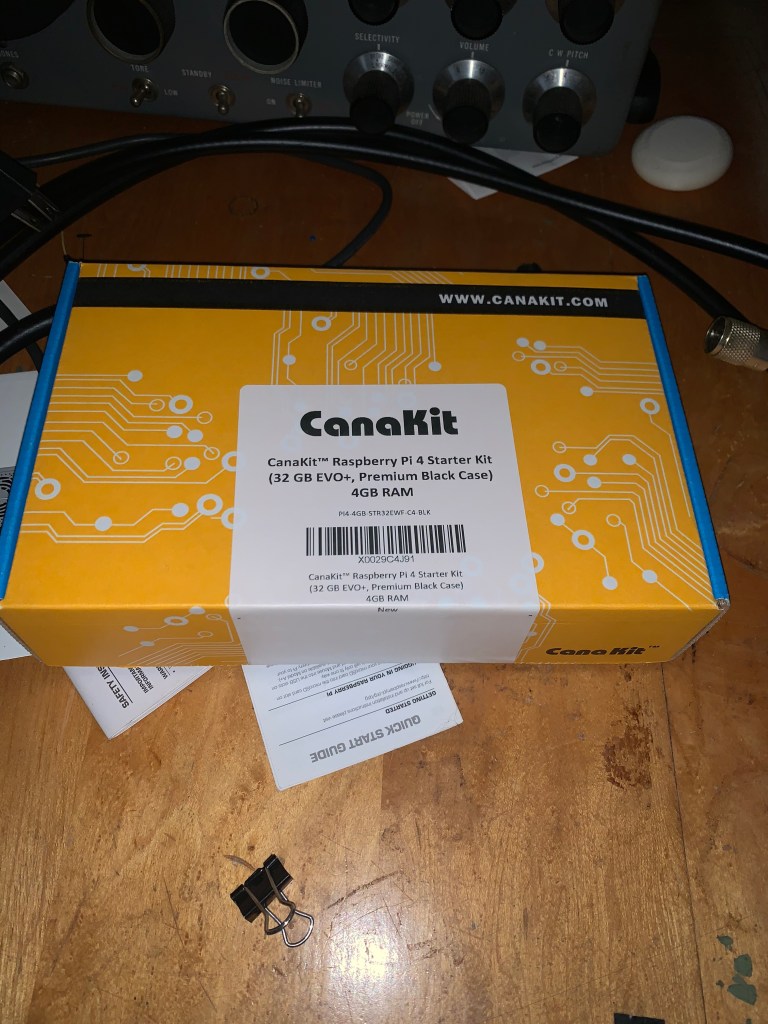
Lets see, what else? Oh, yeah. This showed up courtsey of our friendly UPS delivery person the other day.

I picked up a Raspberry Pi 4 to play with to join the RPi 3s I’ve already been playing with. I have a specific goal for this one. There are Linux versions of FT8 and JS8Call that, I’m told, run just fine and dandy on the RPi. I’ll find out this winter as I experiment. My eventual goal is to put together a compact QRP digital system that is backpackable that I can take along when I’m out on the trails with the bicycle. I’d thought about configuring the Rpi as a tablet computer with just a touch screen and no keyboard. I’ve done that before with the Rpi3s I’ve had, but I think that might be a bit awkward, so I’m looking at compact keyboards and maybe a small trackball or touchpad for mouse control. We’ll see. This is still very much a work in progress.

I know, I know… The used Lenovo laptop I picked up was supposed to serve that role, and it does, but while it works just fine it is also big, heavy and clumsy to lug around. I can squeeze a RPi into a package not much bigger than a small tablet computer and a fraction of the weight. We’ll see how it goes.

And that’s about it for now. I’ve been boring you long enough with this.

Good grief, it actually works!

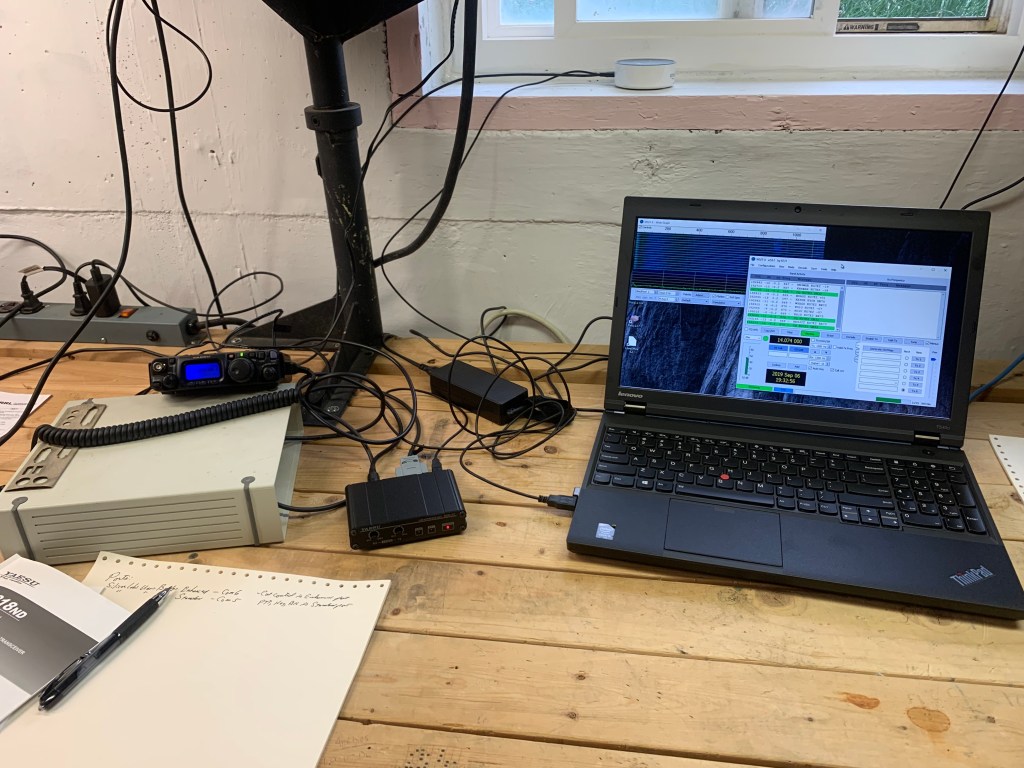
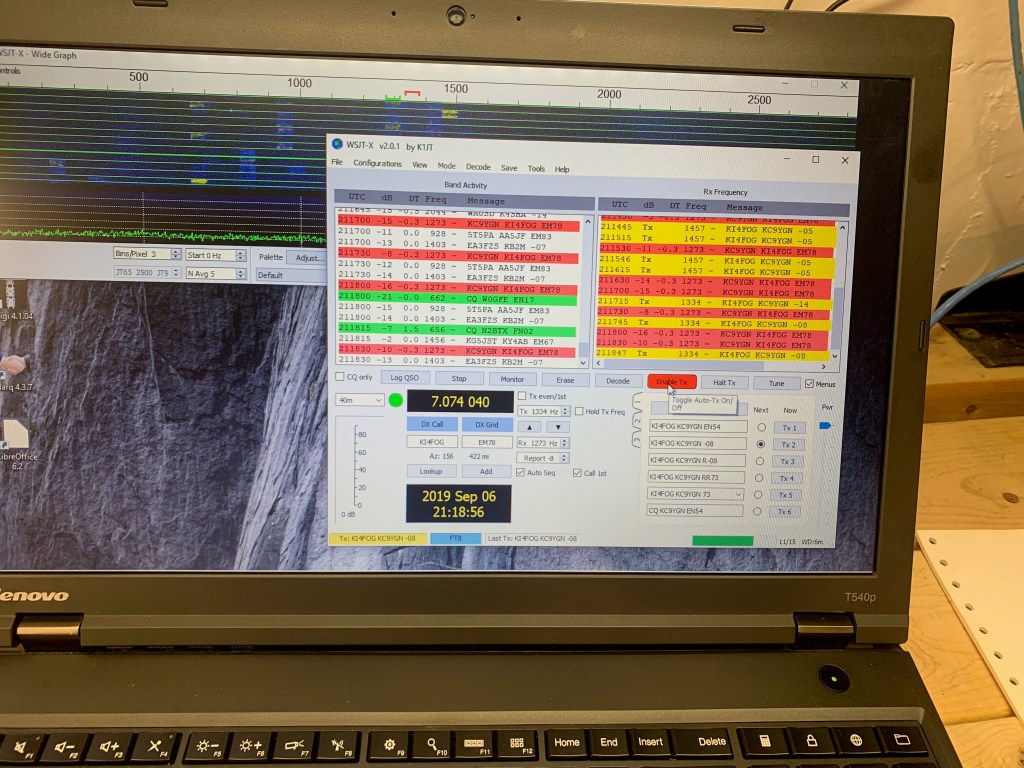
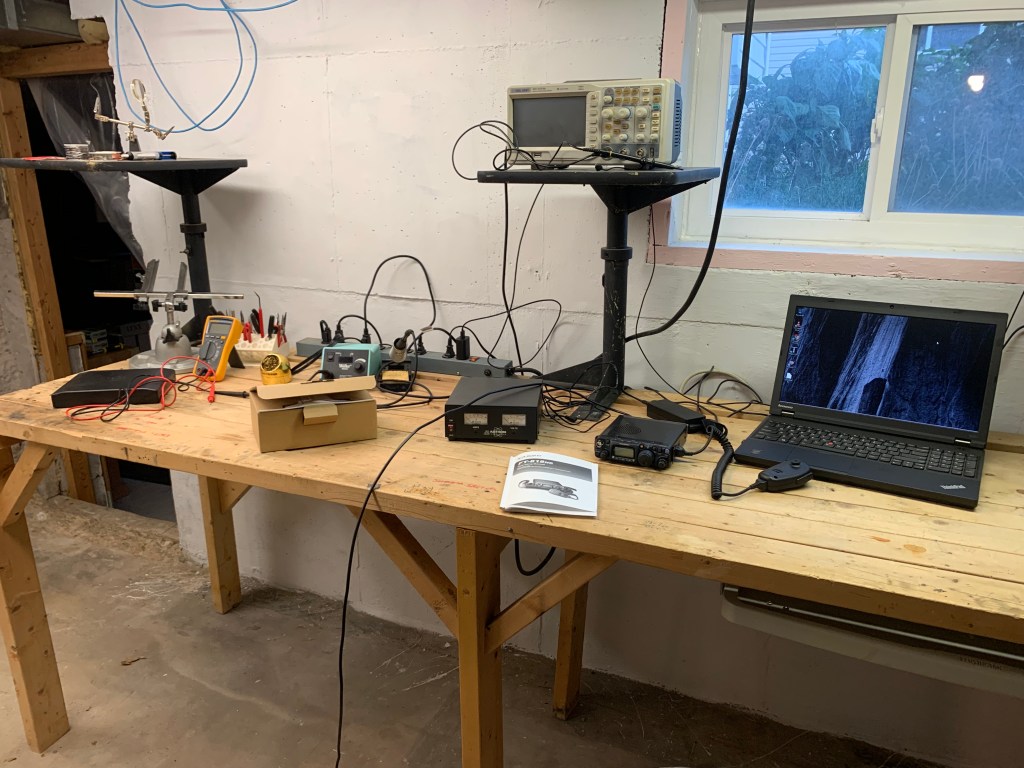
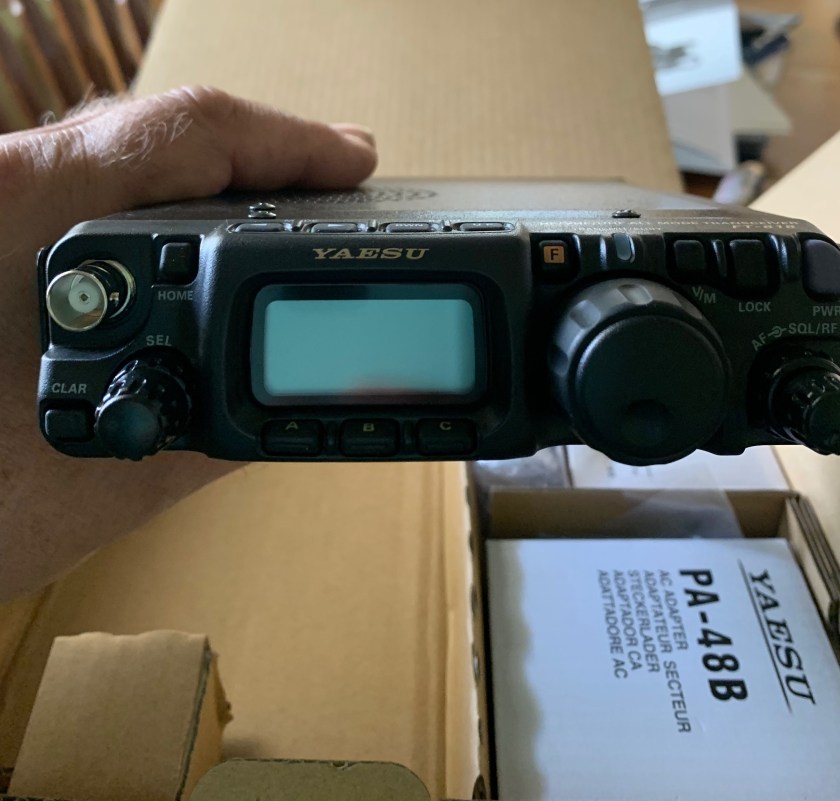
The Yaesu 818ND (that tiny black box leaning up on the gray box with the tiny blue lighted display), a Yaesu SCU-117, patched together with the laptop running FT8, feeding the alpha mag-loop antenna standing off to the left out of sight, and the darned thing actually works!

And I made a contact with the thing. Well, sort of. KI4FOG came back when I called CQ but wasn’t able to complete the contact, but still I’m pleased.

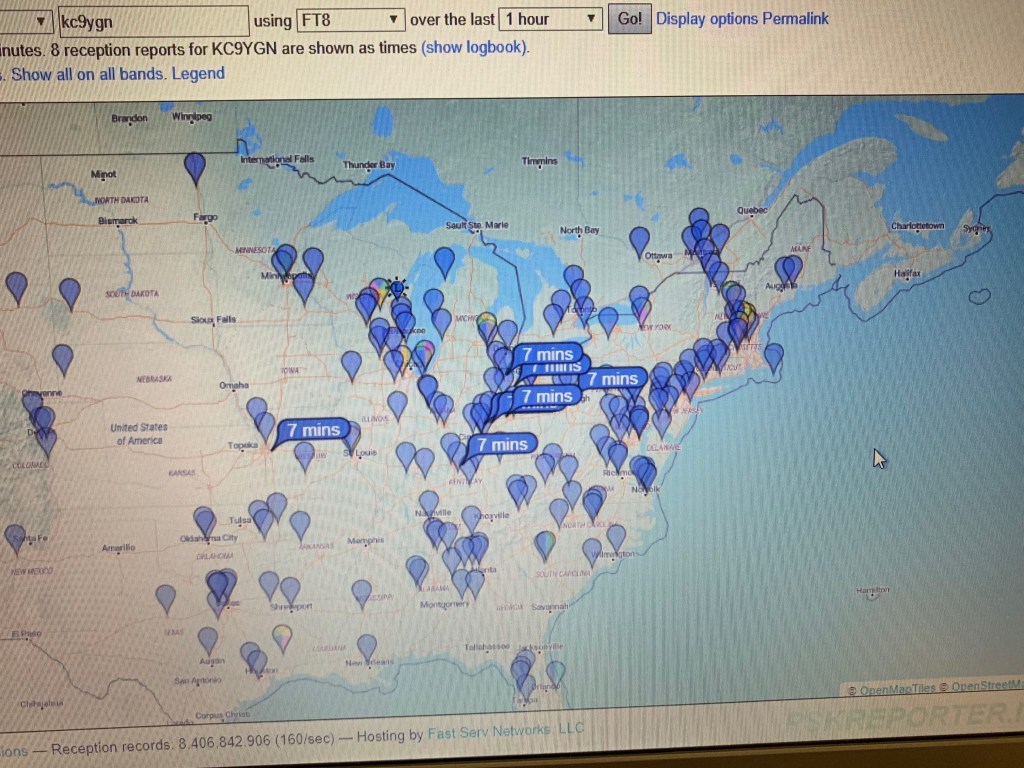
Then I looked at PSK Reporter to see if I was getting out and I was even more pleased.

I know that doesn’t look very impressive but you have to remember I’m running a whopping 2.5 watts into a loop antenna that is standing 5 feet underground in a basement. Considering all that, getting out at all is impressive I think.

Once I get a decent battery system set up and get outside with this thing, this is going to be fun!

Catching Up: Ham Radio and Tomato Soup

I mentioned before that I wanted to move out of the office/library/radio shack area that I currently share with MrsGF, and into a new workshop in the basement. Things have been rather busy here (plus I’m probably one of the laziest people I know, which doesn’t help) but things have been slowly moving along. The goal is to get everything moved and set up before the snow flies.

It’s at the point where I can start moving some stuff in there. I have all my tools, most of my test equipment, soldering equipment and some of the electronics moved down there now. I’ll probably start moving some of the radio gear down there too this week but my primary station, the TS-990 and the Yaesu VHF/UHF gear will stay where it is for the time being. The VHF/UHF gear will probably remain up in the office because MrsGF is the one who uses it the most anyway.

It’s still a mess in the basement and I’m still trying to figure out the best way to lay stuff out. There is still a ton of junk out of the frame of that photo that needs to get moved before I can move everything, but it’s getting there. Most of the ‘heavy lifting’, as they say, is done. And I need to add about 3 or 4 electrical outlets on that wall, plus a 240V outlet for the amplifiers before I can get the rest of the radio gear set up.

It’s been taking a long time but, well, hey, it’s still summer (technically anyway) and I have a lot of other stuff going on, but it’ll get done. Maybe. I did get that GAP Titan antenna up, after all. Took me 4 years, true, but it got up finally…

One very inconvenient thing is that I’m at the point where I really, really need to get into my woodworking shop (that’s through the doorway on the far left) so I can build frames, shelving, etc. to make the new electronics/radio shop convenient to use, but the woodworking shop is packed full of computer junk belonging to my son that hasn’t been moved out yet. Oh well, we’ll get it figured out.

The Great QRP Project

(Definition – QRP is amateur radio jargon for low power communications, usually transmitting with 5 watts or less.)

I’ve had the Yaesu 818 and the mag-loop antenna for some time now and they’ve been fun to play with, but the ultimate goal was to put together a QRP (low power) digital communications package that I could throw into the back of the car and take along when I go fishing or out taking photos. My favorite modes of communications are PSK31, FT8 and JS8Call, so I picked up that refurbished Lenovo laptop you see in the photo of the workbench.

I made some changes in the overall configuration. I was going to use a SignaLink interface to connect the laptop to the Yaesu because A) I had one on the shelf, and B) because, well, because I had one. But then I found out I also had a Yaesu SCU-17 USB interface and, well, where the heck did that come from? So I’m going to go with that instead.

(Side note: Where the heck does some of this stuff come from? I swear I sometimes think people are breaking into the house and instead of stealing stuff, they’re leaving things here.)

The SCU-17 comes with about a zillion different cables to hook it up to just about every imaginable radio, computer, etc. Except, of course, the one that I actually needed. That required cable was, of course, an “optional accessory”. Sigh… Nor did I have the connectors I needed to make one myself. Besides, my history of making specialty cables myself is, well, a bit embarrassing and the less said about that, the better. So off I went to the GigaParts website to order one and that should be here today (he said keeping his fingers crossed). (It came!! Hooray!)

Anyway, with any luck I should finally have the whole thing up and running properly by this weekend. Maybe. I doubt it, but hell, one has to be optimistic, doesn’t one?

I wanted to have the whole thing up and running before Sept. 21, which is WIOPTA (Wisconsin Parks On The Air), an event where amateur radio operators lug their radio gear out to parks, endure bad weather (it’ll probably snow), mosquitoes and ticks which will give you several exotic diseases that you can’t pronounce, and probably get you arrested because anyone with all that weird electronic gear must be guilty of something.

But then I found out only state parks qualify for the event and, well, the heck with that. I thought they meant any park in Wisconsin so I’d planned on doing it at the local one here in town. State parks only? Hmph… They charge money just to get into those places. Yeah, sure I get in for free because I’m a “conservation patron”, but still

(Side note: I should point out that being a “conservation patron” in Wisconsin has absolutely nothing to do with actual conservation. Conservation patron is a combined hunting and fishing license. Basically if it is legal to kill some animal in Wisconsin, whether it swims, walks or flies, the Conservation Patron license lets you kill it. This is why we need words like “irony” in the language.)

(Side note: I should also point out that I don’t actually hunt. Or do much fishing. So why do I have the license? Mostly to irritate people.)

(Side note: I really need to stop this side note nonsense.)

Tomato Soup

The tomatoes are finally starting to ripen up and even as I write this we’re canning tomato soup. If you’ve never made your own tomato soup with home grown tomatoes, you have no idea what you’re missing. The only problem with this stuff is that once you’ve tasted it you’ll never be able to tolerate the commercial canned stuff again.

So, how do you make the stuff, you ask? Here’s the recipe. Note: This recipe is admittedly huge. This will turn out about 10 quarts of soup. We generally only make a half batch at a time. If you want to do that, just cut all of the quantities in half.

Ingredients

  • 14 quarts tomatoes
  • 7 medium onions
  • 2 stalks celery
  • 14 sprigs parsley (dried is OK)
  • 3 bay leaves
  • 14 tablespoons flour
  • 14 tablespoons butter
  • 8 tablespoons canning salt
  • 12 tablespoons sugar
  • 2 teaspoons black pepper
  • *Vinegar (to taste but go easy because lemon juice will be added later)
  • Lemon juice as needed (see method)

Method

Wash tomatoes. Cut into large chunks. You do not need to peel or seed the tomatoes as it will be processed through a food mill. Peel onions and coarse chop. Dice celery and mince parsley (if fresh). Put in large pot with bay leaves. Cook until celery is tender.

Typical food mill. An angled blade inside forces the food being processed through a strainer in the bottom of the pan. There are hooks to rest it on top of a pot. The liquid and pulp is forced through the strainer into the pot, leaving seeds, skin, etc. behind.

Process everything through a food mill. If you don’t have a food mill, you can force the mixture through a sieve but that’s difficult to do and very time consuming. Food mills are fairly cheap and you can pick them up at any store that carries canning supplies or on line.

You put the food mill over a large pot or bowl. The soup mix is ladled into the mill. Turning the handle causes the mixture to be forced through the strainer in the bottom, leaving seeds, skin, etc behind. It’s a bit of work, yes, but it goes a lot faster than you’d think and the results are worth it. The seeds, skins, etc. that are left behind can be composted.

Put the strained soup back in the pot and bring to a gentle boil.

Take the flour and butter and blend together to make a smooth paste. Add a bit of tomato juice. Add the butter/flour mixture to the soup and whisk vigorously to blend it in thoroughly. Bring to a boil, stirring constantly to prevent scorching. Add salt, sugar and pepper.

Note – the original recipe called for 12 tbl of salt which I think is way too much. I cut that down to 8. and you could go even less if you like. Seasoning can always be adjusted when you heat the soup before serving

Note about vinegar: There are a lot of different varieties of tomatoes with different flavor profiles. Depending on how sweet your tomatoes are, you might want to add a bit of vinegar to give the soup a bit more of a ‘bite’, so to speak. You can also add some red pepper as well. The thing to remember is this is your soup, so you can season it any way you like.

Canning

You can use either quart or pint jars. I prefer pints, but it’s up to you.

We sterilize everything when we get started with this. Jars are not only washed but are rinsed with boiling water and the jar lids are put in boiling water. Is that necessary? Maybe? Why take a chance, though.

Fill jars to within 1/2 inch of the top. Add one teaspoon of lemon juice to each jar. This is not just for flavor, it’s for food safety reasons to make sure the soup has enough acid.

Wipe off rims of the jars. Put on lids and then screw on the rings and tighten snuggly.

Actual canning is going to depend on the type of canner you’re using. I strongly recommend using a pressure canner for this stuff. I know some people say you can just use a water bath, but pressure canning is actually faster and safer, so that’s what we do here, use a pressure canner.

pressure canner

Read the instructions that came with your canner to make sure you are setting it up right.

Put the jars in your canner and start the process. We follow current recommendations which is to process it at 11 pounds pressure for 15 minutes. If the pressure goes a bit higher than that it’s perfectly fine, but it shouldn’t drop below 11 pounds for the entire 15 minutes.

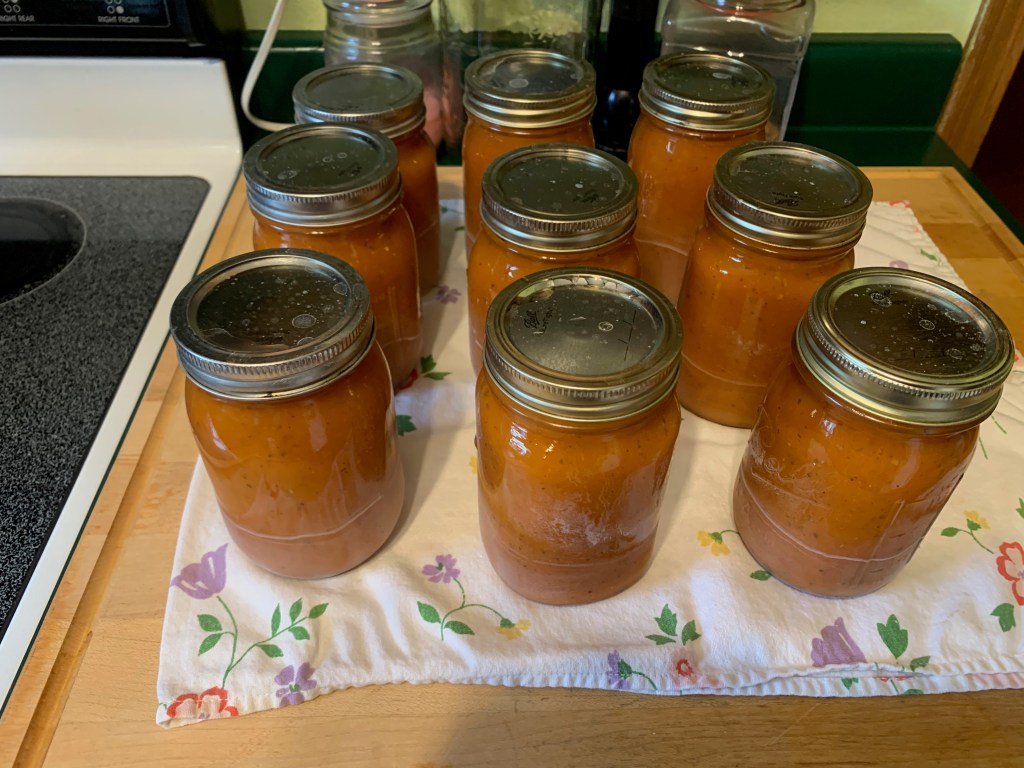
Here’s a batch I just pulled out of the canner a few minutes ago.

I think I’ve been babbling along for too long already here, so I’m off to irritate the cats for a while, fiddling with radios, etc.

Tumblr, and the Ever Popular Misc. Stuff

I have to admit that I haven’t been keeping track of what’s been happening on the blogging/social media platform since I abandoned it years ago. I just completely lost interest in it. I wouldn’t have been surprised if the service had simply disappeared because I’d heard little about what was going on over there following Verizon’s decision to eliminate “adult” content on the service. Since probably 60% of the content on Tumblr might be considered “adult” in one way or another, it didn’t bode well for the survival of the service, so I just assumed it was going to go the way of dozens of other social media services and gradually fade away into nothing.

But Tumblr is once again back in the news. Verizon just sold Tumblr to Automattick Inc., the parent company of WordPress. When Yahoo bought Tumblr originally they paid $1.1 billion for the company. Automattick bought it off Version for — wait for it — less than $3 million according to The Verge.

How the hell does a company go from a value of over a billion dollars to less than three million? Well, it wasn’t easy. Yahoo did the best it could to kill the service off, and Verizon tried to nail the coffin shut and bury it.

“Tumblr is a marquee brand that has started movements, allowed for true identities to blossom and become home to many creative communities and fandoms,” Verizon Media CEO Guru Gowrappan said in a statement. “We are proud of what the team has accomplished…”

Well, I’d be proud too. It isn’t everyone who can take a billion dollar company and drag it’s value down to the point where it’s worth less than a fancy house. Takes real talent to do that. (We really need a sarcasm font)

As for what WordPress is going to do with the thing, that’s anybody’s guess. From what I’ve been hearing even they aren’t sure what they’re going to do with it. I think they bought it more because it was cheap. Sort of like when you go to a garage sale and find that $500 piece of electronics you really wanted way back when being sold for $1 and you can’t resist buying it even though its obsolete and you don’t know what you’ll do with it.

Hemp

The whole hemp situation is just getting more and more silly. When it comes to hemp and agriculture I don’t think I’ve ever seen this much hype and nonsense being spouted by people who really should know better. I hear a lot of people proclaiming that hemp is going to “save” agriculture, despite the fact that no one seems to be able to actually make any money at it. At least not here in Wisconsin. Everyone I’ve heard of who has tried raising hemp here in Wisconsin so far has lost money on it. In some cases, they lost a lot of money on it.

And speaking of CBD, what a fiasco that’s turned into. Cannabidiol, or CBD, is being sold everywhere it seems. People are selling edible products laced with CBD (or what they claim is CBD) all over the place. There are supplements and food products and oils and lotions, even CBD products for pets for heaven’s sake. And all of them make various health claims. Depending on who you talk to, the stuff will cure everything from dandruff to cancer. And almost none of those claims are actually true. CBD seems to have some benefits for some types of epilepsy, and may be beneficial to help alleviate symptoms of arthritis, and that’s about it. Every other health claim you hear is unproven and quite probably an outright lie.

The other thing about CBD is that it isn’t legal to sell. At least not as it’s being sold by most places. Seriously. That link up there will take you to the FDA page that explains it. But to give you a summary, it is illegal to sell any food product, supplement or other product intended for human or animal consumption that contains CBD. The only exceptions are FDA approved drugs that contain the substance as part of their makeup, and there are only about three of those at the moment.

Why haven’t the feds gone after the places selling it? Well, they have, at least the more outrageous violators. But the rest, the FDA doesn’t have the money and other resources to go after everyone, especially when it’s being sold at every gas station, every convenience store, tattoo parlors, hardware stores…

The other problem is that you don’t know what the hell is actually in that CBD laced product you’re buying. There are no standards, no testing programs, no inspections, no nothing. So basically you have absolutely no idea what is actually in that stuff.

Ooo, purty flowers…

Antenna Update

If you remember from last time, I finally got the Gap Titan-DX vertical antenna up, but still didn’t have it functional because I didn’t have the right connectors for the coax. A trip down to the local Radio Shack (well, I call it that even though it isn’t really technically a Radio Shack any more) and a rummage around in the parts bins turned up the adaptor I needed, and it is officially on the air.

It still needs some tweaking. The SWR on some bands is higher than I really like, but I expected that. I haven’t yet tried to actually tune it by adjusting the stubs and it’s located right alongside of the garage and it’s aluminum rain gutters, which I’m sure isn’t helping things. Does it work? Oh, yeah! I hooked it to the Kenwood TS-990 with a Palstar auto-tuner, and it most definitely works very, very well. Mostly I’ve been using it with FT8 and holy cow, it gets out. It’s been giving me much better results than my OCFD antenna. I’ll put together a post specifically about the antenna with more details in the future.

ASF China Update

ASF (African Swine Fever) is sweeping through China no matter what they try to do to stop it. According to Rabobank (a huge multinational financial services company that specializes in agriculture) China will probably lose half or more of its pork production by the end of the year because of the disease. Just think about that for a moment – China is the largest producer of pork in the world, and it is facing losing half or even more of it’s pig population because of this disease. That’s going to have huge repercussions through the country’s entire economy.

Why is ASF so hard to stop? Because it is highly contagious (fortunately it doesn’t harm human beings), the virus can survive for a long time outside of the host animals, there is no treatment for it, there is no vaccine for it, and it kills almost all the pigs that come down with it. The only way to try to combat the disease is to try to prevent it from spreading, which is extremely hard to do.

That’s about it for now. Frankly I’m getting bored. It’s nice out and I could be out on the bike or puttering in the garden or playing radio, so I’m out of here 🙂

Chilton Antique Tractor Show and Well, It’s Been Busy…

… here over the last few weeks. I’m not sure what the heck happened after I retired. I was supposed to have all this free time to play with amateur radio, do gardening, dabble more in photography, go fishing, etc. Instead it seems I have less time than when I was working full time. Oh, well.

We did go up north last weekend to visit some friends, although we did run across this —

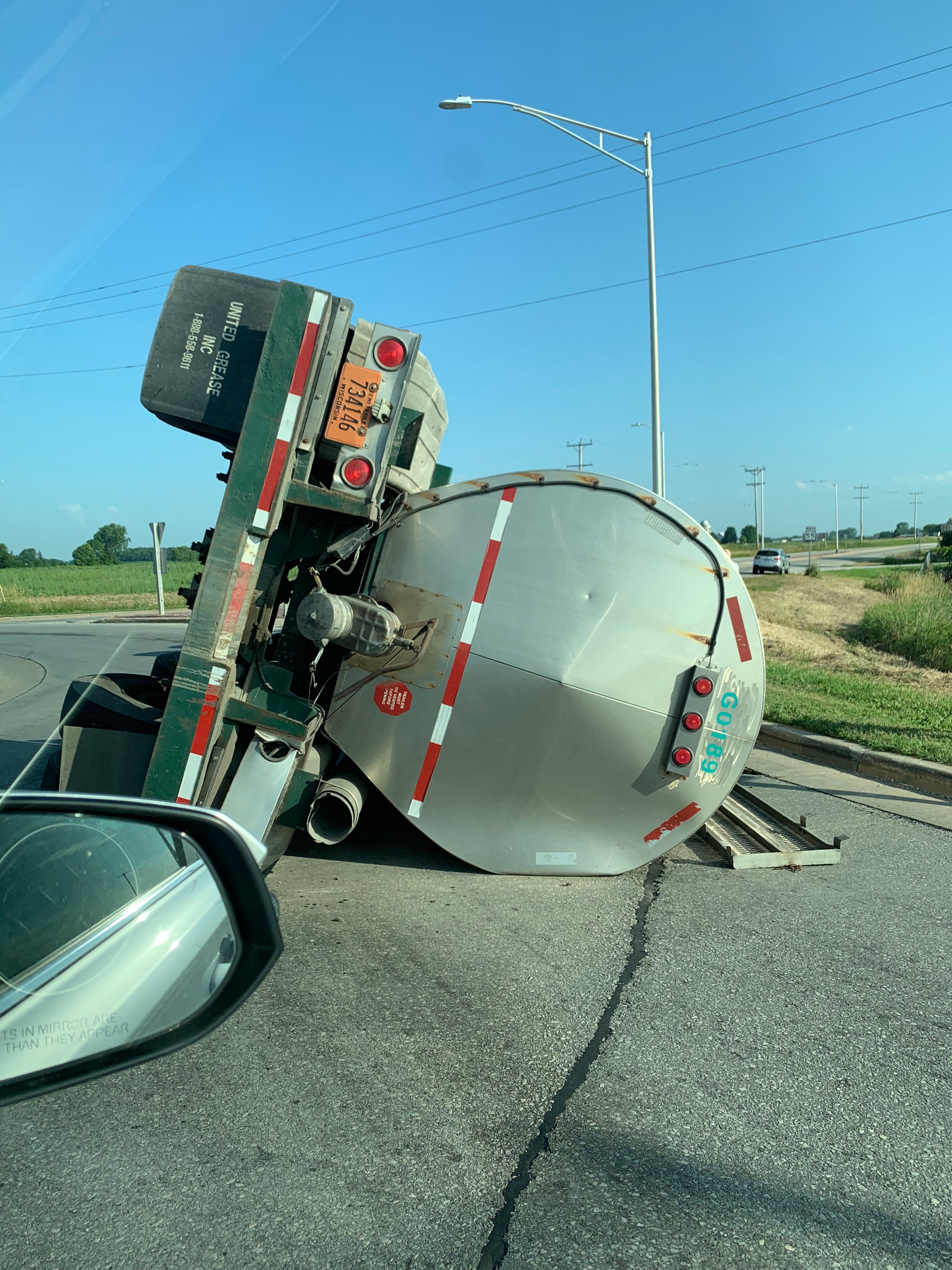
We came across the rolled over milk tanker about 10 miles from the house. Fortunately no one got seriously hurt. I think he was empty because there was no leakage when we came across the scene just after it happened. It was on a roundabout, and this happens on a regular basis with these big trucks. They hit the roundabout too fast and flip over trying to make the corner.

The annual Chilton steam engine and antique tractor show was this weekend and that’s something I try to get to every year even though it makes me feel so old sometimes to see equipment that I used to run when I was a kid or teenager now classified as “antique”. Although to be fair a lot of the equipment we had on the farm back then was probably already antique by the time we got our hands on it.

This year the big surprise was this —

Now if you’ve never seen anything like that before, it’s for a good reason. They never made many of these, and there are only three of them left in the world from what I learned talking to the guy who was operating it. When I first saw it, it was largely blocked from sight and all I could see was part of the front with the engines and I thought someone had lugged a Shay type locomotive to the show.

Yes, it’s fully operational. This isn’t just a static display, it actually runs.

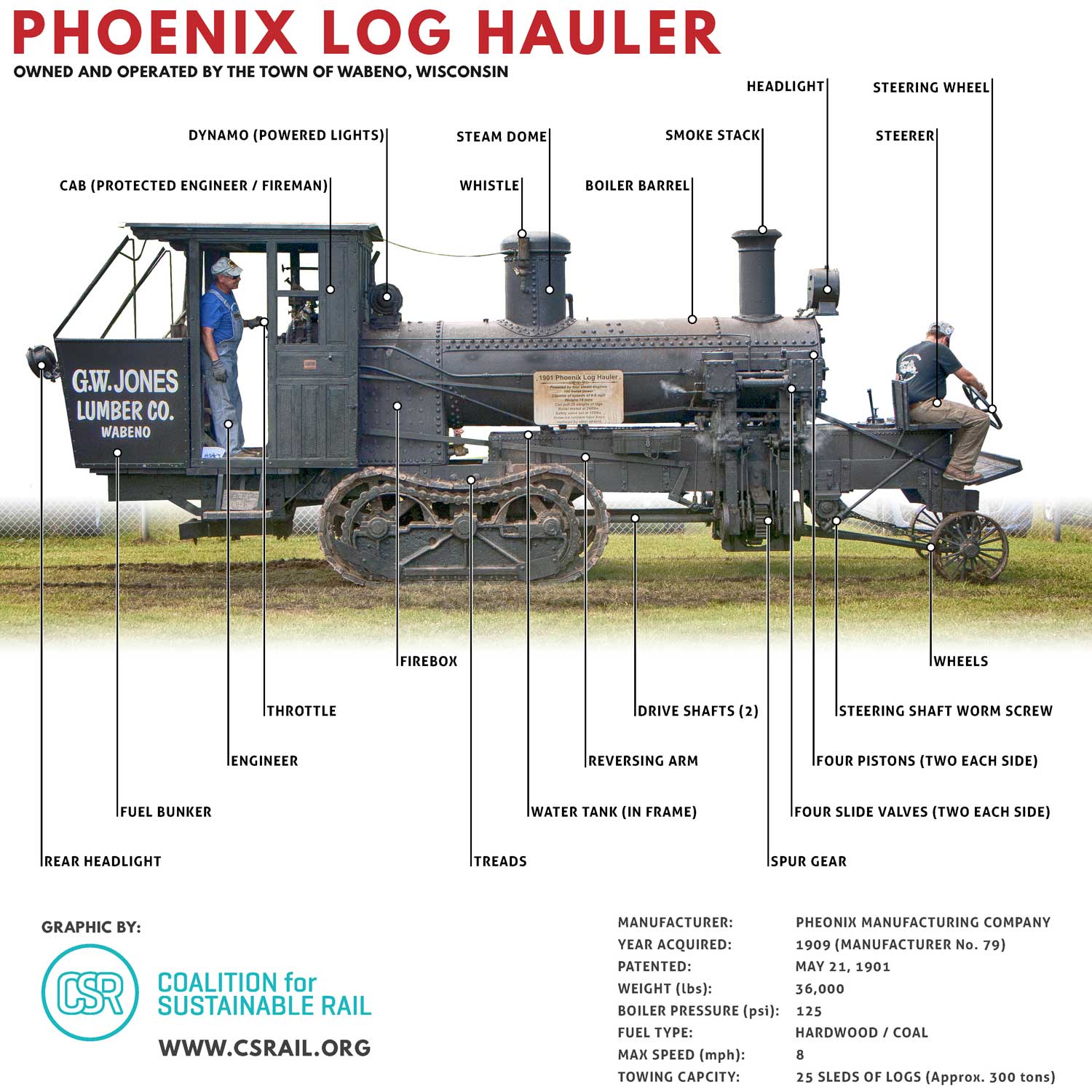
What the hell is it? It’s a log hauler that was used up until the 1930s to pull huge sleds carrying logs through the woods during the winter. Only about 175 of them were ever built. It could pull up to 300 tons of logs on as many as 25 sleds at a time. I ran across this when I was looking up more info on it-

I can’t even begin to imagine what it must cost to keep that engine repaired and operational. It must be incredibly expensive. I’m very glad they do, though. If it weren’t for people who support the preservation of equipment like this all we’d have are photos. They show it at Wabeno, where its home is, but they also take it out to at least one of these shows a year.

As I said, sometimes it makes me feel very old when I go to these and run across equipment I used to use, like this Massey 44. I used one of these when I was a kid. For a long time it was our primary tractor that did everything from hauling out manure to chopping feed to plowing. And while it may look pretty and make me feel nostalgic, when it comes down to it it was a nasty, nasty tractor to actually use. The front end was too light. Those front wheels would be entirely off the ground as often as not when it was pulling a heavy load. It was difficult to steer. It had mechanical issues. The engine was decent, but ours tended to overheat and the transmission wasn’t very good. And it sucked gas like you wouldn’t believe.

What I like about these shows too is that it gives us a glimpse into what life was like for our not so distant ancestors. Just the simple job of washing clothing was a major operation not that long ago.

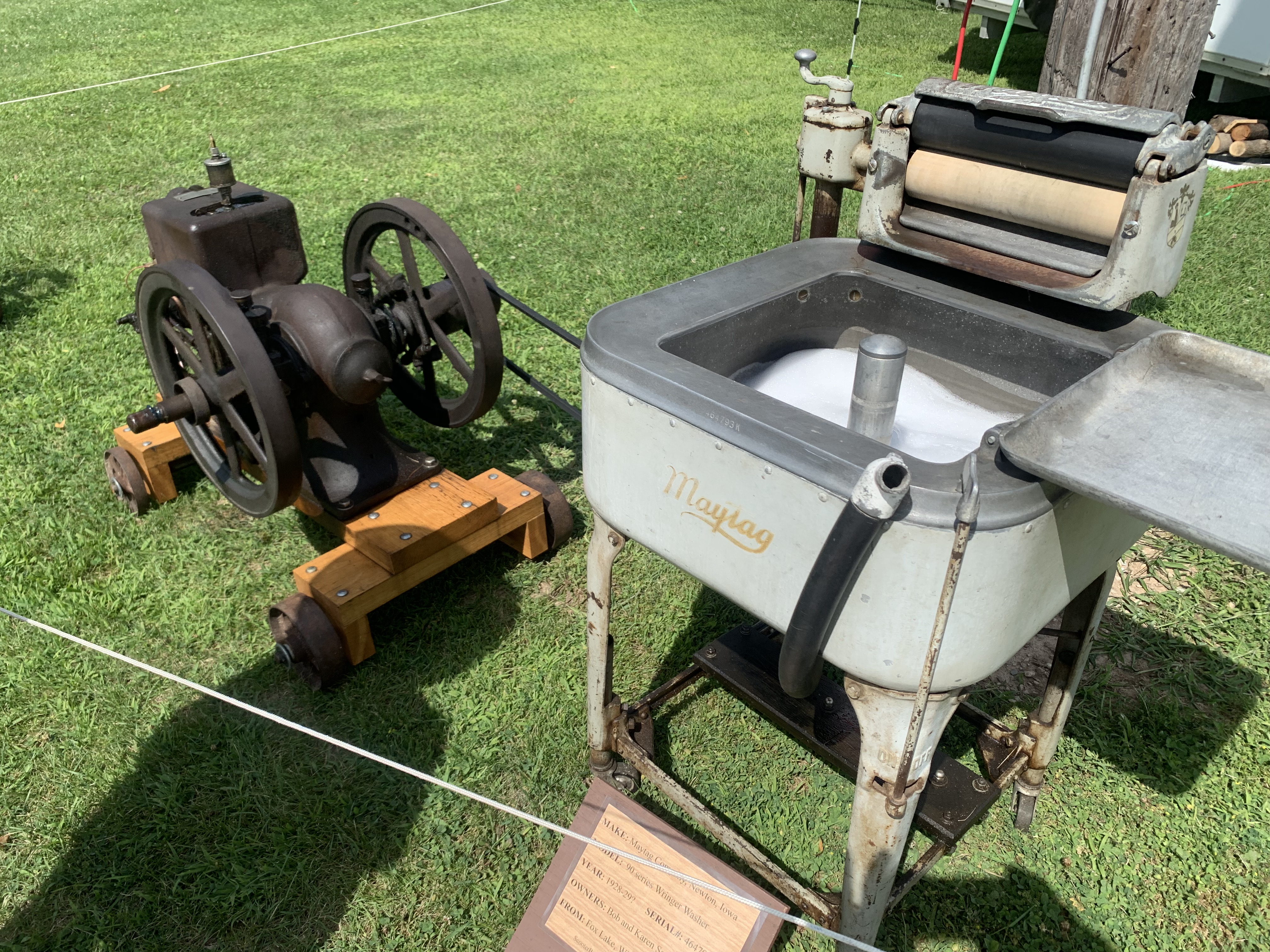
Yes, that’s a washing machine being powered by an ancient gasoline engine. And while that engine might be a bit elderly for this setup, washing machines running off gasoline engines was not uncommon in rural areas. You have to remember that a lot of rural areas didn’t get electric service until the 1930s or even later.

On the amateur radio front, I’ve been fiddling with antennas again. Well, sort of. I’m finally getting around to getting the Gap Titan vertical finished and hooked up.

It successfully survived the winds we had during the recent storms. After 60 – 70 MPH winds hit us during those storms I more than half expected to see it laying on the ground when I got up the next morning, but it made it through unscathed. We almost forgot to put guy lines on the thing. If we’d neglected that I’m sure it would have come down.

I got the counterpoise/ground plane installed finally and, well, it takes up a wee bit bigger area than I thought it would. Going to be fun mowing lawn through there. But that area is going to be part of an extension to the existing flower beds anyway so I only have to worry about it for the rest of this season.

And I still don’t have the dopey thing connected. I got started, got all the tools out and began to work on putting the connectors on the coax and… Sigh…

I had the wrong one. I needed a female and only had the male variety, so I either needed a female or an adaptor. Not a big deal, but mildly annoying nevertheless. In any case, I didn’t really like the style connector they sent with the antenna in the first place. Thankfully, Farm and Home, the big hardware store down in Chilton has a big electronics section (used to be a Radio Shack store) and they’ll probably have what I need.

As for the weather – this has been one of the wettest summers I can remember. The lawns should all be brown and dormant from a lack of rain this time of year. Instead they’re all lush and green, as you can see from the photo there. I’ve only had to water the gardens about three or four times all summer long so far. Most summers watering is something we need to do every two days or so.

The rivers and lakes are all abnormally high around here because of all the rainfall.

This is the river down by the old stone bridge the other day. Normally this time of year the river is so low and stagnant that it’s choked with algae and weeds, and so shallow it would hardly be halfway up your shins if you tried to walk through it. It’s a good four feet deep or more, though, and had more than enough current to keep the algae from accumulating.

That’s about it for now. Hopefully by the next time I get around to writing something I’ll have some amateur radio stuff to talk about. I should have that antenna finally set up. I should have the new Yaesu 818ND up and running with the laptop using FT8, JS8Call and PSK.

And hopefully I’ll have made some progress in moving all my equipment down into the basement. MrsGF found a matching set of old, heavy duty tables at St. Vinnie’s that might make good work benches. They’re about 4′ square with heavy duty 4″ square legs. They’re beat up but look solid, and I can get ’em for $5 each, so I’ll go take a look at those on Tuesday.

Still have to make a decision on where the electrical outlets are going to be placed down there, but I didn’t want to do that until I had an idea on where the work benches were going to be, how tall they were, etc. Probably at least 4, four outlet boxes fed with 20 amp circuits, plus at least one 240V outlet for amplifiers. And need to rewire for better lighting. Want to put in LED lights to replace the existing fluorescent tubes that are in there now.

Stuff

If you live in the midwest in the US you don’t need me to tell you that the weather hasn’t been very good. Unusually cold temperatures and seemingly non-stop rain has been hitting large parts of the midwest. Corn and soybeans were, for the most part, planted late or even not at all. Ohio seems to have been hit the worst. Looks like almost 25% of the Ohio corn crop isn’t going to be planted at all. The situation with soybeans isn’t quite as bad, but the numbers there aren’t looking very good either.

The exact numbers are uncertain because a lot of farmers and people in the ag industry are being openly, even brutally skeptical of the data coming out of USDA. There are claims USDA is including acreage that has been planted but is under water and will never grow, acreage that has been planted with cover crops instead of corn because it’s already too late to plant, etc.

I can’t confirm or deny any of those suspicions. All I know is that when I ride around the countryside I’m seeing a hell of a lot of fields that look like the picture there on the left; lots of mud, lots of standing water, and lots and lots of weeds. It is too late to do anything with fields like that except to try to plant a cover crop to keep down the weeds and prevent erosion. You aren’t going to get any kind of economically viable crop planted in this area, this late in the season.

What about hemp, you ask?

Well, okay, you didn’t ask, but I’ve had a couple of people ask me about what the situation is with hemp. It is now legal to plant, harvest and process hemp here in Wisconsin, and despite the fact that a lot of people have been hyping the hell out of it and claiming that it is going to be the savior of agriculture, well, hemp, so far at least, has been pretty much a total bust for those few farmers who’ve tried it. Raising hemp for grain was a total loss last year from what I heard. Because of wet fall it was almost impossible to harvest the stuff. And what they did get harvested was hit by mold because of the damp weather so they couldn’t sell it at all.

Instead of depressing stuff, how about some pretty flowers instead? This is alyssum growing in my backyard. Wonderful stuff. Beautiful tiny, tiny flowers that produce some of the most amazing scent imaginable. I love this little plant. Those flowers are very small, about the size of a match head.

Raising it to produce CBD oil didn’t work out too well either for a lot of farmers. One farmer I heard about did successfully get his crop in, but trying to actually sell it was a different story. It seems no one actually wants large amounts of the stuff. Or none that he could find, anyway. None of the CBD oil producers he’s dealing with seem to want more than a few pounds of it at a time, and you can’t make money that way. His problem is marketing, of course. It sounds like he jumped into production before he was even sure if he could sell the stuff.

Hemp isn’t going to be “the savior” of agriculture. It is, at best, going to be just another crop that some will have success with. And all of the hype about CBD oil seems to be mostly that, hype, with few actual facts to back up any of the claims. There seems to be some indications it can help with epilepsy and discomfort from arthritis, but that’s about it.

Antenna Stuff

Strange things are growing in my backyard behind the garage. No, that’s not some kind of weird sunflower, that’s a GAP Titan DX vertical antenna which has been laying around for years now. Eldest son and I finally got the dopey thing put up over the weekend. That thing has been laying around for, oh, lord, has it really been three or four years? Sheesh… Talk about procrastination…

It replaces the Comet 250 vertical that was back there since 2013. The Comet – people like to complain about it but to be perfectly fair it wasn’t a horrible antenna. It is exactly what they claim it is, a multi-band vertical that doesn’t need radials or a counterpoise, that works from 80 to 10 meters without an antenna tuner, and can handle up to 250 watts. It is unobtrusive, the neighbors probably won’t complain about it, and under the right conditions it will even work as an antenna. Sort of. Not a very good antenna, true, but it will work.

The Titan has a pretty good reputation. It too is an all-band vertical, but you can see that it isn’t exactly simple, with all kinds of stubs and wires and stuff coming off it. But it is much, much more efficient than the Comet. And I can feed this one up to 1,500 watts if I want to without damaging it, where the Comet, well, I heard reports that if you tried to put more than 100 watts into the Comet you’d melt down the coils. Anyway, I still have work to do on this one. I need to get the counterpoise installed, need to get some connectors on it, need to tune the stubs. Hopefully it won’t take me another four years to get it hooked up!

It’s up high enough so it won’t interfere with the flowerbeds behind the garage. The counterpoise will take up a bit of space so I imagine MrsGF will not like that, but I’m hoping to get her to upgrade to a general class license now that she’s retired and if she does she’ll get as much use out of that antenna as I will.

Speaking of flowers, (well, okay, I wasn’t speaking of flowers but what the heck) the lupins have just gone nuts this year. They’re everywhere. It looks like someone bombed the entire backyard with seed. We didn’t plant any of these, they just came up by themselves. Not that I’m complaining. Those flowers are spectacular.

Let’s see, what else? Oh, yeah…

Stuff On The Air

Amateur radio operators can be a bit, well, odd, shall we say? (Personally I suspect it’s solder fumes.) Some of them seem to be obsessed with lugging their equipment out of the safe environment of their basements where spouses have exiled them and into the great outdoors with the intent of doing “Things On The Air”. They do SOTA (summits on the air), IOTA (islands on the air), POTA (parks on the air) WPOTA (Walmart parking lots on the air), and, well, the list goes on and on.

I’ve decided to join the ranks of these intrepid and brave explorers going to exotic places and sticking still more letters in front of “OTA”, risking life and limb outside of the safety of my normal operating location. Yes, I’ve started FPOTA! Front Porches On The Air! Ooo, the excitement! Ah, the thrills!

The plant there is important. It adds about 0.001 dB to the gain of the antenna.

Well, okay, I’m being silly here. (But to be honest I’m getting really tired of these “OTA” things and people running around “activating” parking lots and hills and parks and bridges and I don’t know what all else.) Still, we had a very rare nice day so I set up the mag loop and the 818 out on the front porch with a cup of coffee, a copy of “The Bathroom Reader” and and contacted, well, no one, to be honest. Chris over at Off Grid Ham tells me he’s been having similar results and not to feel too bad about it. Propagation on the HF bands pretty much sucks because we’re at the bottom of the solar cycle.

By the way, if you’re at all interested in solar power, batteries, solar controllers, and alternative ways of keeping your radios running, battery charging systems, etc, Off Grid Ham is the place to start.

The Great QRP Saga Continues

If you’ve been reading this nonsense for the last couple of weeks you know about my efforts to put together a portable QRP (low power) radio setup that’s small enough I can throw it into the back of the car and take with me when I go fishing and stuff so I can do PTOCCOTA (Picnic Tables Of Calumet County On The Air). Okay, I’m being silly, but I have long wanted to have a nice QRP set up that I could take along with me to play amateur radio while out enjoying the glorious environment of Wisconsin’s great outdoors and it’s swarms of blood sucking, disease carrying mosquitoes and ticks.

I’m mostly interested in digital modes of communications like PSK, FT8 and JS8 because despite the fact my hobby is communications technology, I don’t like to actually, well, talk to people. Yeah, I know. Weird, isn’t it?

So as you may recall, the ancient Toshiba laptop I was going to use decided it was time to go to that great recycling center in the sky. So I’ve been scrounging around for a cheap (emphasis on cheap because I already got way too much money invested in this project already) replacement and came up with this:

It’s a refurbed Lenovo that I picked up for $300 and, frankly, it’s ridiculously nice. I mean this thing looks and feels literally like brand new. There isn’t a single scratch or smudge or physical defect anywhere on it. Has a core i5 processor, 8 gig RAM, 500 gig SSD drive, DVD drive, 4 USB ports and seems entirely too nice to lug around out in the field. I have FLDIGI, JS8Call and FT8 software installed on it already. And I think I have the right cables to hook everything up to the SignaLink and the 818. So this weekend I’ll be taking over the dining room table for a few hours and see if I can actually get all this to work together.

I am not looking forward to that because, well, it’s embarrassing. I’ve been working with computers since 1979, both hardware and software. I’ve been fiddling with radio for even longer even though I didn’t get my amateur radio license until 2013. I was an electronics technician. I repaired laser scanners, set up computer networks, worked with ridiculously complex point of sale systems. So I ought to know this stuff, right? But whenever it comes to trying to hook a computer to a transceiver it quickly turns into an extremely frustrating experience. It never, ever works the first time. Or the second. Or the third. Or the fourth… Well, you get the idea.

I spent days trying to get Ham Radio Deluxe to work with first my Kenwood TS-2000 and then later with the Kenwood TS-990 and a RigBlaster Advantage interface. It was so frustrating that at times I was ready to just give up and then, for no apparent reason, the damned thing would just start working, with the same settings and cabling that didn’t work the day before… Arrgghhhh! The last time I had to rejigger stuff was when I got the new gaming PC and was trying to hook that up. Same settings, same cables, same everything, and, of course, it wouldn’t work right. Ham Radio Deluxe worked just fine and dandy until I wanted to transmit. Then it would key the transmitter but nothing actually transmitted… I struggled with that problem for way, way to long. And then it just started working for no apparent reason… I still don’t know what the hell happened there.

Anyway, enough of that. I’ve been boring you long enough with this stuff. Hopefully come Monday or Tuesday I’ll be able to report that I’ve got the 818 working flawlessly with the ThinkPad and I’m making contacts all over the place.

I doubt it, though.