Yes, I know there’s an apostrophe missing up there in that title. I don’t know why but the service insists on replacing apostrophes with some kind of weird looking code in article titles. I have no idea why and I’m too lazy to go ask someone.
The Witcher
This is the new Netflix series that seems to have everyone raving about it, and I don’t understand why. I managed to make it (barely because, OMG the pain…) through the first episode and skipped through (one finger on the fast forward button) a few more episodes and, well, no. Just no.
No, it is not Lord of the Rings Lite. Nor is it Game of Thrones lite. Nor is it, well, much of anything, really. It is a rehash of various fantasy themes that have been boring us to sleep for centuries, coupled with a stilted, stiff, emotionless reciting of lines from what is allegedly a script. (In a few scenes the actors, if you can call them that, looked like they were literally reading their parts off cue cards.). Cavill tries to look menacing, grits his teeth a lot, tries to look angry and mean and sympathetic, etc. in all the appropriate places and, well, manages to end up looking like he’d rather be anywhere except in this show. Or is suffering from a really bad hangover. Don’t blame him if he is. I’d have to get roaring drunk too if I had to get through that.
And do you have to run everything through visual filters to make everything look “dark” and “edgy”? It seems that every show these has to run the video through filters to desaturate the color or flip it into grayscale and it’s turned into a cliche.
Speaking of cliches – the costumes are a mishmash of styles, like someone took all of the worst costumes from GoT, LoTW, and STNG, along with some really badly modeled Mr. Spock pointed ears, shoved in a generous helping of “cool” steampunk stuff, shook it all up in a barrel, and then dressed the cast in whatever they pulled out at random. They take Cavill, put a bad wig on him, roll him around in some dirt, dress him up like a lumberjack with a leather fetish, and… Oh, come on, really?
The first scene (after the obligatory “hero kills CGI monster” scene at the start) looks like it was stolen almost word for word out of a 1950s episode of Gunsmoke (“We don’t cotton to strangers in these parts, mister.”) And it goes downhill from there.
There is one scene in the first episode where Cavill walks through a door (without opening it – ooo, magic!) and into some kind of Playboy fantasy world where young, naked maidens wander through a soft focus garden, and, well, it was just creepy . The 3rd episode, after the obligatory “horror” sequence in what looks like a medieval version of a meat locker, shows Cavill in bed with a woman who’s shirt conveniently slips down to bare her breasts for no reason other than the hopes that this will help attract teenage boys to watch the show and bump up the ratings. (I can just imagine the production meetings: “Look, this thing is a real stinker and if we want to get anyone to watch it we have to throw in boobs and disembowelments. That will at least get us the high school market…”)
Someone told me that you can’t really understand what’s going on in The Witcher unless you’ve read the original books, and well, no to that too. This thing is more than 8 hours long, for crying out loud! If you can’t adequately explain what is going on in eight hours without making the viewer go read the original books, there is something seriously wrong with your writers and your whole concept of what a video is supposed to be in the first place.
Look, if you like this thing, good for you. Apparently a lot of people do. But frankly the sight of Sean Connery in a pornstache and running around in a scarlet diaper and thigh-high boots for almost two hours in Zardoz is more palatable than this. (Whatever you do, don’t look at that picture over there on the right. If you do you’ll never, ever get it out of your brain and it will torment your nightmares for the rest of your… Oh, you already looked, didn’t you? Oops. Sorry.)
I don’t talk about politics in this blog for a lot of reasons. Primarily because we’re already drowning in it every day, it seems. But I think there is one thing we can agree on, and that is that our current system is badly broken. Can it be fixed? I think it could be and a major part of fixing it would be fairly easy to do, and that’s regulating how politics is funded.
We are not a democracy. The US is a representational government. The people themselves do not decide how the country, its states and local governments operate. Instead we elect representatives who are supposed to govern the country according to the wishes of the people who elected them. Unfortunately this system is broken because more often than not what influences how our elected representatives govern us are not the voters who elected them, but special interest groups, corporations and the wealthy who funnel obscene amounts of money into the politicians’ campaigns, and as such wield an enormous amount of influence over what those politicians do.. We don’t have a government that represents the voters any longer, we have a government that represents whoever has enough money to buy it.
So what would be a fairly simple fix? It’s easy, really.
First – Only individual persons can contribute financially to politicians’ campaigns, not corporations, companies, PACs, unions, etc. Many will claim that this somehow violates people’s rights. This is a lie. Corporations, etc. have no rights. They are not people. They are a legal fiction. A corporation is nothing but a collection of rules and regulations that are intended to make operating as a business easier. Period. It has no rights except those specifically granted by the law to operate as a business. The individual people who work for that organization have rights, yes. But the corporation or other entity does not. This is in no way would eliminate the rights of anyone. But it would go a long, long way to avoid concentrating large amounts of money in the hands of PACs, businesses, etc. that could then use that money to unfairly influence elections.
Politicians will respond that they need that money to run their election campaigns. I will put this bluntly – bullshit. If they would spend the time they now spend schmoozing with lobbyists, attending $5,000 a plate “dinners” where the wealthy bribe their way in to get up close to candidates, and begging money from corporations and the wealthy, etc., and instead spent that time in their home districts actually talking to the people who elect them, they wouldn’t need a fraction of the money they need now.
Second – only individuals actually living in a politician’s home district can contribute financially to a politician’s election campaign. People, PACs, corporations, unions, etc. who are outside of the home district of the politician have no damn business trying to influence an election. Period. The politician in question is supposed to represent the wishes of the voters who elected him or her, not some political action committee in D.C. or multi-national corporation or wealthy individual who doesn’t even live in the state or district of the politician they’re contributing to.
For decades now almost every election of any importance in this state gets flooded with money by PACs, special interest groups, and wealthy individuals trying to influence how a state they don’t even live in is governed. And the amount of money we’re talking about is almost scary. We’re not talking thousands or hundreds of thousands of dollars, we’re talking tens of millions. A certain mining company, for example. made a single contribution of almost three quarters of a million dollars to a dark money pac that supported politicians in Madison that were trying to gut the state’s mining regulations. The only reason the public found out about it was a clerical error. That almost certainly wasn’t the only “contribution” they made to that PAC or other similar organizations specialize in what basically amounts to money laundering, i.e. covering up who is giving how much to who. Cutting off funding from these outside sources would go a long way to making politicians more responsible to the people who they are supposed to be representing.
There. Rant mode off. I’m going to go back to posting pictures, talking about amateur radio and farming and gardening again.
Okay, can we stop with this nonsense already? It’s only Nov 8, for pete’s sake! Normally we don’t get really cold weather and snow until mid to late December. Usually it’s in the mid 30s to low 40s this time of year and you can still go outside without freezing your bits off. Last night it was 10 degrees. Night before that it was 11 degrees. And snow? Really? A lot of years we’re lucky if we have snow by Christmas. In the last two weeks we’ve had a total of about 12 inches here. Most of that melted off, thank goodness, but now that the temperatures have plummeted it’s sticking around.
There’s so much we didn’t get done outside this fall. Between MrsGF’s knee surgery and everything else that’s been going on, I just didn’t have time to get everything done. I didn’t get some of the dahlias dug up, so those are probably going to be a total loss. Didn’t get any of the leaves raked because I was waiting for both the pear tree and the maple in the backyard to shed their leaves. Only they didn’t this year for some reason. It’s been a strange, strange autumn.
On the plus side, MrsGF’s Christmas cactus is in full bloom and it’s gorgeous. I know a lot of people who just can’t get these things to blossom no matter what they do, but MrsGF has a real knack with plants. I’m not sure what it is. I suspect she could take an old, half rotted twig, shove it in the ground, and in a few weeks it would turn into a healthy tree. This thing just keeps going and going. Some years it blooms twice.
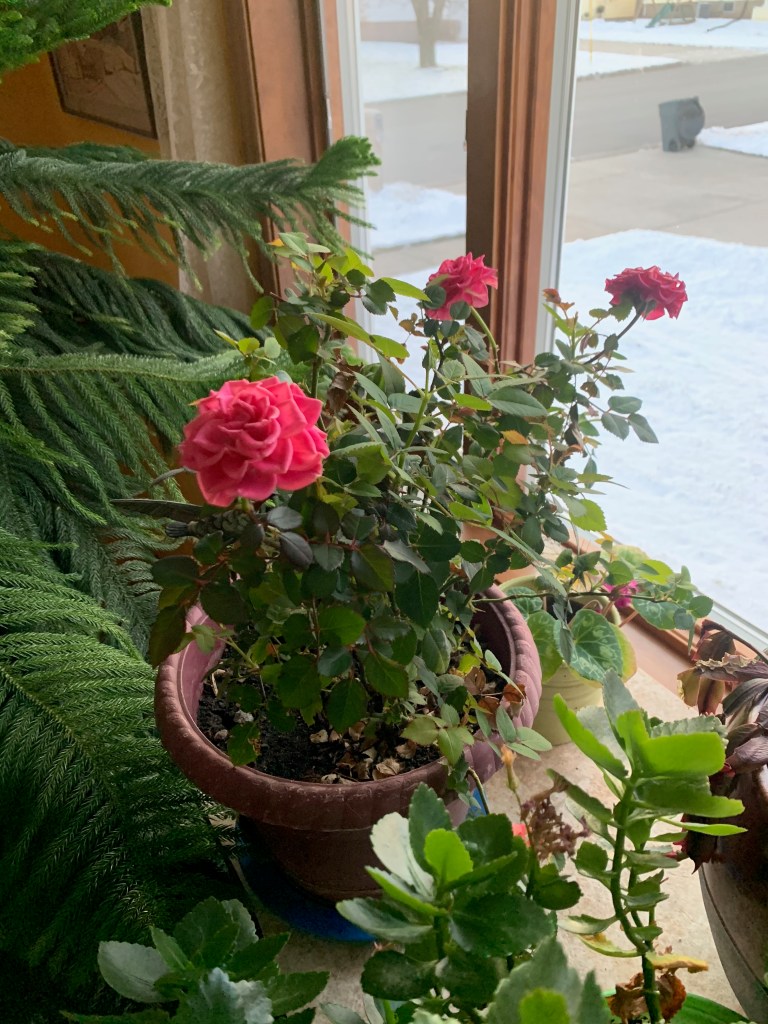
And she has a rose bush in the living room this year, also in full blossom, in November. I don’t know how she does that, either. But it does make me grin like an idiot to have a rose in full bloom while it’s 10 degrees and snowy outside.
But I was really going to talk about amateur radio stuff when I started all of this so let’s get on with this…
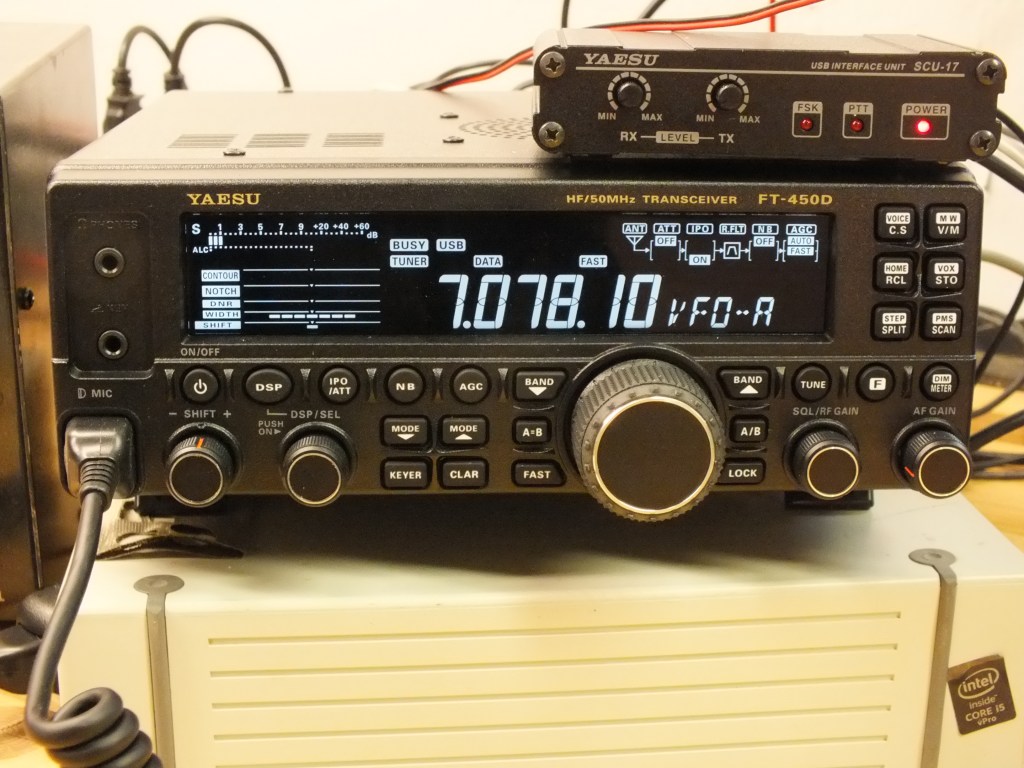
Yaesu FT-450D hooked to the SCU-17 interface. It’s been in production for a while but it’s still one heck of a nice little radio for the money
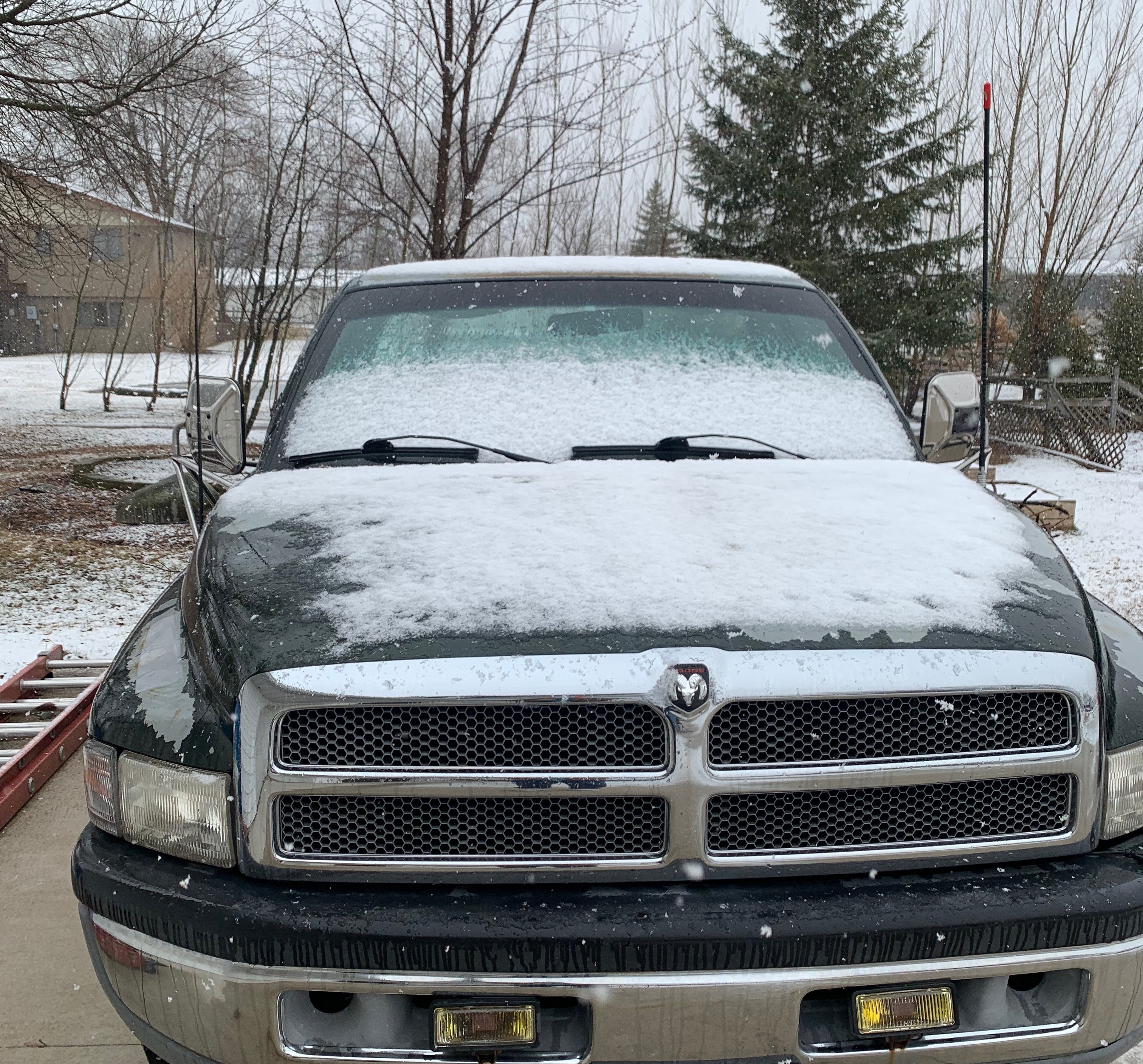
Oh, before that, though, I thought I’d just throw this in even though it has nothing to do with the headline starting this off. This is what it looked like here on Oct 31 a little after 6 AM.
Last day of October in Wisconsin.
Now I know this is Wisconsin and the weather here is a bit, well, odd, but still, really? Ick.
Now, finally, the amateur radio stuff!
The Dilemma
Whenever I start talking to someone about amateur radio, whether they’re other amateur radio operators or people who know nothing at all about it, invariably the topic turns to cost, and it becomes clear immediately that a lot of people, including a lot of hams, think that amateur radio is way too expensive. A lot of people I know who would otherwise be interested in getting into the hobby think it’s so expensive they could never be able to afford it. And that simply isn’t true.
I can’t really blame them for thinking that because some of this equipment is indeed expensive. The top of the line transceivers that the manufacturers and owners love to show off can quickly push up into the $5,000+ range or more. The Kenwood TS-990 sells new for just under $8,000 and iCom makes one that sells for more than $12K, for heaven’s sake. Once you add in other things that you may think you need, if you believe the ads, like amplifiers, computers, morse code keys, etc. you can quickly end up sinking $15,000 or more in a top of the line set up.
But here’s something the manufacturers don’t want you to know:
You don’t need any of that high priced junk.
Seriously. You don’t. If you want to get on the air on the HF bands (shortwave) you don’t have to spend a fortune. That little Yaesu in that photo up there costs literally less than one tenth of what my TS-990 costs new, and to be perfectly honest, does everything you need. Granted, it doesn’t have all the bells and whistles the 990 has, doesn’t have the fancy displays and all that, but when it comes down to actually communicating, those bells and whistles aren’t really necessary and the 450 will do everything you need.
I was looking for a fairly full featured, small, full power (100 watts output), 12V powered transceiver to lug out to field day and special events or whenever I feel like it, in situations where the little low powered 818 wouldn’t do the job. I love that little 818, but let’s face it, with a maximum of 6 watts output (3 watts or less running digital), any kind of communications using it is going to depend more on luck than anything else. I ran across someone talking about the 450 and it sounded like a nice little transceiver so I looked into it more and decided it was just what I needed. It sells new for about $750 – $800 which is, as I said before, one tenth of the cost of my TS-990. You can find them used for about $500 or even less if you look around.
And for that price what you get is not some stripped down little radio, either. This thing has a lot of features, including a built in antenna tuner, decent filtering, good noise reduction features, etc. In fact, just about everything you might need in an HF transceiver is packed into this little unit. True, it doesn’t have many of the goodies my 990 has, but I have to admit that in real life I don’t use a lot of those goodies anyway. If this were the only transceiver I had, I would be more than satisfied with its capabilities.
But for me the main question was how well was it going to work using digital modes like PSK, FT8 and JS8Call because those are pretty much the only modes I use. And it turned out it deals with digital very, very well indeed. It took me all of 10 minutes to get it up and running with the SCU-17 you see sitting on top of it in that photo. It was just a matter of plugging in the cables, setting the baud rate in the menu, firing up the computer and setting things up in the software there, and I was on the air. Now granted I had only just fairly recently set up the Yaesu 818 with the same interface, computer and software, so I already had experience working with Yaesu equipment which certainly made it easier. But still, for me, getting a rig up and running on digital modes in under 10 minutes is a bit of a miracle, really. It took me days to get my TS-2000 working properly with digital modes when I first started this years ago.
It’s currently set up in the basement, hooked to the Titan Gap vertical antenna, and it’s been doing a very, very nice job. I’ve made contacts all over the place with it using JS8 and FT8, putting out about 40 watts.
Sidenote: The 450 may be capable of putting out 100 watts, but you never run full power in the digital modes on any transceiver because the power ratings of all transceivers are seriously misleading. Those maximum power ratings they give you are for single side band, which does not stress the transmitter in the radio. With SSB you’re actually averaging far less power output than advertised. Your signal may peak at 100 watts, but you’re actually averaging 50 – 60 watts or so because of how SSB works. Unlike SSB, most digital modes are considered to be 100% duty cycle. A general rule of thumb is when using digital, always dial your power levels back to less than 50% of the radio’s maximum. Sometimes the recommendations are as low as 25%. Otherwise you risk overheating the radio and damaging it.
Anyway, I’m very pleased with this little radio. I didn’t really expect much from it when I got it, and it has certainly exceeded all of my expectations. I’ve been having a lot of fun with it, and I’ve been using it more than my TS-990 of late.
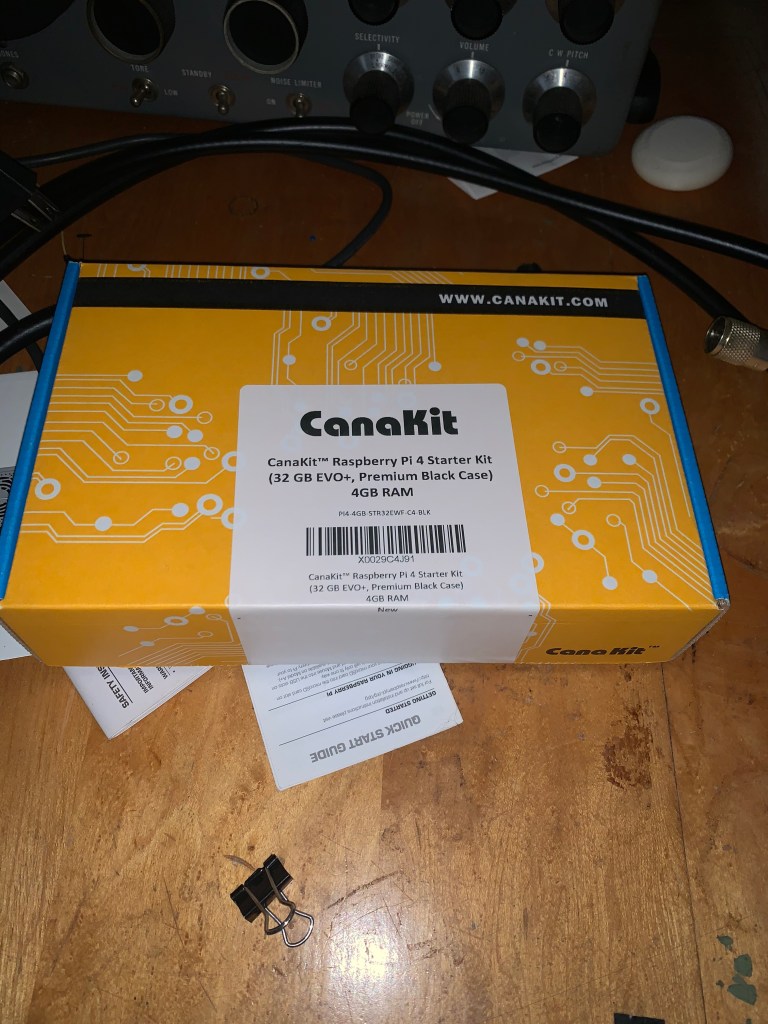
Lets see, what else? Oh, yeah. This showed up courtsey of our friendly UPS delivery person the other day.
I picked up a Raspberry Pi 4 to play with to join the RPi 3s I’ve already been playing with. I have a specific goal for this one. There are Linux versions of FT8 and JS8Call that, I’m told, run just fine and dandy on the RPi. I’ll find out this winter as I experiment. My eventual goal is to put together a compact QRP digital system that is backpackable that I can take along when I’m out on the trails with the bicycle. I’d thought about configuring the Rpi as a tablet computer with just a touch screen and no keyboard. I’ve done that before with the Rpi3s I’ve had, but I think that might be a bit awkward, so I’m looking at compact keyboards and maybe a small trackball or touchpad for mouse control. We’ll see. This is still very much a work in progress.
I know, I know… The used Lenovo laptop I picked up was supposed to serve that role, and it does, but while it works just fine it is also big, heavy and clumsy to lug around. I can squeeze a RPi into a package not much bigger than a small tablet computer and a fraction of the weight. We’ll see how it goes.
And that’s about it for now. I’ve been boring you long enough with this.
Those of you who’ve followed this blog for a while know I’m fascinated with the stock and commodities markets and how they work, and especially with how irrational they can be. I’m fascinated with how investors often throw rationality out the window and invest in companies that are less than viable in the long term. Their investments are based more on hype and hope than on any kind of rational decision based on actual data.
I ran into an article about Beyond Meat(TM) that illustrates just how ridiculous things can get. You can click the link up there to go read it yourself, but I’ll summarize it here.
When BM launched its IPO it was worth about $25 a share. Before the current stock market plunge hit, it was trading for $230 a share. That means the company is now worth more than Wendy’s, Jack ‘n the Box, Red Robin and Shack Shack combined, about $13 billion.
So, how is a company that had total sales of only around $65 million, has never made a profit, and is losing over $6 million a quarter, worth $13 billion? The answer to that question is, of course, it isn’t. Not even close. “Investing in Beyond Meat may be a worse idea than opening a video store in the age of Netflix.” is what a columnist at the Washington Times said when talking about the company.
And to make things worse, BM and its competitors are going after what is almost certainly going to be a relatively tiny niche market to begin with, fake meat, and pushing their products based on information that is, at best, misleading. While claiming it’s “healthier” than meat, what is actually in most of those products is some of the most unnatural and highly processed garbage ingredients you can imagine. As the Washington Times’ Richard Berman said, the company “relies on consumers not knowing what’s in their products”. At a time when there is increasing evidence that the highly processed foods we’re shoveling into our mouths are harming our health, BM and the other fake meat manufacturers are pushing this stuff?
Of course this isn’t the first time people have gone a bit silly over companies. Not even close. It’s been going on forever. Look at Uber. Not only has Uber never made an actual profit, it loses, on average, billions of dollars a year. The latest data I heard was that Uber lost more than $5 billion just in the first quarter of 2019. The only reason it still exists at all is because people who should really know better keep sticking money into it in the hopes that they’ll get something, anything, out of it. You’d think that after the company had lost, oh, ten or fifteen billion people would realize there is something seriously wrong with their whole business model and get the hell out. But no, they keep pumping more and more money into it.
Unfortunately the rabbits ate them overnight. Sigh…
Spring has finally come to Wisconsin and I can tell that easily when I get out around people. Everyone seems in a better mood these days as the temperatures start to warm up and we see some sun again.
It was a long, hard winter by almost anyone’s standards. While it wasn’t extraordinarily cold, we did get near record amounts of snow around here, and it seemed like winter was never going to end. And when it did end, the flooding started. Wisconsin was one of the states that got hit with early spring flooding from a combination of rain and snow melt.
Our yard is an absolute mess now that the snow is gone. Branches and twigs from the trees are everywhere. Dead grass and leaves cover everything. But the weather has still been too cold to really do much out there except some cleanup work.
There are some signs of life out there, though, like the flowers above and our Chives.
The chives are tucked away in a corner of the house where they’re protected and some winters they don’t even freeze back. They’re the first green things that pop up every spring and I suppose they’re really the first harvest of the year from the gardens here. But a few chives go a long way around here so once we have our fill of them early in the season they more or less go wild.
Of course it wouldn’t be spring in Wisconsin if the weather didn’t remind us that it can still pull some nasty tricks on us. We woke up the other day to find the ground covered with snow. We got about an inch or two. fortunately it didn’t stick around long and melted pretty quickly.
We’d hoped to get out and get some work done today (Friday) but it looks like that’s not going to happen. We’re getting light rain that’s going to shut down the chance of getting much done outside today. And the weekend is packed. The bi-annual quilt show in Manitowoc is this weekend and we always try to make that if we can. I’m not a quilter but the quilts that are on display at the event aren’t just quilts to throw on a bed, they’re works of art. I’m always amazed at the skill and talent of the people who make them. Hopefully I’ll have some photos next week.
The there’s the house next door…
This is what we saw when we looked out the window the other evening. Not exactly something you want to see, the local fire department with all their trucks and equipment setting up next door.
No, there wasn’t a fire. It was a training session. All they did was set everything up, get all their gear out, make sure everything worked the way it was supposed to, etc. It was still a bit of a surprise when we looked out the north window and saw that and took us a minute or two to realize what was really going on.
As you can see from the trailer, the big dumpster and debris pile, that place is being worked on at the moment. Someone finally bought the place. When our old neighbors moved out late last summer MrsGF and I seriously considered buying the place if we could get it cheap. The neighbors were just about the nicest neighbors you could possibly ever hope for. An absolutely wonderful young couple with two young kids. But they had more than their share of problems and ended up in bankruptcy and lost the house to the bank. Fortunately it worked out for them in the long run. He has a very good job now and they’re getting back on their feet.
But to get back to that house — MrsGF and I considered buying it if we could get it for the right price. We thought if we could get it for under $50K it would be worth it. But then we found out they were asking $80K for the place and that price was just absolutely ridiculous so we just let it go and talked ourselves out of the idea because, frankly, we couldn’t be bothered. We didn’t want the property badly enough.
It finally sold for $49K. Apparently the mortgage company wanted to get rid of the place fast. Do we regret not getting involved in this? No, not really. Yes, we could have afforded to buy it. We wouldn’t have even had to take out a mortgage. We could have just written a check or used an existing line of credit to buy it. But… Well, what the heck would we do then? Did we really want to get involved in dealing with almost 100 year old buildings, contractors, permits, etc? Well, no, not really. I’m rather relieved that the original sale price was so ridiculously high because otherwise now we’d be stuck with the place.
Turns out the town fire chief bought the place, so at least it went to someone local and someone we know, and not some absentee landlord. He and his son are gutting the place and remodeling it and eventually his son is going to end up buying it from his father.
Let’s see, what else? The move of my electronics gear, radio stuff and computers into the basement is proceeding slowly. I’m still working on cleaning the area up and patching and painting walls down there. I want to get that taken care of first because once I get work benches and equipment in there I’m not going to be able to get at the walls very easily.
I was finally able to get the bicycle out of storage! It’s still been on the cold and wet side to do more than ride around town but it’s still nice to have that out and get even a short ride.
MrsGF and I went to the bi-annual quilt show at the fairgrounds in Manitowoc yesterday and I took lots of pictures. As soon as I have free time I’ll get some of those posted. As usual we saw some absolutely beautiful work by some amazing people.
If you live in Wisconsin you might have noticed something rather curious, the state administration’s campaign ads and the administration itself aren’t talking very much about the most high profile financial fiascoscam deal the state has ever been involved with, the $4 billion plus the state promised to shell out in tax breaks, cash payments and other payouts in order to have FoxConn build it’s factory here. This deal was supposed to bring 13,000 high paying jobs to the state, add still more jobs in various support industries, and help to turn the state into the “Silicon Valley” of the midwest.
And the whole thing has turned into a stinking, reeking mess that smells worse than the local manure lagoon.
Exactly what FC is going to be building on that big hole it’s digging down in southern Wisconsin is anybody’s guess right now, but one thing we can be sure of is that it is definitely not going to be the $10 billion “Generation 10.5” facility the company originally promised. Back in May a news service out of Asia claimed that FC was going to be drastically scaling back the whole plan. FC denied this vehemently. But within about two months it finally admitted that the Gen 10 plant was not going to be built. Instead it was going to be putting in a so-called Generation 6 plant, which was about a quarter of the size of the original facility. But it would be building a Gen-10 plant there sometime in the future. Maybe. It would definitely fulfill its promises about the $10 billion investment and 13,000 jobs. Maybe. It would be done in “phases”, though, not all at once. Maybe.
Well, no.
By the end of summer that story had fallen apart as well. An FC spokesperson told a local paper that it was never going to build a Gen-10 plant here because by the time they had it up and running the market would be glutted with product from other makers. And when you consider the fact that FC apparently never even looked into buying the equipment that would have been necessary to build the Gen-10 plant according to industry analysts, and didn’t make arrangements with Corning to build the required glass manufacturing facility on the site (Corning, BTW, refused to build the facility unless the state coughed up hundreds of millions more in tax breaks and cash), and other things that have come to light since this all started, even someone a lot less cynical than I am would suspect FC never intended to build a Gen-10 plant here in the first place.
And then to make things even more interesting, the spokesperson, said that the Gen-6 plant quite probably wouldn’t be in operation for very long, and all those “good paying” assembly line jobs that they were claiming they were bringing to the state, well, there pretty much weren’t going to be any. Eventually what the facility will really do, they said, was to work on the development of FC’s technologies in displays, cellular and computers. The facility will eventually employ 90% “knowledge workers” and only 10% assembly line work, and most of the assembly line work is going to be done by robots, and, well, that pretty much flushes the hope that the company would employ the lower skilled minority workers from south east Wisconsin right down the drain.
The whole plan has simply evaporated in a puff of smoke. The facility they promised isn’t going to be built. The facility they now claim they will build probably isn’t going to actually operate for very long. The 13,000 jobs has now become maybe 2,000 – 3,000, and 90% of them are going to be “knowledge workers” engaging in research and development. And while R&D is enormously important, well, that’s not the 13,000 allegedly good paying blue collar jobs the company promised in order to sell this boondoggle in the first place.
Now there are a few safeguards in place. FC isn’t going to get $4+ billion out of us. But they are still going to get at least $1 billion from the state out of this deal and the state and local governments are still on the hook for tens of millions of dollars in infrastructure improvements. While we, the people of the state are going to get, well, we aren’t sure what we’re going to get yet, but it sure as hell isn’t going to be the deal the administration and FC promised when this all started.
The administration should have known better. Seriously, it should have. About 15 minutes worth of research on Google would have told them that if you’re dealing with FC, well, leave your wallet and credit cards at home, count all your fingers when you get your hand back after you shake hands with them, because they’ve done this before. High profile, high dollar projects have been reneged on in India, Vietnam, Pennsylvania, China … And remember that this is the company that had to install nets around the roofs of buildings on its factories in China because it allegedly treated its employees so badly they were committing suicide by jumping off the roofs.
Yes, this is that company.
Now I’m not saying that the politicians down there in Madison deliberately lied to us about this deal. But, well, let’s face it, this current crop of people inhabiting the state capital aren’t really all that bright, now are they? That’s glaringly obvious from the things they’ve said and done over the last eight or ten years. Their primary focus down there isn’t doing good things for the people of the state, it’s getting their asses re-elected so they can hang onto their little bit of power, cling to their fancy offices, go to “fund raising” events where they can guzzle cheap champagne and get their pictures taken with the rich and powerful, and pad their expense accounts. So when FC came along and dangled all those bright, shiny promises, they bit like a starving fish at a worm, and never noticed the hook. They totally ignored all of the warning signs, totally failed to properly research this, totally failed, well, totally failed at just about everything on this deal. And now they’re off soliciting bribes attending fund raising events, and we’re stuck with paying the bills.
The trade war has started in earnest and the effects are filtering down through the economy already. Cash price for soybeans has dropped to about $7.70 or even less, the lowest price in over 10 years. Shiploads of soybeans heading for China have been turned away and have to find other destinations. China has canceled planned purchases of tens of thousands of pounds of US soybeans and is now sourcing beans from Brazil and other countries. It has canceled all of it’s purchases of US sorghum from one story I read. It’s canceling planned purchases of cotton… The list goes on and on. The story in the EU, Canada and Mexico is similar. Tariffs of up to 30% on a huge range of US products.
And there are signs it’s going to get a lot worse. There are noises coming out of DC that the administration is considering slapping tariffs on all products coming from China now. A new list of products that could get hit coming from Canada and Mexico, including automotive products is apparently in the works. That would hit the US auto makers hard because there is no such thing as a “made in the USA” motor vehicle any more. All of them have parts made in Canada, Mexico, China and other countries.
The ag sector is going to get hit first, and get hit the hardest because it is one of the few industries where we have a trade surplus. Huge amounts of agricultural products, both raw and processed, are sold to other countries every year. And we are already seeing ag commodities prices in the US plummeting at a time when commodities prices are already at a point where most farmers are just barely breaking even.
The tariffs are being levied on a lot of products that aren’t made in the US at all, or are made in such low quantities that we can’t meet the demand. We have no choice but to buy elsewhere. Some types of steel, aluminum and other metal products, well, we just don’t make the stuff here for a variety of reasons. The paper your newspaper and magazines is made from. Electronics. Clothing…
There are rumors flying around that the Fed is already getting nervous about the prospect of serious inflation as the increased costs filter through the economy.
Apparently China isn’t waiting to implement the tariffs it said it would be imposing, it’s retaliating against the ill advised trade war this administration has implemented by simply refusing to buy US soybeans entirely.
Since about 30% of our soybean crop gets exported to China, if this keeps up for more than a few weeks it could potentially bankrupt a lot of US farmers who are already right on the edge financially because of low commodities prices.
Hopefully no, I’m not going to break it. But I’ve been doing this blog for a long time now and I’m tired of looking at the same style all the time. I haven’t changed the layout or design of this thing since I started it, so it’s high time for a refresh.
I’m not sure if I like this design or not yet. We’ll see. Don’t be surprised if it changes again in the near future. You may see a few posts like this one that essentially have little or no actual useful content (Ha! You could say that about a lot of my articles here, couldn’t you?) so have patience. If there’s something about the new styles you like or don’t like just leave a comment or email to old.grouchyfarmer@gmail.dom.
Okay so I just looked at it and it doesn’t look utterly horrible. Maybe.
I don’t know about you but I get tired of reading stark black text on a bright white background all the time, so that’s the first thing that got changed.
It’s also supposed to be able to do pull quotes. Well, we’ll see about that
This is supposed to be able to do pull quotes too. Well, we’ll see about that. I’ve been promised pull quotes in the past
This format is also supposed to let me put up images at a larger size and higher resolution than the old one did, so we’ll see about that.
Also it’s about 6 in the morning because I can’t sleep and I’m bored so I start fiddling with things.
Now that’s a scary headline, isn’t it? You’ve probably seen similar headlines over the last few days as even some of the major news outlets have been talking about it. What’s especially troubling is that canola oil has been marketed as being a “healthy” oil for many years now, and it is in very wide spread use around the world. So the possibility that it is linked to something as scary as dementia is pretty serious.
What is canola in the first place? Well, in a way “canola” doesn’t really exist. It actually a variety of rapeseed. The term “rape” comes from the Latin word “rapum”, which means turnip. Rapeseed is related to turnip, rutabaga, cabbage and mustard. We’ve been using plants in this family for oil for thousands of years. It seems that rapeseed oil in the first half of the 20th century was used more as a lubricant than as a food product. Production in Canada increased enormously curing WWII.
After the war demand fell drastically and farmers began to look for other uses. Rapeseed oil was brought to the market in the mid 1950s as a food product, but it had some problems. It had a nasty green color and tasted pretty bad. Even worse, it had a high concentration of erucic acid. Animal experiments indicated that consuming large quantities of erucic acid caused heart damage.
In the 1970s Canadian researchers bred a variety of rapeseed that had far fewer objectionable qualities and far less erucic acid. The term “canola” was originally a trademark name for the new variety, made out of “Can” for Canada, and “ola” from other vegetable oils like Mazola.
Modern canola oil is considered, or was considered before this study came along, to actually be fairly healthy. But now…
How concerned should we be about this? This was just one study and more research needs to be done, but it still is something we need to be concerned about. Dementia is very scary and anything that increases the risk of getting it needs to be avoided if at all possible. To be honest, I’m not going to be buying canola oil after this. There are other oils out there with similar smoke points and nutrition profiles that can be used instead.








 Hopefully no, I’m not going to break it. But I’ve been doing this blog for a long time now and I’m tired of looking at the same style all the time. I haven’t changed the layout or design of this thing since I started it, so it’s high time for a refresh.
