MrsGF made the cat her own sofa. Note the cord on the right side. It’s heated. No, the cat is not being spoiled. Not at all….
Woke up around 2 AM and found her in bed with me, snuggled up against my chest. Which was fine until about half an hour later she decided she needed to groom herself, and me. So I had to pick up the little goof and put her in her bed in the living room. Going to have to remember to keep the bedroom door closed.
We have a cat again! After we lost Meg to old age we weren’t sure we realy wanted another cat. But… I can’t believe how much I missed having a cat in the house. It was like there was this empty space in my life… Anyway, once again we have cat. Meet Charlie.
Like almost all of our other cats she is a sort of rescue kitty. Her owner is going in for ankle surgery and after that she is moving into an apartment that doesn’t allow pets so she had to give her up. Then we heard about it from some of our family and without even thinking I said “We’ll take her”. And here she is.
And she is amazing. i know, I know, everyone thinks their new cat is amazing but Charlie really is. She’s 12 years old and is the most mellow, affectionate, well adjusted kitty I’ve ever seen.
We were prepared for drama when Charlie moved in. Anyone who has ever had to move a cat into a new environment or took one into a new family will know what I mean. Cats generally are creatures of habit. They don’t like change. And before this kitty came along most of our cats haven’t exactly been, well, normal. They came from a variety of unpleasant situations where they often were not treated well. It sometimes took weeks, even months or longer before a new cat moving into our home adjusted and came to realize they were in a safe environment.
With Charlie, though? Charlie was always in a pleasant, loving environment from the time she was born and it shows. Within 10 minutes of coming into the house she’d decided she liked it here. She spent some time exploring, let us pet and brush her and make a fuss over her, purred at us a lot, rolled on the floor and asked for tummy rubs, had decided which chair was the most comfortable for naps. She showed us which toys she likes to play with, which brush she prefers. She loves snuggling and when she’s happy she has a purr you can hear from three feet away.
What it boils down to is we love her, and she seems to love us and her new home. This is the third day we’ve had her and every time I see her I grin like an idiot.
The weather, I mean. I’ve never seen a winter like this before in Wisconsin. December was abnormally warm. January started out warm, then we got hit with this…
Actual real winter!
Now my back yard looks like this…
For weeks now it’s just barely been dipping below freezing at night, and during the day the termperatures have been getting warmer, and warmer, and warmer. For the last few days our high temps have been in the mid-40s. And by the middle of next week it’s supposed to hit the 5os here.
We have flowers starting to come up. The vegetable gardens are going to need to be weeded here pretty soon if this keeps up. The grass is starting to grow.
This is February. In Wisconsin. January and February are our coldest months. We generally get weeks of below zero weather here this time of year.
All of the ski and snowmobile trails are closed and have been closed all season except for that one snowstorm we had. Ice fishing? Forget it. What little ice there is out there on the local lakes is now so rotten they’ve had to resort to using airboats to go out to rescue the few damned fools who’ve tried to venture out on the ice.
The sturgeon spearing season is supposed to start on Lake Winnebago on Feb. 10. Usually there will be about 6,000 ice houses out there and hundreds of trucks and ATVs. This year? If this keeps up it’s entirely possible we won’t have a sturgeon season at all.
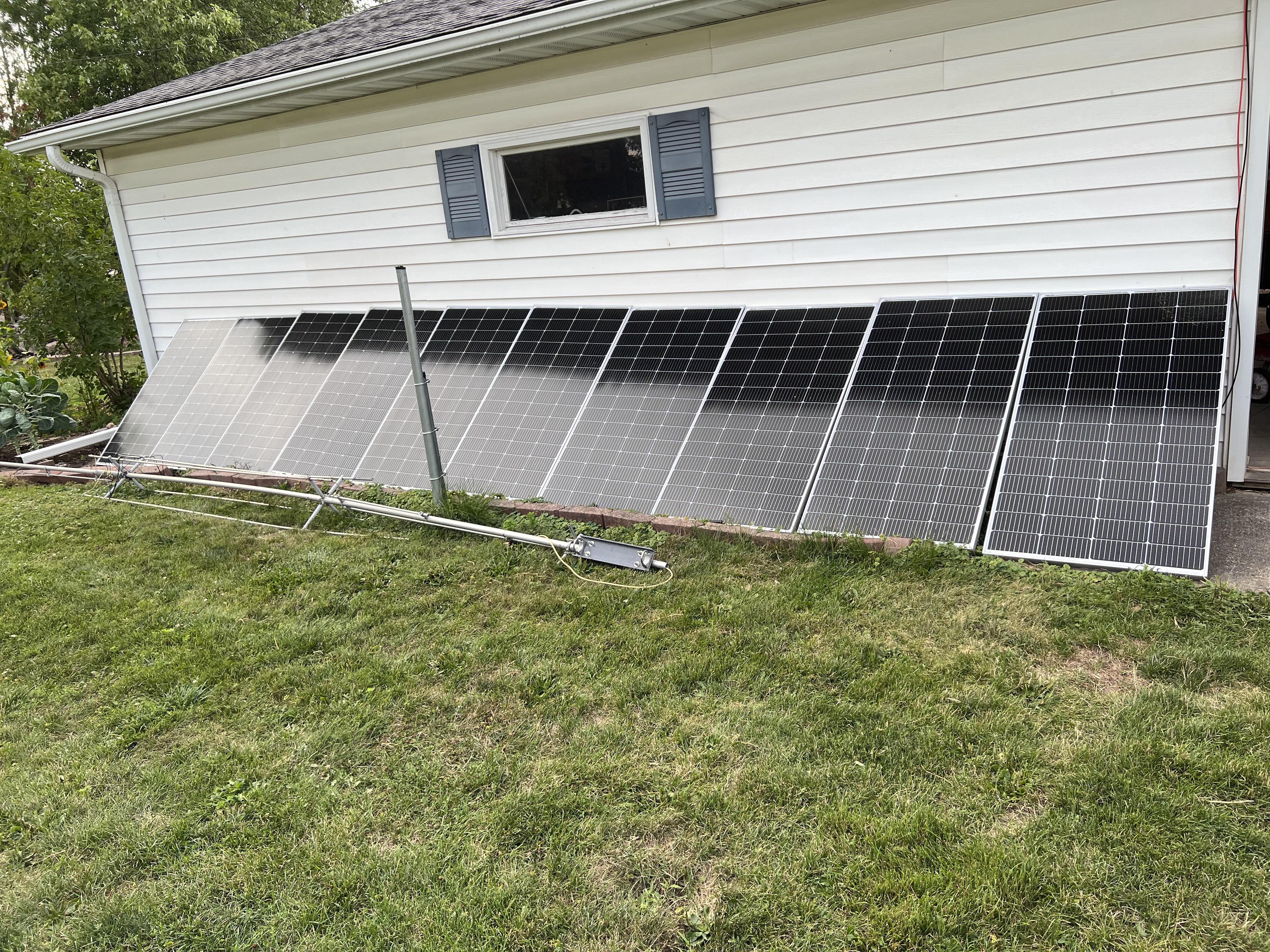
Took me over an hour to dig the solar panels out from under about 3 feet of snow. Great fun.
After one of the warmest Decembers on record, the weather has finally taken a more winter like turn. We got about 5 – 8 inches of snow last week Tuesday into Wednesday. Followed by a full scale blizzard a couple of days later. And now this week we’ve had below zero temperatures. I’m not complaining. This is actually pretty normal for us. Which brings me to this little mini-rant…
What really frosts my cookies is how the local news outlets go almost into total panic mode whenever we have more than a couple of inches of snow or the temperatures get close to zero. This is Wisconsin, for heaven’s sake! We deal with this Every. Single. Year. This isn’t Georgia or North Carolina where an inch of snow shuts everything down because they don’t have the equipment or the expertise to deal with it. If you listened to some of the television weather reports here leading up to this relatively minor snowfall you’d think we had a category 5 hurricane bearing down on us. All things considered, this “storm” was pretty much a total bust. It caused some slight delays, we had to fire up the snowblowers and snowplows for the first time for a few hours, and that was about it. I have literally driven motorcycles in weather worse than what we had.
I sometimes wonder what the heck has happened to people. Maybe it’s because I grew up on a farm? The farm doesn’t shut down for bad weather. Never. The chores still have to be done, the cows still have to be milked and fed, the young stock still has to be cared for, the manure still has to get hauled out, no matter how cold it is, no matter how much snow is on the ground.
Solar Stuff
Speaking of weather, one of the problems with Wisconsin is that from about, oh, November through the end of February we rarely see the sun at all. So if you’re running a solar power system you’re SOL as they say. I don’t think we’ve seen the sun for more than a few hours since mid-November. And after the power flickered and even went out for a couple of minutes during the snow storm I figured I’d better check the state of my battery bank just in case I had to switch over to that. And found that the batteries were down to 48V instead of the 53 or 54 they should have been at. That meant they were down to about 60% capacity. Oops?
Well considering we haven’t had sun in two or three months that shouldn’t have been surprising. I had the batteries in standby mode all that time so they were using a bit of power to keep the BMS operating. I should have just shut them down completely but I’d neglected to do that. I don’t have provisions for charging them from the grid at the moment, so that meant I had to drag out the big old Generac and fire that beast up. It’s out there right now dumping about 30A at 240V into the charger that’s topping up the batteries. And yes, I know it’s too close to the house but I got CO detectors all over the place and it’s only for a few hours so stop clutching your pearls and wringing your hands.
That’s the problem with solar power. In ideal conditions, on paper, it’s fantastic. In the real world there are some serious issues. Like what do you do when there’s no sun?
Fly Me To The Moon
Or maybe not? NASA finally admitted that it’s goal of getting humans back on the moon anytime soon was not going to work. The date for an actual manned landing looks like it’s being pushed back to at least 2026. And I’ll be utterly astonished if they manage to do it even then. It’s proposed schedule was always completely ridiculous.
They’ve done exactly one test flight of their outrageously over priced rocket and it seems to work. But everything else they need? They don’t have any of the other bits and pieces they need to make it work. None. Zero.
They don’t have a lunar lander. They don’t have lunar rated spacesuits. They don’t have anything they need except the launch vehicle. Space X’s starship is an essential part of the planned mission, and Space X hasn’t even managed to get one into orbit yet much less prove the vehicle will do everything it’s supposed to do, including robotic in-orbit refueling of other spacecraft.
Plus no one has yet explained to me exactly why we need to land people on the moon in the first place. Don’t get me wrong. I’d dearly love to see us putting people on the moon again. But ultimately what are they going to do there? Science? The Mars rovers have proven over and over again that we don’t need to put people at risk just to get scientific data. Putting some kind of colony on the moon? That’s a complete pipe dream. For God’s sake, why?
Exploiting the moon’s resources? What resources? As far as I know there isn’t anything, not one single thing on the moon that we need badly enough to go to the expense and risk of putting people up there. Nothing. Zilch.
Other Stuff
I’ve got two or three things on the bench I want to talk about in the near future. There’s an SDR sitting there in the box waiting to be played with. There’s a cheap video microscope that I just got that needs to be put together and fiddled with. I just got a new set of electronics tools from IFixit that I want to talk about too.
Covid For Christmas – The Great Pi Famine -Lettuce In December – Weather – Dreams
Covid
So on Dec. 23 MrsGF got an unwelcome Christmas present, Covid. Don’t worry, she’s doing fine. She still has a nasty cough but she’s feeling much better and has been testing negative for two days now so we’re hoping it’s all over. Somehow I avoided coming down with it. I took precautions, staying in the basement most of the time, eating our meals separately, wearing N-95 mask whenever I was upstairs, etc. But even so I figured I’d come down with it too. Well, I still might. She’s been testing negative for 2 days now. They say that the incubation time for the current strain is about 2 – 4 days, so I’m not going to be able to relax much for another couple of days.
And me… I’m a hypochondriac. All through the pandemic, every time I coughed or sneezed or my head got stuffed up, I was convinced I had Covid myself. And I have some pretty nasty upper respiratory allergies on top of it, so I pretty much have mild symptoms that could be mistaken for the early stages of Covid all the time.
The Great Pi Famine
RaspberryPi 4. I’m still amazed that they can squeeze a complete quad core computer with 8 gig of RAM, hdmi video, sound, 4 usb ports and WiFi into a package this small. Storage on this one is a 128 gig micro-SD card.
If you’ve been following this blog for a while you know I like to fiddle around with electronic gadgets and gizmos and tinker and build stuff. One of the mainstays of the electronic tinkerers out there as a controller of electronic equipment of all types has been a tiny little single board computer called a Raspberry Pi. They’re available in a variety of types ranging from tiny little units that are used as controllers for a variety of gizmos, to a full blown Linux computer that’s smaller than a deck of cards, the Raspberry Pi 4 and now the new, more powerful Pi 5. There are four things that make them attractive. They’re small. Very small. They are designed to make it easy to interface them to the outside world in order to use them to control robots, motors, actuators of various types, collect data from sensors, etc. And three, they’re relatively easy to use, easy to program and enormously powerful for their size.
And the fourth thing, they were cheap. Like really cheap. The Pi 4 which is basically a full blown Linux (using a variation of Debian) computer with up to 8 gig of RAM, built in WiFi, HDMI video, USB 2 and USB3 ports sold for about $40 or even less. If you ever wanted to play around with Linux to see if it could be a viable replacement for the ever increasing horror that is Microsoft Windows, a Pi 4 is an easy and cheap way to do it. Just plug in a monitor, keyboard and mouse, get yourself a good introductory book on the Pi computers, and away you go.
Sidenote: I was just reading an article the other day that illustrated just how much computing technology had advanced in the last few decades. Someone pointed out that the Raspberry Pi 4 is six times more powerful than the original Cray 1 “super computer”.
Note that I used the past tense there. They werecheap. Then the pandemic hit, supply chain problems hit, demand for Pis increased because people were stuck at home and were looking for things to do, and, perhaps most importantly, the profiteers struck. Scalpers, profiteers, scammers and the like snapped up every Pi they could get their hands on, and then turned around and re-sold them for three, four times their original cost. I saw Pi 4s, a computer that sold for about $35 – $40 originally, being sold for $250 or more.
Pre pandemic I had a half dozen or more of the things laying around the house. But I gave them to a friend who was an electronics experimenter and solar power experimenter before the drought hit. Get them back from him? Yeah, well, he lives in Barcelona half the year so that ain’t gonna happen.
After the pandemic, when I couldn’t get them for a reasonable price any more, I switched to using Arduinos for the fiddling around I was doing. But while they and other microcontrollers are extremely useful and fun to play with, they aren’t computers.
But now prices have finally started to settle down. They’re still over priced when compared to what they were before the pandemic, about $75. But that’s cheap enough that I’m willing to get one and start playing around with it.
To make a long story short the nice fellow from UPS dropped one off here (two, actually) and I spent a couple of hours setting it up, updating the software and fiddling around with it last night. So you might be seeing some more stuff pop up here concerning Linux and the Pi in the future.
If you want to fiddle around with one of these yourself and you’re new to the Pi I’d recommend you get something like this from a company like CannaKit in the photo below.
No, I don’t get a kickback from CanaKit or anything like that. There are a lot of disreputable vendors out there, but I’ve bought stuff from CanaKit several times now and they provide exactly what they advertise, ship quickly and their prices, while a bit high, aren’t horrible.
It includes everything needed to get the thing up and running. The Pi 4, a power supply for it, HDMI cables to connect a monitor, a case for it along with a tiny cooling fan, heat sinks for the CPU and two other chips on the board, and a micro-SD card with the operating system pre-installed. It’s more expensive than buying a bare bones Pi but it has everything needed to get it operational. Just plug in a keyboard and mouse, and a monitor.
Lettuce In December
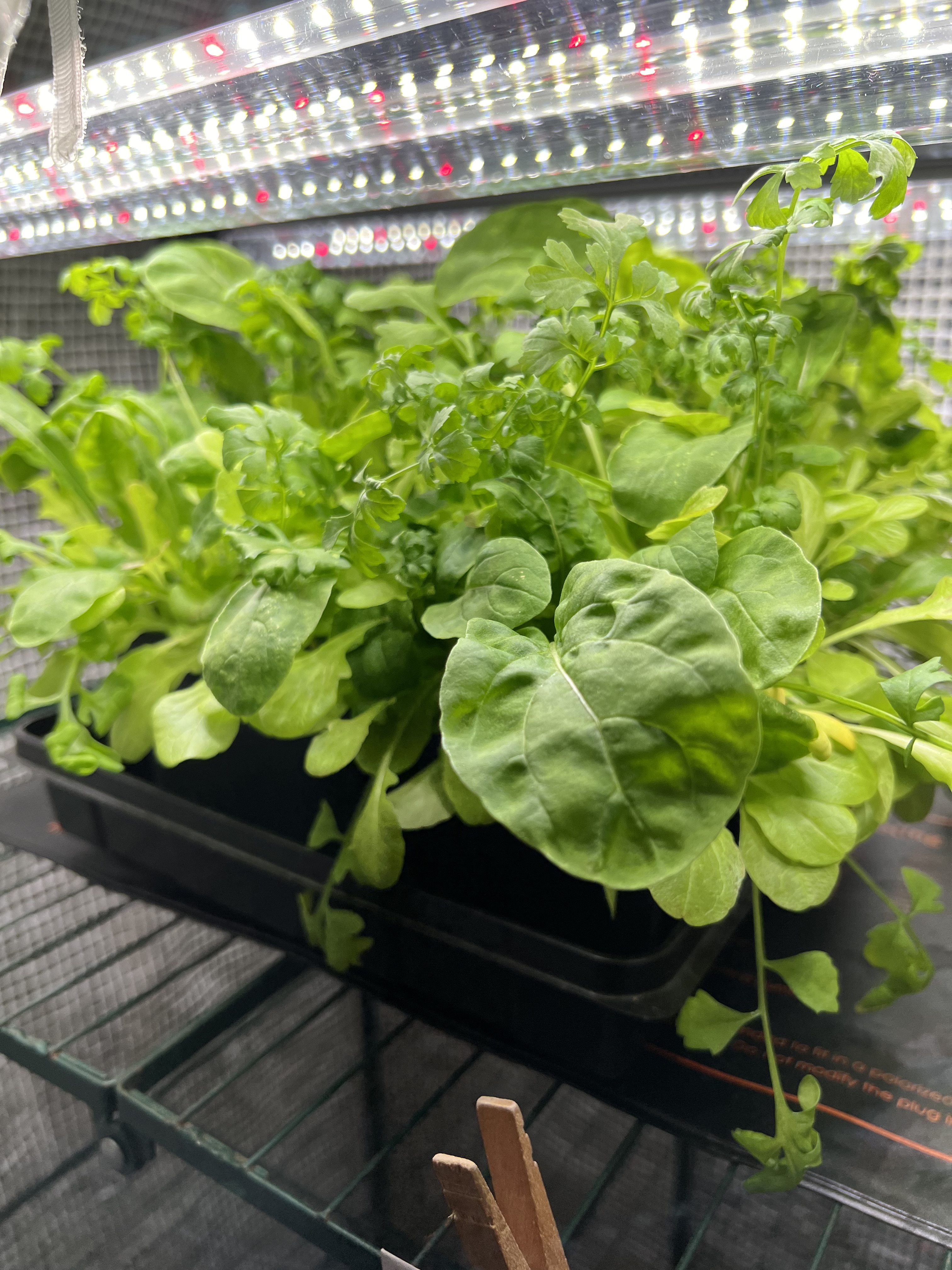
From about the end of may through September we had fresh greens whenever we wanted them out in the garden. All we had to do was go outside, clip off some of the lettuce mix we’d planted, and graze to our heart’s content. I really missed that. And then I was in the basement doing stuff and saw the little portable green house we used to start seedlings in the early spring with the grow lights and heater and thought why the hell aren’t we using that to grow some fresh greens? So we did. And this is what we ended up with.
We didn’t put in a lot because we weren’t sure it was going to work, but as you can see it worked very well indeed. We got more than enough for a couple of good sized salads plus a bit more. And yes, it tasted very, very good. 😊
Other Stuff
The PreciseRF magloop antenna continues to work surprisingly well for me. I was concerned about it’s survivability when set up out in the weather but it’s been holding up well despite the rain, snow and colder weather we’ve had. But the real test is yet to come when it gets really cold here. It’s been abnormally warm here all through December. Even now, on Jan. 3 at 4:30 AM, it’s 35 degrees out there. We’ll see what happens when it’s -30 and blizzard like conditions.
Weather
If we ever get cold weather, that is. Temperatures have been running well above normal here. I vividly remember one New Year’s Eve before MrsGF and I got married. When we got out of the pub where we’d spent the evening it was -34F with a stiff wind and everything, including the car, was frozen solid. We spent the night at a friend’s house and managed to get the car started the next morning, somehow.
It was brutally cold for weeks that January. On Jan 1 after I got back to the farm I had to put a new alternator on one of the tractors. It was so cold that the insulation on the wires the old alternator shattered when I bent them. I managed to get the tractor running well enough to pull it into the heifer barn and then close everything up. 30 or so young heifers put out a lot of heat and it was warm enough in there that I could get the job done. The heifers thought it was great fun. They were all crowded around watching me.
What’s Coming Up
I got a woodworking project going. This is a joint project by ES (Eldest Son) and myself. One of his hobbies is doing stained glass so I’m making a backlighted frame for a piece he did. That promises to turn out to be pretty interesting. More about that when it gets closer to completion. That’s still in the planning stage.
One thing, though, dear sweet lord has good quality lumber gotten expensive! I’ve been spoiled. Years and years ago I bought a whole pickup truck load of very good quality, kiln dried, white oak about 1 1/4 inches thick, 6 feet long and of various widths that ranged from 6″ up to 13″. That’s pretty much run out now so I had to actually go out and buy wood and prices of good quality, furniture grade hardwood are absolutely nuts.
I don’t really have plans for the Raspberry Pi. It’s something I wanted just to be able to play around with Linux and mess around with. If something develops from that I’ll let you know.
Dreams
Dreams are weird. At least mine are. I was up at 3 AM this morning and just couldn’t get back to sleep so I came out here dealt with my email and then started writing this up. I do vividly remember the dream I was having when I woke up. I rarely remember my dreams, but when I do they are often extremely vivid and detailed. This one was like that.
MrsGF and I were having dinner at a rather fancy restaurant with a very nice young couple from India. I have absolutely no idea who they were or why they were in this dream. Nice people, though.
When MrsGF and I left we went out into the parking lot and the car, my Buick, was gone. We thought we mis-remembered where we’d parked it so I pulled out my phone to use the app that tracks my car. And my phone didn’t work. It had been infected with some kind of malware that just kept cycling through obnoxious ads over and over again.
There was a strip mall nearby and a T-Mobile store was there so we walked over there. They were about the close but a nice young woman kept the place open. She got me a replacement phone right away, restored all my stuff and got the phone working. We went back to the parking lot and activated the tracking app and yeah, the car was gone. We called the police and they found it, and the thief, rather quickly.
Elon Musk had stolen it. He’d been at the table behind us and had overheard me making disparaging comments about how utterly hideous his “cybertruck” looked so he’d gotten huffy, hacked the electronic systems in my car and took it.
Still, it’s better than the vivid, realistic dream I had about painting the garage. That was the entire dream, painting the garage. That was it. It was so boring that I bored myself awake.
I suddenly realized this morning that I haven’t posted anything here in a while. That’s because there hasn’t been much going on. Now that the fall cleanup is all done, the gardening season is wrapped up and all that, the solar system is more or less working, etc. I haven’t had much to really talk about. And now I do. So here we are.
Let’s get this vexed business out of the way. (Vexed means mildly pissed off, by the way.)
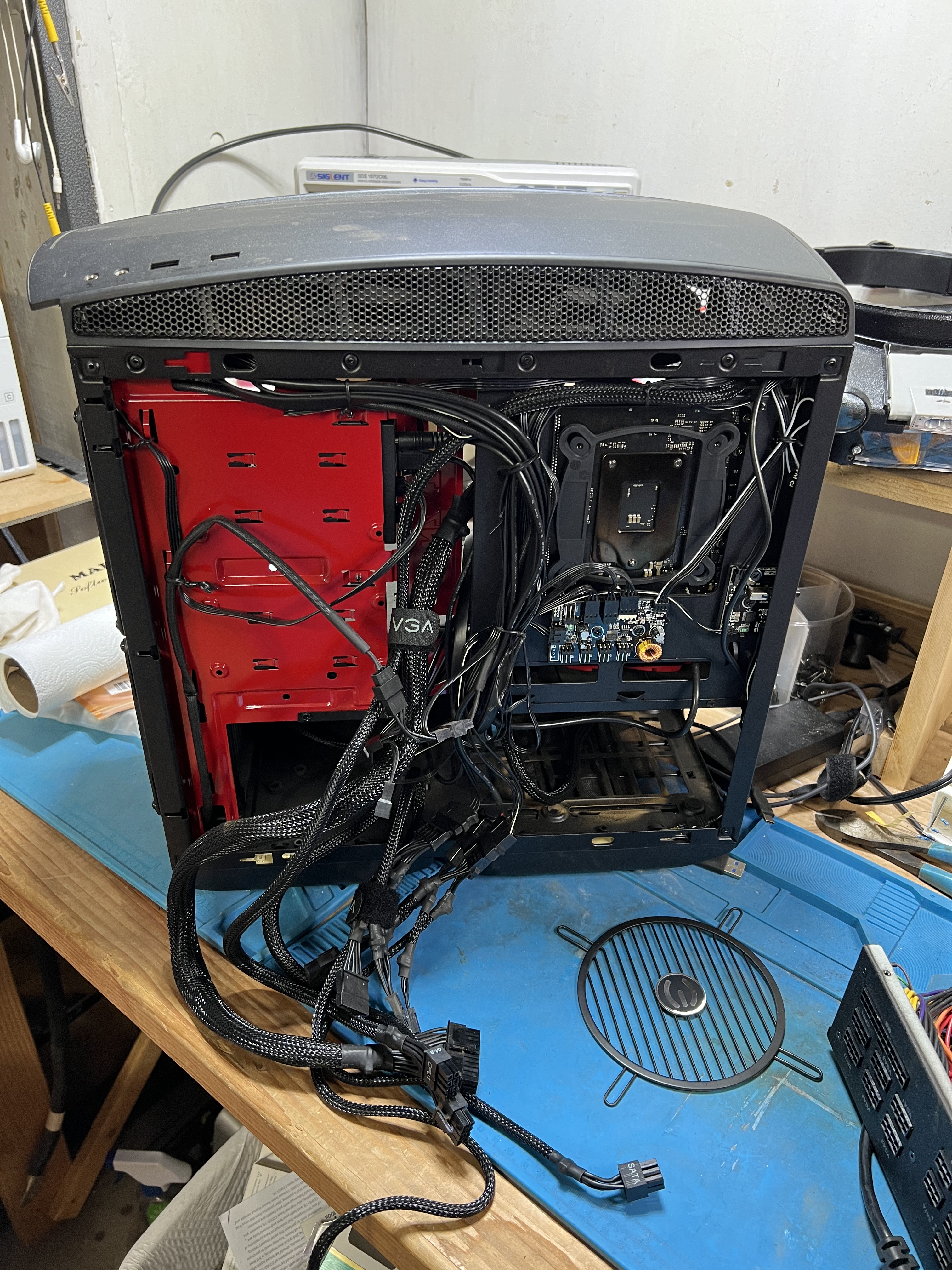
Doesn’t this look like fun?
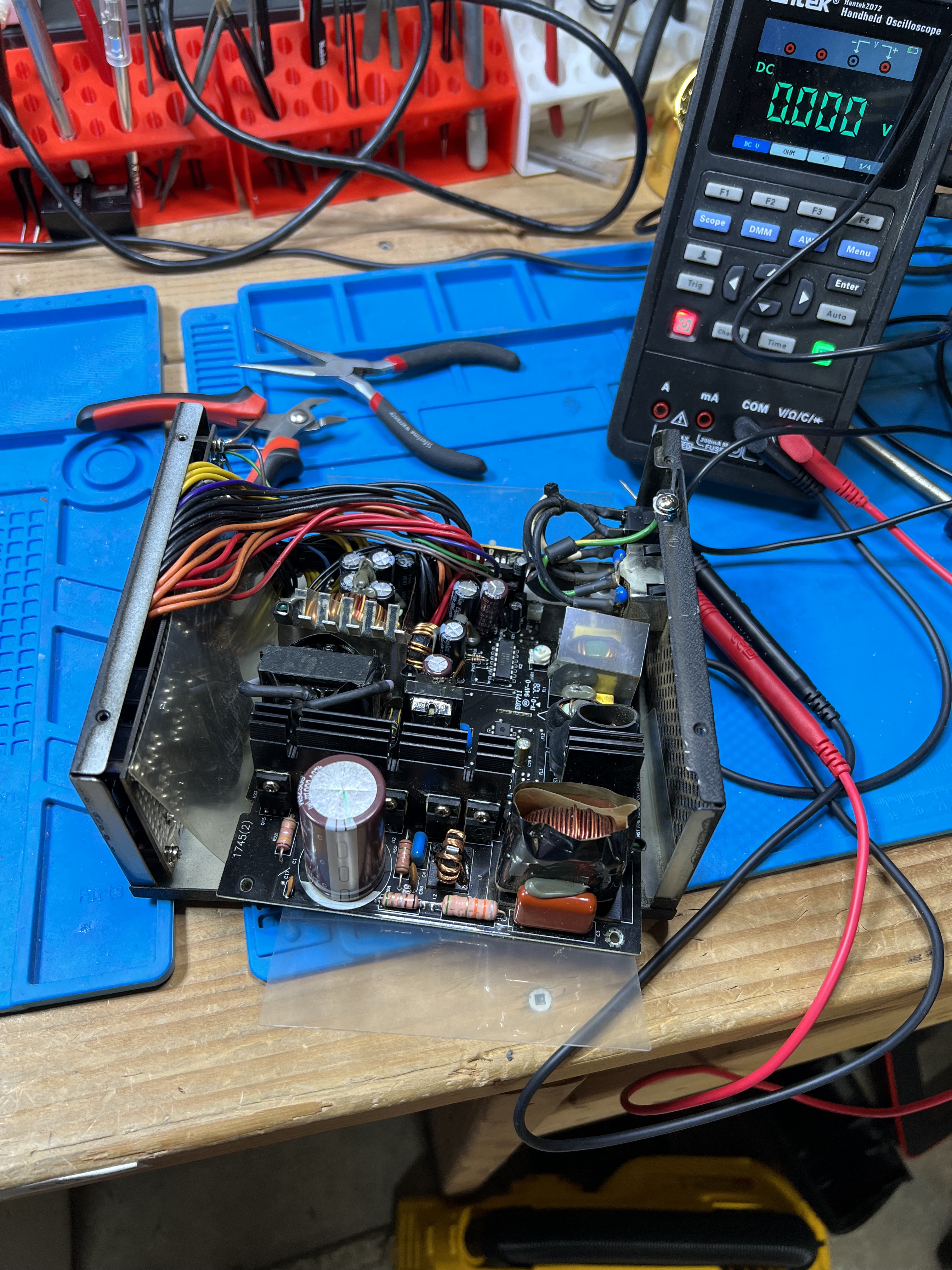
Here’s the deal. I have my old gaming computer sitting on the workbench right now. After it went Pffft a couple of years ago I replaced it with an MSI gaming laptop, shoved the old one in a corner, telling myself I’d get around to looking at it “real soon now”, and it’s been there ever since until I started cleaning out my radio shack/mad scientist’s lab/workshop the other day. This thing wasn’t cheap. There’s a pretty hefty Core i7 processor in there, a decent Nvidia Geforce graphics card and 32G of high speed RAM. Even by today’s standards it would be a pretty decent computer so it would pay to spend some time trying to figure out what’s wrong with it. It would make an excellent auxiliary computer to run the laser engraver, 3D printer and amateur radio equipment and the like.
What happened was that we were in the middle of a late fall thunderstorm. A nasty one. In the space of about 5 minutes we had multiple momentary power failures and brownouts, and the computer just stopped working. So I have no idea of what’s all wrong with it and I can’t diagnose what’s wrong because the power supply doesn’t actually supply power any more. I suspect the power supply may indeed be the only thing wrong with it. So the first thing to do is get a working PS for it.
And, of course, I don’t have one on the shelf. Need a power supply for a TRS-80 Model II? I got one. Need a power supply for a Ti 99/4A? I got one. But not for this thing. And they want something like $150 for one, and I’m not willing to drop $150 on a PS for a computer that might not work anyway.
So I decided to take a stab at fixing the thing’s power supply.
Power supplies are not complicated beasties, all things considered. I used to repair power supplies for laser scanners, cash registers, and misc. equipment all the time back in the bad old days when I was a technician for a POS company. (No, not POS as piece of s**t, POS as in point of sale equipment)
So I yanked the sucker out. It was indeed dead as the proverbial doornail. So popped off the screws and took off the cover and…
What? Seriously? The damned thing is glued together?
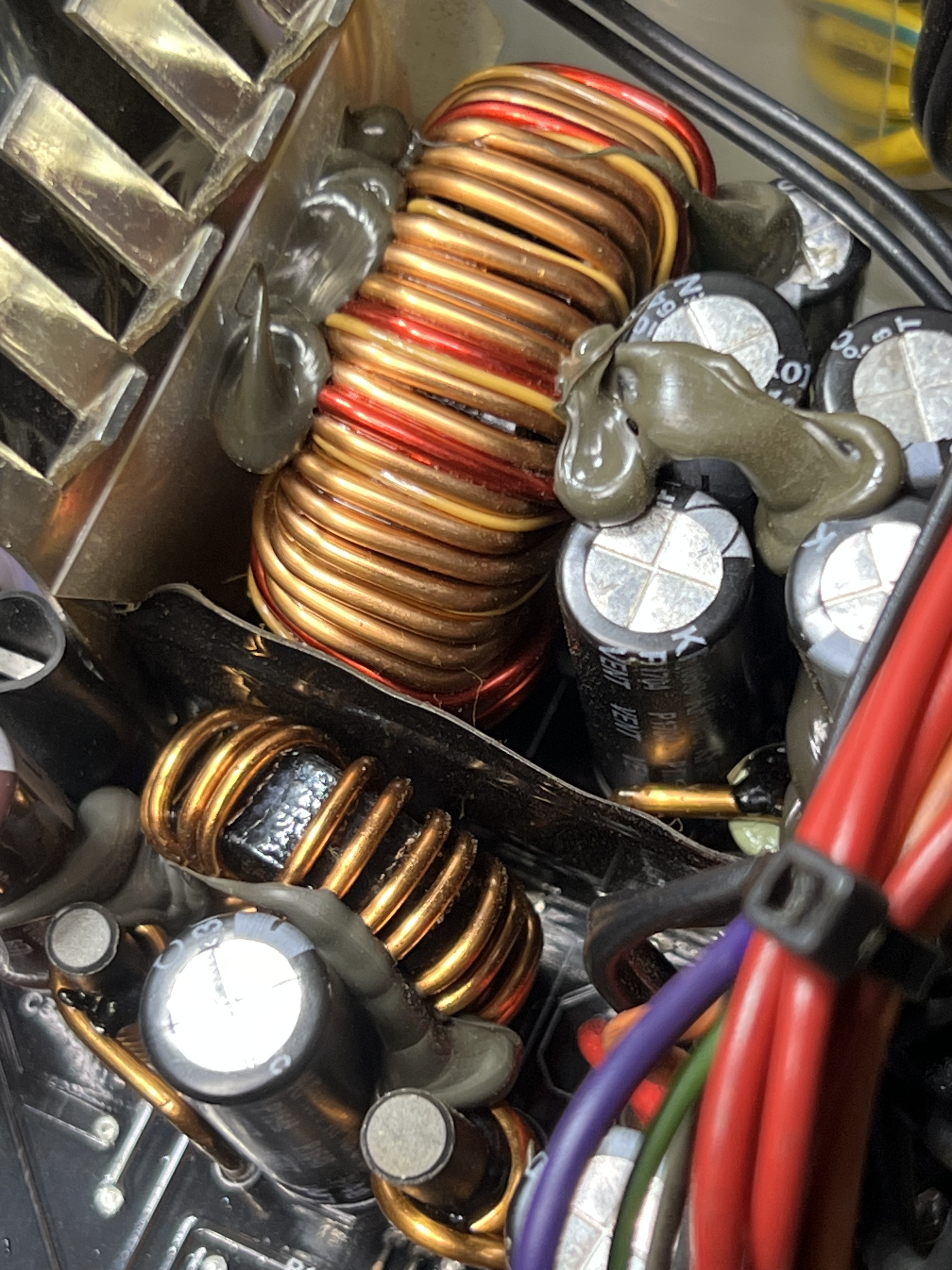
Yeah, they glued everything. Great bloody gobs of rock hard glue or epoxy deliberately gluing the components together to make it damn near impossible to repair. Take a look at this:
That big coil is glued to the capacitors, which in turn are glued to each other. The other coil there is glued to two more capacitors. in the left center you can see another glob of glue where another component was glued to something else. I couldn’t even get the fan connector disconnected until I spent five minutes with an Exacto knife, a small screw driver and a pliers chipping away at the muck to free the connector.
Why would they do this? Someone suggested that they did it to prevent parts from coming loose in shipping. That’s nonsense. This thing is built like an efwording tank, for heaven’s sake. I could drop it off the roof of the house and the only damage would be a slight dent in the heavy steel case it’s in. Gluing down the connectors, maybe that would prevent the connectors from coming loose. But why in the world would you glue capacitors to coils? Or transistors to inductors? The only reason I can think of is to deliberately make the thing virtually impossible to repair so you have to buy a new one.
Now I could go off on a rant about planned obsolescence and manufacturers deliberately making equipment impossible to repair to force you to keep buying new instead of just fixing a broken item, but I will refrain from that. At least for now. Perhaps at some future date when I feel in the mood for a good rant I’ll delve into that.
So what did I do? Ordered a new power supply, of course. It’s the only way I can fully test the stupid thing, and if it does still work, which I suspect it does, I’ll need one anyway.
Growing Lettuce. In December.
So we have this sort of small, portable green house thingie that we use in the early spring for starting seeds before the weather is nice enough to plant stuff outside. Last spring we upgraded a bit, adding a heating pad and grow lights so we could keep it in the basement instead of having to move all the furniture around in the living room to make space for it in front of the windows. That worked out quite well, by the way.
So MrsGF and I got to thinking, we have this green house, we have grow lights, we have that heater, and we have lettuce seed left over, so why not try growing lettuce down in the basement?
So we did. And well, damn, it seems to be working. Within just a few days of setting it all up and planting some lettuce seed in a few pots with some potting mix, dozens and dozens of little lettuce plants popped up.
Hopefully in another week or two they’ll be big enough that we can have some fresh lettuce.
And A New Radio Receiver
On the electronics front I just got this little beastie in a couple of weeks ago, a Mlahit software defined radio receiver. SDRs have been around for years now but I’ve never had one before because I frankly wasn’t all that interested in them. I have enough old fashioned analog radios or hybrid radios to play with to want to dabble with these things as well. But I’ve been curious about these things for a long time so I saw this one and it looked reasonably good and the price was fairly cheap so I bought one on impulse. I haven’t had time to do more than play with it a bit. sometime in the next week I’ll have time to take a closer look at it and I’ll talk more about it then.
Solar Update
The solar power project has been … Interesting? Oh, nothing has gone wrong with the equipment. It’s still working exactly as it is supposed to. What’s interesting is that our electric bill has been literally cut in half ever since we put the system in, even though we haven’t used it that much. It’s been so cloudy here the last few weeks that we haven’t even been able to use it at all for several weeks now. So I haven’t even had the system switched on except for a few days in November.
But our electric bill was still half what it was last year. So what the hell is going on?
When we decided to put the system in we took a close look at how we use electricity here and made some very minor changes. We went through the house and replaced the few remaining incandescent and fluorescent lights with LED lights. We put all of the electronics in the house on power strips. You may not know it but almost all of your electronic equipment like your TV, radio, etc. never actually turn off. The displays may go dark, but they’re still drawing power. We bought a combination countertop convection oven/air fryer that works so well we almost never use the oven in the conventional stove any longer. We’ve become better at turning off equipment and lights when they aren’t really needed. All little things like that which haven’t altered our lifestyle but which, when you add them all up, have made a huge difference in the amount of electricity we use.
So oddly enough the solar power system has, in a way, been successful even when we aren’t using it because it caused us to reevaluate how we use energy in the house and make relatively insignificant changes that have cut our energy usage dramatically. Last year in November our electric bill was $310. This year it’s $157.
So even though we haven’t been able to switch the house over to solar on a regular basis, it is still, indirectly at least, responsible for cutting our utility bill in half. Weird out things work out sometimes.
Postscript
Just before I was going to publish this the new power supply for the computer arrived and… Yeah, it’s still dead as a doornail. I’m afraid the MB is cooked. I’m not even sure if I can salvage any of the parts out of the thing. I’m not sure if it’s worth the effort to dig into it further. Right now it looks like that right before the original power supply failed it dumped a huge power surge into the computer’s motherboard and other equipment connected to the PS. Oh, well…
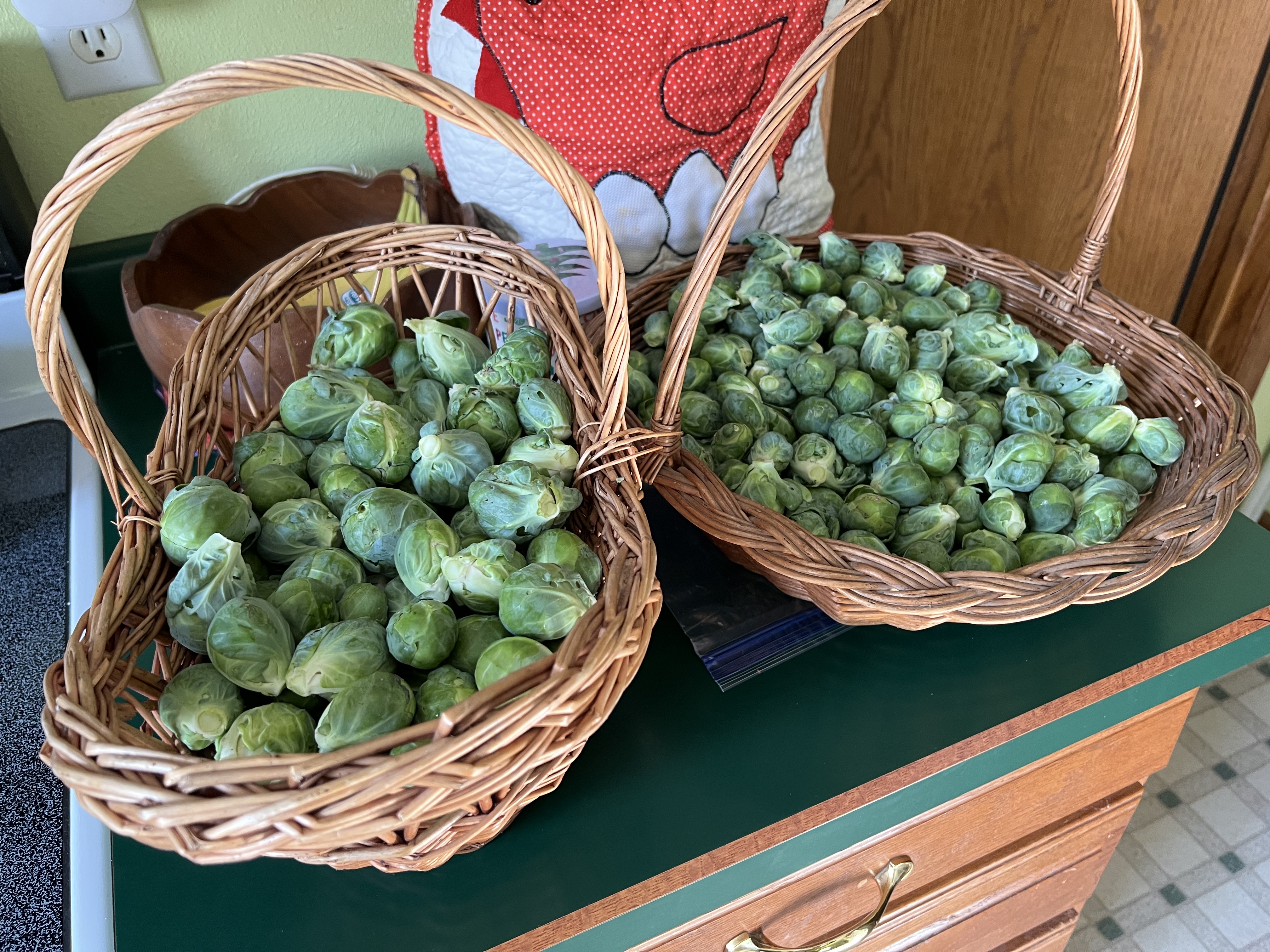
Here at grouchyfarmer.com’s palatial headquarters the gardening season has pretty much been wrapped up. All the gardens have been cleaned up, we’ve done some minor maintenance work around the outside. The last crop of the season, the brussels sprouts, have been harvested. The chest freezer is full right up to the top with tomatoes, squash, green and wax beans, beats, carrots, a variety of peppers, etc. MrsGF blanched and froze the sprouts yesterday. The shelves down in the basement are full of jars of tomato sauces of various types along with pickled beans and pickled beets.
We probably have enough vegetables canned or frozen to last us through the whole winter without having to buy anything from the grocery store, which not only helps the budget but gives one an enormous feeling of satisfaction.
There were no real surprises out in the gardens this year. Some things did better than we thought, some did worse.
It was a rough year overall for gardening because of the drought. We had to resort to watering the vegetable gardens just about every single day. We have 2, 30 gallon barrels and a 50 gallon barrel connected to diverters on the rain gutter system on the house and garage so we normally have rain water to carry us through a short dry spell. But this year the barrels were empty for most of the summer. I’m actually surprised that we didn’t lose a lot of plants this year because of the heat and drought.
The biggest disappointment was the tomatoes. They were a yellow variety called something like Amish Yellow Slicers or something like that. They tasted very good indeed but production was woeful. Small fruits, extremely tough skins, and around the end of August the fruit stopped growing, and even stopped ripening entirely even though the plants themselves looked healthy.
Carrots were another disappointment. We tried something different, carrot seeds that had been “pelletized” so to speak. Carrot seeds are extremely tiny. It’s impossible to just plant a single seed without resorting to using a tweezers and a magnifying glass. So usually there’s an enormous amount of waste because clumps of carrots have to be thinned out. With this pelletized stuff each seed in encapsulated in some kind of biodegradable stuff, about the size of a small pea. And it would have been a nice idea. If it had worked. It didn’t. Almost none of the pelletized seeds came up.
Onions were good flavor but smaller than normal. We expected that though because of the harsh conditions over the summer.
Every year we like to try growing something new that we’ve never tried before. This year it was the brussel sprouts in the lead photo. They are one very strange looking plant. They developed a massive stalk as big around almost as my arm, and about 4 feet tall. And the sprouts themselves just sort of pop out of nowhere wherever a leaf stem attaches to the stalk.
The research MrsGF did on them before we planted them was that it was best to wait until after the first frost to harvest them, so that’s what we did.
Certainly they tasted good, much, much better than the commercial ones we’ve been buying frozen. The commercial ones sometimes have a rather bitter, even nasty flavor, to be honest. These though were amazing. No bitterness at all, very mild flavor.
Still I’m not sure they’re worth growing. We like them but we don’t like them that much, if you know what I mean. And since they’re basically a mutant cabbage of some sort, they are subject to the same problems cabbage has, including some nasty insects you have to watch out for.
Electric/Solar Stuff
On the solar power front… Ah, well, this is Wisconsin, isn’t it? That means we get days, even weeks where we may never actually see the sun. We’ve been going through one of those periods of cloudy weather and it is very irritating. I think we’ve had clear skies perhaps one day out of the last fourteen. Grrr…
I really, really need more solar panels. But with the roof scheduled to be replaced in the next year or two it doesn’t make sense to put 20 solar panels on the roof only to have to take the down just one year later to replace the roof and then have to mount them all again. So the lack of PV means I can’t switch the house off grid as often as I’d like as well. Oh, well. I knew that before I went into this and we decided to do it anyway so all we can do is live with it until we get the roof done and can then permanently mount enough solar up on the roof to adequately feed the system. Until then we’re limited.
Otherwise the solar system has been working just fine when we’ve been able to use it. Haven’t had any issues with it at all. Plus it’s reassuring that we don’t have to panic about keeping the sump pumps, furnace, freezer and fridge running during a power failure. Even without solar, as long as the batteries are full we have enough stored power we have enough power to keep the house running for a long time without having to resort to trying to start the Generac backup generator. Trying to start that thing in cold weather is royal pain in the neck.
And let’s throw in a Christmas cactus just for the heck of it.
MrsGF’s Christmas cactus always blooms right around Thanksgiving, and it’s right on schedule this year. I noticed the other day that it was just starting to form flower buds. In a week or so it’s going to be covered with flowers.
Antenna
The HGR-QRO PreciseRF antenna continues to work amazingly well. I’ve always liked magloop antennas. They have serious drawbacks, are fiddly to get tuned, etc but damn they work well when everything is set up right. Especially for their size. I already had a MLA that I used for portable operations that I liked very much, it couldn’t handle more than a few watts of transmitter power.
The most impressive thing about this antenna is the low background noise level. I’m still amazed at the huge difference in the background noise levels when comparing it to my OCFD antenna. Ever since I got my license ten years ago I’ve had background noise levels running S5 – S8 or even higher on the average day. It might dip as low as S3, rarely, but generally it’s been a pain in the neck. But with this antenna the noise level is essentially zero, while actual radio signals being received are as strong or stronger than they are with the dipole. And it works at least as well on transmit as my OCFD antenna.
Rant Time.
grouchyfarmer.com’s palatial headquarters.
The staff here at grouchyfarmer.com love a good rant more than anything else… Well, okay, so that’s not really true, I guess. They like pizza. Put out free pizza in the employee lounge and it’ll be gone in like five seconds. It’s like as swarm of locusts from some biblical plague on pizza day. And Joann has chickens. She has like twelve of the damned things running around here now and we’re thinking of staging an “intervention”. And maybe a fried chicken day. And our IT guy, Jeff, is the president of the local Black Pink fan club. We try not to talk about that. But generally speaking they do enjoy venting their spleens about whatever it is that’s sticking in their craw, so to keep ’em happy let’s get on with this.
EV Push Back
Certain persons (you know who you are) seem hell bent on to strangle this trend towards electrification any way they can. The problem they’ve been having is that by and large electrification makes a hell of a lot of sense even if you don’t take into consideration the whole climate change thing. There are some legitimate issues with EVs, but those are being dealt with. So they’re starting to just make crap up now.
I think it’s too late to stop it, though. While the doom and gloom crowd is doing its best to shut things down, everyone else is just quietly getting on with things because EVs just make sense. The claim that you can’t electrify heavy trucks? Guess what, it’s already been done. Volvo has been quietly producing electric trucks since 2019 and is currently ramping up production. Makers of farm equipment and earth moving machinery are moving in that direction. JCB, New Holland, CIH, Bobcat, and dozens of others that make equipment ranging from small to gigantic are moving towards electrifying just about everything.
And there are very good reasons why. Maintenance is much easier, for one thing. And a hell of a lot cheaper. No more engine oil changing, no more engine oil filter changing. Ever. No expensive exhaust systems and catalytic converters to mess with. If you’re a major freight carrier with thousands of trucks on the road like Schneider, the potential savings on oil changes alone would be astronomical.
I have to close this off with a sad note. We lost our beloved cat Meg yesterday after a short illness.
Thank you Meg for being a loving companion for almost 17 years. We miss you.
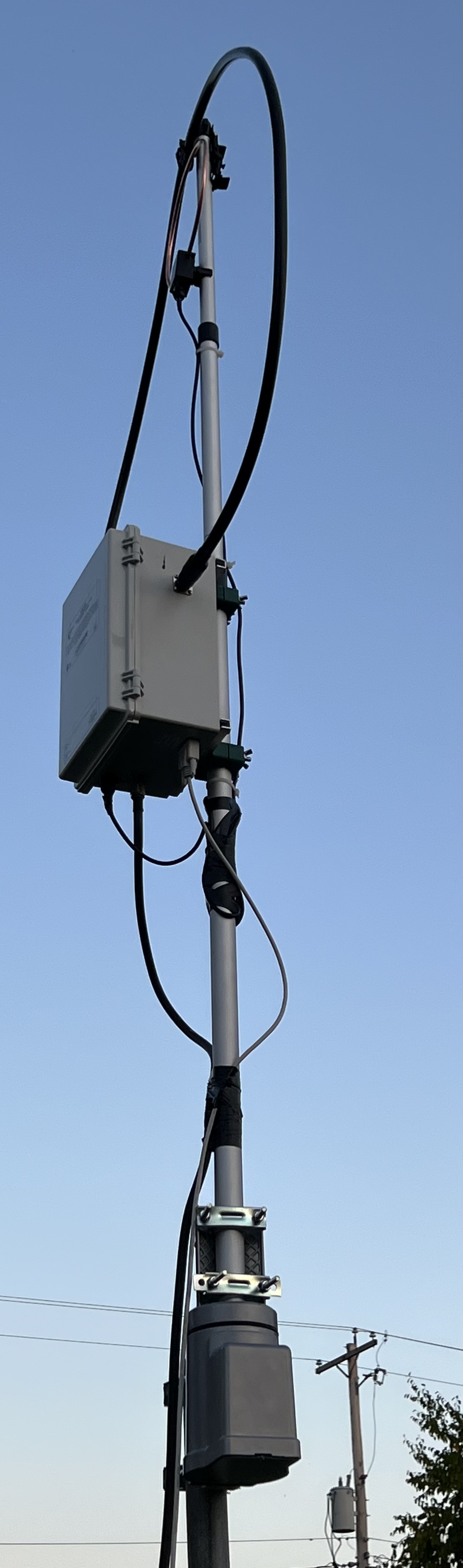
Hams will immediately recognize this thing up there but the rest of you are wondering WTF I have perched in the air outside of the house. Read on if you want to know more.
If you’ve been following this blog for a while you know that I’m an amateur radio operator. And one thing all amateur radio operators (Or hams, as they call us.) need to deal with is antennas. And the one up there in that photo just went up here at grouchyfarmer.com’s headquarters and is what I want to talk about.
(Sidenote: Why do they call amateur radio operators hams? No one seems to know for sure. My personal theory is that the founder of the ARRL, Hiram Percy Maxim, was using his neighbor’s fence as a makeshift antenna back in 1912 when he was experimenting with an early spark gap transmitter and crossed up his wires somehow and accidentally electrocuted his neighbor’s entire herd of pigs, and since he had to pay off the neighbor for the pigs, he started up a side gig selling pork products.)
For a lot of people, including, unfortunately, a lot of amateur radio operators, antennas are a strange and arcane mixture of magic, sorcery, science and blind luck. That’s not true, of course. How antennas work is hard science. We’ve been using antennas for well over a hundred years and how they work is well established. But because the effectiveness of antennas is affected by a wide variety of external factors and operating practices, the experiences of individual hams with exactly the same antenna can vary wildly. This, along with a lack of understanding of exactly how antennas work and a strong aversion to mathematics has resulted in a lot of… I hate to use the term nonsense, but that’s an accurate way of describing a lot of what I see turning up on Youtube and various amateur radio oriented forums.
And of all the antennas out there that hams commonly use, the one that is surrounded with the most nonsense is probably the magnetic loop antenna. According to the self appointed experts, magloop antennas are either the best things ever and deliver absolutely magical results, mediocre at best, or they don’t work at all and you’re better off wiring the rain gutter on your house to your radio. I’ve been playing with magloop antennas for years, both commercially made ones and ones I’ve cobbled together myself. I reviewed one back in 2019 if you want to click the link there and go back and look at the one I own that I use for portable operations. And I’ve had good results with both the Alpha I bought and my home brew copies.
Ultimately it isn’t a matter of which is the best antenna. There is no such thing as a perfect antenna. it’s a matter of which one will do what you need in the situation you are in. The big advantage of magloop antennas is that they are small, relatively unobtrusive and work pretty well, even indoors in some circumstances. This makes them attractive for people who don’t have the space to put up something like my 135 ft long OCFD or a huge beam antenna, or who live in an area where local zoning ordinances or home owners associations restrict the size and placement of antennas or even prohibit them entirely. Something like a magloop antenna may be the only option some people have.
How do they work? I’m not going to launch into a pages long lecture on that. There are very good resources out there available for free on the internet so I’ll leave it to you to do your own research. I’m going to restrict my comments to the HGR-QRO-A MLA .
And before I start in I should point out that I have no relationship with PreciseRF except as a customer. I receive no compensation from them in any way whatsoever. The antenna was purchased through their website and was paid for out of my own pocket. I don’t get free stuff or make any money off these reviews. And considering the conclusions I come to at the end of this review, PreciseRF is never, ever, going to send me free anything. This antenna… It works very, very well as an antenna but there are some serious issues with it that are very troubling. But I’ll come to that later.
If you read CQ magazine or QST, you’ve probably seen this ad:
This is what I’m talking about, the HG series of MLAs from PreciseRF. Specifically the one of the far right. The HGR QRO-A MLA antenna. And yes, this thing really costs $3,000. Let me repeat that. Three. Thousand. Dollars. For an antenna. And yeah, I bought one.
Well, it seemed like a good idea at the time…..
So why is this antenna worth three grand? It’s because of that “QRO” bit they stuck on the name. QRO is one of the “Q-codes” that amateur radio operators used as abbreviations back in the days when morse code was pretty much the only way you could send information long distances. Originally it was one ham telling another to increase the power of their transmitter so they could hear them better. But it has also come to mean someone operating a transmitter at full legal power allowed by the FCC, up to 1,500 watts. That’s why this thing is so expensive, the full power bit.
It is hard to make a magloop antenna that can handle more than a few watts of transmitter power. My Alpha MLA can handle up to 100W using SSB or CW on some bands, but I use digital modes and it can only handle up to about 20W using digital. The reason why, well, it’s complicated. MLA antennas can generate some pretty serious voltages internally when they are in operation, and the commonly available variable capacitors used in the less expensive ones can’t handle those kinds of voltages without arcing and causing damage. If you want to use higher transmitter power to reach out farther with your signal, you need to resort to using electronics, circuits and a vacuum variable capacitor that can handle those voltages. And that takes money. A lot of money.
The HGR QRO can handle up to 1,500 watts SSB or CW, and up to around 400 watts with digital modes. I know of only two MLA antennas that can handle that kind of power, this one and one that’s even more expensive than the HGR.
But let’s get back to this specific antenna. I don’t do “unboxing” or assembly reviews, especially for something as easy to put together as the HGR is. Took me all of twenty minutes to assemble it. There is a collapsable ‘twist ‘n lock’ mast that everything clips or bolts to, a cable that goes from the copper loop to the big gray “box o’ gubbins” which contains the vacuum capacitor, stepper motor that adjusts it and the electronics that controls the system, which also bolts to the mast, and then the DB9 control cable and your coax hooks to the bottom of the box with standard connectors. And that’s it for assembling the antenna itself. I stuck it up on top of a cheap RCA rotator, and all of that is bolted to a 4×4 pressure treated post set in concrete and about 6 ft tall.
There is also the control box. That goes next to your transceiver. The DB9 cable from the antenna connects to the controller. The coax from the antenna goes into the control box, and a short jumper connects from the box to your transceiver. Oh, and you need a 12V power supply to operate the control box. Putting the whole thing together only takes a few minutes. Running the cables and mounting it is going to take longer than assembly does.
Oh, and you’re going to need an SWR meter because the one in the HGR QRO’s control box isn’t even close to accurate, something PreciseRF warns you about in the owner’s manual. And it can only handle about 5 watts of transmitter power. It’s useful only for the auto-tune function. I use the one built into my Kenwood TS-990S transceiver in normal usage.
The control box is what controls the tuning of the antenna. Unlike my Alpha that requires me to be right next to the antenna so I can adjust the variable capacitor by hand whenever I change frequency, the HGR has remote tuning controlled by that box there in the photo on the right up there. And it is very, very nice to be able to sit in my comfy chair in the basement and re-tune the antenna by just pushing a couple of buttons or turning that knob.
The first thing necessary when turning on the antenna is something called indexing. The stepper motor in that big box o’ gubbins out there on the mast starts to sort of recalibrate itself, turning the variable capacitor from its minimum to maximum to recalibrate itself so it doesn’t end up trying to crank the capacitor past its max and minimum range. And it takes a while to do this so be patient. Once it’s done that you generally don’t need to do it again and just bypass the indexing option when turning it on.
MLAs have a very narrow bandwidth so the antenna needs to be re-tuned whenever you change frequency. That’s easily done with the buttons on the front panel. When changing bands it will automatically re-tune the variable capacitor out there on the antenna to something reasonably close to where it needs to be for that band. After that you transmit a carrier at less than 10 watts, watch your SWR levels on your meter, and tune for the lowest SWR. Doing this manually can be a bit fiddly and time consuming.
This version of the HGR has auto-tune, though, and a built in SWR meter. So just press the AUTO button. It will prompt you to transmit a 5 watt carrier. Press OK and transmit, and the controller will re-tune the antenna relatively quickly. It works pretty well too. After some experimenting I never bothered to try to tune it manually. The auto-tune function almost always resulted in the lowest SWR readings all by itself.
I need to tell you right up front that this antenna doesn’t like the lower bands, at least on the digital portions of the band where I operate. On 17, 15, 12 and 10 meters it will easily tune down to an SWR of about 1.1 to 1.4. But on 20 meters the best I could get is 1.8, and on 40 the best was around 2.0. On 20 and 40 meters, after I tune the antenna for the best match, I switch on the transceiver’s internal antenna tuner. And before you start to complain about that yes, it works just fine and even PreciseRF’s documentation tells you to do that if you can’t get a good match and you feel it’s necessary.
Once the antenna is tuned, that’s all you need to do. Just operate as you normally would. All things considered, it’s as easy to use as it was to assemble.
The ultimate test is how well the thing works as an antenna, and my results there have exceeded my expectations.
The first thing I noticed was the background noise level. There is a lot of background noise out there in the radio spectrum. Most of it is caused by electronic devices in our homes and neighborhoods, and the background noise level can be so high sometimes that it makes receiving weak and even moderately strong radio signals almost impossible. Here my noise level is pretty high, usually running around S5 to S7 or even higher.
When I first hooked up the HGR and turned on my transceiver on 40 meters my S meter read zero. No noise at all. None. WTF? I thought the coax cable was bad or a connector was bad. But then I changed frequency to the FT8 part of the band and instantly the radio started chirping with that annoying FT8 chorus and the display on the radio lighted up full of signals. But still no background noise? None? Yeah, none. Between FT8 transmissions the noise level was zero.
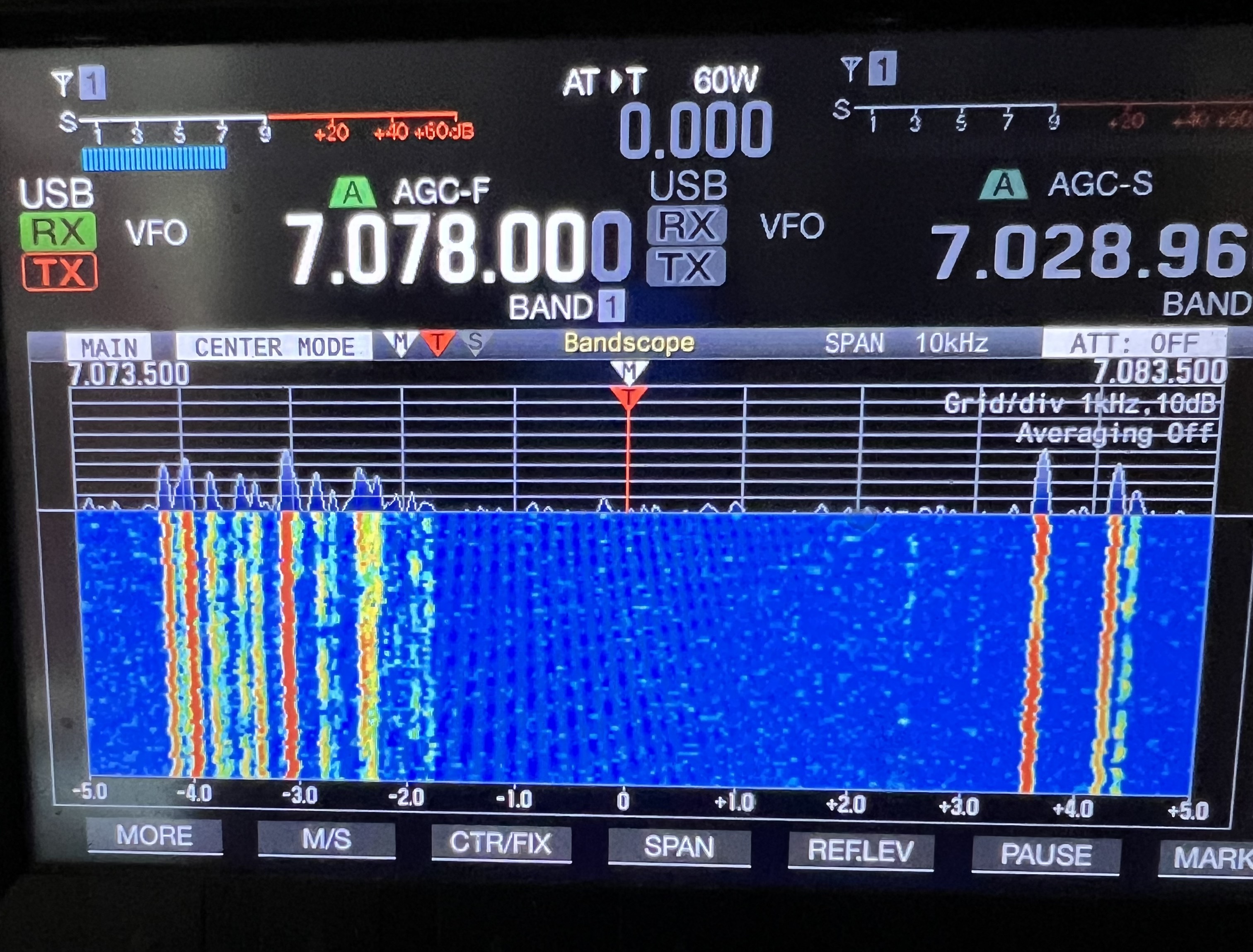
This is what my display showed on 40M with my OCFD antenna.
Those yellow and orange lines are FT8 transmissions. The gray fuzzy stuff is the random background noise I normally see.
This picture below is the display when I switched over to the HGR antenna a few minutes later, on the same frequency.
The signals are a full 2 S units stronger. I’m seeing many more actual radio signals than I did using the dipole. And all that annoying hiss from the background noise? There was almost none. Stronger signals, no noise. Wow… I mean seriously, wow. How does it even do that? i am impressed.
Reception results weren’t always this good of course, but generally speaking the HGR was eliminating almost all of the background noise that I picked up on both my dipole and vertical antenna. And actual radio signals were coming through much stronger than on the other two antennas.
So that’s on the reception side of things. What about transmitting? I tuned up to the FT8 area on 15 meters, turned the transmitter up to 50 watts of power and started calling CQ and in about 5 minutes I’d worked Iceland, Japan, the Netherlands, France, Spain and a half dozen different US stations scattered all around the country. Well here’s a screen shot from PSK Reporter down below showing all of the amateur radio stations that were hearing me at that time down below. I was lighting up the entire continental US, Canada, Alaska, Japan, the EU, using 50 watts and a three foot loop antenna sitting about 6 feet off the ground?
As I said before, wow.
Overall my results using FT8 and JS8Call at 50 watts of power or less have been astonishing when compared to what I get with my OCFD or the GAP Titan vertical. And I’ve gotten similar results on all the bands from 40M up to 10M.
Of course as I pointed out at the beginning the results you see from a specific antenna are highly variable and depend on your local conditions, the weather, solar conditions and a lot of other factors.
So the antenna is small, easy to put together, easy to operate, and gives excellent results. Looked at only from the point of view of the results I’ve been getting the HGR-QRO is, frankly, amazing.
So you’re all waiting for the “But…” aren’t you? You know there’s one coming. In fact there are several.
Some of the “buts” are due to the nature of the beast and I knew they were going to be there. Magloop antennas are fiddly. They have very narrow bandwidth so that means if you change your operating frequency even slightly you’re probably going to have to retune the antenna. Also the SWR changes during the course of the day. I suspect that’s being caused by heating and cooling and the main antenna element, the LMR 600 loop, expanding and contracting as it heats up from the sun and then cools down in the evening. That means you have to check the SWR from time to time and may need to periodically retune the antenna.
No, the real problem with the HGR has nothing to do with how it works as an antenna. The biggest and most serious problem is that while the electronics in the box hanging under the antenna seem to be of high quality, the rest of the antenna isn’t. I’m sorry, but it just isn’t. Everything else uses the cheapest parts they could get away with.
The mast that supports the loops and the box with the vacuum capacitor? It is, frankly, a piece of junk. it’s a thin walled aluminum and plastic “twist n lock” adjustable pole that looks like it came off a bargain basement camera tripod from Amazon. Will it survive the Wisconsin weather for long? I highly doubt it and I’m already scouting around for something to replace it with.
The BNC cable that connects the copper loop to the top of the box? It’s a cheap piece of junk too with ill fitting connectors that don’t even properly lock into place. I had to tape them in place or they would have fallen off all by themselves. That’s going to get replaced ASAP.
The 50 foot RS-232 communications cable? Same as above. Cheap, cheap, cheap… Nasty connectors that were almost impossible to fit into the sockets. The screws that are supposed to hold the connectors in place had bad threads on them so they wouldn’t screw in. After trying to test fit them, I tossed it in the trash and bought a decent 75 ft cable.
Then we come to the control box. The controller works reasonably well and isn’t difficult to use but… The controller is housed in what looks like a cheap, off the shelf project box straight out of a 1980s era Radio Shack. The 4 line monochrome LCD display is like something right out of the 1980s as well, crude looking, difficult to read unless looking at it from the right angle and it’s just, well, nasty.
Am I being too critical? I don’t think so. Remember, this is a $3,000 antenna. Three. Thousand Dollars! Considering I can get a state of the art transceiver, even a decent amplifier for that kind of money, this thing should be top of the line all the way around. For that kind of money you’d think they could afford to give you a mast that wasn’t a repurposed selfie stick and a controller that didn’t look like an antique project that some ham threw together back in 1985. You can get a full color 5 inch touch screen for less than $50 these days for pete’s sake. There’s no excuse for a display like that on a $3K piece of equipment.
And if they cut corners that much on the basic quality there, I find myself wondering what other corners they may have cut when it comes to the electronics in that “big box o’ gubbins” hanging under the antenna out there in the weather.
I’m definitely going to keep using it. There’s no doubt at all that it performs very well indeed as an antenna. But I have serious questions about how long this thing is going to hold up. If they cut corners by providing the cheapest mounting hardware they could find, the cheapest cables they could find, the cheapest everything they could find, how can I be sure that they didn’t cut corners elsewhere in places where it really counts, like the vacuum capacitor, stepper motor and its driver circuits, the electronics inside the controller, etc.?
PreciseRF claims that box mounted up on that mast is weather proof, and while it seems reasonably well made, when I look at how poorly made other components are, i have to wonder about that too.
What it boils down to is that nothing about this antenna instills confidence in its ability to survive in real world conditions. Nothing about it says “Yes, this is a $3,000 antenna and it’s damn well worth it”. It might work very, very well as an antenna, but I have no real confidence that this thing will hold up long. So I simply cannot recommend it. At this price, it should be much, much better than this.
CaseIH has joined New Holland and Monarch in introducing an electric tractor. We all knew that was coming. The only thing that surprises me is that it’s taken this long. Both the New Holland and CaseIH are more or less traditional looking and traditional functioning tractors. They’re considered “utility” tractors, horsepower ranges from about 75 – 80 HP, and both have run times of 4 hours+ depending on how hard you work them.
The Monarch on the other hand… Yeah, I just don’t know. First of all it’s built in partnership with Foxconn. After the way that company screwed over the state of Wisconsin I wouldn’t trust them to clean my cat’s litter box much less build a tractor that actually works. But the Monarch itself isn’t any kind of tractor that we’d find all that useful here in Wisconsin in the first place. It’s small, narrow, has tiny little tires and is frankly strange looking, loaded with radar and sensors and I don’t know what all else. Supposedly it can follow you around like a dog and, well, I’m sorry, I don’t want a tractor following me around without a driver. It might be useful for orchards or vegetable farms, but for the average farm around here? This thing is pretty much useless for someone who has to get 1,000 acres of corn into the ground or harvest 500 acres of beans. And considering all of the fragile electronics and software packed into the thing it is going to break. A lot. It looks like that aside from small vegetable and specialty crop growers this thing is aimed at wealthy hobby farmers.
How successful will these things be? Will farmers adopt them? Well, maybe? I can see these being useful. But ultimately it’s going to come down to value for money. Farmers operate on razor thin profit margins, and they are very, very cautious about adopting new technology until it’s proven itself to be economically viable. E-tractors have a lot going for them besides just not pumping out huge amounts of toxic exhaust. No more engine oil changes, no more engine filter changes, less maintenance necessary, less noise.
It’s going to come down to how reliable these things are. Are they going to be able to stand up to the day to day use and abuse the average tractor experiences during its lifetime?
On the bike trail between Hilbert and Forest Junction. This trail and most of the others around here follow old railroad lines that ran between small towns before they were abandoned.
The calendar may say this is the first day of autumn but it hasn’t felt like it for the last few days. Daytime highs have been pushing 80 and it’s been remarkably pleasant out there. I’ve been out on the bike rather a lot enjoying the nice weather while it’s here.
But it’s dry. Very, very dry. This is what the river north of town usually looks like.
Below is what it looks like now.
I’ve lived in this area since the late 1980s and I’ve never seen the river like this before.
Yeah, completely dry. So dry I could walk across it without getting my shoes muddy.
MrsGF and I have been working on cleaning up some of the gardens. The squash, wax beans and pole beans are all done and we have those all cleaned out and have been working on bringing in some fresh compost.
The beans did not do very well this year. Both the pole and wax beans didn’t seem to thrive. Lots of vegetation and blossoms, but not many beans. I’m not sure why. I think partly that was because of a lack of bees. I saw a lot of bumble bees out there this year but I didn’t see a single honey bee all summer long. And the bumbles seemed to avoid the bean blossoms. Or it could have been the hot, dry weather. We watered the gardens almost every day this summer but it still might have been too dry for the beans.
The squash were fantastic this year, big, beautiful butternut squash, and a lot of them. We ended up with the entire wagon full of them. Excellent quality as well.
We ended up with a lot more than we needed so we gave a lot away to friends and family or traded them for things we didn’t have like pears.
We tried a different variety of tomato this year, something called Amish Gold Slicers, a yellow variety. They had excellent flavor but I was disappointed by the yield. At the moment the plants are still going, still have lots of green fruit, but the fruit seems to have stopped maturing. We’ve had almost no ripe ones at all over the last week or so. No idea what’s going on there. I’m hoping that will change, but the way things are now we aren’t going to get much more off of them. They also had a thick, tough skin making them hard to cut unless we used a freshly sharpened knife. Overall they were a bit disappointing and I don’t think we’ll be using that variety again.
We put in sweet bell peppers, jalapenos and banana peppers this year and they all did well. Are still doing well, especially the jalapenos. They’re producing like crazy still, loaded with young fruit and blossoms.
But even the peppers have been a bit odd this year. The jalapenos heat levels have been strange. One will be so sweet and have so little heat I could eat them like candy, and the one right next to it, from the same plant, would be so hot my eyes would water and I ran to the fridge for some milk to try to quench the fire.
The bell peppers were excellent but we let some ripen to turn red and when we cut them open the entire seed cavity was full of mold. Very strange. I’d never seen that before.
The brussel sprouts are looking excellent. I still think they’re one of the goofiest plants I’ve ever seen, but they’re doing well and we’ve had some of the sprouts for dinner a week or so ago and damn, they taste good!
That being said I’m not sure we’re going to plant them again. They take up a lot of space and don’t really produce enough sprouts to justify the amount of garden space they use. So while they were a success, we aren’t sure if they’re worth the effort.
Of course me being me I can’t do one of these without putting up a picture of a flower, so here you go…
There, I got that out of the way. So let’s move on with this.
E-bike update: I bought the Vado e-bike in mid-July of last year so I’ve had it for 14 months now so let’s take a look at how that’s worked out. In that time I’ve put about 1,300 miles on it and it’s worked flawlessly. I’ve had absolutely no problems at all with it. Mechanically and electronically it’s worked exactly as advertised. I love the thing. Range for a bike this heavy is excellent. Cruising at around 12 – 14 mph in Eco mode it does about 1 mile for a bit more than 1% battery capacity. I did 20 miles the other day and the battery was still at around 75%. It handles well, the hydraulic disc brakes are excellent, the lighting is good. This thing was expensive but IMO it was worth it. If I want to get somewhere fast I can kick it up into “turbo” mode and pedal along at about 20 mph. Generally I’m in no hurry so I just toodle along about 10 enjoying the scenery. And because it has an actual real shifter, not one of those stupid belt drives, it even works as a standard bike with the motor shut off so I don’t have to worry about getting stranded somewhere if something does go wrong.
The solar power system update: It is still working well. As noted before it’s knocked more than a third off my electric bill since I put it in. There have been no glitches or nasty surprises.
Sidenote: Just about all of the electric utility companies in the state are asking for significant increases in rates, one company wants to increase rates by 14% over the next two years. And they’ll probably get it, too. Plus there is talk that they’re going to force everyone to accept rate plans that will drastically increase their rates during peak times of the day. They haven’t put forward that plan yet, but there has been a lot of talk about it behind the scenes. That scheme would double what I pay per kilowatt hour during peak periods, pushing it up to somewhere between 32 cents to 40 cents per kWh.
And that’s about it for now!
Coming up: I’ll probably be babbling about amateur radio again in the near future. I have a new antenna on order that should be here soon so I’ll be talking about that.
I want to do a brief look at the Klein thermal imaging camera I picked up a while back. That’s turned out to be quite handy and a lot of fun to just play with too. I’m sure there will be other things tossed in as well.