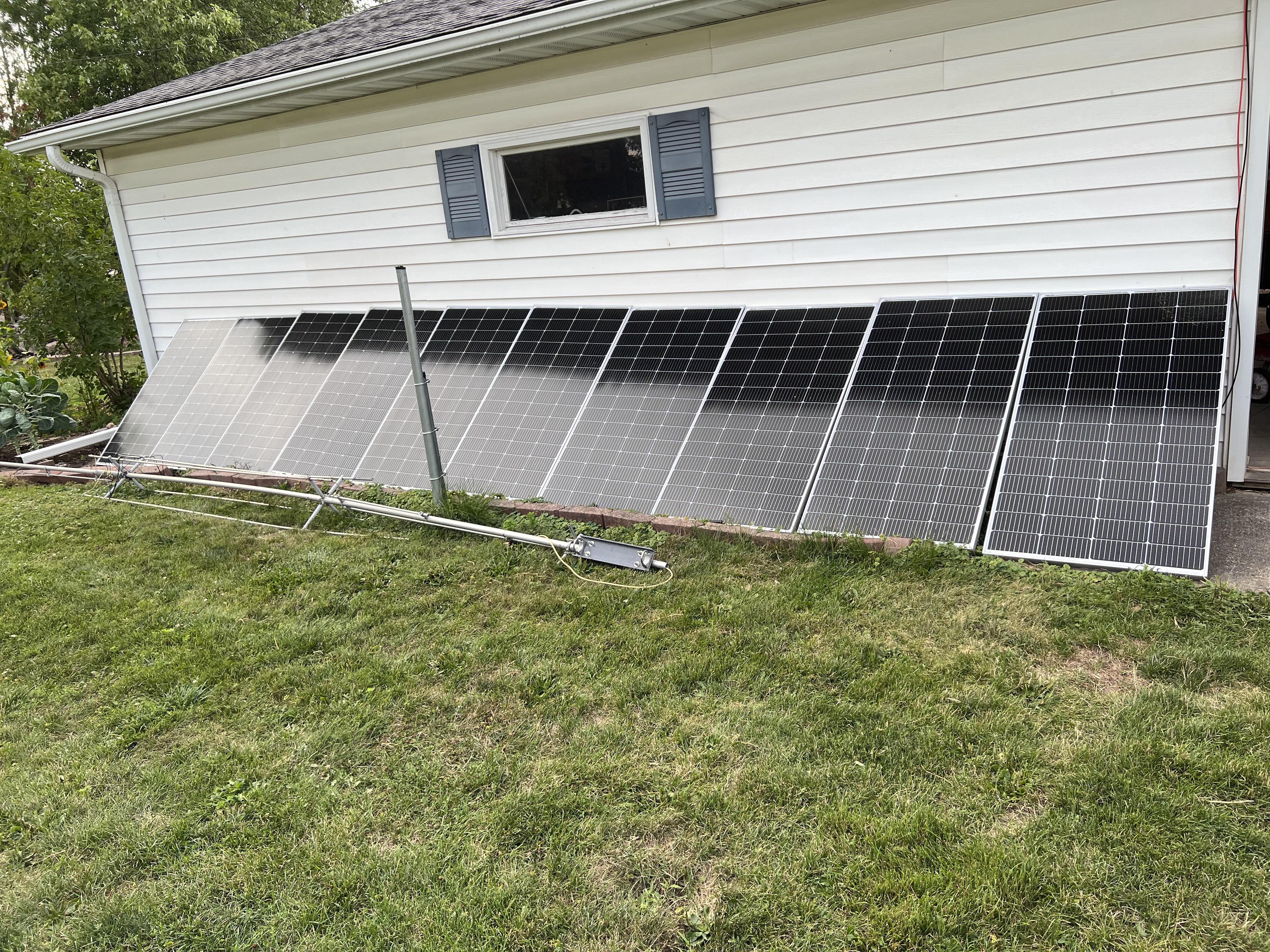
So far so good, but there have been some curious issues so I thought I’d throw this out there quick.
I was looking at the thing sitting there the other day and I said to myself, Self, it’s kind of silly having that $2,000 box sitting there doing nothing possibly for months waiting for a power failure. You should do something with it.
So I did. I took my entire radioshack/office/mad scientist lab off-grid with it. Well, sort of off-grid. My solar panels haven’t arrived yet so I still have to charge the AC200MAX off the grid but I wanted to see if it would work, and yes, it did. Quite well, with a couple of glitches.
Making the switch over was simple because all of my sensitive electronics are all plugged into UPS systems that include meters that tell me many things about the power coming into them, brown out protection, surge protection, etc. (I very strongly urge people to always, always keep their electronic equipment plugged into one of these instead of plugging directly into the mains. I lost a very expensive gaming computer due to multiple brownouts/power surges during a storm a couple of years ago. These things aren’t cheap but they can keep you from losing thousands of dollars of equipment.)
So I unplugged the UPSs from the wall and plugged them into the Bluetti and, well, everything just worked just fine.
Then I noticed that the meter on one of the UPSs was showing the voltage coming out of the Bluetti was shifting +- 2 volts, about 118 VAC to 120VAC. That was curious.
Something odd going on with the inverter in the AC200? Bad plug on it maybe?
I switched the flickering UPS to a different plug on the Bluetti. Did the same thing. I plugged it into the wall outlet. It showed a stead 119V.
Hmmm…
I got out my meters and started checking things. My Fluke definitely showed that the AC coming out of the Bluetti was shifting +- 2 volts.
Now I should point out that a volt or two fluctuation in the current coming into my house from the grid happens rather often. In fact the electrical service coming into the house can go from a high 0f 122V to a low of 110V during the day.
That bothered me, though. I put the scope on the Bluetti and it showed the AC coming out was at a virtually perfect 60 Hertz sine wave, so that was okay.
I shut everything down. I started up the Bluetti again and the voltage fluctuation was still there. I did a ‘restore to factory defaults’ on the device and restarted it and tried it again. The fluctuation was still there.
And then later it just went away. I ran my entire office/lab/radioshack off it for two days, and the power fluctuations just went away. Why? No idea. Did it just need to, oh, stabilize somehow, to ‘burn in’? No idea. All I know is that all day yesterday the voltage coming out of the Buetti was an almost perfect 119V.
Then there was the light issue. I replaced the overhead fluorescent lights in there with LED versions a year or two ago. They give better light and use a fraction of the energy. I plugged one of those into the Bluetti and it flickered rapidly. Sigh…
I got out the meter again and expected to see the voltage fluctuation had gotten worse, but the meters were showing a solid 119V. I put the scope on it again. A perfect sine wave. Okay, now what was going on?
I plugged in a different LED light. That one worked perfectly. I scrounged up several more LED lights. All of them worked fine. Only my overhead tube lights flickered. As far as I can tell the problem is only with that specific light and no others.
Okay….
Now let’s talk about radio. I’m an amateur radio operator as you probably know if you’ve been reading this blog for a while. Solar power systems and these battery inverters can be troublesome when it comes to causing RFI (radio frequency interference). So I was anticipating some problems, and I found them. This is what the scope on my Kenwood TS-990 shows when I’m running it off the Bluetti.
See those vertical lines? Those are not supposed to be there. They represent spikes of radio interference that appear at regular intervals throughout almost the entire HF range.
Now if you’re an amateur radio operator and that image up there just sent you into a panic, it isn’t as bad as it looks. At least not in my particular case. Yes, those spikes are nasty, but with my particular AP200Max none of those spikes appear in any of the amateur radio bands. Whether that will be the case with other units I don’t know. But in my case the situation is tolerable.
There is some more or less generic RFI coming off the thing that seems, in my case anyway, to be concentrated on 40 meters. 30M was completely clear, no RFI at all. 20M was decent, 17, 15, 12, 10 meters were all good. On 40 there was some significant RFI but not enough to prevent me from operating. And engaging the noise blanker on the transceiver knocked a lot of that out.
What the RFI situation will be like once I hook in the solar panels, well, we’ll just have to wait and see. But if necessary I could run my whole radioshack off the Bluetti with very few problems.
I did send a complaint in to Bluetti describing the issues I had with the light flickering, the voltage fluctuations and the RFI issues, including that photo up there showing the RFI problem. I got a canned response back that they would respond within 48 hours, so we’ll see.
Overall the test running my office/radioshack was successful. I discovered that I actually use surprisingly little energy in there. Typically less than 300W, which rather surprised me because that’s including a gaming laptop, two monitors, the Kenwood TS-990, big stereo speakers and a few other goodies. I didn’t try running larger loads like my soldering equipment, the 3D printer or the laser engraver. And, of course, when actually transmitting with the TS-990 the wattage went up considerably.
Coming Up
I have 4, 100W solar panels coming that should be here by the end of the month. I picked the cheapest ones I could find and I’m not expecting much out of them, but it should be enough to be able to test charging the Bluetti off solar. Well, if we ever get sunlight, that is. My eventual goal is to get semi-permanent solar panels up on the garage roof, as much of it as I can afford and fit up there. The roof faces straight south and it is already at nearly the perfect angle, and that location should provide me with solar through almost the entire day now that the trees around the garage are gone. I’d like to get at least 800 – 1,200 watts of solar up there this year.
The other thing I did was buy one of the expansion batteries for the AC200Max, the 3,000Wh one. That should be here by the end of the month as well That will push the capacity of the system to up over 5,000 watt hours. So watch for a review of that in the near future.
I want to talk about how to keep the lights on when the grid fails, something a lot of people were thinking about when that major winter storm rolled over much of the United States during the holidays and then when another hammered California and the southern part of the country, leaving millions of people without power, and sometimes even trapped in their homes.
This is going to be a two part series. I’m going to talk about the AC200MAX first because there are several people waiting for the review of this device. The second part is going to talk about these portable power systems in general, why you might want one, and most importantly how to determine how to properly size it to suit your needs without wasting money and, even worse, getting mislead by the advertising.
These things are often mislabeled “solar generators”, but they are neither solar nor generators. If you buy the almost always optional solar panels to recharge these devices you could make the argument they’re solar generators I suppose. But these devices by themselves are really energy storage devices. Basically they’re a big box of batteries.
Bluetti has been around for a few years now and its PPSs (portable power stations) are generally rated well in reviews and so far my experience with the one in the photo above has been completely positive.
The model I picked, the AC200MAX has a capacity of 2048 watt hours, and it can handle a maximum sustained load of 2,000 watts, and can handle brief surges in demand of up to 4,000 watts. It has a built in inverter that converts the batteries DC power to 120VAC. There are four standard 120 VAC plugs on the front. It also has a 30 Amp 120V NEMA TT-30 connector typically seen in RVs that would let it power an entire RV.
If you have a device that needs power, AC or DC, the Bluetti has enough plug ins of various types to handle just about anything you might need.
It also has a variety of DC power ports including USB-A 5V 3A, two USB A 18W ports, a 100W USB-C port, a DC 12V 10A cigarette lighter type plug in port, a DC 12V 30 Amp port, and as if that wasn’t enough, there are two wireless 15W charging pads for cellphones on the top of the box.
Basically this thing has just about every kind of power plug I’ve ever heard of. All of the outputs have overload and short circuit protection. And no, I did not test that. I’m not about to deliberately short circuit a device that cost me almost two grand just to see if the protection actually works.
The two top connector are for the optional additional battery packs that can be added to give the unit a capacity of up to about 8,500 Wh. The blue cap covers the plug for optional solar panels. The lower right is the connector for the 500 watt AC charger that comes with the unit.
On the lower left side of the unit are there are two connectors to hook up optional external battery packs. Up to two optional battery modules, either a 2048Wh ($1,300) or 3072Wh ($2,200) battery packs can be added to the unit to that can give it a total capacity of more than 8,000 Wh. And that, folks, is a hell of a lot of energy to be packed into that small of a space.
Also on the left side of the unit are the charging ports. You have several options here too for charging. The unit can be charged by, well, just about anything. It comes with a 500 watt charger for topping off the AC200 from the grid and it will charge up the unit reasonably quickly. The single AC charger will replenish the AC200MAX in about 5 – 6 hours.
There is also a DC input port intended for use with an optional solar charging system. There is a solar charge controller built into the AC200. That port can also be used to recharge the unit from a car with an optional cable (I’m not sure how long that would take but at least it’s an available option).
If that’s not enough options for you and you need to recharge the AC200 even faster, you can pick up a second 500 watt charger and with an optional cable charge the unit with two chargers at once, one plugged into the solar charging port. Or you can charge it at the same time from a solar panel system and the AC charger.
If you plan on getting solar panels for recharging the device it can handle up to 145V and 15.2 Amps maximum without the need for an external charge controller.
The manual claims you can recharge this thing by plugging a cable into a car’s cigarette lighter. Considering those things only put out about 120 watts, be prepared to wait a while to do a recharge. But still it’s an interesting feature that might be useful.
Physically, this thing is a beast. It is as large and heavy as my Yamaha 2KW gasoline powered inverter. It weighs in at about 60lbs, and the physical dimensions are around 17″ X 11″ X 15″. At 60 pounds you aren’t going to be casually carrying this thing around. If you end up getting the optional expansion battery packs this thing is going to be seriously heavy. But the weight and size is typical for portable power stations with this capacity.
Oh, and I should talk about the batteries. This unit uses LiFePO4 batteries. The manufacturer claims that after 3,500 charge cycles the batteries should still retain about 80% of their original capacity. That means you could recharge this thing every day for 10 years and still have 80% capacity left.
The touch screen is easy to read. In the “home” screen it shows the basic status of the unit. Here you can see that the AC outlets are turned on and that something is drawing 368 watts of energy, and it has 99% capacity left in the battery. It was running the house’s natural gas furnace when this photo was taken.
Now we come to the control systems. Just left of the screen is a big ON button. Push that and after a moment it will boot up and the color touch screen turns on. The screen not only displays all of the information you need, it is the primary control system for the unit.
Before you can use it you have to specifically turn on the DC and/or AC power systems to make the plugs “live”. But once you do that it’s ready to go and all you need to do is plug in whatever devices or appliances you need to power.
Other information is also available on various screens including load statistics, the ability to switch the system to handle European or Japanese electrical devices which use a different power system, and a few other goodies.
And there is a free app you can get for your phone that allows you to monitor what the Bluetti is doing. It is Bluetooth only, the device has no WiFi capabilities, so the range is limited. I was able to keep in touch with the Bluetti with my phone anywhere I was in the house, garage and even much of my backyard.
How well does it work?
If you thought all of the above was boring, you’re going to find the actual in-use evaluation of the Bluetti even more dull. It just works exactly as specified by the manufacturer. No drama, no problems, no issues, nothing. It just did everything it was supposed to do without any problems at all.
The primary use for mine is to provide backup power for two essential systems in the house, our gas furnace and our sump pumps. So that’s what I’ve been testing it on.
A gas furnace doesn’t use a lot of electricity, just enough to keep the thermostat system operating, which is minimal, and, of course, the blower fans. The actual heating is done by the combustion of natural gas. A natural gas furnace doesn’t use a great deal of electricity, generally in the 350 – 700 watt range. The electronic igniter that actually lights the gas uses some electricity of course. Rather a lot, in fact, but it works for such a short period of time that it isn’t that important.
My furnace was already set up to be used with our backup generator so I didn’t have to do any additional electrical work to make it possible to power the furnace alone. All I have to do was turn off the furnace, plug in a single electrical cable to switch from grid power to the Bluetti, and turn the furnace back on again.
Sidenote: I am going to give the usual disclaimer here. Consult with a licensed electrician before trying to make any modifications to your house’s electrical systems. Yes, I know house wiring isn’t that difficult to deal with, but unless you know what you’re doing you can end up in serious trouble or even dead if you screw something up. Then there is the legal issues to consider. A lot of jurisdictions require a licensed electrician to make any significant changes to a home’s electrical systems. There are also issues when it comes to your home owner’s insurance. If there is a fire in your home and subsequent investigation reveals that the home had electrical modifications that did not meet building codes or that were not performed by a licensed electrician the insurance company may refuse to cover the damage.
So, how did the Bluetti work while powering the furnace? Exactly as I expected it would. It handled the furnace easily with no issues at all. As my research indicated, the furnace required about 350 – 550 watts during operation. The wide range there is because this model furnace has a variable speed blower fan.
After 3 hours running the furnace the Bluetti still had 78% capacity left.
Once you know how much power a device draws, figuring out how long a battery system will run that device is pretty simple. The Bluetti has a bit more than 2,000 watt hour capacity so it should be able to run a device that needs, on average, about 400 watts, for about 5 hours. But that’s assuming that the device will be running all the time, and the furnace isn’t running constantly. The fans only run when the furnace’s burner is actually in use. On the day I did this test after 3 hours of operating the furnace the Bluetti still had 78% capacity, far better than I had anticipated.
So in actual testing, with those particular weather conditions, with the thermostat set at 67F degrees, the Bluetti should have been able to keep the furnace operating for around 12 hours.
Those numbers are under a specific set of conditions that could change quickly, of course. The weather was relatively mild with outdoor temperatures about 30F and very little wind. During colder weather and higher winds the furnace would run more often and for longer periods of time in order to maintain the temperature in the house. That, of course, would deplete the Bluetti more quickly.
The other intended use for the Bluetti is to keep the sump pumps going. We had part of the basement flood because of a sump pump failure here some years ago and we do not want to go through that again. I now have a backup pump on the shelf along with all of the tools and plumbing parts I need, and I changed the whole system so I can swap out a pump in just a few minutes. But in case of a power failure that isn’t going to do me any good. And since power failures often happen during storms when we’re getting heavy rain, they can happen at the worst possible time when we need the pumps the most.
Sump pumps require considerably more power than the furnace. The pumps I have require about 700 watts to run, but they run only intermittently. In addition to that load, there is a significant surge current when the pump first starts up, with can hit 1,300 watts for a few seconds.
I picked the capacity of the Bluetti specifically so it could, hopefully, handle both sump pumps at the same time. It can handle a current demand of up to 2,000 watts, sustained and the pumps together would take about 1,400. The PPS can handle a surge demand of over 4,000 watts. In a worst case scenario the two pumps might start at exactly the same time so there would be a momentary surge demand of about 2,600 watts. So it should be able to handle both pumps, at the same time, even if both pumps start at the same time.
I did test the Bluetti running the pumps. I already knew that because of the surge load and increased power requirements I would get much less actual runtime on the pumps than I would with the furnace. And I was a bit anxious about it being to able to run both pumps at the same time, especially if both started at exactly the same time. I’m pleased to report that it was able to handle both pumps with no problems. The Bluetti’s internal cooling fans did come on while running the pumps, but that was expected and normal.
During an actual rainstorm situation the Bluetti wouldn’t be able to keep both pumps running for more than an hour or so I estimate, but that’s all I need from it. I want it to give me some breathing room, carry the load for a while until I have a chance to get one of the gasoline generators running. My big Generac is cranky and hard to start sometimes, and even my little 2KW Yamaha inverter takes a while to get set up in a good location outside and run a cable down to the basement.
Could it run both of the pumps and the furnace at the same time? Well, maybe? That would be pushing the Bluetti to its full capacity, though. Theoretically it could. Total sustained demand running all three at the same time would be about 1,900 watts, maybe a bit more, really close to it’s top limit of 2,000 watts sustained load, and in a worst case scenario where both pumps and the furnace would start up at exactly the same time the surge load would be pushing the theoretical limits of the device’s maximum surge capacity.
Hopefully that won’t be necessary to deal with. Usually during the heating season the pumps don’t run at all. They’re generally only needed in the spring, summer and fall, and then only when we have a significant rain event.
Now, what about recharging this thing? At the moment I’m using the grid powered 500 watt charger that came with the unit. Bluetti will sell you solar panels that are capable of recharging this unit in a reasonable amount of time, but there are problems with that system. First it’s expensive, Buetti’s system will cost you $800+ for enough capacity. And even worse, these are portable, non-weather proof and not intended to be left outside. They can’t be left up in rain or snow. That’s not what I’m looking for. I want to set up a solar charging system that will be more or less a permanent installation that I don’t need to worry about. I’m still looking into that. I’ll probably set something up this spring when I can get outside to work.
So let’s sum everything up. The Bluetti AC200MAX is a very well made piece of equipment, it works exactly as advertised. I’ve encountered no problems at all with it during testing. It has met and even exceeded my expectations all the way around and I am very pleased with it. Yes, it’s heavy and awkward to lug around but so is any PPS with this capacity. It just plain works, and works well.
But…
This thing ain’t cheap, and this may be a deal breaker for a lot of people. The Bluetti model I’ve been talking about cost me, including taxes, $2,000. That’s a heck of a lot of money, especially when you can get a gasoline powered generator with the same capacity or even more for a quarter of that price. So before you buy one of these you need to consider all of your options and what your needs are.
In our case here, we feel it was worth the money even though we have gasoline powered generators. The Bluetti takes some of the panic out of the situation. If necessary it could keep the essentials, the furnace and pumps, running long enough to give me a chance to get one of the gas generators set up and running. And I was also thinking of MrsGF if I didn’t happen to be home when there was a power failure. There’s no way she could get the big Generac set up and running by herself and there’s a good chance she couldn’t get the little 2KW Yamaha running either. With the Bluetti all she has to do is turn it on and plug in some electrical cords and she has some time to figure out what to do. And she would have some, oh, buffer time, let’s call it, to possibly get out the little Yamaha generator and get it running to take over if the outage lasts more than a couple of hours.
Long Term Plans
I’m looking into a solar panel system to keep it charged but at this point I don’t know what that is going to be. I want something that can be semi-permanently mounted on the roof of the garage where it is out of the way and I don’t need to worry about it. I’m looking for a system that would give me a minimum of 800 – 1,000 watts and that would be easily expandable because I’m seriously considering trying to make at least some of the household independent of the grid, not for any particular reason but just because I want to.
I’m considering getting another PPS, not necessarily another Bluetti, and using that as the primary power source to run my entire combined office, radio shack, electronics work area, charged by solar panels on the roof and/or on the south facing wall of the garage. How far that project will go depends on how ambitious I get and what my budget looks like.
I was promised a lot of things when I was a kid back in the 60s. I was told that I would have my own personal robot to serve me lunch. I was, they told me, going to be able to take a vacation on the moon or maybe even Mars. I was told I would have my very own flying car. I was told I would be able to fly from Chicago to Sydney Australia in an hour. I was told I’d have a talking computer that would understand human speech.
Only one of those things actually came true in my lifetime, the talking/listening computer that is generically called a “personal home assistant”, or specifically the Amazon Echo (often called Alexa after its wake word) and Google’s Assistant (sometimes referred to as Nest). I’m going to focus on the Echo because that’s the one I’m most familiar with.
These things are everywhere. Amazon has sold somewhere around 200+ million of these things. I think they sold about 70 million of them last year alone, and if sales trends continue it’s predicted the company will sell 130 million of them in 2025 alone. I know a lot of people don’t like them and are even suspicious of them. I mean we live in a world now where some poor woman ended up finding a photograph of herself sitting on a toilet that was taken by her vacuum cleaner ending up on the internet. But the fact remains that there are millions of these things out there and millions of people love them and even have come to depend on them for important reasons.
But there is a huge problem with the Echo and the others out there, and that is cost. Amazon sells these things at cost to keep the price down, and they are losing an absolute fortune. The company is losing billions of dollars on the Echo devices. The problem is that they require a massive and extremely expensive behind the scenes infrastructure to work. The devices themselves are, frankly, stupid. What makes them work are massive server farms, huge buildings packed with computers that do the actual work associated with operating these things. And Amazon hasn’t come up with a way to pay for any of it.
When the Echo program was conceived of, it was going to be a marketing tool. The Echo was going to be an advertising device and ordering system. It would remind you to buy coffee or dish soap or laundry detergent and you’d use the Echo to order more and things like that. Only it didn’t work out that way. In order to get people to accept these things into their homes Amazon had to make the a hell of a lot more useful than that. And they did too good of a job of it. They’re used as personal calendars, reminder devices, communications devices, entertainment devices, give reminders to take medication, play cooking videos, play fart noises, tell bad jokes.
And Amazon makes pretty much nothing off any of that.
Amazon makes huge amounts of money, true, but not even that company can afford to keep this going when it is losing literally billions of dollars on the project. The company has been laying off people working on the Echo devices and trying other cost cutting measures, but it’s losing billions and none of that is going to solve that problem.
I suspect Amazon would dearly love to shut down the whole program, but that would be a PR disaster. Despite the fact that a lot of people look at the devices with suspicion, a lot of people love the things, use them every day, and often use them in ways that help improve their health and safety. If Amazon were to just shut the whole thing down it would anger millions of people.
When I start to get bored I start thinking about things and fiddling with things and you never know what I’m going to come up with. Once the weather got colder and I couldn’t get out in the gardens or on the bike I retreated to my little mad scientists laboratory down in the basement and started tinkering and thinking. This is not necessarily a good thing, but it keeps me out of MrsGF’s hair and keeps me from hanging around on street corners selling unlicensed cats. What emerged from this brainstorm was the Wowbagger 2000.
Sidenote: Wowbagger the Infinitely Prolonged was a minor character in the Hitchhiker’s Guide to the Galaxy series. His self appointed task was to insult every single person in the entire universe, in alphabetical order.
The Wowbagger 2000 is an insulting robot. It will, when fully developed, home in on a specific target, someone who deserves to be insulted, someone like, oh, Elon Musk, for example. I’m thinking of sending him the prototype when it’s finished. It will follow them around and at the most potentially embarrassing time, like when one is on the phone with one’s boss or mother in law or something, make snide, cutting remarks about the person’s physical appearance, mental capacity and/or family history. I figure the world needs something like this very badly. Unfortunately my Kickstarter campaign has resulted in a total investment of twelve cents and something that looks like a bit of fossilized chewing gum from the Milwaukee public transit system, so my budget for this project is severely limited.
I almost immediately ran into problems. Normally with a little project like this I’d reach for a Raspeberry Pi computer. These are very small, rather powerful Linux based computers that are extremely useful for little projects like this. I used to get a RaspPi for about $40. Not any more. When I went looking for one they were going for $250, and there was no way I was going to enrich the profiteering scalpers who trying to scam people. So I looked for a possible alternative and came up with the Arduino.
This is where the “change is good” thing comes in. Arduinos have been around for ages but they always seemed to be a bit limited in their abilities and inconvenient to work with. And they aren’t really computers.
Well, okay so technically they are computers, but I mean they aren’t designed to be used like you would use a desktop, laptop or even a RaspPi. Technically it is a microcontroller. It has lots and lots of addressable pins that can be used to control other things. to read data from sensors and things like that. They’re great for projects like robotics and remote sensing platforms like weather stations and things like that. Including a lot of stuff I used to use the RaspPi computers for.
And did I mention they were cheap? They are very, very cheap. I can pick up an Arduino Mega clone for around $15 and even the genuine Italian made ones aren’t all that much more. The cheapest RaspPi I can find is going for about $130. So, $130 compared to $15? Guess which one I bought.
Yeah, right. Well, bought more than one. I got about 8 of the things laying around now but never mind that.
I am now wishing I’d started tinkering with these things a long, long time ago. Yes, they can be awkward to work with. Yes, they are fairly limited when it comes to things like built in memory, speed and convenience. Yes, I need to write the code on a separate computer and download it. Yes, I have to write code in a variation of C++, a language which is, frankly, an abomination on the face of the Earth.
But my goodness they’re fun to play with.
Oh, and I should mention that because they are very popular, very cheap, and have been around for a very long time, there are a tone of add ons available for them that are very fun indeed. And cheap. Very cheap. I can pick up a full color, 3″ touch screen video display, with an SD card reader, for $15??? Seriously?
So I’ve been locked up in my lab (MrsGF lets me out for lunch) fiddling with these things and breadboarding things and puttering around and keeping the nice delivery companies in business shipping me resistors and capacitors and servomotors and stepper motors and even resorting to actually learning stuff.
And the result is…
Yes, the Wowbagger 2000 lives! With a full color touch screen for the display and user input. And it actually works????
I don’t often talk about computer technology and software here because A) it’s generally pretty boring, and B) there are far better sources for information about this stuff than me. But I want to talk about “artificial intelligence”, or AI as it’s known, because it has some serious implications for all of us as it comes into more widespread use. While I used to be a programmer I’m not so much interested in the technology of AIs as I am in the ethical and social implications of AIs, and that’s what I want to talk about briefly.
Take a look at that painting up there. It isn’t bad, really. Personally I’d like it if it were a bit brighter, but overall it isn’t horrible. It’s sort of a generic winter scene, peaceful, pleasant even.
Or what about this one —
Both of these paintings are originals that I just did in the last few days, but I didn’t make them in the usual way by applying paint to a surface or even a using a stylus on a drawing pad as I usually do. These were done by an app on my cell phone that is available for free on Apple’s app store called Draw Things. And as you can see it is pretty damn good. Well, sometimes. I will admit that about 8 out of 10 of the images it generates are, frankly, a bit, well, surreal. Like this one below.
I found myself wondering what kind of drugs my iPhone was on to make it produce something like this.
But that being said, that it works at all is, I think, a bit amazing. What’s even more amazing is that unlike some of the other art AIs out there which actually run on some massive server somewhere out there on the internet, Draw Things runs entirely on the phone, no external processing power required. You can try it yourself although I’ll warn you that your phone will need a lot of free memory (the libraries the software uses are a gigabyte+ in size and you need at least one for the program to work) and using the program frequently will suck up a hell of a lot of battery as well because it really makes that processor work hard.
When you run the program, what you do is type in words and phrases that verbally describe the scene you want painted. Let’s say you type in something like “A white cat sitting on a table with vases of flowers” as an example. What you get is something like this –
MrsGF thinks that image is just creepy but personally I think it’s kind of charming, but everyone’s tastes are different.
But these art AIs have also generated a hell of a lot of controversy as well, and for good reasons.
Yes, this one was generated by that app running on my cell phone.
First of all, artists, actual real world artists who create real world art, are very nervous about all of this and for very good reasons. There are thousands of artists out there who earn their living as graphic artists, illustrators, etc. for advertising agencies, magazines and the like. Publishers and corporations don’t give a fig about things like ‘artistic integrity’ or keeping illustrators gainfully employed. They only care about money. So if it comes down to paying an illustrator money to create a piece of artwork for them, or generating something essentially for free with an AI, guess which option they’re going to take? They’re going to go with the AI everytime.
Another controversy is how these AIs are trained. Before these things will work properly they have to be trained by feeding them literally millions of illustrations. They do this by scraping the internet for every image they can get their hands on, whether those images are protected by copyright or not. Under a strict interpretation of copyright law some claim that this is an illegal use of those copyrighted images. Others claim that this use qualifies as what is known as “fair use” and is legally and ethically acceptable. I’m not a lawyer and I’m not even going to try to figure out whether how these things are trained is legal or ethical or not.
Then there is the question of who “owns” the artwork generated by an AI. That image over there on the right was generated by Draw Things. So who actually owns the rights to that image? You could argue that the image was generated by my phone, using an application that I own, so therefore the image is mine and I own all rights to it.
But it isn’t as simple as that. These days you don’t actually “own” the software you are using. You’re merely licensing it. Basically you’re renting it. That’s been the case for decades now. Under the licensing agreement you agree to, and which you almost certainly haven’t bothered to read because you’d have to hire an attorney to figure it out for you, the maker of the software can set any conditions they like, and it is claimed that your mere use of that software means that you agree to all of the conditions in the license, whether you read them or not. It would be entirely within the realm of possibility for the maker of the AI you’re using to claim any and all rights to any artwork generated by the program. Unless you carefully read the fine print in the license agreement, you have no idea what you are agreeing to.
Some people have started to claim that the AI that generated the image “owns” it. The people who are making this claim either need to find a new hobby or stop taking whatever drugs they’re on because this is just stupid. An AI isn’t an intelligence, it is a computer program. Period. It is no more ‘alive’ than the old Eliza programs people were playing with back in the early days of computing. They’re little more than a complex series of “IF-THEN-ELSE” choices pre-programmed into a computer. Oh, all right it’s a lot more complex than that, but what it boils down to is that an AI is just a computer program like the one I’m using to write this. It is no more “intelligent” or self aware than the calculator you use to figure out your taxes.
The other thing that makes people very nervous is the fact that these things can be used to generate images that mimic specific artists. Want to have your very own original Van Gogh to hang on the wall? You can. These things can easily mimic the artistic style of most well known artists, living or dead. Living artists claim that this reduces the demand for their original artwork. People who like their work don’t need to buy an original or, more likely, an authorized print of the original work, they can use an AI to generate their own in the style of that artist.
I would imagine that the companies that have become wealthy selling stock images for use in publications, companies like Getty, are terrified by this kind of technology because it would very easily put them out of business. Let’s say you’re writing an article about, oh, shopping malls, and you want to put in a photo of a nice looking mall. Instead of going to one of these stock photo companies and buying one, just make your own. Like the one over there on the left. It took Draw Things a little over a minute to generate that. My cost? Zero. So why would anyone ever need to buy generic photos for illustrating articles any more? So let’s just say that investing your pension fund in companies that sell stock images probably isn’t a good idea.
And these things can be used to produce some not so nice images as well. Pornography, s0-called ‘deep fakes’ that portray celebrities, politicians or other well known persons in, oh, compromising positions, let’s call it, can all be generated with nothing but a program like this and a few written descriptions of what you want to see.
Some of the developers of these programs are starting to put filters into the systems to try to prevent or at least limit their capabilities so they can’t be usfed for illicit purposes, but that is ultimately futile. The technology is now out there. A lot of it is open source, meaning anyone can tinker with the underlying code. And there are versions of these programs already out there in the wild, so to speak, tweaked to specifically crank out these types of illicit images. Let’s face it, my friends, that’s what human beings are like. As soon as human beings developed things like writing, painting and drawing, they started using it to make porn.
There are already people out there demanding that something need to be done. Right now. By someone. Somewhere. Congress needs to act now! Act how, though? Ban the software? Sorry, that horse is already out of the barn. Thousands of people are already using it and hundreds are tinkering with the code to make it work even better.
What it all boils down to is that we have a lot of questions, a lot of ethical concerns, a lot of legal issues, and no real answers.
Please feel free to leave comments about this. I’m curious about what other people think of all of this and if anyone has proposed solutions to the problems.
A couple of months back I went through the ordeal of watching administration spox patting themselves on the back over having “fixed” the rail strike threat and everyone breathed a sigh of relief. And it was all a lie because there was no actual agreement. What they had was a proposal thrown together by negotiators, and nothing else. All of the unions, all 12 of them, still had to vote to approve or disapprove the proposal.
It was basically a house of cards that would fall apart almost before they got done announcing their “big win”. If any one of the twelve unions voted against the proposal, the whole deal would fall apart because if one of the unions went on strike, all of them would. If anyone had bothered to talk to the actual union members they would have found out immediately that they were not happy with the proposal. And almost immediately that’s exactly what happened, the proposal was rejected by one of the unions. And as of this week, four unions have now rejected the proposal and we could be looking at a railroad strike by Dec. 5.
So what happened? Why did the deal fall apart? Because the proposal did almost nothing to fix the problems that were causing the employees to consider going on strike in the first place. The problem wasn’t so much salaries, it was was the the railroads arcane and even, according to some, outright sadistic scheduling system and lack of sick leave that caused the problems, and that system was going virtually unchanged under the new proposal. (If you want to see what the employee scheduling system is like, you can read all about it here at Inlander. )
So here we are, nearing the end of November, and there could be a rail strike that could shut down the entire system by Dec. 5. And it’s highly likely that everyone will blame not the railroads which caused the problem in the first place, but the employees. I’ve already seen headlines and news stories laying the blame directly on the employees, and completely ignoring the real cause of the employees’ anger. I just read one headline at CNN that read something like “Unions Reject Lucrative Offer” implying that the union members are just being greedy, and nothing in the following story mentioned what the real grievances were.
So what’s going to happen now? I have no idea. Under a nearly 100 year old law Congress has the authority to force a contract on both parties, and the new contract would almost certainly leave the existing scheduling system in place. The result of that would be a hell of a lot of very angry employees. And, well, let’s put it this way – I know six people who worked for a railroad. Every one of them has quit in the past year because of the scheduling system. If Congress imposes a contract that doesn’t deal with the scheduling system it could result in the railroads losing so many employees it would be almost as bad as a strike.
Copyright 2022 grouchyfarmer.com all rights reserved and all that legal stuff.
Dreams are weird things. I’m not sure if anyone has figured out exactly why we dream although it seems to have something to do with the brain sifting through things for some reason and if you aren’t permitted to dream, it can result in some serious problems. But I don’t want to talk about why we dream. I want to talk about what we dream.
I don’t run around asking people what they dream while they’re sleeping because that would be, frankly, odd and a bit creepy. But occasionally people have offered up brief descriptions of their dreams and they are almost universally far, far different from mine.
People seem to often share similar situations in dreams. Finding yourself back in high school, walking down the hallway, and you suddenly realize you aren’t wearing pants seems to be a theme that is fairly popular. Some people have genuine nightmares. They’re being chased by monsters of various interesting types. One fellow told me he dreamt he was being eaten, from the feet up, by a zombie unicorn. I thought that was a bit odd, but I let it go because he’s a rather odd fellow to begin with.
Some people have erotic dreams, sometimes rather intense and realistic ones, involving prominent celebrities and things like chocolate syrup and a very rude banana.
What about me? Certainly I dream as well but… But to be perfectly frank I think there’s something broken. Let me give you some illustrations.
The other night I dreamed I had to go to my wife’s sister’s place to feed her dog, Dash. I didn’t mind because Dash and I are great buddies and he likes nothing better than to sit on my lap and slobber over me. So I got in the car, drove out to her farm, took Dash out to go potty, gave him food and fresh water, and drove home. And…
And that was it. That was the whole dream.
Or there was the time I had a particularly vivid dream of painting the garage. I was out there on a nice Saturday afternoon, dipping the brush in the paint can, applying the paint, repeat and… And that was it. That was the whole dream. Painting the garage. It was so utterly boring that I think I bored myself awake somewhere in the middle of it just as I ran out of paint.
Then there was the dream where I went shopping. (Ooo0, the excitement!) I went down to Walmart, picked up a few things, pushed the cart down through the grocery aisles. They were out of my favorite brand of mustard but that was okay because they had another that I like so I got that instead.
Those are just a few examples of how utterly dull my dreams are. Other people get man eating unicorns, monsters, sex dreams with B list celebrities, etc. Me? I paint the garage.
I’ve stopped telling MrsGF about them because her eyes sort of glaze over and midway through she sort of wanders away. Don’t blame her.
One fellow I know tells me that what’s happening to me is not dreaming at all. He claims that we live in a multiverse, an endlessly repeating series of universes, each one just slightly different from the other. According to his theory, what’s happening is that while I’m sleeping I am really mentally connecting with other versions of me, living in other universes, and that in all possible universes I am just as boring as I am in this one. But since he also picks wild mushrooms that he finds growing near the nuke plant north of Two Rivers I tend to just nod and mumble and then point and cry out “Look! A duck!” and then run away while he’s distracted when he gets like that.
Now I am trying desperately to come up with some pithy, witty conclusion to this rambling nonsense and I’m having problems doing so, so let’s try this…
It’s the second week of November as I write this. The weather is starting to get colder and it looks like the bicycling season here is pretty much over so this is a good time to look at how my new Vado bike has been doing. I’ve been using this bike just about every day since July and I’ve put about 1,000 miles on it. So I thought this would be a good time to take a look at how well it holds up under long term, real world use.
The Vado has exceeded my expectations in every way. It is heavy, yes, it scales at a bit over 60 lbs. That might be a problem for someone who has to lug a bike in and out of an apartment building or up stairs, but it isn’t a problem for me. When actually riding the bike I never even notice the weight, even when riding it with the motor turned off. The Vado works just fine as a standard bicycle without motor assistance, by the way, thanks to it’s 10 speed derailleur shifter. Having that 10 speed shifting capability, IMO, makes the Vado much, much easier to ride out in the real world when compared to e-bikes that are single speed.
I won’t go into a lot of details here and just hit the high points, looking at it from a rider’s point of view.
The lights, both front and rear, are excellent. The headlight is very bright, more than bright enough to be genuinely useful at night. The taillight wraps around the cargo carrier and is also highly visible even in daylight.
The cargo carrier, a sort of flat pallet rack kind of thing, comes installed on the bike, and a sort of “A” frame extends down bolting directly to the rear axle. Vado claims you can lug 50 pounds of junk on this bike if you need to and I have no reason to doubt that claim. I have a hard sided bag strapped to mine with a tool kit and other stuff tucked in there. I’m thinking of throwing together a complete amateur radio system that will fit in there, with ny Yaesu FT-818, a battery and antenna, etc but that’s I’ll talk about that later if it ever happens.
The squeaky duck with the propeller hat is an extra cost option.
From the front the bike looks, well, busy, to be honest, with cables for the shifter, the electronics, etc, plus the hoses for the hydraulic brakes looking like, frankly, a tangled mess. But when I’m riding I’m not looking at the front of the bike so I don’t care.
Speaking of hydraulic brakes, this is the first bike I’ve had which has hydraulic disc brakes and I am very, very pleased with them. They are so much better than the old caliper style brakes that clamp on the rim, or even the cable actuated disc brakes that I’ve had on other bikes, that I don’t think I’d ever want to go back to the old style brakes. I didn’t really think they would make that much of a difference but they really do.
The computer display is excellent as well. It’s full color, small but easily readable even in bright sunlight. It shows all sorts of interesting statistics that I’m sure will be of interest to somebody. But not to me. I’ve had that Garmin thingie up there on the left side of the handlebars for more than a year. It has built in GPS, mapping functions and other goodies, talks to my cellphone, and does everything I want, so I just transferred that over to the Vado. The Vado’s computer does what it needs to do, and there is an app for it that I have on my phone that does all sorts of nice things. Never used that, either. I’m a bit perplexed by the emphasis some bike makers and reviewers put on these computers because ultimately they do little or nothing to make a bike any better as a bike. There’s one bike out there that includes a video game on the computer for heaven’s sake. The computer needs to have a few basic function, speedometer, odometer, battery health and state of charge indicators, and, if possible, ways to adjust things like the levels of motor assistance. That’s really all this class of bike really needs because people who are interested in a bike in this price range are almost certainly already going to have something like the Garmin or an Apple watch or similar fitness tracker device independent of the equipment it’s used with.
Let’s talk about battery life. Vado’s documentation indicates the bike has about 40 miles of range on a charge, which is considerably underestimating the results I’ve been getting in the real world. I did a 22 mile ride the other day and when I got home the battery indicator said I had 74% battery capacity left. 74%. Now I’m not an aggressive rider. I keep the assistance level in “Eco” mode, the lowest, and I don’t have a lot of lengthy, steep hills to climb around here, so I’m probably easier on battery life than a lot of other people, but even so that’s pretty damned good. Considering what my riding style is like I suspect I could get 80 – 90 miles useable range out of this bike. And I should also remind you that unlike some e-bikes, the Vado works perfectly well as a standard, unpowered bicycle.
I suppose I should talk about speed, too. This is a Class 3 bike which means it can hit 28 MPH (that is limited by law apparently?) And it will. In 10th gear and pedalling my little legs off I can hit 28. I generally cruise at around 13 – 15 mph though. That’s a nice, comfortable pace for me in “eco” mode, the lowest boost level for the motor. And I should add that doing 28 mph on a bicycle is, frankly, a bit scary. If you hit a stone or a hole or just about anything at that speed on a bicycle chances are good you’re going to end up with a nasty crash.
If the bike has one potential problem, it’s that derailleur and shifter. It has a more or less standard 10 speed derailleur. First of all it is, oh, fiddly, let’s say. It will occasionally not shift properly when moving the shift lever and I have to fiddle with it to get it to engage the proper gear. Trying to get it into 10th gear doesn’t work at all unless I jam the lever all the way over and then pedal backwards for a turn or two. But this has been such a minor problem for me that I’ve never bothered to take it back to the dealer to get it adjusted, which I suspect would take care of the problem. The shifting problems have also gotten much better with time.
Another problem that went away by itself after a couple of weeks was that when in a high gear, let’s say 8th or higher, and in Turbo mode, the highest boost mode, getting up on the pedals and really pushing hard would occasionally cause the chain to jump on the sprocket. Considering the amount of force being exerted on that chain by my effort plus the torque of the motor, this is actually understandable. There is a hell of a lot of stress on that chain so it jumping on a gear isn’t all that surprising. And as noted, that problem went away after the first couple of weeks. As noted, I have 1,000 miles on it and if I was going to have serious issues with the derailleur I’d think they would have shown up by now.
There is one significant issue with this bike and that’s the price. If you want this model bike yourself it’s going to set you back about $4,000. That’s a hell of a lot of money. Is it worth it? That’s going to depend on what you’re going to use the bike for and how often you’re going to use it. To me, it is. When the weather is decent enough to ride, this is the vehicle I use. From everything to just toodling around the neighborhood, to running up to the local store to get snacks, to riding over to Brillion or Forest Junction for lunch, or packing up my camera and drone and running around the countryside taking photos, this is what I drive. It’s handled everything from gravel trails to broken up country roads to city streets without a problem. It’s been 100% reliable transportation for me. And meanwhile my Buick has been sitting in the garage most of the summer gathering dust. I’ve only had to buy gas for the Buick once since July when I got this bike. That’s how much I’ve used it. So for me, the Vado has been well worth the price.
I’m going to go wandering off on a tangent so if you were expecting more photos or info about drones or amateur radio or farming you’re going to want to skip this one. I want to talk about the so-called metaverse. And I should warn you up front that there may be satire. Maybe even sarcasm.
Here we see Zuck plucking a pretty VR flower in his little metaverse. He is not, as some wags have indicated, fondling the testicles of a goat.
And I can’t really talk about the metaverse without also talking about Facebook, The Great Satan, We’ll Sell Your Children If We Can Get Away With It… Oh, hell, what’s the name of that company now? Oh, I remember now. Meta. That’s it. Meta and it’s chief overlord, Palpatine… Oh, dear, that’s not right either. Zuckerberg? Is that it? Yeah, that’s it. But I’ll come to that later.
One of Meta’s problems with the whole metaverse thing is that they aren’t really very good at explaining just what it is. Zuck’s “vision” of the future, the metaverse, is a bit complicated. Let me see if I can explain. Please bear with me because this gets a bit complicated.
In his metaverse we will all be wearing something like those silly goggles he has on in that photo up there. In case you haven’t seen those before, that is a VR (virtual reality) headset that you strap over your face that contains cameras, microphones, and two high resolution video screens just an inch or so away from your eyeballs. The idea is that the headset tries to trick your brain into thinking you are actually inside of a different environment, the one being displayed on the video screens.
Now these have been around for a while. Some gamers use them, some drone pilots use them, sometimes they are used for training. You can think of them as, oh, sort of a video screen that completely surrounds you. The headset tracks the movement of your head and eyes so the scene you see on the video shifts perspective as you turn your head. They’ve been around commercially for, oh, must be ten years or so now. They’ve never been all that popular because they have a variety of problems. People who wear glasses can’t use them at all unless they have special lenses made to correct their vision when wearing them. A significant number of people, as many as 25% or even more, suffer from serious motion sickness when using them for any length of time. (I’m one of those people. Just a few minutes wearing these things makes me so ill I can’t function.)
The new models, especially the new “flagship” model Meta’s company Oculus came out with recently, include sensors that can track your movements so those movements can be mimicked inside of the game or world being displayed. Not just your hand and arm movements, but even track your facial expression. Eventually they hope to make the systems sophisticated enough so they can do away things like hand held controllers so that your movements in a game or whatever environment you’re in can be controlled by your gestures.
Now this can actually be kind of fun, if you can tolerate wearing them. Imagine playing Call of Duty or some other video game, only instead of sitting there staring at a flat screen, it looks like you are actually inside of the game itself. When you turn your head, your view of the world changes just as if you were physically there. Flying a drone that’s tethered to one of these headsets is absolutely breathtaking. You’re seeing the world through the drone’s “eyes” so to speak as if you were actually flying yourself. DJI actually makes a drone specifically designed for this purpose, complete with all the hardware and software to make it work and it is absolutely amazing.
Virtual Reality
But so far this just concerns things like gaming. We want to move into something called VR, Virtual Reality. VR doesn’t actually really need the goggles. Technically whenever we’re playing a game we are engaging in a kind of virtual reality. Even something like watching a movie or a video is, in a way, a kind of VR. We are engaging with an environment that doesn’t actually exist. We sort of, oh, lose ourselves in the drama we’re watching, projecting ourselves into the world we’re seeing on the screen.
In a way people have been engaging with virtual realities, well, forever, really. The difference today is that we now have the technology to make it seem as if you, personally, are actually in that world yourself and that you can actively engage in that world, moving through it however you like – walk, run, fly, crawl, whatever. You can manipulate objects that appear in that world. It’s like you can reach into that movie or video and move objects on the screen, engage with characters in the movie, as if you were there yourself.
In these virtual realities you can have a physical presence in the form of an avatar. An avatar is a physical representation of yourself and the other persons also inside of the virtual world you are in. These avatars can range from very realistic representations of human beings, even ones modeled on your real physical appearance, to simplistic cartoonish forms. You can be human or animal or fantasy creatures. You can change how you appear to others with a few keystrokes or mouse clicks. Feel silly? You can be a cartoon cat. Want to look respectable? You can appear as a human in a three piece business suit.
What do you do in these virtual realities? Why would you even want to bother with any of this? I’ll come to that in a moment. But I want to touch on something called AR first.
Augmented Reality
AR stands for Augmented Reality, and this is one of the directions Meta seems to be moving towards. With AR what you see through the goggles is the actual real world around you. Cameras in the headset project an actual image of your real environment. But you are still seeing a computer generated image, so that means it can be, oh, tampered with. AR lets you project objects that don’t actually exist into your real world.
Let’s say you need to have a video meeting with someone. Instead of seeing them on the screen of your computer or phone, you see the person (or their avatar) sitting in your living room on your sofa. Or the system can project information about objects you focus on, with text appearing to float in mid air near the object. Or if you’re walking through town and wondering where the hell you are, you can see the route you need to take projected onto the sidewalk in front of you as you walk.
Now this all sounds actually pretty neat, even fun. And it definitely can be. But it’s nothing new. None of it. Specifically created virtual realities, virtual worlds that can be “inhabited” by people, have been around for a very, very long time. Perhaps the first real attempt to create a VR experience could considered to be Microsoft V-Chat which dates back to 1995. V-Chat was pretty much utterly horrible in every single way but considering what the technology was like back then I suppose it’s surprising that it worked at all.
But I suppose the granddaddy of VR environments is probably Second Life from Linden Labs. Yes, Second Life is still around and doing quite well, actually. Despite all of the bad press it got for a time (some of it justified, some of it not), and articles that indicate that SL has “failed” somehow, it is still out there and doing rather well. The last data I saw showed SL has about 900,000 unique users per month. And then there is the in-world economy to consider.
In-World Economy? WTF?
Oh, I suppose I should explain what an in-world economy is, shouldn’t I?
People being people, you can be sure that no matter what kind of environment they might be in, they will eventually end up doing two things: First, try to figure out a way to make money off it, and second, sex. Yeah, sex. I’m not even going to go down that road, though, so let’s stick with money.
Second Life is an environment that is entirely created by its own users. Every single thing you see in SL was made by the people who “live” in the world. The vehicles, the trees, the flowers, the grass, the buildings, the clothes the avatars wear, the avatars themselves, the little props decorating scenes like pottery, cups, eye glasses, trains, all of it was made by someone. Now you can build your own stuff in SL if you have the time, the patience and skills to do so, but if you want to decorate your own personal space in SL, what you’ll probably do is just buy the stuff you want from the creator.
Now someone will come along and say, well, that’s silly. Why would you pay actual money for something that doesn’t actually exist except as a graphic in a video game? Well think about it for a minute, we do stuff like that all the time as it is. When you pay to rent or buy the latest blockbuster superhero movie from Marvel you aren’t really buying a tangible product either, are you? You’re simply buying the right to view someone else’s intellectual property. It’s the same with systems like SL, you’re buying the right to use someone else’s intellectual property, their artwork if you want to call it that, in your own environment.
And creating and selling virtual objects is big business. Seriously big business. Second Life’s in-world economy generates about $50,000,000 (US dollars) worth of transactions. Per month. That is not a typo. Fifty. Million. Dollars. Per month.
SL has its own currency, the Linden (usually shortened to “$L”, as in $L100 for one hundred Linden. And the value of the Linden is pegged to the US dollar. The current exchange rate is about $L 240 per dollar.
SL mimics the real world in other ways, not just the economy. You can buy or rent virtual land and put up your own buildings or whatever you like on it. Why? Because we’ve found over the years that people like to mimic the real world, even though there is no requirement to do so. We feel more comfortable in an environment that is more or less similar to what we experience in real life.
But to get back to the in-world economy for a moment. With it’s paltry 900,000 users per month, SL’s in-world economy generates about a half billion dollars of transactions a year. Facebook has literally billions of users. If Zuck and Meta can get significant number of Facebook users to buy into this system, the amount of money they could make off of just taking a cut of in-world transactions would be staggering.
What the Heck Do You Do in VR?
In the case of Second life you do pretty much whatever the hell you want to as long as you don’t violate Linden Lab’s terms of service. Linden Labs provides the environment and the tools, and the users define what they want to do with it. A lot of people love modeling things. You can find, for example, a virtually full sized, working, aircraft carrier (used in a Vietnam war simulation). You can find entire cities, both modeled after real world cities or created entirely out of the creator’s imagination. Want to have your own starship? I have one that’s about 250 meters long, has five decks, fully equipped with weapons, shuttles, and can handle a crew of a dozen or more people. You can fly ultra-realistic aircraft. You can go bowling. Want to be a dragon and breathe fire on people? Go for it. Second life has its own railroad, SLRR, and its own highway system if you want to play with trains or wheeled vehicles.
Mostly though, virtual realities like SL are social spaces. People go there to interact with others in some way. I belong to one group which put together a rather elaborate theater environment and we get together once a week or so and stream bad movies in-world while making snide comments and bad jokes.
Here’s a quick little video of one environment in SL, a place called Le Village de Roqueblanche.
Or you can go totally silly if you like:
Or get even more silly.
I’d show you my place but I just completely tore it down and I’m rebuilding it with a new theme so there’s scaffolding all over the place, cement mixers, construction crews, porta potties and debris all over the place.
What, GF, you ask, does Facebook/Meta’s virtually reality look like? It must be really, really cool considering the resources Meta has at its disposal, right?
Well, let’s take a look…
Wait, seriously? That’s it? With all of the billions of dollars Meta has thrown at this thing this is what they think a virtual world should look like? Yeah, seriously. Horizon World hasn’t been doing too good, and that video up there should tell you why.
So, Back To The Metaverse Again
These virtual realities, these metaverses that already exist and have managed to survive like Second Life are games and social spaces, and that’s about it. There are people who make a tidy bit of money creating and selling in-world content, but the majority of people who use these places do so for recreation.
What Zuck and Meta want to do is push you into a world where you will be “in world” a large part of your time. They want you to not just engage with these worlds as a game, but as an extension of your real life. In their vision of the new world order you will have some version of those stupid goggles strapped to your face pretty much all the time. You will work in some kind of version of this virtual or augmented reality.
Your interactions with your colleagues will take place in VR, not in the real world. Your business meetings? You’ll be talking with their avatars in some kind of augmented reality. You’ll work in there, too. Your documents will appear to be floating in space in front of you instead of reading them from a monitor. You’ll write your code or work on your spreadsheets or write your reports all inside of this world. Even when you aren’t actually working you’ll still be connected to this world in a way through augmented reality systems that will project information overlaid onto the real world like the HUD in your car does.
There are serious problems with all of this, though, that Zuckerberg and his people don’t seem to be able to grasp. The first is that we’ve tried a lot of this stuff before and gave up on it because it didn’t work. Second Life is still littered with the remains of companies, charities, news organizations, universities, etc. that tried to do this before. The few properties in SL that weren’t dismantled are now little more than little visited tourist attractions. The virtual world and the real world simply do not play well together.
We are still people, still human beings, and firmly grounded in the real world where we have to live, and Zuck and Meta are ignoring that. We have to accomplish real world tasks in order to keep our lives going. Most of us would much rather socialize with real people down at the local pub or interact with actual real people at work than someone’s cartoonish avatar. These virtual worlds are fine for games or the occasional diversion, but as human beings we crave, no we need, reality, not some bizarre, cartoonish version of it, no matter how realistic that cartoon version might eventually become.
And the majority of us not only live in the real world, we work in it, too. We aren’t stuck in an office somewhere sweating over reports or code or spreadsheets. We’re out here being carpenters, plumbers, electricians, construction workers, road builders, mechanics, caregivers, nurses, farmers, cooks… This metaverse has little or no relevance at all for people like us. Except when I was a writer and a programmer for a time, I’ve never had a job that I could do in some kind of virtual world. Milking cows, planting corn, repairing HVAC systems, repairing plumbing, laying floors, repairing roofs, installing water heaters, repairing laser scanners… None of it could have been done in Zukerberg’s metaverse. And I suspect the same is true for the vast majority of people who are reading this.
In my opinion, the image that Zuckerberg and Meta have for this metaverse of theirs is fundamentally flawed. They’ve put together a bunch of interesting ideas, almost all of which have been tried before and failed, put it all together and have come up with this “vision” of theirs that they claim is going to solve a lot of problems that, frankly, we don’t actually have.
I think that part of the problem is that Zuckerberg and people like him already are living in a virtual world that is disconnected from reality. He lives in a walled garden that is completely isolated from the reality. His power and money give him the ability to already alter his environment to suit his whims. If he doesn’t like something, he has the money to change it. He is surrounded by sycophants who will agree with any kind of stupid idea he comes up with, telling him how wonderful he is, because of, well, money, really. He already lives in a virtual world, but one created by his wealth.
But let’s talk about the real problem with this metaverse, and that is Meta itself, the company, and the people who run it.
Consider, for a moment, what Facebook does. What it does to you, the user. It “harvests” every single bit of data that it can scrounge up about you. It examines every post you make, every photo you put up, every message you send. It tracks every single thing you read or view. It knows how much time you spend looking at a particular type of post. It knows what you like, what you don’t like. It even tracks your physical movements via apps on your cellphone if you haven’t figured out how to turn tracking off. (Even if you have turned tracking off according to some reports I’ve seen.) And what it does with all of that information it has gathered about you is package it up and sell it to anyone who can cough up the money to buy it. Facebook has been called the most sophisticated piece of spyware ever created, and it pretty much is exactly that. That’s how the company works. That’s how it makes money. It sells you.
And now this same company owns this metaverse in its entirety. From the Oculus headset you need to wear, to the software that runs the systems, to the servers that run the code, Meta owns all of it. So everything you do in this metaverse is also going to be owned by Meta. Every document you write, everything you read, every meeting you have, every spreadsheet you work on, even your calls to your grandmother. Meta is going to have all of it. And you can be damn sure that what Meta is going to do with that data is the same thing Facebook does with the data it gathers on its users. It will collect it, slice it and dice it and index it and sell it to whoever can come up with the money to buy it.
You think you you don’t have any privacy now? Just wait.
The weather here in NE Wisconsin was absolutely beautiful for a few days and I took advantage of that and got out on the bike for a while. But that’s changing fast. They’re now talking about a possibility of snow for us by next week. Sigh…
Jalapeno peppers still growing outside in mid October? Yep. Actually they’re doing better now than they did all summer. I didn’t get more than a dozen or so peppers of both plants during the summer but now the dopey things are covered with flowers and baby fruits. Go figure…
But that being said we have no right to complain. The fall weather has been pretty darned nice. We still haven’t had a hard freeze. We’ve had a few mornings when there was frost on the ground but not enough to really cause any damage. We still have flowers growing around the house and I have two jalapeno pepper plants that are still in flower for heaven’s sake.
Some of the flowers that have survived this fall so far are a bit surprising, like the alyssum. This little cluster of flowers popped up in the spring all by themselves, which surprised me a great deal. But I was very pleased to see them because I love those tiny little flowers, not just because they’re beautiful but because some types of alyssum are amazingly fragrant.
Getting out on the backroads and trails on the bike this fall has been great fun. I’m really going to miss being out there every day once winter hits. It’s been especially interesting out there because I’ve been seeing a lot of reptiles and amphibians out there, far more than usual. I’ve seen dozens of snakes, usually grass snakes and the like. We have two of those little beauties living in the backyard. Unfortunately they’re fast little buggers and my attempts to get them on camera haven’t been very successful. I’ve seen quite a few of them out in the wild as well. Unfortunately I’ve also seen quite a few of them flattened on the roads as well because some of them have a habit of sunning themselves on the roadway.
I’ve seen quite a few turtles out there too, including Fred, who is a regular sight down near the stone bridge that goes over the river.
Almost any sunny day I’d find Fred sunning himself on his favorite spot. He’s a cute little guy, maybe about six inches across with beautiful markings. I’ve managed to get about six or seven fairly decent photos of him.
Most of the migrating birds are gone now. I’ve seen a few cranes still hanging around but those will be gone soon. Ducks and geese are mostly gone. I’ve seen very few birds coming to the feeder in the yard as well. I haven’t had to refill in it some time now. But this time of year the seed eating birds are finding more than enough to eat out there in the wild.
Let’s see, what else? MrsGF and I are sketching out plans for major changes to the gardens now that those big trees are down. Now that the area back there is getting full sun it opens up a lot of options. We want to move two of the raised vegetable beds over to that area because they’re now getting shaded out by a fast growing maple where they are now. The area where the beds are now may become occupied by a garden shed because we need the storage space. We want to put a large decorative raised bed where the stump from the ash tree is located, one that matches the existing bed we have now that surrounds the little maple.
That’s not going to be a cheap project, though. If we do everything we’ve been thinking of it’s probably going to end up costing us in the neighborhood of $5K when it’s all said and done.
We’re still waiting for the garage door company to get the new doors in so they can replace the 30+ year old garage doors and openers. They’re in pretty rough shape and I don’t think they’ll last the winter.
Let’s wrap this up with a siamese cat because why not?
Meg, we’re not sure how old she is but she’s at least 16, maybe 17, and an absolute sweetheart. This foot rubbing thing is fairly new with her but I’m told it isn’t uncommon with kitties. She’s turned into quite the lap cat. If there is a lap anywhere in the house, she will find it and sit on it. She has this thing now where when she’s on my lap she likes to climb up on my chest and rub her face in my beard which is cute but that cat’s claws are like little razors and when she gets relaxed she starts doing this kneading thing it gets a bit interesting.
Oh, almost forgot, the new vacuum thingie. It’s a Shark self emptying robotic vacuum. Normally I wouldn’t have bought one of these but I got the dopey thing on some kind of sale on Amazon for less than half the normal retail price. It was marked down to $200 or so from $500, and I admit that it was sort of an impulse buy.
Now we had a robot vacuum before, one of the early Roomba machines, and it was utterly horrible in every single way. It was incredibly noisy. It couldn’t deal with even 1/4″ tall thresholds between rooms, couldn’t deal with, well, it couldn’t deal with anything, really. It fell down the basement stairs twice. It would just stop dead in its tracks for no apparent reason. And even worse it was damn near worthless at actually cleaning anything.
This one is actually surprisingly good. It maps the rooms as it cleans so it can develop a more efficient pattern of movement. It doesn’t just scurry around at random. It’s been able to negotiate even the rather steep threshold between the dining room and living room. It wanders back to its dock and recharges itself when it needs to and when the battery is topped off it picks up where it left off. And best of all it empties itself! The bin on the dock has to be dumped every couple of weeks or so but that’s no big deal. It hasn’t fallen down the basement stairs yet. And best of all it does a pretty darned nice job cleaning the floors.
I’m not quite sure what in the world it’s doing under the sofa, though. It seems to spend an inordinate amount of time under there when it’s cleaning. Since it has wifi I suspect it’s looking at porn while it’s under there.
Anyway we’ve had this thing for a couple of weeks now and we’ll see how it goes. So far we like it. Even the cat doesn’t mind it.