
Amateur Radio Stuff: It’s Alive!

Screen Shot 2017-12-24 at 8.56.34 AM
That spike you see there is the 990 sending a PSK31 signal on 10 meters. It’s working! OMG it’s actually working! Finally! 

The saga of me trying to get operating in digital modes on HF following tearing down my station so I could move in new furniture continues and hopefully it has reached a satisfactory conclusion. But only after a very frustration couple of hours.

I few days ago I commented about the frustrating time I was having trying to get back on the air after putting my radio equipment back together. I primarily use digital modes on HF, usually PSK. And even though everything was set up exactly the same, it wasn’t working. I finally got it working, but only by triggering the transmitter using VOX. This was not ideal, but it did work.

Well, this morning I was going to fire up the equipment and play amateur radio for a while and, well, VOX didn’t work either all of a sudden. And for no apparent reason.

Sigh…

I checked all of the cables. I opened up the RigBlaster and checked for loose wires or bad solder joints and found nothing wrong there. I reloaded drivers, reset all of the settings, tried both Fldigi and Ham Radio Deluxe. Receive worked just fine. The software could control the transceiver just fine. It would even kick the transceiver into transmit mode. But no actual signal was being transmitted. I checked sound levels on the inputs and outputs, checked COM ports and PTT settings… Nothing was working.

After over an hour of this, I was ready to give up. I went through all of the settings one last time, double checked everything, switched the RigBlaster to COM for PTT, clicked the button to do a CQ and…

It worked? It worked??? WTF?

What did I do? How did I fix it? I have absolutely no idea!

Seriously. As far as I can tell all of the settings are exactly the same now as when they were when it wasn’t working. Same drivers, same sound levels, same everything. Only now it works… I must have changed something, but I have no idea what. The infuriating thing is that I must have spent at least four hours over several days trying to figure this out and I still don’t know what was wrong.

Screen Shot 2017-12-24 at 8.56.44 AMOkay, now let’s talk about Ham Radio Deluxe.
Now if you’ve followed this blog for a while, you know I’ve used HRD in the past and did not have a very good opinion of it. It is an extremely ambitious piece of software that tries to do just about everything and anything an amateur radio operator could want in a program. And I had some “issues” as they say. Some of them were pretty serious.

I’m pleased to report that issues I had in the past seem to have been fixed. Customer support seems to be very good. I had a minor issue not long after I bought it, put in a trouble ticket, and got a response back that fixed the problem in just a few hours.

I’m going to keep using it and we’ll see what happens.

Radio Frustrations…

Grrr…. It’s been a very frustrating morning. I recently tore down my entire amateur radio setup in order to bring in a new desk. I have all of the equipment hooked back up and all the radio gear is working, but the software… Arrgghhh…

When I get on the air I generally use one of the digital modes like PSK31. Doing this requires a computer and software to code/decode the digital signals. It’s not that hard to do. Or at least it shouldn’t be.

I have the computer, Rigblaster, transceiver and everything else connected properly. I’m using the exact same computer and software I had running before. All the settings in the software and transceiver are exactly the same. Nothing at all was changed. And before I did the tear down, everything worked just fine and dandy.

Now, though? Of course not. Even though I changed nothing, I can’t transmit for some reason, and it’s driving me nuts. The software settings are the same. The cable connections are the same. The radio equipment is the same. Everything is exactly the same as it was before the tear down.

Only it won’t transmit now for some reason. Spent almost two hours this morning trying to trouble shoot the problem, and have come up with a blank. I’ve checked the software settings, the equipment, everything. Nothing seems to work.

Receive is just fine. I have complete control of the transceiver from the computer. It receives, decodes digital signals, everything. But transmit? Nope.

The transceiver goes into transmit mode. The software seems to be working properly. But there’s no signal actually going to the transceiver.

I remember that I had the exact same problem when I first set this all up some three years ago or so, and it drove me crazy then. And, of course, I can’t remember how I fixed it.

Sigh…

It’s Alive! Sort of

Screen Shot 2017-12-16 at 8.33.33 PM

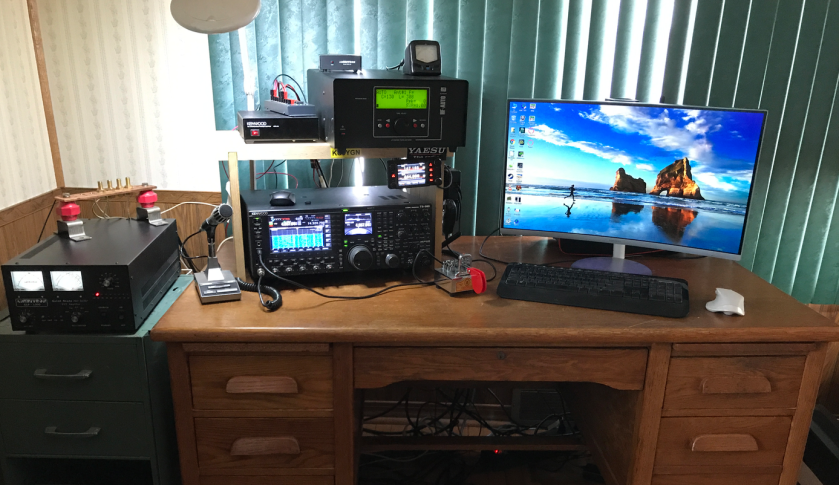
Spent the better part of the afternoon getting everything set up, all the cables connected and all that, and it’s finally done! Well, mostly. And everything seems to be working.

Mostly because I still don’t have the digital stuff up and running yet. But the TS-990 is up and running, as is the Palstar tuner, the FM-400DR, and even the MFJ amp. So I’m rather pleased with the progress.

Need to permanently mount the grounding buss, that’s the thing way on the left, a big copper bar sitting on top of 2 red insulators. That’s the grounding system for all of the electronics and that needs to have a permanent home rather than perched on top of the amp. Even got the Vibroplex paddle wired up and figured out how to program the TS-990 to deal with it.

Now I just have to get the Rigblaster put in place and connected. That interfaces between the 990 and the computer to assist with computer control of the transceiver and digital communications again.

I didn’t set up the Kenwood 2000, and I’m not sure if I will yet or not. I was using that mostly to monitor signal quality when doing digital work and I don’t really need it.

And I still need to decide what to do with my big boat anchor vacuum tube amp. I got the solid state amp right after I got the AL-82, and never even used the AL-82. I installed the transformer, installed the tubes, hooked it up, turned it on, made sure everything worked, and then got the ALS-1300 amp and used that instead. Probably should just see if I can sell the thing.


Stuff: Furniture & Wood

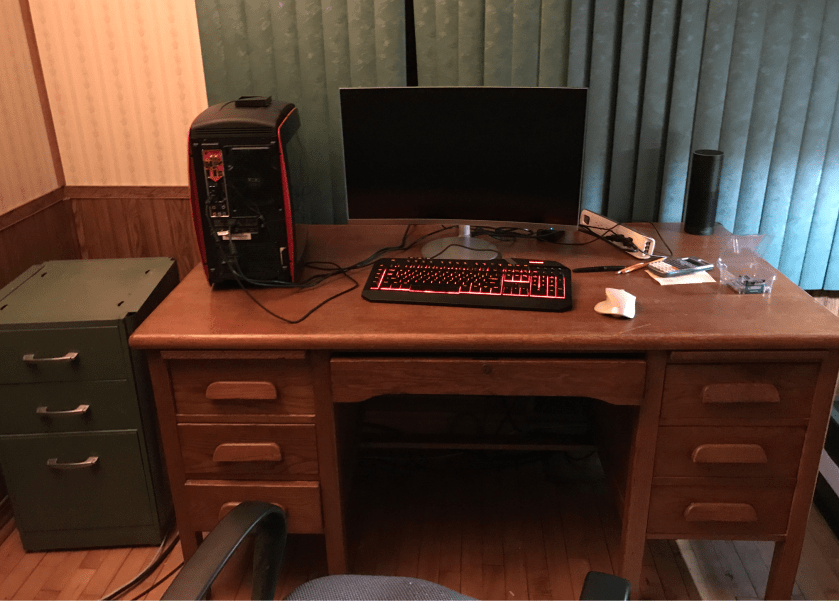
Screen Shot 2017-12-05 at 6.37.29 AMWe finally got the “new” desk in place on Sunday! Youngest son gave me a hand getting the old ones out and bringing the new one in. I am so glad to get rid of the particle board unit that was in there for years. This one is solid wood, looks like fairly decent oak, and it’s huge. 60 inches long and 32 inches deep. It’s probably around 50 years old or so, and actually in good condition considering it’s age. I thought about refinishing it, but decided I rather liked all those years of patina (“Patina” is what antique furniture dealers call scratches, dings, stains and other defects that add “charm” to the furniture.) and left it alone. MrsGF has had one similar to this for years now that we found for around $50 at a thrift store, and we’ve been looking for another one for me. She turned this one up at the local St. Vinnie’s thrift store for about $55, and we were thrilled to find it.

Screen Shot 2017-12-05 at 7.03.46 AMI got curious about what one like this would cost today if bought new and I started digging around on the internet looking for them and finally found one that fit all the criteria; oak with no particle board, dovetailed drawers, same size, same number of drawers and so on. For a whopping $2,200. It’s a bit fancier, but if you  knock off the fancier bits like the quarter-sawn oak, the thru-tennons on the rails at the base, it’s pretty much exactly the same. Judging from the photos, it’s made of higher quality wood and the fit and finish is much, much better. But still, over two grand?

Screen Shot 2017-12-05 at 7.10.37 AMI should have expected that, really. We’re so used to “cheap” flat-pack style, screw it together yourself furniture these days that we experience a bit of sticker shock when we see the prices on well crafted, solid wood furniture.

I started building arts and crafts style furniture many years ago. The Morris chair over there on the right has a matching ottoman and coffee table. The chair and ottoman are made from white oak. The coffee table was made from white ash. Once upon a time I sat down and tried to figure out what I’d have to charge for it if I were going to make any kind of a decent profit, and the numbers were a bit on the large side. I figured I’d have to get around $1,300 for the chair, $400 for the ottoman, and about $700 for the table. And even then I’d barely make minimum wage for my labor. So all things considered, over two grand for that desk probably isn’t all that bad.

Screen Shot 2017-12-06 at 6.43.01 AMThere isn’t really anything wrong with “flat-pack” style furniture you buy in a box and put together yourself. Nothing wrong with particle board, either, as long as you are aware of it’s limitations and problems. And potential health risks.
The particle board in most flat-pack furniture is either made of LDF or MDF. LDF is low density fiberboard, MDF is medium density. Of the two, MDF is better because it’s more dense, has a much smoother surface and is more sturdy. The stuff is very useful. Because MDF is very dense and smooth, it is often used as the base for countertops that have plastic laminate surfaces, even for the frames of cabinets where it can’t be seen. If sealed properly, it can be painted rather easily. It’s often used when the makers of “fine” furniture (Ha! Fine… We really need a sarcasm font.) try to fool you into thinking you’re buying real wood when what you’re getting is a thin veneer of real wood glued to MDF. It is pretty handy though, and can work well if you know how to use it properly.

MDF does have a few issues. Well, okay it has a lot of issues. First of all, it isn’t really wood, it’s basically sawdust and glue forced together under high pressure. It is fragile. It won’t hold screws very well. It breaks rather easily unless it is properly supported. It can’t carry a load unless it is well supported, as the owners of MDF book shelves can tell you as they watch the shelves sag under the weight. If it gets wet it will swell and start to disintegrate. It’s very, very heavy.

And depending on the type of glue used to hold the sawdust together, it can out-gas chemicals for months, even for years. Many of the glues used contain VOCs, Volatile Organic Compounds. These are compounds that will gradually evaporate into the atmosphere over time. Some of them can be nasty. (Some of you may remember the Chinese drywall disaster from a few years ago. Cheap drywall imported from China during a building boom gave off toxic chemicals that literally destroyed copper, I think it was sulphur dioxide but I don’t remember exactly. It wrecked the plumbing and electrical wiring in homes and businesses where it was used, and could have serious health consequences for the people who lived in those buildings.)

And if you work with the stuff, if you’re sawing, drilling or whatever, make darn sure you’re wearing a respirator because heaven only knows what’s in that dust. You do not want to be sucking that into your lungs.

If you get the feeling that I don’t like MDF very much, you’re right. But it is useful for some things, and if you want inexpensive furniture these days, you just can’t get away from it.

Then we come to the whole subject of fake antique furniture, which I’ve been finding with disturbing regularity as I travel around. I’m a sucker for antique shops. I don’t buy much, if anything, but I love browsing through them. One thing that I’ve discovered is that the amount of faked, fraudulent and mistakenly labeled “antique” furniture out there is astonishing. And the problem has become much, much worse over the years. I’d say that on average, about half of the “antique” furniture I see out there has some kind of issue with it. It’s either been badly restored, altered, mislabeled or faked in some way.

How do you know if a piece of antique furniture you’re interested in is the real thing? It can get complicated. You have to know the difference between modern finishes and stains and those that were used at the time the piece was allegedly built. You need to know what kind of screws were used, what kind of glues were used, construction techniques, how to identify different types of wood.

If you’re going to start buying antique furniture, you need to do some homework, or take along someone who knows something about furniture making, because the market right now is full of fakes. Frankly, when I look at a piece of “antique” furniture these days, I assume from the beginning that there is going to be something wrong with it until examination proves otherwise.

Amateur Radio Stuff: Tear Down Day

Screen Shot 2017-12-02 at 10.14.58 PM
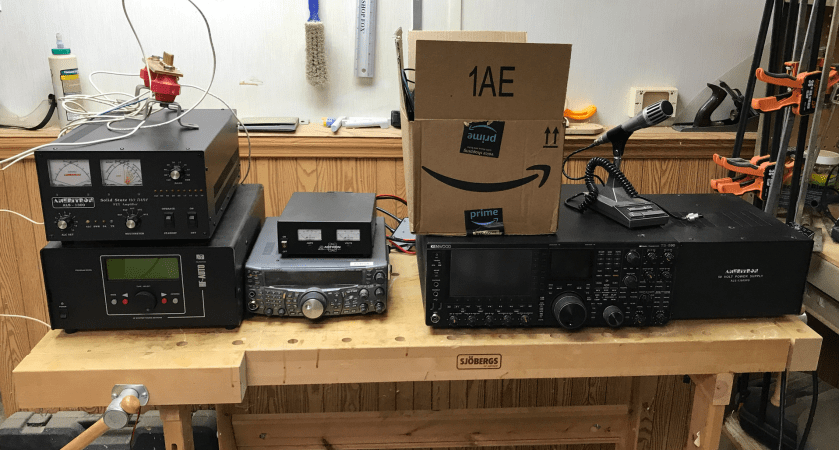
This is just part of it. There are about 4 more big boxes of stuff sitting on the floor full of jumpers, parts, connectors, cables… Oh brother… You will note the big ALS tube amp isn’t sitting there. I wasn’t about to lug that beast all the way down to the basement with the other stuff. Just the transformer in that bugger weighs in at around 40+ lbs. It got shoved into a corner where it will hopefully be out of the way.

Well, I finally stopped procrastinating and started tearing down my station. The battered old particle board desk I had most of my gear perched on should have been tossed out ages ago, but I wasn’t sure what to replace it with. MrsGF found an old oak teacher’s desk from about the 1940s era. Huge, very sturdy, lots of drawers and in pretty good condition, so we snagged that and it’s been sitting in the garage for weeks while I kept putting off actually doing anything because I knew it was going to be a huge pain in the neck.

I finally couldn’t put it off any longer. I have to get new desk out of the garage so I have room to park the motorcycle before we get hit with snow. And the old desk, well, I didn’t trust it any more. Frankly, I didn’t trust it much to begin with. Especially with about 200 lbs. of very expensive equipment sitting on it.

So I started disconnecting everything this afternoon. What a mess back there! Cables, coax, grounding wires, USB cables, video cables… Sheesh. And why did I make my jumper coax cables out of LMR-400? It’s so stiff you literally cannot risk moving anything without disconnecting the cables first or you risk breaking the connectors off the equipment. Sigh…

Of course I didn’t label anything. That would be cheating, right? I’m an amateur radio operator. I should know where all that stuff goes by sheer instinct. Or something…

One interesting revelation was the number of wires and cables back there that weren’t actually attached to anything, including coax disappearing into the wall, going to heaven only knows where, wires running down into the basement for some reason, USB cables. I think those things breed like rabbits. I have a whole drawer full of them. And wall warts… Lord, where did they all come from? What equipment do they power?

The interesting thing is going to be trying to put it all back together again into a working station. I can just see myself in a few days holding the RigBlaster and trying to figure out where that USB cable goes – into the computer? Into the transceiver? And what the hell does that little box with the red LEDs on it with the unmarked connectors actually do?

Great fun!

No Amateur Radio Isn’t Dying And It Doesn’t Need To Be “Fixed”

Screen Shot 2017-11-18 at 6.47.59 AMIf you’re looking for me babbling about farming, gardening, photography or one of the usual topics I go wandering off on, you might want to skip this one. I’m going to jump off the deep end into the “miracle of radio” for a moment here, specifically amateur radio.

One of the most curious things I’ve been seeing is the claim that amateur radio is dying. I hear this claim all the time; on the air from people chatting, at swap meets, and on the AR related blogs and forums on the internet. It is really very curious and at first I wasn’t sure why I kept hearing this when it seemed to be completely untrue.

But then I realized what was going on. Amateur radio isn’t dying, of course. What’s happening is that their idea of what amateur radio should be is dying. Amateur radio is changing, evolving, and they don’t like it. No sir, not at all. And they don’t want to accept that fact. So they take advantage of any little quirk, any little upsetting of the apple cart, any disruption, and through a convoluted thought process that makes the mind boggle, turn it into support for their idea that the entire hobby and everyone involved in it (except for them, of course) is going to hell in a hand basket.

Screen Shot 2017-11-16 at 6.39.55 AMPerhaps the biggest change was when the FCC dropped the need to know morse code in order to get a license. While most accepted this, and even were in favor of it, a significant number of AROs rose up in righteous anger over it.

Other things happened. The tests were changed, study guides began appearing on-line that were easy to use, even free. There were changes to the licensing structure. There were claims that the tests were “dumbed down”. I’ve heard people claim that modern licensees don’t actually “know” anything, all they did was memorize the answers to the questions in the question pool.

Uh, excuse me? Really? You didn’t memorize anything when you took your test, eh? You did, what, exactly? Spent years experimenting and doing the math to develop Ohm’s Law all by yourself? Besides, if someone has the ability to memorize all 700 or so of the questions in the pool for the Extra exam, they probably deserve to get the license.

Some of this nonsense has calmed down as none of the dire predictions that the Good Ole Boys made have come true, but they’re still out there, are still claiming that anyone who was licensed after the no-code license came into effects is an idiot, etc. etc. etc. There are some forums out there where if one of us no-coders dares to stick our head up, we will quickly be insulted, trolled and harassed.

The licensing system had to change, though. Morse code, or CW as we call it, is a lot of fun. Tens of thousands of AROs gleefully still use it, and it shows no sign of dying. But the fact of the matter is that being required to know CW to get your amateur radio license is about as useful as being required to know how to ride a horse in order to get a driver’s license for a car.  Yes, there are those who argue that when “all else fails” CW is the only way you’ll be able to communicate. But if you look at the forms of communications that are actually used during real emergencies, what is being used is SSB voice, FM voice, and, increasingly, digital voice and data. Not CW.

Then there are other “signs” that amateur radio is dying. Supposedly amateur radio isn’t growing, according to a lot of people I’ve talked to. I find that rather odd because we have more licensed amateur radio operators than ever before, and that number is increasing almost every year. Granted, it isn’t increasing by much, but amateur radio is a very technical hobby and it definitely is not for everyone. It requires a fairly extensive knowledge of electronics, mathematics, propagation, antenna design, FCC regulations, operating practices, etc. It requires a fairly hefty investment in equipment as well. So it appeals to a very limited number of people in the first place. If you are technically inclined, if you enjoy playing with electronics and gadgets and occasionally cranking up the old soldering iron and setting off the smoke detectors in your home with flaming resistors, exploding capacitors, etc. there are a hell of a lot easier and less expensive ways to do it than amateur radio, and which don’t require you to have to pass a test and pay a fee to do what you want to do.

Frankly, it’s amazing that we have the number of licensed operators that we have, not that the number is so small.

Here is an observation: I have amateur radio magazines going back to the early 1900s, and if you read the editorials and letters columns, you’ll quickly find that amateur radio has been “dying” since about, oh, 1920. And for pretty much the same reasons being given today: rogue operators, idiots, dumbing down the tests, changes in technology “destroying” the hobby (you should read some of the arguments about how SSB was going to destroy amateur radio when it first became popular)

There are a lot of people out there who simply do not like change. Oh, they won’t admit it, but it’s true. And this isn’t just in the amateur radio community of course. There are people who will not accept change even if those changes badly need to take place, even if those changes offer significant improvements. They will grasp at anything to try to rationalize their feelings.

Are there things about amateur radio I don’t like, things that I believe should be changed, or things that look like they will be changed but which I feel should remain the same? Of course there are. But I don’t have any influence over what will happen, and in the long run none of those things will have any real effect on my enjoyment of the hobby.

So no, amateur radio isn’t dying. All things considered, it is reasonably healthy and it seems it will remain so. It doesn’t need to be “fixed”. Yes, there are some things that could be tweaked, perhaps should be changed. But overall, amateur seems to be doing rather well.

Amateur Radio Stuff: What’s Going On

It’s been quite a while since I mentioned mentioned amateur radio, but that’s been because of a lack of time, not a lack of interest. Things back in the radio room are about to get — interesting, as they say. I’m facing a situation that every amateur radio operator does sooner or later, having to tear down everything.

IMG_0356
It’s even worse than this looks here. There are two more desks crammed into that room, an old drafting table, three book cases, a work table… It’s bad.

The radio room is, to put it bluntly, a mess. There is equipment piled everywhere, test gear shoved onto book cases or in drawers, amplifiers and radios laying on the floor, piles of printouts of manuals, booklets, stacks of mystery electronics in those anti-static bags, drawers full of connectors and parts, coax jumpers, meters, microphones, tools three full sized computers, three printers, all my Raspberry Pi stuff. There are cables and wires snaking along behind the desks, running into holes in the floor. The operating position is too cramped and awkward. The old drafting table my solid state amp is parked on it is too tall and too small, the desk the radios are on is in poor condition. The list goes on and on.

So everything is going to get torn down, moved out of the room. The room is going to get a good cleaning, etc. Then I start trying to put everything back together.

What sparked this is that MrsGF found a huge old teacher’s desk, made out of solid oak, for $50 at St. Vinnie’s. MrsGF already has one of these and I’d been looking for one for a while. The finish isn’t very good and it has it’s share of scratches and scars, but it is rock solid, lots of big drawers, and is long, wide and deep. That is going to get moved in, some of the old, particle board crap I’ve been using is going to go away before it collapses under the weight of the equipment, and then I can start trying to put everything back together again.

If I can remember how to do it… Meters, jumpers, wires, coax. You’d think I’d know enough to label all that stuff, right? I mean I have a label maker laying right there. But no, of course I didn’t. Sigh…

Anyway, Monday is the day when I start all of this. It’s taken me three years to accumulate this mess and put together that rat’s nest of wiring behind the desks, so this could take a while…


Antenna Adventure and Stuff

Screen Shot 2017-06-18 at 6.14.53 AM.png

Like most amateur radio operators I tend to accumulate a lot of stuff. I’ll find something and think ‘oh, that might be useful some day’ or ‘wow, that’s a good price I should get that because I’ll use it some day’. You know the kind of thing. The end result is I have more PL-259 connectors than I’ll ever use in my lifetime, spools of coax cable, rope, miscellaneous spools of wire, bits of this and that, oddball electronics, rather intimidating looking radios, test equipment and tools…

Making things worse is I’m fascinated with antennas and how radio waves propagate, so I have stuff used to make antennas, and even complete antenna systems that I’ve picked up along the way. Including the one in the photo, a Gap Titan DX vertical antenna that’s been laying in a box upstairs since I got it about three or more years ago.

It was intended to replace the Comet 250 vertical I’ve had since I first got my license. Now the Comet works. Sort of.  It’s dirt simple to put up, being little more than 21 foot long aluminum pole that bolts to a pipe hammered into the ground. But let’s face it, it isn’t really a very good antenna, especially at lower frequencies. It was intended to be a stop gap measure, something I could use to get on the air quickly and easily, with the intention of eventually replacing it with something else.

I eventually put up an OCFD that’s my primary antenna, but I kept the Comet up more for reasons of nostalgia than because it worked, which it pretty much didn’t. Oh, I made some contacts using it, but the intention was always to replace it with something better like the Gap Titan, or a vertical from DX Engineering that I picked up around the same time.

Eldest son showed up yesterday and said the Comet was coming down and we’re going to put that Gap Titan. Period. Okay… We worked out in the driveway during the hottest day of the year so far, gulping down water, sweating through our clothes, and finally got it put together. Mostly. It isn’t that difficult to assemble. The instructions are phrased a bit oddly, but if you take your time and pay attention to the diagrams it isn’t hard. And this is about as far as we got because now we are at the point where we have to put the counterpoise together, and that can’t really be done until it’s up because the counterpoise consists of four long aluminum rods about four feet long that are linked together with copper wire and goes around the bottom section of the antenna.

Then we realized that where we wanted to put it, where the Comet is now, isn’t going to actually work because we’d badly underestimated the size of the counterpoise. The Comet, being little more than a big stick with a can on the end containing the matching coils, takes up almost no room at all, and is bolted to a piece of pipe hammered into the ground. It has no counterpoise, no radials, nothing. Just a big stick, like I said. This, though, was going to require a space of about 8 feet across.

I wanted to keep it low to the ground despite the fact that would not help it’s performance. That would mean we wouldn’t have to guy it, it would be easy to take it down if necessary, and it would be easy to adjust. We considered putting it in different parts of the yard, and that would have worked, but that counterpoise would always be awkward to deal with and almost certainly someone would run a lawnmower or something into it. And we’d have to make a new feed line and bury it, and while I probably have about a thousand feet of coax laying around the house, none of it is rated for in-ground use so I’d have to get more, and we’d have to dig a trench and, well, this was starting to look like more work than we really wanted to get involved with.

And then there was the safety aspect of the whole thing. I rarely put more than 30 watts into the Comet, using it mostly for low power digital communications like PSK. Besides, the Comet can only handle about 200 watts anyway before the coils will melt down or something. The Gap, on the other hand is rated for a full 1,500 watts output, and I often use amplifiers putting out 600 – 1,500 watts when conditions warrant it. So getting it higher up would be advisable just in case some goof ball decided to grab the antenna just as I key a mic and dump 1,500 watts into the thing. You can get some nasty burns from RF at those frequencies and power levels.

So eldest son decided the best thing to do was go up. Keep it in the same location, but up above the roof of the garage where it would be out of the way and where it would probably work better anyway. But that meant we had to put up guy lines to keep it from falling over, so he’d have to go buy… No, you don’t, I told him, and rummaged around in my boxes and came up with a complete guying kit, including a few hundred feet of nonconductive line, tie downs and other goodies. And then he said well, it would be nice if we could put in a tip over mount so we can lower it down in case of storms and stuff so I should look into that. And, well, a trip to the famous “box o’ stuff” (well, actually many boxes) turned up a tip over mount originally intended for a DX Engineering antenna that would work… Sometimes it pays to hang onto all that stuff. So all we really had to buy was some sturdy pipe or something to get it about 10 feet up so it would clear the garage roof, and he went off with the truck in search of that.

Now I have absolutely no idea how he’s planning on doing this. As MrsGF pointed out, he’s the genius in the family and it’s best to just leave him alone and let him do it because he’s generally right. So we’ll see what’ll happen.

If we get a chance to actually do it. It looks like more storms are on the way, and working on antennas with thunder storms in the area is generally considered a bad thing to do.

Miscellaneous Stuff & Retired?

IMG_0375Cactus

I think Mr. Spiny the cactus is about to bloom! The cactus has been doing really well out there tucked up against the side of the house but it hasn’t blossomed in two years. It is currently loaded with new pads, but I noticed some of the new buds looked different, and may be flowers, not pads. I really hope so. The flowers on this plant are absolutely spectacular.

Whitefish Dunes State Park has become one of my favorite places. It has about 880 acres of shoreline along Lake Michigan up in Door County, and it’s well worth the price of admission. I’m not sure what the cost is because I get a yearly pass as part of my conservation patron license, but I think it’s about $8 for a day pass.

It’s hard to pick out a single photo from the park that is representative of how beautiful it is, but perhaps this one will do:

IMG_0343.jpg

People seem to think Wisconsin is a rather dull place, with flat land, corn, cows and football. But we have more than 14,000 lakes, plus Lake Michigan. We have cliffs, rivers, forests, water falls… Well, you get the idea.

Alas, I’m not sure how long the state park system is going to continue to exist, though. The current administration down in Madison has cut off all state funding for the park system. It’s only funding now is what it can generate from entrance and camping fees.

Lichen

I continue to be fascinated with lichen for some reason. If I’d ever actually gone to the botany class I signed up for in college I might actually know something about it. But I find the colors, the forms, and everything about it fascinating, and if you’d look through my photo library you’d find a lot of images of lichen and mosses. Most people find the photos rather dull, without the splashy colors of my flower photos, but I think lichen has it’s own unique beauty. Like this, for example

IMG_0362.jpg

The subtle shadings of greens and yellows and browns, the amazing shapes. Like I said, I’m fascinated with it.

Storms

We’ve been getting a lot of them of late. We’ve had severe thunderstorms roll through here two or three days in a row now, and we’re getting a bit tired of it. Here at the house we’ve avoided the worst of it, but there have been trees taken down, power outages, minor flooding and building damage all over the area with every one of these. It’s kept the SkyWarn people busy, as well as the utility crews trying to keep up with the damage.

I was really glad we had the backup generator yesterday. Power was out for about 45 minutes and if I hadn’t been able to use the generator we’d have ended up with about a foot of water in the basement because of the heavy rains. We got over an inch and a half of rain in about half an hour here. The sump pump was kicking in every 2-3 minutes all the while.

We actually have 2 generators. One is a little 2KW Yamaha inverter that was originally intended just to run the radio equipment for field day or in emergencies for ARES operations. The other is a big Generac 9KW that was intended to power most of the house. The intention originally was to put a big connector on the outside of the house going to the Generac and using it to run the whole house. As long as we don’t use the ovens, turn on every light in the house, etc., it would have enough capacity to keep everything going. But we never got around to installing the bypass switches and connectors necessary. And when we do have a power failure, the little Yamaha can keep the sump pumps going as well as the radios and a few lights. It’s also much, much easier to move around and get started. It also uses a hell of a lot less gas and is much, much quieter.

IMG_0377Roses! The first roses of the season have popped open at last. I’m not a huge rose fan. I like them, but generally I find them a bit fussy and fiddly to deal with. The one we have in the front of the house takes care of itself pretty much. It just keeps coming back year after year, surviving drought, wet, cold, heat…

That’s my kind of plant – just stick it in the ground and ignore it and it takes care of itself.

Oh, and while I’m on the subject of plants, we found this incredible tree up in Door County as well when we were up there on Monday. Neither of us had ever seen anything quite like it before. Covered with these beautiful red, white and yellow flowers.. Absolutely breathtaking. I don’t know what it is. Have been too busy (i.e. lazy) to actually do research to look it up.

IMG_0372

Retired…

I turned in my resignation at work last week and I am still trying to wrap my head around the fact that I am unemployed. Willingly unemployed. It doesn’t seem right somehow.

Well, it isn’t like I was putting in a lot of hours at the job anyway, to be honest. The position I’ve been in for the last two years or so was part time, and more or less on an “as needed” basis. I worked for events at the theater, filled in when one of the day guys was out sick, or there was a situation that required extra help, that kind of thing. A lot of weeks I didn’t work at all and it was rare for me to put in more than 20 – 30 hours a month.

Still, not having a job? It feels — strange. Feels, oh, not right somehow.


Amateur Radio Tools and Test Equipment Part Three: Test Equipment

(Note: This rather quickly turned into an article about stuff you don’t need and why you don’t need it, rather than about stuff you do need. So it goes…)

Now there is a whole slew of test equipment some people claim you need. And you go out and spend your hard earned money on it and find that well, no, you didn’t actually need it. The fact of the matter is that unless you’re really into electronics development work, need to diagnose and repair some rather expensive and complicated equipment, you don’t really need much more than a volt/ohm meter and a couple of other items. And this is coming from someone who admits he has a — a problem, shall we say, when it comes to tools and test equipment. Basically I see a new tool or piece of test equipment my eyes glaze over, I start to shiver uncontrollably, instinctively reach for my credit card…

What do you really need? Well, at the top of the list is a decent volt/ohm meter of some sort. Usually abbreviated as VOM or DVM for the digital versions, or multi-meters. It’s pretty much an essential tool. But which one do you get? They come in all kinds of shapes and sizes, all kinds of different options, and prices that range from little more than pocket change to “OMG who the hell can afford that”.

You don’t need to spend a fortune on a VOM, but you don’t want to get one of the bargain basement varieties out of the $2 bin at the lumber yard either. For the average electronics hobbyist you can get a perfectly good VOM for around $30 – $40. I wouldn’t spend more than $150 or so on one for one unless I was, oh, repairing equipment on a professional basis or something like that.

Which one do you get? Well, if you’re me — all of them… Okay, that’s an exaggeration butScreen Shot 2017-03-18 at 7.43.09 AM
the fact is that I have about a dozen of the dopey things laying around, from small pocket models smaller than a deck of cards to bench top models and even rack mounted units. Including one of these over there on the right. I don’t think I have it any more and it never worked in the first place and I have no idea where the thing even came from because I don’t remember buying it. (I think people break into my house not to take things, but to leave me things so they don’t have to pay recycling fees…) And it wasn’t even a VOM come to think of it but some kind of frequency counter or something…

Never mind, let’s get on with this.

The kind you do need is your basic VOM, something like one of these over there on the left. IMG_0020The Fluke is the one that lives on my workbench and that I use the most often these days. The Radio Shack model… Well, heck, I probably have a dozen RS meters because when I was a technician out in the field things happened… Oh, brother, did things happen. And RS stores were just about everywhere and the stuff was cheap and reasonably good.

Anyway, something like that Fluke will set you back about $150. The RS model is a lot less. Think I paid about $40 for that one something like 15 years ago. It seems about as accurate and useful as the Fluke, so why did I buy the Fluke? Well, it’s — it’s so shiny…

They both do pretty much the same things for the most part. Both have replaceable probes/leads. And yes, you need that. You do not want a meter that has the leads wired directly into the meter. Accidents happen – melted probes, broken, frayed wires, melted wires… Stuff happens. (You did remember to unplug the equipment and discharge those high voltage caps, right? Hmm?)

Another piece of test gear that is pretty much essential for the amateur radio operator is something called a dummy load. No, this is not a truckload of ventriloquists dummies. Nor is it a load of politicians. It’s a sort of, oh, let’s call it a radio black hole.

When you’re testing and/or working on a transmitter, you have to actually transmit with it. And you need to hook the output of your transmitter up to something that can suck up the power or it can either damage your transmitter or send potentially illegal radio transmissions out into the air and enormously irritating the FCC. Or your neighbor who suddenly finds all of the electronics in his/her house going wonky.

A dummy load is really just a big, heavy duty resistor or resistors that absorb the power being dumped out by your transmitter and converting it to heat. Nothing magic, just basic physics. You can probably build your own if you like. There are tons of examples out there. Or you can buy one. Ones that can handle under 100 watts of power are out there for well under $100, some down in the $30 range.

If you fiddle around with amplifiers like I do, you’re going to need something that can handle a lot more power because those big HF amplifiers can potentially put out well over 1,500 watts. One of the cheapest methods of dealing with it was the so-called “cantenna” which was basically a paint can with a big honking (that’s a technical term, honking, you know, like ginormous, or widget, or doodad) resistor sitting in a gallon of transformer oil used to cool it. They’re still on the market and they do work pretty well. You can pick them up for under $100.

If you don’t like messing around with all that oil and stuff, you can get fan cooled dummy IMG_0027loads that can handle higher power, but you’ll pay for it. Something like the Palstar over on the right will set you back around $375 or so. A bit less if you can find one used. I think MFJ makes one as well.

Which one do you need? Well, as much as I like the DL2K I’m the first to admit that you don’t need one unless you do a lot of fiddling around with high power amplifiers. At the time I picked this one up I was doing just that and it was very, very useful. But most people don’t mess around with amplifiers that often and you can get away with something a hell of a lot cheaper. Even if you do use amplifiers, one of the “cantenna” type dummy loads will probably work just fine for you at a quarter of the cost.

That’s the thing with some of this equipment. It’s very handy to have around, and IMG_0017sometimes you absolutely have to have it. But you’re going to use it so rarely that you wonder if it’s worth the cost. It’s like this thing, my antenna analyzer over there on the left. It is a genuinely useful gadget for analyzing the performance of antennas, feed lines, helping determine antenna lengths for specific frequencies, etc. but how often do you really need one?

They aren’t exactly cheap. A good one will set you back about $300 or more. And while they are very useful indeed, I hesitate to recommend you buy one because chances are good you don’t really need one. I picked it up because I love messing around with antennas. I have three antennas in actual use at the moment and have about five more I want to put together and set up or am planning on building and experimenting with once the weather gets a bit better. So for someone like me having one of these makes sense. But even I don’t use it all that often. In fact, as often as not I lend the thing to other amateur radio operators who are setting up antennas so they don’t have to go to the expense of buying something they’re only going to use once or twice.

That brings me to this thing, another piece of test equipment you probably don’t need but really, really want, the oscilloscope. Look, I know you want one. You really, really do. It has all those fun IMG_0019buttons and knobs and that fancy display and it’s just so cool. But do you need one? Probably not. I’ve had this thing for like three years now. How often have I actually used it for anything serious? Twice. Twice in three years. Sheesh…

This isn’t the first ‘scope I’ve owned, either. I’ve had various “old school” CRT based models of various vintages over the years, and to be perfectly honest, I’ve almost never used any of them. They look really, really cool sitting there on the workbench. Sometimes I’ll turn it on and smile at it, pet it, scratch it behind the ears, tell it that it’s a good ‘scope and give it a treat, then turn it off and go back to whatever I was doing. But actually use it? But owning an oscilloscope seems to be, oh, like some sort of right of passage for a lot of amateur radio people. Having one of these sitting on the workbench means you’re “serious” about it, not just fiddling around.

That’s the problem with a lot of the test gear out there. It’s often something you’ll only use once or twice, and that’s it. So is it worth investing hundreds of dollars in something you’re going to use once in ten years?

Unless you’re really into circuit design, equipment repair, experimentation, development work, etc. most of the fancy test gear you see out there isn’t going to be very useful.

How often are you going to need a spectrum analyzer? Probably never unless you’re repairing a lot of equipment. Or a function generator? I’ve got one of those as well. I’ve never used it. At least that one didn’t cost me a fortune because I built it myself.

Now I’m not saying you shouldn’t buy the stuff, but make sure you really need it and can afford it before you pull out the credit card. You might also be able to find a super cheap version of the test equipment that isn’t very sophisticated or even isn’t very good, like some of the cheap oscilloscope kits out there, but which will work well enough for what you need it for.

You can often borrow the stuff from a local amateur radio or electronics hobbyist if you can find one. We’re typically friendly people and once we know you aren’t going to go running off into the night and selling off our stuff on eBay or something, we’re generally more than willing to lend you stuff.