Birch

IMG_0241IMG_0242

Close ups of birch trees in my neighborhood. I’ve always been fascinated with tree bark as a photographic subject. The texture, the play of light and shadow, lichen and moss, the amount of detail is astonishing and often quite beautiful.

Birch are getting hit hard here in the state, especially up in the northern part of the state where they’re more common. Not from disease, from tree rustlers, I suppose you could call them.

I’m not the only one who thinks birch are beautiful trees. A lot of others do to, and are running around up north cutting them down, hacking off their branches, and selling them as decorative items. And doing it on private property, public parks, state parks and forest reserves where they’re doing it illegally. They’re finding hundreds of birch trees being hacked down just so people can steal the branches to sell them as decorations. Sigh…


Pear Blossoms And More Little Purple Thingies

IMG_0237.jpgIMG_0236.jpg

The pear tree is coming into full blossom. This dopy tree never ceases to amaze me. It is gnarled, misshapen, leans over at about a 35 degree angle and any arborist would wince at the sight of it. But holy cow, does it produce pears! Some of the most delicious, luscious pears I’ve ever had. We look forward to mid to late September when the fruit gets ripe. At their peak the pears are so sweet, so juicy and lush they melt in your mouth when you eat them. Alas, while they are amazing for eating fresh, they’re terrible for canning because the buttery texture that makes them so delightful for eating fresh means they disintegrate when canned. They do make great jam, though!

IMG_0240.jpg

We tend to ignore the goofy little bushes on the north side of the house. They are generally rather nondescript and often annoying because they grow like nuts and have to be trimmed frequently, and some of them have vicious thorns on them. But every once in a while this one decided to bloom. Tiny little lavender-purple blossoms that are so small they’re easy to completely ignore.

They’re sort of like, well, people. Even the most ordinary, the most nondescript, have incredible beauty within them if you look past the surface.


Hostas! And Little Purple Thingies!

I love hostas. Easy to take care of, can survive a variable climate. The flowers, well, they

IMG_0223
Every single one came back! I am enormously pleased. They’re looking wonderful.

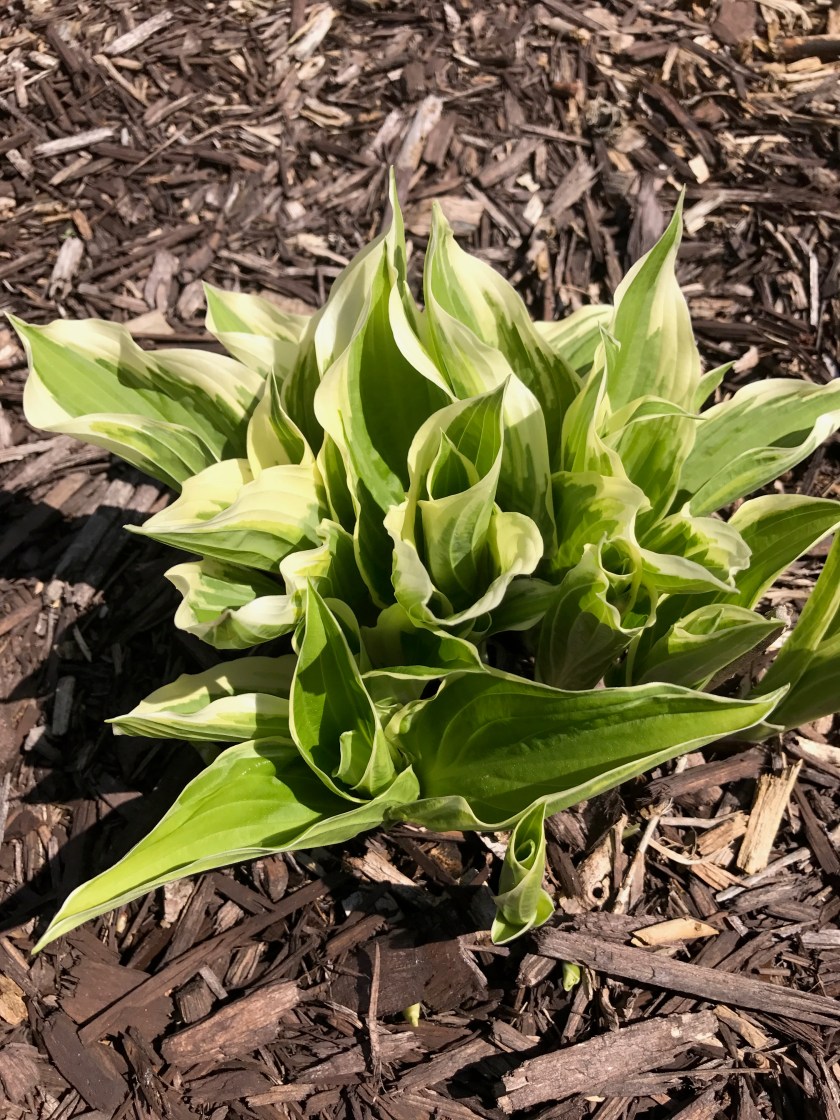
don’t do very good in the flower department, but that’s not why I grow them. It’s the foliage. Over the years growers have developed dozens of different varieties with a huge assortment of different types of foliage; yellow, striped, speckled, different shades of green, different leaf shapes. They’re great fun.

A couple of years ago I ripped out the entire front mess between the house and the sidewalk and put in a hosta bed. Even went to a professional hosta grower to get the plants. Spent way too much money. And much to my surprise, every single one of them has been doing beautifully up there, surviving the cold, the rain, the snow, the ice. Great plants, hostas.

Was out walking with MrsGrouch (She’s not really a grouch, just the opposite, but this isIMG_0234 Grouchyfarmer.com, so what, I should call her Mrsdotcom?) and we ran into these and I had to take a photo. In an otherwise totally nondescript front yard, this cluster of brilliance was sitting there near a step, this tightly packed cluster of brilliant joy… Wow.


Farm Catchup

Time to get caught up with what’s been going on in the farming world.

Elderly Corn

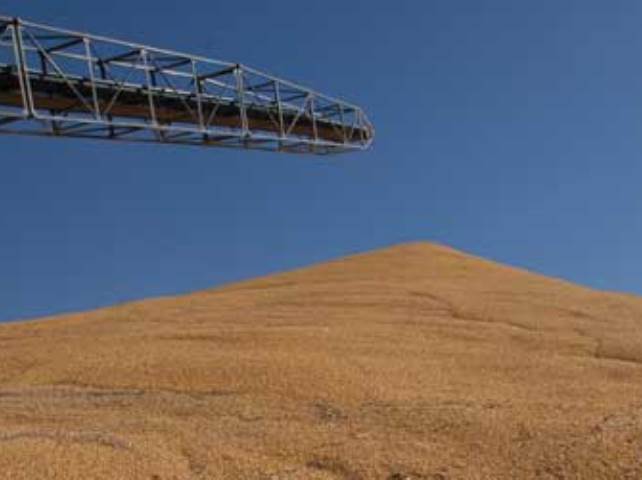
China has a problem with corn. As in it has too much of it. It’s been sitting on a large amount of stockpiled corn for years now, and it needs to get rid of it because some of this has been sitting in storage for ages now and if they don’t get rid of it soon it’s going to be unfit for even animal consumption. Agrimoney posted a story indicating China is going to start dumping a lot of it’s aging corn on the market beginning May 5. Some of this stuff has been in storage since 2012. The country has had a problem with this for some time now, and there are rumors flying around that the quality of this stuff is marginal at best. China has been working to make their grain markets less dependent on government support programs and to draw down massive amounts of grain that they have in storage. The result has been a huge drop in the import of grain, especially corn. Chinese corn imports in March were 91% lower than they were a year ago.

GM Corn Saving Lives?

My opinion of genetically modified crops is mixed. I believe the science that proves that the GM crops in use currently are generally safe and that consuming them does not cause health problems. But GM crops have other issues associated with them that are problematic. Like the fact they don’t really improve yield at all, that they lead to the development of herbicide tolerant weeds and that in the long run, GM crops modified to resist weeds and things like the corn borer are little more than stop gap measures that will ultimately fail… The list goes on and on.

But there is one GM crop that could genuinely be of benefit. Aspergillus is a type of fungi or mold that produces aflatoxin, which is not only a carcinogen, but can also cause stunted growth in children and damage immune systems. And it causes liver cancer. It can be found in all kinds of things; peanuts, walnuts, the list goes on and on. Aflatoxin is especially a problem in corn. Corn that is harvested wet, stored improperly, can easily be hit with this stuff, and it can be very nasty.

Here in the US and other first world countries corn and other food crops are tested for the the stuff, but that’s not the case in other places that don’t have the resources, the money, or the expertise to do the testing.

They’ve developed a modified variety of corn that resists the development of the toxin in the corn kernel. Aspergillus can still develop, the the toxin itself will not get into the kernels of the corn.

The early test results are very promising, but they’re going to have to hook up with someone who can afford to foot the bill for large scale testing of the modified crop and go through all of the regulatory paper work and testing.

It wouldn’t just help poorer countries which can’t do the testing. Farmers have  huge amounts of corn rejected because of testing positive for the toxin, so a variety of corn that didn’t develop the toxin would be a significant financial benefit.

Weed Wars

I ran into this item over at agweb.com: When Will the Herbicide Cavalry Arrive? It talks about herbicide resistant weeds and new chemicals to kill them and all that stuff. The usual kind of thing that reads like a PR piece written by the chemical companies. But if you scroll down a bit over halfway through the piece, you’ll find a somewhat different tone when someone, finally, utters the phrase “we’ll never spray our way out of the problem.

And we won’t. Sooner or later the pests will develop resistance to whatever chemical solutions they come up with and the problem will come back just as bad, probably worse, than it was before. They go on to praise two Australian “innovations” that attach to the combine to capture weed seeds before the combine can blow them back out onto the field.

It’s certainly a good idea. Any weed seeds you can capture at the combine aren’t going to germinate the next year to infest your crops. But innovative? Hardly. Similar technologies have been around for decades. Back in the late 1950s our old Massy Harris combine had a device mounted on it that did something similar. It collected the weed seed that would have been blown back out onto the field or gone into the grain tank with the oats and dumped it into a feed sack attached to the back of the combine. At the end of the day we’d have bags of the stuff. It certainly wasn’t 100% effective, but every weed seed it did collect was one that wasn’t going to cause a problem the following year.

Will these devices be helpful? Hell yes, if they ever get them into production and farmers buy into the idea.

I’m not sure why the process went out of favor. I think our combine was the last one I ever saw that was equipped with it. I suppose people figured why bother when all we need to do is just spray. Just blow the weed seed out the back of the combine and let the chemicals deal with it.

School Lunch Controversy

You’d think that one thing everyone would agree on is that school kids should be fed lunches that are safe and healthy, right? But you’d be surprised. Opinions range all over the place out there, from people who think parents should be responsible to feeding their kids and the schools shouldn’t be serving any food at all, under any circumstances, to those who think schools should be feeding kids everything; breakfast, lunch and dinner.

And as for what schools should be serving, well, it’s turned into an utterly ridiculous and totally unnecessary political fight that started the moment the Obama administration announced new rules to insure that what kids were being fed in schools was, if not actually good for them, at least wouldn’t actively harm them. There is absolutely no doubt that we eat too much fat, too much sugar, too much salt, too much processed food and we don’t eat enough vegetables, fruit and whole grains. The new rules were intended to help deal with that, and from the moment they were even mentioned, the fight started because, well, Obama, and as far as certain politicians and special interest groups were concerned, anything coming out of the Obama administration was automatically the spawn of Satan.

As the current administration works to roll back or eliminate everything that it’s predecessor did, it’s been going after the school lunch program as well. The ag secretary announced in a self promotional fluff piece that reads like it was written by the food processing companies and backed with “information” that either isn’t true, is misinterpreted or cherry picked, that they’re going to “make school meals great again” by rolling back the Obama era nutritional guidelines, and allow schools to return, at least partly, to serving kids little more than junk food disguised as a meal. Restrictions on salt, fat, sugar, serving increased amounts of vegetables and whole grain breads and fat free milk are all being rolled back

One of these days I need to do an article about the school food service system. I’ve been involved in it either directly or indirectly for decades and some of the crap going on in that system, well, it’s scary sometimes.

Milk Wars

Well, the politicians have gotten involved in the dispute with Canada over their change Screen Shot 2017-04-27 at 6.43.56 AM.pngto their milk import policies, and as you might expect, there has been a lot of muttering, tut-tutting, bloviating and ranting, with absolutely nothing being done about anything. The president got involved, appearing in Wisconsin briefly where he said many, many things to try to make it sound like he was going to do something, and as soon as he got out of the state and safely back in DC, the Whitehouse immediately disavowed everything he said, blunted or even eliminated entirely the vague threats, and we aren’t going to do this or that, but oh, even though the dispute is about milk we’re going to put a tariff on Canadian wood…. Wood? Really? Oh, well…

The state’s ag secretary is apparently actually doing his job, trying to help the dairy farms that are being dumped by Grassland. But in the long run there isn’t a heck of a lot that can be done at the state level. Fortunately it seems like most of the farmers effected by this have now found other markets for their milk, but the situation is still very concerning, and I expect things will get worse before they get better.

Blaming Canada for this, as many are doing, is silly. These new rules should not have blind sided anyone. From what I’ve been reading, the rules have been in the works for at least a full year, if not longer. Back in November already we were seeing stories popping up about the change in rules and warnings of how it would effect the markets here. So the processor’s claim that they were blindsided by this is a bit disingenuous. If their management didn’t see this coming, they really should be in a different business.

The real problem is the dairy industry itself and the politicians who keep fiddling with it, not any specific country. And the problem is world wide, not limited to the US or Canada. The problem is that dairy farms are producing way, way too much milk. More than the market can absorb. And instead of trying to deal with the situation, the reaction of the whole industry is to try desperately to come up with some kind of market for the stuff, any way they can, even if it destabilizes some other country’s farming industry. Pressuring politicians to institute still more ways to artificially prop up prices.

Canada has done something no other country has, it has actually been trying to deal with the problem of oversupply. It has a fairly strict quota system on milk production to try to keep the market stable. But in order to make it work, they have to restrict imports of dairy products from outside of Canada or the whole system would fall apart as the country is flooded with cheap imports. (The EU tried a quota system but abandoned it a year or two ago)

Is this protectionism? Of course it is. But you have a choice: Do you protect your businesses at home, giving them a level playing field to work with, restrict production so the farms can be relatively profitable, or do you open up your markets to cheap imports, often cheap because of government subsidies, tax breaks and other things that make it cheaper for them to produce the product than you can?

Then the politicians get involved… Price supports, tax breaks, grants, subsidies, government agencies buying up surplus product to artificially prop up prices, mandates that you have to use certain products (Wisconsin still has laws that force restaurants and food service operations to serve butter, for example), the list goes on and on. The end result is that anyone who thinks there is a “free market” for dairy products is living in a dream world.

What’s the solution to the problem? I really don’t know. My father used to say that the system was so screwed up that the whole thing should be scrapped. All of it. Make it a true free market. No government subsidies, no tax breaks, no marketing boards. Leave the health and safety regulations, testing, etc. But get rid of everything else. Turn it into a real free market that has to respond to normal supply and demand rather than a government supported mess where farms are propped up by various programs and price manipulations that encourage overproduction.

Would it help? I don’t know. But it seems to be about the only thing we haven’t tried yet. It’s obvious that all of the quota systems, price supports, surplus buys and everything else isn’t doing any good.

Ultimate Recycling?

This construction site is on one of the routes I take when I walk the town in the IMG_0218.jpgafternoons when the weather permits and I’ve been watching it with some interest. It may not look like it, but this is a major recycling project. The photo doesn’t do those two houses justice because it was a rainy, dreary day and I was using the cell phone, but those two little houses are actually really quite nice, with new brick facades on the living quarters and a matching stone facade around the garages. Once they get the landscaping done they’re going to be really very nice.

This is actually a very ambitious and rather complex project, because those two houses were actually a single duplex that was moved to that site from another location. The duplex was literally cut in half, separated into two individual houses and garages. While it sat there on the big dollies that were used to transport it, they dug basements, poured foundations, then mounted them on the foundations, then gutted both of them, completely remodeled both, put on new roofs and gutters, did the brick and stone facades, did new heating systems, electrical and plumbing, basically completely rebuilt both of them.

So they took an unwanted old building, moved it to a new location, and turned them into two nice little houses that in the near future will be the pride and joy of their new owners.

It seems like a great idea, doesn’t it? It’s the ultimate in recycling. Instead of tearing down an old house, move it to a new location, remodel it, turn it into a desirable property. So if it seems to make sense to do this, why isn’t it done more often?

Cost, of course. I’d be willing to bet that the total cost of this project is going to be darn near as much as it would have been if they’d built both of those from scratch. Maybe even more.

Back in, oh, the late 1970s or early 1980s, a friend of ours bought a big old farm house. Big, sturdy, very well made. Bought it for $1. Seriously, one dollar.

The catch? He had to move it. In the end that $1 house cost him more than $40,000. And this was at a time when you could get one hell of a nice house for around $35,000. Heck, I could have bought an 80 acre farm with a small house and barn for $18,000 at the time. Wasn’t much of a farm, true, but still, $18K? The owner of a restaurant I’d used to work at in the early 1970s offered to sell me the restaurant, including fixtures, stock, inventory, equipment, etc, for $15,000. (Aside: The place is no longer there, but another restaurant about the same size, just a couple of blocks away, is now on the market for $169,000. So it goes.)

So If you ever wonder why they don’t do this more often, the reason why is the cost. Moving buildings is very expensive, very complicated (just think of the logistics involved in moving/lifting power lines, etc.) and very tedious. And once you do get them on site, they need extensive renovations, updating, etc.

First Harvest! Rhubarb

The first actual harvest out of the garden here every year is rhubarb. The plants are

IMG_0191.JPG
It only started to break through the soil about two weeks ago and it’s already over a foot tall with dozens of stalks.

ridiculously hardy and are always the first to spring up. After the chives, which pop up as soon as the snow is gone, rhubarb is the first real thing we harvest. As soon as the goofy looking red bulbs of the sprouts

IMG_0090.JPG
Sprouting rhubarb looks like some kind of emerging alien eggs or something. Creepy

pop up we start thinking about rhubarb custard pie, rhubarb and strawberry, rhubarb sauces of various types. In some parts of the world the more tender stalks are dipped in sugar and eaten raw.

Oddly it seems a lot of people I know have no idea what to do with the stuff. Granted, it is utterly horrible if you try to eat it raw. But once it’s cooked a bit and has some sugar added — well, okay a lot of sugar added, it’s delightful stuff. Well, to me at least. For a lot of people it is definitely an acquired taste, and one which some have no desire to acquire, I fear.

Rhubarb does have one “gotcha”, and that is it’s leaves. They are fairly high in oxalic acid, which can cause serious problems or even death if you eat enough of them. (I read that you’d have to eat something like 11 pounds of leaves to build up a fatal level of oxalic acid.) The stalks have very little oxalic acid so those are safe to eat. Some people have claimed that you can only eat rhubarb early in the season, and that after the plant has come to full maturity, the level of oxalic acid in the stalks rises and makes it dangerous to use. This is not true. It’s safe to eat the stalks all through the growing season. If you let the stalks get too thick, it becomes woody and even hollow. But if you harvest it regularly and only select the new growth the stalks will remain tender all season long.

You want a fast and easy way to make a sauce? Sure. Here you go:

IMG_0189.JPG

Take about six or ten stalks and cut them into very small pieces. Put in a pan and add about a quarter cup of water. Turn up the heat until the water begins to bubble, then turn it down to low and let simmer. Stir every few minutes. After a very short time the pieces will begin to disintegrate and turn into a kind of pinkish mush. At this point throw in some sugar to taste. Start with a couple of tablespoons and taste, then add more as needed to get it to a level you like. Then serve hot, or throw it in the fridge.

IMG_0190.JPG

What do you use it for? Put it on ice cream, use it on pancakes. Use it instead of strawberries on shortcake. Or use it with strawberries. The two go together very well indeed. I put it on cereal.

Wisconsin Public Radio

I’m a huge fan of Wisconsin Public Radio. I’ve been listening to it since, well, almost my whole life, really. I first learned about it in grade back in the early 1960s when the nuns would occasionally put on some educational program for us to listen to. It is one of the finest news, information, music and entertainment services out there, and there really isn’t anything else like it left on radio any longer. WPR has been on the air 100 years now. It is widely considered to be the first broadcast radio service in the country.

Their pledge drive is coming up next week. A lot of people are under the impression that WPR and other public radio services are funded by taxes. While they get some money from the taxpayers, most of their funding comes from grants, corporate donations, and donations from people like you and me.

This is the second year I’ll be doing a challenge grant on one of WPR’s shows as part of the 9XM leadership circle. This year it’s the Kathleen Dunn show at 1 PM on May 2. If you call in around that time and pledge to make a donation, I’ll match it up to maximum limit. So if you listen to WPR and want to make a contribution, tune in between 1 and 2 PM on May 2 and take advantage of the challenge grant.

Wet. And Jazz

Wet is what describes the weather here. Wet and cold. We had almost 24 hours of rain IMG_0187IMG_0188and everything is completely saturated around here. The gauge indicated we had about 2 inches. And the temperatures plunged as well. High temp yesterday was around 45 degrees, a good 20 degrees colder than the day before. If anyone thought winter was over, this will disprove that. Up in the Bayfield area they actually had to cancel schools the other day because of ice and snow.

Jazz – Last Sunday I worked for the high school jazz band’s spring concert. The students did a great job but the turnout was disappointing.Screen Shot 2017-04-28 at 6.55.47 AM.png I don’t think we had more than 50 – 60 people showed up for it, even though it’s a free concert. Most of the parents showed up, but that was about it. I suppose the scheduling was part of the problem. Because of scheduling conflicts they could only do it at 4 in the afternoon which is a fairly awkward time for a lot of people.

My job at these events is basically to keep things running smoothly and deal with emergencies if they turn up. But they aren’t making it easy. I found out last weekend that they pulled the control computer that operates the HVAC systems at the high school. Now if I have to make changes to the heating/cooling settings, I have to make a 20 minute trip to the downtown building to get on the computer there, then drive back to the high school…

I imagine it saves them money. They probably have to pay a license fee for that software at the high school, plus the cost of the equipment itself, but come on, really? If something goes wrong, I have to drive 20 minutes one way to read the diagnostics, drive 20 minutes back to the HS to fix the hardware problem, then drive 20 minutes back to downtown to check the diagnostics again and reset the systems, then drive 20 minutes back to the high school…

Oh brother… This is not going to work out well for them, I can see that. If we have a HVAC problem at the high school during a special event and I can’t get it fixed quickly because I have to run downtown just to get at the control systems, there are going to be a lot of very angry people at the event. Last year I got a panic phone call on graduation day that the temperature in the gym was 97 degrees and climbing. If I hadn’t had the control computer at the high school itself at the time and would have had to run back and forth between the two buildings just to do diagnostics, I wouldn’t have gotten the problem fixed until after graduation had been over. Hmph….