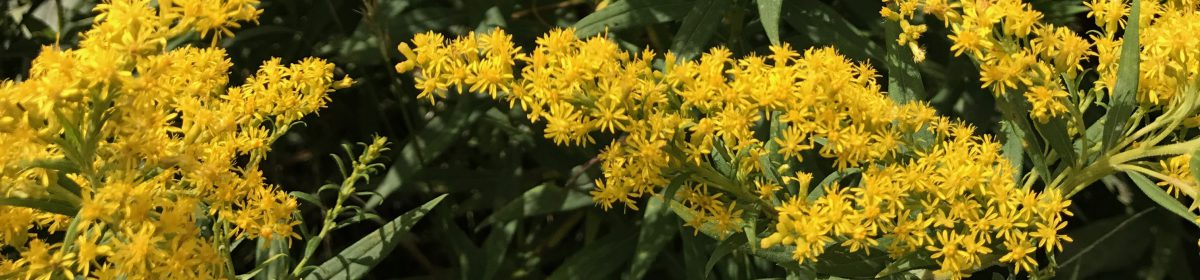
I was finally able to get the bicycle out on the road the other day. It felt great to be out on the road on a warm, sunny day again. Unfortunately I also quickly found out that bicycling takes an entirely different set of muscles than jogging on a treadmill does. It’s going to take a while before I’m comfortable doing 10 or 15 miles, but it was worth it. The frogs were singing, the sun was bright, and the wild flowers alongside the road had me stopping every once in a while to take photos.
So, here’s some photos… Oh, click one of the photos to start a slide show of the full size images.
5.5 inches over night. Total rainfall was a bit over 8 inches in 2 days.
May came in wet and soggy. Very wet. Yesterday morning when I got up we’d had 5 1/2 inches of rain over night to add to the nearly 3 inches we had the day before.
Between a blizzard that dumped 2 – 3 feet of snow on us in April and now the heavy rains just a couple of weeks later, I’d say that our weather could officially be called “weird”. I haven’t been out to look around much, but we went out to eat Friday night and there was some significant flooding in low lying areas, lots of roads closed, lots of areas where water was over the road. The local radio station just announced a list of roads closed due to flooding.
I haven’t had a chance to talk to the farmers around here yet about what the weather has done to their spring planting schedule, but I’m sure they’re worried. My backyard is a swamp and has been since the snow from the blizzard started to melt. Walking through the grass is a mistake because it’s covering up about 2 inches of water and if you stand still for too long you start to sink into the ground. Sigh…
This is an old house for the most part, and the foundation walls leak, so we’ve had water in the basement following the heavy rain. It’s a pain in the neck but we’ve lived in this place for almost 20 years now so we’re used to it and know how to deal with it.
It’s hard to tell from the photo but there is about an inch of water just under the top of the grass. The water way back behind the trees is the neighbor’s pond which is overflowing. Just behind the spruce tree it’s about 2 feet deep.
And out back along the property line, well, the water back there is a good foot deep or more. We aren’t going to be doing much of anything in the gardens for at least a few days. It’s going to take a while for the water to go down so we can get some work done. I think we’ll be lucky if we can start working by mid week. Oh, well.
I was down at the town’s compost site yesterday to drop off some leaves we raked before the rains hit and noted there is a huge pile of sifted compost ready to go. We’re very fortunate in that regard. The compost site is just down the street from us, an easy run with the garden tractor and trailer, and compost is free for the hauling for town residents.
MrsGF got a backyard composter thingie for Christmas, one of those things that looks like a rotating barrel on a stand. She’s going to be experimenting with that this year and see how that works out. I’m curious to see what kind of results we get from it.
Also gardening related is our rain collection system. We have a rain diverter attached to the downspout at the back of the garage. We’ve had that set up for years now and it’s been working great. We found a food grade 55 gallon plastic barrel, attached the valves and stuff to it, hooked it to the diverter, and that’s all it took. Virtually zero maintenance and it’s worked great. There isn’t enough water to keep the veggies watered, but there has always been more than enough to water all of the potted flowers and plants scattered around. The connector hose cracked over the winter and we ordered a new one from the company, but that’s the only problem we’ve ever had with it.
Radio stuff — Still don’t have the new vertical antenna up. We’ve been waiting for a weekend when eldest son can get down here because it’s a two person job to finish putting it together and getting it on the mount. I was a bit concerned about what the neighbors would think but then MrsGF pointed out that our next door neighbor has a big vertical antenna up that’s even higher than mine will be and no one complains about that, so I stopped worrying about it.
For a long time my radio equipment did little more than gather dust, but not long after Christmas I started getting interested in it again, and the reason why is FT8, the relatively new digital mode. Like a lot of other people I quickly discovered that FT8 lets me make contacts even when propagation conditions stink, as they do now, and even though my antennas are not all that good.
Long distance communications down on the shortwave bands depends on reflections of radio waves in the F layer of the atmosphere. Solar radiation causes the F layer to ionize, which causes it to reflect radio waves back down to the Earth rather than shooting straight out into space as they normally would. We are at solar minimum right now, meaning the sun is very inactive. Very few, if any, sunspots, means the atmosphere is not being ionized, which means radio waves aren’t being reflected or are being reflected very weakly generally speaking.
With my less than ideal antenna system, I normally wouldn’t be able to make many contacts. But since I started playing with the FT8 mode, I’ve made contacts in 36 different countries including ones that are notoriously difficult to reach. I’ve worked Australia, Japan, Tasmania, most of western Europe, Hawaii, Alaska, and doing that with about 70 watts of power and an antenna that is little more than a wire strung up between the garage and a couple of trees.
Despite the success of FT8, it generates a lot of controversy among some AROs who don’t consider it to be “real” amateur radio for a variety of reasons.
They don’t like the fact that is partly automated, with a computer decoding the information and issuing appropriate responses. But the fact of the matter is that AROs have been doing that for a couple of decades with packet radio, RTTY, PSK and other modes, using software that can be programmed with macros to generate automated responses.
They claim it isn’t “real” AR because the amount of information exchanged is little more than call signs, a location and a signal report. But that’s nonsense too because that’s often all you hear in a typical contact via any mode of communication on AR except for the guys down on 75 meters who go on and on and on about their hemorrhoids and hip replacement surgery or rant about politics for hours on end.
Fortunately while the detractors are rather annoying and occasionally abusive, the rest of the AR world just gets on with stuff and the attitude for most people is hey, if it works for you and you enjoy doing it and it’s legal, go have fun.
Apparently China isn’t waiting to implement the tariffs it said it would be imposing, it’s retaliating against the ill advised trade war this administration has implemented by simply refusing to buy US soybeans entirely.
Since about 30% of our soybean crop gets exported to China, if this keeps up for more than a few weeks it could potentially bankrupt a lot of US farmers who are already right on the edge financially because of low commodities prices.
I have to admit that things have been a bit slow around here after the blizzard. I’ve been spending most of my time fiddling with radio equipment and antennas, but I haven’t been entirely isolated from the real world.
While we still have some piles of snow remaining, most of the white stuff has melted off thanks to daytime temperatures that have been pushing up into the 50s. The storm did lots of damage around here, mostly from roofs caving in. It’s a miracle no one got killed. Local fire departments were busy helping out farmers by bringing out their ladder trucks and using high pressure hoses to blast snow off of roofs. They saved several barns from collapse in this area.
The Resch Center in Green Bay had it’s entry way caved in when snow falling from the dome hit the entrance. No one is sure what to do about it at the moment because the Resch Center is scheduled for demolition in two years anyway. But they do have events scheduled up until that time so they’re trying to determine if it’s cost effective to repair it, or start canceling events and just bring it down and be done with it.
Any kind of gardening is still on stand-by. It’s probably going to be a week or more before we can get out there and start working on anything except superficial projects. Still, there are signs of life out there. The lilac bushes are starting to bud, the rhubarb is starting to peek up out of the cold, wet ground, and one sure sign of spring is that I got the bike out of storage at last.
Unfortunately I rather quickly remembered that riding a bicycle uses an almost entirely different set of muscles than jogging on a treadmill. That and the fact it was only about 40 degrees out this morning kept the ride rather brief, but it was still nice to be back on the bike again.
Amateur radio stuff —
The ARRL is really pushing the FCC to expand the privileges of the Technician class license. They want to give Techs voice and data privileges down on the HF bands, claiming that this will give Technicians an incentive to eventually upgrade to a General or Extra class license and get them more interested in AR in general.
Don’t get me wrong, the ARRL does a lot to support and improve amateur radio in general, but this is one case where I think they don’t know what the hell they’re talking about. The organization seems to be under the impression that there are tens of thousands of Tech licensees out there who would love to get down on the HF bands, but for whatever reason refuse to upgrade to a General class license, and as a result they aren’t upgrading their licenses, aren’t operating at all, and eventually drop out completely.
The problem with this notion is that the Tech licensees don’t give a damn about HF. I’m sorry, but they just don’t. The Tech licensees who do care about HF quickly upgrade to a General or Extra class license, and the rest just don’t care. I’m sorry, but they don’t. I know a lot of Tech license holders who haven’t upgraded and the reason they haven’t is because either they lost interest in AR completely or the Tech license allows them to do everything they want to do.
The exam to get the General class license is just not that hard in any case. Anyone who’s already passed the Tech exam could easily pass the General with minimal amount of work. It isn’t a lack of privileges on HF that keeps Techs from upgrading, it’s a complete lack of interest in HF in the first place.
That’s what they’re calling it now, Blizzard Evelyn. We’re currently under a full scale blizzard warning and have been since yesterday. The photo doesn’t look very bad right now but we were in a lull in the storm when I took it around 6 AM. So far we’ve had about 12 inches of snow with freezing rain mixed in at times and 40 mph winds. Today they’re predicting as much as 14 inches more on top of what we already have with 50 mph winds.
Here in town it hasn’t been too bad. The buildings and trees help moderate the winds. Out in the countryside the roads are nearly impassible with whiteout conditions in many areas where the visibility is zero.
I heard one news outlet say that we’ve had more snow this April than we had during the entire winter and I suspect that might be true.
Feel sorry for the birds right now. We had a dozen or more wrens, finches, robins and mourning doves sheltering in the corner where the garage attaches to the house trying to get out of the weather.
South Mountain Creamery in Maryland is in something of a bizarre situation. The farm has it’s own bottling plant and sells milk directly to consumers, and it has the FDA going after it because it’s 100% real pasteurized skim milk is, well, 100% real skim milk and nothing else.
That’s right, the FDA claims the creamery cannot label it’s skim milk as “skim milk”. It is trying to order the creamery to label it “imitation milk product” or “imitation milk” when, well, when it absolutely is not imitation anything. The FDA claims it has to be labeled “imitation” because the product does not contain artificially added vitamins.
Now, a bit of background here. The milk you buy in the grocery store is not actually pure milk. Pretty much none of it is. It has vitamins A and D added to it. Basically the bottling plant throws a ground up vitamin pill in it. Why? Because once up on a time about 90 or so years ago, we had problems with vitamin deficiencies so the government began to mandate adding extra vitamins to milk. But the fact of the matter is that this hasn’t been necessary in, well, half a century, really. And there is actually a risk of getting too much A and D. Most European countries actually ban adding adding them to milk because of the risk of overdose. Too much D can cause heart arrhythmia and other problems and too much A can be seriously toxic as well.
Now I’m not going to get into the debate about whether or not D and A should or should not be added to milk. I just want to talk about this whole labeling nonsense because, well, according to the FDA’s own regulations, the agency’s actions in this case seem to be just wrong. Here is how FDA defines “milk”:
[Code of Federal Regulations]
[Title 21, Volume 2]
[Revised as of April 1, 2017]
[CITE: 21CFR131.110]
TITLE 21–FOOD AND DRUGS
CHAPTER I–FOOD AND DRUG ADMINISTRATION
DEPARTMENT OF HEALTH AND HUMAN SERVICES
Subpart B–Requirements for Specific Standardized Milk and Cream
Sec. 131.110 Milk.
(a) Description. Milk is the lacteal secretion, practically free from colostrum, obtained by the complete milking of one or more healthy cows. Milk that is in final package form for beverage use shall have been pasteurized or ultrapasteurized, and shall contain not less than 8 1/4 percent milk solids not fat and not less than 3 1/4 percent milkfat. Milk may have been adjusted by separating part of the milkfat therefrom, or by adding thereto cream, concentrated milk, dry whole milk, skim milk, concentrated skim milk, or nonfat dry milk. Milk may be homogenized.
(b) Vitamin addition (Optional). (1) If added, vitamin A shall be present in such quantity that each quart of the food contains not less than 2000 International Units thereof within limits of good manufacturing practice.
(2) If added, vitamin D shall be present in such quantity that each quart of the food contains 400 International Units thereof within limits of good manufacturing practice.
(c) Optional ingredients. The following safe and suitable ingredients may be used:
(1) Carriers for vitamins A and D.
(2) Characterizing flavoring ingredients (with or without coloring, nutritive sweetener, emulsifiers, and stabilizers) as follows:
(i) Fruit and fruit juice (including concentrated fruit and fruit juice).
(ii) Natural and artificial food flavorings.
(d) Methods of analysis. Referenced methods are from “Official Methods of Analysis of the Association of Official Analytical Chemists,” 13th Ed. (1980), which is incorporated by reference. Copies may be obtained from the AOAC INTERNATIONAL, 481 North Frederick Ave., suite 500, Gaithersburg, MD 20877, or may be examined at the National Archives and Records Administration (NARA). For information on the availability of this material at NARA, call 202-741-6030, or go to: http://www.archives.gov/federal_register/code_of_federal_regulations/ibr_locations.html.
(1) Milkfat content–“Fat, Roese-Gottlieb Method–Official Final Action,” section 16.059.
(2) Milk solids not fat content–Calculated by subtracting the milk fat content from the total solids content as determined by the method “Total Solids, Method I–Official Final Action,” section 16.032.
(3) Vitamin D content–“Vitamin D–Official Final Action,” sections 43.195-43.208.
(e) Nomenclature. The name of the food is “milk”. The name of the food shall be accompanied on the label by a declaration indicating the presence of any characterizing flavoring, as specified in 101.22 of this chapter.
(1) The following terms shall accompany the name of the food wherever it appears on the principal display panel or panels of the label in letters not less than one-half the height of the letters used in such name:
(i) If vitamins are added, the phrase “vitamin A” or “vitamin A added”, or “vitamin D” or “vitamin D added”, or “vitamin A and D” or “vitamins A and D added”, as is appropriate. The word “vitamin” may be abbreviated “vit.”.
(ii) The word “ultra-pasteurized” if the food has been ultra-pasteurized.
(2) The following terms may appear on the label:
(i) The word “pasteurized” if the food has been pasteurized.
(ii) The word “homogenized” if the food has been homogenized.
(f) Label declaration. Each of the ingredients used in the food shall be declared on the label as required by the applicable sections of parts 101 and 130 of this chapter.
[42 FR 14360, Mar. 15, 1977, as amended at 47 FR 11822, Mar. 19, 1982; 49 FR 10090, Mar. 19, 1984; 54 FR 24892, June 12, 1989; 58 FR 2890, Jan. 6, 1993]
If you can wade through the legalese up there, you will note that “milk” is specifically defined, and it says things like “if” vitamin A is added, and “if” vitamin D is added, they must be at certain levels. But it doesn’t say they mustbe added for the product to be called “milk”. Nor does it say anything about a requirement to label milk as “imitation” if they are not added. So if this is accurate, FDA’s claim that this creamery’s skim milk must be labeled “imitation” is not in keeping with FDA’s own regulations.
Now there may be some regulation, somewhere, that requires milk to have added A and D in order to be called “milk” but I haven’t managed to find any regulations that state explicitly that in order to label something “milk” it must have A and D added to it.
This isn’t the first time this issue has come up. About a year ago there was a case in Florida where the state claimed the Ocheesee Creamery couldn’t label it’s skim milk as “skim milk” and had to call it “imitation skim milk”, despite the fact it was 100% skim milk. The state lost and lost badly, ending up with the 11th US Circuit Court ruling against the state and Florida having to pay almost half a million dollars.
The other thing I find curious is that despite the fact that the FDA has a rather strict definition of the term “milk”, i.e. “Milk is the lacteal secretion, practically free from colostrum, obtained by the complete milking of one or more healthy cows.”, it doesn’t seem to have a problem with various nut and legume juices and extracts labeling themselves as “milk”, such as soy milk and pea milk and almond milk.
While we have tulips coming up here in the house and we’ve started flats of seeds in preparation for warm weather, outside it has been decidedly odd. We’ve had more snow now in the first week of April than we did in in most of the winter and outside it currently looks like this:
Ah, spring in Wisconsin! The warm weather, the April showers, the… the snow…
Not exactly what you expect to see when you look out the window on April 7. Tuesday and Wednesday we had winter storm warnings all day long and ended up with about 6 inches of snow here, with some areas getting up to 10. Most of that melted but then we got another couple of inches a couple of days later and there is more snow in the forecast. We’re looking at near record low temperatures in some parts of the state today.
Indoors, though, we’re proceeding on schedule in the hopes that maybe we might get some warm weather. Someday.
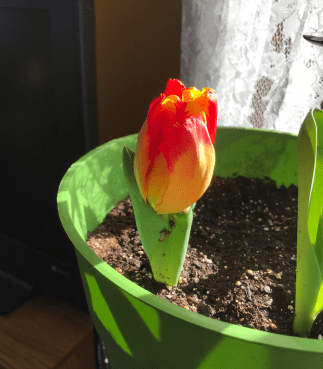
The tulips MrsGF potted up a few weeks ago are still going strong with new blooms popping up and it certainly improves my mood when I walk in the room and see those brilliant yellows and reds. I’m really glad she came up with the idea of potting up some old bulbs. It really brightens the place up.
We sat down the other day to sort through the “Bag ‘o Seeds’ we got for Christmas and figure out what we wanted to plant this year, what had to be started indoors and what could be direct seeded, etc. Then we brought up the little portable greenhouse thingie from the basement and set that up.
That’s this thing over here. It’s a folding metal frame with three racks in it with a vinyl cover over the top. It provides an ideal environment for starting seeds. It stays warm and moist inside and lets in enough light to keep things grown and nice and warm in there. Also prevents temperature fluctuations inside the house from harming the plants.
We found a floor pan for a shower that was the ideal size to fit under it to protect the floor. MrsGF already has it filled with flats with seeds, and we already have some tiny little seedlings peeking up through the starter mix.
It works great and was pretty cheap, too, under $40 if I remember right. It’s easy to set up.
It has the added benefit of keeping the cats out as well or you can be sure they’d be in there digging around, nibbling on plants, tipping things over, etc.
MrsGF has been just as sick of looking outside at the brown wasteland that is March here in Wisconsin as I have, so she shoved some old bulbs into pots and put them in a sunny window a few weeks ago and this is what we have now. Great fun to see tulips starting to pop open again.
That’s not to say that there aren’t things growing already. She was outside looking things over yesterday and discovered that the chives are already six inches tall over in their protected corner. They’re always the first things to spring up and they’ve been ridiculously prolific. We put those in shortly after we bought the house so they’ve been going strong for almost 20 years now.
The big question now is sod, as in how are we going to get rid of it. There is a pretty big section of lawn we want to rip out to expand one of the gardens here, and getting rid of
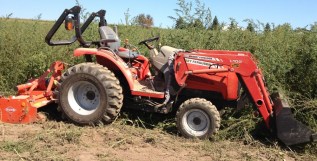
This was the little Massey. Fun, useful little tractor but keeping it in town was a bit ridiculous
the sod is always a pain in the neck. I sold my tractor a couple of years ago. After selling the farm we kept the little Massey for a while, but keeping it was a bit silly. It was mostly in storage over at the farm of a friend about 8 miles from here and there it sat until we needed it perhaps for one afternoon a year. So keeping it and its trailer was ridiculous. So it looks like I’ll resort to the good old fashioned dig it up with a shovel method as soon as the frost is completely out of the ground.
MrsGF and I were sorting through seeds and tentatively making plans earlier this morning. We were thrilled when Eldest Son gave us literally a whole shopping bag of seed packets for Christmas, but we have to be realistic. We can’t grow all of it as much as we’d like to. And there are quite a few that we don’t really like or couldn’t use. Neither of us like melon all that much, and it takes up a lot of space, so those got set aside. Same with eggplant. Don’t get me wrong, eggplant is a perfectly delightful vegetable. But that one summer our eggplant was so ridiculously prolific that we got so sick of eating eggplant that we can’t really stand looking at them any more.
We brought up the little portable greenhouse rack we use to start seed and MrsGF is in the process of starting trays of seeds even as I write this.
Amateur Radio Stuff
I’ve been having a lot of fun with the FT8 mode over the last couple of months. Even with my seriously bad antenna system I’ve had a couple of hundred contacts and have managed to hit something like 35 different countries, including some really long distance contacts with Hawaii, Alaska, Japan and Tasmania.
I’ve even started playing with PSK again and have made a few contacts with that mode as well. Unlike FT8 you can actually chat with people using PSK. Unfortunately it seems most PSK users have jumped ship for FT8 and seeing a PSK signal on the bands has been a rather rare thing. Even more annoying is that the powers that be decided that on 17 meters the frequency recommendation for FT8 mode is the same one as the PSK allocation, so PSK on 17 meters is a lost cause because the frequency is swamped with FT8.
I’m hoping to get this puppy up in the air this spring. It’s already mostly assembled out in the back yard and we have all the hardware for mounting, including the tilt-over base. It’s a GAP Titan multi-band vertical antenna that should help to give me a significant boost over the OCFD I currently have hanging out there now. This one is going to replace the Comet 250 vertical I have and which is… Well, let’s face it, the Comet isn’t that good of an antenna. It can only handle about 240 watts and to be perfectly frank I’m amazed the thing works at all.
I also have a 40 foot antenna tower laying out in the backyard that will hopefully get set up sometime this summer. Of course I said that last summer, too. And the summer before that…
Even though today is officially the start of spring it sure doesn’t feel that way. Temperature around 34 degrees, cloudy… We’re impatient to get outside and do something again.
Nevertheless, I had the camera out and was taking some photos of the indoor plants, some of which are flowering right now.
This guy is sitting in the kitchen window at the moment. Those flowers are only about a quarter of an inch across. Here’s another shot of a different cluster of flowers on the same plant with different lighting…
That camera does a great job taking closeups like that.
Another plant in flower at the moment is this one:
I love this plant. The color of the leaves, the texture, and those tiny little pink flowers that are about the size of the head of a pin. It’s a lot of fun.
MrsGF’s violets are in full bloom too right now:
Then there’s this really weird plant…
That’s Kai. I’m very surprised she held still long enough for me to get that photo. She usually runs away when she sees me with a camera.
And now, on to the stupidity…
Nothing makes me look dumber than when something goes wrong with my radio equipment sometimes. This one was a real gem, though.
For some reason the TS-990 decided to stop transmitting AM and I couldn’t figure out why. Everything seemed to be working just fine otherwise. I could still use SSB, the digital modes, FM, all were working fine. But when I keyed the mic using AM, it would go into transmit mode, but no signal.
I spent something like two hours this morning trying to diagnose what the problem was. As a last resort I got out my morse code key and hooked that up. Not sure why. Just was trying to eliminate other things as problems. I tried sending my callsign in CW and…
And nothing. Same symptoms as the AM problem. It went into transmit, but no signal, no power going to the antenna.
Hmph… I went on line and searched around, found out there was an update for the radio’s firmware, so I downloaded that and installed. That went well. In fact, better than well because now the noise blanker works the way it’s supposed to and some other little things were fixed. But same problem as before, no AM and no CW.
I pulled out the manual once more and started to dig through that and…
Oh. Oh, brother… All right, look, the 990 is a very complicated piece of equipment. I mean it has controls and knobs and buttons on it that I’ve never used in the almost four years I’ve owned the thing. So I suppose I can be excused for not noticing this.
Most of the knobs on the radio are “nested”, that is there is a central knob that controls one function, and an outer ring around the central knob that controls an entirely different function.
The Power knob which controls the rig’s output power is the central knob. The outer ring is something labeled “Car” which stands for carrier. The carrier setting is essential to transmitting in CW and AM modes. I normally have it set dead center right in the middle. But since I almost never do CW or AM I almost never touch it. But I do use the Power knob to adjust the wattage going out to the antenna or feeding into the amplifier.
Somewhere along the way, the Car knob got a bit sticky and started to track along with the Power knob when it was turned. But only in one direction: down. When I turned the power down, it was also dragging the carrier knob down towards zero, but not dragging it back up when the power was turned back up. Eventually the carrier was turned down to nothing. So without a carrier, there was no AM or CW.
Sigh… Spent more than two hours trouble shooting a problem that didn’t really exist. All I had to do was turn the Car knob back up to the center position and all was well.
And now I just found out my amplifier relay isn’t working… How did I get into this hobby in the first place?
“The nation’s dairy farmers are facing their fourth year of depressed milk prices. The outlook is so bleak, it’s increased worries about farmer suicides. One recent outreach effort drew criticism.”
The situation for dairy farmers in 2017 was not good. A lot of diary operations are running right on the edge, trying to stay profitable at a time when there is ever shrinking demand for liquid milk for drinking, and a glut of other dairy products like cheese, butter and powdered milk. This story above from NPR illustrates just how bad the situation is getting. Go read the article if you have the time. It isn’t very long.
If you don’t have the time, here’s a brief summary: A dairy co-op in the north east US, Agri-Mark, has seen three of it’s farmer members commit suicide in the last few years. Agri-Mark makes Cabot cheese among other products, and has about 1,000 members. In February when it sent out the milk checks, it included a chart showing just how bad the dairy market was looking for the upcoming year, and a list of suicide prevention hotlines. The reporter talked with Will Rogers, who milks 75 cows in Massachusetts, who is having a difficult time keeping above water. Even more upsetting is the fact that his own father who used to own the farm, killed himself because of financial problems.
While the letter from Agri-Mark was probably well intentioned, it certainly added to the stress a lot of it’s farmers are already facing and Rogers says in the article, it might push some farmers so far that they think “there’s no point in going on.” Agri-Mark certainly could have done a better job of trying to communicate with it’s farmer members.
And as if dairy farmers don’t have enough problems, they are increasingly worried about being able to sell their milk at all. Dean Foods just told at least two dozen farmers in Pennsylvania, Indiana, and four other states that Dean will no longer take their milk as of May 31, leaving them scrambling to find a milk processor they can sell their milk to.
The same thing happened here in Wisconsin last year about this time when Grassland rather abruptly dumped a group of farmers, leaving them to desperately try to find a market for their milk.
The article at Dairy Management about Dean seems to be trying to blame Walmart for Dean’s decision. Walmart used to buy it’s in-house brand milk from Dean, but Walmart is building it’s own milk processing facility in Indiana which will come on-line in May, so Dean is going to be losing a significant amount of sales as Walmart switches to product coming from it’s own production facility.
Certainly there is enough blame to go around, but everyone is ignoring the fact that the real reason behind almost all of the money difficulties dairy farmers are having is over production. They are producing more product than the market really wants, which is pushing prices down lower and lower.
There are various marketing boards, government agencies and others trying to help the situation, but almost all of them are focusing on one thing, trying to increase sales of a product that increasingly people don’t really want, and shouldn’t be eating much of. At at time when a recent study just found that 75% of the people in this area are overweight, we have government agencies and marketing boards trying to convince food makers to shovel ever more cheese into their products.
Seventy-five percent. Think about that for a moment. We are facing a national health crisis due to people eating too much of what is bad for them, with government agencies and others trying to figure out how to help people get their weight under control, and at the same time other government agencies and marketing specialists are trying to get food manufacturers to drastically increase the amount of cheese they use in their products.


 That’s what they’re calling it now, Blizzard Evelyn. We’re currently under a full scale blizzard warning and have been since yesterday. The photo doesn’t look very bad right now but we were in a lull in the storm when I took it around 6 AM. So far we’ve had about 12 inches of snow with freezing rain mixed in at times and 40 mph winds. Today they’re predicting as much as 14 inches more on top of what we already have with 50 mph winds.
 The tulips MrsGF potted up a few weeks ago are still going strong with new blooms popping up and it certainly improves my mood when I walk in the room and see those brilliant yellows and reds. I’m really glad she came up with the idea of potting up some old bulbs. It really brightens the place up.
 That’s this thing over here. It’s a folding metal frame with three racks in it with a vinyl cover over the top. It provides an ideal environment for starting seeds. It stays warm and moist inside and lets in enough light to keep things grown and nice and warm in there. Also prevents temperature fluctuations inside the house from harming the plants.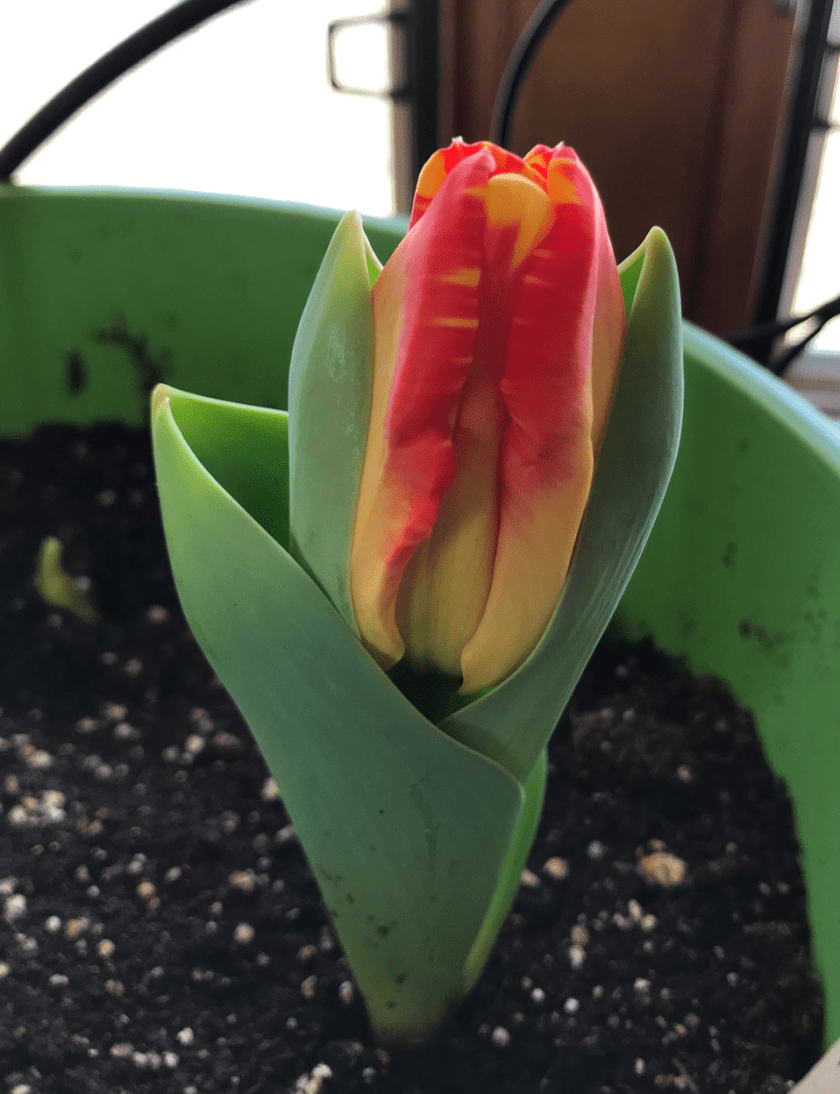

 I’m hoping to get this puppy up in the air this spring. It’s already mostly assembled out in the back yard and we have all the hardware for mounting, including the tilt-over base. It’s a GAP Titan multi-band vertical antenna that should help to give me a significant boost over the OCFD I currently have hanging out there now. This one is going to replace the Comet 250 vertical I have and which is… Well, let’s face it, the Comet isn’t that good of an antenna. It can only handle about 240 watts and to be perfectly frank I’m amazed the thing works at all.