
I had a chance to get outside with the SeeStar last night shortly after dark and got some surprisingly good images. Here are three.
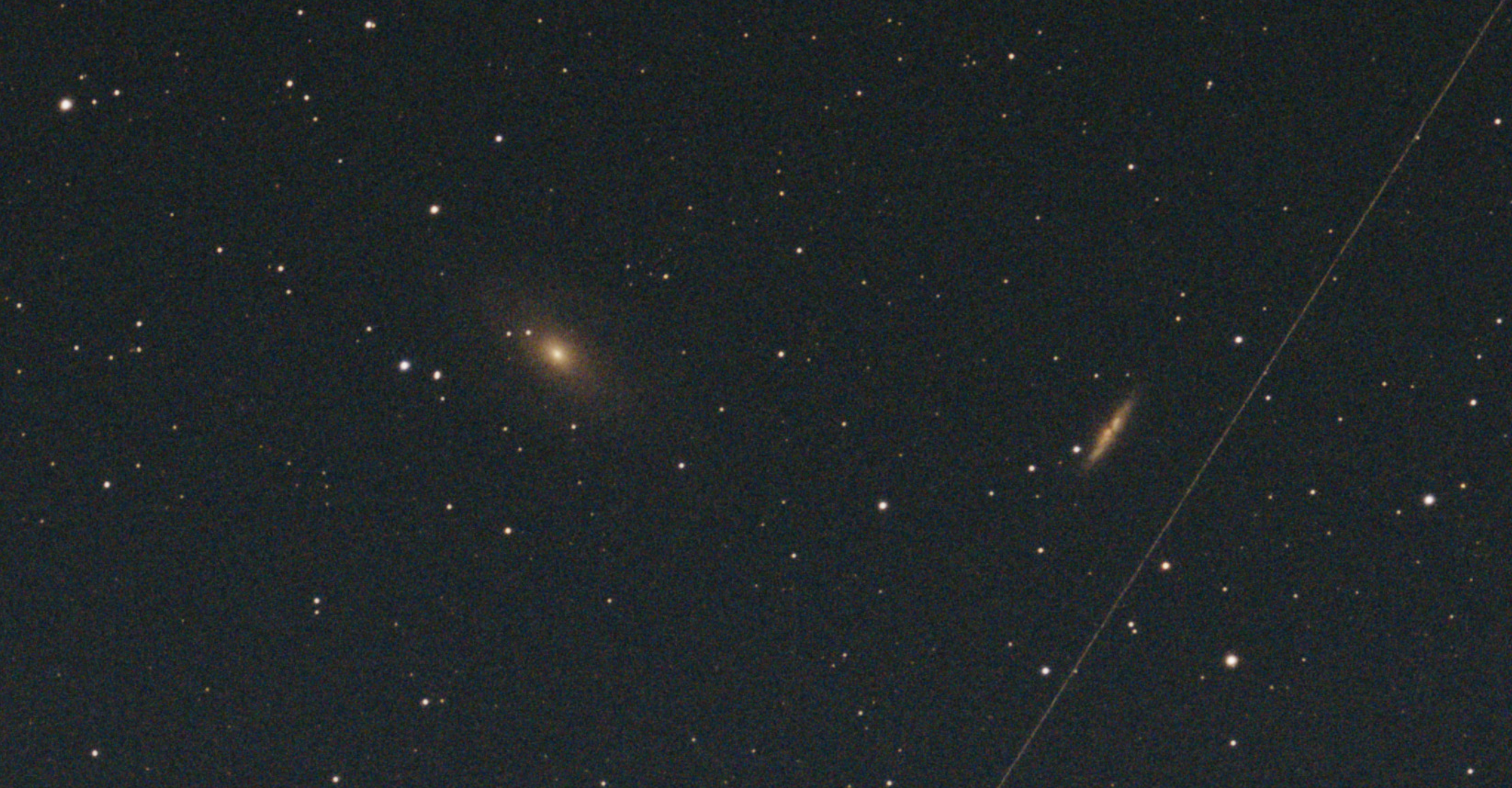
That’s M81 up there, that fuzzy blob just left of center. The more slender cigar shaped blob to the right of center is M82, another galaxy. The long streak you see to the right of M82 is from a satellite that streaked across the frame while the scope was making the image.
But a bit about the “M” designation first. It is the abbreviation of the name Messier, an 18th century astronomer from France. He published an astronomical catalog of about 110 objects that are now known as Messier objects, abbreviated as just M. Messier’s obsession was comets. He was fascinated by these fuzzy, blob like “visitors” and hunted for them whenever he had the chance. But he kept finding a lot of things that, with his primitive observing equipment of the time, looked like fuzzy blobs just like comets, but weren’t. Unlike comets, these objects did not appear to move, therefore they weren’t comets. So he started to chart these comet-like objects so he and other astronomers wouldn’t waste their time thinking these things were comets. The final catalog he published had 103 such objects listed, and eventually researchers discovered he’d found several more so now we have some 110 Messier objects. The objects in the catalog were not ones he studied scientifically, he thought they were annoyances, really.
The Messier object catalog and the “M” designation of these objects is still used even by scientists today because they are some of the brightest and most easily found deep space objects out there, and they are among the most popular targets for amateur astronomers.
Messier had absolutely no idea that when he was looking at M81 he was looking at a massive galaxy about 12 million light years away. In fact M81 and M82 are actually part of a whole group of galaxies known collectively as the M81 group.
M81 is a large, grand spiral type galaxy and is the home to a massive central black hole. It is relatively bright at my location this time of year and it is almost directly overhead, making it an ideal target at my extremely light polluted home.
It is called Bode’s galaxy (or sometimes Bode’s Nebula) because it was first discovered in 1794 by an astronomer named Johann Bode, not Messier, and was later included by Messier in his catalog.
If you can see M81, you can almost certainly spot M82 as well right away. It is also about 12 million light years from us and is part of the same group of galaxies. M82 is seen edge on and is sometimes called the Cigar galaxy. It is an extremely interesting one too because it is what astronomers call a starburst galaxy. It is generating new stars at a rate that’s 10 times that of the Milky Way. It is believed that the reason why is that M82 had a close encounter with M81 in the past, and gas it sucked up from M81 along with the gravitational disturbances the encounter caused are responsible for this.
Both M81 and M82 are relatively easy to see. A decent pair of binoculars will let you see at least a couple of small, fuzzy blobs at a dark site. A good telescope will show them in much more detail, of course.
Now we come to M97
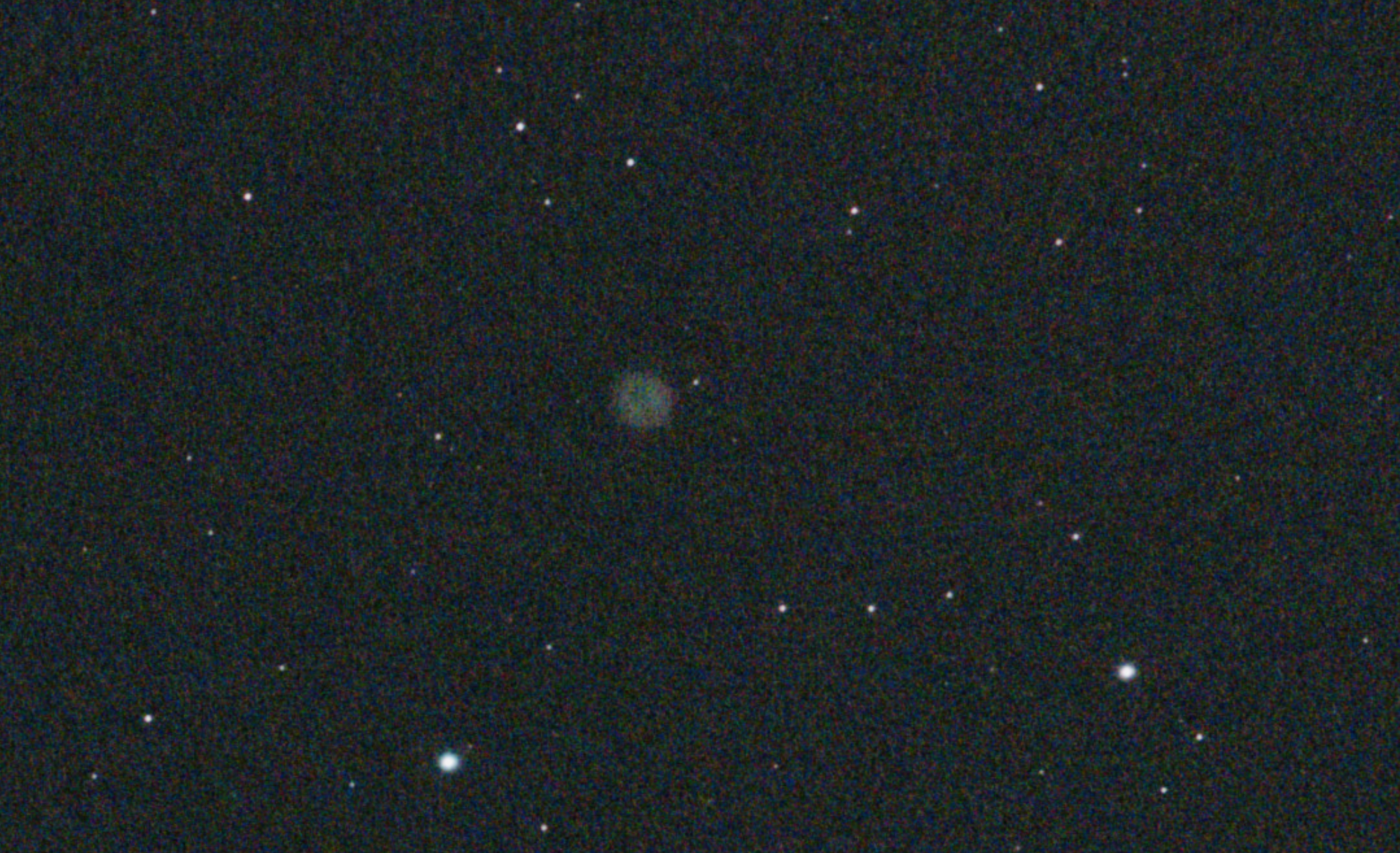
That’s M97, also called the Owl Nebula. Not a very impressive image, I know, but that I could get an image of it at all from this location is a bit astonishing.
M97 is an entirely different kind of object. It’s a planetary nebula about 2,000 light years away. It’s called the Owl Nebula because some people who observe it under high magnification and large telescopes claim that it looks like it has two dark “eyes”. Personally I think they knocked back a few too many Schlitz (real astronomers drink Schlitz, of course. Or Grain Belt. But now that Schlitz is shut down they’re going to be stuck with Grain Belt.) before they started observing but, there you go.
That I was able to get an image this good with just a 4 minute exposure with this tiny telescope astonished me, frankly. When I computer enhance the images I can even see the two dark “eyes”.
The last object I imaged is M57, the Ring Nebula.
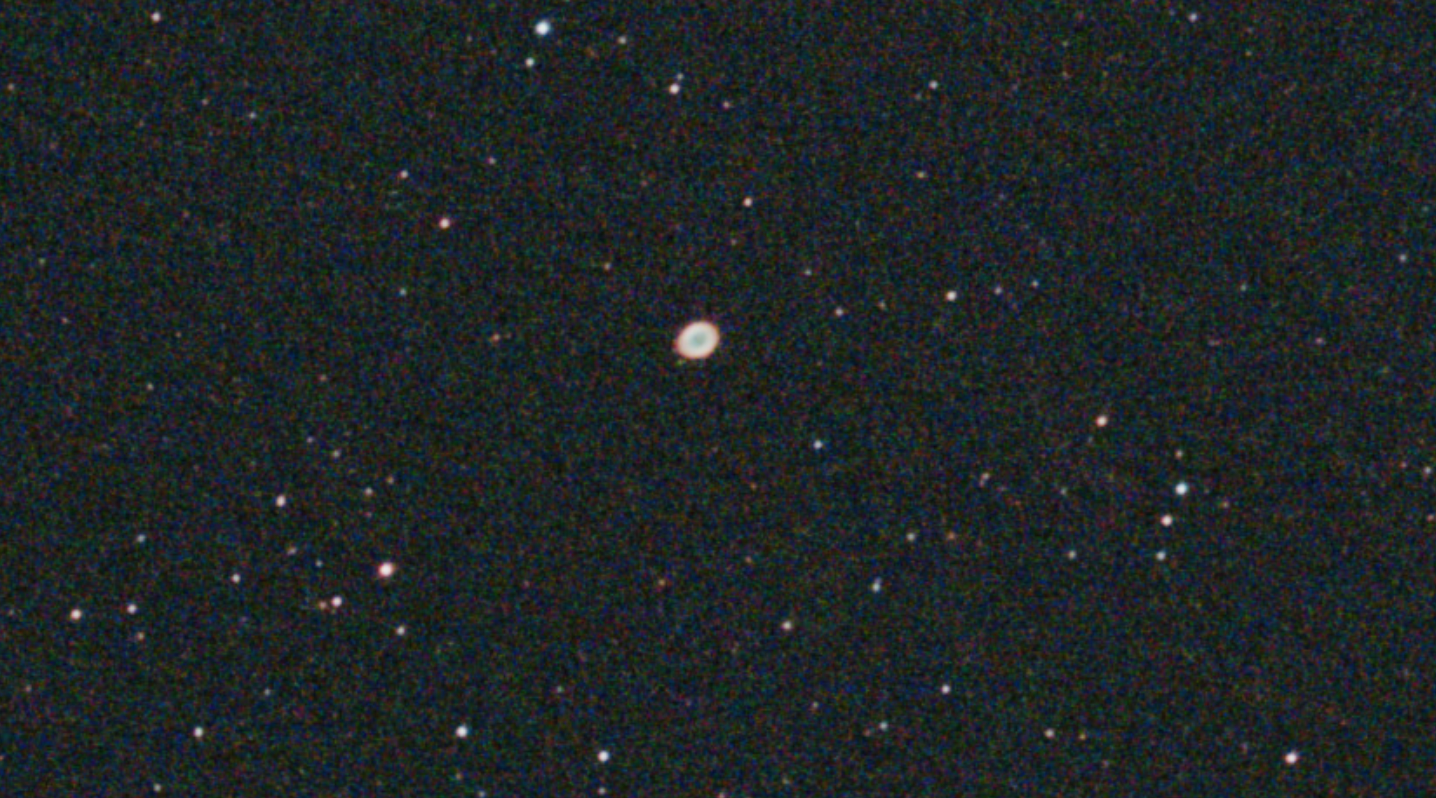
This is another planetary nebula and I was amazed the image turned out at all because the scope was aimed just off to one side of a street light that really should have ruined the image completely. It’s about 2,000 light years from Earth and while relatively bright and easy to see in even a fairly small scope, trying to get an image of it with the conditions I have here was a bit astonishing.
I am extremely pleased with the Seestar so far. After working with the 11″ Celestron for so long, getting results like this from a scope not much bigger than a hard cover book seems almost like magic to me. If I’m getting results this good from my terribly light polluted location here, what will the results be like when I get it out to a relatively dark site like my sister in law’s farm? I can’t wait to try that.


I know zip about our galaxy, but the sheer size of it just blows my mind. Great to see your photos from the new telescope, I ma sure that you are delighted with it already.
Best wishes, Pete.
LikeLike
I’m absolutely thrilled with the thing so far. That I’m getting results like this, without even having read all of the instructions and just winging it, in this location surrounded by street lights and decorative lighting, is amazing.
LikeLiked by 1 person
Where I live there is almost zero light pollution after dark. I’m sure you would get some amazing photos here, but I cannot justify spending $500 when I know so little about what I am looking at.
LikeLike
I am definitely envious! What irks me is that almost all of these lights around me are entirely unnecessary, they’re decorative only. One of my neighbors has his whole yard lit up like circus. Why? No one’s out there to enjoy it so why waste the electricity? Oh, well.
LikeLiked by 1 person
An expensive toy but worth it to be able to see some of the wonders of the universe, right?
LikeLike
I’ve always been fascinated with astronomy, space, all of the “stuff” floating around out there, our intimate relationship with the stars, etc. The atoms that we and everything around us are made from are due to the dying explosions of supernovas that created the heavier elements. If you stop and think for a moment that the atoms of your body were created in a cataclysmic explosion of a massive star, it’s all rather awe inspiring.
LikeLiked by 1 person