I have about 7,000+ photos in the archive and I keep telling myself I really, really need to sort them all out somehow because there’s stuff in there I’d really like to keep and possibly make prints of, and stuff that should just be deleted. I got bored this morning and started doing some sorting, so here’s a few I dug up in no particular order because why not? Some I haven’t published before, some I have. They’ve more or less been selected at random for no real reason.
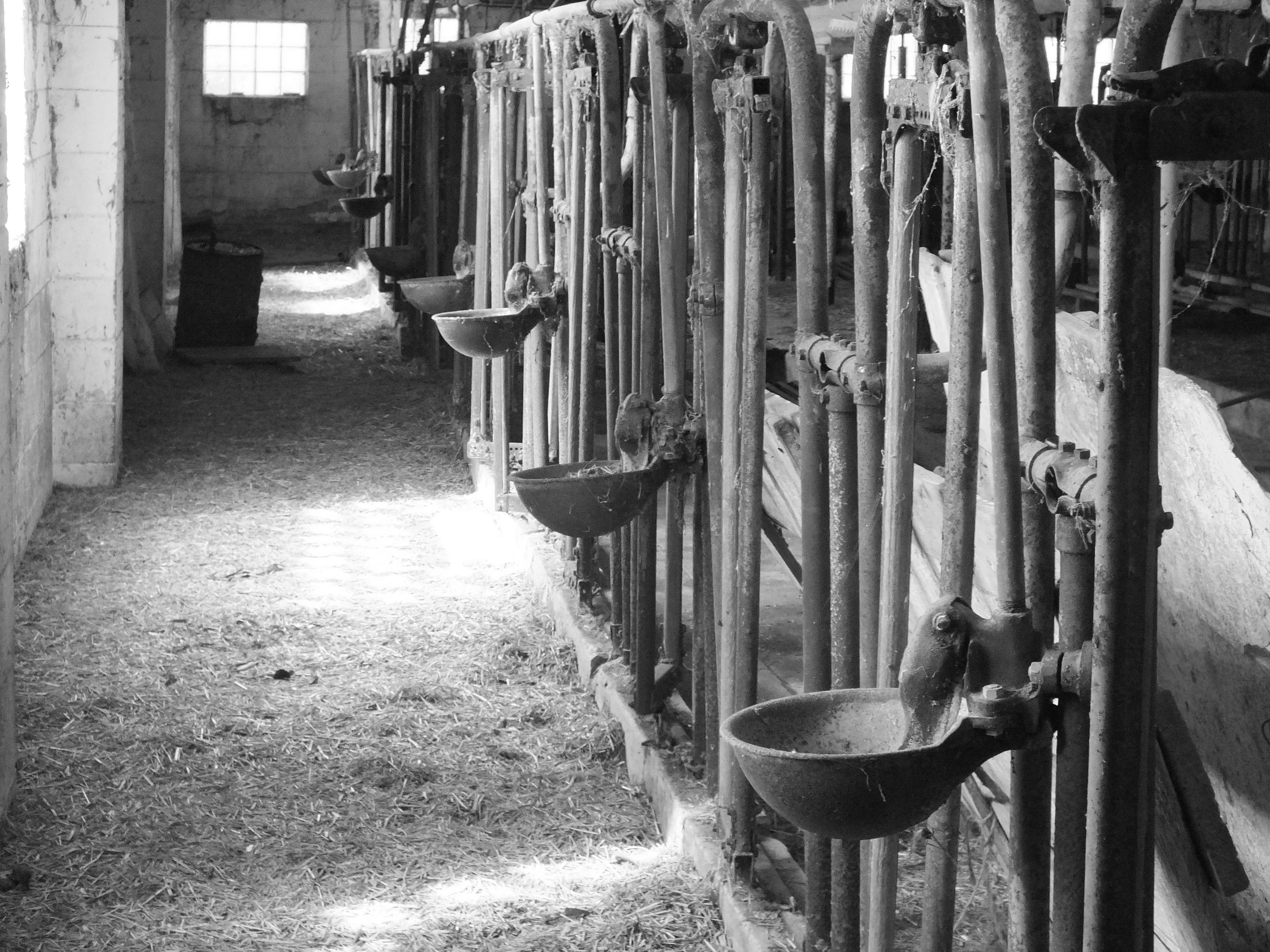
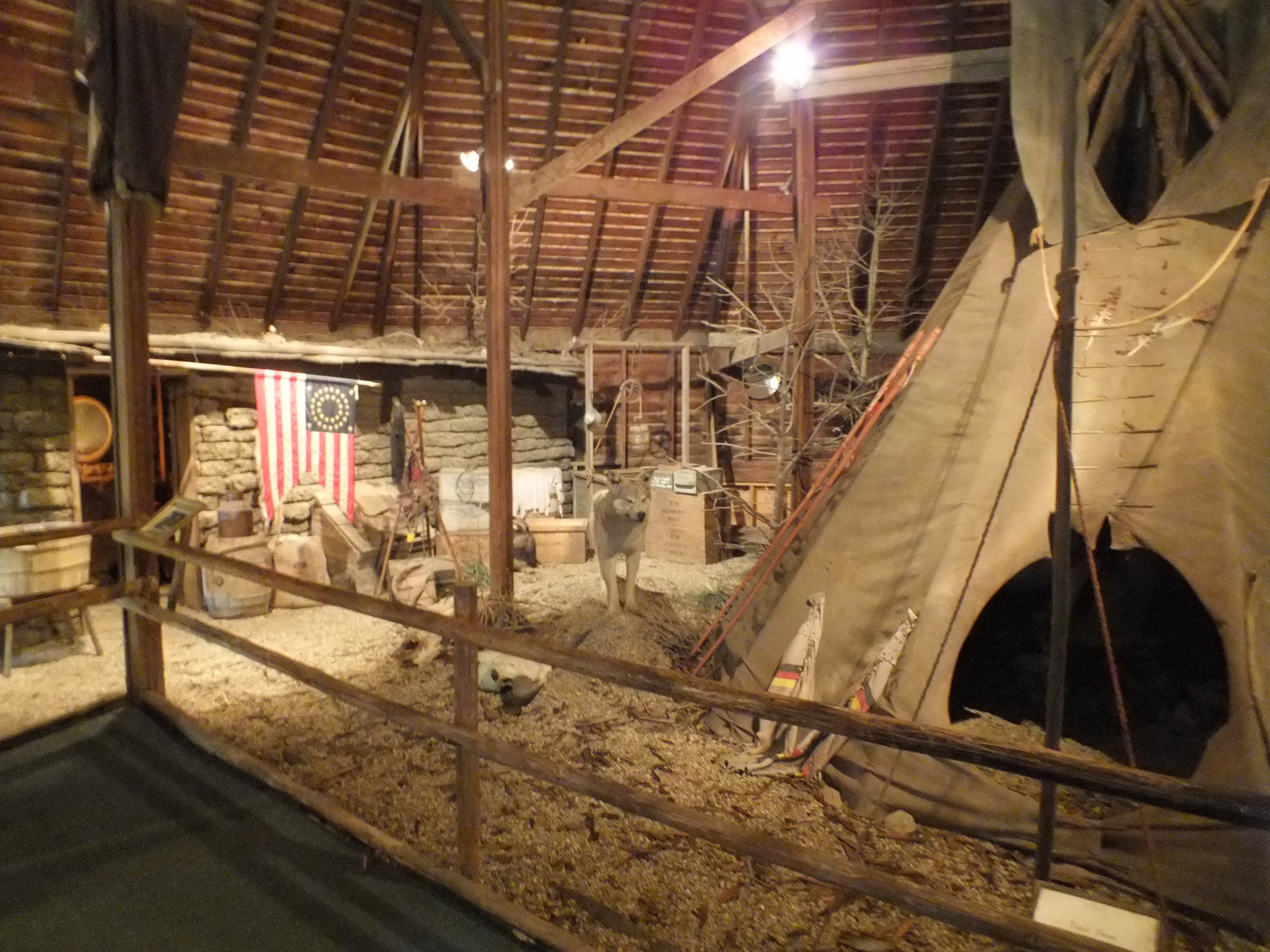
I’m a real sucker for roadside attractions. They’re often silly, cheesy, ridiculous, sometimes inexplicable. This place allegedly bought up all of the movie props from Dances With Wolves and then used them to recreate scenes from the movie. I haven’t seen the movie. My wife chased me out of the room when she watched it because I couldn’t stop laughing. Everything in this place was covered with a thick layer of dust. It was really rather sad.This was supposedly a recreation of a late 1800s classroom. What’s really sad is that those are exactly the same type of desks I had when I was in the 1st and 2nd grade. Seriously. That should give you a hint that either my school was really, really bad, or I am really, really old.Not many people have a hot air balloon land on the road in front of them. I wasn’t in a hurry so I just pulled over and watched them recover the balloon. They were actually pretty lucky. They were coming in from the right and if they hadn’t hit the ground where they did they would have hit the power lines on the left.Did I ever mention I’m an amateur astronomer? Technology has gotten so good that we amateurs now have access to equipment that even professional astronomers would have drooled over twenty or thirty years ago.Alien cat from outer space with laser eyes.
Well it was a wild ride on the commodities market this past week as corn hit $7.40 and soybeans hit $15.71. We haven’t seen prices like this in something like ten years or more, and a lot of people are puzzled by why the commodities prices have spiked up this high, this fast. There are no natural disasters or reports of extreme shortages that would cause this, so what’s going on?
It’s a combination of things that have made the markets a wee bit nervous. China is trying to rebuild its pig herds after they were decimated because of culling from African Swine Fever, so there is increased demand there. There are weather problems in parts of South America that are interfering with some corn production down there. USDA announced that US farmers are going to plant less corn this growing season. The reduction isn’t much, but enough to make people think it might make supplies tight. They think people are going to be driving a lot more this summer which is going to mean increased demand for gasoline which, in turn, means more demand for ethanol to meet the blending requirements.
So here we are with corn at 7.49 at the moment. Extended out into the future commodities prices get more reasonable, but not by much. July corn is sitting at 6.73 which is still high but not utterly horrible, and September corn is at 5.92
So, why should you be interested in corn prices? Because volatility in corn prices ripples through the whole economy. High corn prices mean it costs a lot more for the dairy, beef, chicken and pork producers to feed their cattle. That’s going to put pressure on consumer food prices across the board, not just dairy products and meat. High corn prices can force producers to look at other grains like wheat to substitute. That can push wheat prices up, increasing costs for flour, which increases the cost of baked goods. Well, you get the idea.
It also puts pressure on fuel prices. The government mandates that refiners blend a certain amount of ethanol into their fuels, and in the US the majority of that ethanol is made from corn.
Now the markets can absorb some of these increased costs, but not a lot and not for long, and sooner rather than later it’s going to result in increased prices on consumer products. So if corn prices stay this high for much longer, you’re going to see that rippling out into increased prices on food, fuel and other products that you buy yourself. Some companies like General Mills and a few others have already already announced that they’re going to have no choice but to start raising consumer prices. Wholesale beef prices have gone up about 33% already this past month.
And it isn’t just food. Just look at the craziness going on with lumber. And speaking of lumber…
What The Hell Is Going On With Lumber?
That’s a question a lot of people are asking because lumber prices have gone nuts. Prices on lumber have spiked up around 360% in just the past year. That is not a typo. 360% in one year. I was paying under $2 for 2×4 studs last year, now that’s up to around $7 each. MrsGF and I have pushed back plans to do a few remodeling projects here at the house because not only have prices skyrocketed, it’s hard to get materials even at those prices. I talked to one contractor who builds houses. he bid on building one house late last year at $350K and now the same house would be closer to $450K.
Why this abrupt spike in prices? It isn’t because there’s a shortage of trees or something like that. Nor are the people growing trees getting the money. They’ve seen only a 2% increase in the price they’re getting for the logs. It’s all the haulers, sawmills and processors in between that are the cause.
The claim is that it’s being caused by a labor shortage. They can’t find truck drivers, workers at sawmills, tree cutters, etc.
Herbicide and Plastic Shortages
As if corn and lumber prices weren’t enough to worry about, we’re also seeing shortages of herbicides, insecticides, fungicides and, believe it or not, plastics. Farmers are having trouble finding things like field drainage tile and the plastic wrap used to protect bales. There are reported shortages of glyphosate and some other herbicides, some fungicides and insecticides that are used to prevent weeds and protect crops.
What this all adds up to is considerable pressure to increase prices. Someone has to pay for all of these increased costs and in the long run that’s going to be us, the consumers. How bad those increases will be, well, I have no idea. It is going to depend on how long commodities prices remain high and how much of the cost increases the industry is willing to absorb before they have to raise prices. As I said earlier in this, a lot of companies have already announced price increases.
Dairy Pride Act
So, let’s talk about plant based “milk”. I didn’t really want to talk about things like almond milk and all that, but it’s in the news again thanks to the Dairy Pride Act being pushed by Sen. Baldwin from Wisconsin and a few other politicians.
The whole problem revolves around that one word, milk, and how it is defined. There are two real definitions of the word, one biological, and one legal. Biologically speaking milk is the scrections of the mammary glands from mammalian animals and which are used to feed their young. The legal definition is, well, here’s a direct quote from federal government regulations:
“Milk means the lacteal secretion, practically free from colostrum, obtained by the complete milking of one or more healthy cows, which may be clarified and may be adjusted by separating part of the fat therefrom; concentrated milk, reconstituted milk, and dry whole milk. Water, in a sufficient quantity to reconstitute concentrated and dry forms, may be added.”
You will undoubtedly note a lot of problems with the above. The most glaring problem is that it claims milk only comes from cows, ignoring the fact that goats, sheep, horses, oxen, even beavers, give milk. (Mmmm, beaver milk. Yum. Wasn’t there an old Monty Python joke about Peruvian beaver cheese?) (Sorry, my mind just flashed up an image of a farmer trying to milk a beaver. That’s just the way my brain works. It scares me sometimes. My brain, not beavers.)
So, here’s the problem. For years now certain companies have been selling nut, grain or bean based liquids as substitutes for dairy milk and calling the stuff milk. This is, technically, illegal. The US has very strict labeling requirements when it comes to food, and the government has gleefully gone after a host of companies and individuals who mislabel their products. But not when it comes to this stuff. For whatever reason the agencies responsible for food labeling accuracy have blithely ignored the mislabeling of these products, despite a considerable amount of pressure from the dairy industry to do something about it.
Now you might think this whole thing is silly, and you do have a point. But on the other hand the anger of the dairy industry is understandable as well. The dairy industry has spent many, many decades and hundreds of millions of dollars in advertising, propaganda, health claims, puffed up PR campaigns and other efforts to try to make its products appear to be healthy, good for you, pure and wholesome, and even essential. And then along come these upstarts trying to cash in on all of the work the dairy industry put into making milk look good, and claiming that their products are “milk” as well, and, well, they’re pissed.
Legally speaking, the dairy industry has a valid point. This stuff does not meet the legal definition of “milk”. US food labeling laws, if strictly interpreted, should make the labeling of this stuff as “milk” to be illegal. But the court system doesn’t seem to see it that way and has let this continue, so, well, here we are then.
Politicians from large dairy states like Wisconsin are upset about this as well because, well, let’s be blunt here. The only reason they’re upset is because the dairy industry is paying them to be upset. The dairy industry pumps huge amounts of money into the coffers of these politicians and their PACs. The result is this Dairy Pride thingie which basically says that you can only label actual milk as milk.
Will this actually go anywhere? I have no idea. If it passes, will it help the dairy industry? No. Won’t do a thing to help the dairy industry. Will it hurt the fake milk industry? Probably not. They’ll just come up with something else to call their stuff, pump a few more bucks into their advertising budgets, and that will be it.
Now, let’s see, what else did I want to babble about? There was some more stuff… Oh, amateur radio! Gads, almost forgot about that.
My OCFD (that’s an “off center fed dipole” for you non-radio people out there, a kind of antenna) came down again. That is a long wire antenna, about 130 feet long in total. It had snapped before and I’d repaired it and put it back up, but it snapped again now, so I figure that years of hanging in the air and flapping about in the wind has caused metal fatigue or something in the wires, so I didn’t bother fixing it again. It’s going to come down and I already have another one on order. Why not build my own? I could, but I did mention about the lazy thing, right? Why build one when I can buy one that’s probably going to be better than I could make myself.
Meanwhile I’m using a GAP Titan DX vertical antenna which has turned out to be way, way better than I’d hoped. I’ve had that one up for some time now and it works amazingly well. I had contacts with 3 Japanese stations in the space of about 10 minutes yesterday afternoon using less than 100 watts output, plus one or two in Europe and in other exotic places like Texas, New York, etc.
Who wants to sit in a basement workshop when stuff like this is outside?
My woodworking and wood turning has come to a screeching halt recently because I’ve been spending a lot of time out in the gardens hauling compost, tilling up stuff, etc. We got the onions and garlic in but it’s still too early to put anything else out. The weather hasn’t exactly been warm here except for two days when it was in the mid 80s. Generally it hasn’t gotten much above 50 here, with night time temps pushing down into the mid 30s or even a bit lower. That hasn’t kept the tulips from blooming though as you can see from that photo up there.
But back to wood working to wrap this up. I really enjoyed making decorative lamps with resin and wood and want to do some more of those, so I’ve got more resin on order and that should be coming this week yet. The few “jumble” pieces I did as experiments with odd bits of wood cast into resin, well much to my surprise people really seem to like those for some reason so I’ll probably do a few more of those. But what I really want to make are more decorative lamps. Anyway, more about that when I get into that.
Corn futures prices have been flirting with $6 for weeks now and prices finally pushed over that line when I got up this morning and started reading the news. As of right now May corn is sitting at $6.32. Soybeans were up to $14.78 and I wouldn’t be too surprised to see it hitting $15. We haven’t seen corn prices this high in a long time. If I remember right we haven’t had prices this high since we had a serious drought quite a few years ago.
While high corn and bean prices are good for the farmers who grow the stuff, they’re bad for just about everyone else, and if prices stay this high for more than a short time it is going to have effects that will ripple through the whole economy. Dairy farms are starting to cull their herds already because of high feed prices, as are beef ranchers and hog operations. That could potentially result in higher food prices for you and me. It could put more pressure on wheat, forcing that up causing increases in prices for anything that uses cereal grains like bread. It could even cause significant increases in fuel prices.
Weather
Holy cow it’s been cold up over here in Wisconsin for the last few days. As anyone who’s lived in Wisconsin for more than a few years can tell you, we’re all a bit paranoid about weather up here, and for good reason. We all figure Mother Nature is a sadistic b**ch and is out to get us. She lulls us into a false sense of security with a period of abnormally nice weather, and then BAM, she nails us with something nasty.
So after a couple of days with temps up in the high 70s a few weeks ago, she brought the hammer down and nailed us with icily cold weather ever since, with nighttime temps dropping down to the mid-20s and daytime temperatures rarely getting above 45 or so. We’ve had light snow for a few days, including last night. They had a bridge or two in Green Bay closed for a while because of icing.
So it’s a good thing we finally got the new windows in eh?
This project actually started late last summer when the storm window in the office was literally sucked out of its frame during a high wind. Turned out that what we thought was a solid window frame wasn’t so solid. It had been slowly rotting away behind the paint so we didn’t know how bad it was until the damage was done. So we decided to replace all the office windows and the one in the dining room.
Now usually it doesn’t take long to get new windows made, a week or two at the most. But we hadn’t taken into account the fact that 2020 was far from a normal year. Between shortages of construction materials, disruptions at the factory from sick or quarantined employees and everything else, it was mid November before the windows finally came in and by that time the weather was so bad we couldn’t do the installation.
Anyway, they’re finally in, look good and our contractor, Russ, did his usual excellent job dealing with the situation.
We’d been considering remodeling the main bathroom as well, but we’re going to be putting that off until next year because Russ told me he’s not sure he can even get the stuff we want in any kind of reasonable amount of time. He’s had a bathtub/shower unit on order since January for another job and that won’t be coming in until June. So we’re going to wait until things calm down a bit before going forward with that project.
New Wood
Friends and family know that I’m always looking for interesting bits of wood, so MrsGF’s sister and her husband showed up this weekend with this in the back of their van, some neat looking boxelder from a tree they took down a few weeks ago.
Boxelders are considered a weed around here. They’re extremely invasive, tend to grow fast and die young, and the wood isn’t really good for much. Even healthy looking trees will turn out to be rotting away on the inside. But I’ve seen some really spectacular pieces turned from boxelder so I’m looking forward to tackling this stuff. Some of it looks really promising with some spalting and interesting coloration.
One of the fun things about wood turning is you can put just about anything on that lathe. You don’t need expensive, furniture grade wood to end up with a nice bowl or art project. In fact, some of the nastiest looking stuff that you’d think should end up in the fire pit can end up making some of the most spectacular objects you can imagine.
New Laptop
I do most of the writing and photo stuff for this blog on a 10 year old Macbook Pro that lives on the kitchen table. It gets used a lot. And it is starting to show its age. The keys on the keyboard are chipped, worn and cracked, the LCD display is exhibiting, oh, I suppose you’d call it ghosting. If I bring up a white page like the editing screen for this blog, I can still sometimes see shadows of images that the screen had been showing before. Anyway, I figured it’s time to replace this thing before it just up and dies on me.
Once upon a time what to buy would have been simple, I’d just buy another Macbook. I’ve always liked Apple’s laptops and I’ve had two or three of them over the years. But… Well, Apple’s been having some problems, hasn’t it? There was the infamous keyboard problem with some Macbooks. There have been display issues, battery issues, rumors about problems with SSDs… The latest is that some models of the Macbook had bad cables connecting the LCD display to the computer.
And then there is the price problem. Apple equipment has always been expensive. And what you get for that price — well, Apple’s computers have never exactly been “cutting edge” when it comes to the capabilities of their computers. The hardware stuffed into those fancy cases might be good quality (most of the time), but the actual specifications of that hardware are mediocre at best.
What I ended up with, well, okay, what I ended up with is a bit overkill for a computer that’s probably only going to be used for doing email, writing and reading stuff. (A bit? Ha!). It’s a 17″ MSI GE75 with an i7 6 core processor clocked at a bit shy of 3 gHz, 32 gb RAM, a GeForce RTX 2070 and a 1TB SSD. So, well, yeah, it’s a bit overkill. But on the other hand I got a really good deal on it and it was a lot less than even a low end Macbook Pro would have cost me.
I needed something with some horsepower because eventually it’s going to be used to run Adobe CS to edit photos and videos, and while I don’t do actual gaming any more I do play around in SecondLife and need something with a fairly high end graphics.
Anyway, more about that in the future. Maybe.
That’s about it for now. Hopefully we’ll be getting some decent weather soon so we can get out in the gardens and I can get out on the bicycle. Trying to get on the bike when the temperatures are in the 40s isn’t exactly a lot of fun.
Weather here has been curious. After a few days of temperatures up near 80, it quickly dropped back down to more or less normal temps with highs in the 40s and 50s. And unusually dry as well. Until just a few days ago when we got a bit of rain the entire state was under a fire warning because of the dry conditions.
The irises and sedum are all leaping out of the ground this time of the year along with other assorted flowers and plants back there, including our one surviving blueberry bush, which actually seems to be doing fairly well at the moment.
The cool temperatures and lack of rain hasn’t prevented stuff from growing, though. The grass has greened up finally and things are sprouting all over the place.
Our parsley survived the winter and were some of the first plants to start to turn green, along with the chives. I was rather surprised by that. I honestly didn’t think the parsley would come back by itself but, well, there it is. I really need to learn how to use it better. Except as a garnish or to add color to otherwise colorless dishes I never really used the stuff. And to be honest I’m still not really sure if I like the flavor all that much. I throw it in scrambled eggs and mac and cheese to add some color. MrsGF tells me it’s good for you, lots of vitamins and all that fun stuff.
Chives, on the other hand, I do know what to do with that. Those end up in a lot of stuff around here, potato dishes, sauces, omelets, etc. They’re generally the first plants to pop up in the very, very early spring because they’re in a warm, sheltered corner with lots of sun.
I wasn’t sure the rhubarb was going to survive, but it came back too. I’ve been a bit concerned about it. It’s been in there at least 20 years now, and up until recently it’s been doing very good. But the last couple of years it starts out strong, but by mid summer it starts to look worse and worse. We don’t use a lot of rhubarb so if we do lose the plant it isn’t going to be any great loss.
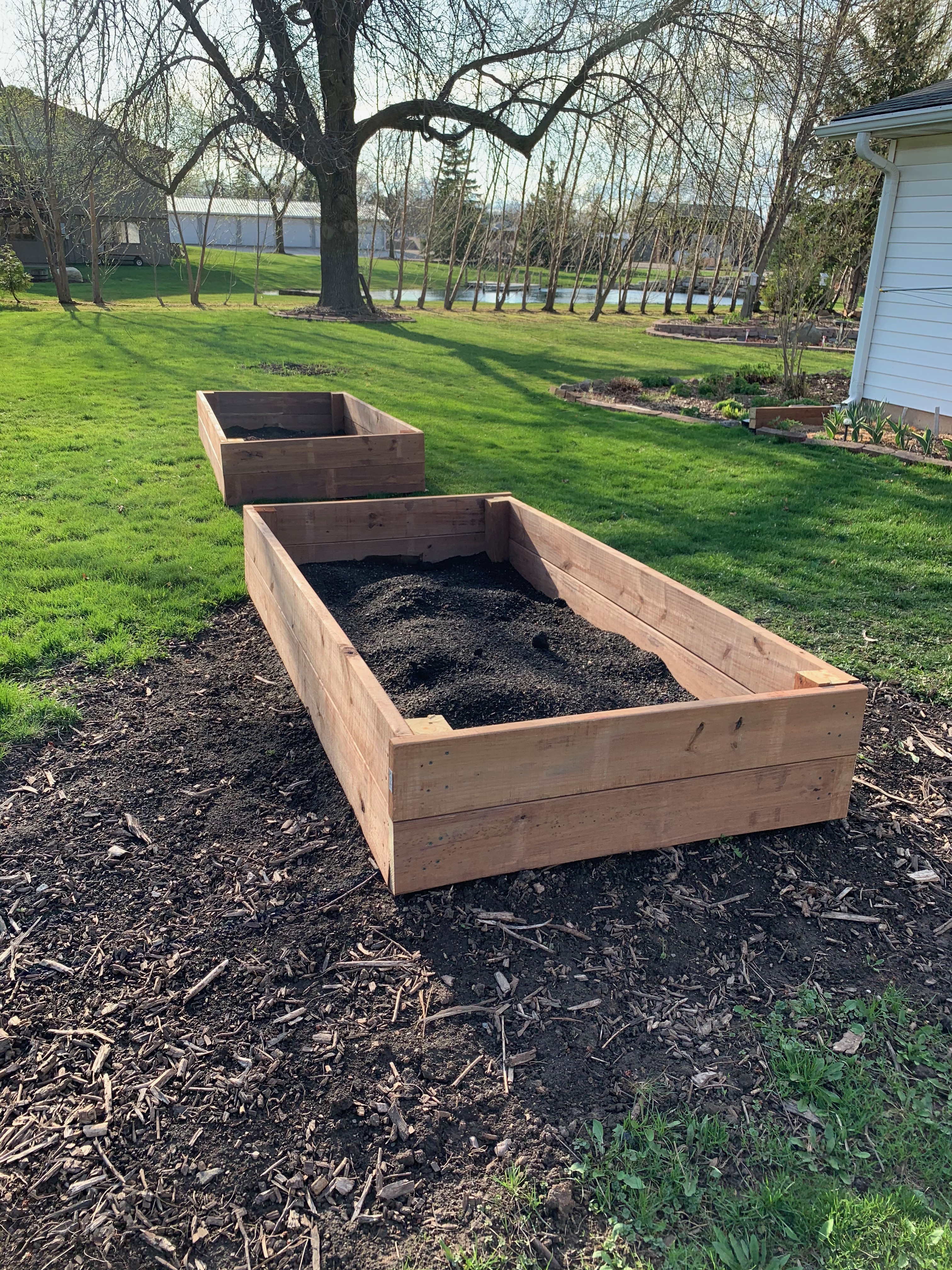
I got the new raised beds built that will go where the old pear tree was. These are 8 X 4 feet, about 16 inches tall, about the same size as the other two. The plan is that eventually they’re going to be surrounded by decorative brick that matches that big oval shaped feature in the photo at the top of the page, but that might not get done this year.
We’re also trying to get a professional in to give us a bid on redoing the entire lawn. It isn’t so much that the grass is really bad, which it is, it’s because the surface of the ground is so rough, so full of pits and diviots that developed somehow, that I’m afraid I’m going to break the mower just mowing the lawn or that someone will twist an ankle.
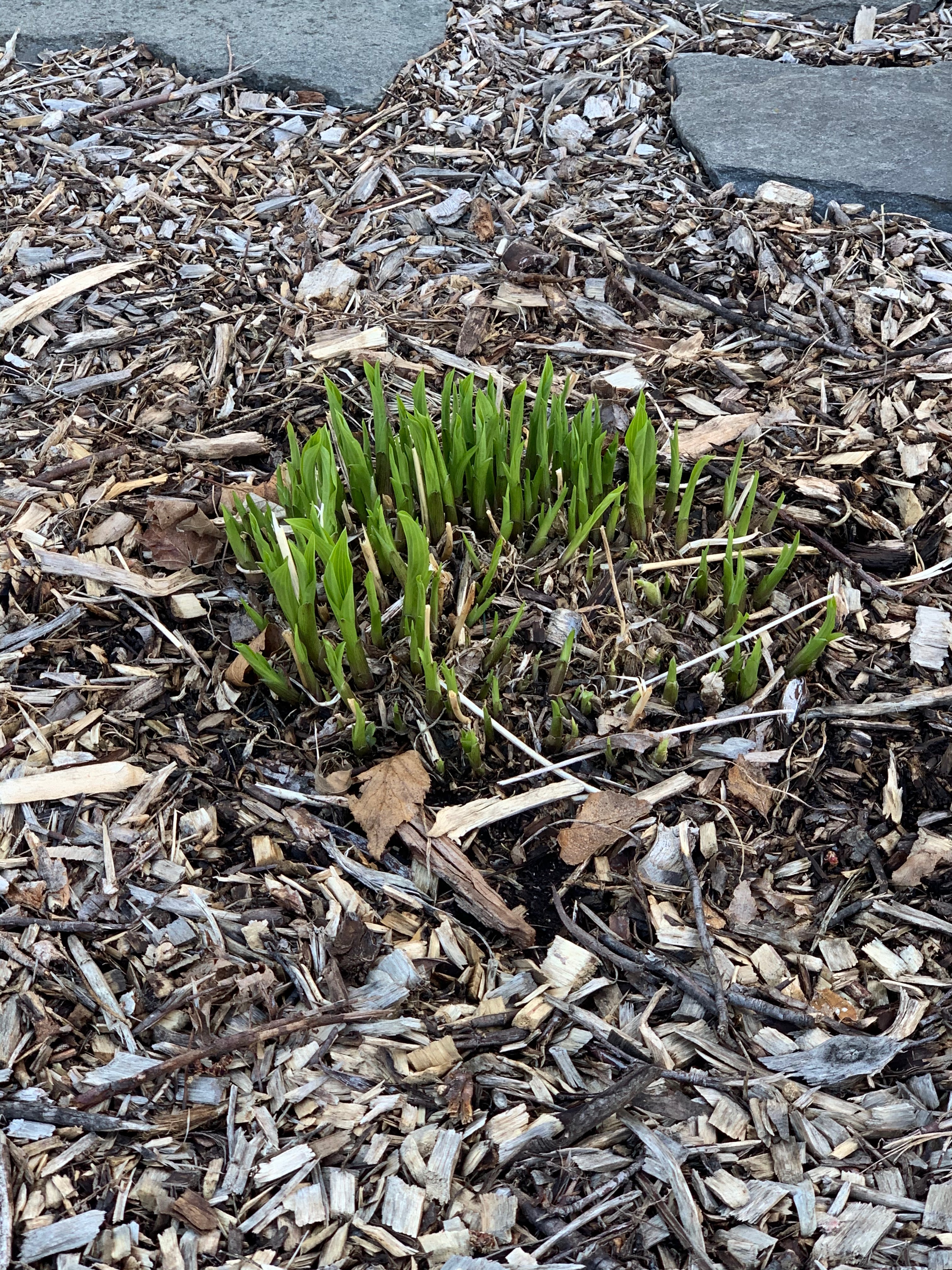
The hostas in the front garden are just starting to peek out. It looks pretty ratty up there right now with all of the mulch exposed, but once the hostas fill out you can’t see any of that.
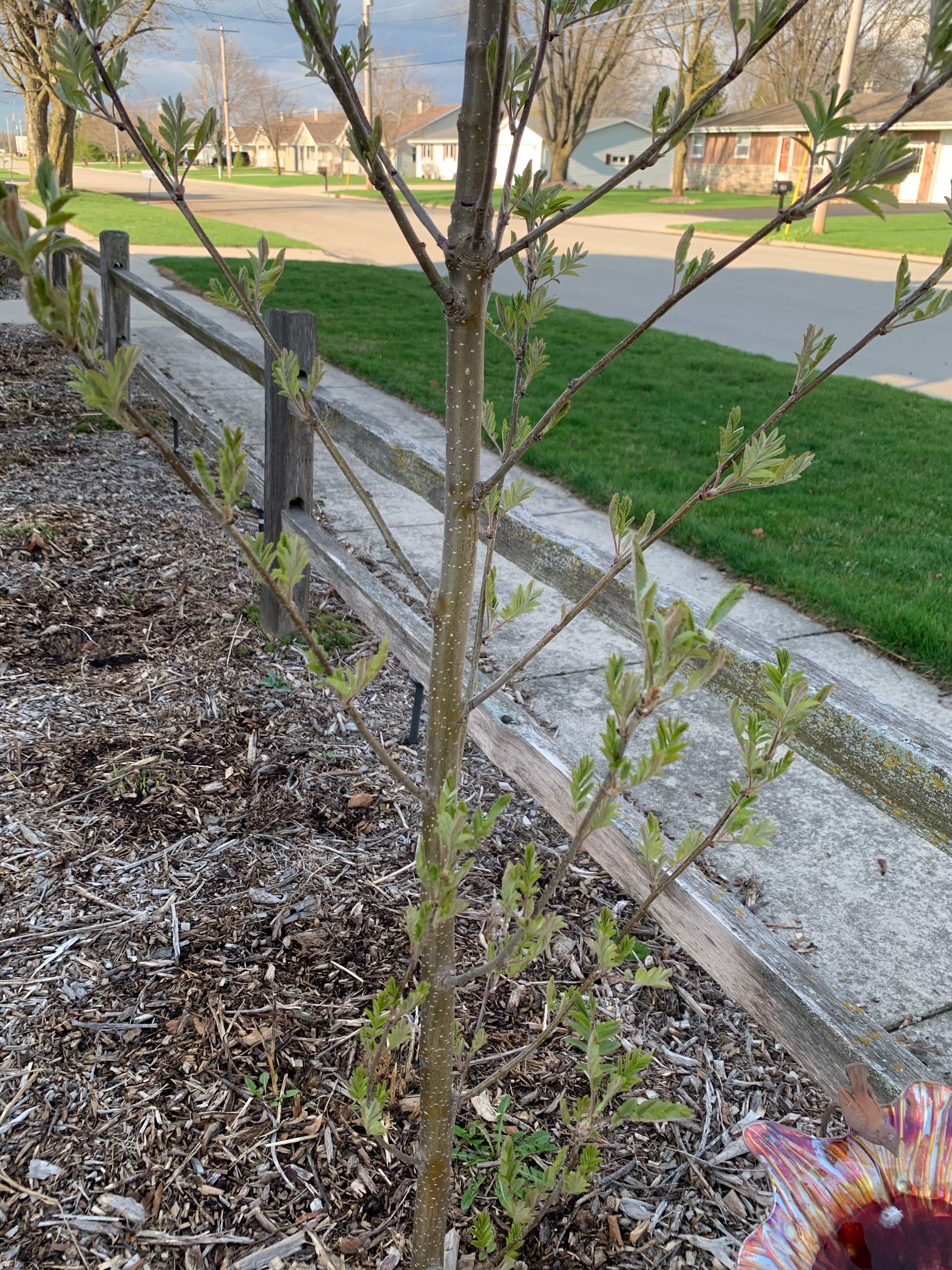
We put in a mountain ash up there about two years ago and apparently it really, really likes it. We grew that from seed from the tree in the backyard and it’s gone from a seedling to about 10 feet tall in just two years. Amazing things, trees. I think I may have to start to trim back the top to keep it from getting too tall.
And how about some color to finish up the photos? These guys are the first plants to show color in the early spring.
MrsGF started ordering seed a month ago already and we have all of that in. She has some seeds started already. Now if only it would start getting warm!
Let’s see, what else?
Oh, windows! We’re getting new windows in the office and dining room. The contractor should be here today to start that project. We actually started that late last summer but because of supply problems the windows didn’t come in until it was too late to put them in because of the weather.
Lumber prices – holy cow, when I went to get some lumber for the raised beds and some other projects, well, talk about sicker shock! I came home with an embarrassingly small pile of assorted lumber for $650, at least twice what it would have cost me a year or so ago.
Coming up: I want to talk about the DeWalt battery operated chainsaw I just got in the future. That turned out to be way better than I thought it would be for the price. And it uses the same batteries as the rest of my DeWalt battery operated tools.
Things have been slow in the woodworking department because I’ve been dealing with gardening stuff and other chores around the place, but I do have a bit of rosewood mounted on the lathe that will probably turn into something in the near future. That was actually already a bowl that developed some problems that I’m trying to re-shape to eliminate some odd cracks that turned up weeks after it had been cut the first time. That bit of rosewood was ridiculously expensive so I’m not going to give up on that. I’m also getting in what I hope will be some really neat looking boxelder from a tree MrsGF’s sister took down a few weeks ago. They’re going to cut it into easily managed chunks for me and once I get that I’ll probably talk about that.
I just got a new MSI gaming laptop yesterday that I’ll probably talk about in the near future as well. I spent a large part of yesterday afternoon removing bloatware, doing system updates and other housekeeping chores to make it useable so I haven’t had a chance to actually use it yet. We’ll see how that goes and whether it’s interesting enough to spend some time on here.
And one of these days I want to talk about Korean and Chinese television. Seriously. I watch Korean and Chinese television. Well, you already knew I was weird but you didn’t think I was that weird, did you?
That’s about it for now. The contractor’s here getting ready to start so I need to wrap this up!
It’s actually starting to look like spring out there now. Sort of. I’ve been seeing robins and finches of late, one late afternoon I even heard frogs singing. And most important of all, the days are getting longer now. I don’t mind winter, but it does get a bit tedious. It still isn’t all that pleasant out, but things are stirring out in the flower beds and signs of spring are beginning to pop up.
This is an amazing time of year. The weather is still chilly and they’re even talking snow by the end of the week, but that will pass and soon we’ll be about to get outside without bundling up. I even spotted a little flower trying to peek out of the mulch the other day!
I mentioned a while back that we had to take down the pear tree after a large part of the canopy collapsed. That was sort of a blessing in disguise because that’s opened up a large area where we can now put in plants that require full sun. We now have a lot of options open to us for that area. MrsGF wants to put in two raised beds there now, so this week I need to get some lumber to build those.
I even had the bicycle out the last few days. A bit cold for me, but pleasant enough out that I could put a few miles on without freezing my bits off. Well, I had to get the dopy thing fixed first. I pulled it out of the garage, checked it over, checked the tire pressures, gears, oiled the chain, and everything seemed fine and dandy, and I got maybe a half mile before spokes started to pop on the back wheel. Again. This is the third time that’s happened now. I keep telling them at the shop that they need to just replace the darned wheel, but no, they said, it’s just the spokes. Well, after the third time, now they’re starting to believe me and if it happens again they’ll replace the wheel. So we’ll see.
Anyway the bike is back on the road again and I’ve finally been able to get out after a long winter hiatus. And wow, am I out of shape!
And then there’s this, the chest:
This was one of those projects that took me way too long. I started this chest ages ago and for whatever reason got distracted or lost interest and it got set aside and forgotten about until MrsGF got on my case about it. This was a gift for some friends of ours on their wedding anniversary and it went out to its new owners, finally, about a week ago. It turned out pretty good. It’s white oak trimmed with walnut edging and the vertical inlaid stripes on the front are purpleheart, with hand made wrought iron handles attached with brass bolts that I picked up somewhere. I’m rather pleased by how it turned out.
I’ve done several of these now with varying types of trim and inlay and they’ve all turned out well, but to be honest I’m not all that fond of making chests. They are, oh, fiddly, I suppose you could call it. I can’t get boards wide enough to make the panels so those have to be glued up from smaller boards. I don’t have a power planer big enough to take the panels so after glueing them up they have to be smoothed down by hand with a hand plane. Then there’s the inlay, the trim pieces… Looking at one I’ve completed is very satisfying, but the process of making one is tedious.
Other stuff…
MrsGF and I both have had our 2nd vaccination now. I’ve already warned the kids that as soon as the waiting period is over we’re going to hunt them down and hug them.
MrsGF had a mild reaction to the 2nd shot. The next day she felt generally out of sorts and achy, but that passed pretty quickly.
My reaction to the 2nd shot? Well, I had more important things on my mind the next day because I was sedated and curled up on a table in a hospital with somebody sticking a scope up my butt getting a colonoscopy. I’d had a Cologuard test come back positive so they were up there rummaging around. Fortunately the biopsies came back negative. But they did the colonoscopy on Thursday and they didn’t get the results back until Tuesday. Nothing ruins a weekend like waiting around to find out if you have cancer or not.
Anesthesia was – interesting. They couldn’t believe at the hospital when they found out I’d never had any kind of anesthesia before. They wheeled me into the room, put an IV in me and the anesthesiologist said “I’m going to start giving you the…” And the next thing I knew I was sitting in a sunny room, fully awake, fully alert. It was like someone threw a switch off and then on again. It was one of the weirdest things I’d ever experienced.
Things are going to get real busy real fast over the next few weeks I suspect. We have new windows going in next week, I need to guild the new raised beds for the yard, it’s almost time to get seeds started.
Oh, and I got a new chainsaw, a DeWalt battery operated one to supplement the ancient Poulan gas model I have. I wanted something that was going to be quiet, easy to operate, and it didn’t have to be big because what it’s mostly going to be used for is cutting wood up into more manageable sizes to fit on the lathe. If I need to do any serious tree cutting or any of that I still have the Poulan to fall back on. Once I’ve had a chance to use the DeWalt I’ll let you know if it’s worth looking into or not.
Let’s talk about green and wet wood. There are a lot of woodturners out there who love to work with green wood, and there are some advantages to doing so. It cuts very easily, produces less dust and allows you to work far more quickly than if the wood was dry. But that’s where the advantages end because once you’ve turned that bowl or other object you are still left to deal with the fact that you’ve got a wet piece of wood that is going to distort, warp, split and crack as it dries unless you do something about it.
This is generally what I end up with when I’ve tried most of the “advice” given by the people who claim you won’t have any problems at all working with wet wood if you follow their instructions and/or use the products they’re trying to sell.
These experts claim this isn’t a problem and that if you do things right everything will work out just fine and dandy. (Personally I think some of these guys have been breathing lacquer fumes too long.) Their solutions to this problem range from painting it with various substances, cutting it in specific ways on the lathe, burying it in buckets full of strange pellets and I don’t know what all else. I’m fortunate enough that I have the time and resources to be able to experiment with a lot of things and I’ve tried most of these techniques and I can tell you from personal experience that none of them actually work very well. At worst they don’t work at all and what you’ll end up with is a cracked and distorted mess. At best your project won’t crack or split, but it will still distort and the resulting object won’t be the same shape it was when it came off the lathe.
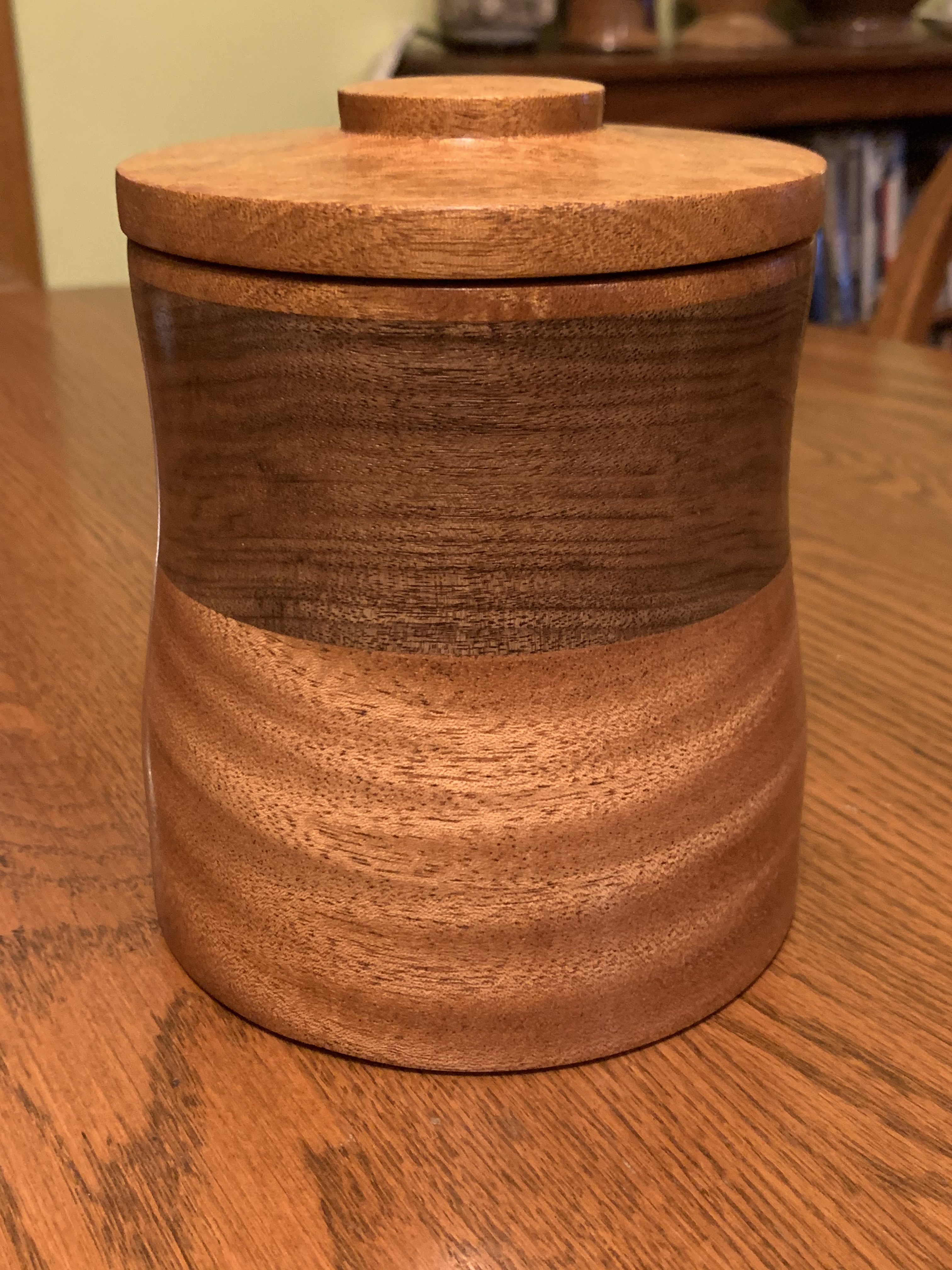
Now if you’re making simple bowls some distortion isn’t going to be a problem so you might be able to deal with it. But I like to make boxes or canisters or whatever you want to call them with fitted lids like the one over there on the right. For something like that any significant change in shape is going to result in a lid that doesn’t fit properly. That means I need to work with wood that is dry and stable to begin with.
But the wood I sometimes get is about as far from “dry and stable” as it can get. Yes, I buy kiln dried wood from commercial sources. But I also like to work with a lot of woods that I can’t get that way. Either the commercial sources sell it only as “processed green” and sealed in wax or anchorseal, or it’s wood I just picked up somewhere from someone trimming trees, or that I found at the town compost site. When I get something like that I have to figure out some way of drying it down to the point where it will be relatively stable. Just putting it on a shelf and letting it dry naturally will work. If I don’t mind waiting, oh, months, maybe years. Wood can take a long, long time to dry, especially something like a 5 inch thick slab.
I could build my own kiln or drying system. They aren’t that expensive or complicated to build and there are plans available all over the internet. Some of them look like they might work reasonably well. But I don’t really have room for something like that. Possibly I will build one in the future, but for the time being that is something I would like to avoid.
So now we come to the microwave. There are a lot of people out there on the internet that claim this works pretty slick if you do it right. But there are also almost as many people who claim that microwaving wood is a very bad idea and it can result in a complete disaster, including starting things like the wood, your microwave, and possibly your house, on fire. So I wanted to find out if microwaving wood really works as a way to reliably dry wood.
Microwave ovens are basically radio transmitters, with consumer microwaves operating at a frequency of around 2.45 GHz (gigaHertz). They work because the radio waves bombarding the object they are directed at cause the molecules of the object to rotate or vibrate, which generates heat. That is a very simplistic explanation but pretty close enough for this. But not all materials absorb this energy to the same degree. Water is very good at absorbing this energy, meaning it will generally heat up faster than other materials in the object in a process known as dielectric heating.
So I know that, theoretically at least, microwaving wood to help to dry it should work. In theory the water molecules in the wood will become warmer than the surrounding wood, causing it to force its way out of the wood fibers. Maybe. Emphasis on that last word: “Maybe”.
The problem with most of the videos and other sources you find on the internet is that they rarely provide you with any real quantitative data. With a lot of these guys they’re like “chuck it into the microwave and nuke it for X seconds (or minutes), then wait a while and do it again. If it starts on fire stop.” This doesn’t exactly give me enough information to get decent results. I decided to go about this in a more thoughtful way, measuring moisture content, weight, temperatures and other factors along the way so if I did get interesting results I could repeat the experiment, altering the parameters to try to get better results.
The Equipment
First I needed a microwave. I suspected MrsGF would not appreciate me using the one in the kitchen, so I went out and bought the cheapest decent microwave oven I could find. That cost me $70 including shipping. And to be honest, well, damn, this thing was nice. Nice fit and finish, stainless steel trim, stainless steel interior, lots and lots of options and one of those rotating turntable thingies inside, which I wanted because I figured rotating the wood while it was being nuked would help to prevent hotspots from developing in the wood. (How can they make an oven this nice, ship it all the way from China, sell it for $70 and still make money off it?) I almost felt guilty about using it for this. Almost.
Next is a wood moisture meter. These things used to be ridiculously expensive but prices have come down to where you can get a pin type moisture meter for around $25 – $35. I’m not going to go into the differences between pin and pinless models or how they work and all that. You can find that info yourself if you’re really curious. The one thing I do want to emphasize is that you shouldn’t trust these things too much. They tell you only what’s going on at or near the surface of the wood. The outside of the wood could indicate it has, oh, 5% moisture level, but just a short distance farther into that hunk of wood the moisture level could be significantly higher.
The best way to measure how much moisture a piece of wood has given up is with a scale. That’s how I keep track of wood I have drying naturally on the shelf. I periodically weigh it, the write down the weight and date. When it stops losing weight that means it has probably dried down to a point where I can consider actually using it. A decent scale isn’t that expensive. This one cost me $27 from Amazon. And it is surprisingly accurate. I used to repair and certify scales for commercial use and I still have my test weights, and this thing was accurate down to something like 0.001 of a gram. It can handle weights up to about 22 pounds according to the manual.
The next piece of equipment is a contactless thermometer because I want to measure how hot that piece of wood gets during this process, and, hopefully, keeping it from getting too hot and starting on fire. Mine is a Fluke but you can get brands that are a lot cheaper than that which will still work reasonably well, especially for something like this.
I want this for three reasons. First I’m going to be handling the wood that I put in that oven so I can weigh it and I want to measure the temperature before I grab the thing so I don’t end up in the ER with burned fingers. Second, I want to do everything I can to make sure that nothing starts on fire. I want to stop this immediately if the temperatures of the wood get too high. And third I want to measure the temperature of the wood at various stages of this process to see how much it heats up after specific periods of time being zapped in the oven.
The final piece of essential equipment is that fire extinguisher up there. Seriously. I’m about to chuck a piece of wood into a microwave oven. I don’t think it will start on fire, not if I am reasonably cautious. But it is far better to be prepared and have it ready to go rather than try to run and grab it after things start smoking.
Sidenote: You should have one, probably several, in any case. If you are a woodworker, you’re working with power tools with motors that can overheat, even produce sparks. You’re sharpening tools which can also produce sparks. So you have a variety of potential ignition sources scattered through your entire wood shop, which is also filled with wood, wood dust and wood shavings. So yes, you need a fire extinguisher. They aren’t that expensive. Buying a few extinguishers and having them located in convenient locations in your shop, garage and house is a hell of a lot cheaper than losing your shop, your garage or your house to a fire that you might have been able to prevent. End of rant.
The Test Subject
The final element in all of this is the wood. I want a chunk of wood that is typically sized. Most commercially available bowl blanks are about 6 inches square and 2 – 3 inches thick, so I needed one about that size. I also wanted a piece of wood I didn’t like very much. So I ended up with a block of cherry because it was the right size, was wet, and I don’t like cherry very much to begin with so if things went horribly, horribly wrong, which was a distinct possibility, I wouldn’t care too much. In hindsight cherry was probably not a good choice for this experiment. But I’ll get to that later. If I remember. (I probably won’t.)
The piece of wood I’m working with here is in the photo up above sitting on the scale. It’s approximately 6″ square and 3″ thick. It’s been sitting on the shelf for several months now and it’s pretty wet. You’ll note that it is coated in what looks like wax. If you buy wet/green wood from commercial vendors this is how it will come, coated in wax or Anchorseal to prevent it from drying too quickly and cracking. You’ll note that at the start of this it weighs 1,411 grams. That starting weight is important because how much weight it loses during this process will tell me how much moisture it has given off during this process.
Gads that was a mess.
I didn’t think that chucking a hunk of wood coated with wax into a microwave was a good idea so first I had to get that wax off. I did that with a hand plane. It was really messy and I had to stop to clean my plane several times but it wasn’t hard to do and only took a few minutes.
Once I did that I proceeded to microwave it, checking the temperature and weighing it after each step to see what happened.
I have to admit that this was a very tedious process. At first I only cooked it for 30 seconds at a time, but it quickly became apparent that wasn’t doing much. Eventually I started increasing the times up to 3-4 minutes. That length of time brought the temperature of the wood up to approximately 180 degrees. At that temperature the wood was uncomfortably warm to the touch, and it was obviously giving off moisture. Parts of the wood became visibly wet, indicating moisture was migrating from the inside of the wood to the outside surface. I kept going, keeping extensive notes about times, temperatures, weights and the visual appearance of the wood during the process. I won’t bore you with all of that data.
There was no doubt that the process was forcing the wood to give up significant amounts of moisture. The exterior of the wood became visibly wet at some points during the process.
Now in hindsight I probably should have done this with more patience but dear lord this got boring fast. I didn’t want to take the wood up to a temperature higher than 180 because I could only measure the surface temperature of the wood and it was possible the interior was much hotter. So I let it cool down to about 80 – 90 degrees before repeating the process. This was possibly also a mistake in hindsight and I’ll tell you why at the end of this. After fiddling with this for a couple of hours I went and did something else until, well, until the next day when I realized I really needed to get back to work on this.
It gave off significant amounts of moisture. It was losing weight with almost every cycle in the oven. And finally it reached the point where it was no longer going down in weight when I put it on the scale. In total it lost almost 500 grams in weight, and the moisture meter registered 2% when I tested it.
Slight end grain cracking but nothing serious.
So, the results. Did it actually work? Well, yes. Sort of. Microwaving it did indeed dry it down. It was by no means a fast process, but I was making tests and notes and doing other things in between and certainly could have wrapped this up a lot sooner if I hadn’t gotten bored and wandered off.
But there were issues. First there was cracking in the endgrain. That had started before I was even halfway through the process. I rather expected that, however. And the cracks seemed shallow and superficial. Once I started cutting the wood on the lathe I found that was indeed true, the endgrain cracks did not extend more than 1/2 inch into the wood. Endgrain is always a problem when it comes to wood. Even if you let the wood dry naturally there is going to be some cracking of the endgrain unless you resort to sealing the ends with Anchorseal or paint.
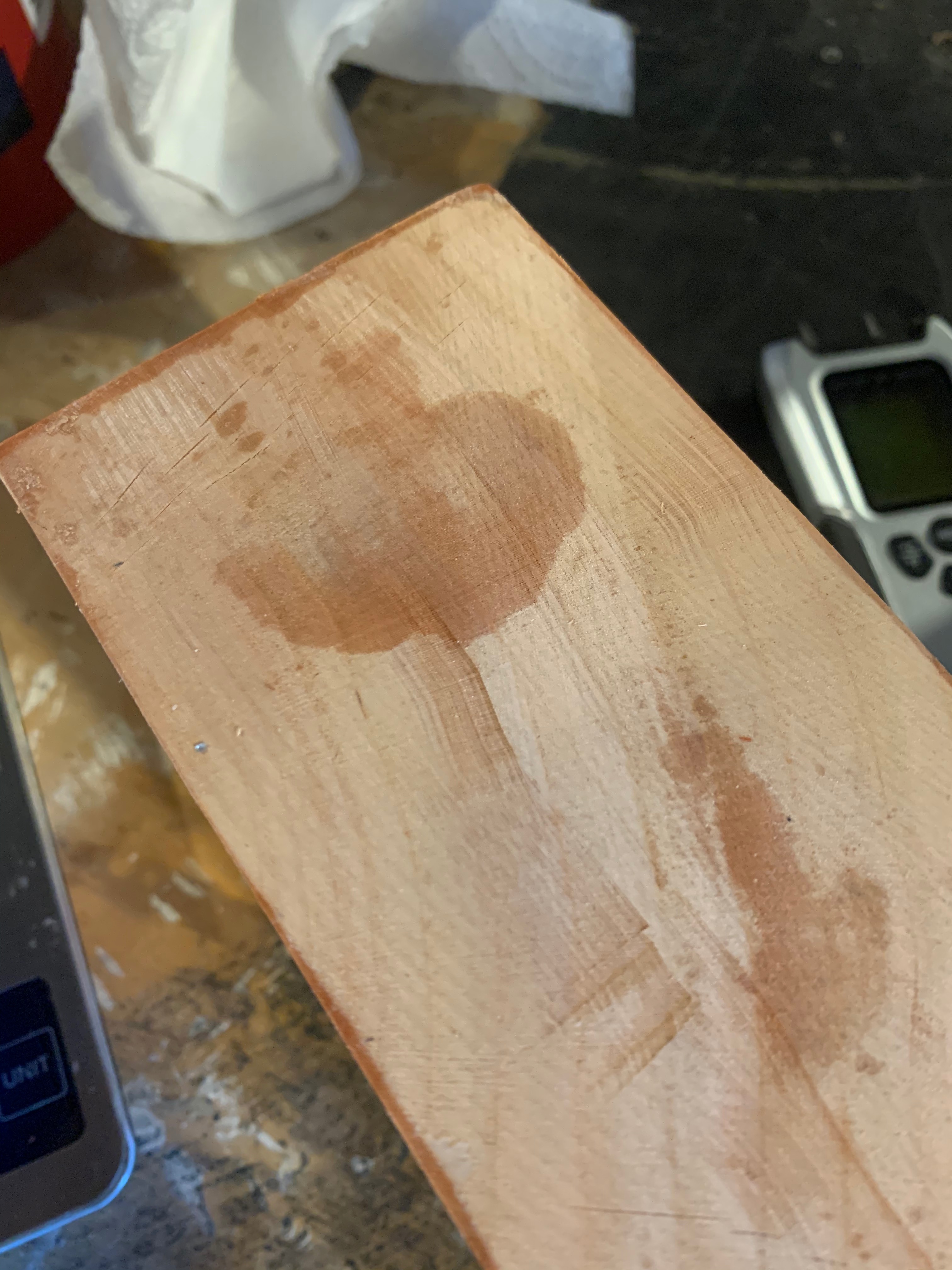
There was also considerable discoloration on the surface of the wood. But this was cherry. One of the reasons I don’t like cherry is that it often does get blotchy looking, so I had rather expected this to happen. And some of that discoloration was due to the fact some of the wax it had been sealed in had remained in the pores of the wood near the surface.
Also the block of wood was now distorted in shape as you can see in that photo up there. Still that isn’t going to be a real problem either because this is going to get turned into a bowl anyway.
The only way to see what’s going on inside of the wood is to put it on the lathe and start turning it. So here’s what I ended up with in the photo below
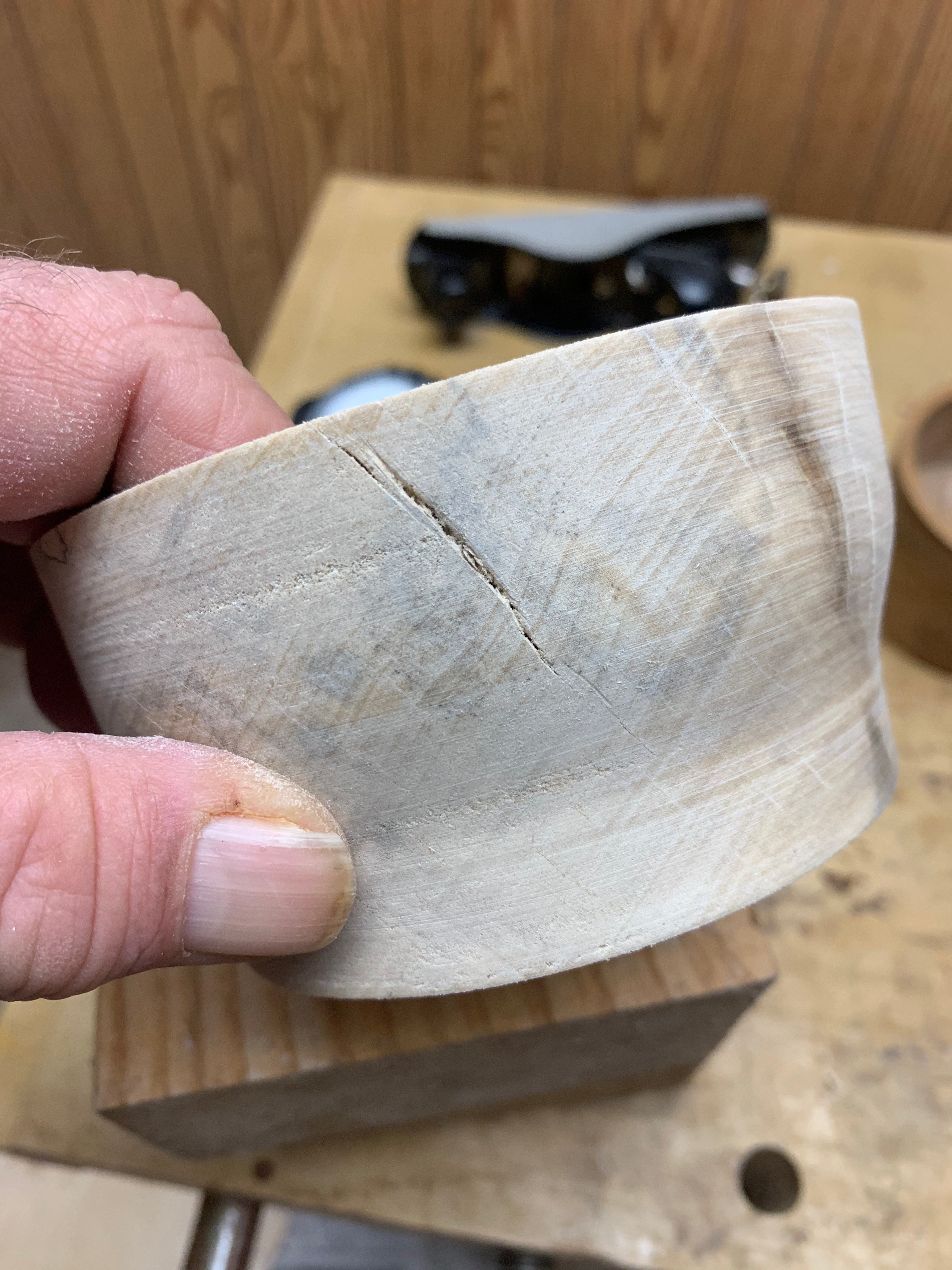
The wood was indeed dry and stable. But as you can see there was a problem. There three significant cracks in the wood running diagonally across the grain.
Does this mean the experiment was a failure? No. Not at all. In fact I’d consider this experiment successful. Or at least successful enough that I’m going to try it again in the future.
The wood did indeed get dried down to the point where it was stable. The sample bowl did have those three cracks, yes, but the resulting bowl has been sitting on the shelf now for three weeks now and shows no signs of warping, twisting or otherwise distorting. No new cracks have appeared, only those three. So the process did indeed take a wet piece of wood and dry it down in a relatively short period of time.
As for those three cracks, to be honest I’m not all that concerned about those. The wood could have had internal flaws to begin with. Or, more likely, I overheated the wood. When going back over my notes I see that twice the external temperature of the wood reached 190+ degrees during this. That means it is entirely likely that internally the temperature could have been well over the boiling point of water which means that pockets of steam were being produced inside of the wood which could have caused enough stress to crack the wood. I was also allowing the wood to cool down during the process. That heating and cooling cycle almost certainly was introducing stresses into the wood that could have caused problems.
I’m actually pleased and encouraged by the results of this. There are still a lot of variables to take into consideration. What would happen if I used the “defrost” cycle on the oven for an extended period of time rather than just nuking it at full power? Would that result in a more gentle process that wouldn’t put as much stress on the wood?
What if I tried to maintain a stable temperature, say 150 degrees, rather than letting it cool down between cycles? That also would result in less stress on the wood and might have prevented those three cracks from developing.
Overall I’m very encouraged by the results and I’m probably going to try this again. But I need to make better notes, have more patience and do it in a more methodical fashion to make it easier to get easily reproducible results. If I do it again I’ll keep you posted.
Meanwhile, if you want to try this yourself, do I need to tell you to be very, very careful? From some of the things I’ve seen on the internet it appears to be very easy for this kind of thing to go bad very quickly.