
Well, I’m bored, I haven’t written much here of late, so let’s take a look at what’s been going on in the ag world recently.
Dicamba Issues Abound — The controversy over Monsanto’s dicamba herbicide blends and those approved under license, XtendiMax, Engenia and FeXapan, continue to have problems and generate considerable controversy, complaints and legal issues. Minnesota and other states have instituted restrictions on when, where and how the herbicides can be uses, new federal restrictions regarding training requirements and new application restrictions, etc. Other states have issued wide ranging restrictions as well. Even Mother Jones has gotten into the act with an article about the drawbacks of the product.
The companies involved are fighting back, blaming anything and everything for the fact that over 3.5 million acres of crops were allegedly damaged by the herbicide drifting away from the application area this past year. They’ve been claiming farmers are spraying the product with the wrong equipment, failing to follow the proper application techniques, etc. They’ve even tried claiming that famers are illegally spraying non-approved types of the herbicide. In one case one of the companies involved tried to get a member of the board that regulates herbicides in one of the states involved removed from the board.
Words Are Worth Money — The University of Arizona did a study of how consumers react to the term “natural” on meat labels and found out pretty much exactly what you might think: that people who know what the term means were unwilling to pay more for meat labeled “natural”. In the study half of the people involved were told the legal definition of the term, and half were unaware of what the legal definition was. They found that those who did not know would pay $1.26 more for steak labeled “natural”, while those who did know wouldn’t pay more.
Under USDA definitions, all fresh meat, even hamburger, can be labeled as “natural” as long as it does not contain artificial flavors, colorings, chemical preservatives or other synthetic ingredients. So basically if you’re paying more for a package of steak or roast labeled “natural” you are being scammed.
What it boils down to is that a lot of these companies will use any kind of marketing tricks they can to fool you into paying more for a product than you should.
Meat Tax Coming? — Methane and carbon emissions from cattle raising operations makes up almost 15% of the total production of greenhouse gases, and the production of cattle is projected to increase by 70% over the next fifty years or so. So some people are considering taxing the production and sale of meat to try to reduce the reduce greenhouse gas production from cattle. There are serious talks going on in some countries to institute tax policies similar to those used to curb tobacco in order to reduce production and consumption.
Frankly this seems a bit silly to me. The two largest producers of greenhouse gases are electric power plants and motor vehicles. The amount of methane and carbon dioxide produced by cattle hardly makes more than a blip on the charts when compared to that. So I’d think that if they were really serious about greenhouse gas reduction they’d be going after those two sources far more vigorously.
Corn Acreage Shrinking — It looks like farmers are finally beginning to cut back on the amount of corn they’re raising in response to poor prices. USDA is predicting that for the first time in years the number of acres of soybeans will equal or even surpass the number of acres of corn being planted in the US. Corn prices on the Chicago Exchange never went much over $3.75 or so at the peak, and have been sitting at the $3.50 or lower level for some time now. And, of course, the commodities price generally isn’t what the farmer gets for the corn. They often get considerably less than that. When you add in other costs like storage fees, etc. farmers are often getting a lot less than the commodities price. A awful lot of farmers out there are just barely breaking even on corn this year.
Some people are pinning their hopes on China increasing their imports of corn. China has been drawing down it’s huge stockpiles of corn over the last year or so, and some are taking that as a sign the country will begin to import more corn. But continuing to produce corn in the hopes that China might increase imports sounds like a great way to end up bankrupt.
 Chicken Suits — No, not that kind of suit. The legal kind. Both California and Massachusetts are being sued over regulations they’ve instituted regarding how chickens (and other farm animals as well in the case of Massachusetts) are raised. The regulations require chickens (and in the case of Mass. other agricultural animals as well) from which products are derived for sale in the state, must be raised according to certain minimal humane standards. The plaintiffs claim that the regulations dramatically increase the cost of eggs and that it will cost consumers hundreds of millions of dollars, and that the cost of eggs nation wide has increased as much as 5% because of it. A claim I view with considerable skepticism. Locally the retail price of eggs is at almost an all time low. They’re going for about $1.00 to $1.28 per dozen at most retail outlets around here for standard, non-organic “generic” brands, and I’ve seen them as low as $0.79 and even less.
 Let’s catch up with what’s been going on in agriculture.
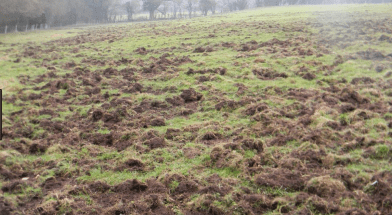
 Butter Tumbles In Europe:
  Sargento Expansion:
 Dicamba Battle Continues:
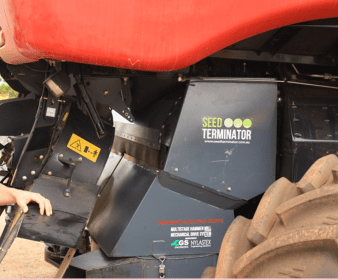 etc., and spreading weed seeds all over your fields. The problem is that a lot of weeds are coming ripe at around the same time as your crop. So when you combine your crop, you’re also combining the weeds and blowing the weed seeds out the back of the combine and scattering them all over the field. A lot of people have worked for a very long time on this problem, with various attempts at a solution.
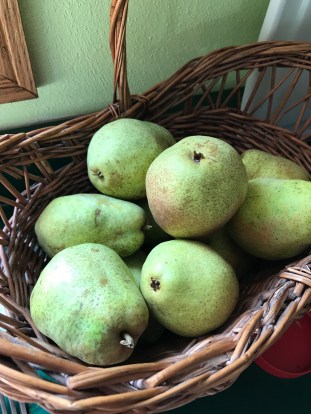 The pears have just started to ripen, something we always look forward to. Alas, it hasn’t been a good year for pears. Normally we end up filling five gallon buckets with the things and giving them away to anyone we can talk into taking them, but this year we’re going to be lucky if we get more than a few dozen. The weather this spring when it was putting out flowers was not very good. We were getting cold days, lots of rain, and not a single bee in sight. I think it was the lack of pollinators that caused the drastic cutback in production this year.
 So how we ended up with these guys, I have no idea. The little red ones… Dear lord, they’re hot! When they were green they were tolerable and had a fairly good flavor, but now? Just cutting one in half sends out fumes that make the eyes water, and those little yellow ones are almost as bad. MrsGF, it seems, didn’t label the seedlings with great accuracy last spring, if at all, so we had no idea what we were going to get until they started to produce fruit.
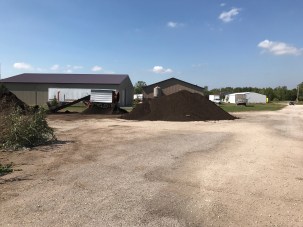 We’re very fortunate in that the town has an outstanding composting program that it’s been running for years now. We’re even more luck in that we’re just a couple of blocks away from the compost site. The guys have been busy sifting the newest batch of compost and it’s ready to go. After cleaning out the garden spaces I’ll be making regular runs down here with my little trailer to take advantage of it.
 Last weekend I proved to myself that I’m still a 6 year old at heart because seeing this thing in the parking lot at the grocery store made me grin like an idiot. Yes, the Weinermobile. Oscar Meyer has been running these for a lot of years, but this is the first time I’ve ever seen one of them close up.
 Then we woke up to the sound of our street being reduced to gravel. Literally. Big road grinder moving slowly back and forth in front of the house grinding the pavement and everything else in it’s path into dust as they prep for repaving a section of the street. Loud? Oh dear… Sounded and felt like a 747 was landing in the backyard. They’ve been prepping for this for weeks now, replacing sections of curb and gutter and driveway aprons.
 We’re hoping they get this done soon. Right now the road in front of the house is pretty much nothing but dust. We get a lot of big trucks through here and there is a patina of dust over everything. It’s getting more than a little annoying.

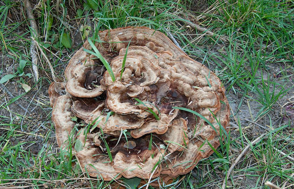 Once upon a time we dealt with cow manure like this. The cows grazed out in the field, they’d drop a pile here and there, and move on and nature dealt with it. Insects laid eggs in it, animals foraging for food scattered it about looking for the insects, rain would gradually wash it away, and over the course of many days the pile would gradually erode away, absorbed into the soil where the nutrients would be taken up by the surrounding plants.
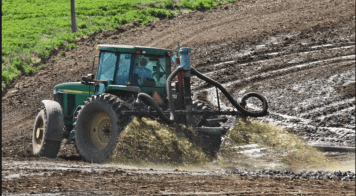 sewage as a city, disposing of manure becomes a serious problem and you end up with this kind of thing over there on the right; massive manure pumping operations dumping tens of thousands of gallons of liquified manure across fields all over the countryside.
 Or imagine you live in the country and you wake up one morning and find huge tanker trucks full to the brim with reeking sludge, leaking all over the road, parked right across from your house like my friend did a couple of years ago. They woke up that morning to the sound of heavy trucks, went outside, and found this going on right in front of their house.
 grouchyfarmer