Computers that should have been great but weren’t

The item I wrote about the Epson HX-20 the other day reminded me about one of the other items I was supposed to try to sell for that business supply company, the Epson QX-10. This beastie:

screen-shot-2016-09-18-at-7-46-32-am

This particular example is, judging from the color of the case, an elderly one. The plastics used for computer cases rather rapidly turned an unappealing shade of dirty yellow. In its prime, though, it was a rather handsome creature, and it was both one of the most advanced, and the most useless computers I’d ever worked with.

At the time the QX came out the computer market was going through a shakeup and even more importantly, a shakeout. There were dozens of different computer makers back then, offering an astonishing variety of systems that ranged from the silly to the sublime. But at the time, IBM with its PC and the MS-DOS operating system was well on its way to becoming the standard for small business and, eventually, home computers. By the time Epson brought the QX-10 to market, its underlying hardware was already pretty much obsolete, and it’s sophisticated software and graphics weren’t enough to make up for it’s lack of horsepower.

Before IBM jumped into the market with the PC, the ‘standard’ for small business computers was the 8080 or Z80 CPU based microcomputers running the CP/M operating system. These computers were based on an 8-bit CPU and limited to 64K of RAM. Then IBM came along with it’s PC, which used the 16-bit Intel 8088 which could handle up to 640K of RAM, at around the same price as the 8-bit CP/M machines, and the rest is, as they say, history.

How did Epson hope to compete in a market that was already crowded with other 8-bit, Z80 based computers, or to compete against IBM and MS-DOS?

By coming out with a operating system of their own which was combined with a hardware package that made the QX-10 the most sophisticated system ever produced. Or so they claimed.

The QX-10 was admittedly pretty sophisticated. It had a high-resolution monochrome graphics system with up to 128K of dedicated video memory that blew away anything except dedicated CAD systems. It’s Valdocs operating system was incredibly advanced for it’s day with a built in Help system, 128 character long file names when everyone else struggled along with 8 characters. And it had 265K of RAM.

And it had what was possibly the first WYSIWYG ‘what you see is what you get’ word processor to become widely available at a (somewhat) reasonable cost. Boldface a word? It showed up in bold on your screen. Same with italics, underlining, etc. Virtually every word processor on the market at the time showed not bold face, but codes embedded in the text to turn on or off control functions, if they allowed things like bold face or italics at all.

They gave me one of these things and I had it at home for a few weeks while I learned it inside and out because I was supposed to support the thing. It was definitely sophisticated. The graphics capabilities were outstanding. It was undeniably an amazing computer when combined with the Valdocs system.

The problem was that it just didn’t work very well. Valdocs and TPM, the underlying operating system, were full of bugs. It seemed every other day I was getting updates and bug fixes. And since this is the pre-internet, that meant either dialing the company’s BBS system with a 300 baud modem and paying long distance phone bills, or waiting until they shipped me a floppy disk with the updates.

The biggest problem though was it was slow. Oh dear lord it was slow! Any kind of competent typist could easily outdistance the Valdocs word processor, getting forty, sixty characters ahead of the display update. So far ahead that you could easily overload the buffers and lose characters and words. And since we were supposed to push this as a word processing system because of the WYSIWYG display system, well, it’s pretty hard to sell a word processor that made you work slower.

The other problem was that there was no software for the Valdocs system except what was supplied by Epson. The word processor, calculator and drawing program and, I think, a rather brain dead database. There was a spreadsheet but it was so abysmally slow you could go get a cup of coffee while it was recalculating.

If you wanted to use it for actual work, that meant you had to reboot the system with the old CP/M operating system to actually do anything useful. And, of course, once you booted into CP/M, all of the fancy features Epson was pushing were lost and all you had was a generic and overpriced CP/M computer.

Then there was the competition. At the same time Epson was pushing the QX-10, the IBM-PC was becoming the standard for small business computers. There was lots of genuinely useful business software available for it. So basically there was absolutely no reason to buy the QX-10 with it’s outdated hardware, useless Valdocs system or the increasingly obsolete CP/M system.

Epson’s solution to the competition from IBM was to find someone to supply them with a plug in card that was basically an IBM-PC clone on card, while they scrambled to get the QX-16 system on the market. This ‘solution’ was literally a PC clone on a card that plugged into the computer’s internal bus, with an 8088 CPU, it’s own memory, everything. It worked, sort of. But it didn’t actually run MS-DOS, it ran PC-DOS which was an MS-DOS clone. It would run some MS-DOS based software. Sometimes. Maybe.

It also cost in the neighborhood of $1,500 if I remember right.

So you have a computer with a base price of around $2,500, already far more than comparable CP/M machines. And now you have to drop another $1,500 for a card to make it use MS-DOS software, and there’s no guarantee it will actually run the software you need…

Oh, brother…

Could it have been a great computer? I don’t think there’s any doubt that it could have. The QX was, on the surface at least, one of the most sophisticated systems to hit the market at the time. It had a lot of features that eventually became standard on later generations of computers; long file names, WYSIWYG word processor, high resolution graphics, etc.

Unfortunately, design decisions crippled it. The decision to go with the Z80 processor meant it would never have enough raw horsepower to live up to the hype. The graphics system’s hardware was woefully slow. The Valdocs system, while very nice, was bogged down by the obsolete hardware and inefficient programming techniques. Even worse, Epson never brought out any software that ran under Valdocs except that which was included with the computer. That meant that in order to run the popular business software of the day, the computer had to be rebooted into CP/M, and that turned it into nothing but a vastly overpriced, generic business computer.

Valdocs itself acquired a reputation of being buggy. I never really ran into serious problems with it except it’s woefully slow speed, but I wasn’t using the computer under actual business conditions.

There were rumors flying around that over at Rising Star, the company that made Valdocs and its underlying OS, TPM, programmers were routinely fired as soon as they finished work on their assigned modules, leaving people who were unfamiliar with the code to try to support and debug problems.

I was told that large parts of Valdocs and even TPM had been written in Forth, of all things. Forth is not exactly what I’d call user friendly. It was never designed for large projects. It was originally designed as a hardware control language used to control telescopes. I’m not saying it can’t be done, but oh brother… I’ve programmed in Forth and I wouldn’t want to use it for any kind of complex system.

Epson went on to bring out the QX-16, an interesting machine that was intended to compete head to head against the IBM PC. It had both a Z80 and 8088, and would run either Valdocs, CP/M or PC-DOS. Alas, it wasn’t very good either.

The upgraded hardware didn’t cure the system’s speed issues. The word processor was faster, but screen updates were still unacceptably slow. The spreadsheet was terrible. Reviews at the time claimed that a spreadsheet that would recalculate in just five or six seconds in MS-DOS or CP/M spreadsheets, would take minutes to recalculate under Valdocs. And while it could run some MS-DOS software, a lot of it wouldn’t run at all.


Computer Memories

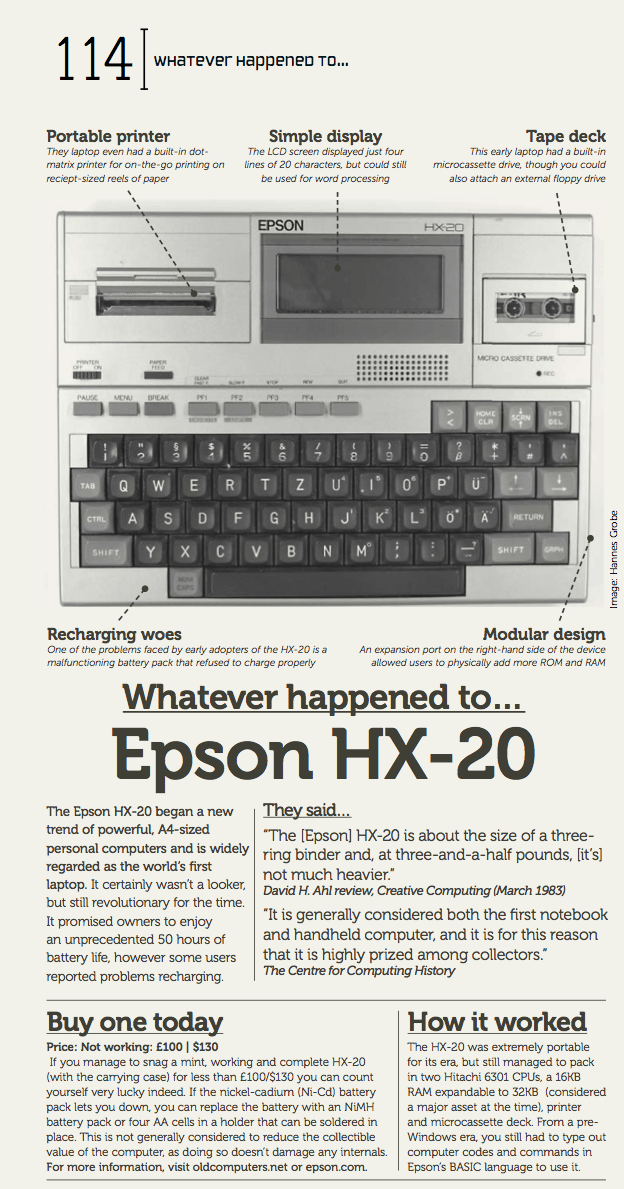
I ran into this little item in a nostalgia piece in a UK magazine called Gadget, and it brought back a lot of memories. I’ve had a lot of jobs over the years, some better than others, and one of them involved trying to sell these things–

screen-shot-2016-09-17-at-7-03-42-pm

I’ve been involved with the personal computer industry in one way or another since 1979, and in 1983/1984 while I was back in college studying business, computer science and electronics, I was also working a part time job for a business supply company that sold, among other things, this — this thing.

Epson’s claim to fame was making relatively inexpensive, relatively well made, dot matrix printers. Not computers. And when the company decided to move into the lucrative personal computer market, things didn’t go all that well for them, largely due to things like this, and the famous, (or infamous if you had to try to sell the damned things) QX-10 computer.

The HX-20 was, to put it bluntly, utterly useless. The 4 line, 20 character long display was was too small for any kind of serious work. And while the built in thermal printer was a nice feature, well, it doesn’t do you much good if you don’t have any software that actually does something useful, and the HX-20 had pretty much no software support at all. As the blurb above points out, the rechargeable battery usually didn’t. Recharge, I mean. And it certainly didn’t last 50 hours, especially if you used the printer or the tape.

The Epson factory rep took me out to dinner and dumped one of these things on me in the hopes I’d help him get my boss to buy them. I fiddled with it for an hour, the battery went dead, the printer only worked when it felt like it, and the tape deck immediately ate the one cassette tape I tried using. With the wonky battery, the dodgy tape deck, the ridiculously tiny display, and total lack of any kind of useful software, I refused to have anything to do with it.

Somehow he managed to talk our boss into ordering a dozen of the damned things, and now it was my job to try to sell them.

Meanwhile Radio Shack was coming out with the TRS-80 Model 100, which was the same size, had a 40 character by 10 line display that was actually useful, all kinds of goodies like a built in modem, built in bar code reader, real standardized I/O ports for RS-232, a ROM port for speciality software, and, better still, you could buy actual, real and useful software for it. And it cost less.

The things are probably still sitting in a box in storage somewhere. We certainly never sold any. They’re probably with the dozen or so QX-10 computers he was talked into stocking that we never sold, either.

Conversation Becomes Shouting in a Society Without Authority – The Daily Beast

We are now at a point in politics, a new book warns, where reality has lost its authority: Facts are considered a matter of opinion.

Source: Conversation Becomes Shouting in a Society Without Authority – The Daily Beast

I put up that post about the ‘Age of Stupidity’ too quickly, or I could have brought up this item over at the Daily Beast, which also touches on the matter of belief vs. facts.

The writer of the article believes that is due almost entirely to a lack of some kind of authority figure.

I don’t believe that’s true, however. We are in a situation now where a significant number of people base their beliefs not on actual fact or evidence, but on what someone tells them to believe, exactly such an ‘authority figure’ that the writer claims we need.

But we have ‘authority figures’, and they are part of the problem. The anti-vaccination crowd that puts it’s mindless belief in the ‘authority figures’ of B-list celebrities who know nothing of science or biology, the climate change deniers who blatantly ignore facts and evidence, and spout opinions based on ridiculous conspiracy theories, quasi-supernatural explanations or outright lies that offer them some kind of financial or other personal gain. The list goes on and on.

Charles Sykes, one of the right wing radio ranters here in the state, did an interview in which he explained how this is largely the fault of himself and people like him. For years now, he and others like him, like Limbaugh, Hannity, Jones and the other far right pundits, have been deliberately doing everything they can to undermine any kind of ‘authority figure’ that the public might rely on for accurate information. They’ve worked hard to undermine the mainstream media, government agencies, even science itself in order to further their own agenda.

The mainstream media itself has to take some of the blame for this current climate. In its effort to generate a never ending string of clickbait headlines, generate controversy where there is none, cause fear and panic in order to pump up its ratings and profits, it’s given voice to loony conspiracy theories, blatantly inaccurate statements by politicians and others, ridiculous health claims and I don’t know what all else. It’s failed to call out politicians over outright lies. It has just — just failed. In everything except generating profits, of course.

The Fermi Paradox: Where the Hell Is Everyone?

I’m beginning to become a bit — irritated with astronomers, and especially with astronomy publications like, well, Astronomy Magazine, Sky & Telescope, the BBC’s Sky at Night. Even with NASA, the space program in general, and a lot of astronomers and astrophysicists in general, who start babbling like little children about stuff when they should really know better. The ‘mainstream’ media is even worse, of course.

It’s this whole life thing. As in life out there, on other planets, other star systems, other galaxies.

Every once in a while some news outlet that really should know better pops up a headline like “Life on Europa!” or “Life in Oceans Under Pluto!” or “Life Floating in Clouds in Venus” or, “Life Discovered at the Republican Convention”. It’s just — just silly. (Especially that last one.).

I’m sorry, but it is. And they really should know better. Even worse, most of them do know better.

The popular press and even otherwise allegedly rational real live scientists with actual degrees from actual universities who have actual jobs doing sciency stuff, have just gotten silly over this whole life thing.

So let’s talk about the Fermi Paradox for a bit. (Wondered when I was going to get around to getting to the point of the title up there at the top, didn’t you? Relax. It takes me a while sometimes but eventually I get to the point. Sometimes. Maybe.)

The Fermi Paradox has been floating around for a long time now. Jump over to Wikipedia and go look it up. I’ll wait. I don’t have anything going on at the moment. I’ll just babble along here until you get back. While you’re at it, look up the Drake Equation over there too…

I’m an amateur astronomer with actual telescopes and everything. I love astronomy. Fun stuff, astronomy. Nothing better than sitting around outside, shivering, your feet gradually turning to ice, wondering if your health insurance covers having your toes amputated because they turned black, chipping the frost off your scope while you try to get a picture of Jupiter that doesn’t have a bloody airplane track across the middle of it. Great fun. Highly educational and all that stuff. Highly recommended. I’m also a science fiction fan. I discovered SF when I was about 9 years old and never looked back. I grew up in a fantasy world filled with starships, exotic aliens, odd characters, bizarre societies, horrific space battles throwing planets at people, time travel, time paradoxes, alternate universes, time travel to alternate universes, time travel for the purposes of, well, weird sex. Have you read Heinlein’s later stuff? Oh my…

So I’ve more or less been living in a universe full of life. I’d love to live in a universe full of that stuff. Well, except when the Fnezeer come to, well, eat us. That I probably wouldn’ like.

The thing is, I know that is fantasy. It isn’t real, all that stuff. The zooming starships, the aliens with tentacles, the time travel incest (what the hell was Heinlein thinking?) the alien races around every corner… They’re made up. They don’t exist. Unfortunately a lot of the news media and, it seems, NASA and real actual astronomers and stuff, haven’t figured that out, or that’s what it looks like if you some of the stuff they’re pushing.

Oh, you’re back. Good!

Let’s get back to the Fermi thing, then now that you got done over at Wikipedia.

The Fermi Paradox basically asks the question, if life is as common as a lot of people think it is, where the hell is it? Why haven’t we found any? And why the hell hasn’t it found us?

Considering the age of the universe, the ginormous (that apparently is a real word, I had no idea) number of galaxies, the even more ginormous number of stars in those galaxies, and the even furtherly more intensely ginormous (now that I found out it’s a real word I’m going to use it a lot, damn it) number of planets, somebody, from somewhere, should have come ringing our doorbell to try to sell us something or try to convert us to worshiping a giant space turtle or talk us into a time share out in the Wompel Galaxy or something.

Only they haven’t. There isn’t even a single sign that there’s anyone out there. Granted, the universe is a really, really big place. But if you run the math, a single, high tech civilization, could colonize an entire galaxy in a surprisingly short amount of time, maybe four, five million years. Sounds like a long time, but species even here on Earth have been around and essentially unchanged for far longer than that.

Of course maybe they’re busy, or just don’t care.  Like these alleged life forms might look up and go “meh, the hell with all that noise”, and get on with important things. Like, oh, I don’t know, frelking, let’s say. I have no idea what frelking is, but it’s like really, really important to them and it’s way more important than stars and stuff like that. So they give up on the whole space thing and get with some serious frelking. Probably has something to do with sex, I imagine.

So that’s one theory about why no one has come to try to sell us time shares or convert us or eat us or something. They don’t give a flying fig.

This space travel stuff all assumes that the race in question thinks it’s important. And maybe it is. To us. Well, some of us, anyway. But that’s us. They, if they’re out there, don’t care, maybe. That’s the point. They are going to look different, think different, have different priorities. Like frelking. They don’t care.

The point is that they come up with all these excuses to rationalize why we haven’t seen anything out there. And they do have a valid point. I mean, frelking is really, really fun. Maybe.

But the other thing that no one seems to want to bring up, is that maybe there isn’t anyone out there. Just flat out isn’t.

Yes, I know, statically speaking it is a virtual certainty that there is something alive out there, somewhere. But we have  scientists going off the deep end claiming there’s life everywhere almost.

So where is it? We don’t exactly have a good track record finding it, do we. Let’s see, well, there’s Earth, that has life (whether it’s intelligent or not is up for debate) And then there’s… well, that’s about it. One planet out of eight (nine if you’re a Pluto fan).

It’s entirely possible that Earth is just a fluke. For all we know life is an aberration that the universe gets rid of as soon as it can conveniently bash it with a rock.

And let’s talk about the intelligence thing. We want intelligent life, too. Well, come on, let’s face it. Intelligence really isn’t much of a survival trait, now is it? When it comes down to survival as a species, one could argue that intelligence is even a drawback, because the most successful species, the ones that have been around the longest, for tens of millions of years, function almost entirely on instinct, pre-programmed behaviors, not on intelligence.

I understand that it is statistically likely there is life out there. It is statistically likely that some kind of intelligent life is out there. But it seems increasingly likely that you’re not going to find it by just turning over a rock as some scientists are claiming.

But they keep at it. “Inhabitable planet found!” “Conditions on Europa favorable to life” and… It’s just silly. I’m sorry, it is. We know better. They know better.

So why do they do it?

Money, I suspect. Trying to drum up interest to get funding, get grants, convince congress to increase NASA’s budget. They figure we’re too stupid to understand things like pulsars and event horizons and how important the measurements of high energy particles is or why it’s important we understand what the hell happened to Venus to turn it into an acidic furnace from Dante’s Inferno. But, well, hey, they say, that alien movie made a hell of a lot of money. So did that Star Trek Clone Laser thingie that was in the theaters. So people like aliens, right? So, well, okay we can’t make it all up, but we can maybe pretend kind of that there’s something out there so they give us money.

Look, just stop it, all right? Stop with the phony press releases about life on space rocks. Stop with the phony press releases about planets made of diamond and places where it rains iron and all that. It’s hype and you know it. We know it. They know it.

Just tell us what you’re doing. Tell us why you think it’s important. Tell us why we should think it’s important. Stop trying to sell us space unicorns that we all know are b.s. Maybe you’ll be surprised.

The CEO of Soylent Is Enraging LA by Throwing Parties in a Shipping Container | MUNCHIES

The CEO of Soylent has run into trouble with the city of LA over his sustainable living experiment.

Source: The CEO of Soylent Is Enraging LA by Throwing Parties in a Shipping Container | MUNCHIES

If you aren’t familiar with Soylent and it’s more than a little irritating CEO, Rhinehart, let me give you the background.

Soylent Green was a 1973 movie starring Charlton Heston about a dystopian future where the world suffers from out of control over population, horrific environmental pollution, dying oceans and a seriously degraded climate due to climate change. Abject poverty is the norm. Housing is so bad a dozen or more people can be crammed into a single room. You know, sort of what like the “small house” movement wants to do to us, only they’re trying to make us think we want to do it.

Oh, dear, I just realized something. Horrific environmental pollution, dying oceans, seriously degraded climate, housing so bad a dozen people are crammed into a single room… Sort of like, well, what’s going on right now, isn’t it?

Never mind…

The movie was named after a food product, Soylent Green, which is the primary food source, often the only food source, for the vast majority of the population. Heston is basically a drone, an unthinking cop, an enforcer for the government/big corporations, mindlessly following orders and committing what are just flat out atrocities, all in the name of keeping the ‘peace’, including one horrific scene where they deal with a riot by bringing in huge armored garbage trucks and simply scooping up the protestors, dumping them into the back of the trucks, and presumably, well, squeezing them like garbage.

A key element in this new culture is death, and the promotion of death. Basically trying to talk people into committing suicide voluntarily in the hopes of attaining some kind of peaceful, more pleasant afterlife (I think — it’s been decades since I saw the thing).

The kicker to the whole story is that Heston’s character discovers that Soylent is made from people. Presumably the people the friendly government has been scooping up in garbage trucks and talking into offing themselves in pleasant, luxurious government operated death palaces.

Anyway, the new Soylent is all about food, as in not having to actually eat any. Seriously.

Rhinehart, well, apparently he doesn’t like to eat. (I say ‘apparently’ because I don’t really know. Never met the guy. While he’s probably a nice person, doesn’t kick stray dogs, doesn’t yell at the hired help too much and all that good stuff.) He seems to think eating, cooking and all that fun stuff that normal people like you and I enjoy, even relish, is evil. Total waste of time. He thinks everyone should just gulp down this green goo he calls Soylent a couple of times a day, and you’re good to go. This way you don’t have to cook, don’t have to go through all the hassle of, well, what he thinks are stupid things like enjoying time with your friends over dinner, and eating really tasty food.

The green goo (i.e. Soylent) is, he claims, supposed to supply everything you need to survive, all crammed into a drink a bit smaller than a Big Gulp.

Now as silly as this may sound, he apparently isn’t the only one who thinks this way. There are people, allegedly real live actual people, who actually pay allegedly real live money for this stuff, and allegedly even (down stomach, down boy…) drink it.

(Easy there, stomach. Hang in there, we don’t have much farther to go.)

And not just a few people. Him and his company are now supposedly worth about $100 million, for heaven’s sake.

Oh, and ignore the fact that there is at least one lawsuit going on at the moment over the alleged safety of this goo.

Rhinehart, not content with attempting to utterly destroy the joy of food, seems to be trying to expand his realm into also destroying our enjoyment of living in general. His solution to the world housing crisis is — shipping containers. As in shoving in a chemical toilet, cutting a few holes in the side to let in light, and living in them. And like all good ideas, he basically stole it from someone else. Using shipping containers as housing has been going on for a long time with mixed results.

And judging from the example he’s set up out in California, well, let’s just say that living in the original Soylent Green’s conditions is pleasant when compared to what he’s got set up.

The thing is, well, it’s just flat out horrific. It’s an old shipping container, a few holes cut crudely into the walls, a chemical toilet, and, well, that’s about it. Looks like there’s no insulation at all, so under the hot California sun interior temperature will… Well, let’s face it, you’re inside an uninsulated metal box. In California. You could roast a turkey in that sucker for heaven’s sake.

The photos, well, dear lord, it looks just bloody horrible, there’s no other way to put it. If this is Rhinehart’s “vision” of how he wants people to live… Well, considering what he wants us to gulp down instead of real food, trying to shovel people into what is little more than an oversized coffin with windows shouldn’t be surprising.

Rhinehart has, of course, never actually lived in the thing. No thank you. He claims that he has, true, but according to at least one source cited in the article, he’s never actually lived it in. He has a perfectly nice, luxurious real home to go to at the end of the day.

He has, however, used it for parties. Although how he got anyone to actually go there is beyond me. Now I admit that some of the frat houses from my college days were pretty much real, live, waking nightmares and you’d want to dip your entire body in sanitizer just looking at them. But this — this thing? Oh, my…

Well it seems the local government feels pretty much the same way, and is going after this pusher of green goo and his rather curious idea of what constitutes “housing”.

To get to the point, though…

Rhinehart reminds me of something my father once said about a particular Christian church with a reputation for being — irritating, shall we say. I was still a child and was curious about this bunch and asked him what in the world was going on with them

“They’re the kind of people,” he told me, “who live in constant fear that someone, somewhere, might be having fun, and believe it’s their job to put a stop to it.”

Those weren’t his exact words, I’m sure, but it’s close enough.

But that’s not why I’m posting this. Oh, no.

This is a test. For the next thirty seconds, this station will be conducting…

Oh, all right, I know, really, really bad joke, but I tend to do that. Sometimes a lot, I fear. I blame my father. I think I inherited his snarky sense of humor. Which is curious because I’m not actually related to my father. Or to my mother for that matter. Or to my sister.

But that’s a different story entirely. I also tend to go off track, I fear.

Ah, now I remember!

This was a test. And a kind of shot across your bow, you poor people out there reading this. I just found the “Press This” tool! One click and bang! Up pops my editor, I drop in a few pithy comments, and instant post!

Well, okay, so I had the ‘press this’ thing for a while now, but I didn’t actually use it because the one from Tumblr is so wonky it hardly works at all and I figured this one was probably going to be wonky too.

But it works!

Oh brother, you’re in trouble now…

Brexit

After seeing all of the arguments, anger, outrage and occasional insanity going on over the whole exit situation in the UK right now, I find myself having decidedly mixed feelings over the whole thing. While it’s nice to see that their political system is just as screwed up as ours is over here, I do have considerable sympathy for them and what they’re going through.

The arguments by both sides of the issue have ranged from thoughtful and logical to utterly ridiculous and even borderline insane. The leave faction has blamed the EU for everything from unemployment, to a failing health care system, to increased violence and crime, to, well, everything, really. Basically if it was bad, and it happened in the UK, the leave faction blamed the EU for it.

On the other side of the coin, the stay faction was employing similar tactics. The EU was responsible for everything great and good, according to them. It was fostering economic prosperity, improving human rights, made the sun come up in the morning, was responsible for nice weather…

Well, okay, so I’m getting a bit silly, but no more silly than some of the things I’ve heard and read that were coming from the people on both sides of the issue.

The truth of the matter is that both sides are right. Or both sides are wrong. However you want to look at it.

I don’t think there’s much doubt that the EU was economically beneficial for some (but certainly not for all) people. It almost certainly helped improve human rights for a lot of people. It made trade easier, made business easier, made travel easier.

But at the same time it could be argued that the average citizen of the UK, people in the low to mid income ranges, so little or none of those benefits. In fact, as far as lot of them were concerned, their situations got worse. Housing prices skyrocketed, the job market shrank, wages stagnated. The EU seemed to become increasingly dictatorial, overriding local and national laws and policies.

Still, I think that the vote would have swung the other way if it hadn’t been for Cameron and his cronies panicking as it came down to the wire and they saw the polls were indicating that the stay or leave vote was in a dead heat.

Instead of continuing to focus on the benefits of staying in the EU, they began uttering vague, even overt threats. The pension system would be decimated if they leave. The country will be thrown into depression. The economy would go down the toilet. The UK would become a third world country overnight…

Most of those threats were either outright lies or wildly exaggerated, and the people realized that. Nor do the British respond well to being threatened. It tends to make them dig in their heels and get a bit testy. And I think that in the end, that’s what helped push the leave vote over the top.

Cameron and his advisers are, I think, largely responsible for the leave faction winning. They completely misread the situation. Frankly, I always got the impression that Cameron and his people were in over their heads since they came into power, but that’s another story.

Is Flying a Drone Illegal? A Comprehensive Guide to America’s Drone Laws | Motherboard

An entirely too thorough look at the absurd state of drone regulations in the United States.

Source: Is Flying a Drone Illegal? A Comprehensive Guide to America’s Drone Laws | Motherboard

If you want to see the definition of the word “nightmare”, go read this article over at Vice that tries to make sense out of FAA drone regulations, it’s utterly ridiculous attempts at enforcing those regulations, and all the other nonsense going on over in Washington.

The situation is indeed a nightmare. There is no other way to put it. Essentially not even the FAA knows what the hell the regulations are, what they should be or really anything about the whole situation.

To make matters even more interesting, there are several laws already on the books and court cases dating back to the beginning of aviation that make a pretty good case for the FAA not being legally allowed to regulate drones in the first place. 

The FAA claims that to use a drone commercially, you have to get a 333 exemption. But the FAA doesn’t have any regulations on the books nor case law to point to that makes commercial drone operation illegal or against the rules in the first place. Right now the most prominent lawyers dealing with drone operations are advising operators to not get the 333 exemptions because A) the FAA can’t give a permit to do an activity that isn’t illegal in the first place, and B) if you do get one you’re putting yourself at risk for breaking the 333 rules which are just as bad as the rest of the situation.

The other interesting thing is that unless you’re flying a drone for commercial purposes (i.e. making money off it), you are using the drone for hobby or personal use. And in that case, the FAA is specifically forbidden, by federal law, from having any jurisdiction at all. The FAA Modernization Act of 2012 specifically states that the FAA has absolutely no jurisdiction over model aircraft if it is flown strictly for hobby or recreational use.

Let’s make things even more interesting: In the wake of some well publicized incidents, a lot of state and local jurisdictions have been rushing to pass restrictions on the use of drones. The problem with that is they can’t. State and local jurisdictions have no legal authority over airspace. They might be able to regulate launching and landing, but actual flying? No. That’s a federal matter.

Then there are the yahoos who keep threatening to shoot down drones. Shooting at any aircraft is a felony. Plain and simple, and carries a maximum 20 years in federal prison.

But… But there’s disagreement in the courts as to whether a drone is an “aircraft” or not, believe it or not. Part of that goes back to model aircraft, which are specifically exempt from FAA regulations except under limited circumstances (i.e. can’t fly near air ports, etc.)

If it’s not an “aircraft” then all bets are off because the FAA has no jurisdiction at all except if the drone intrudes on lawful manned aircraft operations. If it is an “aircraft”, well, that opens up a whole different kettle of worms…

Now add in this fact: There are cases dating back to the early days of flight regarding land owners shooting at aircraft or otherwise trying to impede the operation of aircraft flying over their property. it’s been generally interpreted that you cannot ‘own’ the airspace above your property except up to a certain altitude. While the FAA claims it controls all the airspace in the country from ground level up, according to the courts, it almost certainly doesn’t. There have been legal cases dating back to the 1940s and before that state that the landowner controls the airspace up to a varying amount of altitude that bounces all over the place.

According to some rulings, you would be legal to fly over anyone’s property, at any time, as long as you’re higher than any structure on the property. Other rulings put the altitude at varying distances.

The whole situation is an utter and complete mess.

The FAA is finally going to be coming out with actual rules and regulations later this summer. I’ve seen early drafts, and, surprisingly, most of the new rules actually make sense. The requirement that you have a pilot’s license is being eliminated, a requirement that was utterly ridiculous from the beginning because knowing how to fly manned aircraft has absolutely nothing to do with flying a drone. The two skill sets are completely different. Especially since the big commercial drones literally fly themselves with little or no input from the “pilot”, using GPS, on-board gyros and collision avoidance systems. Requiring a pilot’s license to fly a drone is like requiring you to be a heart surgeon to buy aspirin.

But those regulations don’t do much to resolve the fact that it seems the FAA doesn’t seem to have the legal authority to regulate drones in the first place except with regard to them interacting with manned aircraft.

Farming…

I realized this morning that for a blog that’s called ‘grouchyfarmer’, I haven’t talked much about actual farming here. (Well, to be honest, considering how rarely I’ve posted things here over the last year I haven’t talked about much of anything. But that’s a different story.)

I was a farmer, though. I worked on the family farm while growing up, all through high school and even while I was in college. Before we got married, Mrs. Grouchy (egads, I’m sure she would have a few choice words if she heard me call her that…) and I seriously considered doing something like buying into the family farm. But she was starting into a serious career, already had pretty good job prospects, and we moved to follow her career, and it was a choice that we never regretted.

I went back home from time to time to help my father out. Later when jobs were scarce, I worked as a farm hand for a year or so. But I generally haven’t been involved in the industry much since the early 1990s. For a time, briefly, we considered growing vegetables and fruit as a part time occupation when we inherited the farm, but quickly had to abandon that idea when reality set in and we realized that to make it work we would have to devote far more time to it than we could afford to. Basically one of us would have had to quit our day job and work full time at it, something we couldn’t justify economically.

Even when I was a kid farming was already changing. The so-called mega-farms were starting up, milking not just 40 or 50 cows as we were at our peak, but hundreds of cows. One of our neighbors pulled up and moved to Arizona in the early 1960s, to start one of the first mega dairy farms.

Even back in the 1960s farming was a difficult business, and in every way imaginable; economically, physically, emotionally… A lot of people have this romanticized image of farming; the noble famer out tilling the land, his or her own boss, working outside on warm, summer days, planting, cultivating, harvesting, brushing cows, watching sheep, whatever.

Isn’t like that. Never was. Never will be. Those pastoral scenes are largely the creation of Victorian era writers and artists who romanticized farming, created these peaceful, calm, lovely images in words and with oil on canvas.

George Henry Durrie (American Painter, 1820-1863)  Haying at Jones Inn.JPGWhenever I see a scene like this in an art gallery or museum, I would like to take the artist, put a shovel in his hand and let him clean out pens for a day and see if he still thinks farming is romantic. Or being up 29 hours straight because you spent all night nursing a cow who’s having a difficult birth. Or watching one of your tractors burning out in a field because a fuel line ruptured. Or…

Well, you get the idea.

Farming isn’t a ‘lifestyle’. Farming isn’t romantic. Farming isn’t images of cows grazing placidly in meadows. Farming is bloody hard work interspersed with moments of sheer panic as you watch things turning to crap because of circumstances outside of your control.

NeuroLogica Blog » Theranos Exposed

Source: NeuroLogica Blog » Theranos Exposed

As someone who has to surrender several rather large vials of his blood every six months for a variety of tests, I can assure you that it is a royal pain in the ass. Or in the arm, since that’s the part that’s being repeatedly punctured every time I go to the clinic. So it’s understandable that a lot of people wanted to believe that Theranos had invented some kind of magical machine (called Edison) that could do the job with just a couple of drops of blood and do it in just a few minutes.

Alarm bells should have went off all over when this company appeared out of nowhere with it’s claims. And in some circles they did go off. This would require an incredible breakthrough not only in medical science but in technology as well, and which seemed far too good to be true.

But that didn’t prevent the media, even the media that should have known better, from heaping praise upon the company and it’s founder, Holmes. Nor did it prevent some health care corporations, who also should have known better, from buying into the deal and using Theranos as their testing service.

Then little things started to show up. Like the fact that Theranos itself wasn’t even using it’s own machine, Edison, for most of the testing, and was using standard testing technologies that required large blood samples. Or how the fact that the results from the Edison machine seemed to be off just a wee bit. Well, okay more than a wee bit, really. Some estimates I’ve seen claim the results coming from this ‘revolutionary new testing procedure’ were wrong 50% – 80% of the time. So wrong that Theranos itself has had to invalidate all of the test results done by the machine over the last two years.

Other little nasties turned up. Like untrained, unqualified people doing the testing, according to Medicare’s auditors.

The company has gone from being worth over $5 billion dollars to literally nothing almost overnight, now.

There is no shortage of individuals and companies selling ‘health’ products that are utterly worthless, even down right dangerous. Things like supplements, naturopaths, the utterly insane people who are trying to tell parents that giving their autistic kids enemas of what essentially is industrial strength bleach… The list goes on and on. Theranos is just the latest and most high profile.

Breakfast Backtrack: Maybe Skipping The Morning Meal Isn’t So Bad : The Salt : NPR

The Salt is a blog from the NPR Science Desk about what we eat and why we eat it. We serve up food stories with a side of skepticism that may provoke you or just make you smile.

Source: Breakfast Backtrack: Maybe Skipping The Morning Meal Isn’t So Bad : The Salt : NPR

For years I’ve been trying to convince people that the whole “breakfast is the most important meal of the day” nonsense is exactly that, nonsense. It is just one of dozens of things that ‘everyone knows’ that is just plain wrong. And because of that emphasis on breakfast, what’s happened is that breakfast is, instead of ‘the most important meal’, one of the most miserable and unhealthy because of our reliance on prepackaged breakfast foods like cereal that offer up tons of sugar, salt, and very little actual nutrition.

As is often the case, what ‘everyone knows’ is based largely on little more than a marketing campaign to sell you stuff you don’t need. In this case, breakfast cereals and foods. The whole ‘most important meal’ nonsense seems to be based almost entirely on a marketing campaign to improve cereal sales decades ago, and is backed by almost zero actual science. (And, believe it or not, an anti-masturbation campaign by Kellogg back in the early 1900s.)

One of the very few studies to look at this goes back to 1965 and is often referred to as “the Alameda 7”, where seven health habits were shown to be associated with physical health.

But there’s a problem with the Alameda 7 study — it had nothing to do with breakfast itself. It was looking at seven habits; sleeping, smoking, alcohol consumption, body weight, exercise and snacking as well as breakfast. Any one or any combination of those seven different factors can and do influence one’s overall health. The study never looked at breakfast’s influence on health by itself, only in combination with these other factors.

Basically there is little or no actual evidence that regularly eating breakfast does anything special for you, health wise. There is no relationship between eating or not eating breakfast and weight loss/gain. There is no relationship between eating breakfast regularly and overall health. There is nothing magical about eating right after you get up in the morning. It doesn’t alter your metabolism, doesn’t increase your calorie burning, it doesn’t… well, it doesn’t do much of anything special for you at all.

And if your usual breakfast consists of processed carbohydrates like sugared cereals, sweet rolls, high fat breakfast sandwiches loaded with salt, it’s probably worse for you than eating nothing at all.

If you’re hungry when you get up in the morning, by all means eat a healthy breakfast. Have some fruit, some non-sugared cereal. Quick cooking oats (not the ‘instant’ stuff), even some nice whole grain toast.

But if you aren’t hungry? If you’re idea of a good breakfast is an early lunch around ten in the morning, go for it.

Weight gain/loss is totally dependent on your total calorie intake versus your total calorie expenditure. Period. There is no magic about breakfast. It doesn’t reset your metabolism, making you burn calories faster as I keep hearing from people who should know better. When you eat doesn’t really matter. It’s what you eat and how much of it, not what time of day.

How was breakfast turned into what it is today, surrounded by so much misinformation and mythology?

Marketing, really. Before the 1800s there pretty much was no such thing (unless you were rich). People pretty much ate whatever was left over from the day before for breakfast, if they ate at all after getting up.

As the economy improved in the US during the mid-1800s, breakfast had turned into a full blown meal more similar to dinner. More affluent households served up breads, pancakes, lots and lots of butter, cake, pie. And meat. Lots and lots and lots of meat. Beef steak, roasted chicken.

And lots and lots of indigestion and constipation because of the lack of fiber in the diet. (Magazines and newspapers of the era were overwhelmed with advertisements for various laxatives, many of them harmful, because of it.)

Along came Dr. John Kellogg. Yes, that Kellogg, the one the cereal company was named for.

And he was… Well, there’s no pleasant way to put it. He was basically a loony, but he was a well meaning loony in a lot of ways and some of the stuff he came up with was actually not all that bad. Well, except for alleged corn flake enemas. And there was the obsession with masturbation…

But cereal, it wasn’t bad. And it did add fiber to the diet which helped with the whole constipation thing. (Although cereal did not ‘cure’ masturbation as Kellogg claimed it would. Seriously. He believed it would help prevent masturbating. He also advocated tying children up at night to prevent them from fiddling with their bits in the dark.)

Kellogg’s diet wasn’t really all that bad, nor was his cereal. It didn’t taste all that good according to contemporary reports (it was called ‘wheat rocks’ by detractors). But it did help, and people noticed.

And it launched the cereal industry which, in those days of a total lack of regulation, immediately began making wildly ridiculous health claims, which remain to this day, most of them totally unproven. Post claimed their cereal cured everything from appendicitis to malaria and everything in between, and that was one of the more mild of the ridiculous health claims made.

The whole “most important meal of the day” nonsense can be traced directly to advertising campaigns during the mid 1900s and later. And there was never any actual science to back it up. The whole notion was conjured up to sell you stuff.

It’s all marketing.