
Doing still more testing
Doing still more testing
Ha! You thought I was going to get bored with this and there wouldn’t be a part two, didn’t you? Well there is a part two, so let’s get on with this, shall we?

Almost any kind of fiddling around with electronics of any sort is going to require soldering sooner or later. Soldering is the joining of two or more bits of metal together via the application of heat and solder, a metal which has a lower melting point than the two bits of metal being joined. The solder serves two purposes: First it physically joins the two parts together. Second, it provides electrical continuity, a path for electricity to flow. It requires the use of a heat source, i.e. a soldering iron or pencil, and the solder itself.
Solder is usually an alloy of lead and other metals, or one of the newer lead free solders that generally include antimony, copper, silver, zinc and/or other metals to replace the lead. Silver solder, a mixture of silver and copper, is widely used in reflow and wave soldering, and often for hand soldering as well. Because of the health issues related to lead, many manufacturers are moving to the use of lead free solder. Lead based solder is still widely available and is still legal, but I would not be surprised if it is phased out entirely in the fairly near future.(1)
Now I’m not going to launch into a tutorial on how to solder. There are hundreds of the things floating around out there on electronics web sites, YouTube, etc. Some of them actually know what they’re talking about. I’m going to talk about the equipment you need to actually do it. And the first item is a soldering iron.
A soldering iron or soldering gun or soldering pencil is the essential tool. It is the device

that actually generates the heat that is required to melt the solder. Oh, look, there’s a soldering iron over there on the right. The big can thing is, by the way, a blow torch. My, isn’t it a handsome thing, all 19th century looking and steampunky and all that.
Well it is a soldering iron, but not exactly the kind we’re interested in, now is it? I think we’re interested in something a bit more modern and which won’t burn down the house if you actually try using it the way this one could. So let’s look at this one instead, shall we?

This is a cheap Radio Shack soldering pencil from a hobbyist soldering kit that I picked up for… Well, I forget what I paid for it but it was under $30. And with Radio Shack going bankrupt (yes, again) if there are any RS stores in your area you might want to run out and see what kind of deals you can pick up. It came with a clip on heat sink, needle nose pliers, side cutters and a few other goodies. RS has been selling this same basic kit for something like 40 years. The soldering pencil is cheaply made and often doesn’t last very long, but if you’re just looking for a cheap way to solder a few joints this will get the job done.
If you’re going to do any kind of serious electronics work, though, you’re going to need something like this over here on the right. That’s my Weller variable temperature soldering station with a digital readout for the temperature. It is a lot more money than the RS special, going for around $140 or so,
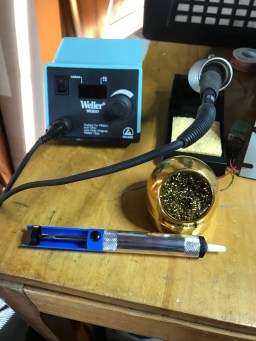
but I’ve had this one for about 5 years now and it’s still going strong and works quite well.
Two things you want to look for – a variety of different tips for different soldering jobs, and variable temperature. You need different tips for different types of soldering, from needle sharp tips for small components to spade type tips for desoldering. And the temperature control is, I feel anyway, essential. Different formulas of solder have different melting points. You want it hot enough to adequately melt the solder while at the same time not too hot to avoid damaging the equipment you’re working on.
A couple of other things before we move on here. You see a couple of other items in that photo, a thing that looks like a rather odd syringe, and a golden ball full of what looks like hair.
The ball thing is actually a tip cleaner. The ball holds steel wool. The hot tip is rammed into the steel wool, cleaning it of accumulated solder, flux, etc. Some kind of tip cleaner is essential. A dirty soldering tip does not conduct heat well, and heat is what it’s all about. The cleaner the tip, the better.
The blue and chrome gadget is what is generally called a solder sucker, a tool for removing rather than applying solder.

I find that I’m often using my soldering equipment for removing solder rather than applying it. You’ll find you have to desolder components from a circuit board before you can make a repair or modification. The only way to do that is by melting the existing solder and removing it somehow.
The sucker works by applying a vacuum which sucks up the solder. There are different types. Some use rubber squeeze balls, some use a piston powered pump like this one, others, much more expensive, have electric vacuum pumps. The other way is to use solder wick or braid. This is a metal braid, usually coated with some kind of flux to attract liquid solder better. The braid is pushed down onto the cold solder with the tip of the soldering iron when then heats everything up and the braid absorbs the liquified solder.
If you do a lot of desoldering, you might want to get an actual desoldering system. But for most of us good old desoldering wick or a solder sucker is good enough.
Let’s move on to one final item in this discussion about soldering, and that’s this puppy,  the ubiquitous soldering gun. These things are designed to apply a lot of heat to large objects, quickly, and as such they are virtually useless for most electronic soldering jobs. They’re too big, too awkward, apply too much heat. Using one of these on a circuit board is sort of like using a 12 gauge shotgun to hunt mice. You can do it, sure, but there isn’t going to be anything left of your quarry when you’re done.
But there are times you need something like this. Especially if you’re trying to solder PL-259 connectors. Your average soldering pencil just doesn’t supply enough heat quickly enough. By the time you’ve heated the connector up enough to solder it, you’ll discover you’ve also melted about two inches of the insulation on the coax as well.
Now there are other things I haven’t touched on that are related to soldering, but which I’m not going to get into. Like SMD. SMD stands for Surface Mount Device. Discrete components (even entire IC chips) are now often mounted not via good old fashioned through-hole connections, but on solder pads on the surface of the board. While this is great for robotic assembly systems, it’s not good for people who want to try to repair the blasted things or have to otherwise work with SMD technology. Dealing with resistors, capacitors, diodes and other components that are about the size of a quarter of a grain of rice and mounted on the surface of a board on solder pads, well, it isn’t exactly a great deal of fun. Working with SMD can be done, but it takes practice, a steady hand, and a pretty good magnifying lens, preferably with a built in light.
Then there is the question of fumes. There is no denying the fact that some of the fumes given off by solders and fluxes when heated are not healthy for you to breathe. Even some of the plastics that the components are made from can give off fumes that are toxic. If you’re just soldering a joint or two it isn’t bad, but if you’re doing a lot of it, you’re going to want to look into a good venting system or a fume extraction device of some sort.
Now let’s look at power.
Power. As in electrical power of course. You need it.
Now with most devices you just plug the thing into a wall socket and turn it on. But sometimes things are that simple. Once you get into amateur radio and/or electronics, you will quickly find out that different devices have different power requirements. Odd ball voltages, weird batteries that no one carries, and odd power connector plugs. Sometimes very odd power plugs.
Now a lot of amateur radio equipment runs on 12 volt DC. My Kenwood TS-2000 transceiver requires 12V, my antenna tuner runs on 12V, my big dummy load runs on 12V.
And to complicate things a bit more, 12V doesn’t actually mean 12V. For reasons I won’t get into here (you do have that google thing, right?) most 12V devices actually want around 14V, and if you try to feed them less than that some very strange things can happen.
Now if you do have 12V equipment you want to run, what do you do? Go out and get

yourself a car battery or something? Well, you could if you really wanted to. It would work. For a while. But you’re going to need a 12V power supply similar to this one over on the left. This particular one has a handy Amp meter that tells you how many amps the device(s) connected to it are drawing, and a meter showing the actual voltage the power supply is producing. This particular power supply allows you to adjust the voltage up to about 16V if you need it for some reason.
You can get power supplies with all kinds of bells and whistles on them, but you don’t really need most of them. You can get switching power supplies, transformer power supplies… Generally the switching power supplies are a lot lighter, but they have more electronics in them that can screw up. Transformer based power supplies generally work well, but can use significantly more electricity than switching supplies. Which one you choose depends on what your preferences are, budget, etc. Before you buy one go check out the reviews on eham.net or other sources first.
Once you do get a power supply, the question of how to get that power to the equipment that needs it comes up. Most 12V power supplies only have one or two supply points on them, and generally they aren’t the most convenient things in the world to use. You basically shove a couple of wires into holes and have to tighten down screws to make the actual connection. It’s awkward, and if you have more than one piece of equipment and only one power supply, you’re going to wear those screws out pretty fast switching things around. So I use one of these for 12V power.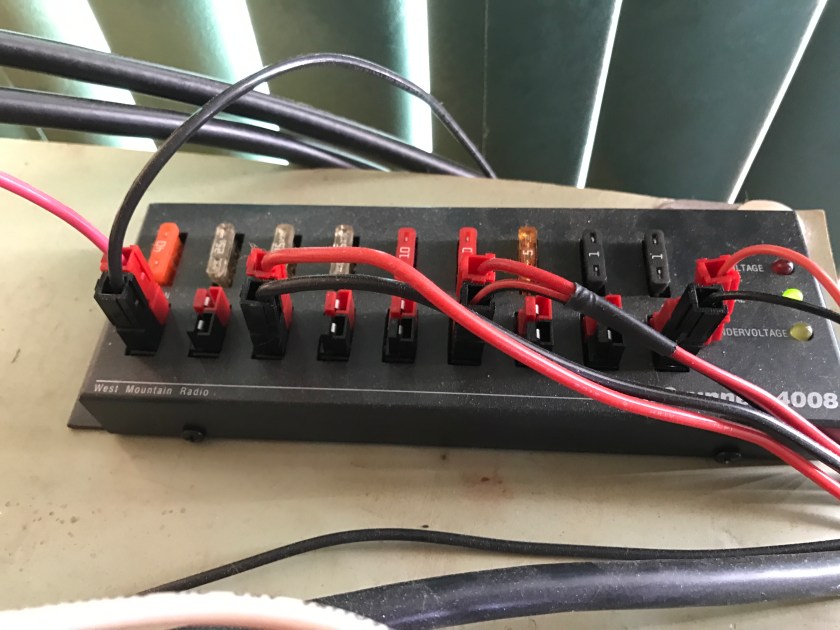
This particular unit is a Rig Runner from West Mountain Radio. It’s basically just a power strip, but for 12V rather than 120V. The main line from the 12V power supply is plugged into the outlets on the far left, and the other connectors then distribute that power. Each of the outlets is fused for various amperage requirements. If you’ve never seen that kind of connector before, don’t worry, I’ll come to them in a minute.
Now power strips like this are available from a variety of companies. MFJ makes them, as does West Mountain. Or you can make your own easily enough.
Now let’s talk about those connectors. If you haven’t seen those before, they’re called 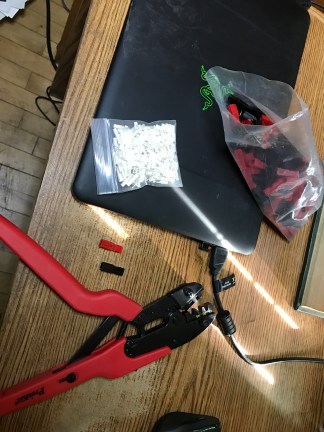 Anderson Power Pole connectors, and they’ve become something of a standard method of connecting power to devices in the amateur radio community. ARES has declare them to be the universal power connector out in the EmCom world, and I have to admit they make life a hell of a lot easier. No more stripping wires, fiddling with electrical tape and all that nonsense. Just install them on the ends of your power leads and you’re good to go.
The drawback is that while they’re simple to use, they do require a special crimping tool to install them on the ends of your wires. A good one like the one in the photo there can set you back a hefty chunk of money.
But if you’ve ever had to fiddle around in the cold under the dash of a car trying to strip insulation off wires, wrap wires with electrical tape, well, that kind of thing gets old fast.
Let’s talk about 240 volt for a moment. The only reason you might need 240V in your shack is if you’re going to be running a 1,500 watt output amplifier. If you want to fire up a big old tube amp and pump enough energy into your antenna to melt the vinyl siding on the neighbor’s house, hey, who am I to tell you not to? But do you really need it? No.
If you really need to put out more power, a 500 – 600 watt amplifier will generally run pretty well on 120V. A lot of the high output amps can be rewired to run on 120v, although at reduced output. So no, you don’t really need 240 volt in your shack.
I was going to talk about farming less often here but there’s been so much going on and it’s hard to do that. So let’s see what’s going on, shall we?
Bird Flu – We haven’t been hearing much about bird flu since 2015, but it hasn’t gone away just because it’s fallen off the news media’s radar. There have been some serious

outbreaks in China, including at least 84 human deaths from one form of the virus. China either already has or is in the process of shutting down live bird markets and putting other rules in place to try to curb the spread. In France the government was forced to slaughter all of the ducks in an entire region, and it’s popping up in the US now. An outbreak of a very nasty strain of the virus was found in Tennessee. A mild version of the virus was found at a turkey operation here in Wisconsin. And as a result a lot of people are very nervous indeed.
What about a vaccine? Well, vaccines are out there for some, but not all versions of the virus. Flu virus evolves very rapidly, which is why it’s necessary for us to get vaccinated every year, and even then the vaccine may not do much good. A year or so ago they estimated that the vaccine that was distributed for human use was only about 30% effective because the type of flu sweeping the country was different from the one the vaccine was developed for.
Even worse, a lot of farmers raising birds are reluctant to vaccinate their birds because the tests that are required on poultry being exported to other countries will flag vaccinated birds as having virus because vaccination gives the bird the same antibodies as if it had the actual disease. So it’s complicated.
Labor – Trying to find reliable, intelligent farm labor has always been difficult, and it’s become especially bad since, oh, the 1970s or so. The days of being able to hire a couple of high school students to stack bales, pick rocks or milk cows are long gone for a variety of reasons, some legal, some economic, some social. Even though wages and benefits have risen to the point where they are often competitive with the manufacturing sector (starting wages at some of the farms around here are higher than they are at most of the local manufacturing companies) it’s still almost impossible to find employees unless the farm is willing to employ immigrant labor, usually from Mexico and Central America. Something like 80% of the farm jobs here in Wisconsin are now held by immigrant laborers, either legal or undocumented. While it is illegal for a US employer to hire undocumented workers, the penalties for doing so are often little more than a slap on the wrist. So when a worker presents a slightly dodgy looking set of papers to prove he or she is in the country legally, well, let’s just say it’s really easy to overlook problems with the paperwork when your choice is to either hire that person, or go out of business because you can’t get people to do the work. Besides, with modern technology it’s possible to crank out very official looking documents that can fool almost anyone except the experts.
So in today’s political climate, a lot of farmers are very, very nervous about the real possibility that they are going to get up one morning and find that most of their employees are gone and they can’t replace them.
If one adheres to the ideas of the far right, then the belief is that these immigrants are taking away jobs from “real Americans”, and the reason unemployment is so high and people aren’t making money is because the immigrants are somehow stealing our jobs…
But wait a minute. Right now Wisconsin’s unemployment rate is under 4%. Almost every time I turn on the radio I hear businesses claiming they can’t find employees. Now granted a lot of the people who are employed are under-employed, that is they are working at jobs below their qualifications, at pay rates less than they really would like to have. Many, far too many, are the working poor who, despite working one or two or even three jobs, are just barely hanging on by the skin of their teeth. But the claim that we have huge numbers of “real Americans” unemployed because of immigrant labor is not really true.
And most of the jobs the immigrants are “stealing” are jobs those “real Americans” don’t want to do in the first place: like shoveling manure out of calf pens, cleaning toilets, scrubbing floors, the backbreaking work of picking fruit or vegetables…
Uncertainty – Right now one of the biggest worries in agribusiness isn’t climate, isn’t flooding, isn’t weed or insect infestation, isn’t drought, it’s politics. Everyone in any kind of business associated with agriculture right now is nervous about the new administration and for very good reasons. Between threatening to institute huge tariffs on imports that would decimate the markets and cause massive retaliation by trading partners, to immigration policies that would cut off badly needed labor, to renegotiating long standing trade agreements that would open the country up to restrictions on our exports, the current administration has done little or nothing to curb the nervousness in the ag sector. The commodities markets have been churning, prices refuse to stabilize making planning difficult. No one knows what the FDA or USDA is going to be like under the new administration. Some farm operators I’ve talked to are terrified they’re going to wake up one morning and find their entire labor force has fled out of fear of the immigration authorities. One fellow I talked to said even people who are here legally are leaving because they’re hearing rumors that anyone who looks or sounds even vaguely “un-American” is going to be rounded up and deported or put in concentration camps somewhere.
Scandal – Everybody loves a good scandal, so let’s wrap this up with a nasty and expensive scandal going on in the University of Wisconsin system at the Oshkosh campus.
Apparently former UW-O chancellor Richard Wells and vice chancellor Sonnleitner, both now retired, are accused of funneling university funds to the private UWO-Foundation, a separate nonprofit that supports UWO projects through fundraising and other activities. Under state law the university is not permitted to support a private organization like the foundation in any way.
But it is alleged that Wells and Sonnleitner gave university money to the foundation and issued “memorandums of understanding” in which the university promised to cover the foundations debts in order to help the foundation procede with several multi-million dollar building projects that included two biomass digester systems, one on a private farm, a new hotel, a conference center and a sports complex. In addition it’s alleged that Sonnleitner gave money amounting to well over a quarter of a million, and signed a $700,000 a year lease agreement with the foundation to use one of the digesters.
In all it seems to have cost UWO around $11 – $12 million.
The head of the foundation has been fired, the foundations accountant was put on “administrative leave”, and everyone is wondering how the hell this happened in the first place and how they’re going to keep it from happening again Investigations by the DOJ and law enforcement are going on, lawsuits are already in the works, and the whole thing is a massive mess.
What’s that got to do with agriculture? I said this post was going to be about agriculture, didn’t I? Well, the digester, of course.
One of the projects was a massive biodigester system built on a farm in Rosendale not too far from Oshkosh that was backed by the foundation. The system cost $10 million. Manure digesters use bacteria to produce methane which is then burned in generators to produce electricity. The idea is that it reduces pollution from spreading manure (it doesn’t), it produces methane (which it does, although not very well and methane has some serious problems in the first place) which is then burned to produce electricity which, apparently, none of the utilities actually want because they don’t want to pay more than a token amount for it. For reasons I won’t go into right now, manure digesters are a “solution” to a problem which doesn’t actually solve anything and which creates a whole new set of problems.
I’m not exactly sure why the foundation got involved in this project in the first place, but it’s in it up to its neck. As of June the foundation still owed almost $7 million on the thing. The university itself dumped over $4 million into the project via illegal funds transfers to the foundation. And while some of the money was repaid, the foundation still owes the university almost one and a half million.

Tumblr: Pulling the Plug At Last – I’ve had a blog over there for ages. I’ve put up with all of the nonsense they’ve pulled for far too long now. The company’s various attempts to make money off the service have done little except alienate the bloggers who made the service successful in the first place. Things have gotten much worse over the past year. Advertising is so invasive I can’t even read my dashboard without my ad blockers running full on. The service now seems to be in the process of being taken over by fake automated blogs that don’t have an actual person behind them. Most of these seem to be automated systems that “harvest”, so to speak, cute photos from Tumblr or other internet services, then offer them up on the blog, interspersed with dozens and dozens of fake posts that are links to advertising. The porn bots, the automated porn blogs that were “following” random blogs in the hopes of generating page hits were bad enough, but these new fake blogs are even worse. I’ve had about 50 new followers over there in the last couple of weeks and every single one of them has been one of these automated advertising systems.
I’ve had it with the whole mess over there. I’ll keep reading the blogs of people I follow over there, but I’m not going to be posting anything there any more.
Not sure what that means for this blog. You’ll probably see an increase in activity here. Maybe?
Amateur Radio Irritations Part One: “Contesting” or “Radio Sport” – The first time I heard someone use the term “radio sport” in amateur radio I almost fell over laughing. Until I realized they were serious. What they are trying to do is rebrand various contests as some kind of sport, and failing miserably. But I wanted to talk about contesting, didn’t I? So let’s get on with this.
Let me explain what contesting is in the amateur radio world for those of you who aren’t familiar with it. The basic idea is you have a limited amount of time, 48 hours, let us say, to contact as many other amateur radio operators as possible using a specific mode of operation; CW, SSB, digital, etc. The rules vary from one contest to another. Some are restricted to specific frequency allocations, some restricted to specific operators like the Rookie Roundup, etc. You get points for every contact, with some types of contact being points multipliers. And it’s just – well, it’s just silly. I’m sorry, but it just is.
The two print publications still catering to the amateur radio market, QST and CQ, make a Big Deal out of contesting. They claim it is wildly popular, fun, etc, etc, etc. And while it may be fun for those who enjoy that kind of thing, popular it is definitely not. One of the “big” contests was just reported on in the last QST magazine. They devoted four pages to the thing. How many participants did it actually have? About 4,500 if I remember right.
Now, there are something like three quarters of a million amateur radio operators in the US alone, so 4,500 participants world wide when there are around 750,000 operators in the US alone isn’t exactly popular by any stretch of the imagination. That’s a participation level of – what? About 0.006%?
Now don’t get me wrong. Contests are just fine and dandy if you get into that kind of thing. I can certainly see how someone might even enjoy it. But popular? I’m sorry, it just isn’t. When less than one percent of the total number of a particular group of people do an activity, it is not “popular” by any stretch of the imagination.
Amateur Radio Irritations Part Two: Own Worst Enemy – If you get on the amateur radio websites or read the letters in the magazines, there seems to be one question: Where the hell are all the new amateur radio licensees? We know they’re out there. People are getting licensed in droves. But you never hear any of them actually on the air. So where are they?
If my own experience is any indication, the biggest problem is that the amateur radio community isn’t exactly very welcoming to newcomers. I know there are many exceptions to this, but first impressions count, and when your first experiences are as difficult as mine were, well, you have to have a thick skin to deal with it.
Join a club, they tell you. Well, first of all, good luck even finding one. And if you do, chances are good you’ll have the same experience I did when I joined the Fox Valley club. I dutifully sent off my check, my email address, call sign, and all the other stuff they wanted, and heard — nothing. Absolutely nothing. Not even a confirmation they got the check. The only reason I know they got it was because it was cashed. No email reply, no information about membership, nothing. Meetings were scheduled when I was working so I couldn’t get to those. Emails to them asking about my status never got a response.
The local ARES group was more responsive and more helpful. But the only thing they care about is emergency communications, an area where amateur radio is increasingly irrelevant and unwelcome, only ARES hasn’t figured that out yet.
If you dare to get on the air, especially down on HF, watch out. The very first contact I made on 10 meters was to someone out in California who spent ten minutes telling me I was an idiot, I was doing everything wrong, that I didn’t know what the hell I was doing, all because I hadn’t been required to learn morse code. A few days later I was talking to someone down on 75 meters when someone jumped in and launched into a long rant about how people like me were ruining amateur radio, how I was an idiot, didn’t know a resistor from a capacitor, how all us new operators couldn’t repair a piece of equipment to save our lives and had to buy everything we used. We dropped down to a different frequency and let him rant. He was still at it twenty minutes later.
I’ve been told that most newcomers don’t run into that kind of nonsense, that amateur radio is generally very welcoming. I was probably just very unlucky, at the wrong place and the wrong time. Perhaps. But it only takes one or two unsavory encounters like that to make people wonder if they should be looking at a different hobby.
The Future – So, what’s going to happen here at grouchyfarmer now that my other blog on Tumblr is no more? I’m not really sure yet. There will probably be more activity here in the future. Other than that I don’t know. yet.
So, let’s talk farming. I ran into this article about weed control over at Agweb and it’s actually pretty good so go take a peek at it if you have the time.
Differentiate fact and fiction as you plan your weed control strategy. Source: Myth-Busting Weed and Herbicide Rumors | Agweb.com
Now, the reason this article has popped up (and I’m sure you will see others in the ag press similar to this in the future) is that there are a few new GM crops coming on-line now, modified to work with a couple of new blends of herbicides in an effort to deal with increasing weed resistance to glycophase. The herbicides aren’t really new, though. They are simply blends of previously existing herbicides with glycophase. They incorporate either 2,4-D or dicamba, both of which have been around for decades already. The only thing new about the system is the GM crops that have been engineered to tolerate 2,4-D and/or dicamba.
And they aren’t going to work any better than glycophase alone did. At least not in the long run. Sooner or later weeds will eventually develop resistance to these new blends as well, and we’ll be right back where we are now. In fact, there is already resistance to both of those herbicides “out in the wild” so to speak, because both have been in use for some time.
We have allowed ourselves to become dependent upon a system of weed control that we know is eventually going to fail. So, if we already know that these reformulated mixes are going to eventually fail, why are we bothering with them at at all?
Part of the reason this isn’t going to change any time soon is that over the last few decades we have adopted almost across the board farming techniques that make it difficult, if not impossible, for us to change.
How did we do it in the “good old days”? Well, like this:
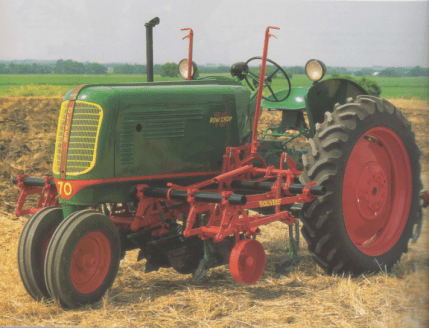
Now, if this text editor has managed to put the image in the right place, that is an old Oliver 70 with it’s optional corn cultivator rig. I used to drive one of those when I was a kid. For hours. And hours. And hours. And hours. And hours. And.. Well, you get the idea.
It was boring, tedious, took huge amounts of time, huge amounts of fuel. And with how expensive fuel is these days, how expensive labor is, if you can even find labor, how time consuming it is… Well, it isn’t surprising that the agricultural industry has always been looking for something, anything, to try to eliminate weeds that doesn’t involve so much time, labor and expense.
But some alternative to this never ending cycle of herbicide failures is going to have to be found. We’re running out of options. No matter what kind of chemical intervention we may come up with, sooner or later nature will figure out a loophole to work around it because that’s just how nature works.
I wish I could tell you that there is a solution to this, but there isn’t. People are experimenting, yes. But so far all of the efforts I’ve seen in trying to get out of this dependency on herbicides have involved techniques that simply can’t be scaled up. I’ve seen flame throwers to burn weeds, steamers to steam weeds, “cookers” that scoop up soil and literally cook it to kill weed seeds… All of them are tedious, time consuming, and worst of all, very energy hungry.
There are some new robotics and AI technologies that are looking promising. I suspect that may be one possible solution; machines that do the cultivation for you using cameras, LIDAR, GPS to guide them. Even systems that can identify weeds by sight and mechanically remove them, leaving the desired plants alone.
But those are years away, maybe decades. But who knows? Maybe there is some kind of “magic bullet” out there. Ah, well, no, there isn’t, but we keep looking for one, don’t we?
“Property tax reforms in Nebraska could help farmers, but not as much as some groups want.”
Source: Nebraska Gov. Ricketts Touts ‘Major’ Property Tax Bill | Agweb.com
Please have patience with me while I talk about agriculture and property taxes for a moment so I can explain why this is important for farmers and environmentalists. Talking about things like taxes and government policies tends to make my eyes glaze over and I find myself with a sudden desire to take a long nap. But if you aren’t a farmer you may not know why this move by Nebraska is important for farmers. Wisconsin already did something like this years ago, and I think it’s the right thing to do.
Property taxes are based on the value of your property, of course. If your house, for example, is valued at, oh, $100,000, you pay property taxes based on that value. If it’s valued at $200,000, your property taxes are going to be significantly higher.
It’s the same with farmland. Under law here in Wisconsin the property is supposed to be assessed for purposes of property taxes at fair market value. (That law had to be instituted because some local jurisdictions were playing fast and loose with property evaluations in order to jack up the tax money they were getting. Before that law was put in place, I knew one poor bugger who had a mobile home that was worth about $10,000 get a tax assessment for $64,000. Seriously. I saw the documents myself.)
The question now is what exactly is “fair market value”? Is it the value of the property as it currently exists, what it is being used for at the moment, or the potential value of the property if it were sold for some other purpose.
That distinction is important, because what was happening in Wisconsin and a lot of other states is that local jurisdictions were assessing property not at it the value of the property as it currently existed, but what the property could be worth if it were sold for some other purpose.
The result was that if you had a farm on the outskirts of a town or city, you were pretty much screwed. Local governments were assessing the farms not on their value as farms, but their value as if they were commercial or residential property.
To illustrate what I mean, let’s look at an example. Farmland in this area is currently going for around – well, let’s round it off to $7,000 an acre to keep the math simple. So if you have a small, 100 acre farm, it’s worth about $700,000.
Meanwhile, land being used for, oh, let’s say a fairly upscale housing development in a nearby town, is going for about $20,000 per 1/4 acre lot, or about $80,000 an acre. Over time the town grows, and now you find that your farm is on the outskirts of the town. And as a result of that, the local government is now assessing your farm not for what it is worth as a farm, but for what it would be worth if it were sold for a housing development. You are now being forced to pay property taxes not on a farm worth $700,000, but property worth $8 million. Your property taxes just went up more than ten times what they’d been before.
While that’s a bit extreme, it isn’t exaggerated by much. I knew farmers who were seeing their property tax bills shooting up into the astronomical range because the jurisdiction they were in decided to evaluate their property not for what it was, but for what it could be. Their taxes were going up five, eight times what they’d been before when their property was evaluated at commercial or residential rates rather than agricultural.
There was some very heated debates over this, of course. The towns (and the developers) claiming that the new value was fair because that was what the property was actually worth if it were sold off to some developer, and the farmers on the other side saying no it isn’t because that’s not what it’s being used for… It was nasty.
I don’t think anyone ever actually proved that the governmental jurisdictions, seeking ever more tax money, along with developers smelling profits, abused the system by ratcheting up the taxes on farms specifically to force farmers to sell at bargain basement prices to a developer, but it was pretty much an open secret that this was exactly what was going on. At the time the laws curbing this were under consideration dozens of farmers appeared before the legislature claiming that this was exactly what was going on. Developers would find a nice farm in a good location near a town, smell the heady scent of money, convince the local government that it would be to it’s advantage to annex the farm into the town, evaluate the farm as commercial or residential property rather than farmland, and the farmer would be forced to sell at cut throat prices to the developer or go bankrupt from the taxes… It was nasty.
And for those concerned with urban sprawl it was nasty as well. This kind of thing was driving the construction of huge housing developments on the outskirts of cities and towns with McMansions sitting on quarter acre “estates”, endless cookie cutter boxes, hastily constructed, looking exactly alike…
Wisconsin did finally change the property assessment laws, but local jurisdictions and developers are still griping about it and occasionally manage to bribe convince some legislator to try to introduce a measure to “reform” the system, turn back the clock and let local jurisdictions snap up all that yummy, yummy tax money by assessing farmland at utterly absurd valuations.
The change didn’t halt urban sprawl, but it did help to slow it down a tiny bit. Maybe. Depends on who you talk to, really. Certainly it helped a lot of farmers whose property is adjacent to towns and cities.
Dairy proved one of the best commodity performers of 2016, as the price slump of the previous two years at last curbed output. Has the rally got legs?
Source: Agrimoney.com | Dairy prices – will their recovery continue in 2017?
At the start of the year everyone seems eager to present their predictions of what’s coming for the future, and the markets gurus are no exception.
Right now their view of the future looks fairly good, although not exactly what I would call glowing. USDA is predicting a milk price of around $17.25/CWT. While better than the $13-$14 farmers were getting at one point, it’s still not really all that good. To give you some historical perspective, with bonuses for butterfat, protein, low somatic cell count (i.e. our cows were healthy) we were getting around $13 for our milk back in 1979 or 1980. So now you know why dairy farmers were in so much financial trouble over the last year or so as prices dipped below $14/CWT(2).
The US actually escaped the worst of it. New Zealand and other milk producing regions around the world suffered far worse than we did. NZ was hit especially hard because a huge amount of their milk goes to China, and when China began to cut imports of milk, the NZ market crashed so hard it actually caused a devaluation in the NZ dollar and had repercussions through their whole economy.
China has been slowly ramping up imports again. While the country has been increasing its own dairy production, it’s having trouble meeting demand for various reasons. Many Chinese consumers still remember the melamine horror of a few years ago where domestic milk was deliberately contaminated with melamine(1). Consumer confidence in domestic products plummeted, increasing the demand for imported dairy products. Over the last few years China has increased it’s own milk production, and by improving food safety they’ve made some progress in restoring the confidence of consumers. But China still doesn’t produce enough milk to satisfy demand and imports have had to increase to keep pace.
New Zealand and the EU both saw production decline because of the plummeting prices. The EU didn’t return to the quota system it had a couple of years ago, but it did institute pricing incentives to get dairy farmers to reduce quantities. Between the low prices, farmers in NZ being pushed out of business, and the new pricing system in the EU, milk production in both areas has dropped by several percent.
Not in the US, though. Here production has continued to ramp up. Depending on whose data you believe, production in the US during 2016 went up anywhere from 2 – 4%, and there seems to be no end in sight at the moment. But then the US isn’t as sensitive to the international market as is the EU and NZ. Domestic demand has more of an effect, and it has remained fairly strong. But while we weren’t hit quite as hard as the EU or New Zealand, the prices dropped to the point where a lot of dairy farmers were suffering financially and were just barely hanging on. At $17 – $17.50 the situation is a bit better, but not by much.
I’m not all that optimistic, to be honest. In the US we’re looking at continued growth in production, and almost no increase in demand for milk products. While demand for butter has grown and the cheese market has remained fairly stable, we still have huge stockpiles of both sitting in warehouses. The market for fluid drinking milk is flat or is even shrinking. And now that the holiday season is over demand for both butter and cheese is going to shrink.
None of this bodes well for dairy farmers in the upcoming year. About the only good news dairy farmers have seen is that feed prices have remained low. But that’s bad news for the farmers who raise grain, especially corn. Corn prices have been sitting in the $3.40 – $3.52 range for months on the futures market, with farmgate prices dipping down to the $2.75 level or even less.
Will things ever improve? I hate to say this, but in all honesty, no. Farming has always been like this. You have long periods of mediocre prices, followed by a year or two of absolute panic, with the occasional good year thrown in just often enough to give you hope that maybe things will get better. And then the rug gets pulled out from under your feet…

Okay, what in the world is wrong with GF? It’s the middle of December, the temperature at 6 AM as I write this is about -3 degrees, and by Sunday night we’re supposed to have another 18 inches of snow, and I’m talking about gardening? Ridiculous.
But no, it’s not ridiculous really. This actually is the time when you should be starting, even if you’re here in the Great White North in Northeastern Wisconsin. This is when the planning and preparation for spring really begins, or should. And that’s what we’ve been doing – thinking, planning, looking for deals, etc.
Starting in late fall I begin keeping an eye out for bargains in stores when I’m shopping. A lot of department stores have bargain bin areas where they put heavily discounted items they’re trying to dump to make room for new stock, and you can pick up all kind of goodies, often at steep discounts.
Beginning in late fall and early winter we keep an eye out for deep discounts on things like canning supplies in the bargain bin areas of department stores. Once the prime canning season is over in the fall, a lot of department stores are eager to clear out their stock so they don’t have it taking up storage space and you can find some good deals. Things like pressure canners, waterbath canners, etc. take up a lot of storage space, aren’t hot sellers to begin with, so some places try to clear them out in late fall or early winter. Same with other home canning and processing equipment; funnels, strainers, cheesecloth, etc. We’re pretty well set up with equipment, but we still keep an eye out for good deals.
After the spring rush, you can get huge discounts on seeds, often cents on the dollar in some cases. There’s nothing wrong with picking up left over seeds at the garden center or department store if you get them cheaply enough. Yes, there is a chance there may poorer germination rate with older seeds, but most seed will survive for years if stored properly. When we cleaned out my mother’s house we found packets of seed that must have been 20 – 40 years old and while some didn’t sprout and there was a poor rate of sprouting, well, it was free seed and a lot of it did come up. It’s going to depend on the plant and how well they were stored. Some seeds require specific conditions for storage. Google can be your friend in cases like that. Most seeds will keep quite nicely in a relatively cool, dark place if kept dry, but some may have specific requirements for proper storage. Doesn’t hurt to look.
Anyone who does home canning can tell you that canning jars can get expensive. But if you buy at the end of the canning season in late fall or early winter, you can find some excellent deals there as well. We also tend to watch thrift shops like St. Vinnie’s and those kinds of places. But if you buy used jars, be careful. Check them carefully for nicks, chips, etc. Especially around the neck and mouth of the jar. If there is any damage at all to the neck and mouth of a jar, throw it away. And when buying used jars I stick with brand names like Kerr and Ball. The tomato crop was so good this past year that we ended up using almost every jar we had except for the tiny jelly jars. The ones we seem to use the most are pint jars. They’re ideal for things like soup, chili sauce, etc. I’d picked up a couple of cases on a sale about four years ago that we still had on the shelf and we even used up all of those this year. So I’m looking for pint jars now.
(And do I really need to tell you to never, never use peanut butter, mayonnaise, or other jars that came from commercial products you picked up in the grocery store? Even if you can find lids that fit them, those jars were made as cheaply as possible, were intended for a single use only, and there is no guarantee they will survive use in a home canner. Do you really want to risk your health and safety to save a few bucks on canning jars? I don’t.)
This is also the time we do some planning. I sit down with a notepad and think about the season that just ended. What plants worked well? What plants worked poorly? Was there anything you especially liked or didn’t like? Write everything down. (Keeping a notebook just for the garden is a good idea.)
Our eggplant was absolutely spectacular this past season, for example. They were ridiculously prolific. But we quickly found out we don’t like eggplant all that much, and by the end of the season, we were so sick of the stuff we couldn’t even look at them. So no eggplant. Using that space for more tomato plants is a better idea.
Speaking of tomatoes, we had about a dozen plants in the garden at the end of the garage and they didn’t do very well at all. They were spindly, produced badly, died off early. We hauled a ton of compost in there at the end of the season and that should help, but we aren’t going to be putting tomatoes in there. We know from past experience that leafy greens do pretty well there, so we’ll probably use some of that area for various lettuce in addition to the small stump(1) garden.
The herb garden — I’m not sure what we’re going to do with that to be honest. It’s in a corner where the new addition is attached to the main house, facing south-west. It’s an ideal spot, gets lots of sun, very well sheltered, and has, alas, some of the poorest soil I’ve ever seen. We have a well established area of chives that I don’t want to disturb. We also have an Italian parsley clump that’s ridiculously prolific in there, and we don’t want to mess with that either. But the majority of the area…
We made the mistake of putting oregano in there, and it immediately went absolutely nuts, taking over everything. It even jumped out into the surrounding lawn. And while it makes mowing the lawn back there smell amazing, we would much rather have the oregano go away. One year we dug the entire thing up, down to a depth of six inches, hauling the dreaded oregano down to the compost pile, filled it up with compost and put in strawberries. And within two years, the damned oregano was back… Sigh. My wife put in cone flowers at one end, and those managed to do pretty good against the oregano. But I’d rather be using the space for something edible.
Planning what to put where needs some careful planning. And sometimes you have to admit that something just isn’t working, dig it all up and try again. We did that with the front of the house. We’d inherited some utterly miserable bushes and horrible lawn from the previous owner. The bushes were invasive, required constant trimming and weren’t all that good looking. The only good thing was a ridiculously prolific and beautifully scented rose, which we loved. But the rest of it was just nasty. We left it for a long time because we loved that rose, but finally we gave up. We pulled everything out, went in with a 6 foot rotary tiller and a tractor and ground everything that was left into dust, and started from scratch. We got rid of the grass completely and turned the whole area into a hosta garden and we’re rather pleased with that. So sometimes you just have to bite the bullet, plow everything up and start over.
I think that’s what we’re going to eventually do with the herb garden. I don’t want to give up the parsley or chives, but they’re a fairly small percentage of the whole area and the rest is horrible.
I was going to try an experiment this year. I picked up a couple of really nice yellow roses that I put in containers in the front of the house over the summer and they did beautifully, even though they were in shade most of the day. I was going to try bringing them in and putting them in the living room and seeing if I could keep them going during the winter. If it worked, good. If not I was only out a few bucks for a couple of plants.
Alas, Mrs GF decided enough was enough. The living room already looks more like a greenhouse than a living room, she declared. And I have to admit she has a point. From where I’m sitting now in the kitchen I can see about fifteen different plants in various planters and groupings in the living room, including a bloody great evergreen tree of some kind that we have to keep cutting back every couple of years because it’s decided it likes the living room just fine, thank you. I made a rolling frame for it a few years ago so we could move it around because trying to shift a four foot wide, five foot tall tree is a pain in the neck. During the summer it lives out on the deck and in the fall we roll it back in. It doesn’t care where it is, just keeps growing…
Anyway, enough was enough, she said, so the roses went to live in the basement where, she says, they’ll go dormant and come back in the spring.
Agrimony is one of my favorite sites to go to for current information on the ag markets, and for good reason. They avoid hype, clickbait headlines and pretty much focus on what is actually going on. And one thing that’s going on right now is that people in the ag business are very, very nervous. You can take a look at the current situation here: Source: Agrimoney.com | ags dip, as funds succumb to pre-election nerves
The article only mentions Trump once, but he is really the elephant in the room, and he makes a whole lot of people in the ag industry very nervous indeed.
No one has been able to really pin him down on anything, really, but one thing is certain, is he has an extremely antagonistic attitude towards China. His campaign speeches and his off-the-cuff comments have portrayed China as some kind of economic super villain that has decimated the US economy. While most people understand that most of his comments are largely campaign rhetoric and could very well change 180 degrees the next time he opens his mouth, it makes a hell of a lot of people in the ag business very nervous indeed, and for good reason.
China buys massive amounts of US agricultural products, and making vague threats and uttering dire warnings about what he’d do to interfere with China’s business interests, is a very dangerous thing to do when China could easily put barriers in place to restrict the importation of US farm products.
Has China damaged our economy? Probably. But it was done with the full cooperation of the US companies who gleefully started snapping up Chinese products instead of making them here because it was more profitable. And with the full cooperation of the US government which did little or nothing to try to stop it.
But that point is moot right now. It’s already happened. Pointing fingers and uttering vague threats isn’t going to do anyone much good at this point in time. And it could make things far worse. If Trump gets elected and continues to try to use China as a scapegoat for our own largely self created economic problems, the end result could be very nasty indeed.
Like it or not, we are in a world wide economy. US ag exports are a relatively bright spot in what is an otherwise overall mediocre or even worrisome economy. If Trump becomes elected and continues his blustering, threatening attitude, China could simply take its business elsewhere.
I’m not sure exactly when this happened, possibly with updating to Sierra, possible during one of the security updates to OSX that took place over the last couple of months, but you want to double check your iCloud settings on all of your iMacs and Macbooks. I didn’t find this out until I suddenly got a warning that I was running out of capacity on my iCloud drive.
I had disabled all automatic storage and backup from from my iMac to my iCloud account because I don’t need it except for photo sharing. I do my own backups to external devices so I didn’t need it for that. I also didn’t want documents, emails or other information being stored off-line out in the cloud because I don’t particularly want things like financial information, tax returns and similar information stored heaven only knows where on some server I have no control over.
Somewhere along the way, perhaps with the upgrade to Sierra, Apple decided to reset all of my iCloud preferences and now everything was turned on. It was automatically saving my entire documents folder, desktop files, contact lists, calendar, and pretty much everything out on the iCloud. Even worse, it had also turned on iCloud for every third party application that has iCloud capabilities – word processors, accounting software, a couple of photo editors — all of them were now storing duplicates of everything out on the cloud as well as on my local drives.
Not only is this a privacy concern, it also sucked up a hell of a lot of storage space, and while iCloud storage isn’t exactly expensive, it still costs money.
So if you use iMacs or Macbook computers, go to your system preferences and check your iCloud preferences so you know what’s actually being stored out on the cloud somewhere.
Important – just found out the hard way that if you do disable Sierra’s ability to “share” your documents and desktop with iCloud, and then delete the documents and desktop folders on your iCloud account, it will also delete the documents folder and any documents, photos, etc you have on your desktop from your iMac’s local hard drive as well.
And, of course, I’d emptied the trash bin before I found this out and had to restore my documents folder from backup (Thank you Time Machine)
Additional note: Apparently just switching iCloud functions off doesn’t actually do anything. After switching it off, deleting the unwanted files from the cloud, I discovered OSX put them right back again. I had to log out of my iCloud account, reboot the computer, then log back in before the changes actually went into effect.

