But Is It Milk?

I always thought that milk was a substance that was excreted by special glands of mammals which was used to feed their young. Or, in the case of some types of cattle, to make yummy, yummy cheese (1).

But apparently what I learned in school is wrong, because if you look through the dairy section of the grocery store these days you’ll find out that you can apparently milk a lot of different things. You’ll find almond milk, soybean milk, rice milk, coconut milk, milk stout… One quickly gets the impression that just about anything can be milked. And judging from the prices on this stuff, one quickly discovers that what is really getting milked is the consumer.

So, the question is, is this stuff, these various liquids derived in one way or another from non-mammalian sources, really “milk”?

Of course it isn’t. And some people are getting a wee bit irritated by all of these people calling a product that is basically nothing more than water, thickening agents, flavoring agents and a ground up vitamin pill “milk”. Like these people here. This is a communication from an assortment of Congresspersons to the FDA politely pointing out that calling what is basically some type of nut flavored water, ‘milk’ is grossly misleading, inaccurate and even deceptive.

What’s especially irritating about these various “milks” is that while they are heavily advertised as being nutritional powerhouses, that they are healthier for you than real milk and are more ‘natural’ somehow, they pretty much aren’t.

Let’s look at almond milk. Now there is no doubt that almonds are good for you. Lots and lots of nutritional value and they’re pretty damned tasty. But almond milk? Ah, well, about that…

There are very few almonds actually in commercial almond milk. If you start scrounging around Google you’ll quickly find out that a lot of these almond milks are mostly water, various additives and flavoring agents, and very few actual almonds. Many of them contain only 2% actual almonds. Two cups of almond milk will have, if you’re lucky, maybe 9 actual almonds in it. If you don’t believe me, go look it up yourself. I’ll wait… Ah, back, are we? Good. Let’s get on with this, then.

A year or so ago, a couple of makers of almond milk were being sued in New York because their “almond milk” had only 2% actual almonds in it. It’s basically just almond flavored water with lots and lots of additives. Their argument was that calling something “almond” anything when the product has only 2% almonds in it is wildly misleading.

Then there is the problem of the other ingredients in the stuff. If you read the ingredients labels on most almond milks and similar products, it reads like a high school chemistry experiment. Various gums and thickeners, flavoring agents, salt, sugar and vitamins are added to the stuff. Basically it’s little more than water with thickening agents, flavorings, colorings and a ground up vitamin pill in it, with a bit of almond flavoring.

Now I have nothing against chemicals(2). Everything is chemicals, really. Chemicals are nothing but the basic components of, well, everything. But when you’re buying something labeled “almond milk” wouldn’t you want, well, almond milk, and not something that’s 2% almonds, 8% thickening agents, salt, sugar, flavoring agents and added vitamins, and the rest water?

They have to add all that stuff because when you soak a bunch of nuts in a vat of water, very, very little of the nuts’ actual nutritional content ends up in the water. Neither does flavor. Also the resulting ‘milk’ looks a bit like thin, cloudy water with some sludge on the bottom. So vitamins have to be added to make the stuff seem healthy. Thickeners have to be added to make it look more like real milk and less like, well, water. Flavoring has to be added to make it taste like something.

So, is it legally “milk”, this stuff? Under FDA rules and regulations that I’ve been able to find, the answer is no. Under FDA rules and regulations, milk is defined as “the normal lacteal secretion, practically free of colostrum, obtained from the milking of hooved mammals.” If you want to wade through all of the legalspeak and other nonsense, you can do so here at the FDA’s regulatory information site.

But that’s simplifying things enormously because definitions of terms is a strange and arcane branch of law and when it comes right down to it no one seems to know for sure.

So why don’t they just call it, oh, nut juice, then?

Well, they can’t do that because it isn’t. In order to be labeled ‘juice’ it has to be mostly the juice of the item on the label, and most of these “milks” contain less than 5% (in some cases 2%) of the nut listed on the label.

So is this stuff “milk”? No. Not by any stretch of the imagination. It resembles actual milk only because it is highly processed and has a variety of thickening agents, emulsifiers, colorings and other additives mixed it. It is nutritionally beneficial only in that it has vitamins and minerals from external sources added to it.


  1. Or the infamous Peruvian Beaver Cheese. And the less said about that, the better.
  2. Mmm — yummy yummy chemicals…

Drought, Climate and Agriculture. Like it or not, Change is coming.

Water is an increasingly precious commodity across the country, and lack of water has become an extremely serious issue in Southern California where a years long drought continues. I ran across this item over at Ag Professional’s website and while brief and far from in depth, it does talk a bit about the problems that are going on and the changes that are starting to take place.  California Drought is a U.S. Problem | Ag Professional

The ongoing drought in California is driving a lot of farmers over there into bankruptcy and causing others serious problems as they scramble to fight with cities and other users over an increasingly scarce resource. During his campaign Donald Trump claimed that there is no real drought in California and the other south western states, and he could bring the water shortage to an end if he was elected. But no, Trump is not going to end the drought by simply claiming it doesn’t exist. Even if the new administration changes or repeals existing water regulations, it doesn’t do you much good when there isn’t any water to begin with, which is the situation southern California and Nevada are facing.

With ground water being pumped out of aquifers at rates so high it’s causing the ground to sink, that wells are drying up wells all over that part of the state, and with surface water already being rationed, simply declaring there is no drought and blaming it on regulations is ridiculous. Sooner or later those aquifers are going to be completely depleted or drawn down so far that it is no longer possible to drill deep enough and build pumping systems powerful enough to deal with it.

Are there things that could be done to improve access to water? Sure. But it would take tens, even hundreds of billions of dollars in new infrastructure, new dams, new aqueducts, new pumping systems, etc. And even then they’d have to steal water from other parts of the country, suck rivers dry and pretty much ruin every river system they tap into in order to do it. From an engineering standpoint it could be done, but economically and politically? No state is going to stand by idly and allow it’s water be siphoned off to irrigate crops, water lawns and golf courses and fill swimming pools in states like California and Nevada.

Could the situation out there be solved some other way? Sure. But it would require change. And people don’t like change. The agricultural industry would have to fundamentally change how it works. Not just changing how they farm, but what they farm. Water intensive crops that require irrigation would have to go. Some types of agriculture, like dairy, would probably have to move elsewhere entirely. Consumers would have to get used to the idea of not having “fresh” produce of certain types available every month of the year. It would require a lot of changes that a lot of people don’t want.

And it isn’t just in California and the other states in the south west. How we use water, how we manage our water resources, is going to have to change. The changes are coming whether people like it or not.

When “Journalism” isn’t Journalism: The Rise of the Regurgitator.


We have reached a point in society where most of our news sources aren’t really news sources. The vast majority of websites you see out there that claim they are ‘news organizations’ are really no such thing. They have no actual reporters. They have no real journalists. They have no research staff. The have no fact checkers. They are – well, I suppose you could call them regurgitators.screen-shot-2016-12-03-at-8-47-35-am

If you browse through some of these ‘news’ sites, you’ll quickly find they have absolutely nothing that is actually new or original. What you’ll see is an endless string of references to material that does not originate with the site, but outside sources from traditional newspapers, magazines, and television/cable media, or even sources that have absolutely zero credibility like some wanna-be pundit on Twitter or Facebook.

What they do isn’t journalism, it’s – oh, harvesting, I suppose you could call it. They scrounge the internet for news items, studies, blogs, photos, twitter feeds, facebook posts, etc. for stories that they think will feed into the mindset of their readers, gulp them down, and then like mommy birds regurgitating food for their young, scurry back to their own website and puke it back out again, along with a liberal dose of outraged commentary, to feed their readers.

I’m sorry if that’s a bit disgusting, but that’s pretty much exactly what they do; they scarf down real news stories, digest them a bit, add some digestive juices to blur things, and then regurgitate it for us. Not in it’s original form, but twisted, half dissolved, semi-digested, warped, changed, all to suit the point of view of the website’s backers and to lure the ranks of the outraged and irritated so the website can push its political agenda or moral stance and, even more importantly, generate that yummy, yummy advertising revenue.

Now I make no attempt to hide the fact that I lean towards the left side of the political spectrum, but even I have to admit that while the regurgitators fall pretty evenly on both sides of the spectrum, a lot of the left leaning sites are doing this. If you go to sites like Right Wing Watch or Raw Story, what you’ll find there is an endless string of “stories” that are nothing but regurgitated information from other sources, all selected to support and feed the anger and outrage of us lefties, along with large doses of comments by bloggers that support our feelings. If you switch over to the far right, you’ll find exactly the same thing going on.

I did a totally unscientific (and quick because I get bored easily) study and almost all of the “news” websites I have encountered are either entirely or mostly little more than regurgitators of other people’s work.


A lot of very popular sites do this. Joe My God, Right Wing Watch, TruthOut.  Raw Story, for example. I don’t think I’ve ever seen a piece of actual original journalism over there. Their “reporters” scrounge the net for little tidbits, give us a couple of sentences describing it, and then utter their ‘oh my god isn’t this horrible we’re all going to hell’ commentary. It’s the same over on the right, even worse, I suppose. Mother Jones and Grist occasionally will publish something I’d call ‘original reporting’, but for the most part their websites are little more than regurgitators.

I find this ethically troubling, to be honest. A lot of these sites are entirely based on the work of other people, other organizations. They blatantly scoop it up and regurgitate it for their own readers. They generally give credit to the original, true, but still, they’re taking advantage of someone else’s work and contribute absolutely nothing except a bit of anger and outrage.

I suppose I’ve been guilty of this too. I’ve certainly used news stories I’ve read as a starting point for things I’ve written here, but I like to think that at least I’ve used that material only as a way of introducing something original.


Oat production slump to impact food market

Food companies that rely on supply to be impacted – granola lovers beware.

Source: Oat production slump to impact food market

It’s interesting to see how things change over the years. Once upon a time oats was a major crop here in Wisconsin. Almost every farmer grew it as part of their crop rotation program. It’s fairly easy to grow. Most of the grain went for cattle feed, with the stalks making an excellent bedding for cattle. We used it as a cover crop as well when we planted alfalfa. Alfalfa takes quite a while to get established, so oats were planted with it. The oats grew much faster, provided a cover crop for the new alfalfa plus we’d get a fairly decent crop of oats by the end of the summer. We grew it for both cattle feed and as a seed crop.

Almost no one grows it around here now any more. If they plant small grain at all, it’s always winter wheat here. Seeing a field of oats is so rare now that when we’re driving around the state in late summer and see some it’s almost a shock.

Oats has acquired a bit of a bad reputation around here. It is susceptible to a type of fungus known as rust, which can cause serious yield losses and adversely effect the quality of the grain. During a “normal” summer it wasn’t a big problem. But it seems we don’t really have “normal” hot, dry summers any longer. While our growing season has become significantly longer up here, it has also become more humid on average.

The price of oats doesn’t help much, either. Wheat generally sells for twice as much as oats does, so there isn’t much of an incentive for farmers to keep growing it unless they are under contract to a manufacturer to produce it for food. Right now oats is selling for around $2/bushel while wheat is going for over $4. At one point earlier this fall oats was down to around $1.70.


What Happened to the News Media?

The question I heard being asked most often during the recent election was; what the hell happened to the media? The almost universal opinion of most people seems to be that just when we needed the media the most to keep us informed, discover the truth, to keep things rational, it failed us totally.

The media blithely rolled along, repeating all of the lies, the innuendo, the misinformation, deliberately pumped up phony scandals. It gleefully turned casual comments and jokes into derogatory and misleading memes. It pounced on every conspiracy it could find. It magnified the silly and the ridiculous into clickbait headlines. It leapt upon phony stories from satirical websites or fraudulent sources gleefully and unapologetically.

Instead of helping to solve problems, the media became the problem.

But did it didn’t. Not really.

We have this impression that the news media is supposed to be some kind of watchdog, that it’s supposed to only publish the truth, that it’s supposed to call our attention to corruption, lies, misleading information, to cast light into the dark places inhabited by politicians and corporations. It is this concept that some call the fourth estate, the idea that the news media is some kind of watchdog, a guardian..

But the news media has never been that. The news media has a long and sordid history of manipulating information, spreading misinformation, taking things out of context, and doing it deliberately. The media has helped to foster conflicts and even wars, destroy reputations of innocent people, manipulating public opinion… And if you don’t believe that, just start doing some research. A few minutes running searches on Google is all it takes to discover that what is going on today is nothing new.

I know a lot of people who are laying the blame for Trump’s rise to power on the media and its failure to accurately report the facts. And there are certainly valid reasons to criticize modern media. But it isn’t anything new. The media has always done this. Either for profit, to push some political agenda by the owners of the media outlet, to pander to politicians…

But the fake news stories, quotes taken out of context, attempts by biased owners to manipulate public opinion? That’s been going on for as long as there has been a media.

And as for who is to blame, well, it’s us, really. The media is in business for one reason, for the most part: to make money. And they’ve learned that the easiest, least expensive and most profitable thing to do is publish the garbage they publish. Because we buy it. We click on the clickbait headlines, we gulp down millions of words written about ridiculous celebrities who don’t matter in the slightest. We’d rather read about who got who pregnant or who got a breast enlargement or who is divorcing who, then about things that really matter.

So if you’re looking for someone to blame, it’s not the media. It’s us.

Walgreens is suing Theranos for $140 million

Source: Walgreens is suing Theranos for $140 million – The Verge

The whole story of Theranos is a cautionary tale that illustrates that if something is too good to be true, it probably is.

Theranos was the golden child of Silicon Valley investors. The company and it’s founder Elizabeth Holmes claimed it was going to revolutionize the medical testing industry with it’s revolutionary new testing technology. Instead of health care professionals having to draw huge vials of blood for testing, Holmes claimed their new technology could do exactly the same testing using only a couple of drops of blood from a finger prick. The company sucked up hundreds of millions of dollars in venture capital. The company claimed that it’s testing procedures could do almost 200 different tests in its online documentation. Walgreens jumped on the bandwagon, signing a contract with Theranos to provide medical testing, and began offering testing is dozens of it’s pharmacies.

And then it all fell apart. US regulators issued a letter stating that Theranos’ testing “pose immediate jeopardy to patient health and safety” and could cause “serious injury or harm or death to individuals served by the laboratory” after inspections of one of the labs turned up major problems. FDA was also beginning to scrutinize the company. The company, which had never made it’s proprietary testing technology public, said it asked a prominent research hospital, the Cleveland Clinic, to compare Theranos technology to traditional techniques to prove it worked. But the clinic in question said it hadn’t done any such work, and added that “we are not consultants”.

In May Theranos voided data from thousands of tests that had been done over the previous two years. Unfortunately long after people may have used that data to plan medical treatment based on the testing.  Walgreens terminated its relationship with Theranos and shut down the testing sites it had set up in stores in Arizona.

Other troubling information began cropping up. Like the fact that Theranos had only one test that was actually approved by the FDA. It was selling its other tests through regulatory loopholes. The Wall Street Journal discovered the company wasn’t even using its own technologies for testing. It was using traditional testing equipment made by other manufacturers.

Theranos clinical labs have been shut down and those employees fired, its CEO is banned from operating laboratories for two years. The company is being investigated by prosecutors and in addition to being sued by Walgreens, it is also being sued by at least eight patients and one of its own investors is suing it for fraud.

That doesn’t seem to have bothered it’s founder, Holmes, in the slightest. Holmes is pushing yet another blood testing device the company calls a minilab, about the size of a computer. The claims for this one are more modest than for it’s original technology which they claimed could do 200 tests. This one will only do 40. The Wall Street Journal challenged that claim as well.


Agrimoney.com | ags dip, as funds succumb to pre-election nerves

Agrimony is one of my favorite sites to go to for current information on the ag markets, and for good reason. They avoid hype, clickbait headlines and pretty much focus on what is actually going on. And one thing that’s going on right now is that people in the ag business are very, very nervous. You can take a look at the current situation here: Source: Agrimoney.com | ags dip, as funds succumb to pre-election nerves

The article only mentions Trump once, but he is really the elephant in the room, and he makes a whole lot of people in the ag industry very nervous indeed.

No one has been able to really pin him down on anything, really, but one thing is certain, is he has an extremely antagonistic attitude towards China. His campaign speeches and his off-the-cuff comments have portrayed China as some kind of economic super villain that has decimated the US economy. While most people understand that most of his comments are largely campaign rhetoric and could very well change 180 degrees the next time he opens his mouth, it makes a hell of a lot of people in the ag business very nervous indeed, and for good reason.

China buys massive amounts of US agricultural products, and making vague threats and uttering dire warnings about what he’d do to interfere with China’s business interests, is a very dangerous thing to do when China could easily put barriers in place to restrict the importation of US farm products.

Has China damaged our economy? Probably. But it was done with the full cooperation of the US companies who gleefully started snapping up Chinese products instead of making them here because it was more profitable. And with the full cooperation of the US government which did little or nothing to try to stop it.

But that point is moot right now. It’s already happened. Pointing fingers and uttering vague threats isn’t going to do anyone much good at this point in time. And it could make things far worse. If Trump gets elected and continues to try to use China as a scapegoat for our own largely self created economic problems, the end result could be very nasty indeed.

Like it or not, we are in a world wide economy. US ag exports are a relatively bright spot in what is an otherwise overall mediocre or even worrisome economy. If Trump becomes elected and continues his blustering, threatening attitude, China could simply take its business elsewhere.

The ‘Ick’ Factor

I was reading an item over at AgWeb about what appears to be a growing interest in raising insects for animal feed <click the link to read the item>. Now you wouldn’t think that there would be any interest in feeding bugs to cattle. Cows, after all, are herbivores, they eat grass, grain. And they do. But cattle also need protein, especially if you want them to grow quickly for meat or if you want them to produce milk. Most rations for beef and dairy cattle both have some kind of added protein, often in the form of fishmeal or soymeal, but sometimes other types of proteins derived from animal sources. (Until the discovery of BSE (mad cow disease) including animal protein and bone meal derived from waste from cattle processing facilities was fairly common.)

In the US and EU feeding cattle insect derived proteins is illegal, but it is a common practice in other parts of the world, and there seems to be considerable interest in the practice. There are attempts to start up companies that produce insect proteins (usually some kind of larvae) specifically as a cattle feed supplement. There seems to be some justification for the practice. It would be relatively environmentally sound because the insects would be raised mostly on organic waste that would have otherwise been discarded. They can be grown in controlled, sanitary conditions. And there’s no doubt that it could produce feed supplements that would work just as well as other supplements.

But there has been some rather strenuous objections, especially in the US and the EU, over the practice. Mostly for reasons that aren’t really all that logical. This seems to be changing, but I suspect that many of the arguments against the practice aren’t due to logic, but to the ‘ick’ factor.

In Western cultures we’ve been raised to see insects as dirty, filthy, carriers of disease, to be disgusting, horrible things that should be killed on sight. We’ve been trained to be scared of insects rather than look at them as beneficial animals that have their own and very necessary niche in nature.

This kind of cultural

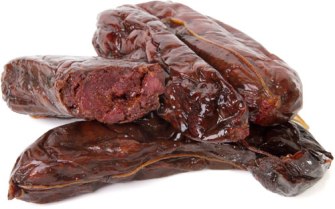
20110712-morcilla-cut-up
Yummy yummy blutwurst

conditioning takes place in all cultures, of course. Every society, every culture, has it’s own ‘ick’ factors. Heck, I probably eat things, and enjoy them, that would make you gag. Like blutwurst or blood sausage. And yes, it’s made with real blood. Headcheese, which isn’t cheese, but is made with heads. Raw fish…. And I’m sure you eat things that would make me shudder. My sister used to dip sardines in milk. I have no idea why. And yes, she’d drink the milk after.

I’ve always been fascinated with this ick factor, why some people are disturbed, even disgusted by some things, while others find the exact same thing not at all disturbing, even kind of nice. And with how it changes in individuals, including myself.

If thirty years ago someone had told me that I would one day love squid, octopus, raw fish, eel, I’d have questioned their sanity. But I do. If they had also told me that I would one day find chicken so disgusting that just the smell of it would make me retch, I’d have told them the same thing. But I do.

People are weird.


Meal Kits? What the heck is a meal kit?

Yesterday I ran across an item over at Mother Jone’s website talking about meal kits, which are supposed to be the hot new thing in the food service industry. These things started up a fairly short time ago, offered by companies like Blue Apron, HelloFresh and many others, and according to the press (some of it anyway, not all) meal kits are the best thing ever.

So what exactly is a ‘meal kit’? The idea is this: Every day a box arrives on your doorstep. Inside of it are all the raw ingredients to make a dinner. Everything you need from the entree, to side dishes, to seasonings,to condiments are pre-portioned and individually packaged. And a recipe telling you how to make it.

And that’s it. You get a box full of raw ingredients and a recipe.

You still have to cook it. You still have to use a stove, oven, etc. You still have to mix and stir. You still have all of the dirty dishes to deal with.

Well, they at least deliver it to your door so you don’t have to shop, right?  Uh, well, no, because these are only dinners. Unless you’re eating breakfast and lunch at a restaurant every day, you still have to go shopping for food.

So you still have to shop. You still have to mix, stir and actually cook. You still have to clean up afterwards and deal with the dishes. So this is useful for, well, who, exactly? People who can’t plan a meal, I suppose?

Then there is the cost. These things seem to be just a wee bit on the pricey side. We’re looking at anywhere from $9 to $50 or more per meal, per person depending on the service you’re talking about. Now I don’t know what restaurant prices are like where you live, but around here that basically means you’d be paying more for a box full of raw ingredients that you have to cook yourself, than  you would pay for a comparable meal at a restaurant, even at the low end of the meal kit price structure. I took a look at some of the menus from these places and figured that one chicken based meal they were sending out for $9 per person could be made for about $3.75 per person.

So just what is the point of all of this? Apparently the only thing this service does is relieve you of the horrible responsibility of — of planning what to have for dinner?

The ads for these places tout the ‘freshness’ of their ingredients. They wax poetic about ‘sustainable’ this and ‘environmental’ that, about how their “chefs” partner with “trusted farmers”. And all of that means pretty much nothing because all of those terms could be applied to just about anything.

The Mother Jones article linked to at the start of this turned up some rather troubling information about these meal kit companies. It seems that I’m not the only one who looks at meal kits with a skeptical eye. Apparently their own customers do as well.

According to independent marketing data that MJ dug up, half or more of the people who sign up for these things cancel the service within the first week. And only 10% or less kept the service after six months. Despite massive injections of venture capital, none of these companies have managed to achieve a positive cash flow from the scanty data I’ve tracked down. They’re continuing to exist only by burning through hundreds of millions of dollars of venture capital as they desperately try to attract new customers to replace the customers who almost immediately cancel the service once they’ve tried it.

The companies themselves vehemently deny that their customers abandon them in droves after trying the service for only a brief time, but refuse to show any data that supports their claims.

Still, the hype goes on. Celebrity chefs are hooking up with these places, the food service press waxes poetic about the ‘potential’ of meal kits. There are services that offer specialty kits, like strictly vegan, or “all organic” or vegetarian or, hell, places that only ship their product in ‘free range’ cardboard boxes, I suppose.

I don’t know, is it just me? Am I the only one who thinks this whole concept is, frankly, ridiculously silly?

It’s been a weird fall here in Wisconsin

This fall has been ridiculously warm. You’d think we’d like this unusually warm fall up here in the land of blizzards, frozen cars, burst water pipes and children frozen to flag poles. But we don’t. Not really. We’re not used to this.

img_0828It’s October 23, and I’m still harvesting eggplant and peppers, for heaven’s sake. I mean look at that box full I picked this morning over there on the left. And there seems to be no end in sight. The eggplant and assorted pepper plants are in full bloom, loaded with baby fruit. I’m harvesting dill for the second time this year. I have a second crop of spring onions about ready to eat. I planted those at the end of September. I have chives coming out my ears. I’d be drying those but we already have far, far more chives than we know what to do with. The greek oregano is going crazy. It’s over a foot tall and in full bloom, for the second time this year. Same with the sage. Some of my hostas have put out flower stalks for the second time this season. I was looking back in the tomato bed that I cleaned out at the end of September and found a dozen or more volunteer tomato plants newly sprouted, some six inches tall already. I’m tempted to pot some of them and see if they’ll grow indoors.

According to the recording thermometer the coldest night we’ve had has been about 41. Daytime temperatures have generally been up in the high 60s to low 70s. The only way we know it’s fall is that the days are much shorter and the trees are losing their leaves.

This isn’t a horrible thing, this extended warm streak. It certainly is keeping the heating costs down. But it’s, well, odd. It doesn’t feel right. And you can tell it’s bothering people. They seem nervous, edgy, waiting for the other shoe to drop. We all have this feeling of mild dread.

I don’t know if it’s our upbringing, or some kind of inherent human trait, but we all seem to share it. We all get this feeling that something is too good. Some malicious deity or force of nature or something is deliberately lulling us into a false sense of security, and then wham, drops ten feet of snow on us, or plunges the temperature down to -30, or — or something is going to happen.

The thing is, we like winter up here. We like the snow. We like the bone chilling cold. It’s part of our heritage. It’s part of our nature.

We complain about the cold, the winter, true. But if you listen to those complaints, you begin to realize that we also take a perverse pride in it as well, pride in our ability to deal with it. And an enormous amount of delight in laughing at the people down south when an inch of snow shuts down the entire metro Atlanta area.

Our complaints about the cold and snow are part of the fun, the bragging about how cold it was, the complaints about shoveling six feet of snow off the porch before we could even get outside to get to the outhouse.

Well, okay, the outhouse thing is a bit outdated. We’ve had real indoor plumbing here in Wisconsin for, oh, two or three years now. But you know what I mean.

What’s the point in living in Wisconsin if we can’t brag about the bad weather any more? Is it really worth putting up with living here if we can’t laugh at the people in Illinois because they don’t know how to drive in the snow any more?