What Happened to the News Media?

The question I heard being asked most often during the recent election was; what the hell happened to the media? The almost universal opinion of most people seems to be that just when we needed the media the most to keep us informed, discover the truth, to keep things rational, it failed us totally.

The media blithely rolled along, repeating all of the lies, the innuendo, the misinformation, deliberately pumped up phony scandals. It gleefully turned casual comments and jokes into derogatory and misleading memes. It pounced on every conspiracy it could find. It magnified the silly and the ridiculous into clickbait headlines. It leapt upon phony stories from satirical websites or fraudulent sources gleefully and unapologetically.

Instead of helping to solve problems, the media became the problem.

But did it didn’t. Not really.

We have this impression that the news media is supposed to be some kind of watchdog, that it’s supposed to only publish the truth, that it’s supposed to call our attention to corruption, lies, misleading information, to cast light into the dark places inhabited by politicians and corporations. It is this concept that some call the fourth estate, the idea that the news media is some kind of watchdog, a guardian..

But the news media has never been that. The news media has a long and sordid history of manipulating information, spreading misinformation, taking things out of context, and doing it deliberately. The media has helped to foster conflicts and even wars, destroy reputations of innocent people, manipulating public opinion… And if you don’t believe that, just start doing some research. A few minutes running searches on Google is all it takes to discover that what is going on today is nothing new.

I know a lot of people who are laying the blame for Trump’s rise to power on the media and its failure to accurately report the facts. And there are certainly valid reasons to criticize modern media. But it isn’t anything new. The media has always done this. Either for profit, to push some political agenda by the owners of the media outlet, to pander to politicians…

But the fake news stories, quotes taken out of context, attempts by biased owners to manipulate public opinion? That’s been going on for as long as there has been a media.

And as for who is to blame, well, it’s us, really. The media is in business for one reason, for the most part: to make money. And they’ve learned that the easiest, least expensive and most profitable thing to do is publish the garbage they publish. Because we buy it. We click on the clickbait headlines, we gulp down millions of words written about ridiculous celebrities who don’t matter in the slightest. We’d rather read about who got who pregnant or who got a breast enlargement or who is divorcing who, then about things that really matter.

So if you’re looking for someone to blame, it’s not the media. It’s us.

Walgreens is suing Theranos for $140 million

Source: Walgreens is suing Theranos for $140 million – The Verge

The whole story of Theranos is a cautionary tale that illustrates that if something is too good to be true, it probably is.

Theranos was the golden child of Silicon Valley investors. The company and it’s founder Elizabeth Holmes claimed it was going to revolutionize the medical testing industry with it’s revolutionary new testing technology. Instead of health care professionals having to draw huge vials of blood for testing, Holmes claimed their new technology could do exactly the same testing using only a couple of drops of blood from a finger prick. The company sucked up hundreds of millions of dollars in venture capital. The company claimed that it’s testing procedures could do almost 200 different tests in its online documentation. Walgreens jumped on the bandwagon, signing a contract with Theranos to provide medical testing, and began offering testing is dozens of it’s pharmacies.

And then it all fell apart. US regulators issued a letter stating that Theranos’ testing “pose immediate jeopardy to patient health and safety” and could cause “serious injury or harm or death to individuals served by the laboratory” after inspections of one of the labs turned up major problems. FDA was also beginning to scrutinize the company. The company, which had never made it’s proprietary testing technology public, said it asked a prominent research hospital, the Cleveland Clinic, to compare Theranos technology to traditional techniques to prove it worked. But the clinic in question said it hadn’t done any such work, and added that “we are not consultants”.

In May Theranos voided data from thousands of tests that had been done over the previous two years. Unfortunately long after people may have used that data to plan medical treatment based on the testing.  Walgreens terminated its relationship with Theranos and shut down the testing sites it had set up in stores in Arizona.

Other troubling information began cropping up. Like the fact that Theranos had only one test that was actually approved by the FDA. It was selling its other tests through regulatory loopholes. The Wall Street Journal discovered the company wasn’t even using its own technologies for testing. It was using traditional testing equipment made by other manufacturers.

Theranos clinical labs have been shut down and those employees fired, its CEO is banned from operating laboratories for two years. The company is being investigated by prosecutors and in addition to being sued by Walgreens, it is also being sued by at least eight patients and one of its own investors is suing it for fraud.

That doesn’t seem to have bothered it’s founder, Holmes, in the slightest. Holmes is pushing yet another blood testing device the company calls a minilab, about the size of a computer. The claims for this one are more modest than for it’s original technology which they claimed could do 200 tests. This one will only do 40. The Wall Street Journal challenged that claim as well.


Agrimoney.com | ags dip, as funds succumb to pre-election nerves

Agrimony is one of my favorite sites to go to for current information on the ag markets, and for good reason. They avoid hype, clickbait headlines and pretty much focus on what is actually going on. And one thing that’s going on right now is that people in the ag business are very, very nervous. You can take a look at the current situation here: Source: Agrimoney.com | ags dip, as funds succumb to pre-election nerves

The article only mentions Trump once, but he is really the elephant in the room, and he makes a whole lot of people in the ag industry very nervous indeed.

No one has been able to really pin him down on anything, really, but one thing is certain, is he has an extremely antagonistic attitude towards China. His campaign speeches and his off-the-cuff comments have portrayed China as some kind of economic super villain that has decimated the US economy. While most people understand that most of his comments are largely campaign rhetoric and could very well change 180 degrees the next time he opens his mouth, it makes a hell of a lot of people in the ag business very nervous indeed, and for good reason.

China buys massive amounts of US agricultural products, and making vague threats and uttering dire warnings about what he’d do to interfere with China’s business interests, is a very dangerous thing to do when China could easily put barriers in place to restrict the importation of US farm products.

Has China damaged our economy? Probably. But it was done with the full cooperation of the US companies who gleefully started snapping up Chinese products instead of making them here because it was more profitable. And with the full cooperation of the US government which did little or nothing to try to stop it.

But that point is moot right now. It’s already happened. Pointing fingers and uttering vague threats isn’t going to do anyone much good at this point in time. And it could make things far worse. If Trump gets elected and continues to try to use China as a scapegoat for our own largely self created economic problems, the end result could be very nasty indeed.

Like it or not, we are in a world wide economy. US ag exports are a relatively bright spot in what is an otherwise overall mediocre or even worrisome economy. If Trump becomes elected and continues his blustering, threatening attitude, China could simply take its business elsewhere.

The ‘Ick’ Factor

I was reading an item over at AgWeb about what appears to be a growing interest in raising insects for animal feed <click the link to read the item>. Now you wouldn’t think that there would be any interest in feeding bugs to cattle. Cows, after all, are herbivores, they eat grass, grain. And they do. But cattle also need protein, especially if you want them to grow quickly for meat or if you want them to produce milk. Most rations for beef and dairy cattle both have some kind of added protein, often in the form of fishmeal or soymeal, but sometimes other types of proteins derived from animal sources. (Until the discovery of BSE (mad cow disease) including animal protein and bone meal derived from waste from cattle processing facilities was fairly common.)

In the US and EU feeding cattle insect derived proteins is illegal, but it is a common practice in other parts of the world, and there seems to be considerable interest in the practice. There are attempts to start up companies that produce insect proteins (usually some kind of larvae) specifically as a cattle feed supplement. There seems to be some justification for the practice. It would be relatively environmentally sound because the insects would be raised mostly on organic waste that would have otherwise been discarded. They can be grown in controlled, sanitary conditions. And there’s no doubt that it could produce feed supplements that would work just as well as other supplements.

But there has been some rather strenuous objections, especially in the US and the EU, over the practice. Mostly for reasons that aren’t really all that logical. This seems to be changing, but I suspect that many of the arguments against the practice aren’t due to logic, but to the ‘ick’ factor.

In Western cultures we’ve been raised to see insects as dirty, filthy, carriers of disease, to be disgusting, horrible things that should be killed on sight. We’ve been trained to be scared of insects rather than look at them as beneficial animals that have their own and very necessary niche in nature.

This kind of cultural

20110712-morcilla-cut-up
Yummy yummy blutwurst

conditioning takes place in all cultures, of course. Every society, every culture, has it’s own ‘ick’ factors. Heck, I probably eat things, and enjoy them, that would make you gag. Like blutwurst or blood sausage. And yes, it’s made with real blood. Headcheese, which isn’t cheese, but is made with heads. Raw fish…. And I’m sure you eat things that would make me shudder. My sister used to dip sardines in milk. I have no idea why. And yes, she’d drink the milk after.

I’ve always been fascinated with this ick factor, why some people are disturbed, even disgusted by some things, while others find the exact same thing not at all disturbing, even kind of nice. And with how it changes in individuals, including myself.

If thirty years ago someone had told me that I would one day love squid, octopus, raw fish, eel, I’d have questioned their sanity. But I do. If they had also told me that I would one day find chicken so disgusting that just the smell of it would make me retch, I’d have told them the same thing. But I do.

People are weird.


Meal Kits? What the heck is a meal kit?

Yesterday I ran across an item over at Mother Jone’s website talking about meal kits, which are supposed to be the hot new thing in the food service industry. These things started up a fairly short time ago, offered by companies like Blue Apron, HelloFresh and many others, and according to the press (some of it anyway, not all) meal kits are the best thing ever.

So what exactly is a ‘meal kit’? The idea is this: Every day a box arrives on your doorstep. Inside of it are all the raw ingredients to make a dinner. Everything you need from the entree, to side dishes, to seasonings,to condiments are pre-portioned and individually packaged. And a recipe telling you how to make it.

And that’s it. You get a box full of raw ingredients and a recipe.

You still have to cook it. You still have to use a stove, oven, etc. You still have to mix and stir. You still have all of the dirty dishes to deal with.

Well, they at least deliver it to your door so you don’t have to shop, right?  Uh, well, no, because these are only dinners. Unless you’re eating breakfast and lunch at a restaurant every day, you still have to go shopping for food.

So you still have to shop. You still have to mix, stir and actually cook. You still have to clean up afterwards and deal with the dishes. So this is useful for, well, who, exactly? People who can’t plan a meal, I suppose?

Then there is the cost. These things seem to be just a wee bit on the pricey side. We’re looking at anywhere from $9 to $50 or more per meal, per person depending on the service you’re talking about. Now I don’t know what restaurant prices are like where you live, but around here that basically means you’d be paying more for a box full of raw ingredients that you have to cook yourself, than  you would pay for a comparable meal at a restaurant, even at the low end of the meal kit price structure. I took a look at some of the menus from these places and figured that one chicken based meal they were sending out for $9 per person could be made for about $3.75 per person.

So just what is the point of all of this? Apparently the only thing this service does is relieve you of the horrible responsibility of — of planning what to have for dinner?

The ads for these places tout the ‘freshness’ of their ingredients. They wax poetic about ‘sustainable’ this and ‘environmental’ that, about how their “chefs” partner with “trusted farmers”. And all of that means pretty much nothing because all of those terms could be applied to just about anything.

The Mother Jones article linked to at the start of this turned up some rather troubling information about these meal kit companies. It seems that I’m not the only one who looks at meal kits with a skeptical eye. Apparently their own customers do as well.

According to independent marketing data that MJ dug up, half or more of the people who sign up for these things cancel the service within the first week. And only 10% or less kept the service after six months. Despite massive injections of venture capital, none of these companies have managed to achieve a positive cash flow from the scanty data I’ve tracked down. They’re continuing to exist only by burning through hundreds of millions of dollars of venture capital as they desperately try to attract new customers to replace the customers who almost immediately cancel the service once they’ve tried it.

The companies themselves vehemently deny that their customers abandon them in droves after trying the service for only a brief time, but refuse to show any data that supports their claims.

Still, the hype goes on. Celebrity chefs are hooking up with these places, the food service press waxes poetic about the ‘potential’ of meal kits. There are services that offer specialty kits, like strictly vegan, or “all organic” or vegetarian or, hell, places that only ship their product in ‘free range’ cardboard boxes, I suppose.

I don’t know, is it just me? Am I the only one who thinks this whole concept is, frankly, ridiculously silly?

It’s been a weird fall here in Wisconsin

This fall has been ridiculously warm. You’d think we’d like this unusually warm fall up here in the land of blizzards, frozen cars, burst water pipes and children frozen to flag poles. But we don’t. Not really. We’re not used to this.

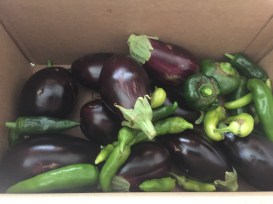
img_0828It’s October 23, and I’m still harvesting eggplant and peppers, for heaven’s sake. I mean look at that box full I picked this morning over there on the left. And there seems to be no end in sight. The eggplant and assorted pepper plants are in full bloom, loaded with baby fruit. I’m harvesting dill for the second time this year. I have a second crop of spring onions about ready to eat. I planted those at the end of September. I have chives coming out my ears. I’d be drying those but we already have far, far more chives than we know what to do with. The greek oregano is going crazy. It’s over a foot tall and in full bloom, for the second time this year. Same with the sage. Some of my hostas have put out flower stalks for the second time this season. I was looking back in the tomato bed that I cleaned out at the end of September and found a dozen or more volunteer tomato plants newly sprouted, some six inches tall already. I’m tempted to pot some of them and see if they’ll grow indoors.

According to the recording thermometer the coldest night we’ve had has been about 41. Daytime temperatures have generally been up in the high 60s to low 70s. The only way we know it’s fall is that the days are much shorter and the trees are losing their leaves.

This isn’t a horrible thing, this extended warm streak. It certainly is keeping the heating costs down. But it’s, well, odd. It doesn’t feel right. And you can tell it’s bothering people. They seem nervous, edgy, waiting for the other shoe to drop. We all have this feeling of mild dread.

I don’t know if it’s our upbringing, or some kind of inherent human trait, but we all seem to share it. We all get this feeling that something is too good. Some malicious deity or force of nature or something is deliberately lulling us into a false sense of security, and then wham, drops ten feet of snow on us, or plunges the temperature down to -30, or — or something is going to happen.

The thing is, we like winter up here. We like the snow. We like the bone chilling cold. It’s part of our heritage. It’s part of our nature.

We complain about the cold, the winter, true. But if you listen to those complaints, you begin to realize that we also take a perverse pride in it as well, pride in our ability to deal with it. And an enormous amount of delight in laughing at the people down south when an inch of snow shuts down the entire metro Atlanta area.

Our complaints about the cold and snow are part of the fun, the bragging about how cold it was, the complaints about shoveling six feet of snow off the porch before we could even get outside to get to the outhouse.

Well, okay, the outhouse thing is a bit outdated. We’ve had real indoor plumbing here in Wisconsin for, oh, two or three years now. But you know what I mean.

What’s the point in living in Wisconsin if we can’t brag about the bad weather any more? Is it really worth putting up with living here if we can’t laugh at the people in Illinois because they don’t know how to drive in the snow any more?


The Magic Bullet Syndrome

Magic bullets. You’ve seen them. We all have. The pill that claims it will melt away pounds while letting you gorge on Big Macs and never exercise. The miracle wrist bands you can get for just $19.95 that will make your joint pain vanish. The miracle nutrition supplement that will let you throw away your glasses, or keep you from getting dementia or cure the ailment of your choice. The miracle food that will prevent cancer. The list is endless.

Every generation has their own unique set, it seems. When I was in college one was laetrile, a quack remedy made from apricot pits that was alleged to cure cancer. It didn’t, of course. Previous generations suffered through a variety of radium cures that claimed to help everything from impotence to ‘female problems’ to gray hair. Or electric cures, or ultraviolet light cures. I could go on listing them all day.

The magic bullet syndrome has infected almost every aspect of society. Medical, nutritional, political. They have the ‘magic bullet’, that if only you’ll elect them or buy them, will be a fast and cheap cure for whatever problem you have.

They don’t work, of course, these magic bullets. They never have. They never will. The frustrating thing is that even though we know they don’t work, that they can’t work, huge numbers of people keep buying into the belief that there is something, somewhere, that will solve whatever problem they need solved, without any work on their part, without them having to make any kind of significant sacrifice or effort, and which won’t cost them much.

And magic bullets almost always make things worse, not better. This belief in a magic bullet masks the real problems and the real solutions to the problems. Often until the situation has become so bad that we can’t hide it, can’t try to ignore it, and finally are forced to do something. And by that time, things have gotten so bad, so out of control, that it’s going to cost ten times more to fix it than it would have if we’d just tackled the problem the right way in the beginning. Or in the case of some of the health scams, you end up dead.

They’re seductive, though, these magic bullets. There is no doubt about that. I can certainly understand the temptation to believe in them despite the fact that I know that, ultimately, they will always make the problem worse than it was before.

But it’s oh so tempting… The magic bullet, well, that means you don’t have to accept responsibility for the problem. You don’t have to change. You don’t have to give anything up. It isn’t going to cost you anything, financially or personally.

As the election insanity approaches its climax, we have packs of politicians swarming around the country, each promoting their own particular magic bullets, they themselves. They are the magic bullet that will solve all of the country’s problems. They can fix the economy. They can create new jobs. They can improve the schools. They can bring peace. They can stop terrorism. They can fix anything and everything.

The root of the magic bullet syndrome seems to be intimately linked to our refusal to take responsibility. No one wants to admit that the problems we are facing are our own fault, and the politicians are taking full advantage of that. They’ve latched  on to  the magic bullet syndrome’s close relative, scapegoatism.

Scapegoatism is simply a different form of the magic bullet syndrome. Instead of a magic bullet fixing something, scapegoatism is the attempt to blame all problems on an individual or small group. It’s been around as long as magic bullets have been, and it has it’s roots in the same basic human fault that makes magic bullets so attractive, our unwillingness to admit that we are responsible for our own problems.

And like magic bullets, it’s so easy to do, so tempting to blame someone else, isn’t it? It’s not our fault, it’s, oh, immigrants or one’s political opponent, or the government. The list of scapegoats is as long as the list of magic bullets, really. Unions, teachers, students, young people, old people, immigrants, governments, politicians, religions, communists, democrats, republicans, liberals, conservatives, rich people, poor people, middle class people… They’ve all been used as scapegoats.

When are we ever going to get over the magic bullet syndrome? When are we ever going to be able to admit that our problems are largely our own fault? When are we going to be able to admit that there is no magic bullet, that the scapegoat is really us?


Junk Science Reporting Drives Me Crazy

It’s been a while since I had a good rant, so I’m going to indulge. Please feel free to skip this one if you like. I occasionally go off on a rant when I run into an especially irritating bit of so-called “journalism”, and this is one of those instances.

When I was going through my various news sources this morning while having my coffee, I ran across a news item at Motherboard, part of Vice.com, about Proxima Centauri and it’s newly discovered planet, b. You can click here to jump over and read it yourself. The headline reads: “Our Closest Earthlike Planet Appears to be Covered in Water”

As I read it I frowned a lot. I might go so far as to say I was seriously irked. Unless someone, somewhere, had come up with something entirely new and unexpected, what they were implying in this little piece was irresponsible and so lacking in any kind of facts that it was pure fiction.  And yes, they use weasel words like ‘could’, ‘possibly’, ‘may’. Technically the article doesn’t come right out and lie, but it is seriously misleading, perhaps deliberately so in order to generate clickbait headlines.

Let me give you some background for you non-astronomers out there. Proxima Centauri is the star closest to us. It is a very tiny and very dim red dwarf star about 4.2 light years away from Earth. While that is close in astronomical terms, in human terms it is very, very far away indeed. Light moves at 186,000 miles per second. Light takes 4.2 years to go from Earth to Proxima. I will leave it to you to figure out exactly how far that is. My calculator doesn’t have enough zeroes.

They recently discovered Proxima has a planet. They immediately gave it the amazingly creative name Proxima b. What we know about this new planet is, well, not much, really. We know it’s about 1.3 times the mass of the Earth. We know it’s between 0.9 and 1.44 times the diameter of the Earth. We know it orbits Proxima at a distance that is one tenth the distance of Mercury to our sun. We know how fast it goes around it’s star. We know it is tidally locked to it’s star. That means the same face of the planet is always facing the star. One side of the planet is in perpetual light, the other side is in perpetual dark.

Or I thought that’s all we knew until I saw this article. This article implies that B is covered with planet spanning oceans teaming with life. There’s liquid water everywhere, and because there’s water, there must be life! Oh my!

Now just a minute here. Really? I follow astronomy news fairly closely. If these discoveries had been made, why weren’t they all over the actual astronomical press? Something smells a wee bit odd here.

And here’s another thing that set off alarm bells. The quotes are all generic, never attributed to a specific person, but they instead use terms like “researchers said”, and “the research team said”, and “scientists concluded”. That kind of thing starts to set off alarm bells with me. It’s been my experience that legitimate news stories almost always give actual names, and if not the name of the person being quoted, at least the name of the press agent or the name of the spokesperson.

Then I started running into other rather odd things.

The Motherboard article posts a link to what supposedly was the original press release from the Marseille Astrophysics Laboratory which appeared in Agence Presse France, the French press agency. But when I click in the link, the APF’s website tells me there is no such story. So I started running searches on the APF’s news website, plugging in terms like Proxima, Proxima Centauri, Proxima B, the research group’s name, the university’s name, and found nothing. Not a single story anywhere on the APF’s website concerning Proxima’s planet, these researchers… Nothing. Unless I missed something, or wasn’t using the search engine properly, the story Motherboard quotes over at APF doesn’t exist according to APF. In fact, there is nothing anywhere on APF about Proxima at all that I could find after running extensive searches of its entire news site.

I freely admit that I might have been using their site wrong, was using their search engine wrong. So I did some more hunting for other related stories from other sources and found a lot of sciencey related popular websites with this same story. But all shared the same troubling traits. No actual names, vague references to universities and research organizations, quotes, again not from real people, but from “scientists” and “researchers.” Even more troubling, many of the stories in these websites were virtually identical, and I mean word for word identical in some cases, indicating that a lot of these places were engaging in good old fashioned cut and paste plagiarism.

I was getting increasingly obsessed with finding out what the hell was going on. Finally, I went to CNRS, the French science research organization, which supposedly was the source of all of this, and once I’d tracked down the actual original sources, I discovered what I had started to suspect already.

What the CNRS actually said about Proxima b bore little or no resemblance to what the media sources were claiming. What the CNRS actually said, if my horrible French and Google Translate haven’t failed me, is that we really know nothing about Proxima B except the few facts I already told told you about.  But that if you make a whole lot of assumptions that are probably wrong, and if those assumptions are correct, which they probably aren’t, and if the planet has an atmosphere, which we don’t know, and if the planet has a magnetic field, which we also don’t know, Proxima B might be capable of having liquid water, maybe even large amounts of it, and if it has water, which we don’t know, it might have a chance to develop some sort of life. Maybe. But we don’t really know.

This is considerably different from the Motherboard headline that says “Our Closest Earthlike Planet Appears to be Covered in Water”. In fact, I have yet to find any legitimate scientist of science organization that has said any such thing.

There is, in fact, no evidence that it has any water at all. There is no evidence it has an atmosphere. The only things we know about the planet at all are it’s approximate mass, it’s approximate size, it’s distance from its star, and it’s orbital period.

If you look at the actual facts, what we do know about Proxima Centauri and its planet, the preliminary data indicates exactly the opposite. Everything we know about it so far tends to contradict everything the Motherboard article claims is possible.

B is very, very close to it’s star. And while Proxima Centauri is a very small, very dim star, it is still a star. Even worse it is a flare star. That means it regularly blasts surrounding space with high intensity radiation and stellar mass ejections. This means that solar radiation and stellar mass ejections would have eroded away any atmosphere and water that the planet might have had billions of years ago.

Some people are trying to get around this fact by claiming B has a magnetic field strong enough to protect it from it’s star, a field similar to the one that protects Earth.

But not only is there no evidence at all to indicate it has a magnetic field, simple physics tells us it pretty much can’t have a magnetic field. A planet’s magnetic field is generated by the rotation of its molten iron core. But Proxima B doesn’t rotate. It’s tidally locked to it’s star. If it doesn’t rotate, it can’t have a magnetic field. Period.

Junk science reporting drives me crazy.

 

Merger Fever

screen-shot-2016-10-07-at-6-57-39-am

If you follow ag news you must be aware of the high profile mergers and buyouts going on in agribusiness. After months of trying to sell itself or merge with another agribusiness company, Monsanto seems as if it is going to be snapped up by pharmaceutical giant, Bayer, so the German company can increase it’s ag presence. Bayer is already a major maker of pesticides and snapping up Monsanto would give it a significant presence in the GM seed market as well.

It is not a done deal by any means. It still has to be passed by antitrust regulators both here and in the EU. There seems to be considerable resistance to the merger in Germany and in the EU as a whole, and a lot of politicians over there have been making disapproving noises.

This isn’t the only big ag merger going on, either. Dupont and Dow Chemical are in the process of merging, with the details still a bit up in the air. Swiss company Syngenta, which Monsanto had attempted to cut a deal with earlier, is being snapped up by the China National Chemical corporation, which is owned by the Chinese government. All four of these companies are major players in the agricultural chemical industry. (ChemChina seems to be on a buying spree. Last year it bought Pirelli, the Italian tire maker)

Mergers, acquisitions, buyouts, etc. aren’t anything new, especially in the ag industry. It’s been going on for ages. And generally the results, at least for the farmers, aren’t pretty. Over the years we’ve seen virtually every small, independent co-op, feed processor, seed maker, machinery dealer and independent mechanic be bought up, forced out of business or merged into ever larger semi-monopolistic businesses. And while competition has dwindled, farmers have fewer choices of where to go to buy seed, fertilizer, feed, chemicals and equipment, prices have, of course, skyrocketed.

The problem with all of these mergers is that they don’t seem to benefit anyone except a handful of investors, lawyers and, of course, the upper management of the companies themselves. They certainly don’t benefit the consumers, that is the farmers and you, the people who buy the milk, cheese, eggs, meat, vegetables and fruit that the farmers produce.

We used to plant 30 to 40 different types of soybeans in the US. Today, 90% of all the soybeans planted in the US are a single variety, produced by Monsanto. The fact that Monsanto has a literal monopoly on soybean seed isn’t the only problem with the situation. It’s the fact that we could be facing a very serious biological crisis. If a new disease pops up that this one variety of bean is susceptible to, the entire US soybean crop could be jeopardized because of this lack of genetic diversity. These monopolies have resulted in such a lack of genetic diversity in our agricultural systems that many of them now lack the genetic diversity to be sustained if a disease strikes them.

What these companies try to do, want to do, is lock farmers into a specific “system” of agriculture. You buy a specific type of seed to plant. That plant comes along with a specific program of herbicide and pesticide control systems, also sold by the company. Farmers do it because it’s easy. Sort of one stop shopping. They get everything they need from one vendor. And generally these systems are profitable.

At least at first. What generally happens is the company starts to get greedy. After releasing the system at a relatively decent price, the company starts ratcheting the price up once farmers get hooked into it. Prices go up until farmers realize the system isn’t all that profitable any longer. But by that time, well, they have such a heavy investment in the system they can’t really get out of it any more. Besides, where else are they going to go because the company has driven all of it’s competition out of business.

Farmers who want an alternative have enormous trouble even trying to find one. These semi-monopolies claim there is still a lot of competition out there. And it’s true that there are some competitors. But not many, and even fewer who could provide large scale farmers with the quantity of seed they need at a price they can afford to pay.

Starving Amidst Plenty

screen-shot-2016-10-06-at-7-23-03-am

Not a day goes by when you don’t see a news item about more food aid being needed somewhere as enormous numbers of people go hungry or are even starving because of natural disasters, political disasters, poverty. If you follow the agricultural media as I do you will see articles about the mega ag companies like Monsanto talking about how they need to get ever bigger, absorb even more small companies, because they need to develop new seeds, new herbicides, to satisfy an ever expanding and increasingly hungry world population. Articles about food deserts in the inner cities in the US and other otherwise prosperous countries. Articles about how we need to cultivate more land, increase the yield of crops because people are starving all over the world.

But then along comes items like this story from AP at AgWeb: Why Is There So Much Food?

The US alone is producing 24 billion gallons of milk a year. We’re producing enough milk every year to fill a good sized lake or two. So much milk that it’s driven the farmgate price down so far farmers are going bankrupt. The US alone has 1.24 billion pounds of cheese in storage and 322 million pounds of butter. USDA has been buying up stored cheese and giving it away to try to keep prices from collapsing.

If milk were the only commodity we have massive surpluses of, it wouldn’t be so bad. But it isn’t. The US has 377 million pounds of strawberries and 313 million pounds of blueberries in storage. In total we have around 1.5 billion pounds of fruit in storage. We have 1.3 billion pounds of turkey and chicken in storage.

If you look at grains, the situation is similar. The 2016 corn harvest is just getting started here in the US, and it looks like it’s going to be a near record breaking crop. And we still have millions of bushels of corn in storage from last year’s near record breaking crop. The price of corn has plummeted to $3.30 or so a bushel, and will probably drop considerably as the new crop floods storage facilities. The story with soybeans is similar. Same with wheat. Eggs, which suffered massive price increases that saw the local stores selling eggs at $1.75 a dozen, have fallen to $0.49 cents in our local grocery store.

Right now we are looking at the lowest prices for ag commodities that we’ve seen in many years. Retail consumer prices are flat or falling. One source I read the other day claimed retail food prices have dropped by 8% in the last six months. The UN claims food prices are at the lowest level they’ve been at (adjusted for inflation) in a very long time indeed. We have a glut of food on the market, so much we don’t have enough storage space for it.

And we still have people going hungry, even starving. Even in the most affluent countries in the world we have large parts of the population who are hungry, who don’t know where their next meal is coming from.

It isn’t agriculture that’s at fault here. It isn’t farming. It’s politics. Petty nationalistic disputes, power struggles in congresses and parliaments. It’s prejudice and discrimination. It’s greed and selfishness.