
“Property tax reforms in Nebraska could help farmers, but not as much as some groups want.”
Source: Nebraska Gov. Ricketts Touts ‘Major’ Property Tax Bill | Agweb.com
Please have patience with me while I talk about agriculture and property taxes for a moment so I can explain why this is important for farmers and environmentalists. Talking about things like taxes and government policies tends to make my eyes glaze over and I find myself with a sudden desire to take a long nap. But if you aren’t a farmer you may not know why this move by Nebraska is important for farmers. Wisconsin already did something like this years ago, and I think it’s the right thing to do.
Property taxes are based on the value of your property, of course. If your house, for example, is valued at, oh, $100,000, you pay property taxes based on that value. If it’s valued at $200,000, your property taxes are going to be significantly higher.
It’s the same with farmland. Under law here in Wisconsin the property is supposed to be assessed for purposes of property taxes at fair market value. (That law had to be instituted because some local jurisdictions were playing fast and loose with property evaluations in order to jack up the tax money they were getting. Before that law was put in place, I knew one poor bugger who had a mobile home that was worth about $10,000 get a tax assessment for $64,000. Seriously. I saw the documents myself.)
The question now is what exactly is “fair market value”? Is it the value of the property as it currently exists, what it is being used for at the moment, or the potential value of the property if it were sold for some other purpose.
That distinction is important, because what was happening in Wisconsin and a lot of other states is that local jurisdictions were assessing property not at it the value of the property as it currently existed, but what the property could be worth if it were sold for some other purpose.
The result was that if you had a farm on the outskirts of a town or city, you were pretty much screwed. Local governments were assessing the farms not on their value as farms, but their value as if they were commercial or residential property.
To illustrate what I mean, let’s look at an example. Farmland in this area is currently going for around – well, let’s round it off to $7,000 an acre to keep the math simple. So if you have a small, 100 acre farm, it’s worth about $700,000.
Meanwhile, land being used for, oh, let’s say a fairly upscale housing development in a nearby town, is going for about $20,000 per 1/4 acre lot, or about $80,000 an acre. Over time the town grows, and now you find that your farm is on the outskirts of the town. And as a result of that, the local government is now assessing your farm not for what it is worth as a farm, but for what it would be worth if it were sold for a housing development. You are now being forced to pay property taxes not on a farm worth $700,000, but property worth $8 million. Your property taxes just went up more than ten times what they’d been before.
While that’s a bit extreme, it isn’t exaggerated by much. I knew farmers who were seeing their property tax bills shooting up into the astronomical range because the jurisdiction they were in decided to evaluate their property not for what it was, but for what it could be. Their taxes were going up five, eight times what they’d been before when their property was evaluated at commercial or residential rates rather than agricultural.
There was some very heated debates over this, of course. The towns (and the developers) claiming that the new value was fair because that was what the property was actually worth if it were sold off to some developer, and the farmers on the other side saying no it isn’t because that’s not what it’s being used for… It was nasty.
I don’t think anyone ever actually proved that the governmental jurisdictions, seeking ever more tax money, along with developers smelling profits, abused the system by ratcheting up the taxes on farms specifically to force farmers to sell at bargain basement prices to a developer, but it was pretty much an open secret that this was exactly what was going on. At the time the laws curbing this were under consideration dozens of farmers appeared before the legislature claiming that this was exactly what was going on. Developers would find a nice farm in a good location near a town, smell the heady scent of money, convince the local government that it would be to it’s advantage to annex the farm into the town, evaluate the farm as commercial or residential property rather than farmland, and the farmer would be forced to sell at cut throat prices to the developer or go bankrupt from the taxes… It was nasty.
And for those concerned with urban sprawl it was nasty as well. This kind of thing was driving the construction of huge housing developments on the outskirts of cities and towns with McMansions sitting on quarter acre “estates”, endless cookie cutter boxes, hastily constructed, looking exactly alike…
Wisconsin did finally change the property assessment laws, but local jurisdictions and developers are still griping about it and occasionally manage to bribe convince some legislator to try to introduce a measure to “reform” the system, turn back the clock and let local jurisdictions snap up all that yummy, yummy tax money by assessing farmland at utterly absurd valuations.
The change didn’t halt urban sprawl, but it did help to slow it down a tiny bit. Maybe. Depends on who you talk to, really. Certainly it helped a lot of farmers whose property is adjacent to towns and cities.
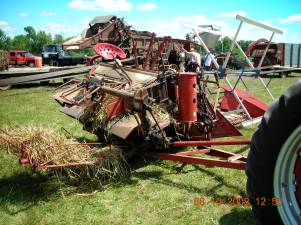 shocking it, and running it through threshing machines, for heaven’s sake. In case you’ve never seen one, here’s a photo of a grain binder from an antique farm equipment show I took some years ago. And yes, that thing over there that looks like it was cobbled together out of bits of old string, wire and old barn boards, is an actual commercially made machine. It was pulled by horses (that’s why there’s a seat on it). It cut the grain off with a sickle bar, put it in a bunch, tied the bunch with twine, then dumped it on the field. Workers would come along, stand the bundles on end with the grain heads up so it would dry. Then it would be loaded onto wagons and taken to a threshing machine.
 threshing machine. This is actually a special machine designed specifically for threshing or hulling clover seed, not wheat or oats, but the principle is the same. Workers would throw the bundles onto the elevator over on the left where it would run through threshing bars, fans, screens, etc. to be separated from the stalks and hulls. The hopefully clean seed would come out one pipe to be bagged, the straw would blow out onto a pile. The whole thing was originally powered by a massive steam traction engine via that long belt you see extending out the left side of the photo. Steam engines were replaced in the 1920s or so by gasoline powered tractors, but the threshing machines themselves remained in use well into the 1950s in some parts of the state. There were still a couple of farmers in the area who were using this setup when I was a kid. These things hung on because as long as you could get inexpensive labor it was cheaper to keep using it than buying a combine.
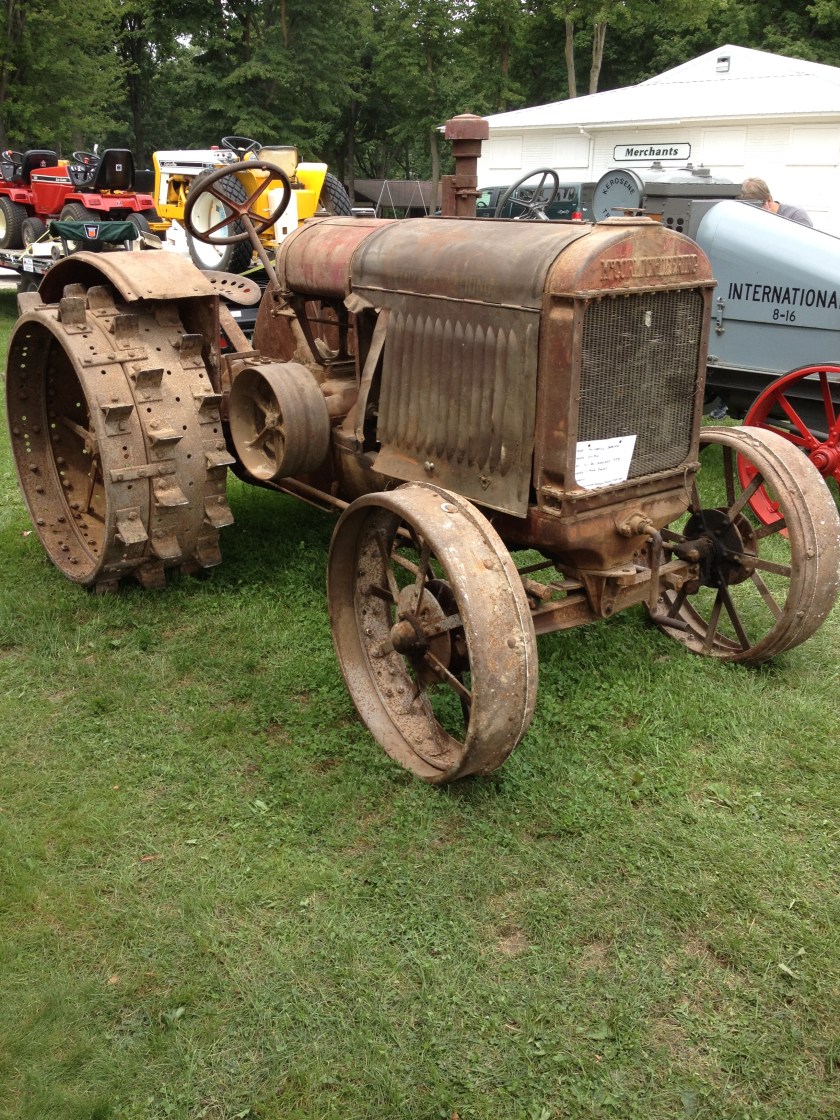 was a kid we actually had one of these beasts, this exact same model. And we didn’t have it for some collection, this monstrosity was an actual working tractor at the time. The only thing we used it for was running the blowers to blow grain or forage into the barns or silos, but it was still a working tractor on the farm. And dear lord we hated that thing. Trying to start that beast… Oh, my. It started by manually cranking it with that big lever you see just below the radiator. That connected to the crankshaft to turn the engine over. And if you didn’t know what you were doing when you tried cranking it, it would gleefully break your arm. Seriously. It would if you didn’t know what you were doing.

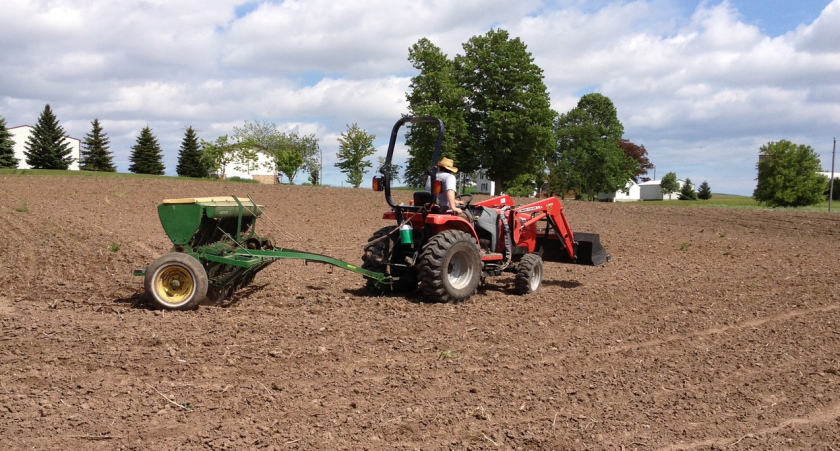 One trend in agriculture has been making me nervous for some time now, and that is how large quantities of farmland are being concentrated in the hands of fewer and fewer people.
 grouchyfarmer