Changes…

Despite the name of this blog, it isn’t really about farming. I guess it’s more like a journal where I write about things I find interesting, curious, infuriating, irritating, fun. But I often return to talking about farming because it was such a big part of my life for so long. But this one is about farming for a change.

What does that have to do with changes? A lot. I was reading an article about new ag technologies, automated and robotic systems to replace human labor. This has been going on for some time, of course. Robotics and automation have taken over product assembly, car manufacturing and a whole host of other industries. Ag has been slower to adopt robotics because it requires above average intelligence, dexterity, strength and gentleness and a lot of other qualities that are difficult to do with robotics. Until now. New advances in software, AI systems, new engineering, new materials and a lot of other technologies have sprung up that are making fundamental changes in how we grow food over the next couple of decades.

Neat, I thought. But then I thought further and realized that this has been going on my entire life. The pace of change has accelerated, true, but when I look at what farming was like when I was a kid and what it’s like today, it’s actually a bit mind boggling.

When I was a kid we still had a crank style phone. We didn’t get a dial phone until I was in second grade. Electricity service went out so often we still had old kerosene lanterns laying around ready to use just in case. A lot of the equipment we used looked like some kind of steampunk nightmare, to be honest.

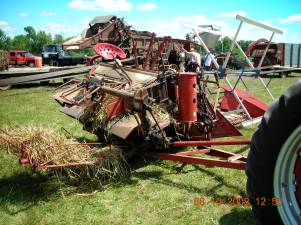
We still had a few farmers in the area who were harvesting grain with grain binders,dscn1419 shocking it, and running it through threshing machines, for heaven’s sake. In case you’ve never seen one, here’s a photo of a grain binder from an antique farm equipment show I took some years ago. And yes, that thing over there that looks like it was cobbled together out of bits of old string, wire and old barn boards, is an actual commercially made machine. It was pulled by horses (that’s why there’s a seat on it). It cut the grain off with a sickle bar, put it in a bunch, tied the bunch with twine, then dumped it on the field. Workers would come along, stand the bundles on end with the grain heads up so it would dry. Then it would be loaded onto wagons and taken to a threshing machine.

And in case you’ve never seen a threshing machine, here’s one. Well, it’s sort of a dscn1422threshing machine. This is actually a special machine designed specifically for threshing or hulling clover seed, not wheat or oats, but the principle is the same. Workers would throw the bundles onto the elevator over on the left where it would run through threshing bars, fans, screens, etc. to be separated from the stalks and hulls. The hopefully clean seed would come out one pipe to be bagged, the straw would blow out onto a pile. The whole thing was originally powered by a massive steam traction engine via that long belt you see extending out the left side of the photo. Steam engines were replaced in the 1920s or so by gasoline powered tractors, but the threshing machines themselves remained in use well into the 1950s in some parts of the state. There were still a couple of farmers in the area who were using this setup when I was a kid. These things hung on because as long as you could get inexpensive labor it was cheaper to keep using it than buying a combine.
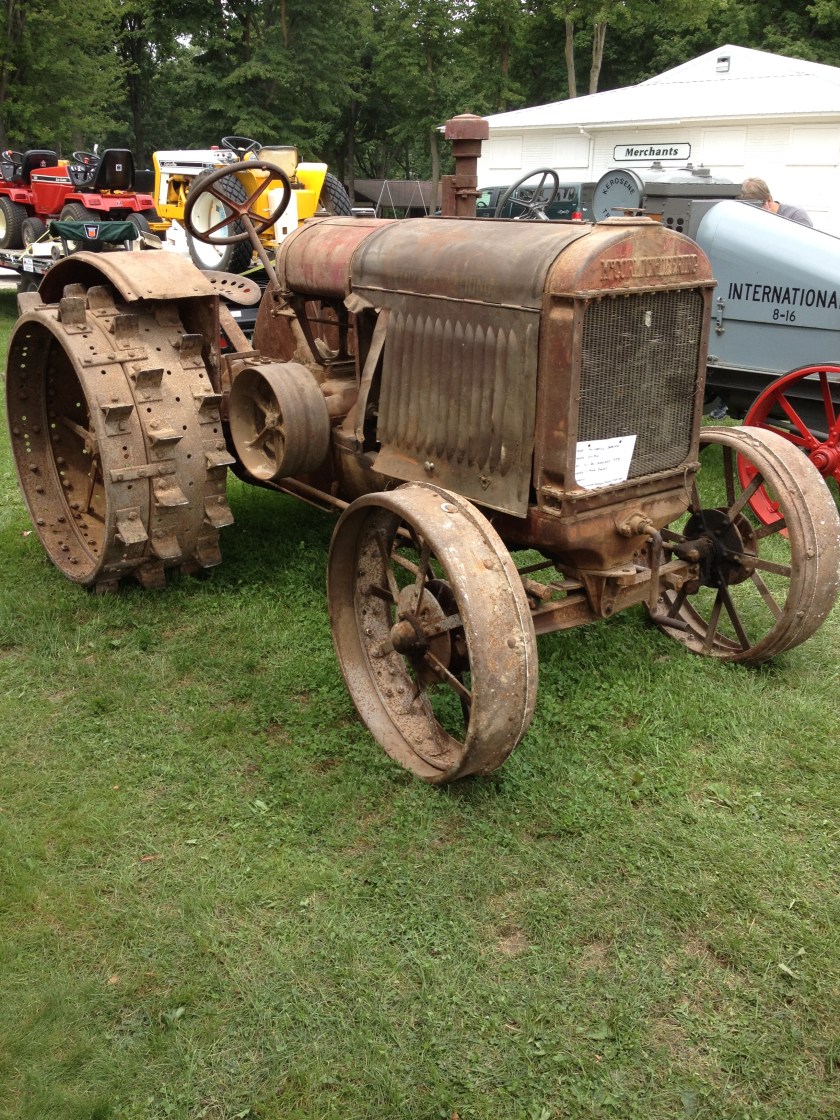
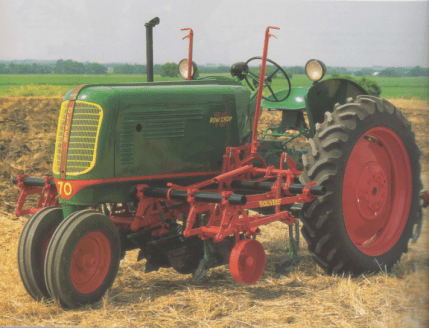
Then there were tractors. Take a look at this beast, for example. Believe it or not, when I img_0279was a kid we actually had one of these beasts, this exact same model. And we didn’t have it for some collection, this monstrosity was an actual working tractor at the time. The only thing we used it for was running the blowers to blow grain or forage into the barns or silos, but it was still a working tractor on the farm. And dear lord we hated that thing. Trying to start that beast… Oh, my. It started by manually cranking it with that big lever  you see just below the radiator. That connected to the crankshaft to turn the engine over. And if you didn’t know what you were doing when you tried cranking it, it would gleefully break your arm. Seriously. It would if you didn’t know what you were doing.

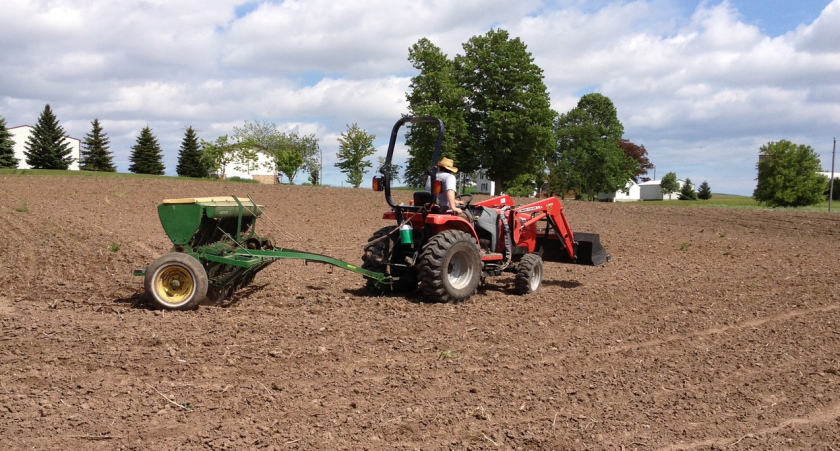
Lest you think we were weird or something, the rest of our tractors looked like this.

A modern (at the time) Oliver 1655 and a 1950s era Oliver 77. (That 77 actually belongs to my eldest son.) So why did we hang onto that old monstrosity? It was cheap power. You could buy them for little more than scrap metal price.

Almost all of the changes that have gone on in agriculture have occurred for one reason: money. They did something that improved the profits of the farm in one way or another. The old threshing machines hung on as long as they did because for some of the tiny farms around at the time it made more sense to keep running them long after they should have gone to the scrapyard than to drop thousands of dollars on a modern combine. Same with the old McCormick tractor. It was cheap power, good enough to run a forage blower, but for nothing else. As soon as it was no longer economical to hang onto the thing, it got dumped. We ended up buying another 1650 to replace it.

Just in my lifetime we’ve gone from grain binders and threshing machines, to GPS guided computerized combines. Harvesting crops by hand to a facility in New Hampshire that raises lettuce that is never touched by a human during its entire life. From planting to harvesting and packaging, everything is done by automated systems or robots.

Changes… Sometimes I look at the world around me and think I’m living in a science fiction novel.

Procrastination, Political Posts, Catching Up, Tumblr…

Procrastination

The problem with a non-commercial, privately funded blog like this, one that is as unfocused and rambling as this one is, is that there are no deadlines, no sense of urgency to get something written and posted. Don’t feel like writing? Fine. Don’t. No worries…

But it also means I tend to procrastinate terribly. This poor blog has sometimes sat here for weeks, maybe even a month or more, with nothing new appearing. And the only thing urging me to write something are feelings of guilt. Especially when the annual bill for keeping this thing up and running turned up in my email the other day. That’s always a shock. (Wait, what? How much am I paying for this thing? Why did I opt for the ‘business platinum’ package in the first place? Sheesh…)

The thing is, I hate deadlines. Decades ago I was a writer and editor for small market (very small) computer magazines and I came to loathe deadlines. But they were a fact of life. There were notes taped all over my computer with various dates and times, “drop dead” dates that had to be met or the magazine wouldn’t get to the printer in time, writers I had to call to find out where the article they’d promised was, last minute rewrites, getting the new ad from that software company and finding out it’s .25 inches taller than last month’s and having to scramble to try to cut two lines from an already dense technical article to try to make room…

No, I do not like deadlines. But they are sometimes necessary. Maybe I should set deadlines for this thing…

Dear mother of milk of magnesia, no. No no no no…

Political Posts

With the entire country having apparently gone stark, raving mad, I must admit that the temptation to join what seems to be about four hundred million self-appointed political experts and launch into lengthy and impassioned political rants is indeed lurking in the back of my head.

But, well, why? What good would it do to join the ranks of the outraged and turn this into yet another toxic and ultimately useless political blog? None, of course. All it would do is ratchet up my blood pressure, irritate you, attract trolls and other undesirables, and, in the long run, do absolutely no good at all.

screen-shot-2017-01-31-at-7-21-41-am
A Political Post

If you want political posts, here’s one for you. It’s a post. It’s political. Well, I think it’s political. I questioned this post very carefully and from various comments I suspect it’s an ardent supporter of the Bull Moose party. But it’s answers were very confusing. Mostly it was complaining about birds pooping on it.

Oh, wait, it’s not in the Bull Moose party, it was complaining about a bull moose that was using it to scratch its butt last week…

To be blunt, I am not going to turn this into a political rant. I hereby declare this to be a political free zone.

Maybe.


Tumblr

Ah, Tumblr, the blogging service I love to hate. Or hate to love. Or hate to hate. Or something like that.

Do you mind if, for a moment, I use strong language? No? Thanks

Tumblr is really pissing me off.

There, I said it. I’ve been reduced to expressing my irritation with vulgarity.

It seems like I’ve been on Tumblr since the end of the last ice age. I think I’m up to over 6,000 posts over there or something equally ridiculous. But it’s become so irritating…

I’ve had 30 new followers of the Tumblr blog over the last week. Of those, 21 were hard core porn blogs, almost certainly part of the infamous “pornbot” system operating on Tumblr. Eight were blatant advertising scams, filled with post after post of links leading to commercial advertising sites.

And one actual real person.

Seriously, only one was an actual real person.

And then there’s the advertising. Dear lord… I run ad blockers, security software, firewalls, etc. so when I’m on Tumblr about 99.9% of that crap is blocked before I can see it. But every once in a while I’ll have the blockers turned off for some reason and, oh, dear lord, it’s horrible. It’s like every scam, fraud and fly by night outfit in the world is advertising over there now. Ads for ambulance chasing “legal services”, ads for fraudulent “alternative” health products, ads for dietary supplements that claim to cure everything from bad breath to cancer…

Then there are the bots… A lot of us are convinced that the ten gazillion users Tumblr claims it has are a wee bit exaggerated. In actual fact there are only about 300 accounts by actual real people and all of the others are pornbots and spambots.

Some of us suspect that’s how Tumblr makes money, the bots serving up advertising to other bots, which in turn serve up ads to still more fake accounts, with Tumblr’s counters ticking them all off and counting them as legitimate hits when in actual fact it’s just an unending circle jerk of bots botting other bots…

And I’ve just run out of things to say

I suppose at this point I should come up with some pithy, insightful, thought provoking comment that would make you all nod and go “oh my I wish I’d thought of that” to wrap this all up. Sorry. Can’t think of one.

Give Me Land Lots of Land

screen-shot-2017-01-04-at-4-37-48-pmOne trend in agriculture has been making me nervous for some time now, and that is how large quantities of farmland are being concentrated in the hands of fewer and fewer people.

This has been going on for some time, of course. When I was a kid the road we lived on was dotted with small farms of various sizes ranging about 80 acres to 150 acres or so. Ours was actually one of the larger ones when I was a kid, with 140 acres and about 120 under cultivation. If memory serves me correctly, there were ten or twelve farms just on that one stretch of road when I was a kid. Today the houses and even many of the barns are still standing, but they aren’t farms any more, they’re residences. The actual farmland is now owned by one of three huge farming operations.

Whether or not this is a “good thing” is open to debate. But there is one trend that I think is definitely not a good thing, and that is that large amounts of farmland is being snapped up by investment companies.

Corporations like Farmland Partners (which doesn’t actually do any farming) and a lot of others, located both in the US and in other countries, are buying up farmland wherever they can find it and then renting it back to real farmers. For, of course, a profit

One can understand their point of view. People have to eat, after all. Therefore there is always going to be demand for land on which to grow crops. If a farmer can’t afford to buy land, he or she has to get it from somewhere, so they’re forced to rent it from a land owner. To an investor this seems like a fairly safe type of investment, especially with the stock markets being as volatile as they are.

But for farmers, for agriculture in general, this practice is disturbing in more than one way and is potentially damaging for consumers, farmers and agribusiness in general.

These companies do no farming, grow no crops, harvest no grain, raise no cattle. They do nothing to improve the quality of the land they own. They exist for only one reason, to rent land back to real farmers for the maximum amount of money they can squeeze out of them. They contribute nothing to agriculture. I dislike the term ‘parasite’, but, well… Isn’t that what you call an entity which does nothing but syphon off the resources of others and provides no benefit to those it feeds off of?

So far these companies have had little adverse effect on agriculture. Up until now they have been picking off the ‘low hanging fruit’, so to speak, snapping up deals here and there, in widely scattered areas. But as they acquire more, as more farmland is taken out of the control of farmers and placed in the hands of a few companies that care only for making profit… Well, the potential for abuse is obvious.

This kind of thing is legal. I certainly can understand the attraction people may have for this kind of an investment. With the stock market going through endless series of boom/bust cycles over the last few decades, a fairly stable investment like farmland is certainly attractive.

But what kind of effect is this going to have on agriculture as ever increasing amounts of land are being held in perpetuity by companies whose only goal is to squeeze as much profit out of farmers as possible?

Dairy prices – will their recovery continue in 2017?

Dairy proved one of the best commodity performers of 2016, as the price slump of the previous two years at last curbed output. Has the rally got legs?

Source: Agrimoney.com | Dairy prices – will their recovery continue in 2017?

At the start of the year everyone seems eager to present their predictions of what’s coming for the future, and the markets gurus are no exception.

Right now their view of the future looks fairly good, although not exactly what I would call glowing. USDA is predicting a milk price of around $17.25/CWT. While better than the $13-$14 farmers were getting at one point, it’s still not really all that good. To give you some historical perspective, with bonuses for butterfat, protein, low somatic cell count (i.e. our cows were healthy) we were getting around $13 for our milk back in 1979 or 1980. So now you know why dairy farmers were in so much financial trouble over the last year or so as prices dipped below $14/CWT(2).

The US actually escaped the worst of it. New Zealand and other milk producing regions around the world suffered far worse than we did. NZ was hit especially hard because a huge amount of their milk goes to China, and when China began to cut imports of milk, the NZ market crashed so hard it actually caused a devaluation in the NZ dollar and had repercussions through their whole economy.

China has been slowly ramping up imports again. While the country has been increasing its own dairy production, it’s having trouble meeting demand for various reasons. Many Chinese consumers still remember the melamine horror of a few years ago where domestic milk was deliberately contaminated with melamine(1). Consumer confidence in domestic products plummeted, increasing the demand for imported dairy products. Over the last few years China has increased it’s own milk production, and by improving food safety they’ve made some progress in restoring the confidence of consumers. But China still doesn’t produce enough milk to satisfy demand and imports have had to increase to keep pace.

New Zealand and the EU both saw production decline because of the plummeting prices. The EU didn’t return to the quota system it had a couple of years ago, but it did institute pricing incentives to get dairy farmers to reduce quantities. Between the low prices, farmers in NZ being pushed out of business, and the new pricing system in the EU, milk production in both areas has dropped by several percent.

Not in the US, though. Here production has continued to ramp up. Depending on whose data you believe, production in the US during 2016 went up anywhere from 2 – 4%, and there seems to be no end in sight at the moment. But then the US isn’t as sensitive to the international market as is the EU and NZ. Domestic demand has more of an effect, and it has remained fairly strong. But while we weren’t hit quite as hard as the EU or New Zealand, the prices dropped to the point where a lot of dairy farmers were suffering financially and were just barely hanging on. At $17 – $17.50 the situation is a bit better, but not by much.

I’m not all that optimistic, to be honest. In the US we’re looking at continued growth in production, and almost no increase in demand for milk products. While demand for butter has grown and the cheese market has remained fairly stable, we still have huge stockpiles of both sitting in warehouses. The market for fluid drinking milk is flat or is even shrinking. And now that the holiday season is over demand for both butter and cheese is going to shrink.

None of this bodes well for dairy farmers in the upcoming year. About the only good news dairy farmers have seen is that feed prices have remained low. But that’s bad news for the farmers who raise grain, especially corn. Corn prices have been sitting in the $3.40 – $3.52 range for months on the futures market, with farmgate prices dipping down to the $2.75 level or even less.

Will things ever improve? I hate to say this, but in all honesty, no. Farming has always been like this. You have long periods of mediocre prices, followed by a year or two of absolute panic, with the occasional good year thrown in just often enough to give you hope that maybe things will get better. And then the rug gets pulled out from under your feet…


  1. When melamine is added to milk, it makes milk quality tests indicate it has a higher protein content than it really has so they can get a higher price for it. It sickened hundreds, even thousands of people and even caused the death of some children. China acted quickly and clamped down hard, even executing some of the people responsible. But the damage was done and people didn’t trust domestically produced milk any more.
  2. CWT stands for hundred weight. While you may buy milk by the gallon in the store, farmers get paid by weight, not volume.

Comments…

screen-shot-2016-12-31-at-8-05-33-am
Don’t feed trolls!

One of my favorite websites, Doubtful News, has joined many other websites in shutting down its comments section. While I’m a bit disappointed, I can’t really blame her for making that decision. Even non-controversial websites can be deluged with trolls, loonies, people who think that screaming, insults and making threats are a legitimate form of debate. A site like hers is like dangling a juicy worm in front of a hungry fish for people like that. I’ve been fortunate enough that GF is small enough and non-controversial enough that it doesn’t attract a great deal of that.

I occasionally enjoy the comments sections. Or did. Once upon a time you might find additional information about the story, or insightful comments, polite disagreement, well thought out arguments. But for the last couple of years or so I generally don’t bother any more. Those days of rational debate are long gone. (If they ever existed.) Now it seems that there is no topic so innocuous, no subject so non-controversial, no statement so utterly innocent, that it doesn’t cause a writer to be verbally abused by someone. Having an unmoderated comments section on almost any website these days is an invitation to descend into pure lunacy.

It is simply impossible to have a comments section without some kind of controls being placed that restricts that kind of behavior. But the simple act of refusing to publish the more outrageous comments is itself an excuse for further abuse. If you refuse to print even the most insane and abusive comments, someone, somewhere,  will accuse you of somehow violating their right of “free speech”.

When it comes to that “right”, however, you don’t have one. At least not in those circumstances. The right to free speech applies really only to government control of the media. Privately owned magazines, newspapers, websites, etc. can publish or refuse to publish anything they wish. You may have the right to say whatever you want, but no one is under any obligation to give you a forum for your words.

So while I regret Sharon closed down the comments over at Doubtful News, I do not blame her in the slightest.

But Is It Milk?

I always thought that milk was a substance that was excreted by special glands of mammals which was used to feed their young. Or, in the case of some types of cattle, to make yummy, yummy cheese (1).

But apparently what I learned in school is wrong, because if you look through the dairy section of the grocery store these days you’ll find out that you can apparently milk a lot of different things. You’ll find almond milk, soybean milk, rice milk, coconut milk, milk stout… One quickly gets the impression that just about anything can be milked. And judging from the prices on this stuff, one quickly discovers that what is really getting milked is the consumer.

So, the question is, is this stuff, these various liquids derived in one way or another from non-mammalian sources, really “milk”?

Of course it isn’t. And some people are getting a wee bit irritated by all of these people calling a product that is basically nothing more than water, thickening agents, flavoring agents and a ground up vitamin pill “milk”. Like these people here. This is a communication from an assortment of Congresspersons to the FDA politely pointing out that calling what is basically some type of nut flavored water, ‘milk’ is grossly misleading, inaccurate and even deceptive.

What’s especially irritating about these various “milks” is that while they are heavily advertised as being nutritional powerhouses, that they are healthier for you than real milk and are more ‘natural’ somehow, they pretty much aren’t.

Let’s look at almond milk. Now there is no doubt that almonds are good for you. Lots and lots of nutritional value and they’re pretty damned tasty. But almond milk? Ah, well, about that…

There are very few almonds actually in commercial almond milk. If you start scrounging around Google you’ll quickly find out that a lot of these almond milks are mostly water, various additives and flavoring agents, and very few actual almonds. Many of them contain only 2% actual almonds. Two cups of almond milk will have, if you’re lucky, maybe 9 actual almonds in it. If you don’t believe me, go look it up yourself. I’ll wait… Ah, back, are we? Good. Let’s get on with this, then.

A year or so ago, a couple of makers of almond milk were being sued in New York because their “almond milk” had only 2% actual almonds in it. It’s basically just almond flavored water with lots and lots of additives. Their argument was that calling something “almond” anything when the product has only 2% almonds in it is wildly misleading.

Then there is the problem of the other ingredients in the stuff. If you read the ingredients labels on most almond milks and similar products, it reads like a high school chemistry experiment. Various gums and thickeners, flavoring agents, salt, sugar and vitamins are added to the stuff. Basically it’s little more than water with thickening agents, flavorings, colorings and a ground up vitamin pill in it, with a bit of almond flavoring.

Now I have nothing against chemicals(2). Everything is chemicals, really. Chemicals are nothing but the basic components of, well, everything. But when you’re buying something labeled “almond milk” wouldn’t you want, well, almond milk, and not something that’s 2% almonds, 8% thickening agents, salt, sugar, flavoring agents and added vitamins, and the rest water?

They have to add all that stuff because when you soak a bunch of nuts in a vat of water, very, very little of the nuts’ actual nutritional content ends up in the water. Neither does flavor. Also the resulting ‘milk’ looks a bit like thin, cloudy water with some sludge on the bottom. So vitamins have to be added to make the stuff seem healthy. Thickeners have to be added to make it look more like real milk and less like, well, water. Flavoring has to be added to make it taste like something.

So, is it legally “milk”, this stuff? Under FDA rules and regulations that I’ve been able to find, the answer is no. Under FDA rules and regulations, milk is defined as “the normal lacteal secretion, practically free of colostrum, obtained from the milking of hooved mammals.” If you want to wade through all of the legalspeak and other nonsense, you can do so here at the FDA’s regulatory information site.

But that’s simplifying things enormously because definitions of terms is a strange and arcane branch of law and when it comes right down to it no one seems to know for sure.

So why don’t they just call it, oh, nut juice, then?

Well, they can’t do that because it isn’t. In order to be labeled ‘juice’ it has to be mostly the juice of the item on the label, and most of these “milks” contain less than 5% (in some cases 2%) of the nut listed on the label.

So is this stuff “milk”? No. Not by any stretch of the imagination. It resembles actual milk only because it is highly processed and has a variety of thickening agents, emulsifiers, colorings and other additives mixed it. It is nutritionally beneficial only in that it has vitamins and minerals from external sources added to it.


  1. Or the infamous Peruvian Beaver Cheese. And the less said about that, the better.
  2. Mmm — yummy yummy chemicals…

John Deere’s Electric Tractor

Source: John Deere’s Electric Concept Tractor Sparks Interest – News | Agweb.com

Deere has been recently showing off it’s concept electric tractor, with the rather awkward and unfortunate name “Sustainable Energy Supply for Agricultural Machinery”, or SESAM. Deere is supposedly going to show it off at the Paris Agribusiness Show in Feb.

While it sounds interesting, whether or not it will actually work in practice is something else again. I haven’t been able to find out much about it. Deer claims that it will work for about 4 hours in “normal use”, whatever that is, or can drive about 55 kilometers on the road.

Both of those claims are essentially meaningless, though. What kind of work? What kind of load was it under, if any? Under what kind of conditions? What kind of weather, temperature, etc? Can I use it to plow snow when it’s -10 or do the batteries turn into mush at low temperatures? Or high temps? How well does it work at 100 or 110 degrees?

The statistics given out that I’ve found don’t sound utterly horrible. It recharges in about 3 hours, which is pretty good. I imagine that would require a specialized charging station, however. Almost no normal domestic power source could charge a big battery pack, that fast.

The battery’s life is estimated at 2,100 charge cycles, which also sounds pretty good until you remember that the average tractor isn’t kept for just a couple of years, but often for decades. That battery isn’t going to last for the life of the tractor, not even close. It would probably have to be replaced many times. So what is that going to cost?

The 3 hour run time may seem pretty good as well, but something like that would be almost useless for the average farm where a tractor may be expected to operate 10, 16 hours straight during  busy times.

And once you’re out in the field and the battery gets low, how do you recharge it? You’d have to take it back to the shop, which could be miles away, wait 3 hours to charge it…

Basically it means you would have to have multiple tractors to fill the same role that was performed by a single machine if you’re going to keep going during busy times.

It might be useful for utility tractors used around the farm itself and that never wander far from a charger, but for harvesting, plowing, tilling… At this stage of the game they’d be useless.

I’m not saying electric tractors are useless. But they are going to need to be better than this. The technology will almost certainly improve with time, but it’s going to take better battery technologies and charging systems that we have today.

It’s Gardening Time (Brrr)

dscf3688
We are not planting eggplant. They were so ridiculously prolific we can’t even look at another one for a while.

Okay, what in the world is wrong with GF? It’s the middle of December, the temperature at 6 AM as I write this is about -3 degrees, and by Sunday night we’re supposed to have another 18 inches of snow, and I’m talking about gardening? Ridiculous.

But no, it’s not ridiculous really. This actually is the time when you should be starting, even if you’re here in the Great White North in Northeastern Wisconsin. This is when the planning and preparation for spring really begins, or should. And that’s what we’ve been doing – thinking, planning, looking for deals, etc.

Starting in late fall I begin keeping an eye out for bargains in stores when I’m shopping. A lot of department stores have bargain bin areas where they put heavily discounted items they’re trying to dump to make room for new stock, and you can pick up all kind of goodies, often at steep discounts.

Beginning in late fall and early winter we keep an eye out for deep discounts on things like canning supplies in the bargain bin areas of department stores. Once the prime canning season is over in the fall, a lot of department stores are eager to clear out their stock so they don’t have it taking up storage space and you can find some good deals. Things like pressure canners, waterbath canners, etc. take up a lot of storage space, aren’t hot sellers to begin with, so some places try to clear them out in late fall or early winter. Same with other home canning and processing equipment; funnels, strainers, cheesecloth, etc. We’re pretty well set up with equipment, but we still keep an eye out for good deals.

After the spring rush, you can get huge discounts on seeds, often cents on the dollar in some cases. There’s nothing wrong with picking up left over seeds at the garden center or department store if you get them cheaply enough. Yes, there is a chance there may poorer germination rate with older seeds, but most seed will survive for years if stored properly. When we cleaned out my mother’s house we found packets of seed that must have been 20 – 40 years old and while some didn’t sprout and there was a poor rate of sprouting, well, it was free seed and a lot of it did come up. It’s going to depend on the plant and how well they were stored. Some seeds require specific conditions for storage. Google can be your friend in cases like that. Most seeds will keep quite nicely in a relatively cool, dark place if kept dry, but some may have specific requirements for proper storage. Doesn’t hurt to look.

Anyone who does home canning can tell you that canning jars can get expensive. But if you buy at the end of the canning season in late fall or early winter, you can find some excellent deals there as well. We also tend to watch thrift shops like St. Vinnie’s and those kinds of places. But if you buy used jars, be careful. Check them carefully for nicks, chips, etc. Especially around the neck and mouth of the jar. If there is any damage at all to the neck and mouth of a jar, throw it away. And when buying used jars I stick with brand names like Kerr and Ball. The tomato crop was so good this past year that we ended up using almost every jar we had except for the tiny jelly jars. The ones we seem to use the most are pint jars. They’re ideal for things like soup, chili sauce, etc. I’d picked up a couple of cases on a sale about four years ago that we still had on the shelf and we even used up all of those this year. So I’m looking for pint jars now.

(And do I really need to tell you to never, never use peanut butter, mayonnaise, or other jars that came from commercial products you picked up in the grocery store? Even if you can find lids that fit them, those jars were made as cheaply as possible, were intended for a single use only, and there is no guarantee they will survive use in a home canner. Do you really want to risk your health and safety to save a few bucks on canning jars? I don’t.)

This is also the time we do some planning. I sit down with a notepad and think about the season that just ended. What plants worked well? What plants worked poorly? Was there anything you especially liked or didn’t like? Write everything down. (Keeping a notebook just for the garden is a good idea.)

Our eggplant was absolutely spectacular this past season, for example. They were ridiculously prolific. But we quickly found out we don’t like eggplant all that much, and by the end of the season, we were so sick of the stuff we couldn’t even look at them. So no eggplant. Using that space for more tomato plants is a better idea.

Speaking of tomatoes, we had about a dozen plants in the garden at the end of the garage and they didn’t do very well at all. They were spindly, produced badly, died off early. We hauled a ton of compost in there at the end of the season and that should help, but we aren’t going to be putting tomatoes in there. We know from past experience that leafy greens do pretty well there, so we’ll probably use some of that area for various lettuce in addition to the small stump(1) garden.

The herb garden — I’m not sure what we’re going to do with that to be honest. It’s in a corner where the new addition is attached to the main house, facing south-west. It’s an ideal spot, gets lots of sun, very well sheltered, and has, alas, some of the poorest soil I’ve ever seen. We have a well established area of chives that I don’t want to disturb. We also have an Italian parsley clump that’s ridiculously prolific in there, and we don’t want to mess with that either. But the majority of the area…

We made the mistake of putting oregano in there, and it immediately went absolutely nuts, taking over everything. It even jumped out into the surrounding lawn. And while it makes mowing the lawn back there smell amazing, we would much rather have the oregano go away. One year we dug the entire thing up, down to a depth of six inches, hauling the dreaded oregano down to the compost pile, filled it up with compost and put in strawberries. And within two years, the damned oregano was back… Sigh. My wife put in cone flowers at one end, and those managed to do pretty good against the oregano. But I’d rather be using the space for something edible.

Planning what to put where needs some careful planning. And sometimes you have to admit that something just isn’t working, dig it all up and try again. We did that with the front of the house. We’d inherited some utterly miserable bushes and horrible lawn from the previous owner. The bushes were invasive, required constant trimming and weren’t all that good looking. The only good thing was a ridiculously prolific and beautifully scented rose, which we loved. But the rest of it was just nasty. We left it for a long time because we loved that rose, but finally we gave up. We pulled everything out, went in with a 6 foot rotary tiller and a tractor and ground everything that was left into dust, and started from scratch. We got rid of the grass completely and turned the whole area into a hosta garden and we’re rather pleased with that. So sometimes you just have to bite the bullet, plow everything up and start over.

I think that’s what we’re going to eventually do with the herb garden. I don’t want to give up the parsley or chives, but they’re a fairly small percentage of the whole area and the rest is horrible.

I was going to try an experiment this year. I picked up a couple of really nice yellow roses that I put in containers in the front of the house over the summer and they did beautifully, even though they were in shade most of the day. I was going to try bringing them in and putting them in the living room and seeing if I could keep them going during the winter. If it worked, good. If not I was only out a few bucks for a couple of plants.

Alas, Mrs GF decided enough was enough. The living room already looks more like a greenhouse than a living room, she declared. And I have to admit she has a point. From where I’m sitting now in the kitchen I can see about fifteen different plants in various planters and groupings in the living room, including a bloody great evergreen tree of some kind that we have to keep cutting back every couple of years because it’s decided it likes the living room just fine, thank you. I made a rolling frame for it a few years ago so we could move it around because trying to shift a four foot wide, five foot tall tree is a pain in the neck. During the summer it lives out on the deck and in the fall we roll it back in. It doesn’t care where it is, just keeps growing…

Anyway, enough was enough, she said, so the roses went to live in the basement where, she says, they’ll go dormant and come back in the spring.


  1. Ah, the stump garden… When we bought this place about 20 years ago there was a big old tree stump back there. We didn’t want to go to the expense of having someone grind it off, didn’t want to go through the work of trying to dig the thing out, so we built a retaining wall around it, filled it with dirt and compost and planted strawberries over the top. The stump completely disintegrated within four or five years, and we got a lot of tasty strawberries out of it. We kept it, occasionally planting flowers, but also using it for onions and lettuce which seem to do pretty well there.

Drought, Climate and Agriculture. Like it or not, Change is coming.

Water is an increasingly precious commodity across the country, and lack of water has become an extremely serious issue in Southern California where a years long drought continues. I ran across this item over at Ag Professional’s website and while brief and far from in depth, it does talk a bit about the problems that are going on and the changes that are starting to take place.  California Drought is a U.S. Problem | Ag Professional

The ongoing drought in California is driving a lot of farmers over there into bankruptcy and causing others serious problems as they scramble to fight with cities and other users over an increasingly scarce resource. During his campaign Donald Trump claimed that there is no real drought in California and the other south western states, and he could bring the water shortage to an end if he was elected. But no, Trump is not going to end the drought by simply claiming it doesn’t exist. Even if the new administration changes or repeals existing water regulations, it doesn’t do you much good when there isn’t any water to begin with, which is the situation southern California and Nevada are facing.

With ground water being pumped out of aquifers at rates so high it’s causing the ground to sink, that wells are drying up wells all over that part of the state, and with surface water already being rationed, simply declaring there is no drought and blaming it on regulations is ridiculous. Sooner or later those aquifers are going to be completely depleted or drawn down so far that it is no longer possible to drill deep enough and build pumping systems powerful enough to deal with it.

Are there things that could be done to improve access to water? Sure. But it would take tens, even hundreds of billions of dollars in new infrastructure, new dams, new aqueducts, new pumping systems, etc. And even then they’d have to steal water from other parts of the country, suck rivers dry and pretty much ruin every river system they tap into in order to do it. From an engineering standpoint it could be done, but economically and politically? No state is going to stand by idly and allow it’s water be siphoned off to irrigate crops, water lawns and golf courses and fill swimming pools in states like California and Nevada.

Could the situation out there be solved some other way? Sure. But it would require change. And people don’t like change. The agricultural industry would have to fundamentally change how it works. Not just changing how they farm, but what they farm. Water intensive crops that require irrigation would have to go. Some types of agriculture, like dairy, would probably have to move elsewhere entirely. Consumers would have to get used to the idea of not having “fresh” produce of certain types available every month of the year. It would require a lot of changes that a lot of people don’t want.

And it isn’t just in California and the other states in the south west. How we use water, how we manage our water resources, is going to have to change. The changes are coming whether people like it or not.

When “Journalism” isn’t Journalism: The Rise of the Regurgitator.


We have reached a point in society where most of our news sources aren’t really news sources. The vast majority of websites you see out there that claim they are ‘news organizations’ are really no such thing. They have no actual reporters. They have no real journalists. They have no research staff. The have no fact checkers. They are – well, I suppose you could call them regurgitators.screen-shot-2016-12-03-at-8-47-35-am

If you browse through some of these ‘news’ sites, you’ll quickly find they have absolutely nothing that is actually new or original. What you’ll see is an endless string of references to material that does not originate with the site, but outside sources from traditional newspapers, magazines, and television/cable media, or even sources that have absolutely zero credibility like some wanna-be pundit on Twitter or Facebook.

What they do isn’t journalism, it’s – oh, harvesting, I suppose you could call it. They scrounge the internet for news items, studies, blogs, photos, twitter feeds, facebook posts, etc. for stories that they think will feed into the mindset of their readers, gulp them down, and then like mommy birds regurgitating food for their young, scurry back to their own website and puke it back out again, along with a liberal dose of outraged commentary, to feed their readers.

I’m sorry if that’s a bit disgusting, but that’s pretty much exactly what they do; they scarf down real news stories, digest them a bit, add some digestive juices to blur things, and then regurgitate it for us. Not in it’s original form, but twisted, half dissolved, semi-digested, warped, changed, all to suit the point of view of the website’s backers and to lure the ranks of the outraged and irritated so the website can push its political agenda or moral stance and, even more importantly, generate that yummy, yummy advertising revenue.

Now I make no attempt to hide the fact that I lean towards the left side of the political spectrum, but even I have to admit that while the regurgitators fall pretty evenly on both sides of the spectrum, a lot of the left leaning sites are doing this. If you go to sites like Right Wing Watch or Raw Story, what you’ll find there is an endless string of “stories” that are nothing but regurgitated information from other sources, all selected to support and feed the anger and outrage of us lefties, along with large doses of comments by bloggers that support our feelings. If you switch over to the far right, you’ll find exactly the same thing going on.

I did a totally unscientific (and quick because I get bored easily) study and almost all of the “news” websites I have encountered are either entirely or mostly little more than regurgitators of other people’s work.


A lot of very popular sites do this. Joe My God, Right Wing Watch, TruthOut.  Raw Story, for example. I don’t think I’ve ever seen a piece of actual original journalism over there. Their “reporters” scrounge the net for little tidbits, give us a couple of sentences describing it, and then utter their ‘oh my god isn’t this horrible we’re all going to hell’ commentary. It’s the same over on the right, even worse, I suppose. Mother Jones and Grist occasionally will publish something I’d call ‘original reporting’, but for the most part their websites are little more than regurgitators.

I find this ethically troubling, to be honest. A lot of these sites are entirely based on the work of other people, other organizations. They blatantly scoop it up and regurgitate it for their own readers. They generally give credit to the original, true, but still, they’re taking advantage of someone else’s work and contribute absolutely nothing except a bit of anger and outrage.

I suppose I’ve been guilty of this too. I’ve certainly used news stories I’ve read as a starting point for things I’ve written here, but I like to think that at least I’ve used that material only as a way of introducing something original.