
Amateur Radio Tools & Test Equipment Part One

I thought it was time to answer a few questions about amateur radio that I’ve gotten over the last couple of months, specifically about what kind of tools and equipment you need if you want to do some serious fiddling around.

Someone once told me that most hobbies are little more than an excuse to buy lots and

Screen Shot 2017-03-11 at 8.33.49 AM
Admit it, you really want one, don’t you, even though you don’t know what the hell it is.

lots of tools that you’ll never use, and for a lot of people, like me, that’s pretty much true. It’s even worse for me because I build furniture as well, so in addition to a whole slew of tools and test gear for amateur radio that I almost never use, I have a whole slew of tools for wood working that I almost never use as well.

One thing they don’t tell you when you get your amateur radio license is that you will immediately be overwhelmed with an intense desire to buy tools and test equipment that you never knew you had to have before.

Do not resist this urge. You have joined the dark side. You are ours now… Ah, oh, sorry. Slipped off there for a minute. Happens sometimes. Solder fumes, I think. Now, where was I? Oh, yeah, tools for amateur radio and fiddling with electronics.

Since amateur radio is about electronics, you need the basic gear that all electronics

IMG_0022
Small hand tools. You probably already have most of ’em, but you probably can’t find them either, can you?

fiddlers need. The stuff isn’t expensive and is widely available. You probably have a lot of it already. Wire strippers for stripping insulation off wires. Unless you want to use your teeth which is really isn’t recommended. Not unless you really want to pay for sending your dentist’s kids through college.

Needle nose pliers, two sizes and two types. Medium and small, and straight and curved. Wire cutters (no, nail clippers will not work!) are essential. Screw drivers are essential as well, both straight and philips, and you might as well get those funny torx ones too while you’re at it. A set of nut drivers will come in handy, needle nose vise-grips are often very useful, especially the small ones.

Do I really need to tell you not to get the bargain basement variety out of the one dollar bin? Hmm? They don’t last and can actually damage the stuff you’re working on.

Oh, some type of non-conducting probes with pointy ends come in handy for digging around through rat’s nests of wiring, prying components up off of circuit boards, etc. Non-conductive because while the nice women and men in the ambulance are more than willing to try to restart your heart after you’ve jolted yourself senseless, sometimes they can’t get you jumpstarted and… You’re life insurance is paid up, isn’t it? Hmm?

That’s the basic hand tools. out of the way, sort of. Most people who’ve done any kind of messing around with anything (no, not that kind of messing around. My, you have a dirty mind, don’t you?) will have the basic tools already in the cupboard, or under the sink, or in the basement. If you can’t find them, don’t worry. They’ll turn up sooner or later. Usually after you’ve bought another one to replace the one you lost.

Let’s assume you have the basic tools in hand, and look at things specifically related to electronics and especially amateur radio, shall we?

Tools and test equipment generally fall into one of three categories: Things you absolutely, positively need to have, things that are nice to have but you can probably get along without them at least if you can borrow it from someone else, and things you pretty much will never need unless you’re into some kind of exotic and unusual kind of activity. Like,

well, this, for example. I can firmly attest to the fact that a set of scale calibration weights is pretty much useless in amateur radio. I keep telling myself I should schlep them around to hamfests along with all of the old laser gear I have laying around, but I can’t bring myself to get rid of the stuff because, well, there might be a scale I really need to calibrate some day, or I might run into a 30 year old laser I can finally use that stockpile of tubes and power supplies I have laying around. You never know, right?

So let’s concentrate on stuff you actually need first. And if you’re in amateur radio, right IMG_0039up at the top of the list is this, an SWR meter. Having one of these is pretty much essential. While a lot of modern transceivers have SWR meters built into them, a lot don’t, especially mobile and hand held transceivers. You really do need one of these. They don’t cost all that much, you can get a decent one for well under $50. It isn’t just essential for tuning antennas, it can help prevent you from seriously damaging your transceiver if something goes wonky with your antenna system without your knowledge.

And while we’re on the the topic of SWR meters, let’s talk about jumpers. This is a short piece of coax with a PL-259 connector on each end (or whatever connector you need) that connects between  your IMG_0035radio and your meter or dummy load or other test gear. They look something like this, and you’re going to want to have a few of them ready to go. Of course you won’t be able to find them when you need them, but that’s the way it goes.

A lot of people make their own. Or claim they do. But soldering PL-259 connectors to coax is such a pain in the neck that I suspect most people just buy them pre-made. You don’t need really super hefty coax for jumpers. They’re generally only 2-4 feet long, so any losses are going to be fairly insignificant.

If you’re cheap, like I am, you can make your own, but don’t make the mistake I did. I picked up an entire spool of LMR-400 coax a few years ago, so rather than spend actual money to buy jumpers, I made ’em out of the 400, neglecting to take into consideration the fact that people tend to move test equipment and radio gear around and LMR-400 doesn’t actually bend very well.

While we’re on the subject of coax, let’s talk about, well, coax. While you can use things like ladder line to connect to your antennas, most amateur radio operators use coax cable IMG_0031because it’s more convenient. Now you can buy coax from a lot of different sources in various lengths, with the connectors of your choice already installed, or you can save a few bucks by buying the cable in bulk and then making it to the specific length you need and installing your own connectors. The type of connector used for most HF and VHF antenna lines is called the PL-259(1), and you either love them or hate them. Well, no, I don’t know of anyone who loves them. Most people either hate them or, well, hate them. Unless you have a lot of practice installing connectors on coax, you may save yourself considerable grief, the use of language you do not want your spouse/children/pets to hear, burns, solder all over the floor, melted coax, etc. and just spend the extra money and buy it pre-made in the length you need.

But that being said, it’s not all that hard to install the things, it just takes patience and practice. There is also an alternative to soldering the connectors, and that is crimp connectors which use a special tool to crimp(2) the connector onto the line instead of soldering. And while a lot of amateur radio operators swear that crimp connectors are utterly worthless, the fact of the matter is that they have been in use for decades and work pretty darn well and seem to be as durable and reliable, when done correctly, as soldered connections.

When it comes down to it, you don’t absolutely, positively need to be able to make your own coax, attach your own connectors, etc. It’s nice to be able to do it, but you can get the stuff in any length you need, with connectors already attached, and probably attached a hell of a lot better than the average amateur radio operator could do it.

To be continued…


  1. I know some guys who will drop five or six grand on a new transceiver or amplifier, and then complain about spending money on high quality coax connectors and buy the cheapest garbage they can find. And then complain later about corroding connectors, solder not adhering to the connector, threads on the collar stripping… Sigh. Do yourself a favor. If you make your own coax, don’t go cheap on the connectors.
  2. Stay tuned! There’s a photo of a crimping tool coming up later in this! Maybe. I think, anyway. Not sure because I haven’t written that bit yet.


Fun Stuff

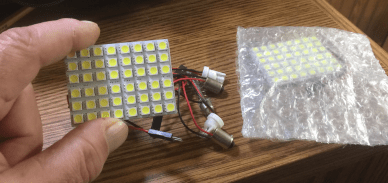
I’m a tinkerer. I love fiddling with stuff, playing with gadgets, and building my own stuff. I’m always scrounging around for interesting little gadgets, widgets and components to messscreen-shot-2017-02-25-at-9-46-26-am with. A while back I picked up a bunch of these LED lighting panels and I’ve been fiddling around with them and I like ’em so much I thought I’d tell you about them.
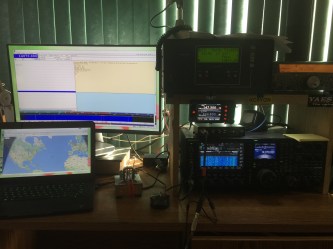
My office/radio shack is a bit of a black hole when it comes to lighting. The room doesn’t have ceiling lights so we make do with a floor lamp and some desk lamps, but I wanted some under-counter style lighting to make it easier to see the controls on my radios because it was impossible to put a desk lamp near them.

These are 12V LED lighting panels designed to replace dome lights in vehicles. They come in a wide variety of styles and sizes. This particular model comes with a fuse and adaptors to replace the incandescent lights in a car or truck dome light, but it was the LED I was interested in. They’re fairly cheap. I just looked ’em up and they’re going for $8 for a pack of two on Amazon and you might find them cheaper if you look. There are a lot of these out there from various manufacturers and distributors, with prices all over the place. Mine came from a company called Cutequeen Trading (yes, that’s the real name).

For the size they put out an amazing amount of bright, white light. One of them in the recess my TS-990 lives in was more than enough to light up the whole front of the rig plus most of the desk around it. They have a peel and stick adhesive back. Just peel off the protective paper, stick it up, hook up the wires to a 12V source and you’re good to go.

Where do you get 12V from? Well if you’re an amateur radio operator you probably already have a 12V power supply because a lot of amateur radio equipment runs on 12V. In my case I have a big 12V supply that feeds a distribution box with Anderson Power Pole connectors already in place to feed other equipment. I just wired up a plug to fit, added a toggle switch from my junk box to turn it on and off and was ready to go. They only draw about 0.4 amp so the power consumption is fairly modest for the amount of light they produce.

One gotcha was I found if I fed it directly, the thing got real hot real fast. Not to the point of burning my hand if I touched it, but painful. I ended up putting a small resistor in line to drop the voltage a bit (think it was a 480 ohm but not sure now and I’m too lazy to go dig into the wiring behind the desk to look). That kept it from getting hot without reducing the amount of light.

Another issue is that the point where the wired connect to the panel are a bit fragile and won’t tolerate a lot of movement. Avoid putting any stress at all at the point where they connect and they should be okay. I’ve heard from other people fiddling around with LED panels like this that this is a fairly common problem.

I could see these easily being used for interior lighting in an RV or enclosed trailer. It would be very easy to turn several of these into an under-counter lighting system in a house if you have a place to tuck a 12V power supply out of sight. Find a cheap, rechargable battery, some kind of box, mount a few of these on the box and you’d have a fairly inexpensive and pretty bright portable work light or flashlight.

So get out there and fiddle with stuff.

Radio Stuff. Emphasis on Stuff.

So let’s talk amateur radio for a while. Especially about stuff. As in where the hell did all this stuff come from, anyway?

I semi-retired a year or two ago. I generally have my summers off and only work for special events in the theater, fill in if someone calls in sick, deal with emergencies and things like that. Which means I should have lots and lots of spare time to fiddle with radios and stuff like that, right?

Yeah, right…

This morning was the first time in probably a month or more than I had all the equipment

img_0951
Damn, that’s a terrible picture

turned on and actually used it. Much to my surprise it actually all worked. I didn’t have anything start on fire, no smoke, no cats came leaping out from under the desk with all their fur standing on end. I didn’t even have to resort to strong language. Amazing.

I finally put a decent cable on the iambic paddle to replace the cobbled together POS I’d thrown together so I could test it when I first got it.

Then I remembered I don’t do CW in the first place. So how in the world did I end up with not one but two Vibroplex CW keys?

It’s like a lot of other stuff I’ve accumulated over the years. I just — just have it for some reason. There’s a 500 foot long spool of LMR-400 coax sitting in the basement. I just ran across a bag of 50 very good quality PL-259 connectors in a drawer the other day. Right after I’d just bought a bag of 25 of them because I needed one and didn’t think I had any. Under that bag was a VOM I don’t remember ever buying. Which is okay. Can’t have too many VOMs, right? Maybe? I mean, everybody needs six or seven volt ohm meters, right?

Eldest son stayed over night a couple of weeks ago and found a new, never used GAP Titan vertical antenna in the box under the bed in the spare room upstairs. Oh, that’s right, I picked that up about three years ago and never got around to putting it up because it was easier to just string up a dipole. Then I stumbled over a DX-Engineering vertical with the complete mounting kit and all the accessories down in the basement. All still in the boxes. Which I bought because I forgot I had the GAP antenna sitting upstairs.

Where did all this stuff come from? How did I end up with two HF amplifiers? Suppose I could sell one of them, but how the hell do you ship a delicate, 100 pound amplifier full of vacuum tubes and a power supply as big as my head?

Some of the stuff I do need. The big dummy load I use for testing, the big antenna tuner. The oscilloscope comes in damned handy sometimes.

But how did I end up with 200 Anderson Power Pole connectors?

I’m convinced people are breaking into the house late at night and instead of stealing stuff, they’re shoveling more stuff in here.

Granted, some of the stuff is genuinely useful. I picked up some LED light panels intended to replace the dome lights in cars. Got those for about $2 each and they’re great for undercounter lighting. Especially if you already have 12V power supplies running to power other equipment like I do here.

But what in the world am I going to do with all those relays I salvaged from the old boiler controllers when we installed the new heating system at work?

And where in the world did that bloody great IBM mainframe tape drive come from? Okay, so it’s really neat to watch it thread the tape through itself using puffs of air to guide the tape, but come on… I suspect eldest son snuck that into the basement when I wasn’t looking. He’s even worse than I am when it comes to snagging stuff like that.

I was looking for the cable cutter the other day, opened the drawer, and there were six laser tubes rolling around along with front surfaced mirrors and other associated stuff. Found my weight set that I used when I serviced, tested and certified scales. Don’t know why I have that either. Get rid of it? Well, what if I ever need to test a scale, hmm?


I need to get rid of some of this — this stuff.

But not my collection of M&M dispensers. No sir… And I really do need six volt ohm meters. And I’d like to hang onto that extra transceiver just in case. And, well, you never know, maybe I’ll actually use that whole drawer full of PL-259 connectors. And the laser tubes…

I’m doomed, aren’t I?


Farewell AES

Screen Shot 2016 07 15 at 4 44 06 PM

Amateur Electronic Supply is going to be closing it’s doors on July 27th. The Milwaukee store along with it’s other outlets are all shutting down effective on that date. A press release by HRO (Ham Radio Outlet) to the ARRL indicates that HRO is buying most, if not all of AES’s stock, and will even be hiring some of it’s employees. It will also be buying the AES building on Good Hope Road in Milwaukee, and will re-open it as an HRO facility after remodeling.

I’m going to miss AES. I’ve been buying stuff from them for three years and I never had a problem with them. Unfortunately I seem to have been the only one buying equipment from them. It was the the only retail facility for amateur radio equipment that was actually in reasonable driving distance, about an hour and a half away. When I ordered something from them online, it almost always appeared at my door in less than 24 hours.

While their prices were a tiny bit higher than some other places, AES was generally my first place to go when I needed something.

Unfortunately, things like convenience, the reliability of the retailer, satisfaction with the purchase, seem to be worth very little in the eyes of most consumers these days. Up-front cost is everything, and I know a lot of people who will endure poor service, hassles with returns and other issues just to save a few bucks, even though that savings may be entirely illusory in the long run if one adds into the mix.

The people at AES always went out of their way to make sure I was satisfied. Well, granted, I spent a lot of money there, but still, they didn’t have to bend over backwards the way they did to make sure I was happy with them.

I’ll miss them.

The Rise and Fall and Rise again of HeathKit and Radio Shack

The story of the rise and fall of companies like HeathKit and Radio Shack is a fascinating and complex subject. I’m going to restrict this to the comeback of both companies. One is almost certainly doomed to failure. The other might manage to hang on and perhaps even succeed.

Let’s look at HeathKit first.

I began getting emails from the company that were a bit, well, odd and, frankly, stupid. Vague announcements that said nothing, press releases that seemed to promise a lot but if you actually read the words, said, well, nothing… They had a web site! Hooray! But there was, well, nothing on it. They kept issuing press releases that promised new kits, upgrades to old kits… Sort of? If you ignored the fact that the tiny, tiny type at the end hinted that, well, maybe not…

Finally, at last, HeathKit is back! Hooray! Yippee!

Yeah, well, don’t get out the champagne just yet, because after all the years of the hype, all of the build up, all of the promises, what we got is this…

Screen Shot 2016 04 04 at 4 06 00 PM

Yeah, that’s it. An AM radio kit. Oh the joy, oh the rapture… Break out my blood pressure pills someone before I faint…

An AM radio kit. For $150.

Note the ultra clean, modern hipster design that eliminates all those unnecessary bells and whistles. Like labels. Or a dial indicator to tell you what frequency it’s tuned to. Or a volume control. Or some kind of indication that the thing is even turned on.

Well to be fair, you don’t need a volume control, I suppose, because it doesn’t have a speaker.

Oh, there’s a speaker for it, or there will be one “real soon now”. A powered amplified speaker. At extra cost, of course. Oh, goodie…

Meanwhile, just plug your headphones into one of the two (Yes, Two! Count them! Two!) headphone jacks.

And all of this can be yours for just $150! Damn, where did I put my blood pressure pills…

Oh, brother… Look, I am going to be brutally honest here. This is just ridiculous. Look, I could literally build this radio out of parts from the junk box in the basement for nothing. Even if I had to buy all of the parts brand new it would cost me less than $30. And for that I’d throw in a speaker and some labels.

But, you say, they must be selling something besides just this, right? Their entire inventory can’t consist of a single radio?

Well, no. Not really. You can get some parts for an old nixie tube clock, a ‘stealth’ VHF antenna that you could build yourself for half the cost, and copies of old HeathKit manuals, and that’s about it. Oh, and little plastic cups for a wind speed indicator.

Now let’s look at the remains of Radio Shack. Yes, it’s still around. While large parts of it were sold off during the bankruptcy, it entered into some kind of partnership with Sprint, and it looks promising.

One of the biggest problems Radio Shack had was it’s entry into the cell phone market. Now the problem when you’re a brick and mortar store that sells cell phones is that people know where you live. In other words, if something goes wrong, they come pounding at your door and demand you fix it. Right now!

This takes up a hell of a lot of time on the part of the sales staff. Which means they can’t take care of people who actually want to buy stuff. Almost every time I’ve been in a Radio Shack store, anywhere, in the past few years, I’ve never been able to actually get someone to take my money.

Seriously. I’d be standing there with whatever little gadget or part I wanted, money in hand, right there at the cash register, and I’d end up giving up in disgust and putting it back and leaving after standing there for ten, twenty, thirty minutes, and all because   the staff were trying to activate phones, or trying to explain why your dropping your phone in a toilet is not their problem or whatever.

Needless to say, this business model was not very successful. It’s hard to make money in retail if your staff is too busy with non-paying customers to even ring up a sale.

But Sprint is now taking over the cell phone part of the business, and will have their own staff in the stores. Radio Shack will, I’ve been told, be Radio Shack once more, selling dopey little gadgets, toys, and even actual real electronics parts and tools.

And it may actually be happening because I ran into this…

IMG 0364

Yes, it’s a kit. A Radio Shack branded kit. In this case a Theremin, but there were a half dozen more on the rack along with this one. And there were parts. And soldering kits. And multimeters. And breadboards. And power supplies. And, of course, the usual selection of goofy, stupid and sometimes fun little gadgets.

I picked it up for $20 because, well, come on… A theremin? Admit it. You’ve always wanted one.

Now, you can imagine which one of these companies I think has a better chance of successfully resurrecting itself.

Old vs. New: The Descent of Publications Into Mediocrity

IMG 0314

I’ve had the good fortune of obtaining, over the years, a few choice issues of old magazines and other publications, and it is irresistible to compare the modern version of those publications with their descendants. Some of these more technically oriented publications like QST and CQ have been around for a long time indeed, with QST going back around 100 years, and CQ having been around for fifty or more.

One thing that becomes glaringly obvious as soon as you open one of these old magazines is just how incredibly bad their descendants have become, at least from a technicians point of view.

Open a QST or CQ magazine from the 1960s, and you’ll find yourself quickly overwhelmed with circuit diagrams, schematics, mathematics, construction articles… If you had a basic knowledge of electronics, could read a schematic and follow instructions, you could build yourself one hell of a nice set of communications equipment just from the articles in the magazines. Not just transmitters and receivers, but linear amplifiers, antenna tuners, a wide variety of essential testing equipment… Just from reading the magazines you could build all of it if you had the ambition to do so.

There were articles about improving commercially made equipment, fixing quirks in existing equipment, modifying it to get better performance. Articles about converting military surplus equipment for ham use.

When’s the last time you saw an article in CQ or QST showing you how to build a complete receiver, a complete transmitter? A full blown linear amplifier? 

The list goes on, and on, and on… Articles explaining everything from basic radio theory for novices to material that would challenge the experts. It was all there…

Now… 

QST is, frankly, hardly worth the effort to open. It seems to be devoted almost entirely to “radio sports” (now there’s one of the most ridiculous uses of the term ‘sport’ I’ve ever heard), DX expeditions begging for money to fund a half million dollar trip to an island so small it only exists at low tide, and the ARRL’s attempt to turn amateur radio into a division of FEMA. About the only thing I read is The Doctor Is In column and the advertising.

CQ is a bit better, but not by much. At least it isn’t under the delusion that ARES is the only thing keeping the country from descending into chaos.

It’s sad to say, but I’ve learned more about electronics and radio from publications dating back to pre-World War II than I ever have from their descendants. 

It’s Fix It Day!

IMG 0291

Putting the MC-60 back together. Finally got around to tinkering with it. It started having intermittent issues a couple of months ago so I was using the Heil headset, which I prefer anyway so I was in no big rush to get this fixed. How the heck does something that’s been working fine for two and a half years suddenly develop a bad solder connection? You’d think it would have started acting up long before this.

Never know, though. Had to take apart the relay box on the remote control system we use to turn the outside Christmas lights on and off. We had that for two years and had no problems, now a capacitor on the circuit board had somehow worked itself loose enough to just fall off the board entirely… I suppose the solder joints were bad to begin with but just good enough to hang on and thermal stress finally forced them to let go.

The Great VHF Wasteland

Wasteland

I read articles all the time in QST and CQ magazines about how active the VHF/UHF bands are, all the radio operators hanging around up there, all the fun you can have, the hundreds and hundreds of repeaters out there. Thousands of hams are out there on simplex. Dozens and dozens and dozens are working various VHF/UHF contests.

I’m sitting right smack dab in the middle of repeater heaven. There are dozens of repeaters close enough for me to hear located in Manitowoc, Green Bay, Fond du Lac, the Fox Valley. Even a few as far away as Wausau and Suring Wisconsin. Every club and group, every ARES group, every SkyWarn group seems to have one or more repeaters on the air. I have about 27 repeaters plugged into the FDR-400 that I know I can get into with no problems at all, ranging from local ones just a few miles away, to distant ones like Wausau and Suring.

So I turn on the 400, put it in scan, and hear…

Well, nothing. I hear the occasional repeater ID. I hear the occasional kerchunk (that’s a technical radio geek speak term, btw) of someone probably testing if they can hit a repeater or if their transceiver is working.

And that’s all I hear. Repeater IDs, an occasional kerchunk… And nothing else. Literally nothing else. For hours and hours on end. Put out a call and you hear — nothing.

There are only two times I hear any activity on two meters, during regularly scheduled nets run by clubs and ARES groups, and when an ARES group is doing support for some special event. Otherwise, nothing.

Simplex? That’s even worse. You can put your transceiver in fast scan mode and sit for days scanning the simplex portions of the band and hear nothing.

Given all of the articles I’ve been reading in QST and other ham publications in print and on-line, I was thinking it was just something about this area. I don’t know. Just shy, maybe? Seems like kind of an odd hobby to get into if you don’t like talking to people.

But I’ve been doing this for a few years now, and the more I talk with other hams outside this area, the more stories I hear that are identical to mine. Unused repeaters, nothing on simplex… If you do start trying to call, there’s no response. Only activity is regularly scheduled nets, and once those conclude, it’s back to silence again.

It’s gotten to the point where I don’t even bother any more. The only time the FDR400 here in the house gets turned on is when my wife participates in the local ARES net. I don’t even have a VHF rig in the car any more. My own Yaesu was transplanted into her vehicle when her aging Alinco began having problems.

So is it just area? Is this an anomaly? Just curious.

As always, comments are welcome…

KC9YGN

P.S. Now that I have the OCFD up again, I’ve been hanging around down on 75 meters, above 3900, often on 3913 during days, so if you get down there, give me a yell.

A Story of Stupidity

Screen Shot 2015 11 19 at 7 58 50 AM

I am an idiot…

I was going to fire up the rig down on 75 meters last night. I switched on the TS-990, checked all the coax connections, turned on the antenna tuner, turned on the amp in standby mode. I found an empty frequency down around 3915. I put the 990 in AM mode, turned the power down to 5 watts, double checked everything, and keyed the mic to make sure the SWR and all the fun stuff was good. The PalStar’s display told me the SWR was 1.05:1 going out to the dipole and I was putting out the right power. The amplifier didn’t start on fire, always a good sign.

So I kicked the amp into ‘operate’ mode and keyed the mic again…

Now, putting 5 watts drive into that amp in AM mode will generally result in about 107 watts output when you key the mic. I looked at the readouts on the PalStar… I was putting out a whopping 10 watts…

WTF?

I looked around. Sniffed. No smoke. That’s good. Nothing exploded. So why was I only putting out 10 watts?

I bumped the output of the Kenwood up to 15 watts in AM mode and keyed. The amplifier clicked and lots and lots of red lights came on.

Oops…

The amplifier, sensing impending doom, and done what it was supposed to do and shut itself down instead of starting the office on fire or exploding or something equally annoying.

So what was going on? It will do that if there is excessively high SWR or something abnormal going on. But it doesn’t tell me exactly what happened.

Well, first thing that comes to mind is the antenna, that it fell down and was laying on the ground. And since my dipole is held up by a combination of para-cord, bailing twine (literally), a plastic fence post and a very elderly apple tree, and we’d had some pretty good winds, the possibility that the antenna was down was highly probable. So I grabbed a flashlight and went to look. Nope. Antenna is just fine.

Now what? The jumpers connecting the transceiver, tuner and amp together? That seemed highly unlikely. They were almost brand new, ultra-low loss coax with silver plated connectors. But still, such things do happen sometimes. I got out my meter, checked all of the jumpers. All were fine. I considered just replacing them all just to be on the safe side, but I am one of the laziest people I know, and the prospect of spending a half hour or more cutting coax and soldering connectors was not very appealing, especially when the cables tested OK.

So I looked more carefully. I dialed the Kenwood back down to 5 watts output to minimize the damage if something went weird, re-set the amp and tried again. The PalStar’s meter was telling me everything was fine. Power output good, SWR damn near excellent. But a quick glance at the amp’s meters everything looked okay… Kicked the amp on, edged the Kenwood up to 20 watts AM which should have given me about 700 watts output on the AMP, and keyed the mic for half a second…

Holy shit! The meter on the amp immediately jumped halfway up the scale and it immediately tripped out.

Well, that was interesting… Why was the PalStar’s meter telling me my SWR was 1.05:1 when the amp’s meter was telling me it was closer to about 7:1??? Either something inside the amp was funky or the coax jumper from the amp was bad despite what my testing had indicated…

I turned the 990 back on and…

Oh shit

Dear Lord, how could I be that stupid? I wasn’t in AM. I was transmitting in FM. Oh for heaven’s sake. The amp can handle AM, SSB and CW. Definitely not FM. It hates FM. No wonder the poor thing had been tripping out.

But what about the difference in the readings between the PalStar’s meter and the amp? I looked…

Oh no… I felt like banging my head against the wall.

The amp’s meter wasn’t set in the SWR position. It was in the power position. What I was reading wasn’t the SWR at the amplifier, it was the amount of power it was putting out. There wasn’t an SWR of 7. I was reading an output power of 700 watts…

So I’d spent almost an hour trouble shooting a problem that was due entirely to me not bothering to read the display on the 990 and seeing I was trying to transmit in FM instead of AM, and failing to notice that I’d somehow managed to change the meter on the amp from SWR to power…

Back on HF again!

IMG 0230

I finally got one of the HF rigs running again! I had to take down the dipole antenna for the summer because it was set up low enough so it was in the way. The last thing I needed was one of the neighbor’s kids grabbing the antenna when I was dumping 1200 watts into the thing!

It’s relatively out of the way now, at least where it runs into the neighbor’s yard. I got that end anchored in his apple tree, well out of reach of seven year old kids (and people on lawnmowers). The end that runs into my own yard goes to a fence post on the corner of the property. Let’s face it, it isn’t exactly an ideal installation. It’s a sort of inverted V type arrangement with the feed point at the peek of the garage about 14 feet high, one leg ending only about 4 feet off the ground, and the other about 10 feet up. I’m almost afraid to hang an SWR meter on the thing and see what the SWR actually is. But the Plastar tuner has no trouble with it at all, bringing it down almost to 1.1:1 most of the time.

The important thing is everything seems to be working – transceiver, tuner, amplifier, etc. and I’m putting out a good signal. Was down on 75 meters last night before the storms forced everyone to shut down and was getting decent signal reports.