Farm Catch Up

Ah, it’s about that time again, so here’s some of the agricultural news for the past week


Budget Pain

Well, I think we all knew that the new administration’s budget was going to be painful, and it is. Well, unless you’re a defense contractor, run a private prison, etc. You people will do pretty good. The rest of us? Not so much.

If you’re a farmer or involved in agriculture in any way, the budget is indeed going to be painful. There are huge cuts to USDA, cuts in the crop insurance program, new fees for inspectors, cuts in research… The list is too long to put here.

In addition to that, there would be massive cuts to the SNAP food assistance program, cuts to the WIC program, cuts to the school lunch program and school nutrition services, all of which would have long term consequences for the agricultural sector.  And even worse consequences for the people who depend on those programs. Even the venerable and highly praised meals on wheels system would be hit hard.

You can read a brief article about the agricultural implications of this over at AgWeb here, and if you spend a couple of minutes on Google you can find out more quite quickly.

Hay Crop almost Total Loss

Here in Calumet County, in neighboring Manitowoc and in other counties nearby we’ve seen nearly a total loss of the hay crop. Inadequate snow cover, coupled with February temperatures that spiked as high as 70 degrees during the day, then plunging into the 20s at night, coupled with extremely wet and cold weather this spring, have decimated the hay crop around here.

To make things worse, the almost nonstop rains we’ve had this spring are making it difficult to get into the fields and do anything. A lot of farmers will try to put in peas and oats to try to get some kind of forage crop off the fields, but it’s going to be a rough year.

Pigs Take Over World

Feral pigs are becoming a major problem in the US and even in Europe. It isn’t a huge problem here in Wisconsin, but the population is growing and becoming a concern. The DNR is putting bulletins into it’s hunting publications about what to do if you find one (basically shoot it). In other parts of the country it’s such a big problem that it’s become a public health issue and they are causing massive amounts of damage to farms.

Feral pigs are very aggressive, smart, reproduce quickly with the average sow producing two litters per year with 6-12 piglets per litter, and they’ll eat anything. If it has any kind of nutritional value at all, and they can eat it, they will. They cause huge amounts of damage to crops and property, kill and eat small animals, and yes, they are physically dangerous towards people. Boars can get to be several hundred pounds, with tusks like razors. And they carry a host of diseases and parasites and spread them over a wide area. Most states have adopted an aggressive policy towards pigs in the wild. A lot of states advise hunters to shoot them on sight.

Ah, well, yummy free pork, then? I wouldn’t eat one. Some states are advising hunters that if they do shoot one, let it lay there. They can carry some very nasty diseases and parasites, many of which can be transmitted to people.

New Herbicide Mix Not So Hot

There was a lot of hype surrounding Monsanto’s introduction of seed varieties that were resistant to both Roundup and dicamba in an effort to control weeds that were becoming resistant to Roundup alone. The biggest problem is pigweed, where a Roundup resistant variety has been spreading widely.

But the new systems don’t seem to be working all that well according to early reports. Early indications are that multiple sprayings are going to be required, and perhaps even resorting to additional types of chemicals. The manufacturer recommends pigweed be no more than 4 inches tall, but since pigweed grows at up to 3 inches per day, trying to time things right is almost completely impossible.

I’m not going to get into debates about the health safety of GM crops. But I will point out that GM plants seem to be, ultimately, a complete failure. At least in their current form. The only commercially successful GM plants right now are those that have been engineered to resist herbicides or insects. And that resistance is rapidly becoming worthless as weeds and insects become resistant to the herbicides or the traits that resisted the corn root worm. These GM plants really have no other desirable traits except that. They do not increase yield, aren’t nutritionally superior. So in the long run, these commercially available GM plants are a failure.

Politics Rears Its Ugly Head

The administrations proposed budget could have widespread and devastating effects on the entire agricultural sector, and cause ripples through the whole economy. There would be big changes to the crop insurance program which could hit some farmers pretty hard. Everyone has probably heard about the cuts to the funding for the Meals on Wheels programs that serve the elderly and disabled. It looks like USDA itself would be hit hard. If I’m reading things right USDA would be looking at losing about a full third of it’s funding.

There would be huge changes to the SNAP program, i.e. “food stamps”. In addition to large cuts in funding, states would have to contribute more money to the program themselves, and would be given more control over how the programs work, who gets help, etc. It would also allow states to institute work requirements.

I don’t really understand the work requirement thing. The vast majority of people in the SNAP program can’t work. They are disabled, the elderly, or children. About two thirds of the people who get assistance through the program fall into one of those three categories. Of the remainder, most of them already do work, but make so little money they qualify for help through the program.

It’s Hard To Be Small If You Raise Meat

The big trend these days is the whole “farm to table” thing where people try to connect directly to farmers to buy food rather than rely on the big commercial processors and distributers. I’m very much in favor of these ideas. Connecting with your local farmers to buy food is generally a good thing for many reasons.

But it isn’t easy to be a small farmer. Agriculture in general doesn’t seem to like small farmers. At all. It’s hard to buy equipment designed for small farms, difficult to find ways to market your products. And if you raise meat animals, well, it’s even more difficult because it’s almost impossible to find a government inspected, licensed slaughter facility to deal with the animals. Bloomberg has an interesting article on the issue, and it’s one that’s turning up all over the country. (Warning, Bloomberg has one of the most bloody awful websites around, loaded with auto-play videos you can’t get rid of that have nothing to do with the story you’re trying to read, along with other annoyances.)

The US market has become such a monopoly that only four companies supply 90% of the meat sold in the country, and the independent meat processors that used to dot the countryside are long gone.

So while the demand for organic, free range and local meat has increased dramatically over the last few years, places where farmers can get that meat processed have become almost impossible to find in many areas of the country. Some are forced to truck their cattle for three, four hours or even more to get them to a processor.

And the government doesn’t want to make things easier. Inspection rules, processor rules and regulations are all geared to the huge meat packing facilities, not the small processors.

Some people in congress are trying to get the rules changed to make it easier for small farmers to deal with this situation, but it’s being fought hard by the big processors, as you might expect.

A Nice Gesture But…

An organization called Dairy Pricing Association put out a PR piece the other day about how they bought and donated 42,000 pounds of cheese to the Hunger Task Force. It’s a nice, feel good kind of item. DPA makes itself sound like it’s doing farmers a favor and that the buy will help push up milk prices. And certainly the Hunger Task Force can use the help. They have over 85,000 people using it’s food pantries and other forms of assistance in Milwaukee county every month.

I hate to sit here and frown at people who are trying to do something, but it’s PR fluff, really. The people at DPA are helping people who badly need food, yes. And that is a good thing. But claiming this is somehow going to help the milk price as some of the statements imply is just silly. It won’t.

That 42,000 pounds sounds impressive until you learn that is half of a single truck load of cheese. Go down to the Sargento plant about 20 miles from here and they crank out dozens of truckloads of product every single day. From one plant.

They removed “23 tanker loads of milk from the market” in 2016. That sounds like a lot until you do the math. Let’s say a tanker holds, oh, 8,000 gallons of milk. That’s 184,000 gallons of milk. A lot, right? Well, no. A 5,000 cow mega-farm puts out up to 30,000 or more gallons a day. So that 23 tankers of milk is only 6 days of production from a single farm.

It’s a nice PR piece, sounds good, and certainly it helps feed people. But boost milk prices? No. Not even a blip.
Farm Catch Up

Catching up with the week’s farm news

Local Alfalfa Die Off

The weather this spring has caused significant damage to the hay crop around here. I’ve been seeing large areas of stunted and even bare ground in a lot of the hayfields here in this county and in Manitowoc county when driving around. But you know it’s really bad when it makes the AP news. According to one report Manitowoc County has lost 10,000 acres of alfalfa, well over half of it’s hay crop due to the weather. From what I’ve seen around here I wouldn’t be surprised if we were almost that bad in this county. The main culprit was February daytime temps climbing into the mid 60s, then plunging down to the low 20s at night.

Addendum: After writing the above new info has been coming out that indicate the losses are as high as 80% here in Calumet County and in neighboring Manitowoc Cty. When you add everything up; increased labor costs, poor milk prices, and now a severe hay shortage, it doesn’t look good for the dairy industry around here, alas.

Manure, Manure everywhere and not a drop to drink

Kewaunee County is trying desperately to find a fix for it’s well contamination problem. Dumping massive amounts of manure from CAFOs (mega-farms) has polluted almost half of the wells in the county. The geology of the county is such that contaminants quickly flush through the soil, through the cracked bedrock, and into the groundwater in the area.

The county is proposing a new ordinance that could change how the farms are allowed to spread manure. Right now they can dump manure only in the spring and fall.

Some have been using high-pressure irrigation systems to spread manure, basically something similar to giant lawn sprinklers. There has been a huge stink about this. Literally, because this stuff doesn’t exactly smell all that appealing. There are also health concerns about the practice because the locals are afraid the vaporized cow poo could also be causing pathogens to get into the air as well.

The county is thinking of changing regulations. The new rules would forbid using high pressure irrigation type spraying of manure, but allow low pressure spraying, under the canopy of plants. It would also allow spreading manure over a 6 month period of time rather than restricting it to just spring and fall.

Will this do any good? Well, maybe??? If farms can spread out the application of manure over six months rather than having to dump all of it in just a few weeks, it might help.

In the long run though, no. It won’t. The problem is too much manure in one area.

When you have grazing cattle on pasture, the situation is entirely different. When a cow drops a pile on grass, it doesn’t just sink into the ground. It sits there on the surface. Insects lay eggs in it, insect larvae burrow through it. Birds and small mammals dig through it to eat the larvae, scattering the manure over a wider area. It naturally rots and decays and it gradually gets absorbed by the soil to be taken up by plants. It takes many days to go through this process, and almost none of the material ends up in the ground water.

But the process CAFOs use? The manure from thousands of cows is dumped into pits, liquified, churned up, allowed to bubble and ferment and cook for months, and then all of that muck is dumped on fields, at one time, tens of thousands of gallons of it dumped in just a day or two… It isn’t surprising we have problems. What’s surprising is that the situation isn’t far, far worse.

US Regains Beef Export to China

In 2003 China banned the import of US beef because of a case of BSE. It didn’t import US beef even after the ban was lifted a year ago. But a new trade deal may change that. In exchange for being allowed to ship cooked chicken to the US, China is going to allow the import of US beef, apparently starting in July.

China has seen a large increase in the consumption of beef in the last decade or so, but most of it’s beef imports have been coming from South America and Australia.

While the beef industry in the US is delighted, exactly how much China will import from the US remains to be seen. China, like the EU, bans the import of meat that was raised with the use of hormones and other growth promoters, a practice that is widespread in the US. It is unlikely China will change this requirement and, at the moment anyway, the production of hormone free beef in the US is very limited and it’s unlikely that will change very  much.

Donkeys? Really???

In the WTF department, I ran across this item over at AgWeb reprinted from Bloomberg. Donkeys are really popular in China. Not as pets or work animals or even for food, but for something called e’jiao. They take the skin of the donkey and render it down into a gelatin that some believe will enhance… Oh, come on, really? That? They think it does that?

Yeah, they do. “Libido enhancers” as the article delicately puts it. Or as those of us who are a lot less delicate would put it, dick pills.

Apparently the demand is so strong that it’s decimating the donkey population in some parts of the world.

I have two basic questions:

First of all, what idiot first said “Hey I’m going to rip the skin off that cute little donkey and boil it down and eat it and I bet it’ll turn me into one of those porn star dudes.”?

And second, who the hell is dumb enough to actually believe that first idiot up there?

Well, apparently a lot of people do believe, to the point where it’s having serious economic impacts on some communities in Africa where work animals are being sold off to be boiled down to make dick pills for impotent rich.

Anyway, if you want to know more click the link up there and read the article over at AgWeb.

What the hell is the matter with people? I mean, really? Boiling down donkeys, killing rhinos for their horns, cutting out bear gall bladders and I don’t know what all else, just so some fat, balding, aging jerk with an overinflated ego can…

No, I won’t go on or I will descend into vulgarity.

Got Milk? Increasingly the Answer is No

Sales of liquid milk for drinking have been falling for years now despite heavy advertising and marketing by the dairy industry. A brief but informative article over at NPR’s The Salt goes into the history of milk in the US and it’s worth clicking the link and taking a couple of minutes to read it.

Milk, as a beverage, has been falling out of favor for decades now. In the 1970s, as the article says, average consumption was about 30 gallons a year. Today it’s about half of that. If you go into the history of milk marketing in the US, it’s fascinating how the dairy industry turned a product that no one really needs, into an “essential source of nutrients”. And it is. If you’re a calf. Yes, milk does provide necessary nutrients, but it doesn’t offer anything that you couldn’t get from other foods.

The problem is that often milk is being replaced by stuff that’s a hell of a lot worse; soft drinks, juices, stuff that looks like juice but is really a blend of sugar water and fruit flavorings. Or with expensive and useless products like water fortified with vitamins you don’t need or herbal concoctions that have never actually been tested for safety.

Probably a more accurate slogan for marketing milk would be something like “Milk: It probably won’t kill you, but some of the other crap your drinking could.”

NAFTA

It’s official. The administration has formally announced it is going to renegotiate NAFTA. But before you get all giddy with anticipation, or full of dread or whatever your opinion is on the subject, don’t hold your breath waiting. From what I’ve been seeing going on in DC I get the feeling that this administration doesn’t have a clue as to how government actually works, doesn’t know what it itself is doing most of the time, and doesn’t understand how treaties like this actually work. Perdue’s earlier claim that the administration would completely renegotiate NAFTA in just a couple of weeks is especially troubling, giving more indications that they don’t know what they’re doing over there in DC.


70 Percent Chance Dec. Corn Futures Hit $4.40-$4.50 – Corn – News | Agweb.com

As

Source: 70 Percent Chance Dec. Corn Futures Hit $4.40-$4.50 – Corn – News | Agweb.com

I read this item over at Agweb twice and I still don’t understand why she thinks there’s a 70% chance corn could go over $4.40. She doesn’t give any data to actually back up that statement in the article. I hate items like this where some “expert” comes along and makes a specific statement, and then the report doesn’t give any reason why.

As of right now I don’t see any indication corn is going to go that high barring some kind of significant weather event or similar wide spread problem. We have massive amounts of corn still in storage from last year’s harvest, planned corn plantings for this year are down only slightly from last year… There basically is no pressure at all on the market to move the price up significantly.

At the moment, China has drastically cut back imports of corn to try to draw down it’s own stocks, and has increased production. There seems to be no increased demand for US corn anywhere, really. Ethanol production is relatively flat, we have grain storage facilities full to bursting with last year’s crop, weather has been relatively good… There doesn’t seem to be any reason for corn to go up almost $1 a bushel over the next few months. So why does she think it’s going to go up? Don’t know.

Farm Catch Up

Looking back at ag news over the last week

NAFTA

The new ag secretary, Perdue, gave a speech in which he claimed the administration was going to renegotiate NAFTA within the next six months. He said, “We’re not talking about this taking years to do, but weeks…”, thus clearly indicating that neither he nor the administration he works for knows what NAFTA is in the first place, or even how trade negotiations work. If they think they can do something as complex as renegotiate NAFTA in a few weeks… Oh, brother, we’re in trouble.

Ag Immigration

With the ag sector in a near panic over the potential loss of much of their labor force due to the policies of the administration, some administration officials have been trying to calm things down. Perdue was out and about again and said in a speech that he had been assured that the administration was not gong to target employers, was not going to raid farms, and that the ag sector should calm down because the administration was not going to go after it’s immigrant labor force.

And then just a couple of days later ICE did exactly that, raiding a Pennsylvania mushroom farm and hauling off nine of it’s employees. So it goes.

Other anti-immigrant activities by politicians and law enforcement have done nothing but make the panic in the ag sector even worse. Texas just put in place a law that permits police to demand proof of citizenship during routine stops and would jail police chiefs and sheriffs who do not cooperate with federal immigration officials. Arizona has passed a similar law. Basically these laws allow, or even require, police to demand proof of citizen ship from anyone they suspect is not a citizen which, in a lot of jurisdictions basically means anyone who is not white.

Some politicians are trying to do something about this. Ag businesses and others that depend on immigrant labor are having serious problems already. There is a bill in Congress that would provide a “blue card” to farmworkers who have worked in agriculture for at least 100 days. That bill will almost certainly go absolutely nowhere. Wisconsin and some other states are trying to cobble together a “state visa” program that would give states more control over immigrant rights to prevent their labor force from being deported. Wisconsin is hugely dependent on immigrant labor and employers are already having problems finding people to work. That proposal will go nowhere as well. Even if it did go through at the state level, it would be over ruled by federal law and possibly would even be unconstitutional because the federal government, not the states, has control over immigration.

Water Wars

Wisconsin has a serious problem with water quality, especially ground water. Because of contamination by huge CAFOs (mega farms) caused by the dumping of millions of gallons of liquid manure on the ground, wells all over the state are being contaminated. Up in Kewaunee county about 40 miles from here it’s estimated that 35% – 50% of the private wells in the county are contaminated. And almost nothing is being done about it. A story in the May 10 issue of the Milwaukee Journal Sentinel (I can’t put in a link because I read MJS on Kindle, but you can find it with Google if you want) discovered that the problem is so serious that the Algoma school district is giving out water to students and families, some farm organizations are giving out drinking water, and even the DNR may be getting into the act, providing drinking water. And almost no one has heard about the story. I’m not a conspiracy nut, so I don’t think that they are deliberately trying to bury the story. I think it is just getting swept aside because of far more important issues. Kewaunee County is a rural area and not very affluent so news organizations tend to ignore it unless something makes a big stink.

Kewaunee County is also problematic because it is bordered on one side by Lake Michigan, and by the Bay of Green Bay (yes, I know it sounds redundant, but that’s what they call it) on the other. The Bay of GB has been suffering from dead zones, areas where nothing but algae grows, because of contamination by fertilizers, phosphorous, nitrates; the same contaminants that are getting into the wells.

Wisconsin isn’t the only state with this problem. Iowa, Indiana, California… Anywhere where large scale agriculture is going on is suffering similar problems. And the politicians are listening.

But, of course, not to the people who are finding their water polluted. Here in Wisconsin they’re ramming through new rules and regulations which would allow mega farms and irrigation systems to draw virtually unlimited amounts of ground water form high capacity wells, even in areas where the draw down has been so bad rivers and lakes are literally drying up because of it. The “new” DNR is doing nothing about the issues in Kewaunee and is working on “voluntary” solutions. And in California they tried to push through a bill that would forbid people from suing suspected polluters, giving the general public no recourse at all if they find their wells contaminated. And at the federal level some members of Congress are trying to push through a similar measure. You can read about that here over at The Hill.

Who Owns What?

One trend that I find troubling is farm land being snatched up by investment companies. Farmland Partners is perhaps the best known of these, but it isn’t the only player in this. FP now owns around 154,000 acres of farmland, and it’s expanding it’s holdings every year.

Perhaps I’m a pessimist, but when I read stories like this I tend to think of how this can be abused and misused. I get nervous whenever an essential item like farmland is being concentrated in the hands of people who don’t give a damn about anything except maximizing their profit. Yeah, I know the companies talk about preserving farmland, protecting our resources, saving the environment, protecting agriculture and all that. But when it comes down to it, the only business FP is in is to make money for it’s stock holders. Period.

Unpasteurized Milk

Consuming unpasteurized milk has become a fad in the “natural food” world. From ridiculous claims that unpasteurized milk can cure everything from rashes, to baldness, to cancer, to claims that pasteurizing milk somehow destroys it’s nutritional content, the internet abounds with utterly absurd claims alleging health benefits from it that simply do not exist.

One thing that unpasteurized milk can do, though, is make you sick. According to a new study published by the CDC this week, 96% of all illnesses linked to milk products were caused by unpasteurized milk, even though only about 3% of the population drinks unpasteurized milk and even fewer eat cheese made with unpasteurized milk. You can read about it here over at Consumerist.

I know this sounds kind of ridiculous from a former dairy farmer, but the fact is that you don’t need milk at all. You can easily get the calcium, protein and other nutrients in milk from other sources. There are studies out there that indicate that contrary to what the milk marketing boards are trying to claim, drinking milk does nothing to improve bone density nor does it do anything that can’t be gained by eating other foods. There are even some studies indicating that drinking milk may be related to some of the very things the marketing people claim it helps.

[Addendum: May 12. I added this edit after someone who read this told me that you need to drink milk to get vitamin D. Yes, D is an essential nutrient and a lot of people don’t get enough of it, but you don’t get vitamin D from milk itself. The only reason D is in milk is because milk processors are required to add it. They basically grind up a vitamin pill and throw it in the jug. ]

Cheese… that’s a different story. Ooo, yummy yummy cheese… I think I have some of that gorgonzola left in the fridge…

Say it with me now — cheese….


Farm Catchup

Time to get caught up with what’s been going on in the farming world.

Elderly Corn

China has a problem with corn. As in it has too much of it. It’s been sitting on a large amount of stockpiled corn for years now, and it needs to get rid of it because some of this has been sitting in storage for ages now and if they don’t get rid of it soon it’s going to be unfit for even animal consumption. Agrimoney posted a story indicating China is going to start dumping a lot of it’s aging corn on the market beginning May 5. Some of this stuff has been in storage since 2012. The country has had a problem with this for some time now, and there are rumors flying around that the quality of this stuff is marginal at best. China has been working to make their grain markets less dependent on government support programs and to draw down massive amounts of grain that they have in storage. The result has been a huge drop in the import of grain, especially corn. Chinese corn imports in March were 91% lower than they were a year ago.

GM Corn Saving Lives?

My opinion of genetically modified crops is mixed. I believe the science that proves that the GM crops in use currently are generally safe and that consuming them does not cause health problems. But GM crops have other issues associated with them that are problematic. Like the fact they don’t really improve yield at all, that they lead to the development of herbicide tolerant weeds and that in the long run, GM crops modified to resist weeds and things like the corn borer are little more than stop gap measures that will ultimately fail… The list goes on and on.

But there is one GM crop that could genuinely be of benefit. Aspergillus is a type of fungi or mold that produces aflatoxin, which is not only a carcinogen, but can also cause stunted growth in children and damage immune systems. And it causes liver cancer. It can be found in all kinds of things; peanuts, walnuts, the list goes on and on. Aflatoxin is especially a problem in corn. Corn that is harvested wet, stored improperly, can easily be hit with this stuff, and it can be very nasty.

Here in the US and other first world countries corn and other food crops are tested for the the stuff, but that’s not the case in other places that don’t have the resources, the money, or the expertise to do the testing.

They’ve developed a modified variety of corn that resists the development of the toxin in the corn kernel. Aspergillus can still develop, the the toxin itself will not get into the kernels of the corn.

The early test results are very promising, but they’re going to have to hook up with someone who can afford to foot the bill for large scale testing of the modified crop and go through all of the regulatory paper work and testing.

It wouldn’t just help poorer countries which can’t do the testing. Farmers have  huge amounts of corn rejected because of testing positive for the toxin, so a variety of corn that didn’t develop the toxin would be a significant financial benefit.

Weed Wars

I ran into this item over at agweb.com: When Will the Herbicide Cavalry Arrive? It talks about herbicide resistant weeds and new chemicals to kill them and all that stuff. The usual kind of thing that reads like a PR piece written by the chemical companies. But if you scroll down a bit over halfway through the piece, you’ll find a somewhat different tone when someone, finally, utters the phrase “we’ll never spray our way out of the problem.

And we won’t. Sooner or later the pests will develop resistance to whatever chemical solutions they come up with and the problem will come back just as bad, probably worse, than it was before. They go on to praise two Australian “innovations” that attach to the combine to capture weed seeds before the combine can blow them back out onto the field.

It’s certainly a good idea. Any weed seeds you can capture at the combine aren’t going to germinate the next year to infest your crops. But innovative? Hardly. Similar technologies have been around for decades. Back in the late 1950s our old Massy Harris combine had a device mounted on it that did something similar. It collected the weed seed that would have been blown back out onto the field or gone into the grain tank with the oats and dumped it into a feed sack attached to the back of the combine. At the end of the day we’d have bags of the stuff. It certainly wasn’t 100% effective, but every weed seed it did collect was one that wasn’t going to cause a problem the following year.

Will these devices be helpful? Hell yes, if they ever get them into production and farmers buy into the idea.

I’m not sure why the process went out of favor. I think our combine was the last one I ever saw that was equipped with it. I suppose people figured why bother when all we need to do is just spray. Just blow the weed seed out the back of the combine and let the chemicals deal with it.

School Lunch Controversy

You’d think that one thing everyone would agree on is that school kids should be fed lunches that are safe and healthy, right? But you’d be surprised. Opinions range all over the place out there, from people who think parents should be responsible to feeding their kids and the schools shouldn’t be serving any food at all, under any circumstances, to those who think schools should be feeding kids everything; breakfast, lunch and dinner.

And as for what schools should be serving, well, it’s turned into an utterly ridiculous and totally unnecessary political fight that started the moment the Obama administration announced new rules to insure that what kids were being fed in schools was, if not actually good for them, at least wouldn’t actively harm them. There is absolutely no doubt that we eat too much fat, too much sugar, too much salt, too much processed food and we don’t eat enough vegetables, fruit and whole grains. The new rules were intended to help deal with that, and from the moment they were even mentioned, the fight started because, well, Obama, and as far as certain politicians and special interest groups were concerned, anything coming out of the Obama administration was automatically the spawn of Satan.

As the current administration works to roll back or eliminate everything that it’s predecessor did, it’s been going after the school lunch program as well. The ag secretary announced in a self promotional fluff piece that reads like it was written by the food processing companies and backed with “information” that either isn’t true, is misinterpreted or cherry picked, that they’re going to “make school meals great again” by rolling back the Obama era nutritional guidelines, and allow schools to return, at least partly, to serving kids little more than junk food disguised as a meal. Restrictions on salt, fat, sugar, serving increased amounts of vegetables and whole grain breads and fat free milk are all being rolled back

One of these days I need to do an article about the school food service system. I’ve been involved in it either directly or indirectly for decades and some of the crap going on in that system, well, it’s scary sometimes.

Milk Wars

Well, the politicians have gotten involved in the dispute with Canada over their change Screen Shot 2017-04-27 at 6.43.56 AM.pngto their milk import policies, and as you might expect, there has been a lot of muttering, tut-tutting, bloviating and ranting, with absolutely nothing being done about anything. The president got involved, appearing in Wisconsin briefly where he said many, many things to try to make it sound like he was going to do something, and as soon as he got out of the state and safely back in DC, the Whitehouse immediately disavowed everything he said, blunted or even eliminated entirely the vague threats, and we aren’t going to do this or that, but oh, even though the dispute is about milk we’re going to put a tariff on Canadian wood…. Wood? Really? Oh, well…

The state’s ag secretary is apparently actually doing his job, trying to help the dairy farms that are being dumped by Grassland. But in the long run there isn’t a heck of a lot that can be done at the state level. Fortunately it seems like most of the farmers effected by this have now found other markets for their milk, but the situation is still very concerning, and I expect things will get worse before they get better.

Blaming Canada for this, as many are doing, is silly. These new rules should not have blind sided anyone. From what I’ve been reading, the rules have been in the works for at least a full year, if not longer. Back in November already we were seeing stories popping up about the change in rules and warnings of how it would effect the markets here. So the processor’s claim that they were blindsided by this is a bit disingenuous. If their management didn’t see this coming, they really should be in a different business.

The real problem is the dairy industry itself and the politicians who keep fiddling with it, not any specific country. And the problem is world wide, not limited to the US or Canada. The problem is that dairy farms are producing way, way too much milk. More than the market can absorb. And instead of trying to deal with the situation, the reaction of the whole industry is to try desperately to come up with some kind of market for the stuff, any way they can, even if it destabilizes some other country’s farming industry. Pressuring politicians to institute still more ways to artificially prop up prices.

Canada has done something no other country has, it has actually been trying to deal with the problem of oversupply. It has a fairly strict quota system on milk production to try to keep the market stable. But in order to make it work, they have to restrict imports of dairy products from outside of Canada or the whole system would fall apart as the country is flooded with cheap imports. (The EU tried a quota system but abandoned it a year or two ago)

Is this protectionism? Of course it is. But you have a choice: Do you protect your businesses at home, giving them a level playing field to work with, restrict production so the farms can be relatively profitable, or do you open up your markets to cheap imports, often cheap because of government subsidies, tax breaks and other things that make it cheaper for them to produce the product than you can?

Then the politicians get involved… Price supports, tax breaks, grants, subsidies, government agencies buying up surplus product to artificially prop up prices, mandates that you have to use certain products (Wisconsin still has laws that force restaurants and food service operations to serve butter, for example), the list goes on and on. The end result is that anyone who thinks there is a “free market” for dairy products is living in a dream world.

What’s the solution to the problem? I really don’t know. My father used to say that the system was so screwed up that the whole thing should be scrapped. All of it. Make it a true free market. No government subsidies, no tax breaks, no marketing boards. Leave the health and safety regulations, testing, etc. But get rid of everything else. Turn it into a real free market that has to respond to normal supply and demand rather than a government supported mess where farms are propped up by various programs and price manipulations that encourage overproduction.

Would it help? I don’t know. But it seems to be about the only thing we haven’t tried yet. It’s obvious that all of the quota systems, price supports, surplus buys and everything else isn’t doing any good.

First Harvest! Rhubarb

The first actual harvest out of the garden here every year is rhubarb. The plants are

IMG_0191.JPG
It only started to break through the soil about two weeks ago and it’s already over a foot tall with dozens of stalks.

ridiculously hardy and are always the first to spring up. After the chives, which pop up as soon as the snow is gone, rhubarb is the first real thing we harvest. As soon as the goofy looking red bulbs of the sprouts

IMG_0090.JPG
Sprouting rhubarb looks like some kind of emerging alien eggs or something. Creepy

pop up we start thinking about rhubarb custard pie, rhubarb and strawberry, rhubarb sauces of various types. In some parts of the world the more tender stalks are dipped in sugar and eaten raw.

Oddly it seems a lot of people I know have no idea what to do with the stuff. Granted, it is utterly horrible if you try to eat it raw. But once it’s cooked a bit and has some sugar added — well, okay a lot of sugar added, it’s delightful stuff. Well, to me at least. For a lot of people it is definitely an acquired taste, and one which some have no desire to acquire, I fear.

Rhubarb does have one “gotcha”, and that is it’s leaves. They are fairly high in oxalic acid, which can cause serious problems or even death if you eat enough of them. (I read that you’d have to eat something like 11 pounds of leaves to build up a fatal level of oxalic acid.) The stalks have very little oxalic acid so those are safe to eat. Some people have claimed that you can only eat rhubarb early in the season, and that after the plant has come to full maturity, the level of oxalic acid in the stalks rises and makes it dangerous to use. This is not true. It’s safe to eat the stalks all through the growing season. If you let the stalks get too thick, it becomes woody and even hollow. But if you harvest it regularly and only select the new growth the stalks will remain tender all season long.

You want a fast and easy way to make a sauce? Sure. Here you go:

IMG_0189.JPG

Take about six or ten stalks and cut them into very small pieces. Put in a pan and add about a quarter cup of water. Turn up the heat until the water begins to bubble, then turn it down to low and let simmer. Stir every few minutes. After a very short time the pieces will begin to disintegrate and turn into a kind of pinkish mush. At this point throw in some sugar to taste. Start with a couple of tablespoons and taste, then add more as needed to get it to a level you like. Then serve hot, or throw it in the fridge.

IMG_0190.JPG

What do you use it for? Put it on ice cream, use it on pancakes. Use it instead of strawberries on shortcake. Or use it with strawberries. The two go together very well indeed. I put it on cereal.

Wet. And Jazz

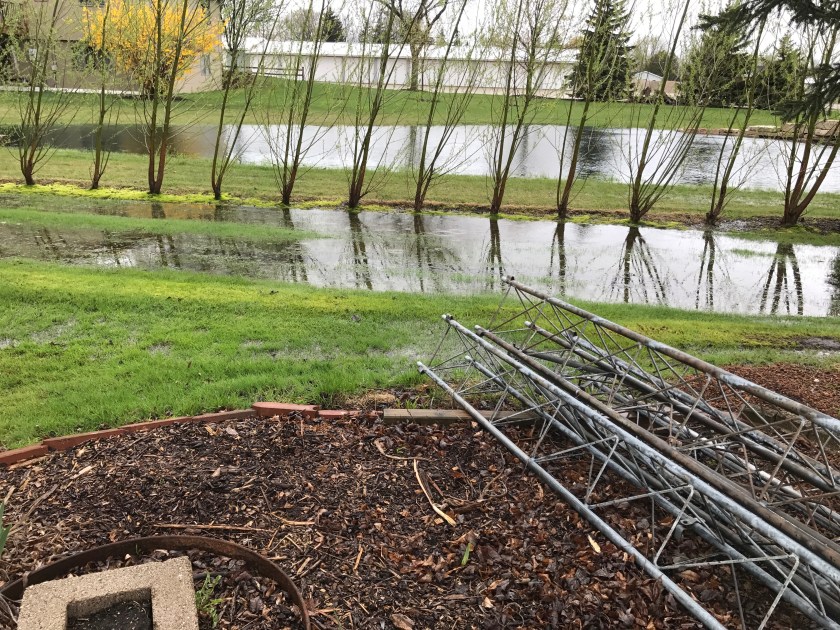
Wet is what describes the weather here. Wet and cold. We had almost 24 hours of rain IMG_0187IMG_0188and everything is completely saturated around here. The gauge indicated we had about 2 inches. And the temperatures plunged as well. High temp yesterday was around 45 degrees, a good 20 degrees colder than the day before. If anyone thought winter was over, this will disprove that. Up in the Bayfield area they actually had to cancel schools the other day because of ice and snow.

Jazz – Last Sunday I worked for the high school jazz band’s spring concert. The students did a great job but the turnout was disappointing.Screen Shot 2017-04-28 at 6.55.47 AM.png I don’t think we had more than 50 – 60 people showed up for it, even though it’s a free concert. Most of the parents showed up, but that was about it. I suppose the scheduling was part of the problem. Because of scheduling conflicts they could only do it at 4 in the afternoon which is a fairly awkward time for a lot of people.

My job at these events is basically to keep things running smoothly and deal with emergencies if they turn up. But they aren’t making it easy. I found out last weekend that they pulled the control computer that operates the HVAC systems at the high school. Now if I have to make changes to the heating/cooling settings, I have to make a 20 minute trip to the downtown building to get on the computer there, then drive back to the high school…

I imagine it saves them money. They probably have to pay a license fee for that software at the high school, plus the cost of the equipment itself, but come on, really? If something goes wrong, I have to drive 20 minutes one way to read the diagnostics, drive 20 minutes back to the HS to fix the hardware problem, then drive 20 minutes back to downtown to check the diagnostics again and reset the systems, then drive 20 minutes back to the high school…

Oh brother… This is not going to work out well for them, I can see that. If we have a HVAC problem at the high school during a special event and I can’t get it fixed quickly because I have to run downtown just to get at the control systems, there are going to be a lot of very angry people at the event. Last year I got a panic phone call on graduation day that the temperature in the gym was 97 degrees and climbing. If I hadn’t had the control computer at the high school itself at the time and would have had to run back and forth between the two buildings just to do diagnostics, I wouldn’t have gotten the problem fixed until after graduation had been over. Hmph….


Catching Up

Brazil Scandal

I haven’t heard much about the meat scandal going on in Brazil on the main stream media but it’s been all over the ag press since the story first broke. According to reports, Brazil’s meat exporting companies have been involved in bribery scheme where government inspectors and auditors were bribed to permit the companies to ignore sanitary regulations and inspections, falsify medical records and certificates, and ignore tampering with products to disguise problems with the meat. It’s also alleged the producers used ascorbic acid and other chemicals to disguise rotten meat, injected water into meat to inflate the weights. It’s just nasty. The whole story sounds like something straight out of “The Jungle” by Upton Sinclair.

There are now reports of large numbers of arrests as the government tries to do damage control. Brazil is the largest exporter of beef and poultry in the world, and the scandal has decimated the industry. Many countries instituted outright bans on importing Brazilian meat and meat products or instituted much stricter inspection protocols. Things are slowly starting to get back to normal, but the Brazilian meat industry really took a hit on this one and it could take some time for it to recover.

The really scary part about this is that meat processing companies had allegedly been bribing the country’s federal meat inspectors for years before this was discovered.

Does No One Remember?

Does no one remember what things were like before the EPA came along and environmental laws were finally brought on-line? It seems not, judging from the stuff I’ve been hearing coming out of the “new” EPA and the new administration. If you read the laundry list of things the new administration is planning on doing when it comes to the environment, it seems none of them do.

And what’s up with this fixation on coal that this administration has? Pruitt just put on a staged event with coal miners in full gear standing around him to try to spin how the gutting of environmental regulations is going to somehow create massive “economic growth”. All things considered, coal is a very, very minor cog in the energy machine. For many years coal has been becoming increasingly irrelevant in the energy world, and not just for environmental reasons. It’s expensive, dangerous, dirty, inefficient, produces huge amounts of waste material when burned, it’s hard and dangerous to mine, and the coal industry doesn’t really employ all that many people.

When I remember what it was like back in the 1960s, and think that we might be going back to those days of cities being entombed in clouds of toxic smog, rivers that were so polluted they actually caught on fire, where if you fell into a river you’d probably die from poisoning before you drowned, and all just so a few politicians can pose for pictures with a handful of miners from an industry that was starting to fail even before they were born, it makes me wonder what the hell is going on.’

Rather than spending all this time, energy and government money propping up the coal industry allegedly to “protect” the jobs of a few thousand miners as the politicians claim they are doing, wouldn’t it make more sense to invest those resources in training the miners for other types of work, giving different types of businesses incentives to move into those areas, etc?

Canadian Dairy Fights Back

The Canadian dairy industry is pushing back against claims that it and the Canadian government are at fault in Grassland cutting off 75 dairy farms here in the state. As I pointed out previously, the story being pushed out by the company about why it abruptly cut off 75 farms, forcing them to scramble to try to find new processors to buy their milk, seems to be a bit disingenuous. Especially when Grassland is claiming it had to cut off those farms because it can’t sell the milk while the company itself is seeking permits to build it’s own 5,000 cow dairy farm.

The Canadians are pointing out that the real culprit is the US’s overproduction of milk. And they’re right. The market for dairy products is utterly saturated. Despite an increased demand for butter, the US domestic market has been flat for years, with some sectors, such as consumption of liquid milk, actually declining despite heavy marketing and various gimmicks. And while demand is shrinking, prices falling, the diary industry responds by drastically increasing production?

Even one of the farmers dropped by Grassland agrees as is noted in the story linked above.

One of the biggest problems with the whole dairy industry in the US is government intervention in the market. Political manipulation of the market has resulted in a maze of rules, regulations, laws, marketing schemes, surplus buys and I don’t know what all else, that has left us with a marketing system that is convoluted, irrational, and so outdated that parts of it go back 75 or even a hundred years.

There is More on the Dairy Farm Story

I mentioned previously that a short time ago Grassland Dairy Products here in Wisconsin, which makes mostly butter, sent out letters to 75 dairy farmers telling them that as of May 1 Grassland would no longer be buying their milk. This left those farmers in a terrible situation. They now have no place to sell their milk. And the way the market is right now, finding a new processor to sell to is almost impossible.

In it’s press releases and comments to the media Grassland blames Canada. Canada, according to Grassland, changed their dairy import policies almost literally overnight, making it impossible for Grassland to continue to sell almost a million pounds a day of ultra-filtered milk, used in cheese making, to Canada. According to some of the information that came from the company, they received only two days notice before the change was implemented. The company had no choice but to cut back on the amount of milk it purchases. Grassland claims that it cut off those farmers that the company felt would have the best chance of finding a new market for their milk elsewhere.

But some people started to do some digging, and as is often the case, what’s been coming out in the press releases and statements from the company seems to have some problems. I ran into an op-ed piece over at Wisconsin Agriculturist that points out numerous problems with the whole story as it’s being presented by Grassland, and if true, there is a lot more going on here. You can read it here.

First of all, allegedly Grassland was not blind sided by this as they seem to be claiming. This didn’t happen overnight as the press releases seem to claim. This has been in the works by Canada for a long time. Grassland allegedly knew about this back in November already, and may have known as much as two years ago according to the editorial piece. Governor Walker actually wrote a column about it back in November.

Then there is the issue of which farms they cut off. The company claims it picked farms that it believed would best be able to find markets for their milk. But almost all of the farms being cut off are the ones that are the farthest away from the company’s processing facility in Clark County. Cutting off the farms that are the farthest away from their processing center would save the company a small fortune on shipping costs.

There there is this little tidbit: At the same time the company is cutting off 75 dairy farms, it is trying to get the permits to build it’s own 5,000 cow company owned mega-farm.

There’s no doubt that the company lost significant sales of product to Canada, but there seems to be a lot more going on here than just a trade squabble with Canada.