… or will production again exceed expectations, extending the run of price declines? In the first of a series of ag price outlooks, leading commentators give their views
As is common this time of year, the experts are trotting out their opinions about what’s going to happen in the upcoming year in the agriculture sector. And as for that question up there in the headline, the answer is no.
The only analyst who seems at all optimistic is McGlone from Bloomberg, and his comments are a bit, well, odd, frankly. McGlone’s comments seem to be made by someone who hasn’t read a market report recently. He thinks ethanol demand is going to hugely increase, China is going to import US ethanol at a high level, and that is going to drive prices up. And none of that is really true. There is no huge increase in demand for US ethanol from China, ethanol use in the US has flatlined. And the “robust” global demand for corn he talks about? If that “robust demand” actually existed we wouldn’t be seeing record levels of corn sitting in storage.
As for the rest of the sources quoted in the summery, none of them are very optimistic about corn prices. Rabobank seems to think corn will reach $4 or better, but it’s basing that on are, I think, some pretty sloppy speculations about decreases in corn acreage.
Most of the others don’t see corn prices going up any time soon. Unless some kind of major disruption occurs like a severe weather event like a widespread drought, corn prices aren’t going to be moving up and may even move down a bit.
I was tempted to add in a bit about the whole ethanol industry here at the end, but I think I’ll leave that for an upcoming article. I’ll leave you with this thought, though. The entire ethanol industry is going to utterly crash and burn within the next twenty years or so, so I wouldn’t invest your 401(K) funds in it if I were you.
Well, I’m bored, I haven’t written much here of late, so let’s take a look at what’s been going on in the ag world recently.
Dicamba Issues Abound — The controversy over Monsanto’s dicamba herbicide blends and those approved under license, XtendiMax, Engenia and FeXapan, continue to have problems and generate considerable controversy, complaints and legal issues. Minnesota and other states have instituted restrictions on when, where and how the herbicides can be uses, new federal restrictions regarding training requirements and new application restrictions, etc. Other states have issued wide ranging restrictions as well. Even Mother Jones has gotten into the act with an article about the drawbacks of the product.
The companies involved are fighting back, blaming anything and everything for the fact that over 3.5 million acres of crops were allegedly damaged by the herbicide drifting away from the application area this past year. They’ve been claiming farmers are spraying the product with the wrong equipment, failing to follow the proper application techniques, etc. They’ve even tried claiming that famers are illegally spraying non-approved types of the herbicide. In one case one of the companies involved tried to get a member of the board that regulates herbicides in one of the states involved removed from the board.
Words Are Worth Money — The University of Arizona did a study of how consumers react to the term “natural” on meat labels and found out pretty much exactly what you might think: that people who know what the term means were unwilling to pay more for meat labeled “natural”. In the study half of the people involved were told the legal definition of the term, and half were unaware of what the legal definition was. They found that those who did not know would pay $1.26 more for steak labeled “natural”, while those who did know wouldn’t pay more.
Under USDA definitions, all fresh meat, even hamburger, can be labeled as “natural” as long as it does not contain artificial flavors, colorings, chemical preservatives or other synthetic ingredients. So basically if you’re paying more for a package of steak or roast labeled “natural” you are being scammed.
What it boils down to is that a lot of these companies will use any kind of marketing tricks they can to fool you into paying more for a product than you should.
Meat Tax Coming? — Methane and carbon emissions from cattle raising operations makes up almost 15% of the total production of greenhouse gases, and the production of cattle is projected to increase by 70% over the next fifty years or so. So some people are considering taxing the production and sale of meat to try to reduce the reduce greenhouse gas production from cattle. There are serious talks going on in some countries to institute tax policies similar to those used to curb tobacco in order to reduce production and consumption.
Frankly this seems a bit silly to me. The two largest producers of greenhouse gases are electric power plants and motor vehicles. The amount of methane and carbon dioxide produced by cattle hardly makes more than a blip on the charts when compared to that. So I’d think that if they were really serious about greenhouse gas reduction they’d be going after those two sources far more vigorously.
Corn Acreage Shrinking — It looks like farmers are finally beginning to cut back on the amount of corn they’re raising in response to poor prices. USDA is predicting that for the first time in years the number of acres of soybeans will equal or even surpass the number of acres of corn being planted in the US. Corn prices on the Chicago Exchange never went much over $3.75 or so at the peak, and have been sitting at the $3.50 or lower level for some time now. And, of course, the commodities price generally isn’t what the farmer gets for the corn. They often get considerably less than that. When you add in other costs like storage fees, etc. farmers are often getting a lot less than the commodities price. A awful lot of farmers out there are just barely breaking even on corn this year.
Some people are pinning their hopes on China increasing their imports of corn. China has been drawing down it’s huge stockpiles of corn over the last year or so, and some are taking that as a sign the country will begin to import more corn. But continuing to produce corn in the hopes that China might increase imports sounds like a great way to end up bankrupt.
Chicken Suits — No, not that kind of suit. The legal kind. Both California and Massachusetts are being sued over regulations they’ve instituted regarding how chickens (and other farm animals as well in the case of Massachusetts) are raised. The regulations require chickens (and in the case of Mass. other agricultural animals as well) from which products are derived for sale in the state, must be raised according to certain minimal humane standards. The plaintiffs claim that the regulations dramatically increase the cost of eggs and that it will cost consumers hundreds of millions of dollars, and that the cost of eggs nation wide has increased as much as 5% because of it. A claim I view with considerable skepticism. Locally the retail price of eggs is at almost an all time low. They’re going for about $1.00 to $1.28 per dozen at most retail outlets around here for standard, non-organic “generic” brands, and I’ve seen them as low as $0.79 and even less.
Now that’s a scary headline, isn’t it? You’ve probably seen similar headlines over the last few days as even some of the major news outlets have been talking about it. What’s especially troubling is that canola oil has been marketed as being a “healthy” oil for many years now, and it is in very wide spread use around the world. So the possibility that it is linked to something as scary as dementia is pretty serious.
What is canola in the first place? Well, in a way “canola” doesn’t really exist. It actually a variety of rapeseed. The term “rape” comes from the Latin word “rapum”, which means turnip. Rapeseed is related to turnip, rutabaga, cabbage and mustard. We’ve been using plants in this family for oil for thousands of years. It seems that rapeseed oil in the first half of the 20th century was used more as a lubricant than as a food product. Production in Canada increased enormously curing WWII.
After the war demand fell drastically and farmers began to look for other uses. Rapeseed oil was brought to the market in the mid 1950s as a food product, but it had some problems. It had a nasty green color and tasted pretty bad. Even worse, it had a high concentration of erucic acid. Animal experiments indicated that consuming large quantities of erucic acid caused heart damage.
In the 1970s Canadian researchers bred a variety of rapeseed that had far fewer objectionable qualities and far less erucic acid. The term “canola” was originally a trademark name for the new variety, made out of “Can” for Canada, and “ola” from other vegetable oils like Mazola.
Modern canola oil is considered, or was considered before this study came along, to actually be fairly healthy. But now…
How concerned should we be about this? This was just one study and more research needs to be done, but it still is something we need to be concerned about. Dementia is very scary and anything that increases the risk of getting it needs to be avoided if at all possible. To be honest, I’m not going to be buying canola oil after this. There are other oils out there with similar smoke points and nutrition profiles that can be used instead.
Let’s catch up with what’s been going on in agriculture.
Let’s lead off with this odd little item. So, here’s the scenario: You’ve just survived a hurricane. Your house has been flooded, your whole neighborhood has been destroyed, you’ve lost everything you own, you’re trying to cleanup and rebuild. You desperately need money, building supplies, cleaning supplies, drywall, lumber, shingles, plywood… So you’re sitting there staring at the ruins of your neighborhood and you think, “Wow, what I really need is a big hunk of cheese…”
That is apparently what some people in Wisconsin thought when they shipped 45,000 pounds of cheese to the hurricane ravaged areas of the country. Yep, they thought, what they need isn’t money or building supplies or cleaning supplies or anything else that might actually be, well, useful. What they need is forty five thousand pounds of cheese…
Little known fact: Cows are one of the few animals that can pick their noses with their tongues.
Dairy/Milk: All things considered, the dairy business wasn’t totally horrible this year. Not great, but not terrible. The average price for Class III milk (the kind that’s used for cheese and butter) for the year was in the $16.10 to $16.20 range for 2017. That’s considerably better than 2016 when the average price was about $1.60 lower. The price seems to have been propped up largely by demand for butter and cheese, which has remained fairly strong through a large part of the year.
But the ever present specter of over production is once more haunting the dairy business. Production in the US was up around 2.5% over the year, and production has been going up in other dairy producing areas of the world as well, and the market is showing signs of strain. Butter prices on the Chicago Mercantile have dropped from 2.65 to around 2.21, butterfat exports have fallen, cheese prices have dropped about 10 cents and cheese in storage has increased almost 6% over last year.
Mexico is one of the biggest purchasers of dairy products from the US, but it is actively seeking other sources of supply because, well, would you be comfortable dealing with a merchant who called you a drug-running murdering rapist? It has cut it’s purchases of nonfat dry milk from the US by around 20%, and is getting it from Canada and the EU.
Throwing a monkey wrench into the works is NAFTA, which the administration is supposedly renegotiating. Does anyone except me remember that the Ag Secretary, Perdue, was proudly claiming that the administration was going to renegotiate NAFTA in just three weeks back in early May? Sigh… I try to keep politics out of this, but it’s hard sometimes.
The end result of all of this is that the future for the dairy industry doesn’t look very good. Between over production, declining demand, declining exports, well, right now it looks like 2018 is going to see milk prices dropping by at least $1/cwt, down to the $15.50 range, and they could even get lower than that.
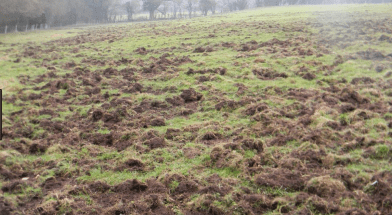
This was a pasture before the pigs got into it
Wild Pig Population On The Rise: Wild pigs are a huge problem. It’s estimated that there are 6 to 11 million wild pigs running around out there, and according to the National Feral Swine Damage Management Program they are responsible for up to $1.5 billion in damage every year.
They’re trying to get approval for a poison based on sodium nitrate called “Hoggone” which would apparently be placed out in the field in “a species-specific feeder”.
The problem with that kind of thing is, of course, that other animals other than that target species often consume the poison because these “species-specific feeders” often aren’t all that specific. Then there are problems with poison residue left in the carcass being consumed by predators and scavengers. And if you read the article tagged up there you’ll see that some of the experts don’t think poisoning is going to do all that much to cut down the size of the population.
Can you hunt them? Hell yes. You need to check the regulations in your own area for specifics, but most states strongly encourage hunters to take wild pigs, and have few restrictions and no bag limits, and no restrictions on size, gender, no specific season.
Can you eat ’em? Ah, well… Here’s where I get a bit nervous. A lot of DNRs encourage people to eat them. But that’s because they hope you’ll go out and shoot a lot of the buggers. I know people who wax poetic about the joys of eating wild pig. Me? I wouldn’t touch one. They carry a lot of diseases, many of which are infectious to humans and pretty nasty. A lot of them are infested with parasites… No, I wouldn’t eat one.
Cranberry Glut: We are growing way, waytoo many cranberries. We have so many cranberries already in storage that even if we’d lost the entire 2017 crop, we still would have had a surplus.
The Cranberry Marketing Committee is trying to get USDA to issue a marketing order that would require cranberry growers to produce 25% less cranberries than market demand.
The problem with cranberries is that except for the holiday season, there is really little demand for them. Despite efforts by marketing companies to boost demand, consumption of cranberries in any form has been shrinking. Cranberries, at least by themselves, just don’t taste very good. They are so sour and so bitter on their own that they are virtually inedible unless you add a huge amount of sugar to them, or use them only in very small quantities as a flavoring agent.
What The Heck Is Actually In That Stuff? You might like to think that manufacturers are required to list the ingredients in a product on the label, but there are all kinds of loopholes in labeling regulations that let them refuse to tell us what exactly is in the products we use. But California has passed new legislation that will lift the veil from at least one category of products, cleaning chemicals. When you see that term listed, it means that chemicals have been added to make the product smell nice. But what exactly is “fragrance”, or the ever popular “cleaning agents” that are listed on the labels? Turns out “fragrance” can contain one or more of thousands of different chemicals, some of which, it seems, are highly toxic, and even are known to be carcinogens. Some labels don’t tell you anything at all. This will will help a bit, but the law doesn’t really go far enough. It only covers cleaning products, for one thing.
Note: The article at Mother Jones that I’ve linked to here seems to be focused on fragrance for some reason, while the bill itself (yes, I’ve read the thing) does not seem to be restricted to chemicals added for fragrance alone. Fragrance is specifically mentioned in the bill, yes, but the bill seems to cover all chemicals in a product not just those used as fragrances.
A reader was going through some of my old posts and ran across something I’d written back in May when I’d run into an article over on AgWeb that claimed that there was a 70% chance that corn prices would be up in the $4.40 – $4.50 range by December. To be honest I’d completely forgotten about that item until Dustin reminded me when he left a comment reminding me of my skepticism about the claims back then. (See? I do read the comments!)
I was more than a bit irritated by the item at AgWeb at the time. The article presented absolutely no data to back this claim up. Just this “expert” from a brokerage firm trying to tell farmers corn was going to hit 4.40 – 4.50. And at the time that claim made no sense to me at all because I was seeing nothing in the markets or crop reports that indicated any kind of significant price increase. There was no decrease in the number of acres planted, there were no significant weather events going on, there was no increase in demand for product, and there was a huge amount of corn still in storage. What I was seeing was that corn prices were going to remain fairly flat, and quite possibly go through a serious drop as the 2017 harvest was completed
So, here it is, mid-November. What happened to corn prices? Well, corn, of course, never got above $4 of course. It briefly flirted with 3.80 – 3.90, but it didn’t stay there for long and quickly fell back to the 3.50 range, and as of this morning, it’s down to 3.43 after it hit a low of 3.40 when the WASDE report came out telling us that US corn stock was at it’s highest level since 1987. And heaven help any farmer who made any kind of financial plan based on the advice from that so-called expert.
Now if seeing advice this wildly wrong was a one time thing, it wouldn’t be so bad. Everyone makes mistakes. But I see this kind of thing over and over again in the ag press. Some “expert”, some pundit, some talking head, crawls out of the woodwork to make some wild and completely unsupported claim, and then disappears back into anonymity to never be heard from again. And the publication goes ahead and prints the item despite the fact there is no rational reason to believe anything the person says.
Over the last year or so I’ve seen articles in which “experts” made unsupported claims that milk would hit $19 (it’s around $16) by this time of the year, soybeans would hit $11 (about 9.80), and wheat would hit 7.50 (sitting at 4.31). And all those claims were presented by the publications without any facts or reasoning to back them up. Often some of these publications are printing material that completely contradicts what articles in the same publication are claiming.
The end result is that in many cases you don’t know who or what you can trust any more. You need to be very, very careful these days. Here’s a bit of advice.
First: Remember that these media companies are in business for one reason, and one reason only, to make money. Oh, they might have noble sounding statements appearing that claim they are out there to help you, etc., but, well, no. I’m sorry, but no, they aren’t there to help. The individual reporters, bloggers, etc. might feel that, but when it comes right down to it they are there to make a buck. Period. And that means they have to generate page hits to drive up advertising revenue. So almost all of these publications tend to lean towards click-bait headlines and stories to drive up page views as high as they can. Oh, they’ll deny that, but it’s true. A headline like “Corn Going Up 70%” is going to generate more hits than a headline that expresses what is actually in that story, like “Someone You Never Heard Of Makes Unsubstantiated Claims”, now doesn’t it?
Second: Remember that a lot of the “reporters” in these publication aren’t actually reporters. They are independent bloggers/writers who have no relationship to the publication itself except that they get paid some money if a piece of theirs is published. They aren’t employees of the publication. They’re freelancers who get paid by the piece. Even worse, often what they’re writing about is not something they’ve come up with on their own through their own work, it’s material they found somewhere else and re-wrote to avoid being charged with plagiarism. That sounds harsh, I know, but it’s also true.
The advent of the internet has resulted in a phenomena that a friend of mine rather crudely refers to as “circle-jerking”. Let me explain. One of these so-called reporters runs across an item that might make good clickbait. He does a quick and dirty rewrite to avoid plagiarism charges, and as his source, refers to the the original item he found. But if you go to that piece you find that it wasn’t the original. That writer too was a “circle jerker”, referring to yet another piece which, in turn, also wasn’t the original but another “jerker”. That site cites as it’s source yet another website which turns out to be another jerker, and…
Well, you get the idea.
Third: Once upon a time most magazines and newspapers had fact checkers. Almost every story, editorial, etc. was run through the fact checking department to make sure that what was in the item was actually true. Those days are long, long gone in most media companies. Some of the more reputable organizations still do it. Sort of. But the majority of them seem to have discarded fact checking as an unnecessary expense, it seems.
Fourth: Editors don’t actually edit anything any more. The job of an editor used to be making sure that the material that appeared in the publication adhered to basic standards of accuracy, that it was suitable for the intended audience, that it was not misleading, etc. And, alas, those days are long gone as well.
This kind of thing isn’t new, of course. It’s been going on for as long as we’ve had the printing press. It wasn’t invented by the internet. The term “yellow journalism”, which was coined to describe the kind of behavior I talk about here, goes back to the 1890s. Newspapers, especially those owned by Hearst and Pulitzer, are considered to have played a significant role in starting the Spanish-American war due to their irresponsible reporting. While their role in starting the war is exaggerated, there is no doubt that they helped to push public sentiment towards war.
There’s been a lot going on in the agriculture world so let’s take a look.
FDA May Remove Heart Healthy Labels on Soy Products: For years now some soy based products have been claiming that they are “heart healthy” based on a claim that using soy caused a reduction in cholesterol. But we’ve known since at least 2005 that consuming soy has little or no effect on reducing cholesterol. It looks like it only took FDA twelve years to figure that out and announce that it was going to make the 300 or so soy products that make that claim to stop using it.
Why the confusion over the issue? It’s suspected that the initial reduction in bad cholesterol that was shown wasn’t caused by soy, but by the participants in the study replacing red meat with soy products. It was the reduction in meat consumption that reduced the cholesterol, not the soy.
Food Waste and Bogus Statistics: Then I ran across this item over at AgWeb which tries to claim that there is virtually no food waste when it comes to eating meat. They claim that about 20% of fruit and vegetables get thrown away rather than eaten, but that only 3% of meat gets thrown out. Therefore, they claim, buying fruit and vegetables is far more harmful to the environment than meat production The article goes on to say that eating meat is “more satisfying” than the equivalent amount of vegetables or fruit, and that meat tastes better than plants and loading meat animals up with antibiotics is just fine and dandy because …
Oh, brother, I just can’t go on any more… She is basically claiming that because consumers throw out only about 3% of the meat they buy, meat is somehow enormously better for the environment than fruit and vegetable production, and that producing fruit and veg is actually harmful to the environment because people throw away some of it..
I’m not even going to try to follow the mental gymnastics that she goes through to try to come to that conclusion.
But I do notice one thing, that the article completely ignores the fact that almost half of a steer is inedible. Assuming you have a 1,000 lb. steer, only about 600 pounds or less is going to be useable meat. The rest; the head, innards, bones, skin, fat, etc. is inedible. Once you add in things that are trimmed off by the consumer after purchase like fat and small bones that are discarded, etc., you quickly discover that almost half of that steer can’t be used as food.
So in one way, yes, when you get that steak home you’re going to eat almost all of it. But that’s because all of the waste has been trimmed off long before you even see it in the grocery store.
Clovis Withdraws Nomination: Sam Clovis withdrew his name from consideration for a post at USDA as undersecretary for research. The job requires a thorough understanding of agriculture, scientific research methods, and basically was intended for someone who is, if not a scientist, at least someone with a thorough understanding of farming, agriculture, and science. So what were Clovis’ qualifications? Is he a scientist? No. Is he a farmer? No. Has he ever worked in any kind of business related to agriculture? No. He is a former talk radio host and a political science professor. Well, here is the man’s own words in response to questions from the Senate Agriculture, Nutrition and Forestry Committee’s top Democrat, Debbie Stabenow:
“Please list all graduate-level courses you have taken in natural science,” the second of 10 questions requested.
“None,” Clovis replied.
“Please list all membership and leadership roles you have held within any agricultural scientific, agricultural education, or agricultural economic organizations,” the third question read.
“None,” Clovis replied.
“Please describe any awards, designations, or academic recognition you have received specifically related to agricultural science,” the fourth question read.
“None,” Clovis replied.
Sigh…
Dicamba. Yes, Again: The apparently never ending saga about the herbicide dicamba continues. According to a report by the University of Missouri dicamba damaged 3.6 million acres of soybeans this past year. That’s a hell of a lot of beans.
The EPA has issued new labeling requirements that more strictly control how the dicamba herbicide blends from Monsanto, BASF and DuPont are used in an attempt to eliminate the problems, but the problem has been so wide spread that some states are considering issuing outright bans on the product. And a lot of people doubt that the new application restrictions and guidelines are going to do much to get a handle on the problem.
I think they’re playing with fire here. So far everyone has been focusing on the damage done to soybeans. Considering how easily this stuff seems to vaporize and drift long distances, it could very easily begin damaging large areas of ornamental plants, food crops, etc.
I’ve even been hearing conspiracy theories from some people. They’re claiming that the herbicide blends were deliberately made to drift like this to force farmers to plant Monsanto’s dicamba resistant soybeans whether they want to or not.
USDA Kills “Farmer Fair Practices Rules” (GIPSA):On Oct. 18 USDA announced it is totally dumping the FFPR, a set of rules that attempted to correct many of the abuses endured by “contract” farmers, farmers who don’t actually own the crop or animals they are growing. The famers own the land, the equipment, buildings, provide the labor, etc. but the product they are growing actually belongs to the company and is grown under a contract for a fixed price. Almost all of the chickens raised in the US are produced this way.
They may be “independent farmers”, because the big companies don’t own them, but they have only one client, and that client controls everything. They are essentially indentured servants with few if any rights. These companies are accused of price fixing, blacklisting farmers, canceling contracts on a whim, and engaging in retaliation against farmers who make waves.
The FFPR was intended to help give the famers a bit more control and flexibility to sue in cases of blatantly unfair practices.
I’m not going to get into this any deeper because it would take many, many pages to describe the whole situation. You can go do the research yourself if you’re interested. But as Chuck Grassley, a senator from Iowa said about killing the FFPR: “They’re just pandering to big corporations. They aren’t interested in the family farmer.”
Just What Is Organic Anyway? I don’t know about you, but when I think of the term “organic” the definition definitely does not include acres of green houses containing thousands of trays of robotically tended plants under grow lights being grown by soaking the roots in a chemical nutrient solution. In other words, hydroponics.
I haven’t done this in a while, so let’s see what’s going on out in the farming world.
Butter Tumbles In Europe: Wholesale butter prices have plummeted by almost 10% from September in the EU, and have dropped by 20% overall from the high point. The market for butter and butterfat was the only thing that was driving improved farmgate milk prices in the EU. There was a very modest reduction in milk production, but that quickly reversed as milk prices began to improve, and from what I’ve been seeing milk production is on the rise once again.
Butter prices in the US dropped a bit, but are still pretty strong, about 20% or so higher than they were a year ago.
I’ve been hearing the price on powdered skim milk in the EU has dropped precipitously because they can’t get rid of the stuff.
Basically it looks like a return to the old boom/bust cycle. As soon as prices start to get even a tiny bit better, dairy farms begin to ramp up production, glutting the market with product, and pushing the prices back down again.
Sargento Expansion: The company is expanding again locally. It’s adding another 40,000 sq. feet to it’s facility here in Hilbert after a major 70,000 sq. foot expansion just a year ago, and will be adding another 150 jobs here. Sargento is privately owned, employs about 2,000 people, and produces cheese, snacks, sauces and ingredients for the food industry. It had net sales of well over $1 billion last year. Starting wages for most jobs are going to be in the $18/hr range I’ve been told.
This situation has been going on ever since Monsanto and it’s partner in this, BASF, brought their dicamba blend herbicides to market to use with Monsanto’s dicamba resistant soybeans. Dicamba has always had a problem with volatility and drifting, meaning the product goes into vapor form very easily and can drift far beyond the point of application. These new formulations were supposed to cure that problem, but the problem with drift seems to still be a serious issue. Ever since these products came to market there have been reports of tens of thousands of acres of crops and ornamental plantings being killed or damaged by the herbicide.
Both companies have been blaming everything but their products for the problems. Arkansas banned Monsanto’s version of the herbicide and only BASF’s was permitted for use in the state, and the reported damage is so bad some states are thinking of banning the product completely. Monsanto is currently suing Arkansas over the ban. Monsanto is also criticizing scientists who are coming forward to point out problems with the product that date back to the first tests of the dicamba blends, and claim that the company’s testing of the product was seriously flawed and failed to point out the dangers of the herbicide.
Now BASF is claiming that the damage is because farmers have been using illegal forms of dicamba, and not it’s product at all. The company claims that it only sold about half the amount herbicide that would be needed to cover the acreage that was actually sprayed.
The whole thing is a complete mess, with lawsuits either in the works or already heading for the courts, lots of finger pointing, bizarre conspiracy theories, and even one murder attributed to the issue.
Not So Great Pumpkin Controversy: If you’re the FDA, a squash is a squash is a pumpkin. Its all pretty much the same. So that orangey brown gunk you dump out of that can to make your pumpkin pie isn’t really, well, pumpkin. Pumpkin is Cucurbita pepo while what you’re mostly getting in that can is Cucurbita maxima, a different variety of squash. The problem is that real pumpkin doesn’t really work very well for a lot of the things we eat, like pie.
Personally I can’t stand the stuff, the pumpkin pie fillings and all that. I love squash. There’s nothing better than a slow roasted butternut or acorn squash with a bit of, oh, apple baked with it, a little brown sugar, some butter, a touch of salt. It is amazingly good. But pumpkin? No thanks. I’ll pass on that pumpkin pie and head straight for the mincemeat. Although come to think of it mincemeat doesn’t really have meat in it either any more, does it?
And don’t get me started on the abomination that is “pumpkin spice”.
That’s it for now. Well, actually there’s probably more but I’m getting bored and MrsGF is making deep dish apple pie and I need to go peel apples.
As always, comments are welcome or you can email me at old.grouchyfarmer@gmail.com
They finally finished paving the street in front of the house the other day! We were very glad of that. The dust from the trucks rolling past over the unpaved sections was getting onto everything. We couldn’t open the windows on that side of the house. For a few days I couldn’t even get the Corvette out of the driveway because after they did the final grading there was a 5 inch drop at the end of the driveway that would have ripped the front splitter off the nose of the car.
We have an open front porch tucked into the side of the house which is a great place to sit and have a coffee and read on warm days, which is now covered in a thick layer of dust. I’m going to have to get out there with the car wash brush, a big bucket of soapy water and the hose and give it a good scrubbing. There’s so much dust you leave footprints when walking across the decking, the window sills are thick with the stuff, and even the poor plants out there should get hosed down.
Colder weather and rain have slowed things down as far as biking is concerned. I manage to get out most days still, but I know the time is coming when the bike is going to have to hang up in the garage and it’ll be back to the treadmill (ick). Still, when the weather does cooperate, it is absolutely beautiful out there in the countryside.
These crisp, cool autumn mornings are amazing. Now that it’s cooler there is less moisture and haze in the air, making everything seem more crisp and clear and brighter. There’s something about the quality of the light as well that changes because the sun is at a lower angle in the sky. The result is that on some mornings everything just seems to glow with this lush, rich, golden light that seems almost impossible to capture with the camera.
There is something magical, mystical about being out in the woods on mornings like this, at least for me. The sounds, the smells, the crystal clear air. Everything seems more — more alive, more vibrant. With the brilliant greens now fading into browns and reds and dull orange, the woods begins to transform itself in that endless cycle of life, dormancy, rebirth…
It becomes a place of wonder and takes on an almost spiritual quality. It makes you wish you were a poet because only a poet could adequately express what you are seeing in mere words.
But then time presses, and you have to leave and you know, hope, you will be back soon to feel that breathtaking beauty, the astonishing complexity of nature, that golden light…
Gads, after writing all that guff switching to this is going to be a jolt. Going from the beauty of nature to, well, to this… Yet another abandoned, collapsed barn. This one is just outside of town and it caved in about a month ago, and I decided to take a picture of it when I was out on the bike the other day.
It hurts when I see this happening, but it is happening more and more often. The whole countryside around here is dotted with abandoned barns in various states of collapse. I keep thinking of the pride, the hope, the joy the original farmers who put it up had as they watched the timber frame going up, the roof being put on, the side boards being nailed into place. A new home for their cattle, storage for the feed. The barn was the center of the farm, it’s heart.
But I know why it happens, why they are abandoned. Farming has changed drastically in the last few decades and these old barns are completely useless for modern farming. They’re the wrong size, the wrong shape, the wrong, well, wrong everything when it comes to modern farming.
And they are incredibly expensive to try to maintain as well, and even more ridiculously expensive if you want to restore one. The wood they are made of was once so abundant it wasn’t worth much. Even if you could find a 10X10 oak beam these days, you couldn’t afford it. And the long, wide, solid wood boards the siding is made from? You can’t afford those, either. So they don’t get repaired because of the huge cost, and there’s no incentive to repair them in the first place because they aren’t useful any more. So they sit, empty, the roofs leaking, timbers rotting, boards falling off, until, at last, this happens.
The big, red barns that dominated the countryside around here are, within another few decades, going to mostly be gone except for the few that are being maintained by people who can afford to do it.
It’s sad, but at the same time it is, I suppose, natural evolution at work. I still wince and shake my head when I see it happening, but I know why it is happening. So there is a feeling of deep nostalgia, but understanding and acceptance as well. Life moves on.
MADISON – United States Department of Agriculture (USDA) Secretary Sonny Perdue designated Calumet County and six surrounding counties as disaster areas due to crop losses from heavy rains in late June and early July. Calumet County lost more than 30 percent of its strawberry crop as a result of excessive rain and flooding that kept fields underwater and soils oversaturated for an extended time.
What the hell is going on here? Strawberries? Strawberries??
Calumet County doesn’t have a strawberry industry. Not really. Oh, there are a few “pick your own” places and home gardens, but other than that there are no large commercial strawberry growing places in Calumet County. I doubt if the entire strawberry crop in the county, including the pick your own, home gardens, etc., amounts to more than a few dozen acres total.
On the other hand, we lost our entire hay crop this year. The figures I’ve seen indicate the hay crop was a 90+% loss here and in neighboring Manitowoc County. Thousands of acres of hay were a total loss. Anyone who raises cattle is scrambling to find fodder for their animals. Corn that was supposed to go for grain is being chopped for fodder to feed cattle at a massive loss to the dairy farms around here.
But we’re getting the disaster declaration because of strawberries according to the governor’s office…
We’ve had some breathtakingly beautiful mornings here recently, and I took full advantage of it, getting out on the bike whenever I could.
We had some very odd weather here recently. Well, to be fair, the weather all spring and summer was a bit odd. The summer was remarkably cool and wet, and when fall finally hit, that’s when it seemed summer finally arrived. We had mid to late September temperatures well into the high 80s and flirting with the mid 90s here away from the lake. We ran the air conditioning more in late September than we did in July and August put together.
But then things started to get back closer to normal with daytime temps around 60, and night temps down in the low 40s, which makes for great biking weather.
I’m not sure what I’m going to do when the weather starts getting really cold and the snow flies and I can’t get out on the bike. Back to pounding the treadmill I guess. Ick.
Banging Your Head On The Table Dept: Windigo Fest
The city of Manitowoc, in its never ending quest to try to get someone, anyone, to come to town and spend some money, is putting on a Windigo Festival on Oct. 6-7. It looks like it could be a good time but I doubt if I’ll get over there because I have stuff on the schedule for both days.
But in a classic example of “why we can’t have nice things”, someone, of course, had to take offense at the town’s attempt to have some fun and drum up some business. Why? Because of, well, Satan apparently.
This person, who owns a very small and utterly insignificant shop in downtown where the festival is going to be held, has gone totally ballistic over this thing. Apparently the person harangued the city council for a considerable amount of time about how this festival was evil incarnate, was a satanic plot to corrupt the youth of the city, how it would lead to the evils of witchcraft and plunge the city into the corruption of sin, bring a host of demons down upon us, God would curse us and the Chicago Bears would beat the Packers…
Oh brother…
It gets worse. The “windigo” is, supposedly, a Native American monster of some sort that would run around and eat people. This person claims it is actually satan himself, and went on and on about satanic worship, demons, etc. for quite a while.
According to this person, pretty much everything about the fest is “satanic”.
The parade they’re going to have is running north to south down the street. That’s “satanic” because normally traffic runs from south to north. Exactly why having the parade route go in that direction is “satanic” is something I’m not really clear about. I mean I’ve read the Bible and I don’t really recall there being any verse that says “And lo, the City of Manitowoc shall route all traffic on Eighth Street from south to north, for routing traffic from north to south is the devil’s work”. And since 10th street two blocks over runs from north to south, does that mean 10th street is satanic and everyone who drives it worships the devil? They weren’t real clear about that one.
Even the dates of the festival are “satanic”. October 6 and 7? Yep, that’s satanic too, it seems. Six plus seven is thirteen, you see, and thirteen is the devil’s number.
The only reason I know about this is because the local paper decided to spend way, way too much time on this nonsense. And while I admit I found it mildly amusing, come on, really? This nonsense should have gotten exactly zero press coverage.
Anyway, if you go to the festival, make sure you say “hi” to Satan. He’s supposed to be hanging out over there. Haven’t seen him in a while. Last time I saw him was when he was in his guise as a state legislator and he sat down next to me at breakfast at a local restaurant.

 Let’s catch up with what’s been going on in agriculture.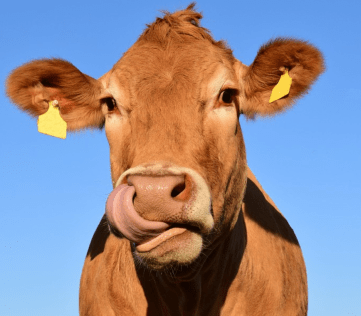
 Butter Tumbles In Europe:
  Sargento Expansion:
 Dicamba Battle Continues:

 Colder weather and rain have slowed things down as far as biking is concerned. I manage to get out most days still, but I know the time is coming when the bike is going to have to hang up in the garage and it’ll be back to the treadmill (ick). Still, when the weather does cooperate, it is absolutely beautiful out there in the countryside.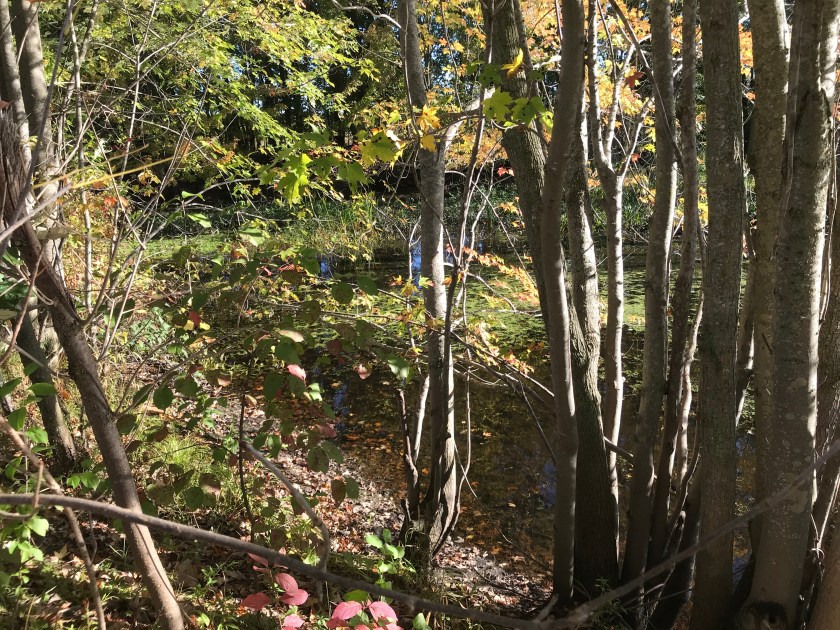

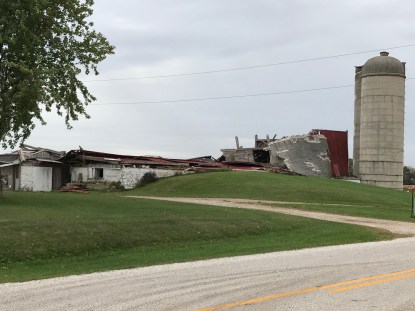 Gads, after writing all that guff switching to this is going to be a jolt. Going from the beauty of nature to, well, to this… Yet another abandoned, collapsed barn. This one is just outside of town and it caved in about a month ago, and I decided to take a picture of it when I was out on the bike the other day.
 The city of Manitowoc, in its never ending quest to try to get someone, anyone, to come to town and spend some money, is putting on a
  grouchyfarmer