People were starting to think that milk prices were beginning to stabilize, and that milk prices were finally starting to go up to the point where dairy farmers might not be under such financial stress from low prices.
But that might all have been little more than a house of cards. There were always a lot of problems with those hopes.
The first problem was that except for the New Zealand and Australian producers, milk production in the rest of the world had not really declined all that much, and in large parts of the world like North America, production had actually been increasing. While prices have been going up here in the US, that increase in milk price seems to have been due more to market stabilization and corrections than to anything else. There has been no significant increase in demand for dairy products to push prices up.
The second was that many seem to rely on prices at GDT as some kind of indicator of the overall health of the milk market. They shouldn’t. Global Dairy Trade is owned by Fonterra, the huge milk co-op in New Zealand. It markets it products mostly to Southeast Asia and China. And because it is owned by Fonterra, Fonterra can do whatever it likes with it. Fonterra has deliberately restricted or increased the amount of product flowing through GDT in order to manipulate the market prices in the past.
So relying on a sales organization that serves a rather narrow market, and which is wholly owned by a milk producer, and which has used that sales organization to manipulate market prices in the past… Well, do I really need to tell you that relying on sales figures at GDT as some kind of indicator of market conditions is really not a good thing to do?
Let’s talk about herbicides. It’s almost the time of year when we’ll start seeing the spraying equipment hitting the fields around here, so let’s talk about herbicides, one in particular called dicamba. And if you read the agriculture press, you’ll be seeing articles like this one that warn of the pitfalls of using this old-but-new-again herbicide: Caution Lights Ahead For Dicamba Use | Ag Professional. (And before you ask, yes, there are already dicamba resistant weeds out there and one experiment showed it took one type of weed only three generations to develop resistance to the herbicide. <read that article here>)
Now I should point out that dicamba has been around for a long time. It was developed back in the late 1950s and has been on the market ever since. It’s used to control broadleaf weeds and brush. What’s new about it is that Monsanto has developed a line of dicamba resistant crops such as soybeans which can tolerate the herbicide. With these crops being resistant to both glyphosate, the active ingredient in RoundUP, and dicamba, the hope is that this double dose of herbicide will help to control weeds that are resistant to glyphosate alone.
But there are, as always, problems.
The first of these is dicamba itself. It volatilizes easily, going into vapor, which then moves over large areas. It also is subject to drift while spraying. The droplets from the sprayers can drift over large areas as well. This combination of easy volatility and tendency to drift makes it troublesome to work with because it can spread over large areas, killing or damaging plants well outside of the area being treated. In order for dicamba to be used in the way Monsanto wanted, special blends and compounds had to be created to help prevent the easy volatility and drift of the product so it wouldn’t contaminate adjacent fields.
Monsanto decided to sell its Xtend seeds before the herbicide blend it was designed to work with was approved by the government. The result was that farmers who should have known better planted the seed, and then used dicamba blends that were not approved for use, and tens of thousands of acres (some estimates are in the hundreds of thousands of acres) of crops were damaged or killed by the drift from the herbicide. There are currently lawsuits going on against Monsanto claiming the company is responsible because it released the Xtend seed before the accompanying herbicide blend was available, and Monsanto should have known that some farmers would use dicamba illegally.
The new legal blend is now available, but even that isn’t going to solve the problem. There are a whole host of restrictions, requirements and warnings adorning the labels of the new herbicide. It can only be used with a particular type of sprayer nozzle, has to be applied no more than X inches above the weeds, has to be used at a certain point in the weeds’ life span, the wind can be no more than 10-15 MPH… The list goes on and on. All of the warnings and requirements indicate that this new “safer” blend isn’t all that much safer than the original form of dicamba was.
And in the long run dicamba is going to end up being just as useless in controlling weeds as glyphosate is becoming because as that article I linked to at the beginning points out, weeds will quickly become immune to it as well.
I keep wondering how much longer we can keep this up, concocting ever more toxic and complex blends of herbicides to try to control weeds, when we know that it is, at best, a temporary fix and that the weeds will eventually become immune to even that.
Meanwhile over in France the government has been trying to push things in the other direction, trying to get agriculture away from the ever increasing reliance on herbicides and pesticides. France <story here> has set a goal of cutting the use of pesticides of various types by 50% over the next ten years through the use of alternative methods of pest and weed control. How successful the program has been is a bit questionable, but studies have indicated that farms could significantly cut their use of pesticides and herbicides without a loss of income. But it would require some significant changes in farming practices.
Can we get away from this apparently never ending cycle of herbicide/pesticide resistance? We’re going to find out and in the not too distant future because the current situation simply cannot continue indefinitely.
So I ran across this little item over at AgWeb, the website of the Farm Journal: How Much Should You Pay for a Drone? – News | Agweb.com and it was a huge disappointment because it’s one of those so-called articles that just doesn’t really tell you anything about drones, what they can be used for, how they work, and gives you pretty much no information at all. So let’s take a look at drones, what you can do with them, how they work, look at the photographic and video capabilities of the different models, etc.
Oh, and there may even be video! Oooo! Well, there will be if I can figure out how to upload video to this thing. But let’s get on with this, shall we?
What are you going to do with the thing?– Well, that’s not my problem, now is it? I’m sure you’ve come up with some kind of excuse to give to your spouse to explain why you dropped $1,500 on a drone, and for all I know maybe you really are going to use it to scout crops or track down missing cows or inspect roofs or something like that and you aren’t at all going to use it to annoy the cats or race other drone owners or build 3D obstacle courses in the back 40. Let me give you a bit of advice, though. When it comes to just having fun, the smaller, less expensive drones are generally more fun to play with than the big ones. They’re faster, more maneuverable, and don’t do as much damage when you hit something with one. Also a lot cheaper to fix. You fly a $50 Walmart special into a tree it’s going to be a lot less financially painful than flying your $2,000 DJI camera drone into a silo or something. So if you’re just looking to play, start small and cheap.
(Oh, and if you are tempted to try to play with cats with one of these things, here’s a word of advice: DON’T. Just don’t. Seriously. Those props spin at hundreds and hundreds of RPM on even small drones. And while they don’t have a lot of mass, those props can slice, dice and otherwise do very nasty things to living tissue.)
That being said, they can be useful in agriculture and other serious applications. Agriculture because this is grouchyfarmer.com after all and I need to put some kind of farming reference in here, don’t I?
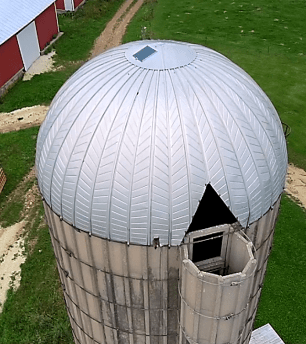
In case you were wondering, this is what the top of an old silo looks like
They are genuinely useful for inspecting roofs and a lot of roofing contractors are using them for that. They’re useful for scouting crops, finding trouble spots out in big fields. And they’re using them to try to find lost cows, and if you’ve ever had to try to find a heifer running around in a 40 acre corn field, you can understand why. They’re very useful for looking at the roofs of old silos as well. Exactly why you might want to look at the roof of an old silo is something you might wish to discuss with your therapist. But just in case you do, here’s one to get it out of your system. Ooo, exciting, isn’t it? And here you thought drones were just silly. I mean, just look at that! A silo! From above! Ooo!
Okay, now I’m just getting silly, aren’t I?
Money: So, how much is one of these puppies going to set you back? Well, it depends on what you want to do with it and how well you want to do it.
Now, if this editor put this photo in the right place, over there on the right is a Hubsan drone, one of the first video capable ones I bought, along with its controller on the left. It’s a nifty little gadget which streams video directly from the drone’s built in camera to a live video display built into the controller. It records video to a SD card that is inserted into the controller. Something like this goes in the $150 – $200 range, and it is about the bottom end of the scale for something that will give you some useful photo/video. Well, almost useful. Okay, be perfectly honest, it’s completely useless for anything serious.
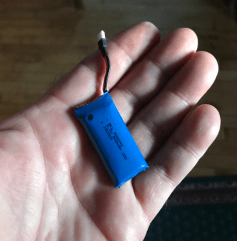
TIny battery means tiny flight time for a drone. Hubsan gets about 4-8 minutes.
Don’t get me wrong, it’s great fun to play with it, but it’s basically a toy that shouldn’t really be used except indoors. You can fly it outside, but if you do all bets are off. The range of the controller and video transmission is limited, just a couple of hundred feet at best, the video quality is, well, pretty miserable, to be honest, and flight time with the tiny batteries is about 4-6 minutes maximum. It’s also extremely unstable in even a light breeze.
Now if you’re flying around in the living room or kitchen taking photos of the dust on top of the cabinets, a 5 minute flight time is no big deal. But if you’re trying to fly around a 40 acre corn field, well, forget it.
If you’re going to do something serious with it like crop scouting, building inspection, etc. you’re going to be up in the $1,000+ range almost immediately. And even then you have to be careful, because what you see isn’t necessarily what you get. In order to keep costs down, a lot of these drones are “bare bones”, no camera, no camera mount, not even a controller. You’ll need to purchase a camera like the GoPro, and use an IOS or Android tablet or smartphone to actually operate the thing. So be careful. Before you buy one make sure you know what is actually in the box so you don’t find out the hard way that you need to drop another $500 or more just to get the thing in the air.
Video/Image Quality: Then there is the video quality on these itty bitty drones. It’s not exactly good, to be honest. Especially if you get them near the limit of their range. Let me give you an example.
The top image is a still from the video feed from the Hubsan drone. The bottom image is the same scene from approximately the same altitude and location but taken with my Yuneec drone. You may notice just a wee bit of difference between the two images if you examine them very closely.
Let’s see if I can figure out how to put video into this to give you a better example of the difference between the toys and the more professional versions.
The above is video from the Hubsan from about 150 – 200 feet in the air above my house. Oh, dear. This should have been well within the stated range of the controller, but obviously it was already at the limits of its communication range. If you can see through all of the static, you can also see the drone is bouncing around a lot, even though there was only a light breeze. It was almost impossible to keep under control and I barely avoided crashing the thing.
The video above is from about the same altitude and same location taken with the Yuneec, and under wind conditions that were actually worse than they were when the Hubsan was in the air. Again, as was the case with the still images, you may notice a bit of difference in the quality of the two videos if you examine them closely. Just a bit.
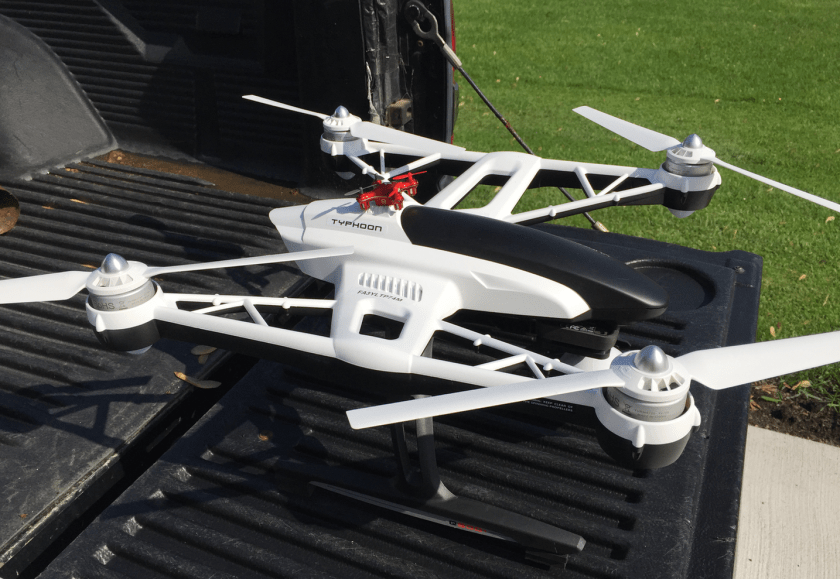
There is also a bit of a difference in size between the cheap drones and the Yuneec Typhoon I own, as you can see here.
That’s my Yuneec with a microdrone sitting on top of it to give you an example of the sizes of these things. The Hubsan that was used to take the still images and video is a bit bigger than the red microdrone shown here, but not by much.
Let me guess, you just came up with an idea to turn a big drone into a flying aircraft carrier for micro drones, didn’t you? Hey, go for it. Who am I to tell you not to do it?
Flying: Okay, so, how do you fly one of these things? Well, it turns out they are ridiculously easy to fly. They basically fly themselves. Especially the big ones. Built in gyros, motor controllers and onboard computers and GPS do all of the work for you. In fact, if it weren’t for all of that technology built into them, they’d be completely unflyable. The basic controls are generally a joystick for up, down, left, right, spin, that kind of thing.
The Yuneec, for example, will just hover wherever you put it. Park it over a specific spot 50 feet in the air, take your hands off the controls, and it will just stay there until the battery runs out, automatically maintaining it’s position and altitude. Even if a significant gust of wind comes along it will stabilize itself and return to its set position. There’s a panic switch. If you lose control of it, lose sight of it or something, press the button. It will go up to a height of 60 feet, return to it’s launch point, and land itself.
Well, if there’s nothing in the way, that is. This unit doesn’t have collision avoidance systems like some do so it can’t avoid obstacles.
The point is that just about anyone can fly one because they essentially fly themselves. The more sophisticated models allow you to plot out a flight plan on a map, and the drone will fly the route all by itself.
Still, you can get into trouble with the things. If the drone goes out of range of the controller, all bets are off. Some models will return to their launch point if they lose communications with their controllers, but a lot won’t.
Wind can be a real problem. The bigger ones are amazingly stable even in a good breeze, but I would not want to fly one if winds of more than 20 mph or so, especially anywhere near a structure or tree.
Regulations: Well, there are a lot of them. And there is still considerable confusion despite the FAA recently updating and clarifying things. If you’re just a hobbyist flying them for fun, you don’t need any special licensing or permits except for registering the drone with the FAA if it exceeds a certain size/weight category. The Hubsan shown above does not need to be registered. The Yuneec does because of it’s size and weight. If you’re flying for a business, you need a Remote Pilot Airman Certificate and have to pass a TSA background check. I won’t go into all of the rules and regulations. You can find them at the FAA’s website: https://www.faa.gov/uas/getting_started/ That will give you all of the information you need about how to stay legal.
So let’s wrap this up: Prices on these things are fluctuating all the time. You can get some real deals on even the better quality drones if you keep an eye out. I dropped about $1,500 on the Yuneec drone I’ve shown you here, but I’ve recently seen it going for under $700 because Yuneec is coming out with new and improved models. I don’t know what the used market is like, but I’m sure there is one. I’d be very cautious about buying a used one, however.
Recommendations: Ah, well, that gets a bit difficult. I’d like to recommend that if you’re interested in a camera drone you start with one of the cheap, small models before you drop a thousand bucks or more on one of the big ones. But it’s difficult to do that because they are entirely different beasts. The small, cheap drones are suitable only for flying indoors, are often twitchy to control. The slightest breeze can send them tumbling out of control. The cameras, if they have them at all, are virtually useless for any kind of decent photography or video. They are basically cheap, unstable toys. Don’t get me wrong, they are a lot of fun to play with, but that’s all they’re good for, play.
Drones like my Yuneec are much more stable, easier to fly outdoors, can handle wind better, feature gimbal mounted high def cameras that provide good video and still photos, but they are much, much more expensive than the $59.99 specials at Radio Shack or Amazon, or even the $180 Hubsan I have. So if you buy one and now decide it’s not something you want to do, well, now you’ve spent over a grand that you could have used to pay off your student loans or something, and you’re going to be mad at me because I recommended it.
Let’s say you’re thinking of doing actual serious work with it, like scouting hundreds of acres of corn or soybean fields. If you’re thinking of that kind of thing, well, even something like my Yuneec isn’t going to work all that well for you. Yes, it’s a damned good flying camera platform with a good, stable camera. But you only get about 20 minutes out of a battery so you’re going to need a lot of pre-charged batteries to scout any kind of significant acreage. You can’t pre-program a flight plan into it…
If you want to seriously do that kind of thing for a large far, you’re moving up into an entirely different and more sophisticated level of technology and, of course, an entirely different price range. For that kind of capability you’re getting out of the $1,000 – $1,500 range and getting into the $3,0000+ range and you might be better off getting one of the professional crop scouting services to come in and do it for you.
Addendum: I really need to point out that the claimed flight times for drones are often wildly optimistic. If the manufacturer claims you can get 30 minutes flight time from a fully charged battery, you can generally assume it’s going to be closer to 20 or even 15 minutes out in the real world.
The same is true for the claimed range of the controllers. As with battery life, the range of the controllers are estimates at best, and done under ideal conditions, not under the kinds of conditions you will find out in the real world.
Tumblr: Pulling the Plug At Last – I’ve had a blog over there for ages. I’ve put up with all of the nonsense they’ve pulled for far too long now. The company’s various attempts to make money off the service have done little except alienate the bloggers who made the service successful in the first place. Things have gotten much worse over the past year. Advertising is so invasive I can’t even read my dashboard without my ad blockers running full on. The service now seems to be in the process of being taken over by fake automated blogs that don’t have an actual person behind them. Most of these seem to be automated systems that “harvest”, so to speak, cute photos from Tumblr or other internet services, then offer them up on the blog, interspersed with dozens and dozens of fake posts that are links to advertising. The porn bots, the automated porn blogs that were “following” random blogs in the hopes of generating page hits were bad enough, but these new fake blogs are even worse. I’ve had about 50 new followers over there in the last couple of weeks and every single one of them has been one of these automated advertising systems.
I’ve had it with the whole mess over there. I’ll keep reading the blogs of people I follow over there, but I’m not going to be posting anything there any more.
Not sure what that means for this blog. You’ll probably see an increase in activity here. Maybe?
Amateur Radio Irritations Part One: “Contesting” or “Radio Sport” – The first time I heard someone use the term “radio sport” in amateur radio I almost fell over laughing. Until I realized they were serious. What they are trying to do is rebrand various contests as some kind of sport, and failing miserably. But I wanted to talk about contesting, didn’t I? So let’s get on with this.
Let me explain what contesting is in the amateur radio world for those of you who aren’t familiar with it. The basic idea is you have a limited amount of time, 48 hours, let us say, to contact as many other amateur radio operators as possible using a specific mode of operation; CW, SSB, digital, etc. The rules vary from one contest to another. Some are restricted to specific frequency allocations, some restricted to specific operators like the Rookie Roundup, etc. You get points for every contact, with some types of contact being points multipliers. And it’s just – well, it’s just silly. I’m sorry, but it just is.
The two print publications still catering to the amateur radio market, QST and CQ, make a Big Deal out of contesting. They claim it is wildly popular, fun, etc, etc, etc. And while it may be fun for those who enjoy that kind of thing, popular it is definitely not. One of the “big” contests was just reported on in the last QST magazine. They devoted four pages to the thing. How many participants did it actually have? About 4,500 if I remember right.
Now, there are something like three quarters of a million amateur radio operators in the US alone, so 4,500 participants world wide when there are around 750,000 operators in the US alone isn’t exactly popular by any stretch of the imagination. That’s a participation level of – what? About 0.006%?
Now don’t get me wrong. Contests are just fine and dandy if you get into that kind of thing. I can certainly see how someone might even enjoy it. But popular? I’m sorry, it just isn’t. When less than one percent of the total number of a particular group of people do an activity, it is not “popular” by any stretch of the imagination.
Amateur Radio Irritations Part Two: Own Worst Enemy – If you get on the amateur radio websites or read the letters in the magazines, there seems to be one question: Where the hell are all the new amateur radio licensees? We know they’re out there. People are getting licensed in droves. But you never hear any of them actually on the air. So where are they?
If my own experience is any indication, the biggest problem is that the amateur radio community isn’t exactly very welcoming to newcomers. I know there are many exceptions to this, but first impressions count, and when your first experiences are as difficult as mine were, well, you have to have a thick skin to deal with it.
Join a club, they tell you. Well, first of all, good luck even finding one. And if you do, chances are good you’ll have the same experience I did when I joined the Fox Valley club. I dutifully sent off my check, my email address, call sign, and all the other stuff they wanted, and heard — nothing. Absolutely nothing. Not even a confirmation they got the check. The only reason I know they got it was because it was cashed. No email reply, no information about membership, nothing. Meetings were scheduled when I was working so I couldn’t get to those. Emails to them asking about my status never got a response.
The local ARES group was more responsive and more helpful. But the only thing they care about is emergency communications, an area where amateur radio is increasingly irrelevant and unwelcome, only ARES hasn’t figured that out yet.
If you dare to get on the air, especially down on HF, watch out. The very first contact I made on 10 meters was to someone out in California who spent ten minutes telling me I was an idiot, I was doing everything wrong, that I didn’t know what the hell I was doing, all because I hadn’t been required to learn morse code. A few days later I was talking to someone down on 75 meters when someone jumped in and launched into a long rant about how people like me were ruining amateur radio, how I was an idiot, didn’t know a resistor from a capacitor, how all us new operators couldn’t repair a piece of equipment to save our lives and had to buy everything we used. We dropped down to a different frequency and let him rant. He was still at it twenty minutes later.
I’ve been told that most newcomers don’t run into that kind of nonsense, that amateur radio is generally very welcoming. I was probably just very unlucky, at the wrong place and the wrong time. Perhaps. But it only takes one or two unsavory encounters like that to make people wonder if they should be looking at a different hobby.
The Future – So, what’s going to happen here at grouchyfarmer now that my other blog on Tumblr is no more? I’m not really sure yet. There will probably be more activity here in the future. Other than that I don’t know. yet.
I’m a tinkerer. I love fiddling with stuff, playing with gadgets, and building my own stuff. I’m always scrounging around for interesting little gadgets, widgets and components to mess with. A while back I picked up a bunch of these LED lighting panels and I’ve been fiddling around with them and I like ’em so much I thought I’d tell you about them.
My office/radio shack is a bit of a black hole when it comes to lighting. The room doesn’t have ceiling lights so we make do with a floor lamp and some desk lamps, but I wanted some under-counter style lighting to make it easier to see the controls on my radios because it was impossible to put a desk lamp near them.
These are 12V LED lighting panels designed to replace dome lights in vehicles. They come in a wide variety of styles and sizes. This particular model comes with a fuse and adaptors to replace the incandescent lights in a car or truck dome light, but it was the LED I was interested in. They’re fairly cheap. I just looked ’em up and they’re going for $8 for a pack of two on Amazon and you might find them cheaper if you look. There are a lot of these out there from various manufacturers and distributors, with prices all over the place. Mine came from a company called Cutequeen Trading (yes, that’s the real name).
For the size they put out an amazing amount of bright, white light. One of them in the recess my TS-990 lives in was more than enough to light up the whole front of the rig plus most of the desk around it. They have a peel and stick adhesive back. Just peel off the protective paper, stick it up, hook up the wires to a 12V source and you’re good to go.
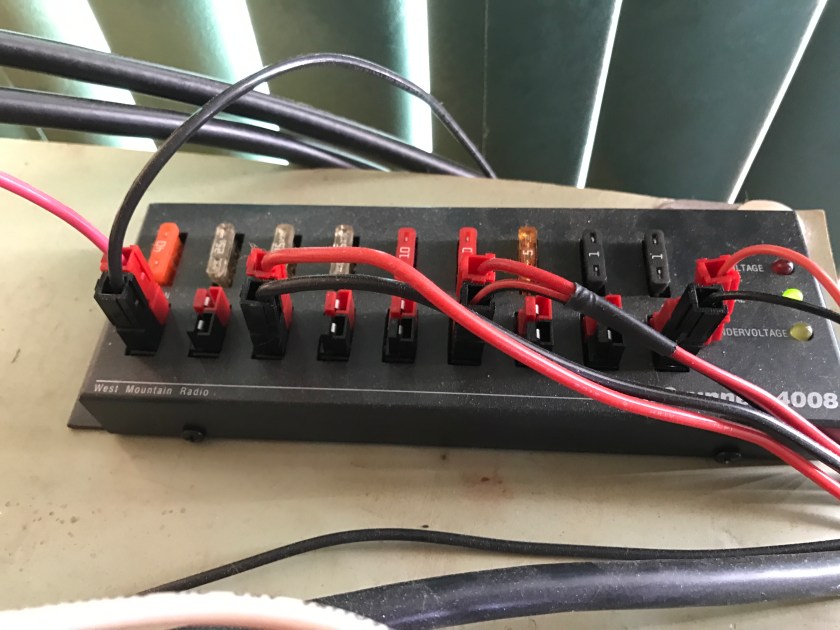
Where do you get 12V from? Well if you’re an amateur radio operator you probably already have a 12V power supply because a lot of amateur radio equipment runs on 12V. In my case I have a big 12V supply that feeds a distribution box with Anderson Power Pole connectors already in place to feed other equipment. I just wired up a plug to fit, added a toggle switch from my junk box to turn it on and off and was ready to go. They only draw about 0.4 amp so the power consumption is fairly modest for the amount of light they produce.
One gotcha was I found if I fed it directly, the thing got real hot real fast. Not to the point of burning my hand if I touched it, but painful. I ended up putting a small resistor in line to drop the voltage a bit (think it was a 480 ohm but not sure now and I’m too lazy to go dig into the wiring behind the desk to look). That kept it from getting hot without reducing the amount of light.
Another issue is that the point where the wired connect to the panel are a bit fragile and won’t tolerate a lot of movement. Avoid putting any stress at all at the point where they connect and they should be okay. I’ve heard from other people fiddling around with LED panels like this that this is a fairly common problem.
I could see these easily being used for interior lighting in an RV or enclosed trailer. It would be very easy to turn several of these into an under-counter lighting system in a house if you have a place to tuck a 12V power supply out of sight. Find a cheap, rechargable battery, some kind of box, mount a few of these on the box and you’d have a fairly inexpensive and pretty bright portable work light or flashlight.
If you’ve followed my blogs for any length of time you’ve probably heard me making disparaging remarks about the so called “Internet of Things”, this idea that one day everything will be networked to everything else, and oh, the fun we’ll have!
Your refrigerator will order your food when it gets low. Your cupboard will order food when you get low on staples. Your toilet will monitor your health and report the data to your doctor. Your bed will monitor your sleep habits. You can turn the lights on and off in your house with your phone. You’ll be able to control the heat and cooling in your home from your cell phone. Your counter top will nag you “Are you sure you really need that cookie? Hmm? Mr. Scale tells me you’ve put on a few pounds…”
Now if you are one of the people who think this is the best thing ever, I have a question for you: Have you actually stopped to think about any of this nonsense?
Let’s have a little chat about the IOT, shall we? Let’s start with this little tidbit:
Now, if you clickety click that link, you’ll find that the Bundeswhatever, a German regulatory agency, banned a children’s doll, declaring it to be little more than a concealed surveillance device because, well, because it pretty much is. Designed to interact with children, it uses an internet connection to monitor everything being said around it, sending it off to some server somewhere. It has little or no security, you don’t know where the information being gathered is being sent or what is being done with it. But you can be sure that someone, somewhere, is probably making money off it by selling the data.
And in case you think this is an isolated incident, it isn’t. Similar complaints have been made about an interactive Barbie doll. Security investigators found that it was a simple matter to use the doll to steal WiFi passwords, login information, files from computers linked to the home network… Fortunately the company that made the software was good about fixing the problems. But legally nothing is being done about what the company actually does with the data because here in the US our government’s policy is that privacy is a wonderful thing, but if someone can make money off violating your privacy so that money can to be used to buy politicians, well, where’s the harm in that, right?
Vizio was just fined $2.2 million for “smart” televisions that were spying on people. The company had installed tracking software in its televisions that tracked everything the owners watched, without telling the buyers of the sets it was doing it. There was a case a few years ago where an internet connected toy in the UK was serving up sexually explicit ads on the toy.
Now consider devices that are even smarter than that, that collect data about your eating habits, what you’re buying at the store, your physical health. There are dozens, hundreds of companies that would love to get their hands on that data to directly market things to you, that would benefit from knowing what your health is like, etc.
Even if the device isn’t actively spying on you, they can be troublesome. If we’ve learned anything about the Internet over the years it’s that it is not a safe place to play in. If a device can possibly be hacked, it will. If not for profit, than just for the sheer pleasure of vandalizing something.
You come home from work and find your garage door open and the garage cleaned out of anything of value because someone hacked your cell phone enabled garage door opener. Your house was emptied too because someone hacked your IOT enabled security system. Oh, and to make things even more fun, they hacked your heating controls and turned your furnace off in January and your house is frozen, the water pipes burst. And just to rub it in, your IOT enabled lights are flashing obscene messages in morse code.
I know this is getting a bit on the long side, but let me babble on here for a while longer before I wrap this up.
Now I readily admit that some of this technology is genuinely useful, especially for someone who is disabled or otherwise challenged. But a lot of it, even most of it, just isn’t. I don’t need to have an app on my cell phone to run my furnace. I have a device hanging on the wall that is connected to nothing but the furnace itself that does it for me. If I want to turn the AC on before I get home from work I can use a non-connected programmable timer that costs less and isn’t hackable.
The same is true of most of this stuff. I don’t need it, you don’t need it. Oh, it may be convenient, but is the convenience of being able to unlock your door with a cell phone worth the security risk? Not really.
It’s all marketing. Most of the convenience, security and safety issues being promoted by the developers of IOT technologies is illusory. The fake fears, the phony convenience, all standard marketing techniques to try to convince you that you really, really need this stuff.
If you can’t be bothered to follow the link to the Wikipedia entry on the case, here’s a run down. A school in Pennsylvania loaded the laptops of all of it’s students with spyware that was capable of monitoring everything the students did for “security” reasons.
Including surreptitiously turning on the cameras in the laptops and recording videos and still images of everything. Including the students in their own homes, in their own rooms, in their own beds. They found over 700 still images that had been captured of one single student, even of him in bed sleeping and changing clothes. And those images were given to other employees of the school district. Since the cameras were active in the bedrooms and homes of other children who had the computers, one can assume that videos and images of them changing clothes, in the nude, etc were also captured. The school turned out to be doing this not just to students, but to teachers as well.
So let’s talk amateur radio for a while. Especially about stuff. As in where the hell did all this stuff come from, anyway?
I semi-retired a year or two ago. I generally have my summers off and only work for special events in the theater, fill in if someone calls in sick, deal with emergencies and things like that. Which means I should have lots and lots of spare time to fiddle with radios and stuff like that, right?
Yeah, right…
This morning was the first time in probably a month or more than I had all the equipment
Damn, that’s a terrible picture
turned on and actually used it. Much to my surprise it actually all worked. I didn’t have anything start on fire, no smoke, no cats came leaping out from under the desk with all their fur standing on end. I didn’t even have to resort to strong language. Amazing.
I finally put a decent cable on the iambic paddle to replace the cobbled together POS I’d thrown together so I could test it when I first got it.
Then I remembered I don’t do CW in the first place. So how in the world did I end up with not one but two Vibroplex CW keys?
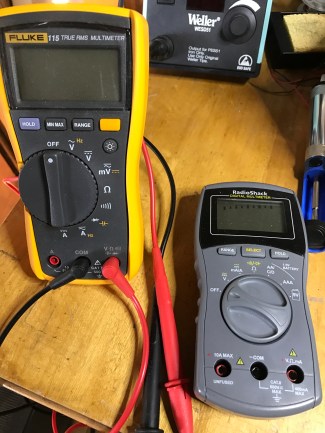
It’s like a lot of other stuff I’ve accumulated over the years. I just — just have it for some reason. There’s a 500 foot long spool of LMR-400 coax sitting in the basement. I just ran across a bag of 50 very good quality PL-259 connectors in a drawer the other day. Right after I’d just bought a bag of 25 of them because I needed one and didn’t think I had any. Under that bag was a VOM I don’t remember ever buying. Which is okay. Can’t have too many VOMs, right? Maybe? I mean, everybody needs six or seven volt ohm meters, right?
Eldest son stayed over night a couple of weeks ago and found a new, never used GAP Titan vertical antenna in the box under the bed in the spare room upstairs. Oh, that’s right, I picked that up about three years ago and never got around to putting it up because it was easier to just string up a dipole. Then I stumbled over a DX-Engineering vertical with the complete mounting kit and all the accessories down in the basement. All still in the boxes. Which I bought because I forgot I had the GAP antenna sitting upstairs.
Where did all this stuff come from? How did I end up with two HF amplifiers? Suppose I could sell one of them, but how the hell do you ship a delicate, 100 pound amplifier full of vacuum tubes and a power supply as big as my head?
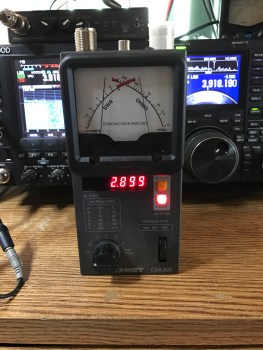
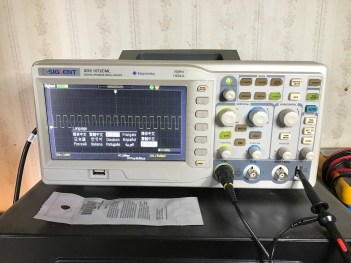
Some of the stuff I do need. The big dummy load I use for testing, the big antenna tuner. The oscilloscope comes in damned handy sometimes.
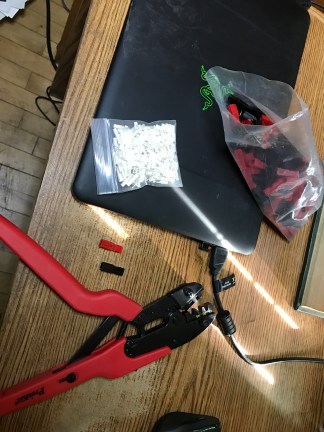
But how did I end up with 200 Anderson Power Pole connectors?
I’m convinced people are breaking into the house late at night and instead of stealing stuff, they’re shoveling more stuff in here.
Granted, some of the stuff is genuinely useful. I picked up some LED light panels intended to replace the dome lights in cars. Got those for about $2 each and they’re great for undercounter lighting. Especially if you already have 12V power supplies running to power other equipment like I do here.
But what in the world am I going to do with all those relays I salvaged from the old boiler controllers when we installed the new heating system at work?
And where in the world did that bloody great IBM mainframe tape drive come from? Okay, so it’s really neat to watch it thread the tape through itself using puffs of air to guide the tape, but come on… I suspect eldest son snuck that into the basement when I wasn’t looking. He’s even worse than I am when it comes to snagging stuff like that.
I was looking for the cable cutter the other day, opened the drawer, and there were six laser tubes rolling around along with front surfaced mirrors and other associated stuff. Found my weight set that I used when I serviced, tested and certified scales. Don’t know why I have that either. Get rid of it? Well, what if I ever need to test a scale, hmm?
I need to get rid of some of this — this stuff.
But not my collection of M&M dispensers. No sir… And I really do need six volt ohm meters. And I’d like to hang onto that extra transceiver just in case. And, well, you never know, maybe I’ll actually use that whole drawer full of PL-259 connectors. And the laser tubes…
Farmers in 10 states can join a possible class action lawsuit against Monsanto over the illegal use of dicamba that damaged their crops because of tine introduction of the company’s Xtend line of GM crops that are immune to the herbicide. AgWeb has a story about it here if you want to take a peek.
The situation is a bit complicated so let me explain what’s going on.
A lot of weeds are becoming resistant to RoundUp and its generic equivalents. Dicamba is an herbicide that has been in use for quite a while already to fight broadleaf weeds, but it wasn’t used in this type of application because it was also toxic to the crops until Monsanto came out with it’s Xtend line which is resistant to it as well as glyphosate, the active ingredient in RoundUp. Monsanto’s plan was to market Xtend seeds along with a new herbicide that blended dicamba with glyphosate in order to deal with weeds that were resistant to glyphosate alone.
The problem comes in because Monsanto started selling the Xtend seed before the new herbicide blend was approved for use by the government.
This is an important point. Dicamba is nasty stuff to work with. It vaporizes very easily while it is being applied, and the vapors can drift for long distances even on a relatively calm day, killing or damaging plants in fields far beyond the field being sprayed. The new herbicide blend contained dicamba in a form that was not as volatile and was safer to use as long as it was applied correctly with the right equipment. The new blend would help to prevent the herbicide drifting.
Even though the new herbicide wasn’t available, Monsanto started selling Xtend seed anyway. And you can see what’s coming, can’t you?
That’s right; now that they had a dicamba resistant seed, some growers drenched their fields with regular dicamba, ignored the application warnings and restrictions, and ended up with herbicide drifting all over the place causing damage to crops in the adjacent fields of other farmers. I’ve heard estimates that the amount of damage caused by drift is as high as 200,000 acres.
Oh, at least one murder that I know of. Yeah. Seriously. They actually shot someone over herbicide drift.
So, as the headline asks, whose fault is it?
The suit claims it’s Monsanto’s fault. They should not have released the new seeds into the market until the new herbicide designed to go with it was ready to go as well. They should have known that some growers would abuse the system and use dicamba herbicides off-label and illegally as soon as they had their hot little hands on the new seeds.
Monsanto says wait just a minute, we didn’t spray the stuff. We warned them not to, and to wait until the new herbicide was ready to go. It’s their fault, not ours.
The other side counters that any rational person should have realized that if the seed was put on sale without the herbicide some growers would use the unapproved and dangerous form of the herbicide…
And so it goes around, and around, and around. This will probably be lurching through the court system for years…
So what is the answer to that question up there? Whose fault is it?
This is one of those situations where I think both sides have a valid point. As Monsanto claims, it did not do the spraying. It’s recommendations for use indicated that Xtend seeds were to be used only with approved herbicides and approved application techniques. Once it sold the seed, it has no control over what the growers do afterwards.
On the other hand, why put seed up for sale where the primary benefit of using it is to enable the use of a herbicide that was not yet legal to use? Monsanto knew there was no reason to buy the new seed unless the growers were going to make use of the seeds capability of withstanding dicamba…
What do I think about all of this? My issues with the whole thing are at a more fundamental level. I think we’ve become locked into methods of food production that are basically unsustainable over the long haul.
And we know that. We know that eventually herbicides are going to fail. They just are. We can’t keep up this endless cycle of having to develop new and ever more toxic herbicides as the old ones fail. It’s the same with insect control. The insect population eventually becomes resistant, and we have to start all over again. BT corn is a good example of this as the insects that are controlled by BT become resistant and begin to spread, and within a few more years we are going to have a root worm problem that was just as bad, if not worse, than it was before BT corn was introduced.
Side Note: I’m going to start trying to move away from talking about agriculture so much in the future. I’m not involved in the business any more, sold the farm a couple of years ago, so why do I still go babbling on and on and on about it when there are other things I’m interested in?
But then I’ve told myself that before and I keep coming back to it for some reason. Oh, well.
I’m going to try to push this onto other things I’m interested in; amateur radio and electronics, amateur astronomy, building furniture and fiddling with wood, photography…
This was never intended to be focused on a single topic in the first place, so I’m going to try to get back to that.
So, let’s talk farming. I ran into this article about weed control over at Agweb and it’s actually pretty good so go take a peek at it if you have the time.
Now, the reason this article has popped up (and I’m sure you will see others in the ag press similar to this in the future) is that there are a few new GM crops coming on-line now, modified to work with a couple of new blends of herbicides in an effort to deal with increasing weed resistance to glycophase. The herbicides aren’t really new, though. They are simply blends of previously existing herbicides with glycophase. They incorporate either 2,4-D or dicamba, both of which have been around for decades already. The only thing new about the system is the GM crops that have been engineered to tolerate 2,4-D and/or dicamba.
And they aren’t going to work any better than glycophase alone did. At least not in the long run. Sooner or later weeds will eventually develop resistance to these new blends as well, and we’ll be right back where we are now. In fact, there is already resistance to both of those herbicides “out in the wild” so to speak, because both have been in use for some time.
We have allowed ourselves to become dependent upon a system of weed control that we know is eventually going to fail. So, if we already know that these reformulated mixes are going to eventually fail, why are we bothering with them at at all?
Part of the reason this isn’t going to change any time soon is that over the last few decades we have adopted almost across the board farming techniques that make it difficult, if not impossible, for us to change.
How did we do it in the “good old days”? Well, like this:
Oliver 70 with cultivator attachment
Now, if this text editor has managed to put the image in the right place, that is an old Oliver 70 with it’s optional corn cultivator rig. I used to drive one of those when I was a kid. For hours. And hours. And hours. And hours. And hours. And.. Well, you get the idea.
It was boring, tedious, took huge amounts of time, huge amounts of fuel. And with how expensive fuel is these days, how expensive labor is, if you can even find labor, how time consuming it is… Well, it isn’t surprising that the agricultural industry has always been looking for something, anything, to try to eliminate weeds that doesn’t involve so much time, labor and expense.
But some alternative to this never ending cycle of herbicide failures is going to have to be found. We’re running out of options. No matter what kind of chemical intervention we may come up with, sooner or later nature will figure out a loophole to work around it because that’s just how nature works.
I wish I could tell you that there is a solution to this, but there isn’t. People are experimenting, yes. But so far all of the efforts I’ve seen in trying to get out of this dependency on herbicides have involved techniques that simply can’t be scaled up. I’ve seen flame throwers to burn weeds, steamers to steam weeds, “cookers” that scoop up soil and literally cook it to kill weed seeds… All of them are tedious, time consuming, and worst of all, very energy hungry.
There are some new robotics and AI technologies that are looking promising. I suspect that may be one possible solution; machines that do the cultivation for you using cameras, LIDAR, GPS to guide them. Even systems that can identify weeds by sight and mechanically remove them, leaving the desired plants alone.
But those are years away, maybe decades. But who knows? Maybe there is some kind of “magic bullet” out there. Ah, well, no, there isn’t, but we keep looking for one, don’t we?
Please have patience with me while I talk about agriculture and property taxes for a moment so I can explain why this is important for farmers and environmentalists. Talking about things like taxes and government policies tends to make my eyes glaze over and I find myself with a sudden desire to take a long nap. But if you aren’t a farmer you may not know why this move by Nebraska is important for farmers. Wisconsin already did something like this years ago, and I think it’s the right thing to do.
Property taxes are based on the value of your property, of course. If your house, for example, is valued at, oh, $100,000, you pay property taxes based on that value. If it’s valued at $200,000, your property taxes are going to be significantly higher.
It’s the same with farmland. Under law here in Wisconsin the property is supposed to be assessed for purposes of property taxes at fair market value. (That law had to be instituted because some local jurisdictions were playing fast and loose with property evaluations in order to jack up the tax money they were getting. Before that law was put in place, I knew one poor bugger who had a mobile home that was worth about $10,000 get a tax assessment for $64,000. Seriously. I saw the documents myself.)
The question now is what exactly is “fair market value”? Is it the value of the property as it currently exists, what it is being used for at the moment, or the potential value of the property if it were sold for some other purpose.
That distinction is important, because what was happening in Wisconsin and a lot of other states is that local jurisdictions were assessing property not at it the value of the property as it currently existed, but what the property could be worth if it were sold for some other purpose.
The result was that if you had a farm on the outskirts of a town or city, you were pretty much screwed. Local governments were assessing the farms not on their value as farms, but their value as if they were commercial or residential property.
To illustrate what I mean, let’s look at an example. Farmland in this area is currently going for around – well, let’s round it off to $7,000 an acre to keep the math simple. So if you have a small, 100 acre farm, it’s worth about $700,000.
Meanwhile, land being used for, oh, let’s say a fairly upscale housing development in a nearby town, is going for about $20,000 per 1/4 acre lot, or about $80,000 an acre. Over time the town grows, and now you find that your farm is on the outskirts of the town. And as a result of that, the local government is now assessing your farm not for what it is worth as a farm, but for what it would be worth if it were sold for a housing development. You are now being forced to pay property taxes not on a farm worth $700,000, but property worth $8 million. Your property taxes just went up more than ten times what they’d been before.
While that’s a bit extreme, it isn’t exaggerated by much. I knew farmers who were seeing their property tax bills shooting up into the astronomical range because the jurisdiction they were in decided to evaluate their property not for what it was, but for what it could be. Their taxes were going up five, eight times what they’d been before when their property was evaluated at commercial or residential rates rather than agricultural.
There was some very heated debates over this, of course. The towns (and the developers) claiming that the new value was fair because that was what the property was actually worth if it were sold off to some developer, and the farmers on the other side saying no it isn’t because that’s not what it’s being used for… It was nasty.
I don’t think anyone ever actually proved that the governmental jurisdictions, seeking ever more tax money, along with developers smelling profits, abused the system by ratcheting up the taxes on farms specifically to force farmers to sell at bargain basement prices to a developer, but it was pretty much an open secret that this was exactly what was going on. At the time the laws curbing this were under consideration dozens of farmers appeared before the legislature claiming that this was exactly what was going on. Developers would find a nice farm in a good location near a town, smell the heady scent of money, convince the local government that it would be to it’s advantage to annex the farm into the town, evaluate the farm as commercial or residential property rather than farmland, and the farmer would be forced to sell at cut throat prices to the developer or go bankrupt from the taxes… It was nasty.
And for those concerned with urban sprawl it was nasty as well. This kind of thing was driving the construction of huge housing developments on the outskirts of cities and towns with McMansions sitting on quarter acre “estates”, endless cookie cutter boxes, hastily constructed, looking exactly alike…
Wisconsin did finally change the property assessment laws, but local jurisdictions and developers are still griping about it and occasionally manage to bribe convince some legislator to try to introduce a measure to “reform” the system, turn back the clock and let local jurisdictions snap up all that yummy, yummy tax money by assessing farmland at utterly absurd valuations.
The change didn’t halt urban sprawl, but it did help to slow it down a tiny bit. Maybe. Depends on who you talk to, really. Certainly it helped a lot of farmers whose property is adjacent to towns and cities.