I read this item over at Agweb twice and I still don’t understand why she thinks there’s a 70% chance corn could go over $4.40. She doesn’t give any data to actually back up that statement in the article. I hate items like this where some “expert” comes along and makes a specific statement, and then the report doesn’t give any reason why.
As of right now I don’t see any indication corn is going to go that high barring some kind of significant weather event or similar wide spread problem. We have massive amounts of corn still in storage from last year’s harvest, planned corn plantings for this year are down only slightly from last year… There basically is no pressure at all on the market to move the price up significantly.
At the moment, China has drastically cut back imports of corn to try to draw down it’s own stocks, and has increased production. There seems to be no increased demand for US corn anywhere, really. Ethanol production is relatively flat, we have grain storage facilities full to bursting with last year’s crop, weather has been relatively good… There doesn’t seem to be any reason for corn to go up almost $1 a bushel over the next few months. So why does she think it’s going to go up? Don’t know.
Well, the politicians have gotten involved in the dispute with Canada over their change to their milk import policies, and as you might expect, there has been a lot of muttering, tut-tutting, bloviating and ranting, with absolutely nothing being done about anything. The president got involved, appearing in Wisconsin briefly where he said many, many things to try to make it sound like he was going to do something, and as soon as he got out of the state and safely back in DC, the Whitehouse immediately disavowed everything he said, blunted or even eliminated entirely the vague threats, and we aren’t going to do this or that, but oh, even though the dispute is about milk we’re going to put a tariff on Canadian wood…. Wood? Really? Oh, well…
The state’s ag secretary is apparently actually doing his job, trying to help the dairy farms that are being dumped by Grassland. But in the long run there isn’t a heck of a lot that can be done at the state level. Fortunately it seems like most of the farmers effected by this have now found other markets for their milk, but the situation is still very concerning, and I expect things will get worse before they get better.
Blaming Canada for this, as many are doing, is silly. These new rules should not have blind sided anyone. From what I’ve been reading, the rules have been in the works for at least a full year, if not longer. Back in November already we were seeing stories popping up about the change in rules and warnings of how it would effect the markets here. So the processor’s claim that they were blindsided by this is a bit disingenuous. If their management didn’t see this coming, they really should be in a different business.
The real problem is the dairy industry itself and the politicians who keep fiddling with it, not any specific country. And the problem is world wide, not limited to the US or Canada. The problem is that dairy farms are producing way, way too much milk. More than the market can absorb. And instead of trying to deal with the situation, the reaction of the whole industry is to try desperately to come up with some kind of market for the stuff, any way they can, even if it destabilizes some other country’s farming industry. Pressuring politicians to institute still more ways to artificially prop up prices.
Canada has done something no other country has, it has actually been trying to deal with the problem of oversupply. It has a fairly strict quota system on milk production to try to keep the market stable. But in order to make it work, they have to restrict imports of dairy products from outside of Canada or the whole system would fall apart as the country is flooded with cheap imports. (The EU tried a quota system but abandoned it a year or two ago)
Is this protectionism? Of course it is. But you have a choice: Do you protect your businesses at home, giving them a level playing field to work with, restrict production so the farms can be relatively profitable, or do you open up your markets to cheap imports, often cheap because of government subsidies, tax breaks and other things that make it cheaper for them to produce the product than you can?
Then the politicians get involved… Price supports, tax breaks, grants, subsidies, government agencies buying up surplus product to artificially prop up prices, mandates that you have to use certain products (Wisconsin still has laws that force restaurants and food service operations to serve butter, for example), the list goes on and on. The end result is that anyone who thinks there is a “free market” for dairy products is living in a dream world.
What’s the solution to the problem? I really don’t know. My father used to say that the system was so screwed up that the whole thing should be scrapped. All of it. Make it a true free market. No government subsidies, no tax breaks, no marketing boards. Leave the health and safety regulations, testing, etc. But get rid of everything else. Turn it into a real free market that has to respond to normal supply and demand rather than a government supported mess where farms are propped up by various programs and price manipulations that encourage overproduction.
Would it help? I don’t know. But it seems to be about the only thing we haven’t tried yet. It’s obvious that all of the quota systems, price supports, surplus buys and everything else isn’t doing any good.
This construction site is on one of the routes I take when I walk the town in the afternoons when the weather permits and I’ve been watching it with some interest. It may not look like it, but this is a major recycling project. The photo doesn’t do those two houses justice because it was a rainy, dreary day and I was using the cell phone, but those two little houses are actually really quite nice, with new brick facades on the living quarters and a matching stone facade around the garages. Once they get the landscaping done they’re going to be really very nice.
This is actually a very ambitious and rather complex project, because those two houses were actually a single duplex that was moved to that site from another location. The duplex was literally cut in half, separated into two individual houses and garages. While it sat there on the big dollies that were used to transport it, they dug basements, poured foundations, then mounted them on the foundations, then gutted both of them, completely remodeled both, put on new roofs and gutters, did the brick and stone facades, did new heating systems, electrical and plumbing, basically completely rebuilt both of them.
So they took an unwanted old building, moved it to a new location, and turned them into two nice little houses that in the near future will be the pride and joy of their new owners.
It seems like a great idea, doesn’t it? It’s the ultimate in recycling. Instead of tearing down an old house, move it to a new location, remodel it, turn it into a desirable property. So if it seems to make sense to do this, why isn’t it done more often?
Cost, of course. I’d be willing to bet that the total cost of this project is going to be darn near as much as it would have been if they’d built both of those from scratch. Maybe even more.
Back in, oh, the late 1970s or early 1980s, a friend of ours bought a big old farm house. Big, sturdy, very well made. Bought it for $1. Seriously, one dollar.
The catch? He had to move it. In the end that $1 house cost him more than $40,000. And this was at a time when you could get one hell of a nice house for around $35,000. Heck, I could have bought an 80 acre farm with a small house and barn for $18,000 at the time. Wasn’t much of a farm, true, but still, $18K? The owner of a restaurant I’d used to work at in the early 1970s offered to sell me the restaurant, including fixtures, stock, inventory, equipment, etc, for $15,000. (Aside: The place is no longer there, but another restaurant about the same size, just a couple of blocks away, is now on the market for $169,000. So it goes.)
So If you ever wonder why they don’t do this more often, the reason why is the cost. Moving buildings is very expensive, very complicated (just think of the logistics involved in moving/lifting power lines, etc.) and very tedious. And once you do get them on site, they need extensive renovations, updating, etc.
MrsGF works with the state’s various food service operations, including monitoring food purchases, and she tells me that the state’s prime food vendor has put out a warning that it may not be able to fulfill orders for lettuce because of adverse weather in California. Those poor buggers out in California — first a years long drought, then they get so deluged with rain that they can’t get their crops planted on time… They just can’t seem to get a break. She’s put out warnings to the state’s food service operations that they’re going to need to change menus, switch to different types of greens, etc. until the situation is resolved. Kale and cabbage haven’t been hit quite as hard, but they’re seeing some serious shortages for various types of lettuce. Apparently it’s hitting the consumer market hard as well and prices are going up fast at the retail level. The Chicago Trib had a story about it just the other day here. (warning: may be paywalled) I was just at the local grocery store this morning and noticed iceberg lettuce is now around $2.50 a head, a dollar a head more than what it was what it was a couple of weeks ago, and they’ve put a limit of 2 heads per customer on purchases. Romain lettuce has also shot up in price. Pre-cut salad mixes containing lettuce have also gone up in price.
If you’re really desperate for leafy greens, fresh spinach looks like a bargain, going for about one third of the cost of lettuce at our local store. It also tastes better and is significantly better nutritionally than iceberg lettuce.
Over Supply
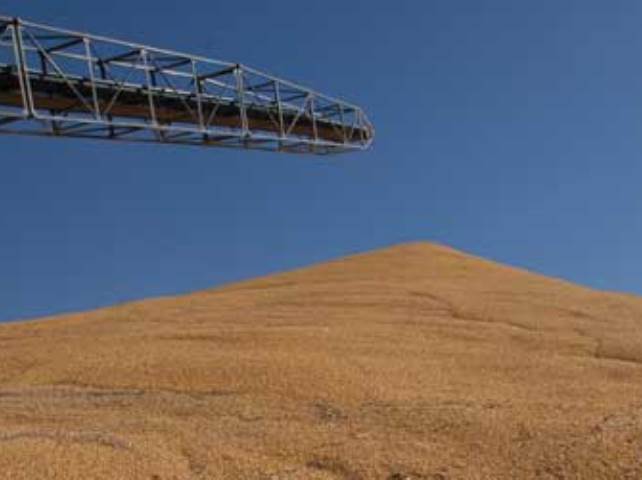
The biggest problem with agriculture right now seems to be over supply. There’s just too much corn, soybeans and milk being produced. Here in the US I’ve heard of co-ops, large farmers and grain dealers renting abandoned airport runways to pile up corn because they don’t have anyplace to put the stuff. Corn prices on the futures market are sitting at around 3.63 right now, and haven’t moved more than twenty cents up or down for months. And with the US looking at a seriously huge corn harvest in 2017, barring some kind of disaster, about the only direction that price is going to go is down.
Low soybean prices have made farmers in Brazil hang on to their crop, storing it rather than selling it in the hopes of higher prices. But now the corn harvest is going to start in June, and with the bins full of beans, there’s no place to store the corn. The Ukraine is predicting a huge increase in corn production to further destabilize things.
And as for the milk market, oh brother… The market is so glutted right now, especially in the US, that they don’t know what to do with the stuff. I’ve heard of processors pouring milk down the drain because they can’t deal with all of it.
The ag industry is going to have to get a grip on the problems with over production or the whole system is going to come crashing down around our ears.
This is just another indication that we really need change the way we deal with weed problems. We can’t just keep trying to come up with ever more toxic chemicals to kill off weeds and GM modified crops. That scheme will always result in weeds eventually developing resistance to the herbicides and the cycle starting all over again.
Climate Change
It’s interesting to note that while we have an administration that continues to deny climate change, everyone else seems to have just accepted it and is trying to deal with it. Even Wal-Mart, which isn’t exactly known as a bastion of liberal policies, is trying to deal with the situation and is putting pressure on its suppliers to do likewise. While the politicians bluster and bluff and bloviate and grasp at straws to try placate whoever writes them the biggest check that week, out in the real world a lot of major companies have realized that if anything positive is going to get done, they’re going to have to do it themselves. Even some of the oil companies have started to admit that something has to be done.
GIPSA Rules Delayed
I don’t blame you in the slightest if you don’t know what the GIPSA rules are. If you raise poultry or pigs for one of the big meat packers, you know all about this and are quite possibly pulling your hair out. But almost no one outside of the business does.
The rules were intended to protect farmers who contract to raise meat animals for a meat packing company from abusive and discriminatory practices. “because the processors own the birds, the feed, and other inputs, they can unfairly disadvantage or preference one grower over another as a way of forcing the growers to do things against their will or shut down dissent.” is how critics put the behavior of the processing companies in one article. The basic idea is that the rules would have given farmers who raise animals on a contract basis some minimal rights without having to jump through a lot of hurdles that are basically impossible to jump. The rules were changed by court interpretations about ten years ago so farmers now have to prove that a company’s actions harmed not just them, but the entire market, before they can try to take any kind of legal action against the processing company. As one representative for farmers put it: “We can’t overstate the level of fear and intimidation felt by poultry growers that contact us or our partner organizations,” says Harvie. “If they choose to speak up, they risk everything—their contract, their land, their homes.” You can read that whole story here.
The administration has delayed the implementation of the rules and right now it looks like they will be eventually be abandoned entirely and the meat packing companies are already celebrating a victory.
Vomitoxin
A nasty name for a nasty mycotoxin. Vomitoxin is nasty stuff and it seems to be getting more common in US corn. It is a toxin caused by mold in corn, and generally hasn’t been much of an issue in the US, but it seems to be getting worse, especially because of wet conditions during last year’s corn harvest. The toxin makes corn unfit for consumption, even as animal feed.
It isn’t even suitable for use for ethanol, because the ethanol makers depend on dried distillers grain (DDG) to make a profit. DDG is what’s left over after the ethanol making process. It’s a fairly high protein cattle feed. The ethanol making process concentrates the mycotoxin, making the resulting DDG even more toxic than the corn originally was.
I mentioned previously that a short time ago Grassland Dairy Products here in Wisconsin, which makes mostly butter, sent out letters to 75 dairy farmers telling them that as of May 1 Grassland would no longer be buying their milk. This left those farmers in a terrible situation. They now have no place to sell their milk. And the way the market is right now, finding a new processor to sell to is almost impossible.
In it’s press releases and comments to the media Grassland blames Canada. Canada, according to Grassland, changed their dairy import policies almost literally overnight, making it impossible for Grassland to continue to sell almost a million pounds a day of ultra-filtered milk, used in cheese making, to Canada. According to some of the information that came from the company, they received only two days notice before the change was implemented. The company had no choice but to cut back on the amount of milk it purchases. Grassland claims that it cut off those farmers that the company felt would have the best chance of finding a new market for their milk elsewhere.
But some people started to do some digging, and as is often the case, what’s been coming out in the press releases and statements from the company seems to have some problems. I ran into an op-ed piece over at Wisconsin Agriculturist that points out numerous problems with the whole story as it’s being presented by Grassland, and if true, there is a lot more going on here. You can read it here.
First of all, allegedly Grassland was not blind sided by this as they seem to be claiming. This didn’t happen overnight as the press releases seem to claim. This has been in the works by Canada for a long time. Grassland allegedly knew about this back in November already, and may have known as much as two years ago according to the editorial piece. Governor Walker actually wrote a column about it back in November.
Then there is the issue of which farms they cut off. The company claims it picked farms that it believed would best be able to find markets for their milk. But almost all of the farms being cut off are the ones that are the farthest away from the company’s processing facility in Clark County. Cutting off the farms that are the farthest away from their processing center would save the company a small fortune on shipping costs.
There there is this little tidbit: At the same time the company is cutting off 75 dairy farms, it is trying to get the permits to build it’s own 5,000 cow company owned mega-farm.
There’s no doubt that the company lost significant sales of product to Canada, but there seems to be a lot more going on here than just a trade squabble with Canada.
As of this morning the ag futures markets are listing corn at 3.67 a bushel, soybeans at 9.46, and wheat at 4.33. But as if often the case, out in the real world, at the farm level, the situation is far different. If you’re a farmer trying to sell, you don’t get the futures prices, you get farm gate prices, what a buyer will actually pay to a farmer. And that is often much, much less than what that commodity is trading for on the floor of the Chicago exchange and other commodities markets.
Out in the real world, farmers are looking at farm gate prices for corn of as little as 2.90 and wheat around 3.15. Those prices are well under the cost of production for most farmers. US farmers are looking at a fourth straight year of increasing costs, declining income, and increasing debt.
The problem is we’re growing too much food.
Sounds ridiculous, doesn’t it? Especially when we’re hearing about mass starvation in some parts of Africa and other parts of the world. But the problem isn’t a lack of production. We’re producing more than enough to keep everyone fed. The starvation is due not to a lack of food, but to government corruption, incompetence and war, not to any kind of shortage of food.
Overproduction has become a very serious problem. Most of the grain producing nations are looking at massive surpluses of product. Storage facilities are packed tight. In Kansas they’re actually renting runways at decommissioned military airbases and parking lots to pile the stuff up because there’s no place to go with it.
Meanwhile countries like China and Russia are trying to dump old stock in storage in order to make room for new production, resulting in prices being driven down even farther.
And there seems to be no end in sight. USDA is estimating that corn, wheat and soybean production in the US alone could be the biggest ever since they started keeping records.
Apparently this company has developed a type of canola that contains relatively large amounts of an oil with omega-3 that is similar to that produced in fish. The GM seed has been produced by adding in genes from microalgae which make omega-3 oils. The claim is that this microalgae is the source of the omega-3 oils that are found in fish. About 2.5 acres of this canola is supposed to produce s much omega-3 equivalent as 10,000 kilos of fish.
The new canola (rapeseed) is still in testing and hasn’t yet received approval from USDA or from other canola growing countries. But everyone is excited about it because this could go a long way to fill the ever increasing demand for omega-3. In the US alone omega-3 supplements are a billion dollar business and people by the millions gobble down the capsules. Food processors are adding it to a wide variety of foods like yogurt, cereals, juice, even cookies for heaven’s sake. So it is hoped that a product like this may help to reduce overfishing that has driven some of the most popular types of fish in the oceans to near extinction.
But there are problems. And everyone seems to have been completely ignoring them. And the biggest problem seems to be that no one seems to be really sure that omega-3 actually works. Even worse, there are some indications that taking omega-3 might actually be detrimental for the health of some people.
The Journal of the National Cancer Institute published a report a year or so ago that indicated that linked eating a lot of oily fish or taking fish oil supplements to a 50% increase in the risk of prostate cancer in men, and a 70% increased risk for aggressive prostate cancer.
Taking omega-3 supplements is supposed to improve heart health, of course. But studies are indicating it doesn’t do that, either. A study published in 2013 in the New England Journal of Medicine showed that taking omega-3 supplements did nothing to reduce heart attack, stroke or death from heart disease.
Why all this confusion and conflicting information? Because how food and it’s components affect the body is an extremely complex subject and often still largely a mystery. Using supplements for anything other than to treat an actual deficiency is generally something you should do only with caution and great reluctance.
Eating a diet that has fish in it is considerably different from gulping down a handful of omega-3 pills because no one seems to be able to prove beyond a doubt that omega-3 is the only thing at work when there is an improvement in health. It’s more likely you need everything in that fish, all of the vitamins, minerals and other substances that are in the fish itself, not just a single component of that fish.
Even though we have hundreds of companies trying to sell you fish oil and omega-3 supplements, adding it to other foods as a marketing gimmick, there are a lot of studies out there that indicate that taking fish oil and omega-3 supplements to reduce heart problems doesn’t work any better than taking a placebo. Like this one. Or this one. Or… Well, you get the idea so why go on.
Everything we do has consequences, things that happen as a result of our actions. Some of those things are planned and are desirable. Some are unintended and can be undesirable or even catastrophic. And as many business owners, farmers and others can tell you, the current climate of antagonism towards immigrants, both legal and non-legal, is already having consequences that are starting to ripple through the country both socially and economically.
I’m not going to talk about the social consequences of what is going on now, there are already people who are doing that far more eloquently than I could. Instead I want to talk about the economic consequences of what is happening now and what will happen if the current administration continues down its present path.
Like it or not, large sectors of the economy are dependent on immigrant labor. The hotel/motel industry, food service, including restaurants and institutional food service, the tourist industry, child care, elder care, custodial and janitorial services, agriculture, all of these industries and more are dependent to one extent or another on immigrant labor. In Wisconsin, state wide about 50% of all agricultural employees are immigrants, mostly from Mexico or Central America. In some parts of the state that number is closer to 80% or even more. And because of this, the crackdown has already started to effect the ag business here in Wisconsin and around the country. (If you want to read about how serious the situation is, jump over to a Wisconsin Public Radio article here.)
Since this blog is (occasionally) farming related, let me stick with the agricultural sector and leave the effects of all of this on other industries to those more qualified to discuss them.
Trying to find people to work on farms and in agriculture in general has always been difficult. The days of being able to hire high school kids to help with the milking or baling hay or whatever are long gone for a variety of reasons. And let’s face it, even back then it wasn’t easy to find farm help. As is generally the case, these so-called ‘golden ages’ when everything was find and dandy before XXXX (insert your favorite conspiracy theory here) got involved and ruined everything, well, those golden ages never existed in the first place. The fact of the matter is that finding reliable help on a farm has always been difficult, and over the years it’s only gotten worse.
Right now about 50% of all workers employed on dairy farms are immigrants. Here in Wisconsin that number is even higher. Around here and in a lot of counties in the state that number is closer to 80%. I know of farms where almost all of their employees are immigrants.
There is an argument that these immigrants are taking jobs that would otherwise have been filled by citizens. But where are these citizens? Even when unemployment was at it’s height during the recession, farmers told me that they never got job applications from local people. None. Even when unemployment was pushing double digits, the only applicants they got were immigrants.
(The fact that us ‘real Americans’ feel that farm work is so demeaning, so degrading, so — so nasty, that we don’t want to work on a farm even as a last resort, is more than a little troubling, and one of these days I might look into that farther, but for now I’ll skip over that and stick to the topic at hand.)
The situation now is even worse when it comes to finding employees. Now the unemployment rate is down to around 3.9% or even less in some parts of the state. Employers at all levels of the economy are having trouble finding employees. And as for agricultural labor, it’s almost impossible to find new employees at all. The idea that there are hundreds and hundreds of ‘real Americans’ waiting in line for these jobs is false. They aren’t. They never were.
While the get tough rhetoric of the current administration makes for good PR in certain political sectors, out here in the real world it’s a different story. Without immigrant labor, the dairy industry here in Wisconsin and in other states, indeed the whole agricultural sector, would collapse. You can’t produce milk without labor. You can’t harvest food without labor. You can’t… Well, you get the idea. Without immigrant labor thousands of farms would have to shut down, food prices would skyrocket, and the whole economy would be disrupted.
So be careful what you wish for. There are often unintended consequences.
I was going to talk about farming less often here but there’s been so much going on and it’s hard to do that. So let’s see what’s going on, shall we?
Bird Flu – We haven’t been hearing much about bird flu since 2015, but it hasn’t gone away just because it’s fallen off the news media’s radar. There have been some serious
I don’t have a photo of a bird flu, so how about a cat instead?
outbreaks in China, including at least 84 human deaths from one form of the virus. China either already has or is in the process of shutting down live bird markets and putting other rules in place to try to curb the spread. In France the government was forced to slaughter all of the ducks in an entire region, and it’s popping up in the US now. An outbreak of a very nasty strain of the virus was found in Tennessee. A mild version of the virus was found at a turkey operation here in Wisconsin. And as a result a lot of people are very nervous indeed.
What about a vaccine? Well, vaccines are out there for some, but not all versions of the virus. Flu virus evolves very rapidly, which is why it’s necessary for us to get vaccinated every year, and even then the vaccine may not do much good. A year or so ago they estimated that the vaccine that was distributed for human use was only about 30% effective because the type of flu sweeping the country was different from the one the vaccine was developed for.
Even worse, a lot of farmers raising birds are reluctant to vaccinate their birds because the tests that are required on poultry being exported to other countries will flag vaccinated birds as having virus because vaccination gives the bird the same antibodies as if it had the actual disease. So it’s complicated.
Labor – Trying to find reliable, intelligent farm labor has always been difficult, and it’s become especially bad since, oh, the 1970s or so. The days of being able to hire a couple of high school students to stack bales, pick rocks or milk cows are long gone for a variety of reasons, some legal, some economic, some social. Even though wages and benefits have risen to the point where they are often competitive with the manufacturing sector (starting wages at some of the farms around here are higher than they are at most of the local manufacturing companies) it’s still almost impossible to find employees unless the farm is willing to employ immigrant labor, usually from Mexico and Central America. Something like 80% of the farm jobs here in Wisconsin are now held by immigrant laborers, either legal or undocumented. While it is illegal for a US employer to hire undocumented workers, the penalties for doing so are often little more than a slap on the wrist. So when a worker presents a slightly dodgy looking set of papers to prove he or she is in the country legally, well, let’s just say it’s really easy to overlook problems with the paperwork when your choice is to either hire that person, or go out of business because you can’t get people to do the work. Besides, with modern technology it’s possible to crank out very official looking documents that can fool almost anyone except the experts.
So in today’s political climate, a lot of farmers are very, very nervous about the real possibility that they are going to get up one morning and find that most of their employees are gone and they can’t replace them.
If one adheres to the ideas of the far right, then the belief is that these immigrants are taking away jobs from “real Americans”, and the reason unemployment is so high and people aren’t making money is because the immigrants are somehow stealing our jobs…
But wait a minute. Right now Wisconsin’s unemployment rate is under 4%. Almost every time I turn on the radio I hear businesses claiming they can’t find employees. Now granted a lot of the people who are employed are under-employed, that is they are working at jobs below their qualifications, at pay rates less than they really would like to have. Many, far too many, are the working poor who, despite working one or two or even three jobs, are just barely hanging on by the skin of their teeth. But the claim that we have huge numbers of “real Americans” unemployed because of immigrant labor is not really true.
And most of the jobs the immigrants are “stealing” are jobs those “real Americans” don’t want to do in the first place: like shoveling manure out of calf pens, cleaning toilets, scrubbing floors, the backbreaking work of picking fruit or vegetables…
Uncertainty – Right now one of the biggest worries in agribusiness isn’t climate, isn’t flooding, isn’t weed or insect infestation, isn’t drought, it’s politics. Everyone in any kind of business associated with agriculture right now is nervous about the new administration and for very good reasons. Between threatening to institute huge tariffs on imports that would decimate the markets and cause massive retaliation by trading partners, to immigration policies that would cut off badly needed labor, to renegotiating long standing trade agreements that would open the country up to restrictions on our exports, the current administration has done little or nothing to curb the nervousness in the ag sector. The commodities markets have been churning, prices refuse to stabilize making planning difficult. No one knows what the FDA or USDA is going to be like under the new administration. Some farm operators I’ve talked to are terrified they’re going to wake up one morning and find their entire labor force has fled out of fear of the immigration authorities. One fellow I talked to said even people who are here legally are leaving because they’re hearing rumors that anyone who looks or sounds even vaguely “un-American” is going to be rounded up and deported or put in concentration camps somewhere.
Scandal – Everybody loves a good scandal, so let’s wrap this up with a nasty and expensive scandal going on in the University of Wisconsin system at the Oshkosh campus.
Apparently former UW-O chancellor Richard Wells and vice chancellor Sonnleitner, both now retired, are accused of funneling university funds to the private UWO-Foundation, a separate nonprofit that supports UWO projects through fundraising and other activities. Under state law the university is not permitted to support a private organization like the foundation in any way.
But it is alleged that Wells and Sonnleitner gave university money to the foundation and issued “memorandums of understanding” in which the university promised to cover the foundations debts in order to help the foundation procede with several multi-million dollar building projects that included two biomass digester systems, one on a private farm, a new hotel, a conference center and a sports complex. In addition it’s alleged that Sonnleitner gave money amounting to well over a quarter of a million, and signed a $700,000 a year lease agreement with the foundation to use one of the digesters.
In all it seems to have cost UWO around $11 – $12 million.
The head of the foundation has been fired, the foundations accountant was put on “administrative leave”, and everyone is wondering how the hell this happened in the first place and how they’re going to keep it from happening again Investigations by the DOJ and law enforcement are going on, lawsuits are already in the works, and the whole thing is a massive mess.
What’s that got to do with agriculture? I said this post was going to be about agriculture, didn’t I? Well, the digester, of course.
One of the projects was a massive biodigester system built on a farm in Rosendale not too far from Oshkosh that was backed by the foundation. The system cost $10 million. Manure digesters use bacteria to produce methane which is then burned in generators to produce electricity. The idea is that it reduces pollution from spreading manure (it doesn’t), it produces methane (which it does, although not very well and methane has some serious problems in the first place) which is then burned to produce electricity which, apparently, none of the utilities actually want because they don’t want to pay more than a token amount for it. For reasons I won’t go into right now, manure digesters are a “solution” to a problem which doesn’t actually solve anything and which creates a whole new set of problems.
I’m not exactly sure why the foundation got involved in this project in the first place, but it’s in it up to its neck. As of June the foundation still owed almost $7 million on the thing. The university itself dumped over $4 million into the project via illegal funds transfers to the foundation. And while some of the money was repaid, the foundation still owes the university almost one and a half million.
So, let’s talk farming. I ran into this article about weed control over at Agweb and it’s actually pretty good so go take a peek at it if you have the time.
Now, the reason this article has popped up (and I’m sure you will see others in the ag press similar to this in the future) is that there are a few new GM crops coming on-line now, modified to work with a couple of new blends of herbicides in an effort to deal with increasing weed resistance to glycophase. The herbicides aren’t really new, though. They are simply blends of previously existing herbicides with glycophase. They incorporate either 2,4-D or dicamba, both of which have been around for decades already. The only thing new about the system is the GM crops that have been engineered to tolerate 2,4-D and/or dicamba.
And they aren’t going to work any better than glycophase alone did. At least not in the long run. Sooner or later weeds will eventually develop resistance to these new blends as well, and we’ll be right back where we are now. In fact, there is already resistance to both of those herbicides “out in the wild” so to speak, because both have been in use for some time.
We have allowed ourselves to become dependent upon a system of weed control that we know is eventually going to fail. So, if we already know that these reformulated mixes are going to eventually fail, why are we bothering with them at at all?
Part of the reason this isn’t going to change any time soon is that over the last few decades we have adopted almost across the board farming techniques that make it difficult, if not impossible, for us to change.
How did we do it in the “good old days”? Well, like this:
Oliver 70 with cultivator attachment
Now, if this text editor has managed to put the image in the right place, that is an old Oliver 70 with it’s optional corn cultivator rig. I used to drive one of those when I was a kid. For hours. And hours. And hours. And hours. And hours. And.. Well, you get the idea.
It was boring, tedious, took huge amounts of time, huge amounts of fuel. And with how expensive fuel is these days, how expensive labor is, if you can even find labor, how time consuming it is… Well, it isn’t surprising that the agricultural industry has always been looking for something, anything, to try to eliminate weeds that doesn’t involve so much time, labor and expense.
But some alternative to this never ending cycle of herbicide failures is going to have to be found. We’re running out of options. No matter what kind of chemical intervention we may come up with, sooner or later nature will figure out a loophole to work around it because that’s just how nature works.
I wish I could tell you that there is a solution to this, but there isn’t. People are experimenting, yes. But so far all of the efforts I’ve seen in trying to get out of this dependency on herbicides have involved techniques that simply can’t be scaled up. I’ve seen flame throwers to burn weeds, steamers to steam weeds, “cookers” that scoop up soil and literally cook it to kill weed seeds… All of them are tedious, time consuming, and worst of all, very energy hungry.
There are some new robotics and AI technologies that are looking promising. I suspect that may be one possible solution; machines that do the cultivation for you using cameras, LIDAR, GPS to guide them. Even systems that can identify weeds by sight and mechanically remove them, leaving the desired plants alone.
But those are years away, maybe decades. But who knows? Maybe there is some kind of “magic bullet” out there. Ah, well, no, there isn’t, but we keep looking for one, don’t we?

 As
As to their milk import policies, and as you might expect, there has been a lot of muttering, tut-tutting, bloviating and ranting, with absolutely nothing being done about anything. The president got involved, appearing in Wisconsin briefly where he said many, many things to try to make it sound like he was going to do something, and as soon as he got out of the state and safely back in DC, the Whitehouse immediately disavowed everything he said, blunted or even eliminated entirely the vague threats, and we aren’t going to do this or that, but oh, even though the dispute is about milk we’re going to put a tariff on Canadian wood…. Wood? Really? Oh, well…
 afternoons when the weather permits and I’ve been watching it with some interest. It may not look like it, but this is a major recycling project. The photo doesn’t do those two houses justice because it was a rainy, dreary day and I was using the cell phone, but those two little houses are actually really quite nice, with new brick facades on the living quarters and a matching stone facade around the garages. Once they get the landscaping done they’re going to be really very nice.
 ignoring them. And the biggest problem seems to be that no one seems to be really sure that omega-3 actually works. Even worse, there are some indications that taking omega-3 might actually be detrimental for the health of some people.

 grouchyfarmer