
Farmers in 10 states can join a possible class action lawsuit against Monsanto over the illegal use of dicamba that damaged their crops because of tine introduction of the company’s Xtend line of GM crops that are immune to the herbicide. AgWeb has a story about it here if you want to take a peek.
Source: Farmers File Class Action Against Monsanto for Dicamba Drift Damage | Agweb.com
The situation is a bit complicated so let me explain what’s going on.
A lot of weeds are becoming resistant to RoundUp and its generic equivalents. Dicamba is an herbicide that has been in use for quite a while already to fight broadleaf weeds, but it wasn’t used in this type of application because it was also toxic to the crops until Monsanto came out with it’s Xtend line which is resistant to it as well as glyphosate, the active ingredient in RoundUp. Monsanto’s plan was to market Xtend seeds along with a new herbicide that blended dicamba with glyphosate in order to deal with weeds that were resistant to glyphosate alone.
The problem comes in because Monsanto started selling the Xtend seed before the new herbicide blend was approved for use by the government.
This is an important point. Dicamba is nasty stuff to work with. It vaporizes very easily while it is being applied, and the vapors can drift for long distances even on a relatively calm day, killing or damaging plants in fields far beyond the field being sprayed. The new herbicide blend contained dicamba in a form that was not as volatile and was safer to use as long as it was applied correctly with the right equipment. The new blend would help to prevent the herbicide drifting.
Even though the new herbicide wasn’t available, Monsanto started selling Xtend seed anyway. And you can see what’s coming, can’t you?
That’s right; now that they had a dicamba resistant seed, some growers drenched their fields with regular dicamba, ignored the application warnings and restrictions, and ended up with herbicide drifting all over the place causing damage to crops in the adjacent fields of other farmers. I’ve heard estimates that the amount of damage caused by drift is as high as 200,000 acres.
Oh, at least one murder that I know of. Yeah. Seriously. They actually shot someone over herbicide drift.
So, as the headline asks, whose fault is it?
The suit claims it’s Monsanto’s fault. They should not have released the new seeds into the market until the new herbicide designed to go with it was ready to go as well. They should have known that some growers would abuse the system and use dicamba herbicides off-label and illegally as soon as they had their hot little hands on the new seeds.
Monsanto says wait just a minute, we didn’t spray the stuff. We warned them not to, and to wait until the new herbicide was ready to go. It’s their fault, not ours.
The other side counters that any rational person should have realized that if the seed was put on sale without the herbicide some growers would use the unapproved and dangerous form of the herbicide…
And so it goes around, and around, and around. This will probably be lurching through the court system for years…
So what is the answer to that question up there? Whose fault is it?
This is one of those situations where I think both sides have a valid point. As Monsanto claims, it did not do the spraying. It’s recommendations for use indicated that Xtend seeds were to be used only with approved herbicides and approved application techniques. Once it sold the seed, it has no control over what the growers do afterwards.
On the other hand, why put seed up for sale where the primary benefit of using it is to enable the use of a herbicide that was not yet legal to use? Monsanto knew there was no reason to buy the new seed unless the growers were going to make use of the seeds capability of withstanding dicamba…
What do I think about all of this? My issues with the whole thing are at a more fundamental level. I think we’ve become locked into methods of food production that are basically unsustainable over the long haul.
And we know that. We know that eventually herbicides are going to fail. They just are. We can’t keep up this endless cycle of having to develop new and ever more toxic herbicides as the old ones fail. It’s the same with insect control. The insect population eventually becomes resistant, and we have to start all over again. BT corn is a good example of this as the insects that are controlled by BT become resistant and begin to spread, and within a few more years we are going to have a root worm problem that was just as bad, if not worse, than it was before BT corn was introduced.
Side Note: I’m going to start trying to move away from talking about agriculture so much in the future. I’m not involved in the business any more, sold the farm a couple of years ago, so why do I still go babbling on and on and on about it when there are other things I’m interested in?
But then I’ve told myself that before and I keep coming back to it for some reason. Oh, well.
I’m going to try to push this onto other things I’m interested in; amateur radio and electronics, amateur astronomy, building furniture and fiddling with wood, photography…
This was never intended to be focused on a single topic in the first place, so I’m going to try to get back to that.
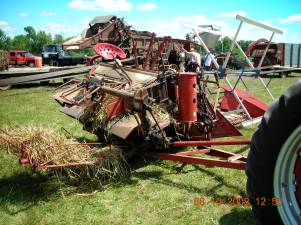 shocking it, and running it through threshing machines, for heaven’s sake. In case you’ve never seen one, here’s a photo of a grain binder from an antique farm equipment show I took some years ago. And yes, that thing over there that looks like it was cobbled together out of bits of old string, wire and old barn boards, is an actual commercially made machine. It was pulled by horses (that’s why there’s a seat on it). It cut the grain off with a sickle bar, put it in a bunch, tied the bunch with twine, then dumped it on the field. Workers would come along, stand the bundles on end with the grain heads up so it would dry. Then it would be loaded onto wagons and taken to a threshing machine.
 threshing machine. This is actually a special machine designed specifically for threshing or hulling clover seed, not wheat or oats, but the principle is the same. Workers would throw the bundles onto the elevator over on the left where it would run through threshing bars, fans, screens, etc. to be separated from the stalks and hulls. The hopefully clean seed would come out one pipe to be bagged, the straw would blow out onto a pile. The whole thing was originally powered by a massive steam traction engine via that long belt you see extending out the left side of the photo. Steam engines were replaced in the 1920s or so by gasoline powered tractors, but the threshing machines themselves remained in use well into the 1950s in some parts of the state. There were still a couple of farmers in the area who were using this setup when I was a kid. These things hung on because as long as you could get inexpensive labor it was cheaper to keep using it than buying a combine.
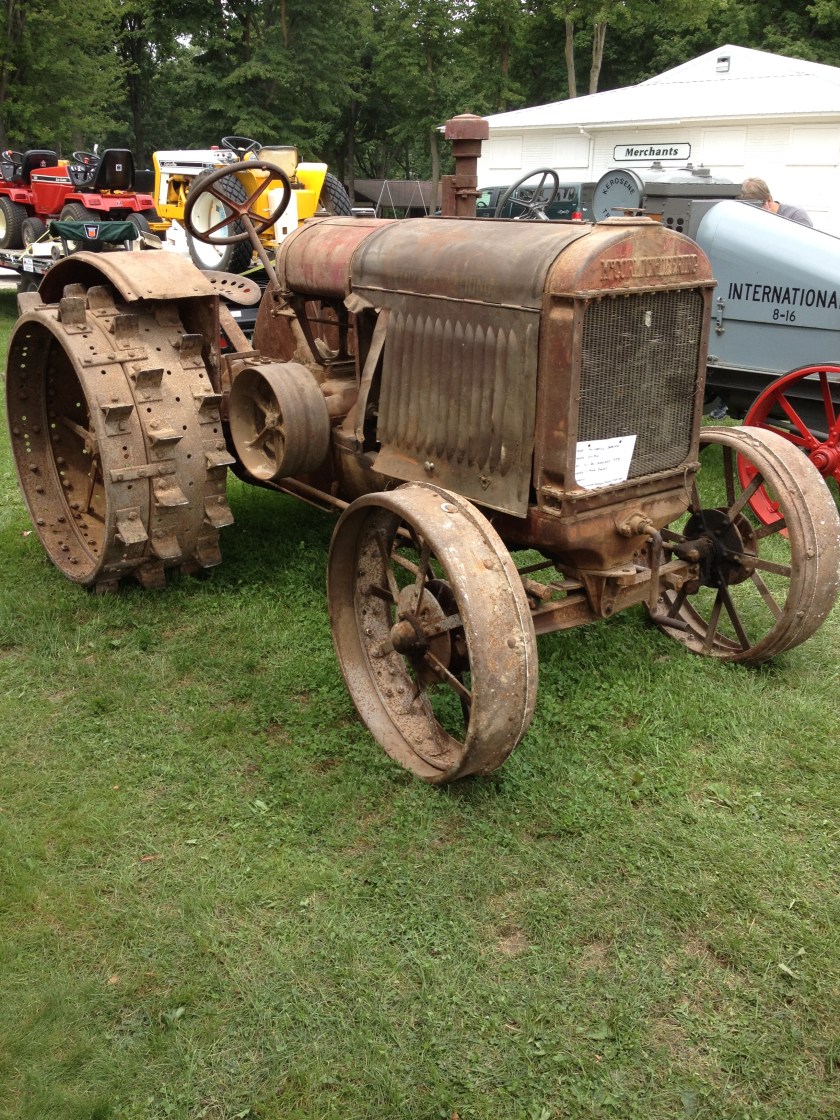 was a kid we actually had one of these beasts, this exact same model. And we didn’t have it for some collection, this monstrosity was an actual working tractor at the time. The only thing we used it for was running the blowers to blow grain or forage into the barns or silos, but it was still a working tractor on the farm. And dear lord we hated that thing. Trying to start that beast… Oh, my. It started by manually cranking it with that big lever you see just below the radiator. That connected to the crankshaft to turn the engine over. And if you didn’t know what you were doing when you tried cranking it, it would gleefully break your arm. Seriously. It would if you didn’t know what you were doing.

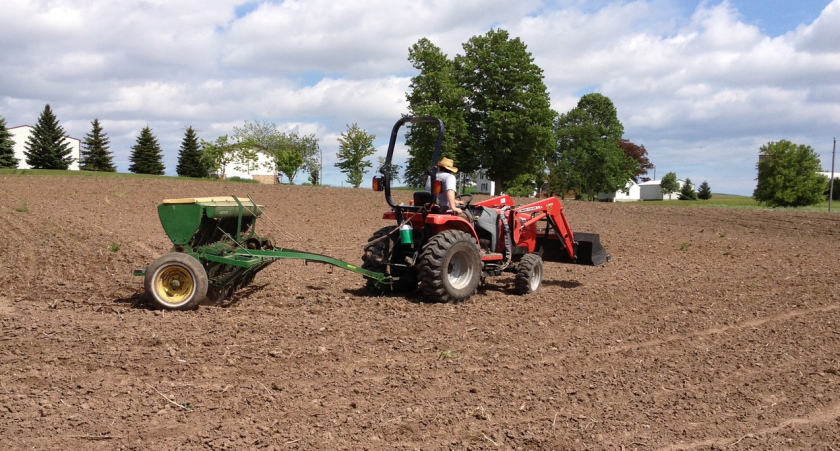 One trend in agriculture has been making me nervous for some time now, and that is how large quantities of farmland are being concentrated in the hands of fewer and fewer people.
 grouchyfarmer