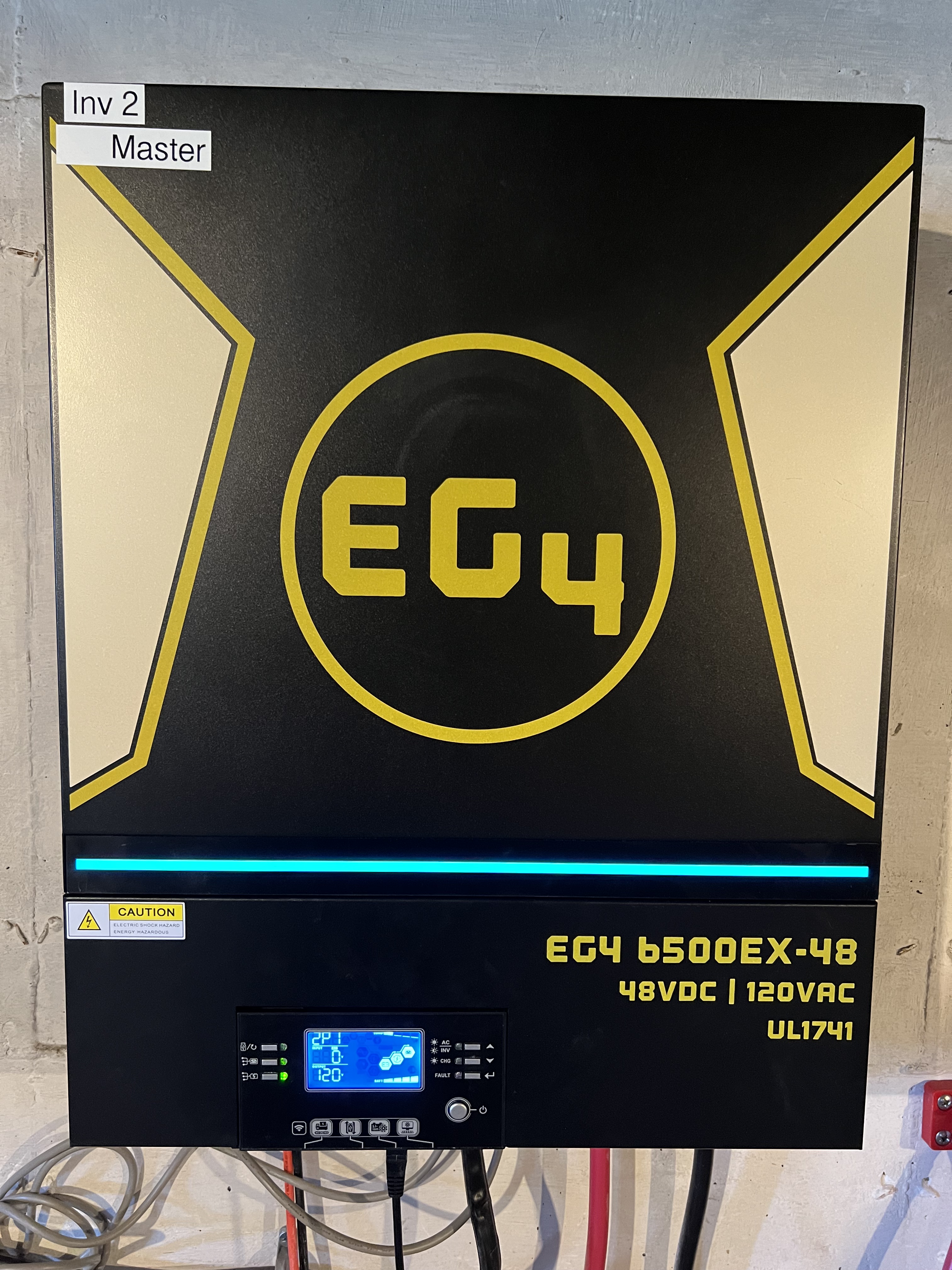
I always assumed I wasn’t going to be able to run our central air conditioning system off the solar power system. I based that assumption on multiple reports from people on Youtube and other places that have systems similar to mine that showed their EG4 inverters going into overload and shutting down when they tried to start up their aircon systems.
I decided to try it myself. I was not optimistic. This is a big house, 2,400 sq feet, it’s about 90 degrees outside, and that’s a huge compressor sitting out there. Still, what’s the worst that could happen? (Don’t answer that.) I decided to try it.
I shut down the air conditioning system, switched the house over to the EG4 inverters. Once everything was switched over, I held my breath and switched on the air conditioning and…
It worked? Yeah, it just worked. No muss, no fuss, no alarms, nothing. The lights didn’t even flicker. The cooling fans in the EG4s didn’t even speed up.
Apparently this air conditioning system is way, way more efficient than I thought. It’s only pulling about 1.8 KW maximum after the initial startup surge. How is that even possible? This is like a 4 ton air conditioner. Those generally average about 3 KW to 4KW, and this one is using half that? Wow… I just ran some rough numbers and it seems I could run the entire house, including the air con, off just the batteries and the EG4s for about 12 hours. Wow… Yeah, I know I said wow before, but still, wow…
Mr. Spiny the cactus is doing beautifully this year. Brilliant flowers for a week now.The poppies, like dill and a few other things in the garden, come up by themselves every year. I’m not a big fan of these. The flowers are beautifully colored but they only last a day or two. This little guy was one I found along the side of the road out in the country when I was on the bike the other day. Google tells me that it’s a type of rose.Columbine is another volunteer that keeps coming back year after year. Very pretty flowers but the darn things spread like weeds in the garden, usually turning up where we don’t want them.
Finally the drought…
This used to be a small river, a branch of the Manitowoc river just outside of the town where I live. Note the white box in the bottom center of the photo. That’s an old computer someone pitched over the bridge.
Dear lord it’s dry here! This is one of the worst droughts I’ve seen in years. I can’t remember seeing water levels in the local lakes and rivers this low. We haven’t had a decent rain since early May. What rain we did get has been very spotty. One day when we did get some rain moving through the area if I looked out one window it was raining, but it wasn’t raining on the other side of the house. The corn fields are looking terrible in a lot of places around here, the leaves curling up and in some places even turning brown.
We’ve been watering the gardens almost every day so they’ve been doing okay but the other stuff… We’ve actually had to start watering the hosta garden in front of the house. That’s the first time in about 15 years that we’ve had to water them.
There’s a 50% chance of rain today and tomorrow. We’re keeping our fingers crossed.
I’ve been thinking about the future of automobiles of late and I’m seeing a lot of things that don’t make a lot of sense to me.
Let’s start with EVs. Don’t get me wrong. I like electric vehicles. But I’m not sure if they are going to be the ultimate solution to the problem of weaning people off of internal combustion engines. I’ve talked before about how I don’t think that we have enough electrical generating capacity or a resilient enough electrical distribution system to deal with the tens of millions of EVs some people would like to see on the road. Then add into that mix electric long haul trucks, electric tractors and electric, well, electric everything, and the situation becomes even more strained.
But that is a problem that can (or could be if we’d be willing to actually pay for it) fixed relatively easily, however. There is another problem that is not so easily fixed.
There are something like 1.4 billion motor vehicles in the world. That is not a typo. 1.4 billion. There are close to 300 million in the United States alone. And people think that we can replace every single one of those internal combustion engine powered vehicles with their electric counterpart.
Guess what? We can’t.
Building those hundreds of millions of electric vehicles requires raw materials that aren’t easy to find, are difficult to mine, difficult to refine and distribute. And even the more common resources that are needed, like copper for wiring, are becoming increasingly difficult to obtain. (And that doesn’t just affect the car makers, it’s rippling out through the whole economy. Have you seen what copper wire sells for these days?) And to make things even more interesting, a lot of those resources come from places that aren’t exactly friendly towards us, like China.
What it boils down to is that we simply don’t have enough raw materials to be able to make even a significant fraction of the number of EVs it would take to replace all of the ICE powered vehicles currently in use.
Production could be expanded, true. But it can take years, decades even, to find mineral deposits, obtain financing, build infrastructure necessary to develop a mine, build the infrastructure to do the processing, etc. Even worse, some of these materials are so scarce that there’s a very good chance that even if we went all out with trying to exploit our natural resources, we wouldn’t have enough.
And I have another question. Who suddenly decided that the best, the only solution to our transportation problems, was the electric vehicle? What happened to all of the other alternatives that were being experimented with like the various hydrogen powered alternatives for example? We’ve been experimenting with hydrogen powered cars for decades. They work pretty well, the only emission that comes out of them is water vapor. There are about 50,000 of them on the road and they’ve proven to be a viable alternative to gasoline powered vehicles.
What about other alternative types of transportation that would eliminate the need for a lot of driving in the first place like light rail or even bus service? You’d think that if the government wanted to wean people off ICE powered vehicles the first thing it would try to do would be to make it easier for people to not drive in the first place. Instead the state legislature here in Wisconsin is trying desperately to shut down every expansion of rail or bus service it can, and even eliminate existing facilities by starving them of funding of any sort.
But let’s forget about EVs for a moment and look at the trends in car manufacturing in general. I have questions about that as well.
Car Makers Making Cars Worse
Yeah, they are. From stupid noise generators that try to make EVs sound like overpowered gas or diesel engined monsters, to fake gear shift levers, to “info -tainment” systems that distract driver’s attention by making it impossible to even adjust the temperature of the heater without taking your eyes off the road, car makers seem determined to make cars worse.
The fake engine and exhaust noises and the fake gear shifters are, at least, not dangerous. But some of the other things they’re doing are, like what’s going on with a vehicle’s control systems, are dangerous.
Why do they have to make cars so damned complicated? Let’s look at my Buick Envision. This thing is supposedly a “luxury” car, with the top of the line trim level with all of the goodies you can get. And some of them are admittedly pretty neat and even improve the safety of the car. But some of the things they do…
Like where the hell is the headlight switch? Seriously. I couldn’t find the switch to manually turn the headlights on and off when I got the car. It was set in auto mode when I got it, so the headlights turned themselves on and off as necessary depending on light levels and weather conditions, but I still wanted to be able to turn the damned things on manually if I needed to. I finally found it. It turned out to be a tiny dial located way down out of my light of sight on the dash near my left knee. Oh, and it wasn’t labeled as a headlight control. All it said was “on off auto”. On off auto what, though? No idea until I actually played with it.
Same with the auto dimming headlights. That’s a nice feature. It automatically dims the headlights a night when there is an oncoming car. But it also dims the lights when it comes upon a lighted billboard, a reflective road sign, and it does it even in town, the lights constantly going from bright to dim when I go past a street light. I finally found that. It’s a little button labeled “Auto” embedded in the turn signal stalk.
Now I could have found that out by reading the owner’s manual, but who actually ever reads that thing? And in any case, systems as essential to operate as the headlights should be so clearly labeled that anyone can find and operate them properly.
One day I went out to the garage and I noticed that all of the windows in the car were down. All of them. Uh? I had to go back in the house to get the key fob so i could get in the car and start it, roll all the windows back up again, and didn’t think anything else much about it. Until the next day I went out there and all of the windows were down again. That happened maybe another three times. So I complained to the dealer about it.
The dealer didn’t know what the hell was going on either so the service manager started to do some research while the car was in for an oil change. Turns out this is a “feature”. Apparently under the right conditions, if you hit the right combination of buttons on the key fob, all of the windows in the car open up to cool off the interior of the car before the air conditioning starts up to put less strain on the aircon system. Why was my car doing it? I didn’t remember hitting random buttons on the key fob or anything like that. But we unanimously agreed that a car that rolls down all of its windows while no one is even near the car is not a good idea and they figured out how to disable that, thankfully, and it hasn’t happened since.
Then there is the massage system built into the seat. Yeah, it has one. And it is utterly horrible in every single way. It is distracting, irritating and even painful if you already have a bad back the way I do. And if you fumble around down on the left side of the seat to try to adjust the seating position, you absolutely will hit the damned massage button and then you can’t turn the effing thing off again without stopping, getting out of the car so you can see the controls down there and figure out which one does what so you can shut the thing off.
What I really want is something like, well, this…
alas I don’t have photos of the one I had, but mine looked exactly like this one, right down to the hideous orange color. It was an absolute hoot of a car.
That is an old Honda Z600 from the early 1970s and I used to have one of these little beasties back in the day. It’s what is known as a kei car, and they are the most popular vehicle in Japan and have been for some time. I had it back in the mid 1970s. It had a 2 cylinder air cooled, 600CC engine, a 4 speed transmission, front wheel drive, these cute little 10 inch tires and it was utterly nasty in every way. Even so the thing was an absolute hoot to drive. Despite the tiny engine it could cruize at 65 mph all day long, it got about 50 MPG, and you could fix it with a screwdriver and a few bits of tin foil. Thanks to its light weight and front wheel drive it even worked good in the snow.
The only problem I had was that it often wasn’t where I left it when I came out of work or school because people thought it was great fun to pick it up and run off with it. Four guys could pick the thing up and carry it off.
It had a AM radio, a heater that didn’t work, and, well, nothing else. No power anything. No frills, no luxury nonsense. It was basically a box with a small, zipping little engine, four wheels, and that was it.
And, thanks to the infinite wisdom of the US government, they banned their import shortly after I got mine for “reasons”.
When I got the 600 it was about a year old and had only about 10,000 miles on it. I paid about $500 for it and it was the best $500 I’d ever spent. And if I could get another one I’d buy it in a heartbeat because ultimately that’s all I want or need, a basic, simple, cheap, reliable car.
So the question that everyone has is now that the system is installed and up and running, is it really doing any good? The answer to that seems to be yes. It’s early days yet but what we’re seeing is encouraging, even a bit surprising.
MrsGF is the one who keeps track of these things and according to the data she’s been accumulating one year ago, June, 2022, we used 1,600 kWh of electricity according to the utility company. This year, in June, 2023, we used 1,100 kWh, 500 kWh less than last year.
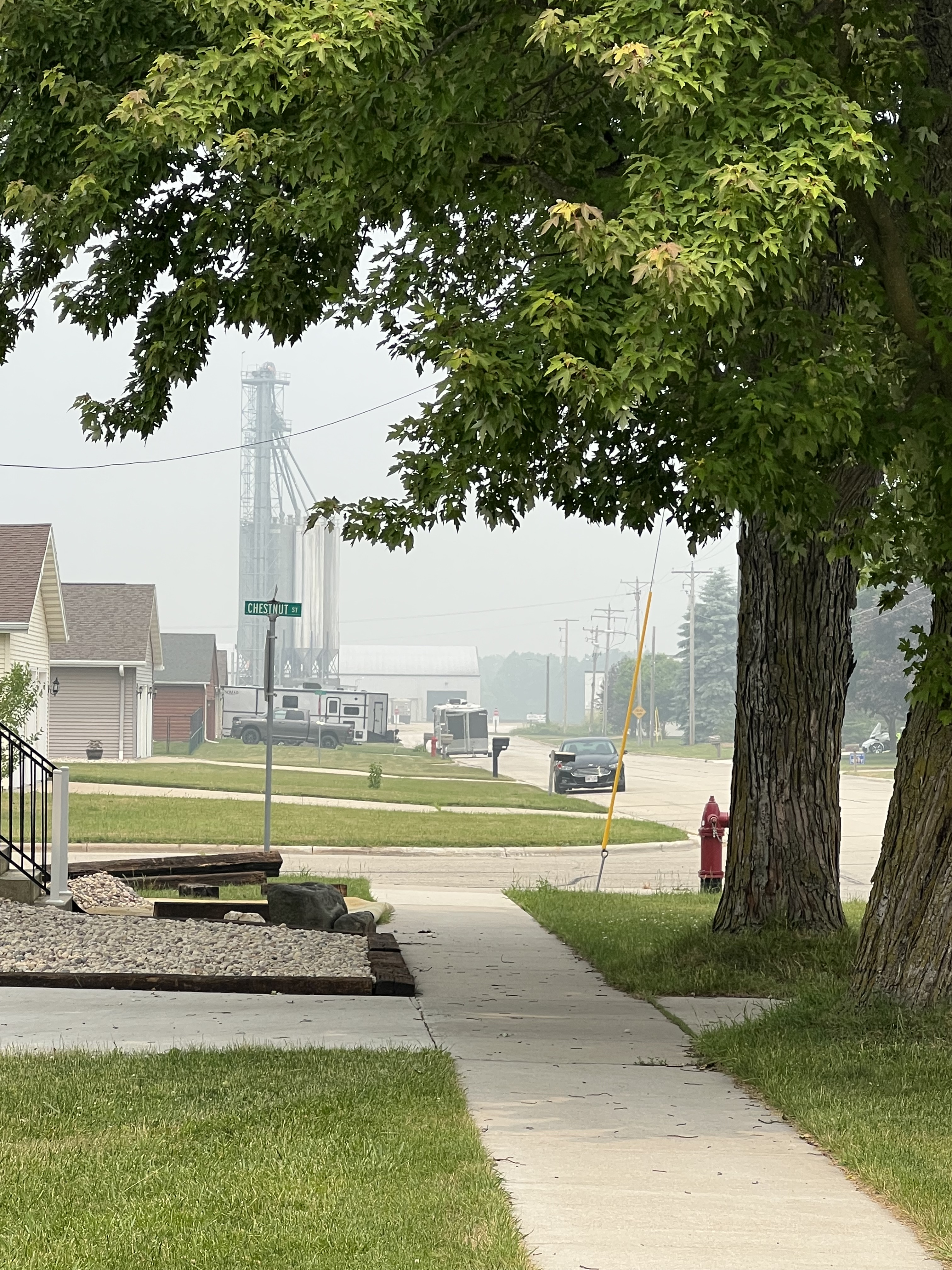
That’s smoke, not haze or fog. We’ve been under air quality warnings for weeks now, on almost a daily basis, because of the forest fires in Canada. I think this is the worst it’s been, though. As soon as I walk outside I can smell it. They’re warning people with asthma, breathing issues, heart problems, and the elderly to stay indoors and limit physical activity. I was outside for about an hour mowing the lawn and my eyes were watering and I could feel it in the back of my throat. We have all the windows closed, the HEPA filters running on full blast and the HVAC system fans running to pull air through those filters so hopefully that’s keeping it from getting into the house.
Egads, it’s been dry here, as it is in much of the rest of the country. We finally got a good rain yesterday and hopefully that will indicate that we’re getting out of this dry spell. Up until yesterday we were watering everything just about every day. But things have still been growing like crazy.
We have a little bit of everything in the raised bed this year. We have a several different types of lettuce, beets, carrots, onions, pole beans, tomatoes and peppers in the four raised beds this year and they’ve been doing pretty darned good as you can see from that picture up there.
We put in a lot of onions this year. We’ve had good luck with putting onions around the outside of all of the raised beds. There doesn’t seem to be much competition between the onions and whatever is growing in the main part of the beds as long as they get enough sunlight.
MrGf and I both love the flavor of home grown onions. They tend to have a much more intense flavor than the store bought variety. I don’t know if it’s just me, but it seems that over the years the commercial varieties we’ve been buying in the store seem to be becoming sweeter and having a less intense and less spicy onion flavor.
And we’re trying something new.
Those are brussel sprouts. We like to try growing something new every year and we picked brussel sprouts because, well, why not? So far they’ve been doing pretty good.
Most of the pepper plants went into a narrow bed along the south side of the house. We’ve put them in there before and they’ve always done very well. The biggest problem with that location is that it’s very dry there and we have to be especially careful to keep them well watered.
The wax beans and squash are doing quite well also, as you can see up there. All things considered the gardens have been doing pretty well. Some of the pepper plants and the tomatoes are starting to blossom already.
And, of course, we have flowers everywhere. We rarely water our decorative plants but somehow they’ve managed to make it through the drought.
I am a bit worried about the hostas, though.
We’ve never had to water the hostas in their location, but if we hadn’t started to get rain I think we would have. They were starting to look a bit rough around the edges, suffering from heat stress, I think. Days of 90 degree temperatures and the lack of rain was starting to get to them.
After a rather dreary and cool spring, summer has hit with a vengeance. Temperatures for the last few days have been abnormally hot, in the high 80s and low 90s, temperatures we usually don’t see until well into mid summer. It’s also been very dry. We haven’t had a decent rain in something like a month now. Grass normally doesn’t go brown and dormant around here until late July. My lawn is already as dry as dust and turning brown. Still, the flower beds seem to be enjoying it and it’s a riot of color out there.
There are the irises, of course. They’re looking absolutely stunning right now.
But if you stop and get down on the ground and peer around you’ll find little treasures as well, like these…
With the showy irises taking center stage it would be easy to overlook those little guys up there.
And no collection of flower photos would be complete without the first rose of the season.
That’s it for now. The weather changed drastically. We went from hot and dry to cold and wet which is actually something of a relief. We hadn’t had any rain in something like a month and a half before this weather system moved in so no one is complaining.
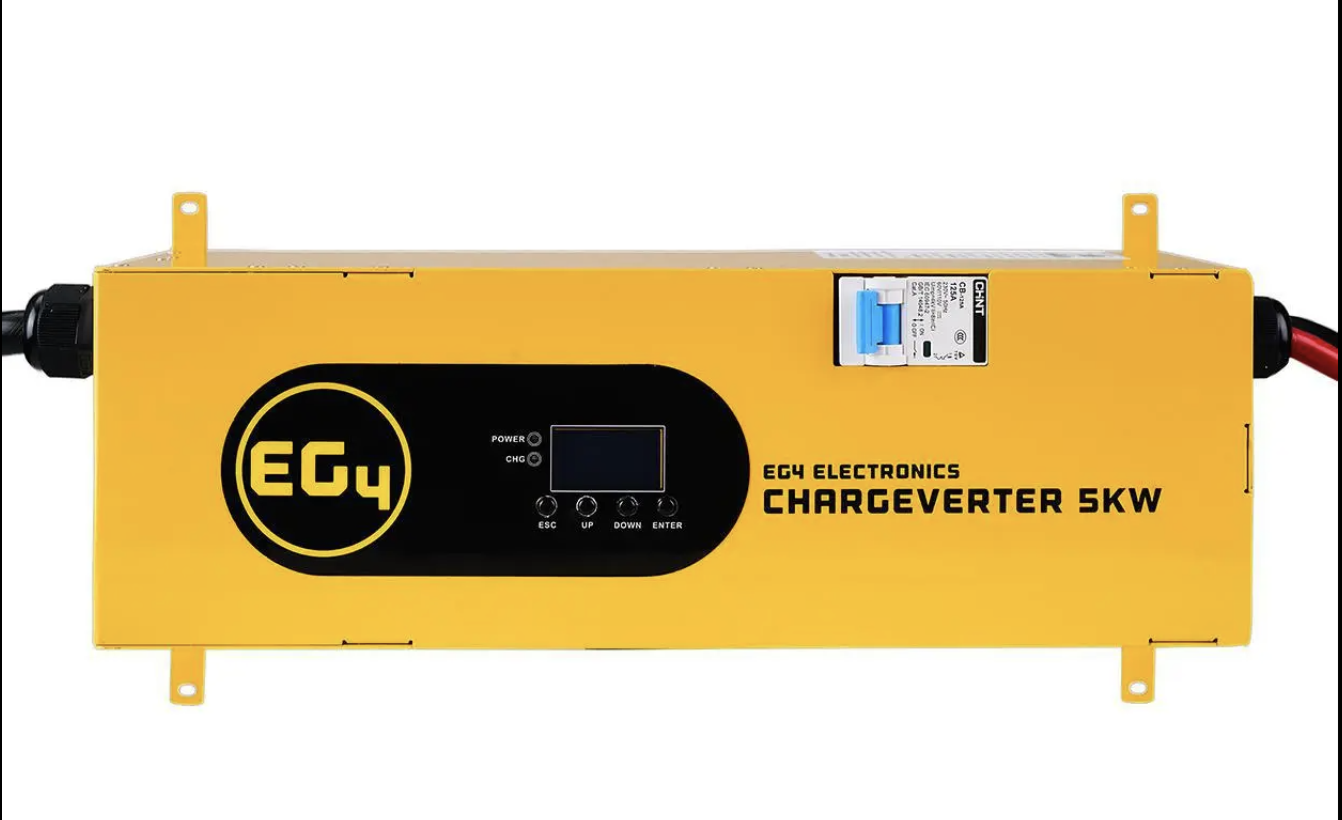
I wanted to take a look at the EG4 48V Chargeverter and I finally had a chance to try it over the weekend. I got in three more EG4LL batteries last Tuesday and before they could be installed they had to be at the same voltage as the existing batteries in order to avoid problems. So that meant they had to be charged up from about 54% to 99%. So this was a good opportunity to test it.
It’s that small yellow box on the floor. Not the best picture in the world, I know.
In the interest of full disclosure I should point out that I got the Chargeverter free from Signature Solar. They were running a deal where you’d get the device if you bought a package deal with two EEG6500EX inverters. Normally it sells for about $500.
So why does someone need this device? Well if you are really off grid or you are in an extended power outage, and you aren’t getting enough solar power to keep your batteries charged because of cloudy conditions, you’re going to need to recharge those batteries somehow if you want to keep your electrical devices working. And chances are good you’re going to turn to a good old fashioned gasoline powered backup generator to recharge those batteries. And that’s where this yellow box comes in.
Someone will point out that many inverters like my 6500EX already have AC powered battery chargers built into them. Just plug the 120V AC input on the inverter into the generator and let it charge the batteries. And you can, in theory, but there are some serious issues with that. There have been reports of people wrecking their inverter/chargers by trying to do just that. Apparently a lot of these inverter/chargers don’t work very well with backup generators. The problem is that a lot of these generators put out some of the nastiest, dirtiest, power imaginable with lots of voltage fluctuations. The inverter/chargers expect to see nice, clean, steady, pure 120V AC sine wave power coming in from the utility company, while the power coming out of some of these generators is so bad it can actually damage the inverter/charger.
The EG4 Chargeverter is designed specifically for these situations. It’s intended to plug directly into the 240V socket of a backup generator, convert that power to nice, steady 48V DC, and pump that into your batteries. Well actually 56V AC but I’ll come to that in a moment.
Yes, I said 240V. This thing can be rewired to work off 120V or you can get adaptors to let it do so, but you’re going to need at least a 120V, 30 Amp circuit power this thing if you’re going to try to use it off our house’s electrical system. If you have a 240V electric clothes dryer you might be able to plug it into that with the right adaptor but I don’t really care about that so I didn’t look into it. I’m interested in running this thing off a backup generator.
Since this charger can suck up at least 5KW of power to dump into the batteries, you’re going to want a fairly hefty generator to plug it into. You can use a smaller one but you’re going to need to adjust the power level of the charger to a lower amperage or you’re going to overload the generator. I’m using it with my big Generac 7.5 KW gasoline generator.
I bolted the plus and minus cables from the chargeverter to the battery. I started up the Generac….
Ah, the Generac… I have a love/hate relationship with that generator. It hasn’t been used much over the years, there are only a few hours on it and most of that is from test runs. It can be a real beast to get started. It has electric start, which generally doesn’t work because no one ever remembers to put the battery on the maintainer, so that means it either has to be jump started from an battery pack or started with the recoil starter. I will not describe the language I used trying to get that thing going with the pull starter. I finally found one of those jump starter packs used to jump start cars and used that to power the electric starter and got it going. Once it’s running, it’s fine. When the engine is warm, it’s fine. But starting it that first time…
Never mind. I got it started, plugged in the chargeverter and… And the engine immediately died. WTF?
I started it again. I plugged in the chargeverter and… And the engine immediately died again. WTF?
Oh… I forgot to turn the gas on. Sigh…
Now with the generator finally running, I plugged in the chargeverter. The display came on. I used the buttons on the front to set the voltage to 55.5V and the amperage to 50A, and flipped on the circuit breaker to start it up and, well, it just worked exactly the way it was supposed to.
It was really going to be that easy? Apparently it was. According to the display on the battery it was being charged with about 48.5 amps of current. Cool.
I kicked the amperage up to 80A which made the generator work a bit hard for the first time in its life and the battery reported it was getting 78.8 amps…
What can I say? It just worked exactly as specified.
I charged all three batteries from about 50% to 99% in about two hours total.
The only issue is that the case of that charger gets seriously hot, hot enough to be painful to touch but the manual warns of this so it wasn’t unexpected.
I like it when things just work.
EG4 6500EX and EG4LL Battery long term evaluation.
This is another rather dull report because the EG4 6500EX inverters have just plain worked. Something that was made abundantly clear when we had a power failure this morning about 8 AM that lasted for about two hours. First the power flickered out for about 10 seconds or so around 7:3o. And then at around 8 it went out completely and stayed out. So down into the basement I scurried, flipped a couple of circuit breakers and we were back to the electrical system running normally in about a minute. Furnace, sump pumps, furnace (weather changed from hot and dry to cold and wet so the sump pumps and the furnace have all been running), lights, microwave and, most important of all in the early morning, the coffee maker, all worked just fine and dandy.
The outage lasted about two hours and even the sump pumps weren’t a problem. By the time power came back on the batteries were still at about 95%. Granted we weren’t using a lot of power. The sump pumps only cycled once and the furnace only ran for a few minutes.
Anyway I’m quite pleased with the system. It’s nice to be able to just switch over like that with just a couple of circuit breakers and get back to normal.
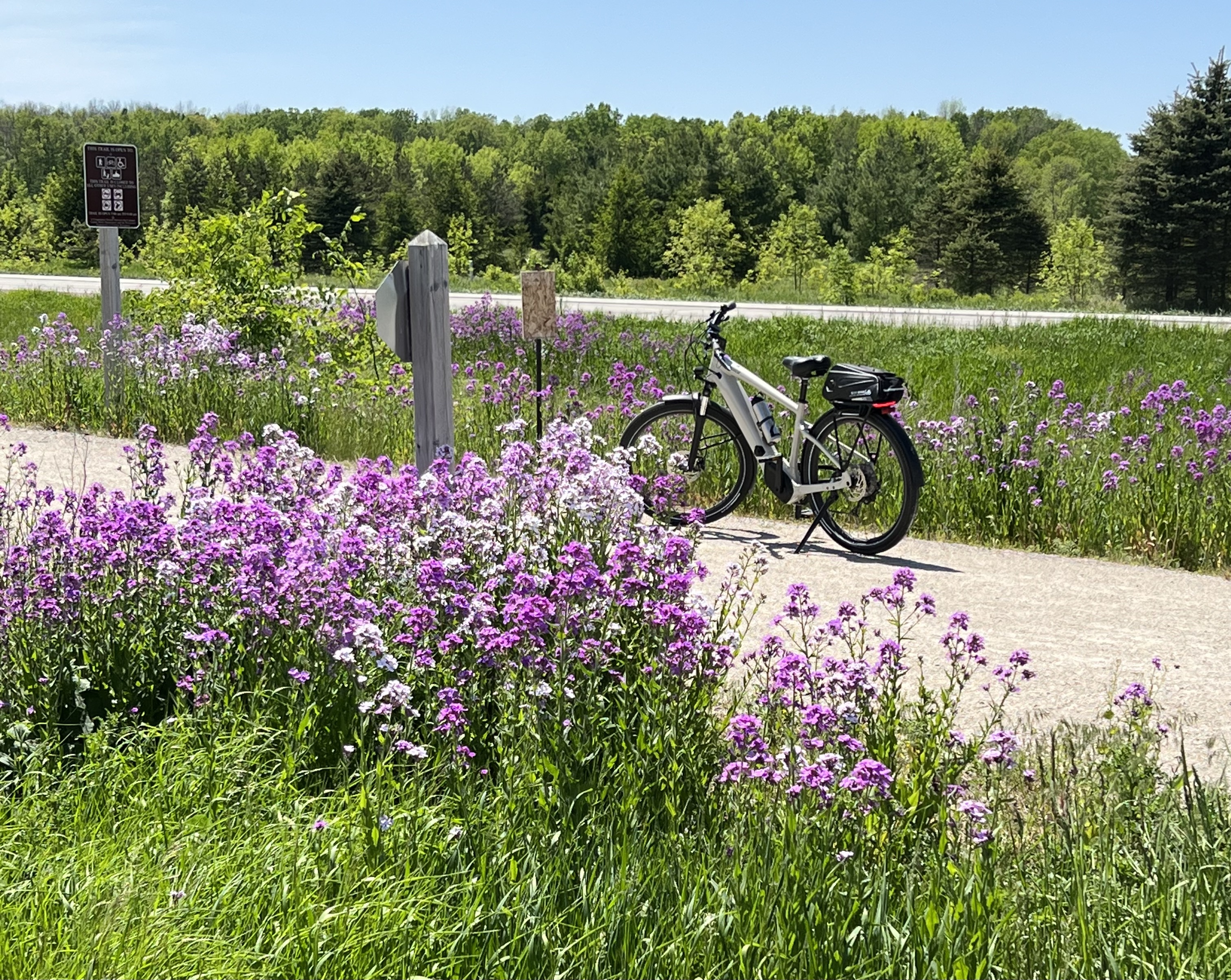
I managed to injure my left leg when I was wrestling around with those massive batteries for the solar power system so my physical activity was seriously limited for a couple of weeks. Yesterday was the first day I felt comfortable enough to get out on the bike for an extended ride, and it was a great day to start. Was absolutely beautiful out with temps in the high 70s and a gentle breeze.
Phlox everywhere. They’re pretty but they’re an invasive species that spreads very aggressively in this area.
I injured my left calf pretty seriously back in the 1990s in a farm accident. Took me 6 weeks to recover from that one and ever since I’ve had to be cautious with that leg. Lugging 100 lb batteries down the basement stairs and into the battery cabinet didn’t do the leg any good. Neither did repeatedly kneeling down on the floor to work on wiring.
Out in the gardens the irises are coming into full bloom. They don’t bloom for very long but when they do that whole area is covered with these amazing flowers in brilliant blue, purple and yellow. When the sun hits them the colors are so brilliant they almost glow.
Alas the flowers don’t last long but by the time they fade away others will have blossomed to take their place.
More solar stuff: I really need to do some meaningful testing of the EG4 system to get some basic data about run times and things like that. I can guess how long the batteries will last when running the house off the EG4 system but I don’t have any actual operational data giving me actual run times under particular sets of circumstances and things like that. Two days ago I started it up, took the house off-grid and ran entirely from the EG4 system starting at 7 AM and ending at 3 PM, a total of 8 hours. At the end of that time the batteries were still at about 78% capacity because we had a pretty good day for solar production. While that was interesting I really need to see how long I can run the house just off the batteries, with no solar power at all.
The string of Newpowa panels have been peaking at around 1,000 watts, and the HQST panels at around 600 watts. That’s less their rated peak output which should be around 1,320 and 800 respectively. The HQST panels were putting out close to 700W earlier this year so I know they can do better than what I’m seeing. And the weather was clear with bright sunshine…
Or was it? The sky looked clear when looking straight up, but if you’d look towards the horizon it was a different story. The wind shifted again and we’re back to getting air quality alerts because of the forest fires in Canada. It looks clear and sunny but it really isn’t. There is a significant amount of fine particulate material floating around in the atmosphere that is cutting back on the amount of solar radiation that is reaching the ground. What it boils down to is that I theoretically have enough solar out there to take my batteries from about 50% to near 100% in one day of full sun. In reality, with variable cloud conditions and the smoke from the fires, I’m lucky if I get half of that.
(And I can sure tell there are air quality problems with my allergies, too. I was up at 3 AM this morning with my head so stuffed up I could hardly breathe. I gave up trying to get back to sleep. Since all of this air quality stuff started I’ve been having problems sleeping, stuffed up sinuses, etc. Makes it very hard for me to stay asleep. I’ve generally been waking up around 3 or 4 AM and find it almost impossible to get back to sleep again. Running on four or five hours of sleep is unpleasant. Sigh…)
This thing started out at around $500 but is currently selling for $399 over at Signature Solar. In the interest of full disclosure I should point out that I got this thing free from Signature Solar.
Speaking of battery charging I got one of these in earlier this week from Signature Solar, the EG4 Chargeverter, a 48V battery charger that plugs into a 240V AC power source to rapidly recharge LiFePo batteries. This thing can put out up to 100 Amps which means it could fully recharge my 15 KWh of batteries in just 3 hours. It’s only been on the market for a few months and I’m curious to see how well it works so when I get a chance to check it out I’ll talk about it in the future.
Now why would someone need one of these? After all a lot of modern inverters like my EG4 6500EX already have built in AC battery chargers. I could wire my EG4s directly to the house’s AC power and they would automatically keep the batteries topped up even when there is no solar. But a lot of these systems are sold to people who are entirely off the grid. They have no connection to the grid at all. (And my system has no grid connection.) If they don’t get enough solar power to keep their batteries topped up, they have to resort to using a gasoline powered generator to charge them up. And that’s where the problems come in. These cheap, gasoline generators often produce very dirty power that isn’t even close to a pure sine wave and which can damage electronics. This chargeverter apparently doesn’t care how dirty the AC power coming into it may be. So if you’re living entirely off the grid, or if you’re going through an extended blackout and there isn’t enough solar to keep the batteries charged, you could plug this thing into a cheap Harbor Freight generator to charge your batteries and not have to worry about damaging anything.
I have a 7,500W Generac gasoline generator sitting out in the garage and this thing should plug right into it so I’ll be testing this out in the near future. If it works as advertised it will probably be kept permanently wired up to the bus bars in the battery cabinet. I doubt if it will get much use but it could come in very handy if we have an extended power outage.
What I’ll probably do is run my batteries down to about 25% and then try charging them with the chargeverter connected to the Generac and see what happens.
The weather finally moved into a warmer, drier pattern here in east central Wisconsin and the plants responded by going nuts to make up for lost time. This is really the perfect time of year here, climate speaking. It’s warmer, sunnier, and the mosquitoes have yet to emerge to drive us back into the house.
We put #10 cans around new seedlings to protect them from wind and little creatures until they get well established. We’ve been doing that for ages now and it works quite well.
We made a lot of changes out in the gardens, but you can’t really tell unless you look closely. One thing we are doing again is putting peppers along the south side of the house. That narrow strip of ground between the house and the grass produced a fantastic crop of peppers of various types last year so we’re going to do it again.
We did something different this year with starting seedlings. We used to put a sort of mini green house in the livingroom in front of a south facing window to start seeds but the results were mixed. The seedlings were often spindly and weak and suffered from severe transplant shock. This year we set the mini greenhouse up in the basement with some inexpensive grow lights we got off Amazon along with a heating pad designed for seedling trays. That system worked amazingly well. The peppers, tomatoes and other seeds we started were all thriving in that environment.
Every year we like to try at least one new thing we’ve never grown before and this year it’s brussel sprouts. MrsGF and I both like them a lot so we thought we’d try growing our own and see what happens. They’re a late season crop, usually not harvested until after the first frost they tell me. Brussel sprouts have a bit of a bad reputation, but over the last decade or so the flavor has changed drastically thanks to new varieties that have been introduced. The new varieties have a milder, less bitter flavor, along with a better texture.
And it’s lilac season here in town. There are lilacs all over town, including in our backyard. It seems to be people’s favorite bush around here, and when they all come into bloom around the same time the whole town smells of lilacs. Another reason why I love this time of year.
Other stuff:
it’s hard to tell but if you look to the right of those factory buildings back there at the trees in the distance you can see how hazy it’s been around here.
–> We’ve been under air quality warnings for some time now because of smoke from massive forest fires up in Canada. Down at ground level it’s hard to tell but it’s especially easy to see early in the morning right at sunrise. Off to the east right now at around 6 AM it looks like there’s a thick haze up there. I feel sorry for those poor people up there. Huge areas of forests have burned off already, whole communities are under evacuation orders. It’s pretty bad.
The DNR hasn’t been helping air quality here either. They were doing this the other day…
They’ve been burning off marshes around here adding to the already poor air quality. I was told you could see the smoke from this one for 20 miles and could smell it over the entire county.
–> The biofuel industry is continuing to try to desperately to put off its impending demise as long as possible. We live in a world where it seems we are on an inevitable course to switch to electric powered everything, including transportation, garden tools and everything else that is currently being powered by the burning of some kind of fuel. And that means the entire biofuel industry is about to crash and burn because there isn’t going to be a market for its product any more. That hasn’t stopped them from trying to rake in as much cash as they can until the end comes. It looks like they’ve succeeded in pushing for an increase in sales of 15% ethanol blended gasoline and now they’re pushing for more mandates to blend biodiesel into traditional fuels. Diesel fuel is probably going to be the last gasp for this. Trying to make long haul trucks and trains to run off electricity has been difficult because of the huge power demands so those will probably remain for some time after automobiles and light trucks have gone full electric.
What they really need to be doing is trying to slowly and carefully shut down the whole biofuel system to avoid a massive financial crash that will ripple through the whole agricultural sector. Continuing to invest in biofuels at this point in time is sort of like someone heavily investing in horse drawn carriages right after Ford came out with the Model T.























 grouchyfarmer