The age of Conspiracies

I wrote about “The Age of Stupid” a few weeks ago, but “Age of Conspiracy” could be just as appropriate to describe what we’re going through these days. And it’s been going on for a long, long time.

You could say that I grew up in an age of conspiracy theories. I was born about halfway through the “red scare” that started in the late 1940s and ran into the late 1950s. Politicians like McCarthy latched onto it immediately as a way of expanding their power and influence, claiming there were evil communists lurking in every corner, infiltrating our schools and even taking over our popular media. It resulted in very public witch hunts. It ruined the lives of a lot of people because of the tactics of people like McCarthy, who engaged in unsubstantiated accusations, public attacks and fear mongering. I suspect that McCarthy didn’t give a fig about communists, nor about the homosexuals he’d tried to go after in the so-called Lavender Scare (1) earlier. I suspect he was trying to do anything he could to revive a rather mediocre political career and saw this as a possible path to power.

McCarthy and his red scare was perhaps the beginning of the modern era of conspiracy theories. After his disgrace and his death in 1957, other people, other organizations, took up “the cause”, whatever that cause might be. Whether that cause was the government poisoning us by putting fluoride(2) in the water, the United Nations taking over the US, Catholics (3)… The list goes on and on.

Any time there is some kind of crisis going on it seems that someone will come up with some kind of conspiracy theory to try to explain it.

The development of the internet has resulted in such an explosion of conspiracy theories that it’s impossible to keep up with what’s going on out there. There’s Jade Helm, which somehow linked empty Walmart stores with FEMA, the UN, Obama (of course) and I don’t know what all else and morphing it all into some kind of invasion attempt. Airliners pumping tons of chemicals into the atmosphere via ‘chemtrails’. Weird, mysterious groups of people who secretly control the world. Fake moon landings. FEMA stockpiling “disposable coffins” to deal with the bodies when Obama purges the country of A) gun owners/NRA members, B) Christians, C) heterosexuals, D) all of the above. FEMA setting up “death camps” in secret locations all around the country so it has enough bodies to put in the ‘disposable coffins’. Fluoride (again and still). Canada pre-staging its entire military force along the border to invade the US. The NRA board of directors being taken over by the Islamic Brotherhood. Hillary has brain cancer. Hillary has tuberculosis. The list goes on and on and on.

How do these things get started in the first place? And even more importantly, why do some people actually believe them?

How they get started isn’t difficult to discover in many cases. Someone, somewhere, finds something, some little fact, some photo, some tiny, tiny bit of reality, and goes off the deep end with it, totally transforming into something it isn’t. Over time other people get their hands on it, add to it, expand it, modify it, and you end up with… Well, let’s look at the FEMA coffin thing.

What seems to have happened in that case is that someone stumbled on a field covered with not coffins, but with burial vaults that are used to put over coffins to prevent coffins from collapsing when you drive thousand pound lawnmowers over cemeteries. In a lot of areas these things are required by law. You can’t just shove a coffin in the ground, you have to put a vault over the top of it. Because burial vaults are tough and weather proof the company didn’t see much point in building expensive warehouses to store them, they just stack them up outside in a vacant field. Eventually this field of burial vaults morphed into the FEMA coffin nonsense.

Same with the FEMA death camps. They have actual photos that prove there are actual camps complete with tacky old trailer houses where they’re going to shove all us gun loving god fearing americans while they line us up to kill us off. Probably with fluoride? That story also started with a very tiny grain of truth. There are areas where large numbers of these trailers are parked. They aren’t “camps”, they’re storage areas. Where do you think FEMA gets the trailers they use to house people after a major disaster? Just call up some manufacturer and say they need, on, 5,000 trailers and deliver them tomorrow? Of course not. They already have them stockpiled. Someone stumbled across one of the storage sites, and the story evolved into the whole death camp nonsense.

I know how these things get started, but what’s always puzzled me is why so many people, many of whom seem reasonably intelligent, believe this stuff.

I think part of the reason is we often refuse to accept the fact that a lot of things are our own fault. We have made decisions in our lives that have resulted in certain undesirable consequences, and because we like those decisions, because they make our lives more comfortable or make money for us, we desperately try to rationalize away the undesirable consequences.

Like climate change. It is a flat out fact that pumping hundreds of millions of tons of carbon dioxide and methane into the atmosphere as we have been doing for decades is going to have an adverse effect on the climate of the planet. But a lot of people won’t accept that because it means that it would be their fault and, even worse, trying to fix the problem might have an adverse effect on them personally. So they latch onto some tenuous and irrational explanation for what’s going on, rather than accept the facts.

The list goes on and on, with people latching onto conspiracy theories for whatever reason.

There are always going to be people who, for whatever reason, appear to genuinely believe this stuff. There’s nothing we can do about that.

The real problem is when politicians and the media deliberately embrace this kind of thing for no other reason than for financial gain or to try to expand their support.


—- Footnotes

(1) Most people don’t remember the so-called “lavender scare” that McCarthy and a few others attempted first, a witch hunt McCarthy and others conducted against suspected homosexuals. McCarthy seemed almost desperate to try to find some issue, any issue, that would bring him some kind of influence and power after his mediocre and largely unnoticed career in the Senate.

(2) Still is in some areas. The fluoridated water scare is something that goes through cycles it seems. It eventually fades away, but sooner or later some news service comes across something on a slow day, runs it, and it heats up again, only to fade out of the public eye until the next slow news day.

(3) Yes, Catholics. They’re plotting to take over the US and turn it into the Pope’s private estate, you know, or something like that. You wouldn’t believe the nonsense we used to hear when Kennedy was running for president.

Is The ‘Golden Age’ of GM Tarnishing Already

This entry was sparked by an article I read over at NPR’s website about the failure of GM corn, and the seed companies desperate search for something to replace it. You can read it yourself by clicking here. As the article points out, one of the original commercially available genetically modified plants, BT corn, is failing. But a lot of my readers aren’t farmers and don’t know what BT corn is or know about the problem it was developed to cure, so let me tell you about that first.

The problem is this guy here:

This is the european corn root worm, otherwise known as the corn borer, and its rather nondescript parent moth. The european corn root worm is not native to North America. It first appeared in the US around 1917, and quickly spread throughout the US and up into Canada. The moth itself is harmless. It’s offspring, however, loves to eat the roots of corn plants, tunneling through them, weakening them, reducing yields, and even killing the plant. Over the years it became a serious problem, infesting much of the corn belt. There were pesticides that could kill it, but they are expensive, and a lot of the most effective pesticides are toxic and many have been outright banned because of their toxicity over the years.

BT corn was one of the first genetically engineered plants to be approved for commercial use. It incorporated genes from bacillus thuringiensis, a naturally occurring bacteria that lives in the soil. The modification causes the corn plant to produce a protein called Bt delta endotoxin, which kills the larvae of the corn borer. The BT toxin itself is not new. It’s been available for use as a pesticide since the 1960s, and it has a pretty good safety record. It is generally recognized as safe for humans, other mammals, fish, birds, and most insects.

BT corn worked very well indeed. So well that it quickly dominated the market and a large number of different varieties of BT corn are now available. But there’s a problem. It’s not working very well any longer.

In just twelve years the corn borer began to develop a tolerance for the BT toxin, and it began to spread. We are rapidly approaching the point where BT corn will no longer be effective against the pest and we’ll be right back where we started.

The same thing is happening with the other big GM cash cow, engineered plants like soybeans that are immune to glyphosate, the active ingredient in RoundUp from Monsanto. As was the case with BT corn, it wasn’t long before the so-called ‘super weeds’ began to emerge which were immune to glyphosate. And they are spreading throughout the country.

In both cases, these products were supposed to be quick and easy fixes for problems that have no quick and easy solution. And in both cases these ‘solutions’ were doomed to fail from the beginning. And everyone knew that they were not going to be long term solutions. Even as they were developing these products, the researchers involved were warning that sooner or later the pests they were intended to fight would eventually develop resistance and we’d be back where we started again. They recommended various techniques to help to reduce the spread of resistance. Those techniques were ignored because most companies these days operate on the basis of generating as much profit as possible right now and the hell with the future.

And that seems to be the problem with a lot of the GM products I’ve seen. They’re little more than quick fixes. Very little thought seems to go into determining if the products are going to be viable, useful, over the long term. The focus is profit, as much profit as possible, and profit right now. And hopefully the CEOs can cash out their stock options and bank their bonuses before the whole thing falls apart and leaves the company, and the farmers, worse off than before.

I’m not anti-GMO. Genetically modifying organisms has the potential to be incredibly beneficial. But as long as this current business climate where the only thing that matters is profit, right now, and the hell with the future, remains in effect, it is never going to fulfill that potential.


Disconnection from Reality in Agriculture

I often find myself irritated by what appears to be a serious problem with how some ag news outlets and their various pundits report on the dairy industry. Ever since milk prices plummeted a couple of years ago, I’ve been reading an endless string of opinion pieces by the so called experts, the pundits, even actual news reports, that indicate that milk production is dropping, or is going to drop, the number of milking cows is going to shrink, and there is going to be a significant improvement in farmgate(1) prices.

Even as I was reading some of those items I was scratching my head because the actual data I was seeing was telling me exactly the opposite of what the pundits at the ag web sites were claiming. While there was some shrinking numbers in some parts of the world, like New Zealand, what I was seeing in the rest of the world was a significant increase in production almost world wide.

The experts were claiming that production in the US was shrinking as well. They were claiming that production was flat or even shrinking as farmers culled herds and halted expansion plans.

The problem was that at the same time I was seeing new permits for mega farms being applied for, news stories about expansion plans, and other indications that exactly the opposite was happening.

The new USDA report that came out yesterday supported what I’d been seeing in the news, and indicated that the pundits don’t read the news reports in their own magazines or websites.

August milk production was up almost 2% in the US. Texas’ production was up 11%. The report said that 16,000 milking cows were added in July alone, and 45,o00 were added over the past year. And just ten minutes ago I was reading about yet another application here in Wisconsin for a dairy CAFO(2) to expand to 5,000 head.

The problem with a lot of these experts seems to be that they look at a specifically local condition and extrapolate from that and apply it world wide, while ignoring what’s really going on.

Some of the claims that production in the US was in decline was due to California. Production there has been declining significantly for the last ten years for a variety of factors. But they’ve been ignoring the fact that almost everywhere else in the US production has been going up. Wisconsin, North Dakota, Arizona, Minnesota… almost every state with any kind of significant dairy farm presence has been increasing production, often dramatically, as with Texas.

It’s been the same thing with the EU. They focus on a single country that’s seen a decline in production, and from that claim production is going down through the entire EU. When it isn’t.

It’s been a similar story when it comes to demand for milk products. They seem to focus on a small part of the world that is experiencing an increase in demand for milk products, and apply that world wide.

Even worse, they’ve gotten in the habit of looking at Global Dairy, a milk marketing system in New Zealand, as an indicator of world wide demand. But they tend to ignore the fact that GD is not an independent market. It is a wholly owned subsidiary of Fonterra, the New Zealand milk processing giant, and that it has a history of deliberately manipulating supplies flowing through the market in order to manipulate prices. Neither the amount of product flowing through GD, nor the prices of the products sold, is an accurate picture of supply and demand.


  1. Farmgate price is not the commodity futures price, but the actual price that the farmer gets for her/his product. There is often a significant difference between the commodities prices and the farmgate price. For example, a couple of months ago when the corn price on the Chicago market was running about 3.49, the actual price farmers in this area were getting for their corn was 2.78.
  2. CAFO is the term used by government for a mega farm. Concentrated Animal Feeding Operation. It applies not just to dairy farms but to any animal operation that has more than a certain number of cattle, pigs, etc. Generally around 500 – 700 animals.

Computers that should have been great but weren’t

The item I wrote about the Epson HX-20 the other day reminded me about one of the other items I was supposed to try to sell for that business supply company, the Epson QX-10. This beastie:

screen-shot-2016-09-18-at-7-46-32-am

This particular example is, judging from the color of the case, an elderly one. The plastics used for computer cases rather rapidly turned an unappealing shade of dirty yellow. In its prime, though, it was a rather handsome creature, and it was both one of the most advanced, and the most useless computers I’d ever worked with.

At the time the QX came out the computer market was going through a shakeup and even more importantly, a shakeout. There were dozens of different computer makers back then, offering an astonishing variety of systems that ranged from the silly to the sublime. But at the time, IBM with its PC and the MS-DOS operating system was well on its way to becoming the standard for small business and, eventually, home computers. By the time Epson brought the QX-10 to market, its underlying hardware was already pretty much obsolete, and it’s sophisticated software and graphics weren’t enough to make up for it’s lack of horsepower.

Before IBM jumped into the market with the PC, the ‘standard’ for small business computers was the 8080 or Z80 CPU based microcomputers running the CP/M operating system. These computers were based on an 8-bit CPU and limited to 64K of RAM. Then IBM came along with it’s PC, which used the 16-bit Intel 8088 which could handle up to 640K of RAM, at around the same price as the 8-bit CP/M machines, and the rest is, as they say, history.

How did Epson hope to compete in a market that was already crowded with other 8-bit, Z80 based computers, or to compete against IBM and MS-DOS?

By coming out with a operating system of their own which was combined with a hardware package that made the QX-10 the most sophisticated system ever produced. Or so they claimed.

The QX-10 was admittedly pretty sophisticated. It had a high-resolution monochrome graphics system with up to 128K of dedicated video memory that blew away anything except dedicated CAD systems. It’s Valdocs operating system was incredibly advanced for it’s day with a built in Help system, 128 character long file names when everyone else struggled along with 8 characters. And it had 265K of RAM.

And it had what was possibly the first WYSIWYG ‘what you see is what you get’ word processor to become widely available at a (somewhat) reasonable cost. Boldface a word? It showed up in bold on your screen. Same with italics, underlining, etc. Virtually every word processor on the market at the time showed not bold face, but codes embedded in the text to turn on or off control functions, if they allowed things like bold face or italics at all.

They gave me one of these things and I had it at home for a few weeks while I learned it inside and out because I was supposed to support the thing. It was definitely sophisticated. The graphics capabilities were outstanding. It was undeniably an amazing computer when combined with the Valdocs system.

The problem was that it just didn’t work very well. Valdocs and TPM, the underlying operating system, were full of bugs. It seemed every other day I was getting updates and bug fixes. And since this is the pre-internet, that meant either dialing the company’s BBS system with a 300 baud modem and paying long distance phone bills, or waiting until they shipped me a floppy disk with the updates.

The biggest problem though was it was slow. Oh dear lord it was slow! Any kind of competent typist could easily outdistance the Valdocs word processor, getting forty, sixty characters ahead of the display update. So far ahead that you could easily overload the buffers and lose characters and words. And since we were supposed to push this as a word processing system because of the WYSIWYG display system, well, it’s pretty hard to sell a word processor that made you work slower.

The other problem was that there was no software for the Valdocs system except what was supplied by Epson. The word processor, calculator and drawing program and, I think, a rather brain dead database. There was a spreadsheet but it was so abysmally slow you could go get a cup of coffee while it was recalculating.

If you wanted to use it for actual work, that meant you had to reboot the system with the old CP/M operating system to actually do anything useful. And, of course, once you booted into CP/M, all of the fancy features Epson was pushing were lost and all you had was a generic and overpriced CP/M computer.

Then there was the competition. At the same time Epson was pushing the QX-10, the IBM-PC was becoming the standard for small business computers. There was lots of genuinely useful business software available for it. So basically there was absolutely no reason to buy the QX-10 with it’s outdated hardware, useless Valdocs system or the increasingly obsolete CP/M system.

Epson’s solution to the competition from IBM was to find someone to supply them with a plug in card that was basically an IBM-PC clone on card, while they scrambled to get the QX-16 system on the market. This ‘solution’ was literally a PC clone on a card that plugged into the computer’s internal bus, with an 8088 CPU, it’s own memory, everything. It worked, sort of. But it didn’t actually run MS-DOS, it ran PC-DOS which was an MS-DOS clone. It would run some MS-DOS based software. Sometimes. Maybe.

It also cost in the neighborhood of $1,500 if I remember right.

So you have a computer with a base price of around $2,500, already far more than comparable CP/M machines. And now you have to drop another $1,500 for a card to make it use MS-DOS software, and there’s no guarantee it will actually run the software you need…

Oh, brother…

Could it have been a great computer? I don’t think there’s any doubt that it could have. The QX was, on the surface at least, one of the most sophisticated systems to hit the market at the time. It had a lot of features that eventually became standard on later generations of computers; long file names, WYSIWYG word processor, high resolution graphics, etc.

Unfortunately, design decisions crippled it. The decision to go with the Z80 processor meant it would never have enough raw horsepower to live up to the hype. The graphics system’s hardware was woefully slow. The Valdocs system, while very nice, was bogged down by the obsolete hardware and inefficient programming techniques. Even worse, Epson never brought out any software that ran under Valdocs except that which was included with the computer. That meant that in order to run the popular business software of the day, the computer had to be rebooted into CP/M, and that turned it into nothing but a vastly overpriced, generic business computer.

Valdocs itself acquired a reputation of being buggy. I never really ran into serious problems with it except it’s woefully slow speed, but I wasn’t using the computer under actual business conditions.

There were rumors flying around that over at Rising Star, the company that made Valdocs and its underlying OS, TPM, programmers were routinely fired as soon as they finished work on their assigned modules, leaving people who were unfamiliar with the code to try to support and debug problems.

I was told that large parts of Valdocs and even TPM had been written in Forth, of all things. Forth is not exactly what I’d call user friendly. It was never designed for large projects. It was originally designed as a hardware control language used to control telescopes. I’m not saying it can’t be done, but oh brother… I’ve programmed in Forth and I wouldn’t want to use it for any kind of complex system.

Epson went on to bring out the QX-16, an interesting machine that was intended to compete head to head against the IBM PC. It had both a Z80 and 8088, and would run either Valdocs, CP/M or PC-DOS. Alas, it wasn’t very good either.

The upgraded hardware didn’t cure the system’s speed issues. The word processor was faster, but screen updates were still unacceptably slow. The spreadsheet was terrible. Reviews at the time claimed that a spreadsheet that would recalculate in just five or six seconds in MS-DOS or CP/M spreadsheets, would take minutes to recalculate under Valdocs. And while it could run some MS-DOS software, a lot of it wouldn’t run at all.


Computer Memories

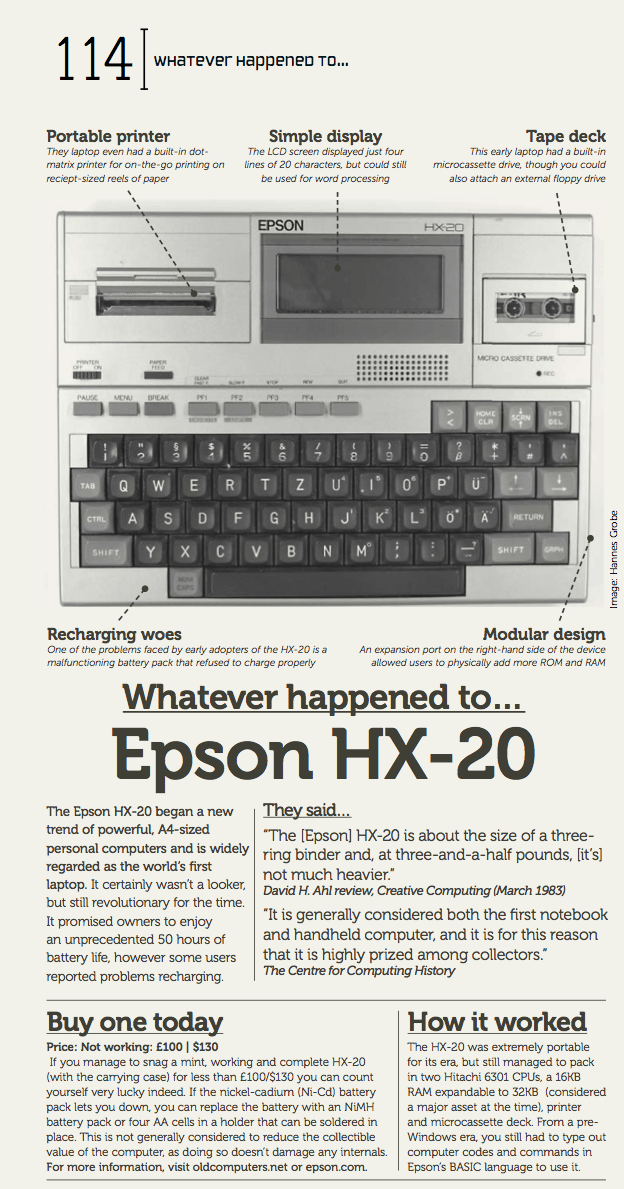
I ran into this little item in a nostalgia piece in a UK magazine called Gadget, and it brought back a lot of memories. I’ve had a lot of jobs over the years, some better than others, and one of them involved trying to sell these things–

screen-shot-2016-09-17-at-7-03-42-pm

I’ve been involved with the personal computer industry in one way or another since 1979, and in 1983/1984 while I was back in college studying business, computer science and electronics, I was also working a part time job for a business supply company that sold, among other things, this — this thing.

Epson’s claim to fame was making relatively inexpensive, relatively well made, dot matrix printers. Not computers. And when the company decided to move into the lucrative personal computer market, things didn’t go all that well for them, largely due to things like this, and the famous, (or infamous if you had to try to sell the damned things) QX-10 computer.

The HX-20 was, to put it bluntly, utterly useless. The 4 line, 20 character long display was was too small for any kind of serious work. And while the built in thermal printer was a nice feature, well, it doesn’t do you much good if you don’t have any software that actually does something useful, and the HX-20 had pretty much no software support at all. As the blurb above points out, the rechargeable battery usually didn’t. Recharge, I mean. And it certainly didn’t last 50 hours, especially if you used the printer or the tape.

The Epson factory rep took me out to dinner and dumped one of these things on me in the hopes I’d help him get my boss to buy them. I fiddled with it for an hour, the battery went dead, the printer only worked when it felt like it, and the tape deck immediately ate the one cassette tape I tried using. With the wonky battery, the dodgy tape deck, the ridiculously tiny display, and total lack of any kind of useful software, I refused to have anything to do with it.

Somehow he managed to talk our boss into ordering a dozen of the damned things, and now it was my job to try to sell them.

Meanwhile Radio Shack was coming out with the TRS-80 Model 100, which was the same size, had a 40 character by 10 line display that was actually useful, all kinds of goodies like a built in modem, built in bar code reader, real standardized I/O ports for RS-232, a ROM port for speciality software, and, better still, you could buy actual, real and useful software for it. And it cost less.

The things are probably still sitting in a box in storage somewhere. We certainly never sold any. They’re probably with the dozen or so QX-10 computers he was talked into stocking that we never sold, either.

Conversation Becomes Shouting in a Society Without Authority – The Daily Beast

We are now at a point in politics, a new book warns, where reality has lost its authority: Facts are considered a matter of opinion.

Source: Conversation Becomes Shouting in a Society Without Authority – The Daily Beast

I put up that post about the ‘Age of Stupidity’ too quickly, or I could have brought up this item over at the Daily Beast, which also touches on the matter of belief vs. facts.

The writer of the article believes that is due almost entirely to a lack of some kind of authority figure.

I don’t believe that’s true, however. We are in a situation now where a significant number of people base their beliefs not on actual fact or evidence, but on what someone tells them to believe, exactly such an ‘authority figure’ that the writer claims we need.

But we have ‘authority figures’, and they are part of the problem. The anti-vaccination crowd that puts it’s mindless belief in the ‘authority figures’ of B-list celebrities who know nothing of science or biology, the climate change deniers who blatantly ignore facts and evidence, and spout opinions based on ridiculous conspiracy theories, quasi-supernatural explanations or outright lies that offer them some kind of financial or other personal gain. The list goes on and on.

Charles Sykes, one of the right wing radio ranters here in the state, did an interview in which he explained how this is largely the fault of himself and people like him. For years now, he and others like him, like Limbaugh, Hannity, Jones and the other far right pundits, have been deliberately doing everything they can to undermine any kind of ‘authority figure’ that the public might rely on for accurate information. They’ve worked hard to undermine the mainstream media, government agencies, even science itself in order to further their own agenda.

The mainstream media itself has to take some of the blame for this current climate. In its effort to generate a never ending string of clickbait headlines, generate controversy where there is none, cause fear and panic in order to pump up its ratings and profits, it’s given voice to loony conspiracy theories, blatantly inaccurate statements by politicians and others, ridiculous health claims and I don’t know what all else. It’s failed to call out politicians over outright lies. It has just — just failed. In everything except generating profits, of course.

The Age of Stupid

Some people like to classify different periods of human development in terms of ‘ages’. We’ve had the Stone Age, the Bronze Age, the Iron Age, the Steam Age, the Space Age, the Nuclear Age.

According to a friend of mine, we have entered what will be the last age of humanity, the Age of Stupid. And one of the problems is, well, this kind of attitude:

screen-shot-2016-09-11-at-8-03-56-am

This quote from William James, a philosopher and psychologist from back around the end of the 19th century, pretty much sums up what’s going on these days. This quote was bogus at the time, and it is bogus now.

Belief does not create  fact. Belief does not alter the facts.

But that doesn’t stop millions of people from thinking that it does.

We seem to have come to a point in human evolution where a lot of people think that belief does indeed equal fact, is even superior to fact. All you have to do is turn on the television, listen to the radio, read on the internet, and you can see that.

Sometimes when I see the list of people who, for whatever reason, accept belief over fact, I despair about the future of the human race. I see it every single day. The anti-vaxxers, the creationists, the climate change deniers, the scammers selling phony cures, the conspiracy theorists… The list goes on and on. And the apparently endless string of politicians willing to exploit the ‘true believers’.

How did it happen? How did we evolve a culture where the claims of a former Playboy model are given more credibility than those of actual doctors? When did the beliefs of someone like Ken “Jesus rode a dinosaur’ Ham become more credible than those of actual geologists, paleontologists and biologists? How did we end up in a world where people share the ‘outrage’ of the “Food Babe” when she expressed horror that there was nitrogen in the air of an aircraft she was in?

Do we really live in the “Age of Stupid”?


U.S. Bites Into Cheese Mountain With Stockpile Purchase (1) | Agweb.com

Milk glut has pushed dairy prices to lowest levels since 2009.

Source: U.S. Bites Into Cheese Mountain With Stockpile Purchase (1) | Agweb.com

The buy by USDA will do little to improve farmgate milk prices, and in the long run might actually do more harm than good by temporarily improving wholesale prices and thus encourage even more overproduction.

It has not been a good time to be a dairy farmer almost anywhere in the world over the last year or two. A variety of factors, including wide spread drought one year and China stockpiling milk products led to a dramatic upturn in the farmgate price for milk. And for a time dairy farmers were doing pretty darn good.

Unfortunately, it seems that everyone, including a lot of people who should have known better, seemed to think that this situation was going to continue into the future, that dairy prices would remain high, and that there were massive profits to be made if they expanded production. As a result dairy operations began expanding all over the world. The EU lifted its production restrictions, farmers added cows, processors began building new production facilities. Fonterra, the world’s largest dairy co-op based in New Zealand, was investing heavily in the Chinese dairy industry because it saw massive profits were just waiting.

Well, it couldn’t last. And it didn’t.

China wasn’t buying up milk products because it really needed them. China was buying because it was first of all, getting a really, really good price. It wasn’t using the products it was buying, it was stockpiling them against future price increases. Chinese consumption of imported milk products was also being driven by a series of serious food contamination scares, including the deliberate adulteration of milk by criminals with chemicals that made the milk appear to have higher protein levels in order to get higher prices. The adulteration resulted in hundreds, even thousands of people becoming sick and some even dying. Ventures into marketing milk products in Southeast Asia were failing badly. The Chinese themselves were investing heavily in domestic milk production. China hates being dependent on imported foods for obvious reasons, and has been trying to do something about it. Western style mega-farms were starting to pop up, supported by the government. China was also cleaning house internally, launching extremely strict monitoring of food production to prevent things like the milk adulteration horror. They actually executed people for that crime.

So while China’s imports of milk products was shrinking drastically, world wide demand was flat, production continued to expand.

And milk prices plunged.

My father often said that a lot of farmers were their own worst enemy. Unfortunately he was largely correct.

He was also enormously skeptical of government price support efforts, and he was largely correct there as well. While these government programs like this cheese buy are well intentioned, in the long run they only serve to make the problem worse by temporarily propping up market prices and encouraging over production. Once the program ends, the market ends up being worse than it was before.


Reboots and Remakes

Screen Shot 2016 08 05 at 12 06 49 PM

Oh dear lord I’m so tired of the remakes and reboots…

But I suppose we should start with some definitions, shouldn’t we?

A remake is where they look at what was originally a perfectly fine, probably good, maybe even outstanding movie, and they just make the whole damned thing all over again for no good reason.

This is, of course, theft, but they call it homage so they get away with it.

But, well, why? I mean, really, why? The original was a fine movie, perhaps even excellent. Maybe even a true work of art. So why the hell remake it? Just watch the original, for heaven’s sake.

A reboot is something else again. A reboot takes a film idea and fundamentally alters it, transforms it totally. Basically it is the reboot maker saying the original was crap, the director was crap, the writers were crap, so I’m going to do it better. It is arrogant beyond belief. It’s the director and film makers claiming they can do it better. But everyone knows they can’t because if they had any creative talent at all, they’d be doing something original and not be digging through the archives looking for something to steal.

I call it theft because that’s what it is. Remakes and reboots are both essentially theft. Oh, sure, they legally own the rights, but it is still the taking of ideas that were not theirs to begin with.

It’s sort of like house robbery.

The remaker breaks into your house, steals your TV, but does the dishes for you, waters your plants and feeds the dog on the way you.

The rebooter breaks into your house, steals your TV, smashes your dishes, urinates in the potted plants and shoots your dog on the way out.

The Fermi Paradox: Where the Hell Is Everyone?

I’m beginning to become a bit — irritated with astronomers, and especially with astronomy publications like, well, Astronomy Magazine, Sky & Telescope, the BBC’s Sky at Night. Even with NASA, the space program in general, and a lot of astronomers and astrophysicists in general, who start babbling like little children about stuff when they should really know better. The ‘mainstream’ media is even worse, of course.

It’s this whole life thing. As in life out there, on other planets, other star systems, other galaxies.

Every once in a while some news outlet that really should know better pops up a headline like “Life on Europa!” or “Life in Oceans Under Pluto!” or “Life Floating in Clouds in Venus” or, “Life Discovered at the Republican Convention”. It’s just — just silly. (Especially that last one.).

I’m sorry, but it is. And they really should know better. Even worse, most of them do know better.

The popular press and even otherwise allegedly rational real live scientists with actual degrees from actual universities who have actual jobs doing sciency stuff, have just gotten silly over this whole life thing.

So let’s talk about the Fermi Paradox for a bit. (Wondered when I was going to get around to getting to the point of the title up there at the top, didn’t you? Relax. It takes me a while sometimes but eventually I get to the point. Sometimes. Maybe.)

The Fermi Paradox has been floating around for a long time now. Jump over to Wikipedia and go look it up. I’ll wait. I don’t have anything going on at the moment. I’ll just babble along here until you get back. While you’re at it, look up the Drake Equation over there too…

I’m an amateur astronomer with actual telescopes and everything. I love astronomy. Fun stuff, astronomy. Nothing better than sitting around outside, shivering, your feet gradually turning to ice, wondering if your health insurance covers having your toes amputated because they turned black, chipping the frost off your scope while you try to get a picture of Jupiter that doesn’t have a bloody airplane track across the middle of it. Great fun. Highly educational and all that stuff. Highly recommended. I’m also a science fiction fan. I discovered SF when I was about 9 years old and never looked back. I grew up in a fantasy world filled with starships, exotic aliens, odd characters, bizarre societies, horrific space battles throwing planets at people, time travel, time paradoxes, alternate universes, time travel to alternate universes, time travel for the purposes of, well, weird sex. Have you read Heinlein’s later stuff? Oh my…

So I’ve more or less been living in a universe full of life. I’d love to live in a universe full of that stuff. Well, except when the Fnezeer come to, well, eat us. That I probably wouldn’ like.

The thing is, I know that is fantasy. It isn’t real, all that stuff. The zooming starships, the aliens with tentacles, the time travel incest (what the hell was Heinlein thinking?) the alien races around every corner… They’re made up. They don’t exist. Unfortunately a lot of the news media and, it seems, NASA and real actual astronomers and stuff, haven’t figured that out, or that’s what it looks like if you some of the stuff they’re pushing.

Oh, you’re back. Good!

Let’s get back to the Fermi thing, then now that you got done over at Wikipedia.

The Fermi Paradox basically asks the question, if life is as common as a lot of people think it is, where the hell is it? Why haven’t we found any? And why the hell hasn’t it found us?

Considering the age of the universe, the ginormous (that apparently is a real word, I had no idea) number of galaxies, the even more ginormous number of stars in those galaxies, and the even furtherly more intensely ginormous (now that I found out it’s a real word I’m going to use it a lot, damn it) number of planets, somebody, from somewhere, should have come ringing our doorbell to try to sell us something or try to convert us to worshiping a giant space turtle or talk us into a time share out in the Wompel Galaxy or something.

Only they haven’t. There isn’t even a single sign that there’s anyone out there. Granted, the universe is a really, really big place. But if you run the math, a single, high tech civilization, could colonize an entire galaxy in a surprisingly short amount of time, maybe four, five million years. Sounds like a long time, but species even here on Earth have been around and essentially unchanged for far longer than that.

Of course maybe they’re busy, or just don’t care.  Like these alleged life forms might look up and go “meh, the hell with all that noise”, and get on with important things. Like, oh, I don’t know, frelking, let’s say. I have no idea what frelking is, but it’s like really, really important to them and it’s way more important than stars and stuff like that. So they give up on the whole space thing and get with some serious frelking. Probably has something to do with sex, I imagine.

So that’s one theory about why no one has come to try to sell us time shares or convert us or eat us or something. They don’t give a flying fig.

This space travel stuff all assumes that the race in question thinks it’s important. And maybe it is. To us. Well, some of us, anyway. But that’s us. They, if they’re out there, don’t care, maybe. That’s the point. They are going to look different, think different, have different priorities. Like frelking. They don’t care.

The point is that they come up with all these excuses to rationalize why we haven’t seen anything out there. And they do have a valid point. I mean, frelking is really, really fun. Maybe.

But the other thing that no one seems to want to bring up, is that maybe there isn’t anyone out there. Just flat out isn’t.

Yes, I know, statically speaking it is a virtual certainty that there is something alive out there, somewhere. But we have  scientists going off the deep end claiming there’s life everywhere almost.

So where is it? We don’t exactly have a good track record finding it, do we. Let’s see, well, there’s Earth, that has life (whether it’s intelligent or not is up for debate) And then there’s… well, that’s about it. One planet out of eight (nine if you’re a Pluto fan).

It’s entirely possible that Earth is just a fluke. For all we know life is an aberration that the universe gets rid of as soon as it can conveniently bash it with a rock.

And let’s talk about the intelligence thing. We want intelligent life, too. Well, come on, let’s face it. Intelligence really isn’t much of a survival trait, now is it? When it comes down to survival as a species, one could argue that intelligence is even a drawback, because the most successful species, the ones that have been around the longest, for tens of millions of years, function almost entirely on instinct, pre-programmed behaviors, not on intelligence.

I understand that it is statistically likely there is life out there. It is statistically likely that some kind of intelligent life is out there. But it seems increasingly likely that you’re not going to find it by just turning over a rock as some scientists are claiming.

But they keep at it. “Inhabitable planet found!” “Conditions on Europa favorable to life” and… It’s just silly. I’m sorry, it is. We know better. They know better.

So why do they do it?

Money, I suspect. Trying to drum up interest to get funding, get grants, convince congress to increase NASA’s budget. They figure we’re too stupid to understand things like pulsars and event horizons and how important the measurements of high energy particles is or why it’s important we understand what the hell happened to Venus to turn it into an acidic furnace from Dante’s Inferno. But, well, hey, they say, that alien movie made a hell of a lot of money. So did that Star Trek Clone Laser thingie that was in the theaters. So people like aliens, right? So, well, okay we can’t make it all up, but we can maybe pretend kind of that there’s something out there so they give us money.

Look, just stop it, all right? Stop with the phony press releases about life on space rocks. Stop with the phony press releases about planets made of diamond and places where it rains iron and all that. It’s hype and you know it. We know it. They know it.

Just tell us what you’re doing. Tell us why you think it’s important. Tell us why we should think it’s important. Stop trying to sell us space unicorns that we all know are b.s. Maybe you’ll be surprised.