It’s been a while since I did one of these. It isn’t that I’ve lost interest in what’s going on in the ag industry, it’s just that since I’m not personally involved any more it just hasn’t had the same importance for me. But a lot is going on out there in the farming business, and one thing I want to focus on is ethanol today.
2020 was a bad year for the ethanol industry. This was due to the pandemic, of course, but only partly. A lot of production facilities had to cut back, even temporarily close. Some shut down completely and will probably never be brought back online. Adding to the problems the industry is facing is the fact that they primarily use corn as the base material to make ethanol from, and corn prices have jumped up to $5.50 a bushel and show no signs of going down any time soon. (It’s a bit ironic that an industry that was created, at least partly, as a government mandated program to push up corn prices is now threatened by high corn prices.)
But the real problem with the ethanol industry isn’t the pandemic or corn prices, it’s the fact that the entire ethanol fuel industry is dead and the promoters of this stuff simply refuse to admit it. Like it or not, it seems that the future of transportation is not the internal combustion engine, it is going to be electric motors.
Electric vehicles are no longer a novelty item, they’ve gone mainstream, and consumers are buying them in droves. And it’s easy to see why. There is little to no maintenance. No more oil changes, no more cooling systems to flush and fill with antifreeze, no more transmission fluid to check and change and flush, no more exhaust systems rusting off that need to be replaced regularly. They’re quiet, efficient, with ranges of up to 300 miles depending on the model. Fast charging systems that can recharge a vehicle in a half hour or less are finally starting to turn up in a lot of cities, and will quickly become more common. It seems virtually certain at this point that the vehicle you buy in the near future is almost certainly going to be electric.
It isn’t just me who’s saying this. Several countries have already declared that they will ban sales of cars and light trucks with internal combustion engines within the next 15 to 20 years. California will ban the sale of new gasoline powered cars in 2035, as will the Canadian province of Quebec. Britain will ban the sale of new gasoline and diesel powered cars in 2030. Norway is doing it in 2025. China, of all places, is considering doing something similar.
And now GM, General Motors, has announced that it will only produce zero emissions vehicles by 2035 or 2040. And they aren’t the only car maker considering it. Heck, even the railroad and tractor manufacturers are getting into it. One company already has small utility tractors in the 30 – 40 horsepower range suitable for orchards, landscapers, organic farms and the like, in the $25,000 range. Run times are up to 4+ hours, and if you can’t wait to recharge, you can get a second battery pack and swap the uncharged one out, put the charged on in and keep working while the other battery charges.
The future is clear. The entire ethanol fuel industry is as good as dead.
It isn’t going to go down without a fight. It is spending millions of dollars lobbying politicians to try to keep itself on life support. It is about to embark on a massive lobbying campaign against electric vehicles, claiming they are actually more polluting than internal combustion engines, demanding ever increasing percentages in blending with gasoline, pushing for even more government subsidies and tax breaks… The industry will bluster and threaten and lie and bribe and do everything it can to try to hang on. It isn’t going to work. It’s time to nail the lid on the coffin of ethanol and bury it once and for all.
Instead of trying to continue to prop up a dying industry with ever more government bailouts and mandates, we should be preparing to deal with the repercussions of the industry shrinking and eventually going away entirely. This will cause problems that will ripple through the entire ag industry. Corn prices could potentially plummet. Livestock and dairy will have problems because they have come to depend on brewers grain, what’s left after the ethanol is made, as a relatively low cost protein supplement for cattle. All of this, and more, will happen. And it looks like no one is going to try to deal with this before it turns into a crisis.
I’m interested in a lot of different things, as you already know if you’ve been reading this blog for a while. I’ve dabbled with amateur radio, electronics, farming, gardening, photography, astronomy, wood working, etc. I can’t help it. That’s just the way I am. I’m enormously curious about just about everything, especially if it’s something I can play with personally. And once upon a time I did needlework like crewel, needlepoint, etc.
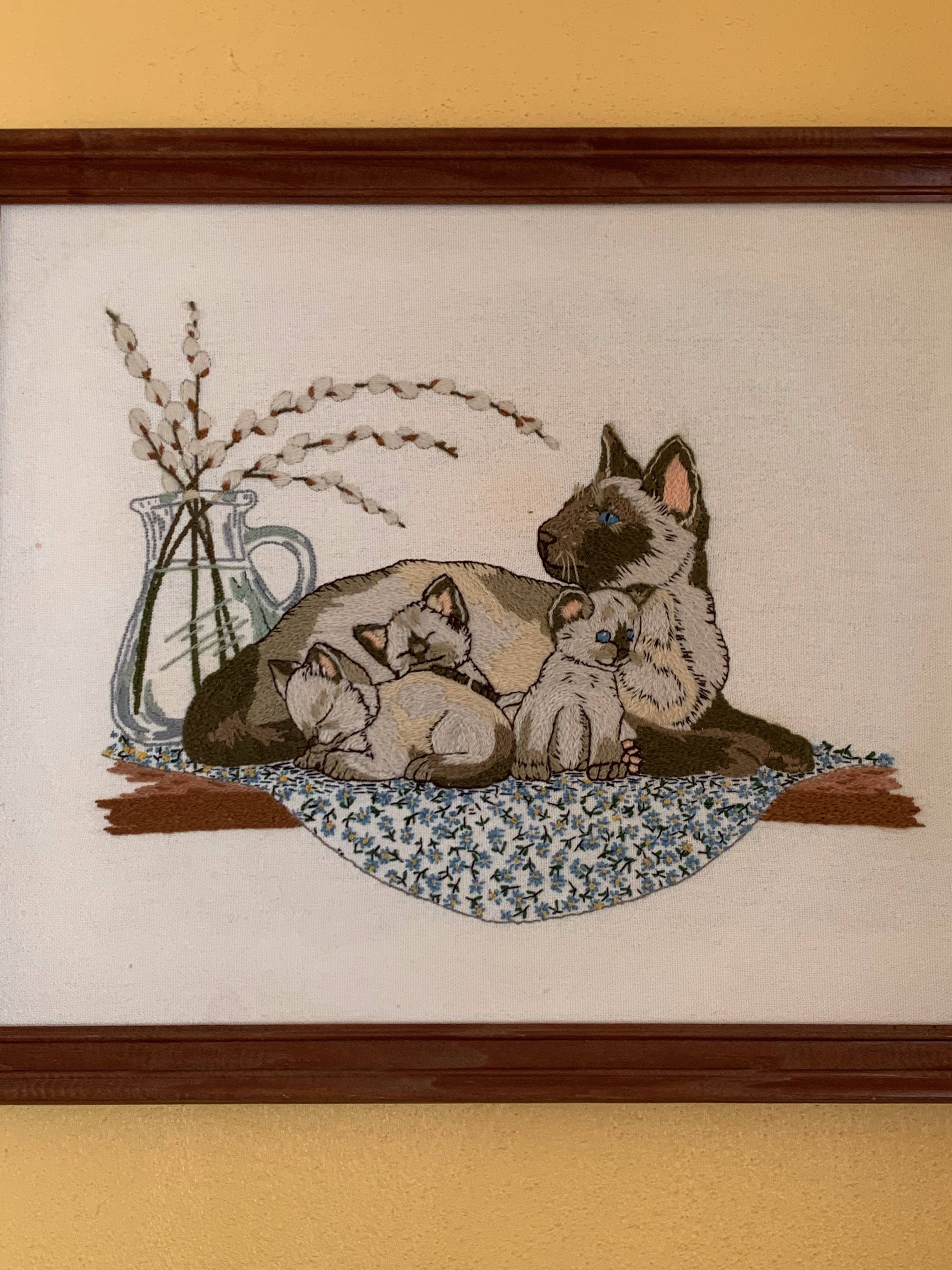
Stuff like this:
This dopey cat and kittens needlework project took 41 years to complete. Seriously. Let me explain.
It was 1980. MrsGF and I were just married, had moved into a tiny one bedroom apartment, and we were looking for things to do to wind down once we got home from work. Something that didn’t take up any space because we basically didn’t have any space in the cramped apartment we were living in. Oh, and something that didn’t cost any money because we had even less money than space.
So for some strange reason I started to fiddle around with needlework. That’s when this project started, 1980. And I rather enjoyed doing it. I got the cats more than half done and then stopped. Why? It got lost when we moved. We moved a lot the first couple of years we were married. The cats, all the yarn and thread, the hoops, needles, everything, got stuffed into a box and it was forgotten about.
Until late in 2020 when MrsGF found the thing in the attic when she was looking for something else. It was badly stained but MrsGF said why don’t you finish it anyway, and I said I just don’t have the time and told her she should just do it if she wants to. So she went to work trying to get the stains out, and did a darn good job of it. The thing was really dirty. And she finished up the needlework and we stuck it in a frame. I did maybe 60% of it or so before we lost it back in 1980, and she did all the rest, and now it’s hanging on the wall, our 41 year long project.
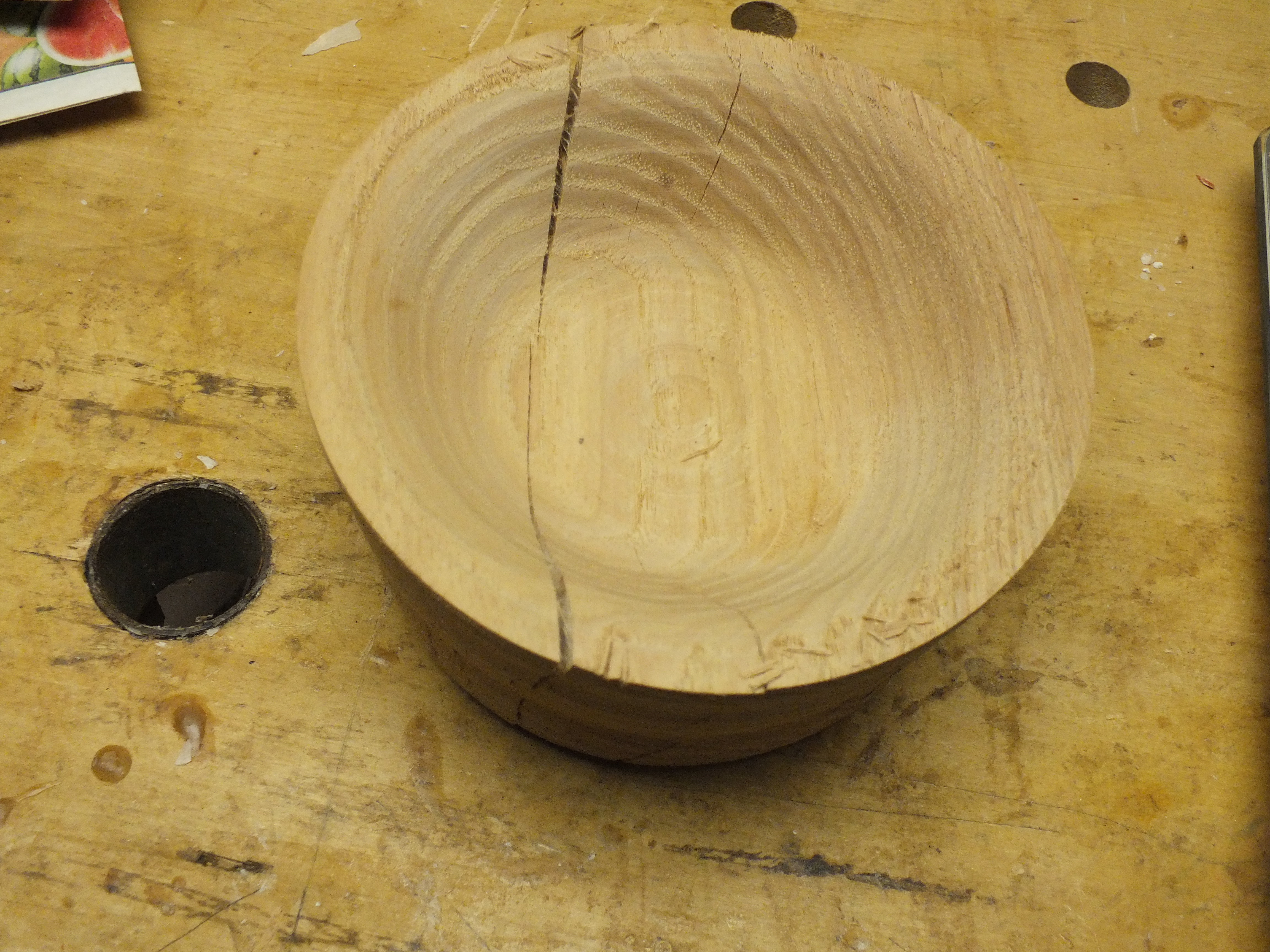
I’ve made a lot of mistakes learning how to do this, but sometimes the wood itself is just – just weird and things go wrong no matter what I do, and that’s what happened here. There was no sign of cracking or anything at all odd about this block of wood when I started turning it, but for some reason it ended up with cracks all over. It was reasonably dry, well under 15% moisture. The wood itself seemed reasonably stable, with nice grain. But by the time I got it turned into a rough shape it started cracking. I took it off the lathe and let it sit for a few days and this is what it looks like now.
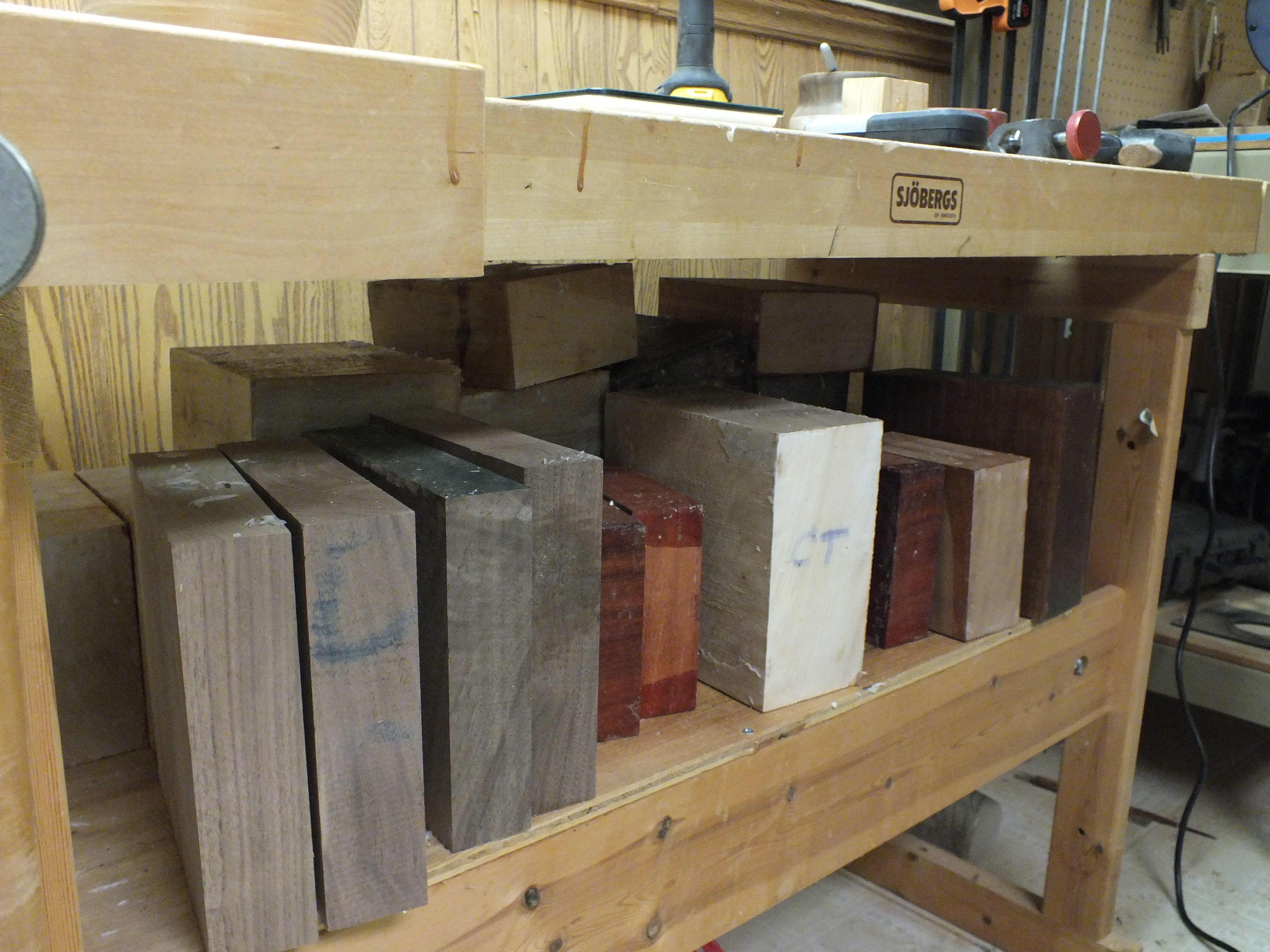
I seem to collect wood like some people collect baseball cards.
I suppose I could try to salvage something from this piece. I could seal up the cracks with CA or cast it in resin but, well, why? It would still look like a badly cracked bit of wood. This one will get chucked into the burn pile, I think. Won’t be the first time I’ve had to do that. And it isn’t like I have a wood shortage around here. I have dozens of blanks of various sizes and species sitting on the shelf in varying stages of drying, quite a few probably ready to turn.
I don’t just do wood turning, of course. I do everything from rough framing to furniture.
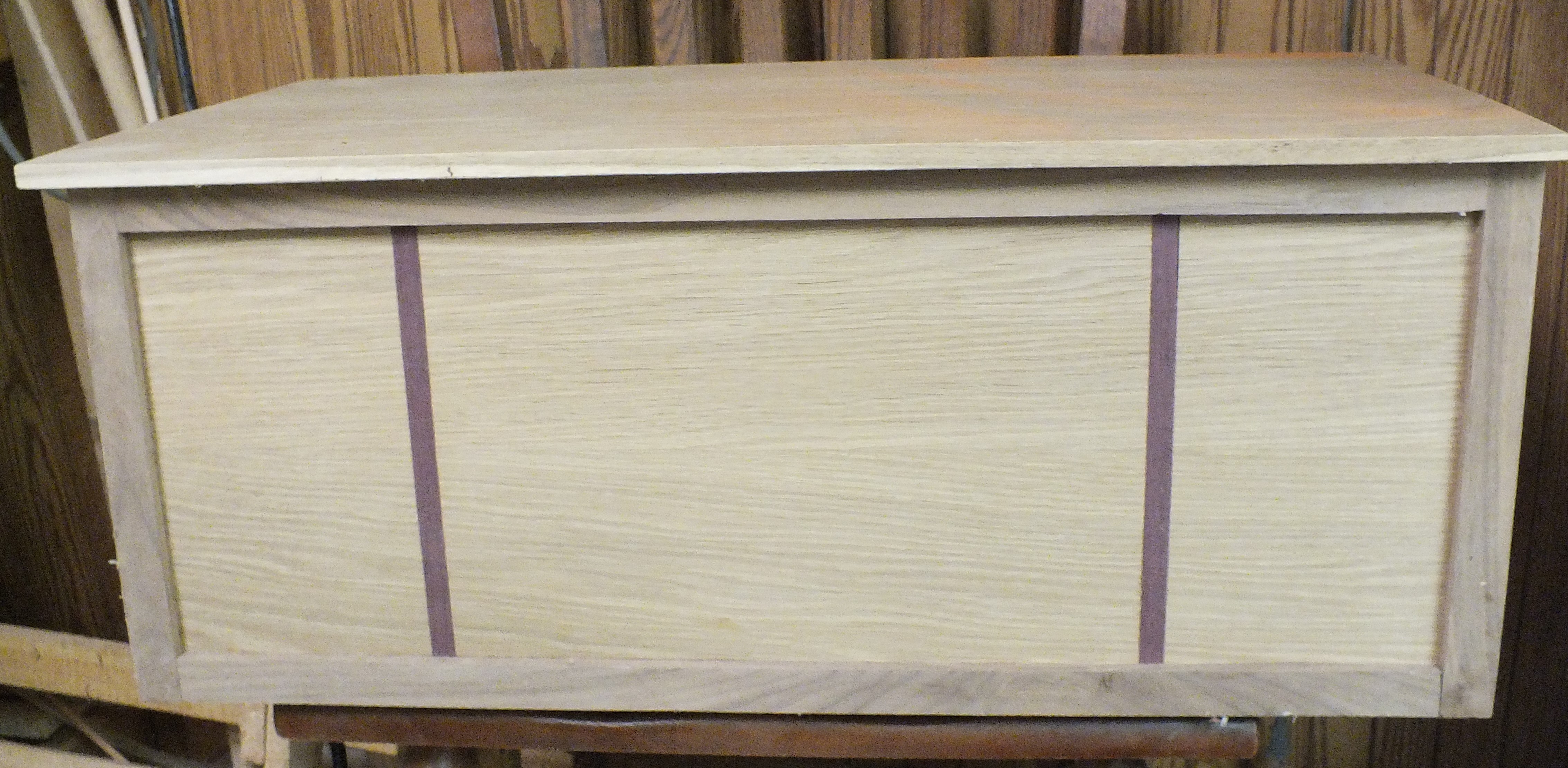
This a blanket chest and it is on the agenda for tomorrow. It was kicking around the shop for ages and finally MrsGF put her foot down and told me to just finish the dopy thing, so I got the lid done and a few other things finished up and now it needs finish sanding and some of the glue joints to be cleaned up and I need to get some handles for it and this will be ready to go out the door. It looks rather pale now but once the finish is on the inlay will really pop and the black walnut edges will really show.
I forgot one item when I looked at the tools I’d picked up during 2020, and that’s the Oneida “Dust Deputy” in the photo over there on the left. It helps to deal with an ever present problem for anyone who works with wood, the dust and debris generated by woodworking.
In an ideal world we’d all have professional quality dust collection systems. But those things are big, expensive, etc. Not all of us have the space or the money to set one of these up, so a lot of us end up using a good old fashioned shop vac as our primary dust/debris collection system. Modern, good quality shop vacs can be almost as efficient at removing dust and debris as a traditional dust collection system, although they don’t have the capacity to keep up with some tools like planers and jointers. It all depends on the power of the motor, the CFM (cubic feet per minute air movement) and the filtration system the vac uses. The biggest drawbacks are that the vacs are (usually) very loud, have to be moved around the shop to be hooked up to individual pieces of equipment, and have to be emptied very frequently. Lugging my big 16 gallon sized shop vac up and down a flight of stairs to get it in and out of the house in order to empty it is not fun.
This Dirt Deputy gadget and similar devices have been around for a long time, but I’ve never been that interested in them before because A) I wasn’t making that much dust and debris before now, and B) I figured that like a lot of things that sounded too good to be true, it was, well, too good to be true. But wood turning generates massive amounts of dust and wood shavings, far more than making furniture did. So not only was I lugging that big vac up and down the stairs all the time, I was going through filters like crazy. No matter how good of a job you may do blowing out or cleaning that filter, you can’t get it completely clean and eventually it will get plugged up to the point it won’t pass enough air to permit the vac to work. So I decided to try this thing.
The basic idea behind these things has been around for a long time. You hook the shop vac up to the outlet on top, hook your hose to the lower outlet, slap it on top of a standard 5 gallon bucket, and that’s it. As the air (and dirt) whirls around inside of the funnel shaped thing, the dust and shavings and other debris end up falling down into the bucket instead of getting sucked into your vac.
Almost all the debris and dust ends up in the bucket.
As I said I was skeptical of this thing, but the darned thing actually works, and works pretty well. Even fine dust seems to settle into the bucket instead of ending up in the vacuum. Instead of having to lug the whole vac up the stairs and out to the garage I can just carry the bucket. But the biggest hope I had was that this would save me money. Those big cartridge filters on my shop vac are expensive. About three of those filters would pay for this whole Dust Deputy thing, so it could potentially save me a lot of $$. And it does. This thing has already paid for itself in the two months or so I’ve had it. I’m really quite pleased with it.
almost nothing ends up in the vac itself. Yes, the very fine dust passes through and eventually the filter will plug up, but I get much, much longer life out of the filters than I did before.
Are there drawbacks to it? Sure. There always are with things like this. The biggest drawback in this case is a reduction in suction power, which makes sense. You’re adding several feet of air hose, the Deputy itself, possible air leaks, etc, into the system. So that all restricts air flow and reduces the amount of vacuum power. In my case, my big vac, which could keep up with my thickness planer without the Deputy installed, can no longer handle my DeWalt planer with the Deputy. That’s not a big deal, though. I don’t use the planer all that often these days and when I do need it I simply hook the vac up to it direct and bypass the Deputy.
So, what’s this thing cost? Oneida will gleefully sell you a whole “kit” for about $100+ which includes the Deputy wind tunnel swirly thingie, the bucket lid it attaches to, a short hose to hook to your vac, some hose clamps, a 2nd bucket that the first bucket nests into, and little wheels to bolt to the outer bucket to make it easier to lug around and the instructions tell you to drill holes through the side of your vacuum and bolt the 2nd bucket to your vac for some reason and, well, don’t. You don’t need the 2nd bucket, you don’t need the wheels, you don’t need the hose clamps (if your existing hoses don’t fit perfectly, you can always resort to duct tape, that’s what I did), you don’t need any of that stuff. Basically they’re charging you $50 for a couple of buckets you can probably get free and $10 of hardware. If you want to try one of these, get the “basic” kit.
The basic kit goes for about $50 without the wheels, the buckets and all the other guff, and that’s all you need. It comes with the cyclone thing, some bolts and a gasket. That’s it. You get your own 5 gallon bucket with a lid (probably free). Cut a hole in the lid, screw the cyclone thing to it, and use your own hoses and clamps. If you need more hose or clamps you can get everything you need at the local home improvement store.
The way things look right now, this thing is going to save me easily going to save me money on filters.
Rosewood
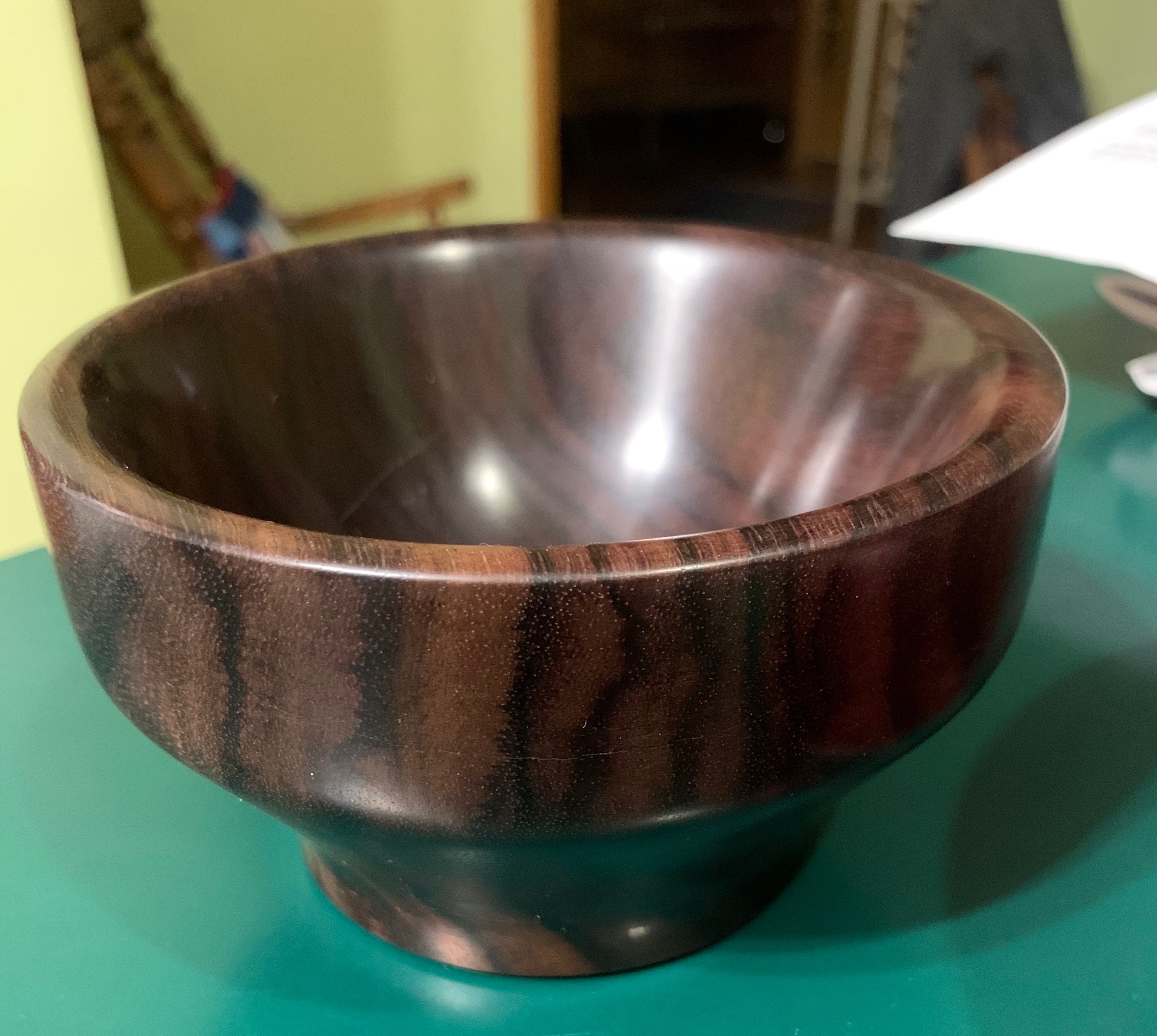
I found a vendor on Amazon that was selling large blocks of Indian rosewood. It was actually not all that expensive and I’d never worked with it before so i got a couple of blocks just to see what it was like. I picked up two pieces, about 6 inches square and 3 inches thick. I think I paid about $30 each for the two pieces. That may seem like a lot but that’s actually pretty reasonable for this stuff on the commercial market. If you want good quality imported woods, you’re going to pay for it. Rosewood is really popular with the pen turning people. I see a lot of places selling rosewood blanks sized for pen makers, but almost never see large pieces big enough to make bowls.
As you can (hopefully) see in that photo over there the wood is absolutely beautiful once it’s sanded and finished. And it just feels nice to the touch. Whenever I walk past that bowl I find myself running my fingers over it. I can see why pen turners like this stuff. It is a bit messy, though. I don’t know if it was just the pieces I got or if it is normal, but the stuff seemed really oily, with the dust clinging to my tools (and me). It machined beautifully, though. No problems with catches or snags or weird tear outs or anything like that, and it even sanded down beautifully. And it polishes up to a beautiful luster.
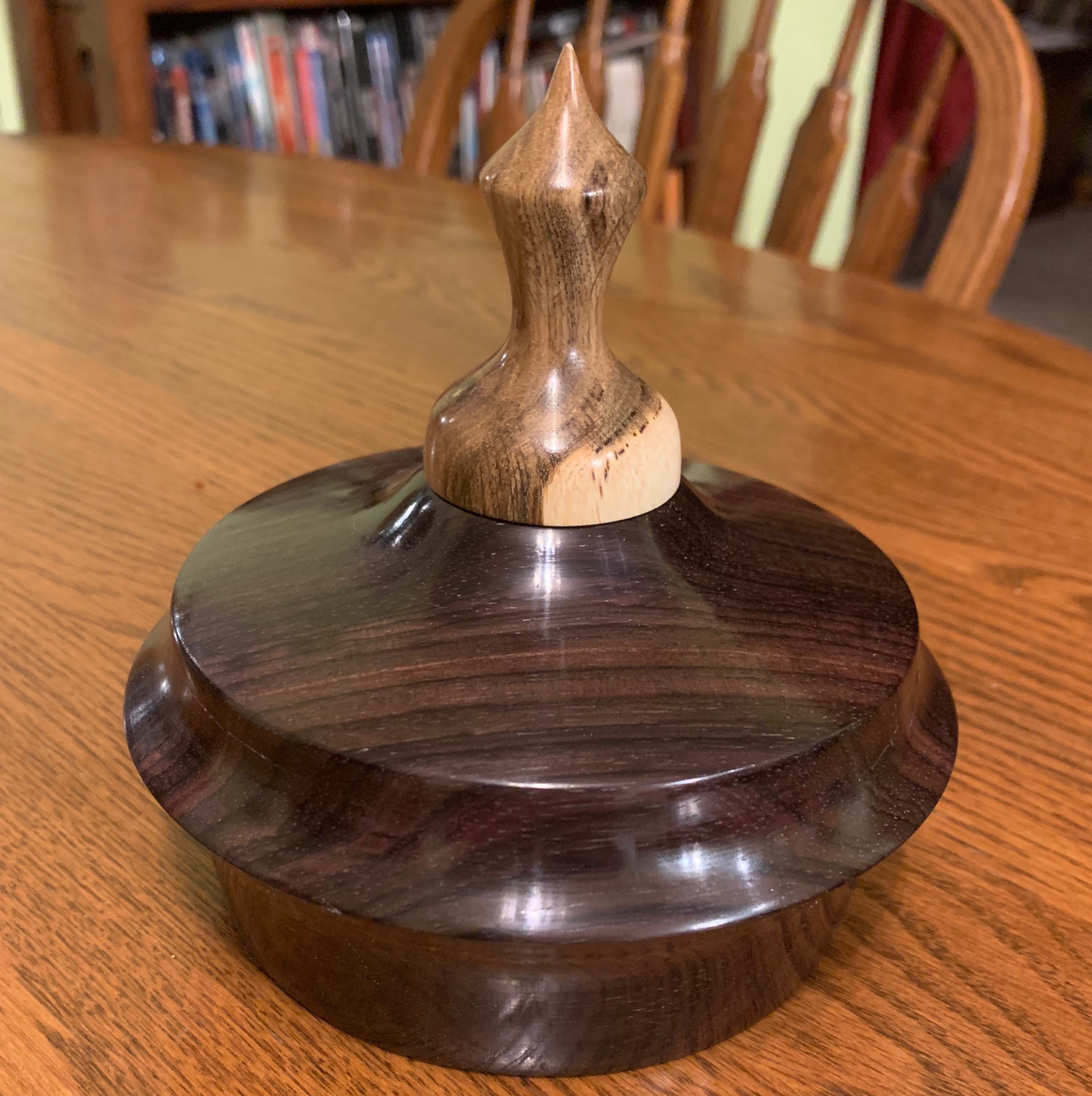
This is what the 2nd block of rosewood turned into. I love working with this stuff, despite the smell. The finial, by the way, is made from a piece of tree limb I found at the compost site, believe it or not. Not sure I like that finial. I think it’s too tall. I might end up making a different one.
But the smell… Now I’m one of those weird people who are classified as a “super smeller”. I have a ridiculously sensitive sense of smell (and taste, for that matter). To me this stuff has a very distinctive aroma that vaguely resembles, well, poo, to be blunt. MrsGF can’t smell it at all. After putting a finish on the bowl the smell diminished greatly, but I can still smell it when I get within a couple of feet of it. I wondered if maybe it was just that one block of wood, but the second one smelled just like the first.
I like this rosewood stuff, but… There are problems. I’m seeing what I suppose you could call micro-cracks in the wood, very fine, almost invisible cracks that I can’t see unless I get within a foot or two of the bowls. I’m rather concerned about that because I have no idea why they are there. I need to take a closer look at this and figure out what happened. Wood is, well, wood. It moves, absorbs and gives off moisture, swells, contracts. It’s all part of the challenges of working with the stuff. I generally know what happened when a piece of wood cracks or warps, but I’m not sure what’s going on here. MrsGF is encouraging me to start trying to sell some of this stuff, but I don’t want to end up with people complaining about something like this so I want to figure out what went wrong before I turn out more stuff in rosewood.
Let’s see, what else…
Oh, the pear tree – I saved a lot of the wood from the pear tree when we took it down last year after it collapsed with the intention of possibly using it for various projects. I got curious about how it would look and work so I grabbed a bit that seemed reasonably dry and ended up with this small vase.
The stuff machines nicely, sands well and looks fairly good once it’s finished. It seems to be prone to cracking. You can’t see it in this photo but on the backside of that thing there is a vertical crack running almost the entire length of the vase that’s sealed up with epoxy. Still the results are encouraging and I’m going to keep fiddling with this stuff as I get time.
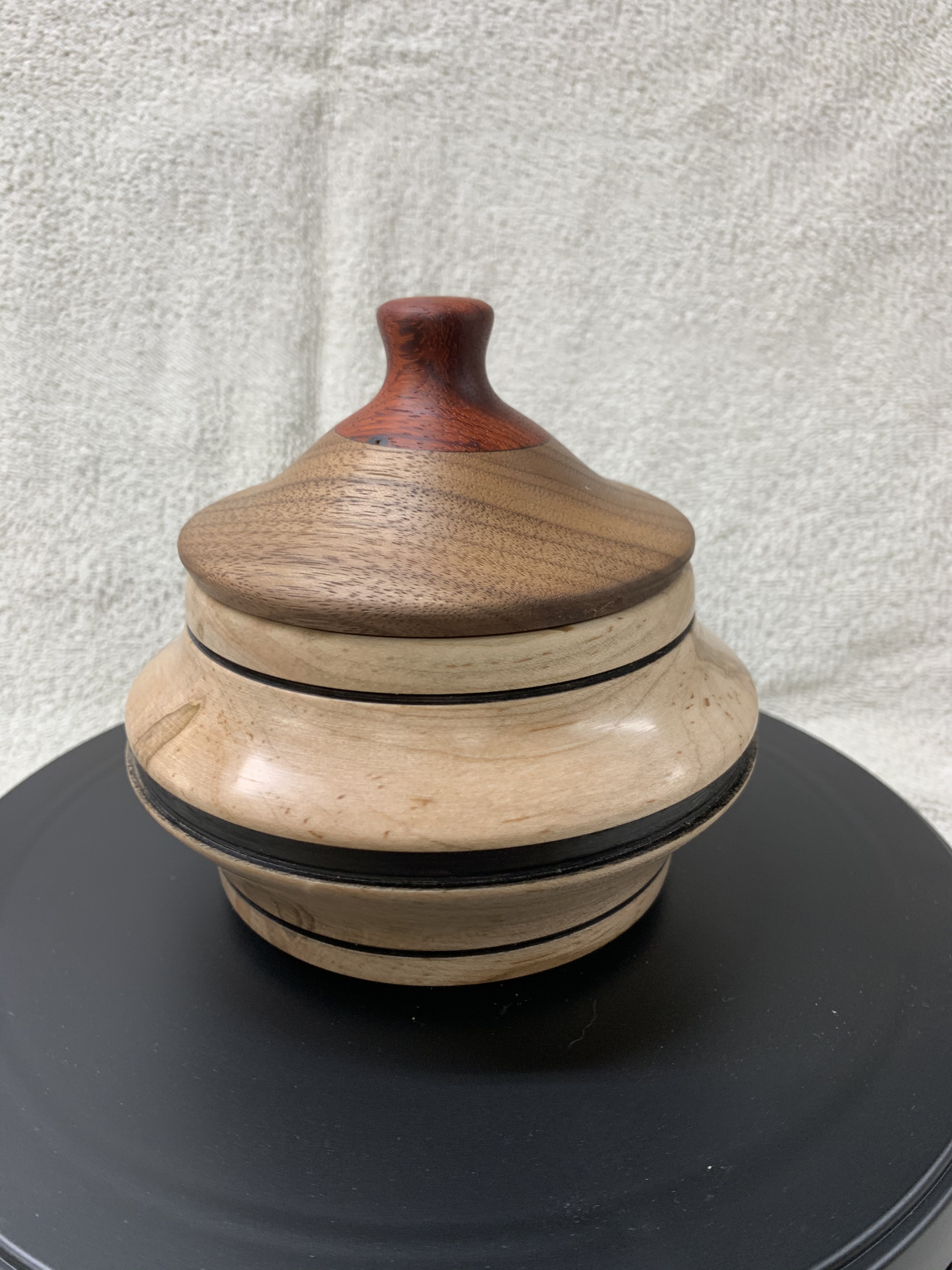
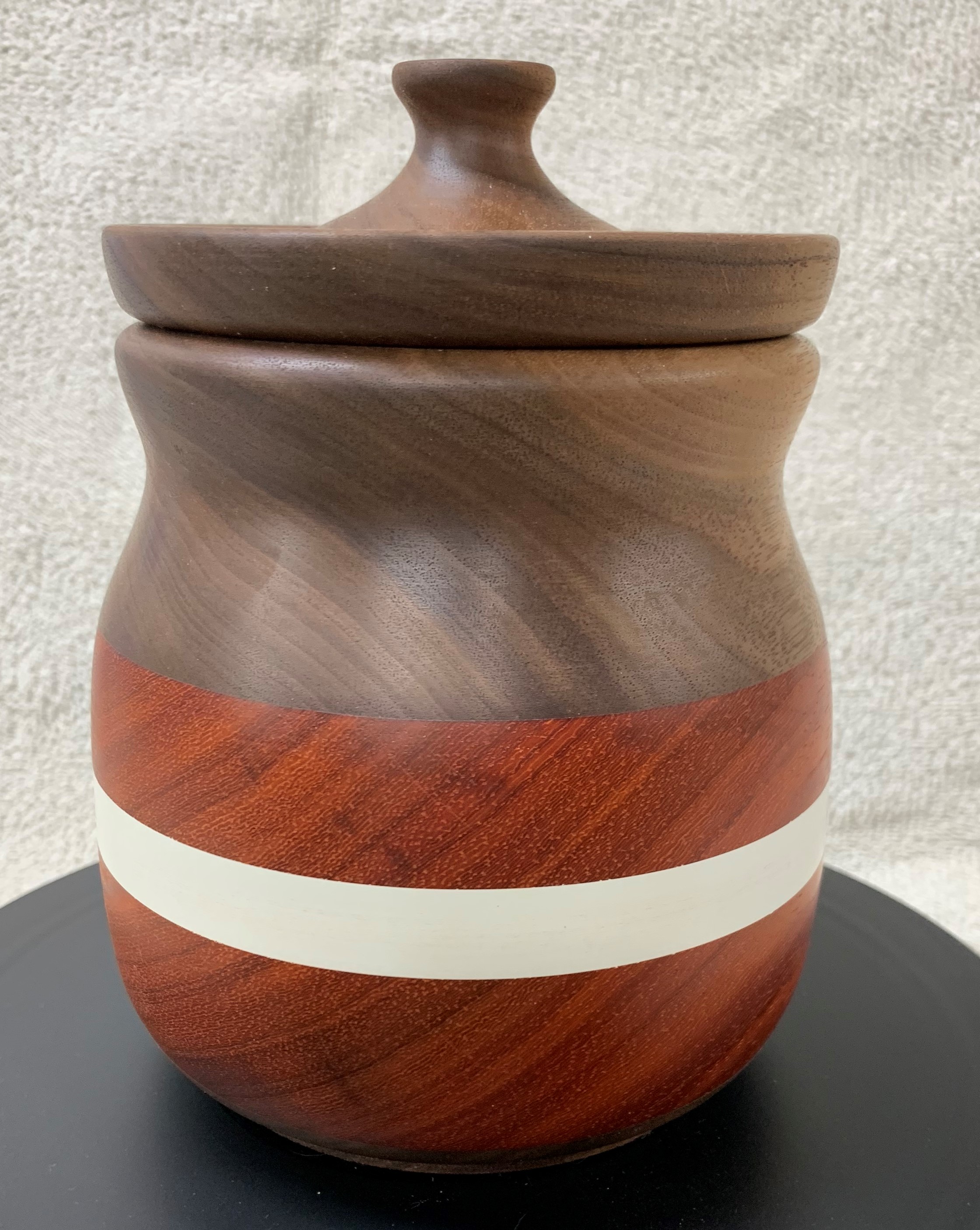
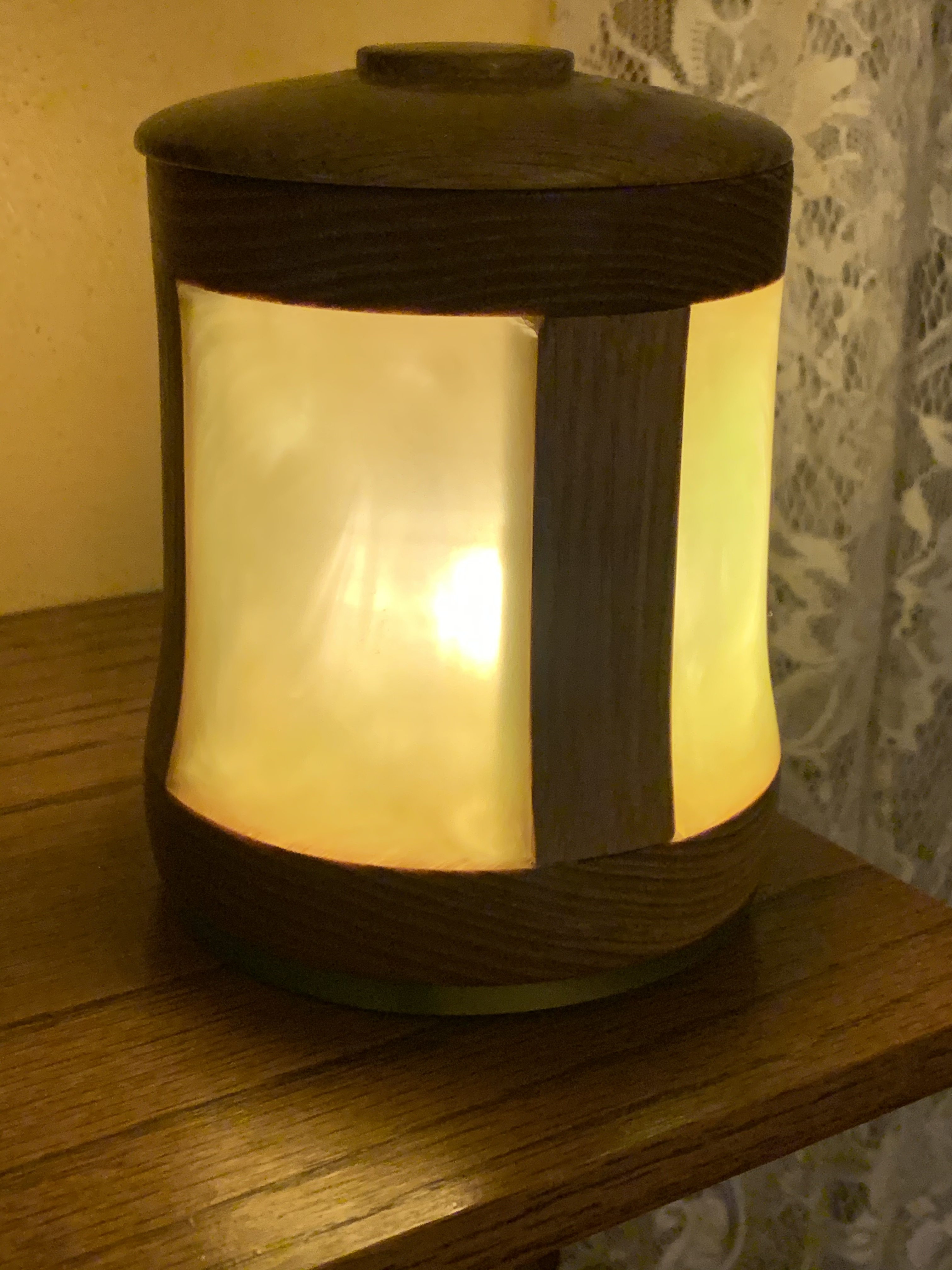
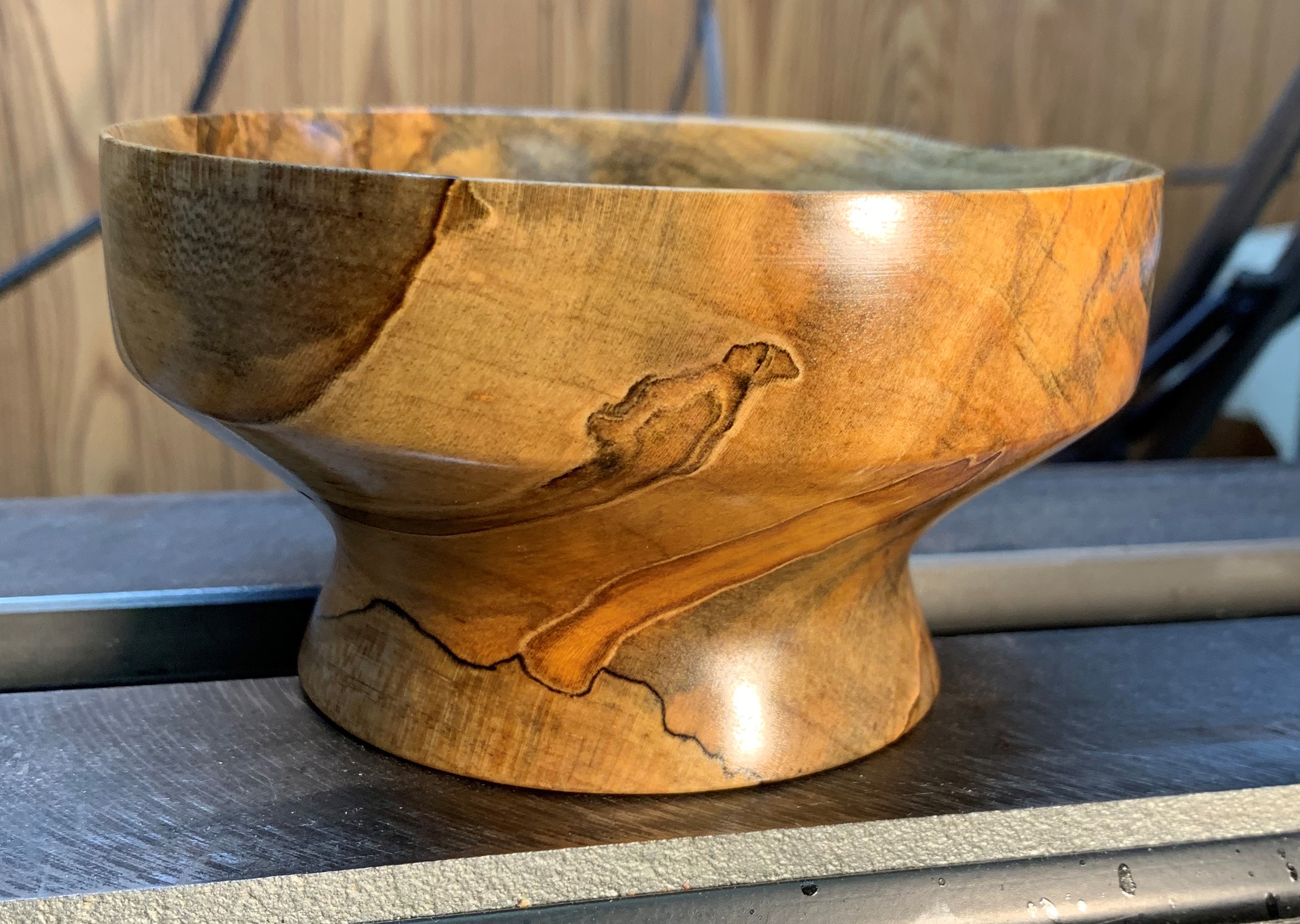
As I said, MrsGF and a few other people are telling me I need to try selling some of the stuff I’ve been cranking out so they’re pushing me to set up a shop on Etsy. Sigh… I don’t really want to get involved in all of that guff, but I do see their point. If I keep this up much longer I’ll have to rent a storage unit somewhere just to store the projects I’ve been cranking out.









 grouchyfarmer