South Mountain Creamery in Maryland is in something of a bizarre situation. The farm has it’s own bottling plant and sells milk directly to consumers, and it has the FDA going after it because it’s 100% real pasteurized skim milk is, well, 100% real skim milk and nothing else.
That’s right, the FDA claims the creamery cannot label it’s skim milk as “skim milk”. It is trying to order the creamery to label it “imitation milk product” or “imitation milk” when, well, when it absolutely is not imitation anything. The FDA claims it has to be labeled “imitation” because the product does not contain artificially added vitamins.
Now, a bit of background here. The milk you buy in the grocery store is not actually pure milk. Pretty much none of it is. It has vitamins A and D added to it. Basically the bottling plant throws a ground up vitamin pill in it. Why? Because once up on a time about 90 or so years ago, we had problems with vitamin deficiencies so the government began to mandate adding extra vitamins to milk. But the fact of the matter is that this hasn’t been necessary in, well, half a century, really. And there is actually a risk of getting too much A and D. Most European countries actually ban adding adding them to milk because of the risk of overdose. Too much D can cause heart arrhythmia and other problems and too much A can be seriously toxic as well.
And in any case, the amount of A and D being added may not even be what it says on the label to begin with as the New York Times discovered back in 1992 when independent testing of milk samples found that the actual amounts of vitamins in the milk being sold varied wildly, and in at least one case back in 1992 the level of vitamin D was so high it was dangerous causing medical problems for at least eight people.
Now I’m not going to get into the debate about whether or not D and A should or should not be added to milk. I just want to talk about this whole labeling nonsense because, well, according to the FDA’s own regulations, the agency’s actions in this case seem to be just wrong. Here is how FDA defines “milk”:
| [Code of Federal Regulations] |
| [Title 21, Volume 2] |
| [Revised as of April 1, 2017] |
| [CITE: 21CFR131.110] |
|
|
|
CHAPTER I–FOOD AND DRUG ADMINISTRATION
DEPARTMENT OF HEALTH AND HUMAN SERVICES |
|
| SUBCHAPTER B–FOOD FOR HUMAN CONSUMPTION |
|
PART 131 — MILK AND CREAM
Subpart B–Requirements for Specific Standardized Milk and Cream
| (a) Description. Milk is the lacteal secretion, practically free from colostrum, obtained by the complete milking of one or more healthy cows. Milk that is in final package form for beverage use shall have been pasteurized or ultrapasteurized, and shall contain not less than 8 1/4 percent milk solids not fat and not less than 3 1/4 percent milkfat. Milk may have been adjusted by separating part of the milkfat therefrom, or by adding thereto cream, concentrated milk, dry whole milk, skim milk, concentrated skim milk, or nonfat dry milk. Milk may be homogenized.
(b) Vitamin addition (Optional). (1) If added, vitamin A shall be present in such quantity that each quart of the food contains not less than 2000 International Units thereof within limits of good manufacturing practice.
(2) If added, vitamin D shall be present in such quantity that each quart of the food contains 400 International Units thereof within limits of good manufacturing practice.
(c) Optional ingredients. The following safe and suitable ingredients may be used:
(1) Carriers for vitamins A and D.
(2) Characterizing flavoring ingredients (with or without coloring, nutritive sweetener, emulsifiers, and stabilizers) as follows:
(i) Fruit and fruit juice (including concentrated fruit and fruit juice).
(ii) Natural and artificial food flavorings.
(d) Methods of analysis. Referenced methods are from “Official Methods of Analysis of the Association of Official Analytical Chemists,” 13th Ed. (1980), which is incorporated by reference. Copies may be obtained from the AOAC INTERNATIONAL, 481 North Frederick Ave., suite 500, Gaithersburg, MD 20877, or may be examined at the National Archives and Records Administration (NARA). For information on the availability of this material at NARA, call 202-741-6030, or go to: http://www.archives.gov/federal_register/code_of_federal_regulations/ibr_locations.html.
(1) Milkfat content–“Fat, Roese-Gottlieb Method–Official Final Action,” section 16.059.
(2) Milk solids not fat content–Calculated by subtracting the milk fat content from the total solids content as determined by the method “Total Solids, Method I–Official Final Action,” section 16.032.
(3) Vitamin D content–“Vitamin D–Official Final Action,” sections 43.195-43.208.
(e) Nomenclature. The name of the food is “milk”. The name of the food shall be accompanied on the label by a declaration indicating the presence of any characterizing flavoring, as specified in 101.22 of this chapter.
(1) The following terms shall accompany the name of the food wherever it appears on the principal display panel or panels of the label in letters not less than one-half the height of the letters used in such name:
(i) If vitamins are added, the phrase “vitamin A” or “vitamin A added”, or “vitamin D” or “vitamin D added”, or “vitamin A and D” or “vitamins A and D added”, as is appropriate. The word “vitamin” may be abbreviated “vit.”.
(ii) The word “ultra-pasteurized” if the food has been ultra-pasteurized.
(2) The following terms may appear on the label:
(i) The word “pasteurized” if the food has been pasteurized.
(ii) The word “homogenized” if the food has been homogenized.
(f) Label declaration. Each of the ingredients used in the food shall be declared on the label as required by the applicable sections of parts 101 and 130 of this chapter.
[42 FR 14360, Mar. 15, 1977, as amended at 47 FR 11822, Mar. 19, 1982; 49 FR 10090, Mar. 19, 1984; 54 FR 24892, June 12, 1989; 58 FR 2890, Jan. 6, 1993] |
If you can wade through the legalese up there, you will note that “milk” is specifically defined, and it says things like “if” vitamin A is added, and “if” vitamin D is added, they must be at certain levels. But it doesn’t say they must be added for the product to be called “milk”. Nor does it say anything about a requirement to label milk as “imitation” if they are not added. So if this is accurate, FDA’s claim that this creamery’s skim milk must be labeled “imitation” is not in keeping with FDA’s own regulations.
Now there may be some regulation, somewhere, that requires milk to have added A and D in order to be called “milk” but I haven’t managed to find any regulations that state explicitly that in order to label something “milk” it must have A and D added to it.
This isn’t the first time this issue has come up. About a year ago there was a case in Florida where the state claimed the Ocheesee Creamery couldn’t label it’s skim milk as “skim milk” and had to call it “imitation skim milk”, despite the fact it was 100% skim milk. The state lost and lost badly, ending up with the 11th US Circuit Court ruling against the state and Florida having to pay almost half a million dollars.
The other thing I find curious is that despite the fact that the FDA has a rather strict definition of the term “milk”, i.e. “Milk is the lacteal secretion, practically free from colostrum, obtained by the complete milking of one or more healthy cows.”, it doesn’t seem to have a problem with various nut and legume juices and extracts labeling themselves as “milk”, such as soy milk and pea milk and almond milk.
 That’s what they’re calling it now, Blizzard Evelyn. We’re currently under a full scale blizzard warning and have been since yesterday. The photo doesn’t look very bad right now but we were in a lull in the storm when I took it around 6 AM. So far we’ve had about 12 inches of snow with freezing rain mixed in at times and 40 mph winds. Today they’re predicting as much as 14 inches more on top of what we already have with 50 mph winds.
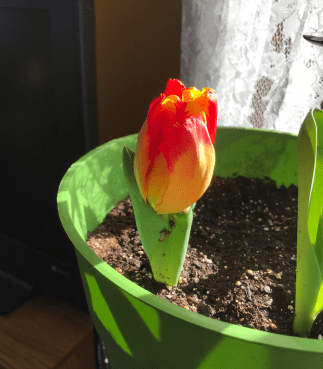 The tulips MrsGF potted up a few weeks ago are still going strong with new blooms popping up and it certainly improves my mood when I walk in the room and see those brilliant yellows and reds. I’m really glad she came up with the idea of potting up some old bulbs. It really brightens the place up.
 That’s this thing over here. It’s a folding metal frame with three racks in it with a vinyl cover over the top. It provides an ideal environment for starting seeds. It stays warm and moist inside and lets in enough light to keep things grown and nice and warm in there. Also prevents temperature fluctuations inside the house from harming the plants.
 grouchyfarmer