After a rather dreary and cool spring, summer has hit with a vengeance. Temperatures for the last few days have been abnormally hot, in the high 80s and low 90s, temperatures we usually don’t see until well into mid summer. It’s also been very dry. We haven’t had a decent rain in something like a month now. Grass normally doesn’t go brown and dormant around here until late July. My lawn is already as dry as dust and turning brown. Still, the flower beds seem to be enjoying it and it’s a riot of color out there.
There are the irises, of course. They’re looking absolutely stunning right now.
But if you stop and get down on the ground and peer around you’ll find little treasures as well, like these…
With the showy irises taking center stage it would be easy to overlook those little guys up there.
And no collection of flower photos would be complete without the first rose of the season.
That’s it for now. The weather changed drastically. We went from hot and dry to cold and wet which is actually something of a relief. We hadn’t had any rain in something like a month and a half before this weather system moved in so no one is complaining.
I managed to injure my left leg when I was wrestling around with those massive batteries for the solar power system so my physical activity was seriously limited for a couple of weeks. Yesterday was the first day I felt comfortable enough to get out on the bike for an extended ride, and it was a great day to start. Was absolutely beautiful out with temps in the high 70s and a gentle breeze.
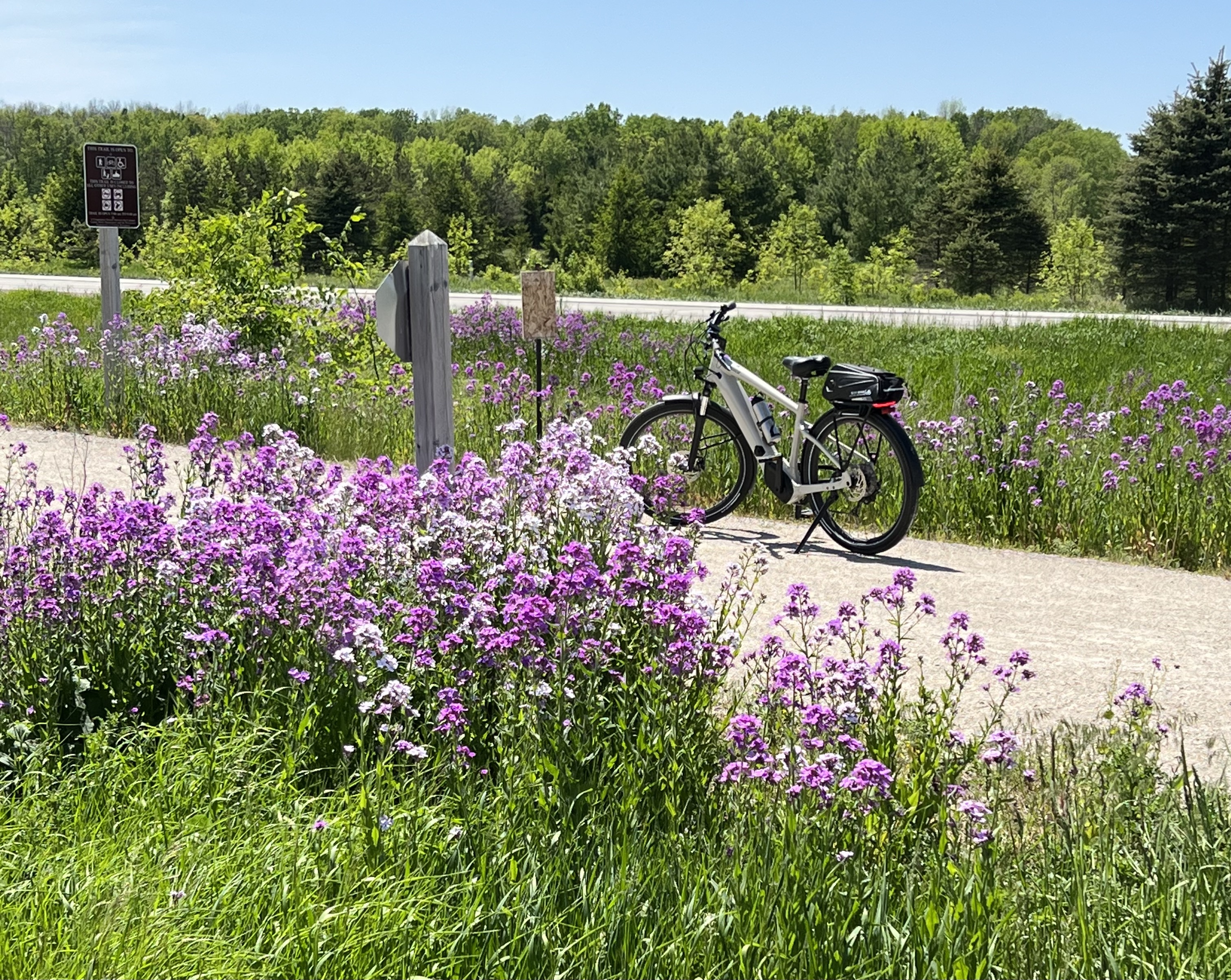
Phlox everywhere. They’re pretty but they’re an invasive species that spreads very aggressively in this area.
I injured my left calf pretty seriously back in the 1990s in a farm accident. Took me 6 weeks to recover from that one and ever since I’ve had to be cautious with that leg. Lugging 100 lb batteries down the basement stairs and into the battery cabinet didn’t do the leg any good. Neither did repeatedly kneeling down on the floor to work on wiring.
Out in the gardens the irises are coming into full bloom. They don’t bloom for very long but when they do that whole area is covered with these amazing flowers in brilliant blue, purple and yellow. When the sun hits them the colors are so brilliant they almost glow.
Alas the flowers don’t last long but by the time they fade away others will have blossomed to take their place.
More solar stuff: I really need to do some meaningful testing of the EG4 system to get some basic data about run times and things like that. I can guess how long the batteries will last when running the house off the EG4 system but I don’t have any actual operational data giving me actual run times under particular sets of circumstances and things like that. Two days ago I started it up, took the house off-grid and ran entirely from the EG4 system starting at 7 AM and ending at 3 PM, a total of 8 hours. At the end of that time the batteries were still at about 78% capacity because we had a pretty good day for solar production. While that was interesting I really need to see how long I can run the house just off the batteries, with no solar power at all.
The string of Newpowa panels have been peaking at around 1,000 watts, and the HQST panels at around 600 watts. That’s less their rated peak output which should be around 1,320 and 800 respectively. The HQST panels were putting out close to 700W earlier this year so I know they can do better than what I’m seeing. And the weather was clear with bright sunshine…
Or was it? The sky looked clear when looking straight up, but if you’d look towards the horizon it was a different story. The wind shifted again and we’re back to getting air quality alerts because of the forest fires in Canada. It looks clear and sunny but it really isn’t. There is a significant amount of fine particulate material floating around in the atmosphere that is cutting back on the amount of solar radiation that is reaching the ground. What it boils down to is that I theoretically have enough solar out there to take my batteries from about 50% to near 100% in one day of full sun. In reality, with variable cloud conditions and the smoke from the fires, I’m lucky if I get half of that.
(And I can sure tell there are air quality problems with my allergies, too. I was up at 3 AM this morning with my head so stuffed up I could hardly breathe. I gave up trying to get back to sleep. Since all of this air quality stuff started I’ve been having problems sleeping, stuffed up sinuses, etc. Makes it very hard for me to stay asleep. I’ve generally been waking up around 3 or 4 AM and find it almost impossible to get back to sleep again. Running on four or five hours of sleep is unpleasant. Sigh…)
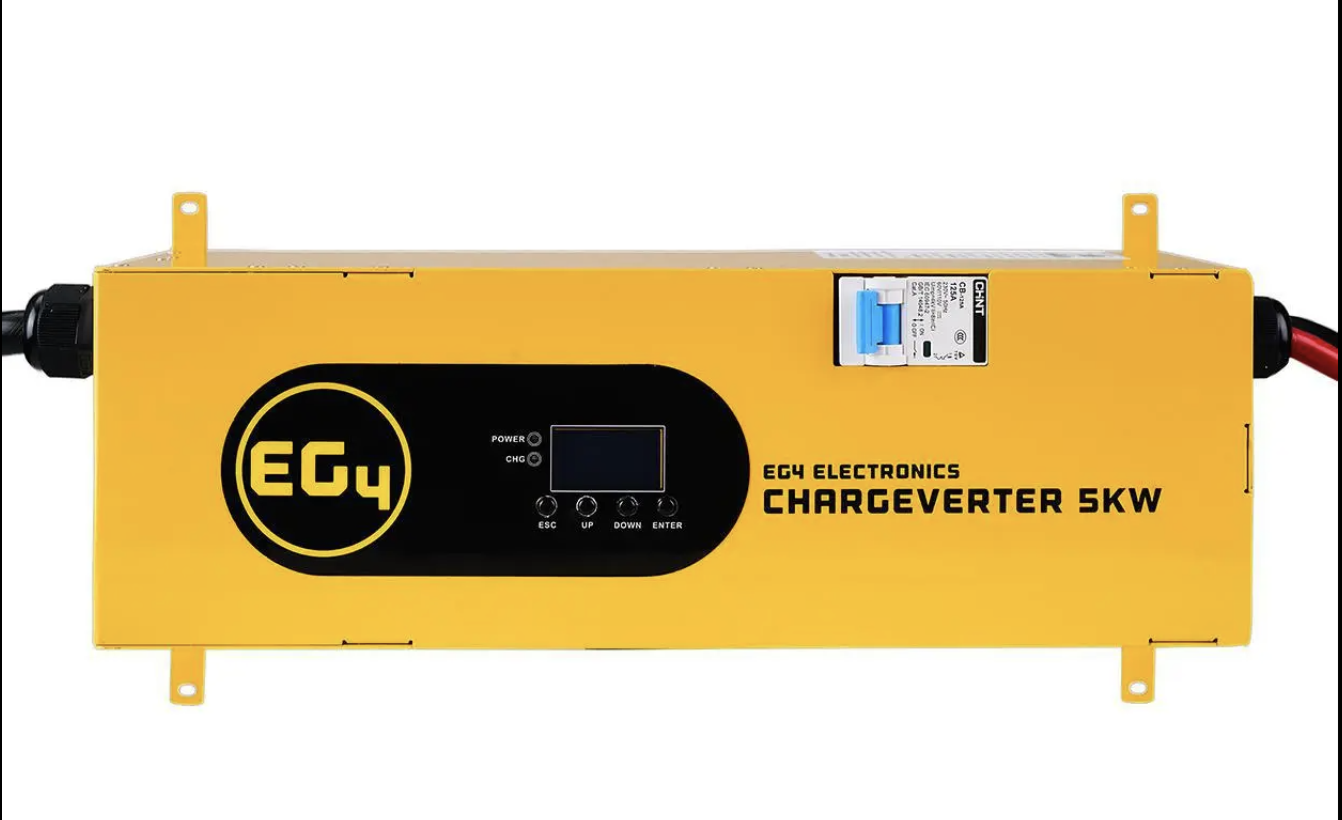
This thing started out at around $500 but is currently selling for $399 over at Signature Solar. In the interest of full disclosure I should point out that I got this thing free from Signature Solar.
Speaking of battery charging I got one of these in earlier this week from Signature Solar, the EG4 Chargeverter, a 48V battery charger that plugs into a 240V AC power source to rapidly recharge LiFePo batteries. This thing can put out up to 100 Amps which means it could fully recharge my 15 KWh of batteries in just 3 hours. It’s only been on the market for a few months and I’m curious to see how well it works so when I get a chance to check it out I’ll talk about it in the future.
Now why would someone need one of these? After all a lot of modern inverters like my EG4 6500EX already have built in AC battery chargers. I could wire my EG4s directly to the house’s AC power and they would automatically keep the batteries topped up even when there is no solar. But a lot of these systems are sold to people who are entirely off the grid. They have no connection to the grid at all. (And my system has no grid connection.) If they don’t get enough solar power to keep their batteries topped up, they have to resort to using a gasoline powered generator to charge them up. And that’s where the problems come in. These cheap, gasoline generators often produce very dirty power that isn’t even close to a pure sine wave and which can damage electronics. This chargeverter apparently doesn’t care how dirty the AC power coming into it may be. So if you’re living entirely off the grid, or if you’re going through an extended blackout and there isn’t enough solar to keep the batteries charged, you could plug this thing into a cheap Harbor Freight generator to charge your batteries and not have to worry about damaging anything.
I have a 7,500W Generac gasoline generator sitting out in the garage and this thing should plug right into it so I’ll be testing this out in the near future. If it works as advertised it will probably be kept permanently wired up to the bus bars in the battery cabinet. I doubt if it will get much use but it could come in very handy if we have an extended power outage.
What I’ll probably do is run my batteries down to about 25% and then try charging them with the chargeverter connected to the Generac and see what happens.


















 grouchyfarmer