I’m a serious photographer and have been for something like 40 years. I’m not a professional, but I try to turn out photographs that are as good as I can make them. One of the problems photographers have always had is making good prints of the images they make, especially making prints that are larger than the usual snapshot sized print.
There are a lot of inkjet printers on the market that claim they are “photo printers”, a lot of them are really cheap, well under $100. But let’s face it, most of them aren’t very good, especially when you’re trying to make larger sized prints. The biggest size they can handle is the standard 8X10 or 8X11 sized papers, and the images they crank out aren’t that good when scaled up to that size, and all too often the inks and pigments used fade quickly when exposed to light.
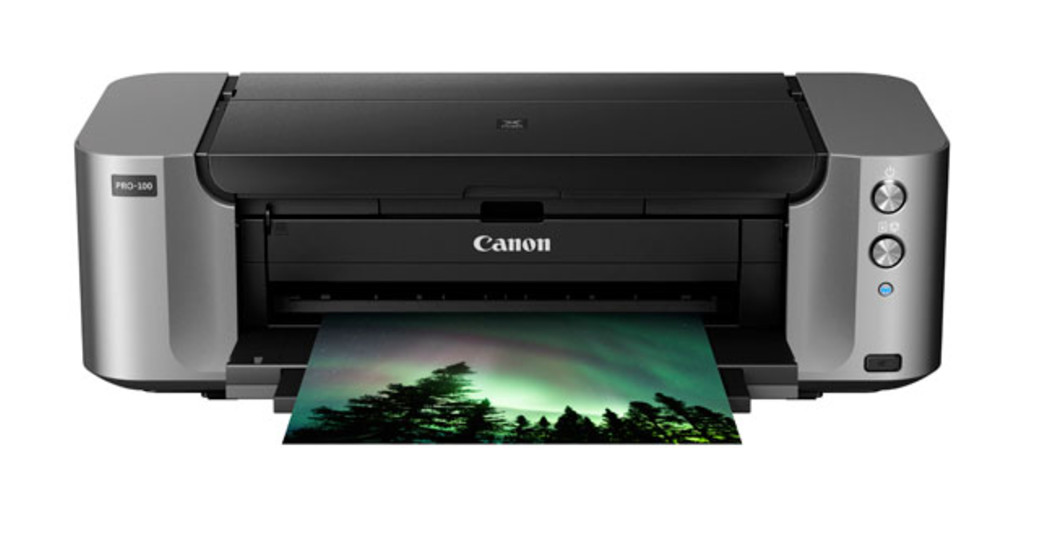 So I finally broke down and got a professional grade photo printer, the Cannon Pixma 100. It’s at the low end of the professional level printer. It retails for around $500, and can handle paper up to 13 X 19 in size, which is big enough for my purposes. It uses dyes rather than pigments. There is a big argument going on between the dye proponents and the pigment proponents about quality of the images, their long term stability, color, etc. and I’m just not going to get into that nonsense. As far as I can tell, the two different techniques are about equal when it comes to overall quality and the lifespan of the images.
Now there are a lot of printing services out there that will take your images and make larger format prints for you, and they do a decent job. But if you want to print a lot of images, it doesn’t take long before you realize that it’s a heck of a lot cheaper to do it yourself.
There was a bit of a learning curve as I figured out how to get the most out of the printer, but now that I’ve discovered the right papers to use (stick with the Cannon Luster line of paper, that seems to work best), the right settings, and how to properly tweak an image for printing, I’m more than satisfied with the results. Some of the ads I’ve seen for the Pixma line of printers claim “gallery ready prints” and they aren’t far off the mark on that claim.
All of this got me thinking about how photography has evolved in the last 40 years or so, and the advances in technology have been mind boggling when I stop and think about it.
 When I first got interested in photography on a serious basis, a good 35mm camera would set you back about $350 for just the camera body. The lens was usually sold separately, and a good one could set you back more than what the camera itself cost. The first good 35mm camera we had was a Minolta XGM, an almost but not quite professional 35mm SLR camera. That cost me $345 back in 1981. By the time I got a decent lens, filters and everything else I needed, I think the grand total was about $800 for the whole package. And that’s in 1980 dollars. Adjusted for inflation I suspect that would come to around $2,000 today.
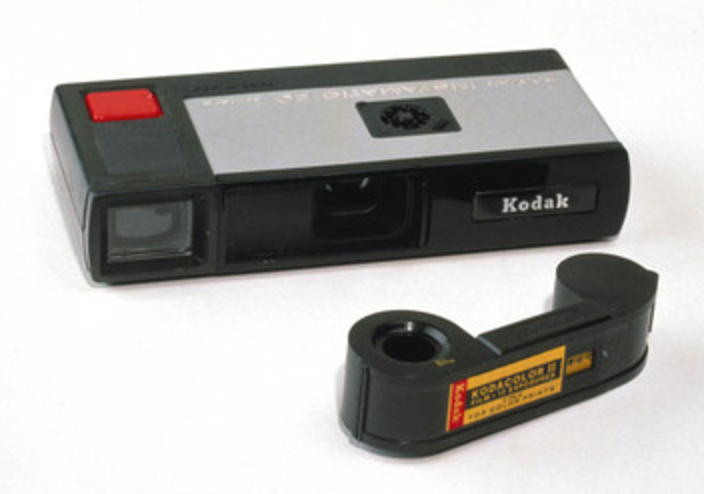 It was, for it’s day, a very good camera, especially when compared to the crappy pocket cameras like the Kodak Instamatic with it’s even worse film loaded into those dopy cartridges which was the most popular mass market photography system at the time. They were horrible. The photos and negatives they turned out were even worse, thanks in part to poor manufacturing, poor materials, bad lenses, and the cheapest, nastiest film you could imagine. While it was good enough for a small, wallet sized image, if you wanted to blow it up to a larger size, forget about it. The film was so grainy the images were totally unacceptable if you tried to blow them up to anything larger than a 4X5 print.
While I’m on the subject of film, let’s continue along that line.
Ah, film — The good old days of 35mm film. Well, no, they weren’t all that good, the film days. In fact, they were bloody horrible, the film days. The photographers who wax poetic about the “good old days” of film and how wonderful they were probably never had to actually work with the stuff.
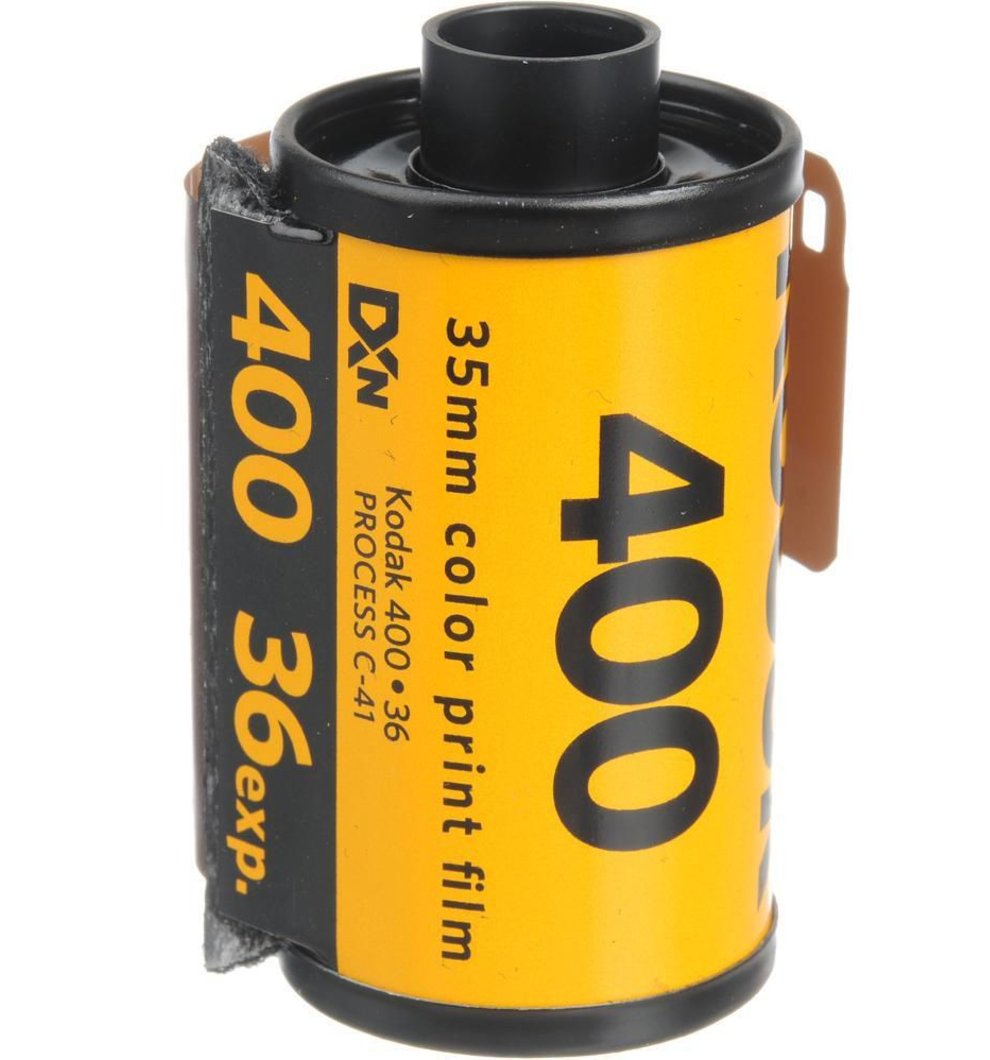 Most people bought film in small canisters like the one shown here. The body was generally made of metal and the end caps were plastic. Film was wound on a spool inside of the canister. You can see where the film comes out of the can on the right side of the cartridge, it’s that little brown flap. That’s the leader. A couple of inches of film stuck out.
You’d open the camera, drop the canister into a space in the camera, pull a few inches of film out of the cartridge, across the shutter opening, onto a take-up spool on the other side, thread the film onto that spool. Then close the camera up and wind several inches of film through to make sure the take-up spool had latched onto it. Oh, and there were slots in the edges of the film that had to fit onto small gears in the camera to pull the film through when you turned the film advance knob or lever. And hope like hell the those holes lined up right and didn’t strip out, because if they did, you’re film wouldn’t advance and you’d lose the entire roll of film.
Film was not cheap. It wasn’t wildly expensive, all things considered, but it wasn’t exactly cheap, either, and most photographers gave careful thought to what they were shooting because you couldn’t afford to waste film or processing. And you only had a very limited number of images per roll, usually 24-36 images.
 People who did a lot of photography often bought film in bulk and loaded the canisters themselves using gadgets like the one here. This is a bulk film loader. Your roll of bulk film would go in the big end, and then you’d use the crank to wind it into your film canisters. It was a pain in the neck, but it did work, and it did help cut costs a bit. I used to do this and it worked fairly good most of the time. Well, sometimes. Maybe.
Oh, and I should point out that whenever you were working with film before it had been processed into negatives you had to do it in total darkness. And I mean total darkness. Any stray light at all would fog the film and ruin it.
Then there was the question of what kind of film to get. There were dozens of different kinds, some intended for general use, some intended for special purposes. There was slide film. There was print film. There was B&W and color. Films came in different grains, different speeds… The list goes on and on.
The most important was probably film speed. That’s what that big “400” is on the canister above, the ISO rating of the film. To keep things simple, ISO was a rating of how sensitive the film was to light, basically how quickly the film could capture enough light, so to speak, to make a usable image. Generally speaking, the bigger that number, the “faster” the film was, i.e. the more sensitive it was to light. The faster the film, the less time the shutter had to be open to allow the film to capture enough light to make a usable image. ISO 100 was the most common in use for hobby photographers, but it was considered a “daylight” film, in that it needed bright lighting conditions or use of a flash or strobe. Otherwise the shutter had to be open so long that you needed a tripod to keep the camera stable so the image wouldn’t be blurred.
ISO 400 was a much faster film that permitted faster shutter speeds, reducing blur, and reducing the need to use a flash or strobe in lower light conditions. But there are always trade offs. ISO 400 films were not as fine grained, didn’t give as good detail in the final image as the slower speed films did. It was also a bit more expensive. In the 1980s the technology and chemistry improved to the point where some ISO 400 films were almost as good as the ISO 100 films when it came to grain size and image quality and for general use most people had switched to the 400 speed films.
ISO ratings ran from about 30, a very, very slow film, up to about 1,600, if I remember right. And then there were tricks you could do to “push” film to a faster ISO rating through processing back in the darkroom. Some films could be push processed with some success, some couldn’t. And again there were tradeoffs. Image quality degraded rapidly when you push-processed film in most cases. I experimented with push processing, pushing 400 film up as high as 1600 or more for night photography, but the results were not very good.
Now, you’ve got the camera, you’ve got the lens, you’ve got the film. You’ve taken some photos, now, let’s take a look at them, shall we? Uh, well, no. Not yet. If you open up that camera at that point, all you’ll do is ruin the film and all of the photos you took.
Remember that canister, and the takeup spool and the gears and all that stuff inside the camera? Once you reach the end of the spool of film, now you have to wind all of it back into the canister before you can even open up the camera. You’d turn a little crank or knob on the camera to wind it back into the can. Once you did that you could take out the canister safely.
You now have to get the film processed into negatives and made into prints. Most people took them to a store where you’d stick it into an envelope with your name and address on it and it would be shipped off to a lab somewhere, and in a week or so you’d get your film back in the form of negatives, and a set of snapshots, small prints of the images you’d made. And the results were, well, terms like “generic” come to mind because all of that film was fed through massive developing and printing machines that used standard processing and exposure times for everything that was shoved through them. If al you were taking were snapshots of the family vacation, they were fine. But if you were a serious photographer and were making images that were in any way outside of the norm, well, forget it. That kind of thing meant shipping it off to a custom processing lab, which was expensive, or you did it yourself as I did.
First you had to get the film out of the canister. You’d pop the end off, pull the film out, and then…
Oh, did I mention that you have to do this in complete darkness? Yeah, you do…
 You then put the film on a special spool that fits inside of a developing tank. Once you get the spool in the tank and get it closed, you can turn the lights back on because the tanks were light proof.
Now comes developing. You mix up a witch’s brew of developing chemicals. Exactly what you used depended on the kind of film you were using. Pour it in the tank, then gently agitate the tank for the specified amount of time. Then you rinse it with clean water, take out the spool, and bingo, you have negatives. They have to hang up and dry, then you generally cute the long strip into shorter lengths with about four to six images per strip.
And you aren’t done yet. Now you have to take those negatives and make actual prints of them on special photographic paper.
And just as there were many different types of film, there were many, many different types of papers, and which one you used depended on the kind of film you were using, what kind of prints you wanted, what kind of surface you wanted the finished print to have… There were dozens of different kinds of papers for color and black and white.
Oh, and the paper has to be kept in totally light proof boxes, and can only be used in total darkness. Those “safety lights” you’d sometimes see in darkrooms that allegedly let you see what you were doing without damaging the paper? Uh, about those… They only worked with a very limited number of paper types, and even then, they had to be kept so dim they were virtually useless or the paper would be ruined. So most of us worked in complete darkness.
Now, to make a print, you need still more special equipment. You need an enlarger, a timer, and a laboratory that looks like it came straight out of the Mad Scientist’s Handbook.
Let’s look at enlargers first. Why do you need one in the first place? The reason is that 35mm film yields 35mm negatives. Which is why they call it 35mm film in the first place. Duh… Now you could make a print by just laying the negative on the paper and shining a light on it. But that will give you a 35mm print, and that’s just, well, silly, okay? You want something larger, like an 8X10.
 So, here’s an enlarger. I had a Durst enlarger back in the day. Mine was considerably more elaborate (and expensive) than the one in this ad.
How they work is the negative is placed in a frame that is inserted in the head. There is a lamp in the head which shines the light down through the negative, through a special lens, down onto the paper placed on the bed below. Enlargers could get as complicated and expensive as you cared to make them. Probably the most important part of the enlarger was the lens, because that determines the quality of the image that is projected onto the photo paper.
Now you also needed a timer, because that image had to be projected onto the paper for a specific period of time. Too short and the image would be pale and ghostly. Too long and you’d end up with a print that looked like it was taken at midnight or even completely black. Exactly how long you exposed the paper depended on a variety of factors; the film, the film density, how bright or dark you wanted the print, the kind of paper you were using. Proper exposure could take just a few seconds, or it could take many minutes depending on what you were doing and the materials you were using.
 Once you have the photo paper exposed with the enlarger you’re still not done. Now you have to develop the paper using a variety of different chemicals. You need several trays big enough to hold the paper, a dark room, timers, a sink, a water supply, and lots and lots of yummy chemicals.
The paper has to be soaked in various chemical solutions – developer, fixer, etc. for varying lengths of time until the image appears on the paper. Then it has to be washed in clean water and hung up to dry. Oh, and most of that has to be done in complete darkness as well. That photo up there is red because they’re using safety lights. But about 99% of the time you were working with film and papers that could only be handled in total darkness, and even the dim safety lights would ruin them.
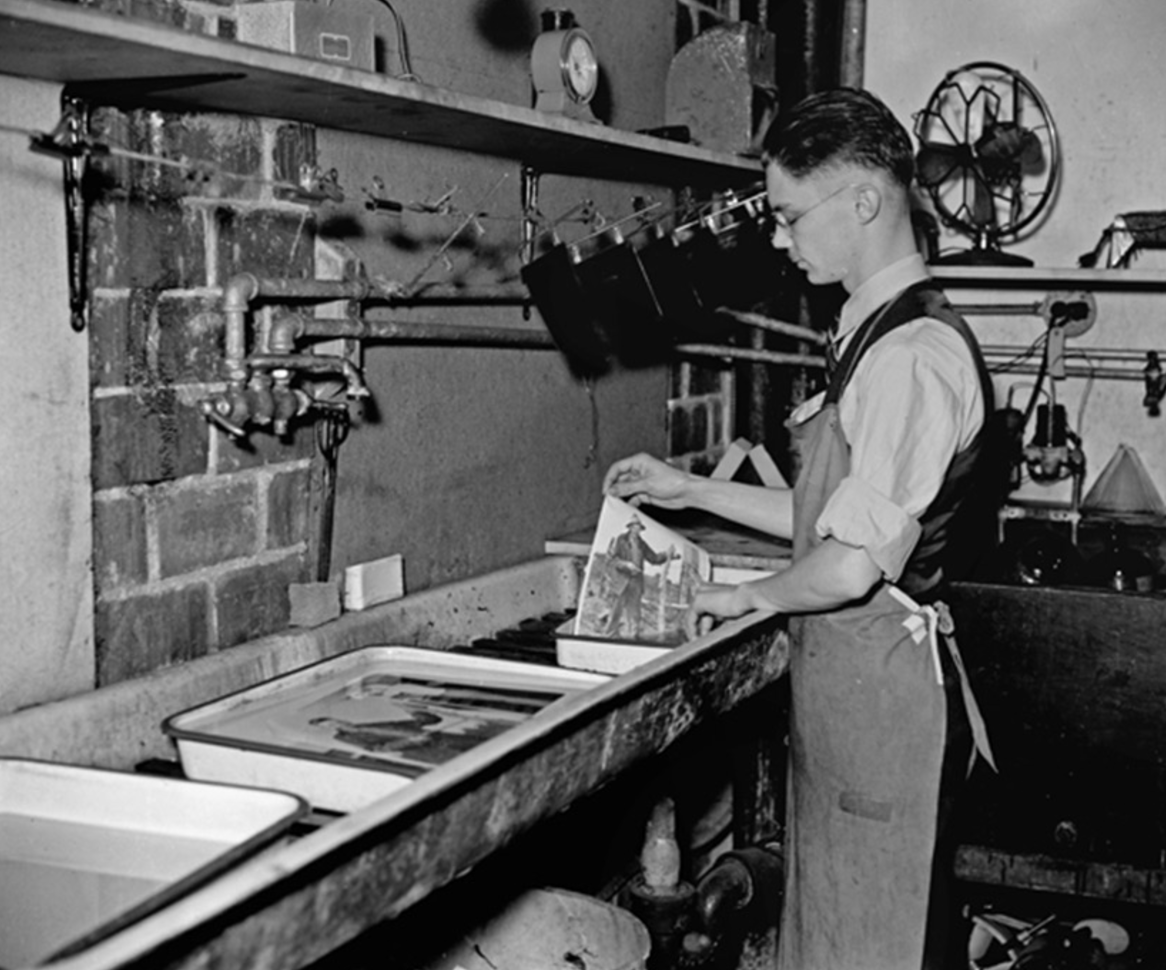 Now the lab up there looks pretty good, it’s probably a professional or semi-pro lab. Most home darkrooms looked more like this because they were squeezed into basements, large closets, even special built rooms in spare bedrooms or wherever they could be crammed in. They were messy, smelly, nasty, and you were working with some pretty hairy chemicals sometimes, many of which were poisonous.
And this was just for B&W photography, by the way. If you wanted to do color, it required a whole different setup, with much more complex and expensive enlargers, processing tanks, timers, heaters…
Now I admit that every once in a while I feel a bit of nostalgia for the “good old days” of film photography. But then I take and aspirin, have a little lay down and I feel better and remember that the “good old days” were bloody awful. And I have gladly, even gleefully traded all of that for digital cameras and computers and modern photo printers.




































 grouchyfarmer