
So I ran across this little item over at AgWeb, the website of the Farm Journal: How Much Should You Pay for a Drone? – News | Agweb.com and it was a huge disappointment because it’s one of those so-called articles that just doesn’t really tell you anything about drones, what they can be used for, how they work, and gives you pretty much no information at all. So let’s take a look at drones, what you can do with them, how they work, look at the photographic and video capabilities of the different models, etc.
Oh, and there may even be video! Oooo! Well, there will be if I can figure out how to upload video to this thing. But let’s get on with this, shall we?
What are you going to do with the thing? – Well, that’s not my problem, now is it? I’m sure you’ve come up with some kind of excuse to give to your spouse to explain why you dropped $1,500 on a drone, and for all I know maybe you really are going to use it to scout crops or track down missing cows or inspect roofs or something like that and you aren’t at all going to use it to annoy the cats or race other drone owners or build 3D obstacle courses in the back 40. Let me give you a bit of advice, though. When it comes to just having fun, the smaller, less expensive drones are generally more fun to play with than the big ones. They’re faster, more maneuverable, and don’t do as much damage when you hit something with one. Also a lot cheaper to fix. You fly a $50 Walmart special into a tree it’s going to be a lot less financially painful than flying your $2,000 DJI camera drone into a silo or something. So if you’re just looking to play, start small and cheap.
(Oh, and if you are tempted to try to play with cats with one of these things, here’s a word of advice: DON’T. Just don’t. Seriously. Those props spin at hundreds and hundreds of RPM on even small drones. And while they don’t have a lot of mass, those props can slice, dice and otherwise do very nasty things to living tissue.)
That being said, they can be useful in agriculture and other serious applications. Agriculture because this is grouchyfarmer.com after all and I need to put some kind of farming reference in here, don’t I?
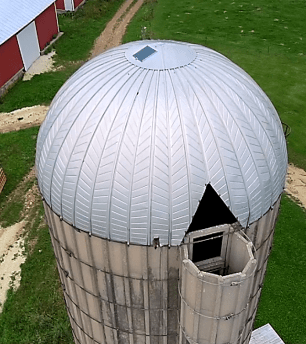
They are genuinely useful for inspecting roofs and a lot of roofing contractors are using them for that. They’re useful for scouting crops, finding trouble spots out in big fields. And they’re using them to try to find lost cows, and if you’ve ever had to try to find a heifer running around in a 40 acre corn field, you can understand why. They’re very useful for looking at the roofs of old silos as well. Exactly why you might want to look at the roof of an old silo is something you might wish to discuss with your therapist. But just in case you do, here’s one to get it out of your system. Ooo, exciting, isn’t it? And here you thought drones were just silly. I mean, just look at that! A silo! From above! Ooo!
Okay, now I’m just getting silly, aren’t I?
Money: So, how much is one of these puppies going to set you back? Well, it depends on what you want to do with it and how well you want to do it.


Now, if this editor put this photo in the right place, over there on the right is a Hubsan drone, one of the first video capable ones I bought, along with its controller on the left. It’s a nifty little gadget which streams video directly from the drone’s built in camera to a live video display built into the controller. It records video to a SD card that is inserted into the controller. Something like this goes in the $150 – $200 range, and it is about the bottom end of the scale for something that will give you some useful photo/video. Well, almost useful. Okay, be perfectly honest, it’s completely useless for anything serious.
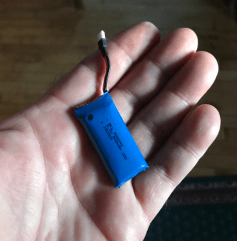
Don’t get me wrong, it’s great fun to play with it, but it’s basically a toy that shouldn’t really be used except indoors. You can fly it outside, but if you do all bets are off. The range of the controller and video transmission is limited, just a couple of hundred feet at best, the video quality is, well, pretty miserable, to be honest, and flight time with the tiny batteries is about 4-6 minutes maximum. It’s also extremely unstable in even a light breeze.
Now if you’re flying around in the living room or kitchen taking photos of the dust on top of the cabinets, a 5 minute flight time is no big deal. But if you’re trying to fly around a 40 acre corn field, well, forget it.
If you’re going to do something serious with it like crop scouting, building inspection, etc. you’re going to be up in the $1,000+ range almost immediately. And even then you have to be careful, because what you see isn’t necessarily what you get. In order to keep costs down, a lot of these drones are “bare bones”, no camera, no camera mount, not even a controller. You’ll need to purchase a camera like the GoPro, and use an IOS or Android tablet or smartphone to actually operate the thing. So be careful. Before you buy one make sure you know what is actually in the box so you don’t find out the hard way that you need to drop another $500 or more just to get the thing in the air.
Video/Image Quality: Then there is the video quality on these itty bitty drones. It’s not exactly good, to be honest. Especially if you get them near the limit of their range. Let me give you an example.

The top image is a still from the video feed from the Hubsan drone. The bottom image is the same scene from approximately the same altitude and location but taken with my Yuneec drone. You may notice just a wee bit of difference between the two images if you examine them very closely.
Let’s see if I can figure out how to put video into this to give you a better example of the difference between the toys and the more professional versions.
The above is video from the Hubsan from about 150 – 200 feet in the air above my house. Oh, dear. This should have been well within the stated range of the controller, but obviously it was already at the limits of its communication range. If you can see through all of the static, you can also see the drone is bouncing around a lot, even though there was only a light breeze. It was almost impossible to keep under control and I barely avoided crashing the thing.
The video above is from about the same altitude and same location taken with the Yuneec, and under wind conditions that were actually worse than they were when the Hubsan was in the air. Again, as was the case with the still images, you may notice a bit of difference in the quality of the two videos if you examine them closely. Just a bit.
There is also a bit of a difference in size between the cheap drones and the Yuneec Typhoon I own, as you can see here.
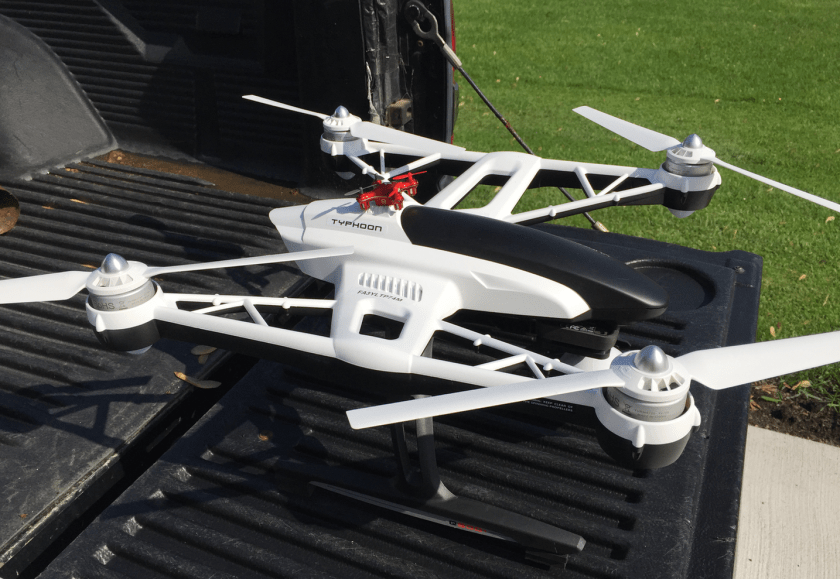
That’s my Yuneec with a microdrone sitting on top of it to give you an example of the sizes of these things. The Hubsan that was used to take the still images and video is a bit bigger than the red microdrone shown here, but not by much.
Let me guess, you just came up with an idea to turn a big drone into a flying aircraft carrier for micro drones, didn’t you? Hey, go for it. Who am I to tell you not to do it?
Flying: Okay, so, how do you fly one of these things? Well, it turns out they are ridiculously easy to fly. They basically fly themselves. Especially the big ones. Built in gyros, motor controllers and onboard computers and GPS do all of the work for you. In fact, if it weren’t for all of that technology built into them, they’d be completely unflyable. The basic controls are generally a joystick for up, down, left, right, spin, that kind of thing.
The Yuneec, for example, will just hover wherever you put it. Park it over a specific spot 50 feet in the air, take your hands off the controls, and it will just stay there until the battery runs out, automatically maintaining it’s position and altitude. Even if a significant gust of wind comes along it will stabilize itself and return to its set position. There’s a panic switch. If you lose control of it, lose sight of it or something, press the button. It will go up to a height of 60 feet, return to it’s launch point, and land itself.
Well, if there’s nothing in the way, that is. This unit doesn’t have collision avoidance systems like some do so it can’t avoid obstacles.
The point is that just about anyone can fly one because they essentially fly themselves. The more sophisticated models allow you to plot out a flight plan on a map, and the drone will fly the route all by itself.
Still, you can get into trouble with the things. If the drone goes out of range of the controller, all bets are off. Some models will return to their launch point if they lose communications with their controllers, but a lot won’t.
Wind can be a real problem. The bigger ones are amazingly stable even in a good breeze, but I would not want to fly one if winds of more than 20 mph or so, especially anywhere near a structure or tree.
Regulations: Well, there are a lot of them. And there is still considerable confusion despite the FAA recently updating and clarifying things. If you’re just a hobbyist flying them for fun, you don’t need any special licensing or permits except for registering the drone with the FAA if it exceeds a certain size/weight category. The Hubsan shown above does not need to be registered. The Yuneec does because of it’s size and weight. If you’re flying for a business, you need a Remote Pilot Airman Certificate and have to pass a TSA background check. I won’t go into all of the rules and regulations. You can find them at the FAA’s website: https://www.faa.gov/uas/getting_started/ That will give you all of the information you need about how to stay legal.
So let’s wrap this up: Prices on these things are fluctuating all the time. You can get some real deals on even the better quality drones if you keep an eye out. I dropped about $1,500 on the Yuneec drone I’ve shown you here, but I’ve recently seen it going for under $700 because Yuneec is coming out with new and improved models. I don’t know what the used market is like, but I’m sure there is one. I’d be very cautious about buying a used one, however.
Recommendations: Ah, well, that gets a bit difficult. I’d like to recommend that if you’re interested in a camera drone you start with one of the cheap, small models before you drop a thousand bucks or more on one of the big ones. But it’s difficult to do that because they are entirely different beasts. The small, cheap drones are suitable only for flying indoors, are often twitchy to control. The slightest breeze can send them tumbling out of control. The cameras, if they have them at all, are virtually useless for any kind of decent photography or video. They are basically cheap, unstable toys. Don’t get me wrong, they are a lot of fun to play with, but that’s all they’re good for, play.
Drones like my Yuneec are much more stable, easier to fly outdoors, can handle wind better, feature gimbal mounted high def cameras that provide good video and still photos, but they are much, much more expensive than the $59.99 specials at Radio Shack or Amazon, or even the $180 Hubsan I have. So if you buy one and now decide it’s not something you want to do, well, now you’ve spent over a grand that you could have used to pay off your student loans or something, and you’re going to be mad at me because I recommended it.
Let’s say you’re thinking of doing actual serious work with it, like scouting hundreds of acres of corn or soybean fields. If you’re thinking of that kind of thing, well, even something like my Yuneec isn’t going to work all that well for you. Yes, it’s a damned good flying camera platform with a good, stable camera. But you only get about 20 minutes out of a battery so you’re going to need a lot of pre-charged batteries to scout any kind of significant acreage. You can’t pre-program a flight plan into it…
If you want to seriously do that kind of thing for a large far, you’re moving up into an entirely different and more sophisticated level of technology and, of course, an entirely different price range. For that kind of capability you’re getting out of the $1,000 – $1,500 range and getting into the $3,0000+ range and you might be better off getting one of the professional crop scouting services to come in and do it for you.
Addendum: I really need to point out that the claimed flight times for drones are often wildly optimistic. If the manufacturer claims you can get 30 minutes flight time from a fully charged battery, you can generally assume it’s going to be closer to 20 or even 15 minutes out in the real world.
The same is true for the claimed range of the controllers. As with battery life, the range of the controllers are estimates at best, and done under ideal conditions, not under the kinds of conditions you will find out in the real world.
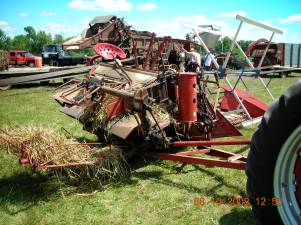 shocking it, and running it through threshing machines, for heaven’s sake. In case you’ve never seen one, here’s a photo of a grain binder from an antique farm equipment show I took some years ago. And yes, that thing over there that looks like it was cobbled together out of bits of old string, wire and old barn boards, is an actual commercially made machine. It was pulled by horses (that’s why there’s a seat on it). It cut the grain off with a sickle bar, put it in a bunch, tied the bunch with twine, then dumped it on the field. Workers would come along, stand the bundles on end with the grain heads up so it would dry. Then it would be loaded onto wagons and taken to a threshing machine.
 threshing machine. This is actually a special machine designed specifically for threshing or hulling clover seed, not wheat or oats, but the principle is the same. Workers would throw the bundles onto the elevator over on the left where it would run through threshing bars, fans, screens, etc. to be separated from the stalks and hulls. The hopefully clean seed would come out one pipe to be bagged, the straw would blow out onto a pile. The whole thing was originally powered by a massive steam traction engine via that long belt you see extending out the left side of the photo. Steam engines were replaced in the 1920s or so by gasoline powered tractors, but the threshing machines themselves remained in use well into the 1950s in some parts of the state. There were still a couple of farmers in the area who were using this setup when I was a kid. These things hung on because as long as you could get inexpensive labor it was cheaper to keep using it than buying a combine.
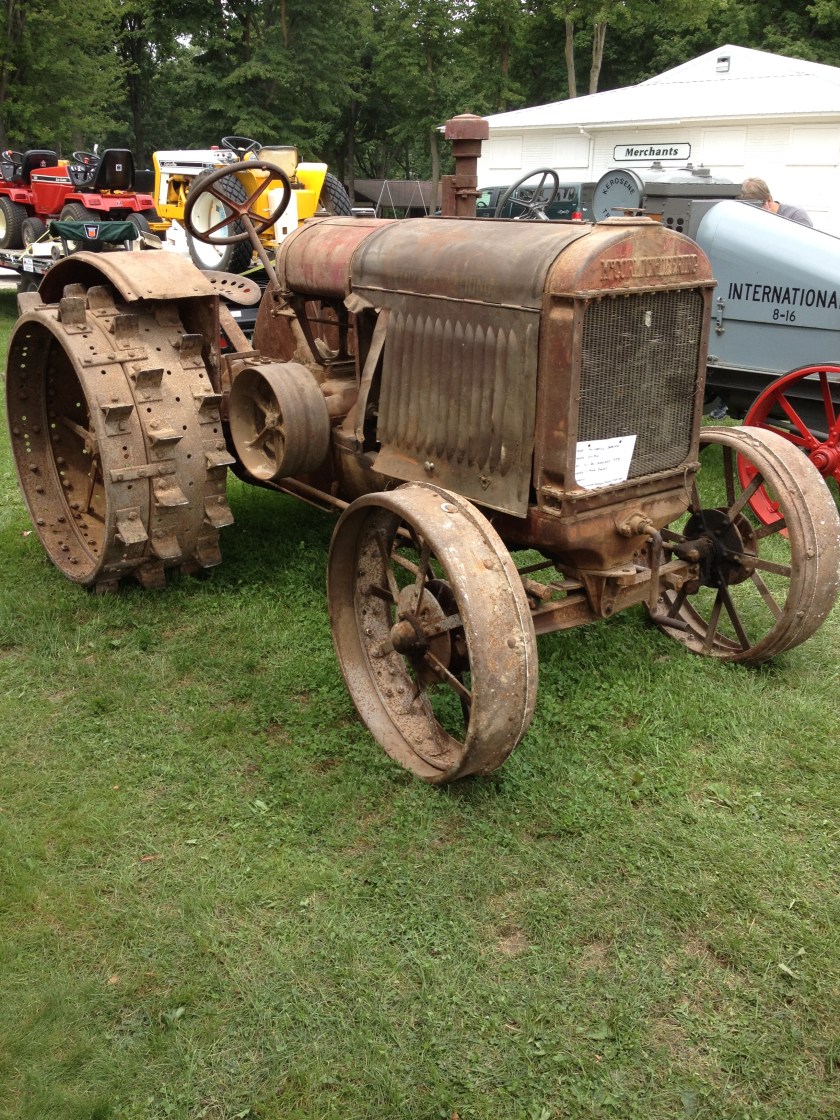 was a kid we actually had one of these beasts, this exact same model. And we didn’t have it for some collection, this monstrosity was an actual working tractor at the time. The only thing we used it for was running the blowers to blow grain or forage into the barns or silos, but it was still a working tractor on the farm. And dear lord we hated that thing. Trying to start that beast… Oh, my. It started by manually cranking it with that big lever you see just below the radiator. That connected to the crankshaft to turn the engine over. And if you didn’t know what you were doing when you tried cranking it, it would gleefully break your arm. Seriously. It would if you didn’t know what you were doing.









































 grouchyfarmer