
I wanted to take a look at the EG4 48V Chargeverter and I finally had a chance to try it over the weekend. I got in three more EG4LL batteries last Tuesday and before they could be installed they had to be at the same voltage as the existing batteries in order to avoid problems. So that meant they had to be charged up from about 54% to 99%. So this was a good opportunity to test it.

In the interest of full disclosure I should point out that I got the Chargeverter free from Signature Solar. They were running a deal where you’d get the device if you bought a package deal with two EEG6500EX inverters. Normally it sells for about $500.
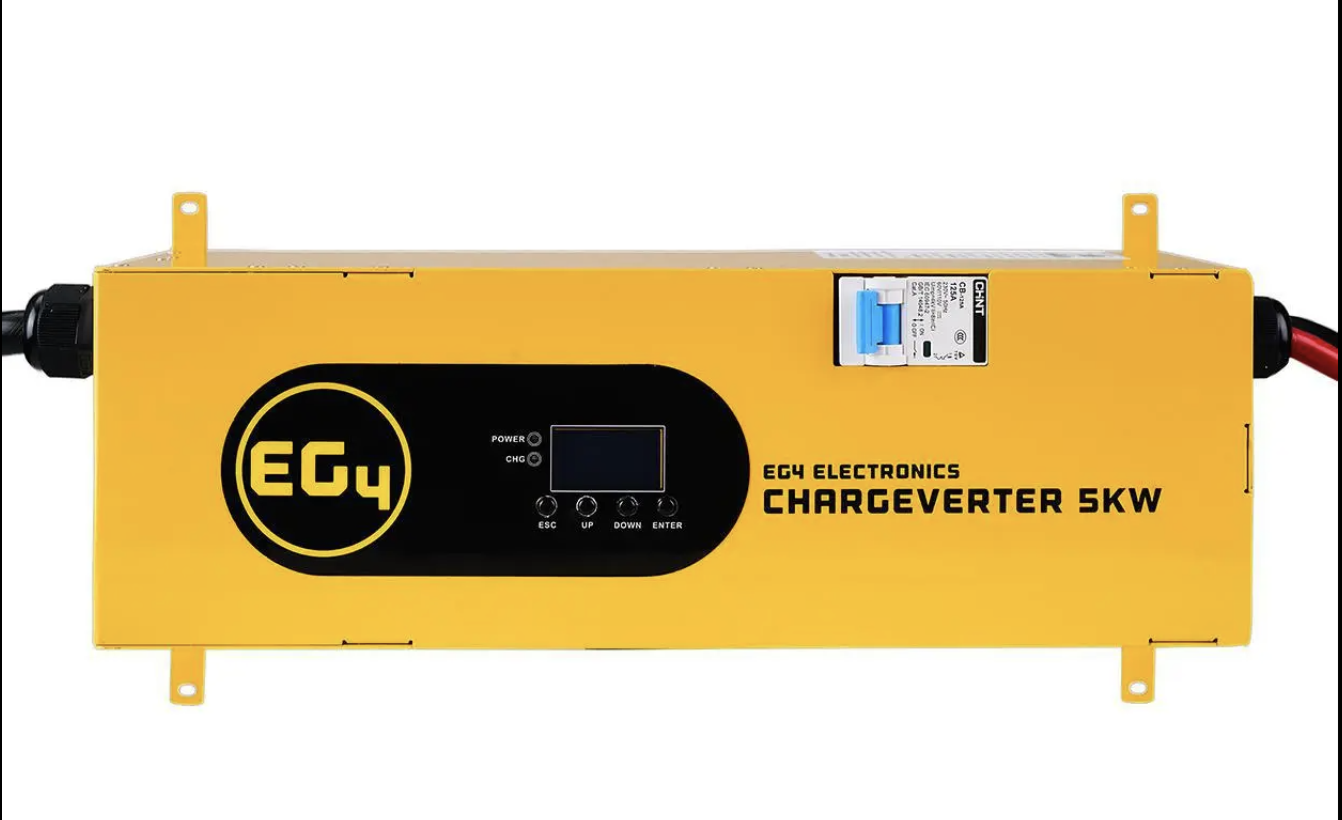
So why does someone need this device? Well if you are really off grid or you are in an extended power outage, and you aren’t getting enough solar power to keep your batteries charged because of cloudy conditions, you’re going to need to recharge those batteries somehow if you want to keep your electrical devices working. And chances are good you’re going to turn to a good old fashioned gasoline powered backup generator to recharge those batteries. And that’s where this yellow box comes in.
Someone will point out that many inverters like my 6500EX already have AC powered battery chargers built into them. Just plug the 120V AC input on the inverter into the generator and let it charge the batteries. And you can, in theory, but there are some serious issues with that. There have been reports of people wrecking their inverter/chargers by trying to do just that. Apparently a lot of these inverter/chargers don’t work very well with backup generators. The problem is that a lot of these generators put out some of the nastiest, dirtiest, power imaginable with lots of voltage fluctuations. The inverter/chargers expect to see nice, clean, steady, pure 120V AC sine wave power coming in from the utility company, while the power coming out of some of these generators is so bad it can actually damage the inverter/charger.
The EG4 Chargeverter is designed specifically for these situations. It’s intended to plug directly into the 240V socket of a backup generator, convert that power to nice, steady 48V DC, and pump that into your batteries. Well actually 56V AC but I’ll come to that in a moment.
Yes, I said 240V. This thing can be rewired to work off 120V or you can get adaptors to let it do so, but you’re going to need at least a 120V, 30 Amp circuit power this thing if you’re going to try to use it off our house’s electrical system. If you have a 240V electric clothes dryer you might be able to plug it into that with the right adaptor but I don’t really care about that so I didn’t look into it. I’m interested in running this thing off a backup generator.
Since this charger can suck up at least 5KW of power to dump into the batteries, you’re going to want a fairly hefty generator to plug it into. You can use a smaller one but you’re going to need to adjust the power level of the charger to a lower amperage or you’re going to overload the generator. I’m using it with my big Generac 7.5 KW gasoline generator.
I bolted the plus and minus cables from the chargeverter to the battery. I started up the Generac….
Ah, the Generac… I have a love/hate relationship with that generator. It hasn’t been used much over the years, there are only a few hours on it and most of that is from test runs. It can be a real beast to get started. It has electric start, which generally doesn’t work because no one ever remembers to put the battery on the maintainer, so that means it either has to be jump started from an battery pack or started with the recoil starter. I will not describe the language I used trying to get that thing going with the pull starter. I finally found one of those jump starter packs used to jump start cars and used that to power the electric starter and got it going. Once it’s running, it’s fine. When the engine is warm, it’s fine. But starting it that first time…
Never mind. I got it started, plugged in the chargeverter and… And the engine immediately died. WTF?
I started it again. I plugged in the chargeverter and… And the engine immediately died again. WTF?
Oh… I forgot to turn the gas on. Sigh…
Now with the generator finally running, I plugged in the chargeverter. The display came on. I used the buttons on the front to set the voltage to 55.5V and the amperage to 50A, and flipped on the circuit breaker to start it up and, well, it just worked exactly the way it was supposed to.
It was really going to be that easy? Apparently it was. According to the display on the battery it was being charged with about 48.5 amps of current. Cool.
I kicked the amperage up to 80A which made the generator work a bit hard for the first time in its life and the battery reported it was getting 78.8 amps…
What can I say? It just worked exactly as specified.
I charged all three batteries from about 50% to 99% in about two hours total.
The only issue is that the case of that charger gets seriously hot, hot enough to be painful to touch but the manual warns of this so it wasn’t unexpected.
I like it when things just work.
EG4 6500EX and EG4LL Battery long term evaluation.
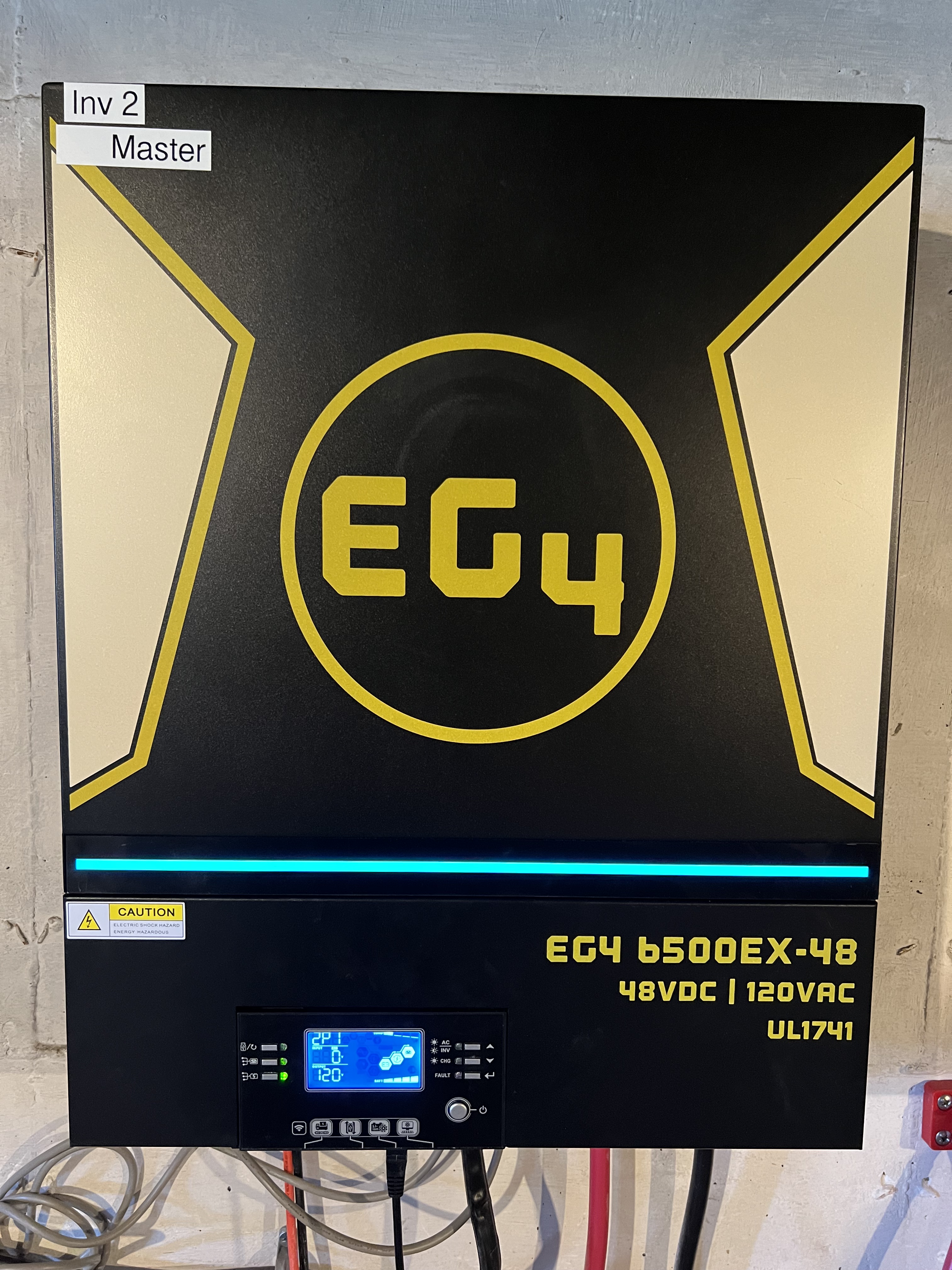
This is another rather dull report because the EG4 6500EX inverters have just plain worked. Something that was made abundantly clear when we had a power failure this morning about 8 AM that lasted for about two hours. First the power flickered out for about 10 seconds or so around 7:3o. And then at around 8 it went out completely and stayed out. So down into the basement I scurried, flipped a couple of circuit breakers and we were back to the electrical system running normally in about a minute. Furnace, sump pumps, furnace (weather changed from hot and dry to cold and wet so the sump pumps and the furnace have all been running), lights, microwave and, most important of all in the early morning, the coffee maker, all worked just fine and dandy.
The outage lasted about two hours and even the sump pumps weren’t a problem. By the time power came back on the batteries were still at about 95%. Granted we weren’t using a lot of power. The sump pumps only cycled once and the furnace only ran for a few minutes.
Anyway I’m quite pleased with the system. It’s nice to be able to just switch over like that with just a couple of circuit breakers and get back to normal.



 grouchyfarmer