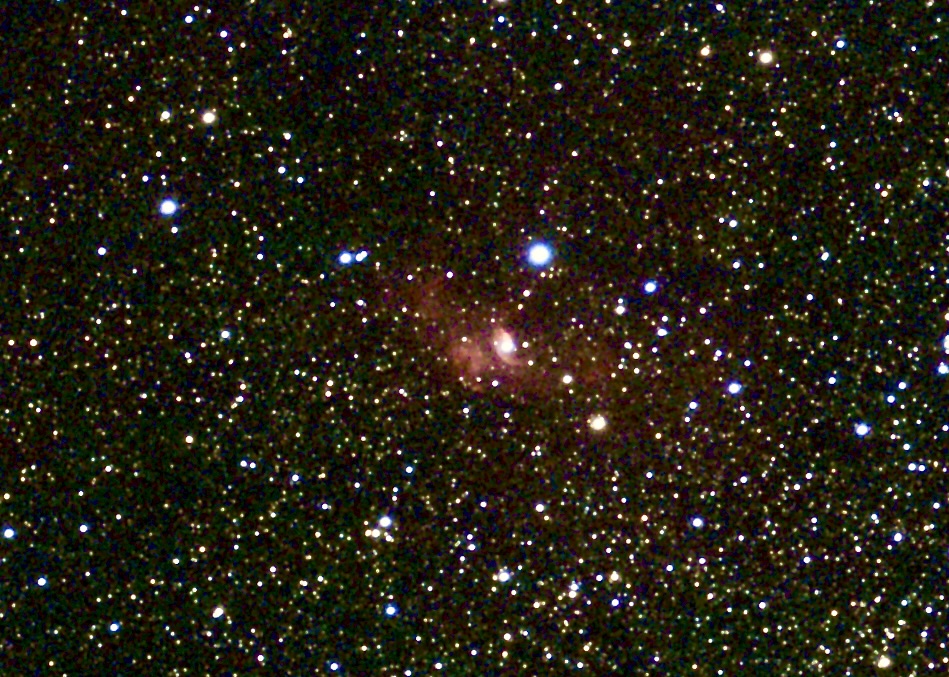
Not the best image I’ve ever seen of this object but considering that’s just a 20 minute exposure taken from the driveway behind the house, surrounded by street lights and lights from the neighbors and taken with a telescope the size of a lunch box, it’s not bad at all. Taken with a SeeStar S30 Pro around 10 PM local time.
Background: Often called the Bubble Nebula because if you zoom in up there you’ll see what looks like a bubble being blown in the middle of the image. At the center of that is a very hot, very bright and very big star known as SAO 20575. This is a massive, blue-white O type star that has 45 times the mass of our sun and is thousands of times brighter. It’s about 7500 light years from Earth. It’s not only putting out enormous amounts of radiation, it’s also producing a “stellar wind”, material being blown off the star, at about four million miles per hour. The stellar wind impacting the surrounding molecular cloud causes a sort of shock wave effect that makes the bubble structure and the intense radiation causes the gas cloud to “light up” so to speak.
SAO 20575 is doomed to an early death. It’s still an infant, so to speak. It’s only about 2 million years old but when it comes to stars, bigger isn’t better. Stars this size burn through their nuclear fuel faster than a keg of beer at a frat party. It’s already burned through all of its hydrogen and is burning helium now. In another few million years, maybe 10 or 12, it will run out of fuel and gravity will take over. It will collapse in on itself and blow up in a spectacular fashion ending in a supernova.
Damn astronomy is fun!


I can’t even imagine the amount of time it took for those lights to reach your driveway ⛄
LikeLiked by 1 person
It is a bit astonishing, isn’t it? The light from that nebula took about 7,500 years before it finally reached my telescope.
I was photographing a galaxy that’s about 40 million light years away the other night. Those photons were traveling for 40 million years?? I still have trouble wrapping my head around some of these numbers.
LikeLiked by 2 people
I use the (Stellarium Program) to view anything beyond my back yard ✨
LikeLike
Incredible isn’t it? 7500 years ago the SUMERIANS (!) were just beginning to establish a societal structure while that light was just leaving that star! I just think of ALL the incredible things that have transpired on Earth since then! It’s nuts!
LikeLike
I love that telescope of yours but I remember when astronomy was something else indeed…i had a friend, old Mr. Mitchell who would take me out into the yard at dark (we lived in an agri-culture community out in the boondocks away from a lot of artificial lights) and the stars were so brilliant they looked like they could touch the horizon (like in certain parts of Ontario, Canada at dark) and he knew hundreds of stars and constellations by name that he had memorized– and he became something of a bore because whenever I would visit him that is all he would do …and I always visited after dark …because he worked throughout the day pushing a cart around town selling pots, pans and Watkins Home Products.
LikeLike
When I was a kid I lived in a very rural area on a dairy farm and I still remember the utterly brilliant night skies we had back then with virtually zero light pollution. Most of us kids back then knew most of the constellations and the planets that were visible with the naked eye. My parents got me an inexpensive telescope from a discount store for my birthday when I was about 12 and I spent way too much time watching the moon, Mars, Saturn and Jupiter.
I’ve had small scopes on and off over the years but about, oh, 10 years or so I bought an 11 inch Celestron with a computerized drive system. I had great fun with that but then a back injury made it difficult for me to get that beast set up. It weighs something like 70 – 80 pounds so my eldest son has it now. I really missed having a scope but then in spring I learned about the Seestar and I’ve been having a blast with it ever since.
LikeLiked by 1 person
Looks like a bunch of fun…sadly down here we have clouds seemingly all the time so any attempts would be limited…..chuq
LikeLiked by 1 person
It’s not much better here. I think we had skies clear enough to use the scope at all maybe 6 nights during July and August. Now that it’s getting into autumn the weather is getting a bit better and the atmosphere is clearing up.
LikeLiked by 1 person
Super interesting! And the picture is amazing, especially for the equipment! I wonder if there’s any intelligent life out there? Doesn’t seem to be any here!
LikeLike
The capabilities of these little “smart” astrophotography scopes is amazing. I’m astonished at the results almost every time I take it out. Astrophotography with the Celestron was such a pain I gave up. Set up a massive tripod. Hoist up a 70 pound telescope onto it and bolt it down, go through 20 minutes of alighment procedures, attach the special guide scope, attach the camera and filter holder, attach the computer. Plug everything into a huge battery pack to keep it going… It took me over an hour just to get set up before I could even try using it. Even if I hadn’t had the back injury that made lugging that scope around impossible, I’d have given up out of sheer frustration. This one? It takes about a minute to set up the tripod and scope, turn it on, pair it to the iPad and then go inside away from the mosquitoes and run it all from the kitchen table.
I know what you mean about intelligent life!
All kidding aside, though, I do not think life out there is anywhere near as common as some people claim. Considering the sheer number stars out there, and the fact that almost all of them seem to have planets, the likelihood that at least some of them have developed life at some point in the lifespan of the planet is virtually 100%. Emphases on “some of them” and on “at some point in the lifespan of the planet”. The development of life, at least by our definition, requires an extraordinarily rare set of circumstances and conditions. Not a single one of the thousands of exoplanets that we’ve discovered so far comes even close to having conditions that would permit life to develop. And even if life did develop, the chances of it surviving long enough to evolve into a technologically advanced civilization are even smaller.
LikeLiked by 1 person
-OR- the life that MAY have developed would be suitable for the environment of that planet. Of course, most humans want to/would like to believe that any extraterrestrial “life” is the same as “us.”
LikeLiked by 1 person
The thing I emphasize when I’m talking about stuff like this is that intelligence is not a survival factor for a species. Ants, for example, have been around for something like 110 – 140 million years as a species. They’ve been extremely successful, very adaptable, have even developed complex societies. Crocodilians have been around for even longer, 200+ million years. Modern humans, on the other hand, have only been around for less than a million years and we’re well on the way to killing ourselves off already. From the one example we have direct experience with, us, intelligence actually seems detrimental to the long term survival of a species. Do I think there is life “out there”? There almost certainly is. But intelligent life? On that issue I have my doubts.
LikeLiked by 1 person
I think there is very little hope of that (Thank goodness!). Darwin said neither intelligence nor placement in the food chain is any indication of a successful species; it is simply the species most ‘adaptable’, i.e., the species most able to meet the challenges of the environment including changing conditions within the food chain/supply. Even after the asteroid that devastated the dinosaurs many other species – including mammals (thank you!), some reptiles, birds, etc. survived somehow and continued to develop successfully 66,000,000 years later! I would assume that life on whatever planet out there would have to do the same; conform to the challenges of the environment and develop the internal and external systems that would meet the challenges of life, whether it is the environment itself or predators, or food supply, etc. and allow it to survive or flourish.
LikeLike