
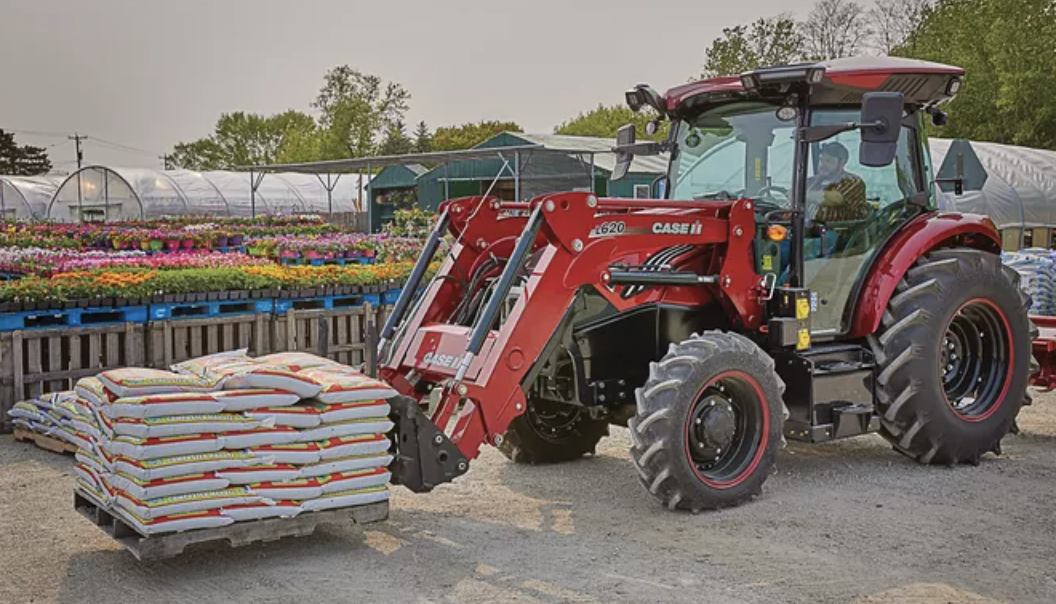
CaseIH has joined New Holland and Monarch in introducing an electric tractor. We all knew that was coming. The only thing that surprises me is that it’s taken this long. Both the New Holland and CaseIH are more or less traditional looking and traditional functioning tractors. They’re considered “utility” tractors, horsepower ranges from about 75 – 80 HP, and both have run times of 4 hours+ depending on how hard you work them.

The Monarch on the other hand… Yeah, I just don’t know. First of all it’s built in partnership with Foxconn. After the way that company screwed over the state of Wisconsin I wouldn’t trust them to clean my cat’s litter box much less build a tractor that actually works. But the Monarch itself isn’t any kind of tractor that we’d find all that useful here in Wisconsin in the first place. It’s small, narrow, has tiny little tires and is frankly strange looking, loaded with radar and sensors and I don’t know what all else. Supposedly it can follow you around like a dog and, well, I’m sorry, I don’t want a tractor following me around without a driver. It might be useful for orchards or vegetable farms, but for the average farm around here? This thing is pretty much useless for someone who has to get 1,000 acres of corn into the ground or harvest 500 acres of beans. And considering all of the fragile electronics and software packed into the thing it is going to break. A lot. It looks like that aside from small vegetable and specialty crop growers this thing is aimed at wealthy hobby farmers.
How successful will these things be? Will farmers adopt them? Well, maybe? I can see these being useful. But ultimately it’s going to come down to value for money. Farmers operate on razor thin profit margins, and they are very, very cautious about adopting new technology until it’s proven itself to be economically viable. E-tractors have a lot going for them besides just not pumping out huge amounts of toxic exhaust. No more engine oil changes, no more engine filter changes, less maintenance necessary, less noise.
It’s going to come down to how reliable these things are. Are they going to be able to stand up to the day to day use and abuse the average tractor experiences during its lifetime?

 grouchyfarmer
Well, over time, as they phase out ICE’s, we won’t have the choice in whether to participate or not.
Electric is coming. Durability will get better as we go I think. We always learn as we go…
I welcome our new electric overlords. I just hope they get the infastructure up across the country before I am assimilated.
LikeLike
Quite true. And we do need to phase ICE out of existence, and not just because of climate change. A lot of people, myself included, think we’ve reached “peak oil” already, the point at which all of the easily extracted oil and natural gas has been sucked out of the ground. It is getting increasingly difficult and much more expensive to keep pumping ever harder to extract fossil fuels.
Electric vehicles have been around far longer than most people think. The first electric powered taxi appeared in London in 1897.
LikeLike
Reliability is the key….most electric cars are having problems kinks will have to be worked out. chuq
LikeLike
You’re right. Reliability is an issue even for modern ICE powered tractors. They’re so laden down with computers and sensors these days that they’ve become increasingly fragile and far more difficult to repair. The first generation or two of electric ones are going to be even worse until they get the bugs worked out ofthem.
LikeLiked by 1 person
The electronics is my problem with cars as well….you need an engineering degree to do basic repair. chuq
LikeLike
Very true. This is a problem not just for backyard mechanics but for farmers too. I’ve seen $700,000 tractors shut down for days because of a minor problem that normally would have been easily fixed. Same with cars, motorcycles, etc. You can’t just replace a part, you now need special computers to get into the software to reset fault codes, etc. in addition to doing actual physical repairs.
LikeLike
And the cost of repair goes up and up with no end in sight…..chuq
LikeLiked by 1 person
Howdy y’all!
I drove a ’63 VW van for twenty-odd years. I drove with everything I needed to pull the engine because VW. If a headlamp went it, it cost a quarter for a new bulb and the removal of two Phillips head screws. Now, you have to replace the whole unit for $100.00+.
In Kenya, I drove a 2005 Toyota. I couldn’t do a damn thing with it. Modern cars are made so that you have to take them to a specialist for repair. They go longer without needing repair, and if you keep up with the maintenance, they do well.
When you think about it though, we’re still driving around on 125 year old technology. We’ve tinkered with it, but it’s basically the same as it was in 1900.
Electric motors should not be needing much repair. They have fewer moving parts. An electric motor is a hardy device that theoretically will run forever just about. The batteries and supporting systems are the problem.
Apple makes a very hardy computer. I’ve seen MacBooks take a huge beating and keep on working. Electronics don’t have to be delicate.
When your profits rely on increasing and repeated sales, you build in obsolescence. Thank you capitalism.
Huzzah!
Jack
LikeLike
You’re absolutely right on all of that. Modern cars have become so complex it’s damn near impossible for the average person to do anything with them any more.
EVs are probably going to be far more reliable. And fleet owners, companies like the car rental companies and the big freight carriers like Schneider will probably adopt EVs even for trucking just because of the lower maintenance costs. No oil changes, no oil filters, no exhaust systems. In a lot of cases no transmissions any longer either. A big trucking company would save tens of millions of dollars a year just because it didn’t have to do oil changes any more.
The infrastructure will come, of course. People complain about the lack of public chargers but that will change quickly. Charging time is down to about 15, 20 minutes. Longer than it would take to gas up a car but not that much longer. Batteries are getting there. The newer LiFePo chemistry batteries have lifespans of 6,000 – 10,000 charge cycles, plus they don’t blow up or turn into blowtorches like the older type batteries did. Yeah, they’re more expensive than gas powered cars, but not that much more. And you’ll recover that extra cost because the maintenance costs are so low.
LikeLike
Especially for farms with wind and solar power, this could really reduce operating/maintenance costs. It would at least make those costs more predictable.
I’m curious about the right-to-repair and subscription aspects, although that’s not really an EV-only topic nowadays.
LikeLike
One of the things I like about EVs is they are much easier to maintain. No engine oil to change, no filters to change, many have no transmissions. No exhaust systems to rust and need replacing. And that means we need less oil for lubrication and there is less waste oil to have to deal with. EVs may have a higher up front purchase price but with maintenance costs being lower I think that over the lifespan of the vehicle total cost per mile is going to be lower even with the cost of the car factored in.
The right to repair issue is a serious one but the government seems to be looking at dealing with it thanks to a lot of pressure by consumers, third party repair shops, etc. Subscriptions are another matter.
What it boils down to is that manufacturers of all manner of devices don’t want you to actually “own” a device when you buy it. They want you to keep paying on a continuing basis for the entire life of the product, not just an upfront purchase cost.
LikeLiked by 2 people
That’s capitalism for ya. Don’t get between a capitalist and their profits, you’ll lose every time.
Jack
LikeLike
I expect the electric tractors will be egregiously expensive and I hope they do not use those dangerous lithium ion batteries that tend to get overheated and burst into 3000 degee flames.
LikeLike
There’s no doubt they’re going to be expensive, but then prices of farm equipment in general have skyrocketed in recent years. I haven’t seen any retail prices yet. These days you can easily drop a half million dollars or more on a tractor and larger sized combines and harvesters are through the roof. I see late model used John Deere combines in the half to three quarter of a million dollar range.
As for batteries, they are indeed lithium, they’re the only chemistry that can offer that much power density. But modern lithium batteries are much different from what they used to be. Lithium iron phosphate chemistry batteries (LFP) don’t explode or turn into blow torches the way the earlier chemistries did.
LikeLike
I hope the new electric tractors do not use those horrible dangerous lithium ion batteries that overheat and burst into 3,000 degree flames.
LikeLike
Unfortunately the earlier generation Lithium batteries were downright dangerous. The new chemistries like lithium iron phosphate don’t react the same way. I’ve seen them stabbed, drilled through, speared, etc. and the worst thing they do is generate some heat and gas. The high capacity lithium iron phosphate batteries like the ones I have are UL listed and safe. even have their own fire suppression systems.
LikeLiked by 1 person
That makes me feel better but hve you heard of manufacturers buying cheap knock offs of good batteries and using them in their products and encountering the same problems as the old batteries caused?
LikeLike
Yep, I’m afraid that does happen. Or people buy replacement batteries for things like E-bikes and order the cheapest garbage they can find on ebay or Amazon. When they start buying off-brand stuff they never know what’s really going to be in that box.
Unfortunately there are still a lot of nasties floating around out there, some of them in cars like some models of the Chevy Bolt. Tesla has, I’ve heard, now switched to lithium iron phosphate batteries so they won’t be going up like torches any more in some circumstances, but there are still a hell of a lot of the old batteries out there.
LikeLiked by 1 person
and then– off topic– there are those explosive air bags killing folks out there.
LikeLike
Maybe it’s just me, but a 4hr run time doesn’t sound like enough. I don’t use my tractor for farming, so maybe I’m way off. I’m typically out in the woods hauling brush away and bringing logs to my sawmill, typically for more than 4 hrs at a time. I’m also off grid, so phasing out ICE’s makes me concerned. I don’t ever see myself having enough solar panels to charge a tractor. Thanks for sharing!
LikeLike
I know what you mean. An electric tractor isn’t going to do the job for a lot of people. But so far these are aimed at the market for small utility tractors on commercial farms where they’d be used mostly for things like scraping out a cow yard or hauling feed, relatively light duty and for limited amounts of time. There they’d never really leave the main area around the buildings and would be close to a charge.
LikeLike